About the Report
Base Year 2024Saudi Arabia Beef Market Overview
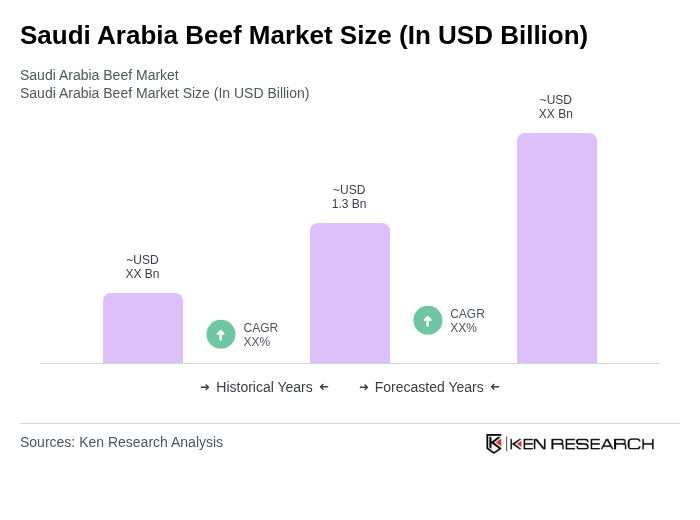
- The Saudi Arabia Beef Market is valued at USD 1.3 billion, based on a five-year historical analysis. This growth is primarily driven by increasing consumer demand for beef products, rising disposable incomes, and a growing population. The market has seen a shift towards higher quality and diverse beef products, including organic and grass-fed options, catering to both local consumption and export opportunities. Premiumization and health-conscious consumer trends are further accelerating the demand for specialty beef segments .
- Key cities such as Riyadh, Jeddah, and Dammam dominate the market due to their large populations and significant economic activities. These urban centers have a higher concentration of food service establishments and retail outlets, which boosts the demand for beef products. Additionally, the presence of major distribution networks in these cities facilitates efficient supply chain operations .
- The Executive Regulations for Food Law, issued by the Saudi Food and Drug Authority (SFDA) in 2023, mandate comprehensive food safety standards for the beef industry. These regulations require mandatory inspections, certifications, and traceability for all beef products, ensuring compliance with health and safety protocols. The regulatory framework aims to enhance consumer confidence and promote the consumption of locally sourced beef by enforcing strict operational controls across the supply chain .
Saudi Arabia Beef Market Segmentation
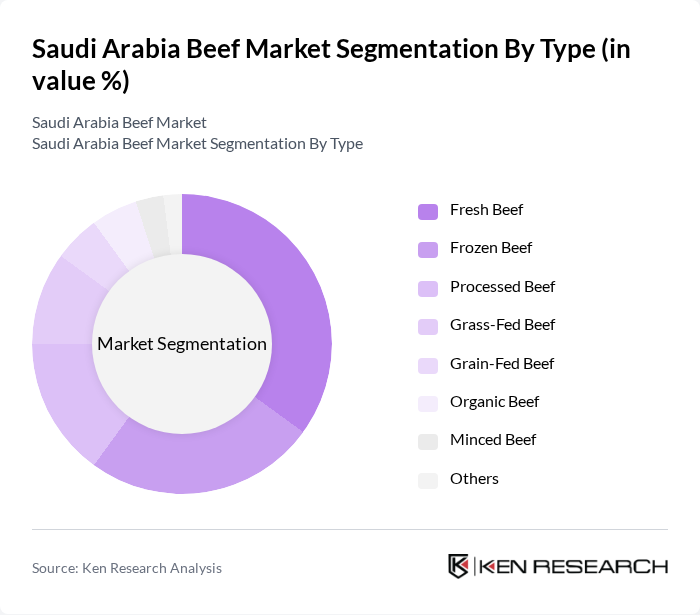
By Type:This segmentation includes various forms of beef products available in the market. The subsegments are Fresh Beef, Frozen Beef, Processed Beef, Grass-Fed Beef, Grain-Fed Beef, Organic Beef, Minced Beef, and Others. The demand for fresh and frozen beef is particularly high due to consumer preferences for quality and convenience. There is also a rising interest in organic and grass-fed beef, reflecting growing health and sustainability awareness among consumers .
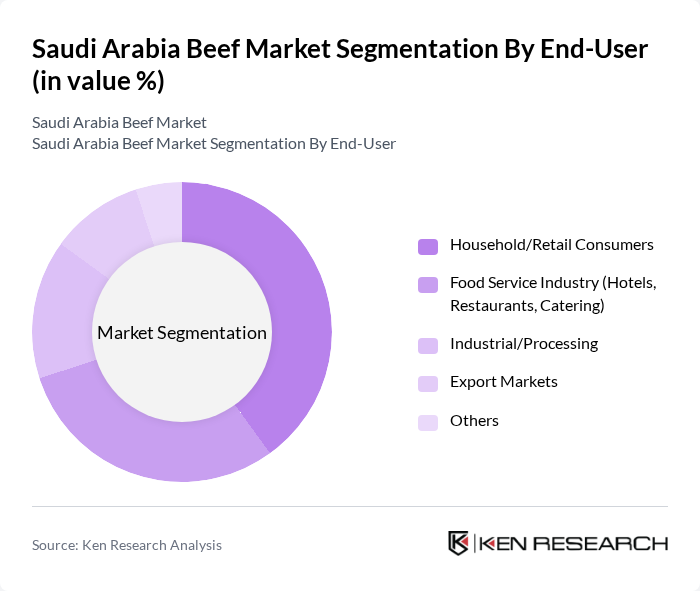
By End-User:This segmentation focuses on the different consumer categories for beef products. The subsegments include Household/Retail Consumers, Food Service Industry (Hotels, Restaurants, Catering), Industrial/Processing, Export Markets, and Others. The food service industry is a significant driver of beef consumption, with restaurants and catering services increasingly sourcing high-quality beef. Demand from households and industrial processors is also robust, reflecting the broadening use of beef in both home and commercial settings .
Saudi Arabia Beef Market Competitive Landscape
The Saudi Arabia Beef Market is characterized by a dynamic mix of regional and international players. Leading participants such as Almarai Company, Tanmiah Food Company, Halwani Bros, BRF S.A., Al-Watania Agriculture, Al-Jazeera Agricultural Company, Al-Othaim Foods, Al-Faisaliah Group, Al-Muhaidib Foods, Al-Mahmal Group, Al-Rajhi Group, Al-Suwaidi Group, Americana Group, Almunajem Foods, Sunbulah Group contribute to innovation, geographic expansion, and service delivery in this space.
Saudi Arabia Beef Market Industry Analysis
Growth Drivers
- Increasing Demand for Protein:The demand for protein in Saudi Arabia is projected to reach 1.6 million tons in future, driven by a growing population and dietary shifts. The average per capita meat consumption is expected to rise to 65 kg annually, reflecting a significant increase in consumer preference for protein-rich diets. This trend is supported by the World Bank's report indicating a 3% annual growth in food consumption, emphasizing the need for local beef production to meet this demand.
- Government Support for Local Production:The Saudi government has allocated approximately SAR 1.5 billion (USD 400 million) in subsidies for local beef producers in future. This initiative aims to enhance self-sufficiency in meat production, reducing reliance on imports, which accounted for 55% of beef consumption in future. Additionally, the government is investing in agricultural technology to improve livestock productivity, further bolstering local production capabilities.
- Rising Population and Urbanization:Saudi Arabia's population is projected to reach 38 million in future, with urbanization rates exceeding 90%. This demographic shift is driving increased demand for beef products, particularly in urban centers where convenience and quality are prioritized. The urban population's growing disposable income, expected to average SAR 15,000 (USD 4,000) per capita, is also contributing to higher meat consumption, particularly among younger consumers.
Market Challenges
- Fluctuating Feed Prices:The volatility of feed prices poses a significant challenge for beef producers in Saudi Arabia. In future, feed costs surged by 20% due to global supply chain disruptions and adverse weather conditions affecting grain production. This increase has pressured profit margins for local farmers, who rely heavily on imported feed, which constitutes about 75% of their operational costs, making it difficult to maintain competitive pricing against imported beef.
- Competition from Imported Beef:The Saudi beef market faces intense competition from imported beef, which accounted for 55% of total consumption in future. Countries like Brazil and Australia offer lower-priced beef due to their established supply chains and economies of scale. The influx of cheaper imports has led to a 15% decline in local beef sales, challenging domestic producers to innovate and improve quality to retain market share amidst this competitive landscape.
Saudi Arabia Beef Market Future Outlook
The Saudi beef market is poised for significant transformation, driven by increasing consumer awareness of health and sustainability. As the demand for organic and ethically sourced beef rises, local producers are likely to adapt by implementing sustainable farming practices. Additionally, the expansion of e-commerce platforms for meat sales is expected to enhance market accessibility, allowing consumers to purchase high-quality beef conveniently. These trends indicate a shift towards a more resilient and consumer-focused beef industry in Saudi Arabia.
Market Opportunities
- Growth in Organic Beef Segment:The organic beef segment is anticipated to grow significantly, with sales projected to reach SAR 600 million (USD 160 million) in future. This growth is driven by increasing health consciousness among consumers, who are willing to pay a premium for organic products. Local producers can capitalize on this trend by adopting organic farming practices and obtaining certification to attract health-focused consumers.
- Technological Advancements in Farming:The adoption of advanced farming technologies, such as precision agriculture and genetic improvements, presents a substantial opportunity for the beef market. Investments in these technologies are expected to enhance productivity by 25% in future, allowing local farmers to produce higher-quality beef more efficiently. This innovation can help reduce production costs and improve competitiveness against imported beef.
Scope of the Report
| Segment | Sub-Segments |
|---|---|
| By Type | Fresh Beef Frozen Beef Processed Beef Grass-Fed Beef Grain-Fed Beef Organic Beef Minced Beef Others |
| By End-User | Household/Retail Consumers Food Service Industry (Hotels, Restaurants, Catering) Industrial/Processing Export Markets Others |
| By Distribution Channel | Supermarkets and Hypermarkets Butcher Shops Online Retailers Wholesale Markets Food Service Distributors Others |
| By Region | Central Region Eastern Region Western Region Southern Region Northern Region |
| By Packaging Type | Vacuum Packaging Modified Atmosphere Packaging Canned Beef Tray Packaging Others |
| By Quality Grade | Prime Choice Select Halal Certified Organic Certified Others |
| By Price Range | Premium Mid-Range Economy Others |
Key Target Audience
Investors and Venture Capitalist Firms
Government and Regulatory Bodies (e.g., Ministry of Environment, Water and Agriculture)
Manufacturers and Producers
Distributors and Retailers
Food Service Providers
Industry Associations (e.g., Saudi Meat and Livestock Company)
Logistics and Supply Chain Companies
Financial Institutions
Players Mentioned in the Report:
Almarai Company
Tanmiah Food Company
Halwani Bros
BRF S.A.
Al-Watania Agriculture
Al-Jazeera Agricultural Company
Al-Othaim Foods
Al-Faisaliah Group
Al-Muhaidib Foods
Al-Mahmal Group
Al-Rajhi Group
Al-Suwaidi Group
Americana Group
Almunajem Foods
Sunbulah Group
Table of Contents
Market Assessment Phase
1. Executive Summary and Approach
2. Saudi Arabia Beef Market Overview
2.1 Key Insights and Strategic Recommendations
2.2 Saudi Arabia Beef Market Overview
2.3 Definition and Scope
2.4 Evolution of Market Ecosystem
2.5 Timeline of Key Regulatory Milestones
2.6 Value Chain & Stakeholder Mapping
2.7 Business Cycle Analysis
2.8 Policy & Incentive Landscape
3. Saudi Arabia Beef Market Analysis
3.1 Growth Drivers
3.1.1 Increasing Demand for Protein
3.1.2 Government Support for Local Production
3.1.3 Rising Population and Urbanization
3.1.4 Export Opportunities in GCC Markets
3.2 Market Challenges
3.2.1 Fluctuating Feed Prices
3.2.2 Competition from Imported Beef
3.2.3 Regulatory Compliance Costs
3.2.4 Limited Cold Chain Infrastructure
3.3 Market Opportunities
3.3.1 Growth in Organic Beef Segment
3.3.2 Technological Advancements in Farming
3.3.3 Expansion of Retail Channels
3.3.4 Increasing Health Consciousness Among Consumers
3.4 Market Trends
3.4.1 Shift Towards Sustainable Practices
3.4.2 Rise of E-commerce in Meat Sales
3.4.3 Demand for Halal Certification
3.4.4 Innovations in Meat Processing
3.5 Government Regulation
3.5.1 Import Tariffs on Beef Products
3.5.2 Animal Welfare Standards
3.5.3 Food Safety Regulations
3.5.4 Subsidies for Local Farmers
4. SWOT Analysis
5. Stakeholder Analysis
6. Porter's Five Forces Analysis
7. Saudi Arabia Beef Market Market Size, 2019-2024
7.1 By Value
7.2 By Volume
7.3 By Average Selling Price
8. Saudi Arabia Beef Market Segmentation
8.1 By Type
8.1.1 Fresh Beef
8.1.2 Frozen Beef
8.1.3 Processed Beef
8.1.4 Grass-Fed Beef
8.1.5 Grain-Fed Beef
8.1.6 Organic Beef
8.1.7 Minced Beef
8.1.8 Others
8.2 By End-User
8.2.1 Household/Retail Consumers
8.2.2 Food Service Industry (Hotels, Restaurants, Catering)
8.2.3 Industrial/Processing
8.2.4 Export Markets
8.2.5 Others
8.3 By Distribution Channel
8.3.1 Supermarkets and Hypermarkets
8.3.2 Butcher Shops
8.3.3 Online Retailers
8.3.4 Wholesale Markets
8.3.5 Food Service Distributors
8.3.6 Others
8.4 By Region
8.4.1 Central Region
8.4.2 Eastern Region
8.4.3 Western Region
8.4.4 Southern Region
8.4.5 Northern Region
8.5 By Packaging Type
8.5.1 Vacuum Packaging
8.5.2 Modified Atmosphere Packaging
8.5.3 Canned Beef
8.5.4 Tray Packaging
8.5.5 Others
8.6 By Quality Grade
8.6.1 Prime
8.6.2 Choice
8.6.3 Select
8.6.4 Halal Certified
8.6.5 Organic Certified
8.6.6 Others
8.7 By Price Range
8.7.1 Premium
8.7.2 Mid-Range
8.7.3 Economy
8.7.4 Others
9. Saudi Arabia Beef Market Competitive Analysis
9.1 Market Share of Key Players
9.2 Cross Comparison of Key Players
9.2.1 Company Name
9.2.2 Group Size (Large, Medium, or Small as per industry convention)
9.2.3 Revenue Growth Rate (YoY %)
9.2.4 Market Share (%)
9.2.5 Volume Sold (Metric Tons)
9.2.6 Distribution Network Coverage (Number of Outlets/Regions)
9.2.7 Product Portfolio Breadth (Number of SKUs/Beef Types)
9.2.8 Supply Chain Efficiency (Lead Time, Fill Rate %)
9.2.9 Brand Recognition (Consumer Awareness Index)
9.2.10 Export Ratio (% of Production Exported)
9.2.11 Halal/Quality Certifications (Number/Type)
9.2.12 Customer Retention Rate (%)
9.2.13 Pricing Strategy (Premium, Value, Economy)
9.3 SWOT Analysis of Top Players
9.4 Pricing Analysis
9.5 Detailed Profile of Major Companies
9.5.1 Almarai Company
9.5.2 Tanmiah Food Company
9.5.3 Halwani Bros
9.5.4 BRF S.A.
9.5.5 Al-Watania Agriculture
9.5.6 Al-Jazeera Agricultural Company
9.5.7 Al-Othaim Foods
9.5.8 Al-Faisaliah Group
9.5.9 Al-Muhaidib Foods
9.5.10 Al-Mahmal Group
9.5.11 Al-Rajhi Group
9.5.12 Al-Suwaidi Group
9.5.13 Americana Group
9.5.14 Almunajem Foods
9.5.15 Sunbulah Group
10. Saudi Arabia Beef Market End-User Analysis
10.1 Procurement Behavior of Key Ministries
10.1.1 Ministry of Agriculture
10.1.2 Ministry of Health
10.1.3 Ministry of Commerce
10.1.4 Others
10.2 Corporate Spend on Infrastructure & Energy
10.2.1 Investment in Cold Storage Facilities
10.2.2 Infrastructure for Transportation
10.2.3 Energy Efficiency Initiatives
10.2.4 Others
10.3 Pain Point Analysis by End-User Category
10.3.1 Retail Consumers
10.3.2 Food Service Providers
10.3.3 Exporters
10.3.4 Others
10.4 User Readiness for Adoption
10.4.1 Awareness of Local Beef Products
10.4.2 Willingness to Pay for Quality
10.4.3 Adoption of E-commerce Platforms
10.4.4 Others
10.5 Post-Deployment ROI and Use Case Expansion
10.5.1 Cost Savings from Local Sourcing
10.5.2 Increased Sales from New Channels
10.5.3 Customer Satisfaction Metrics
10.5.4 Others
11. Saudi Arabia Beef Market Future Size, 2025-2030
11.1 By Value
11.2 By Volume
11.3 By Average Selling Price
Go-To-Market Strategy Phase
1. Whitespace Analysis + Business Model Canvas
1.1 Market Gaps Identification
1.2 Business Model Development
2. Marketing and Positioning Recommendations
2.1 Branding Strategies
2.2 Product USPs
3. Distribution Plan
3.1 Urban Retail vs Rural NGO Tie-ups
4. Channel & Pricing Gaps
4.1 Underserved Routes
4.2 Pricing Bands
5. Unmet Demand & Latent Needs
5.1 Category Gaps
5.2 Consumer Segments
6. Customer Relationship
6.1 Loyalty Programs
6.2 After-sales Service
7. Value Proposition
7.1 Sustainability
7.2 Integrated Supply Chains
8. Key Activities
8.1 Regulatory Compliance
8.2 Branding
8.3 Distribution Setup
9. Entry Strategy Evaluation
9.1 Domestic Market Entry Strategy
9.1.1 Product Mix
9.1.2 Pricing Band
9.1.3 Packaging
9.2 Export Entry Strategy
9.2.1 Target Countries
9.2.2 Compliance Roadmap
10. Entry Mode Assessment
10.1 JV
10.2 Greenfield
10.3 M&A
10.4 Distributor Model
11. Capital and Timeline Estimation
11.1 Capital Requirements
11.2 Timelines
12. Control vs Risk Trade-Off
12.1 Ownership vs Partnerships
13. Profitability Outlook
13.1 Breakeven Analysis
13.2 Long-term Sustainability
14. Potential Partner List
14.1 Distributors
14.2 JVs
14.3 Acquisition Targets
15. Execution Roadmap
15.1 Phased Plan for Market Entry
15.1.1 Market Setup
15.1.2 Market Entry
15.1.3 Growth Acceleration
15.1.4 Scale & Stabilize
15.2 Key Activities and Milestones
15.2.1 Milestone Planning
15.2.2 Activity Tracking
Research Methodology
Phase 1: Approach1
Desk Research
- Analysis of trade statistics from the Saudi Ministry of Environment, Water and Agriculture
- Review of market reports from industry associations such as the Saudi Arabian Meat Company
- Examination of consumer behavior studies published by local universities and research institutions
Primary Research
- Interviews with key stakeholders in the beef supply chain, including farmers and distributors
- Surveys conducted with retail managers in supermarkets and hypermarkets across major cities
- Focus group discussions with consumers to understand preferences and purchasing behavior
Validation & Triangulation
- Cross-validation of findings with data from local agricultural cooperatives and trade associations
- Triangulation of insights from primary interviews with secondary data sources
- Sanity checks through expert reviews from industry veterans and market analysts
Phase 2: Market Size Estimation1
Top-down Assessment
- Estimation of total beef consumption based on national dietary guidelines and population growth
- Segmentation of market size by beef type (e.g., fresh, frozen, processed) and distribution channel
- Incorporation of government initiatives promoting local beef production and consumption
Bottom-up Modeling
- Collection of sales data from major beef suppliers and retailers in the region
- Estimation of average price points for different beef products across various channels
- Volume estimates based on historical sales trends and projected growth rates
Forecasting & Scenario Analysis
- Multi-variable forecasting using economic indicators, population demographics, and dietary trends
- Scenario analysis based on potential impacts of import regulations and trade agreements
- Development of baseline, optimistic, and pessimistic market growth scenarios through 2030
Phase 3: CATI Sample Composition1
| Scope Item/Segment | Sample Size | Target Respondent Profiles |
|---|---|---|
| Retail Beef Sales | 100 | Store Managers, Category Buyers |
| Wholesale Beef Distribution | 80 | Wholesale Distributors, Supply Chain Managers |
| Consumer Preferences | 120 | Household Decision Makers, Health-Conscious Consumers |
| Local Beef Production | 60 | Farm Owners, Agricultural Experts |
| Food Service Sector | 50 | Restaurant Owners, Chefs, Menu Planners |
Frequently Asked Questions
What is the current value of the Saudi Arabia Beef Market?
The Saudi Arabia Beef Market is valued at approximately USD 1.3 billion, driven by increasing consumer demand, rising disposable incomes, and a growing population. This market is experiencing a shift towards higher quality and diverse beef products.
What factors are driving the growth of the beef market in Saudi Arabia?
What are the main types of beef products available in Saudi Arabia?
Who are the major players in the Saudi Arabia Beef Market?
Other Regional/Country Reports
Indonesia Beef Market Analysis Size, Share, Growth Drivers, Trends, Opportunities & Forecast 2025–2030
Malaysia Beef Market Analysis Size, Share, Growth Drivers, Trends, Opportunities & Forecast 2025–2030
KSA Beef Market Analysis Size, Share, Growth Drivers, Trends, Opportunities & Forecast 2025–2030
APAC Beef Market Analysis Size, Share, Growth Drivers, Trends, Opportunities & Forecast 2025–2030
SEA Beef Market Analysis Size, Share, Growth Drivers, Trends, Opportunities & Forecast 2025–2030
Vietnam Beef Market Analysis Size, Share, Growth Drivers, Trends, Opportunities & Forecast 2025–2030
Other Adjacent Reports
Kuwait Lamb and Mutton Market
UAE Dairy Products MarketAsia Pacific Animal Feed Market Outlook to 2030: Size, Share, Growth and TrendsGermany Meat Processing Market
India Halal Food Market Outlook to 2030South Africa Food Retail Market
Japan Cold Chain Logistics MarketGCC veterinary services market report size, share, growth drivers, trends, opportunities & forecast 2025–2030Italy Agricultural Machinery Market (2022-2027)Why Buy From Us?

What makes us stand out is that our consultants follow Robust, Refine and Result (RRR) methodology. Robust for clear definitions, approaches and sanity checking, Refine for differentiating respondents' facts and opinions, and Result for presenting data with story.

We have set a benchmark in the industry by offering our clients with syndicated and customized market research reports featuring coverage of entire market as well as meticulous research and analyst insights.

While we don't replace traditional research, we flip the method upside down. Our dual approach of Top Bottom & Bottom Top ensures quality deliverable by not just verifying company fundamentals but also looking at the sector and macroeconomic factors.

With one step in the future, our research team constantly tries to show you the bigger picture. We help with some of the tough questions you may encounter along the way: How is the industry positioned? Best marketing channel? KPI's of competitors? By aligning every element, we help maximize success.

Our report gives you instant access to the answers and sources that other companies might choose to hide. We elaborate each steps of research methodology we have used and showcase you the sample size to earn your trust.

If you need any support, we are here! We pride ourselves on universe strength, data quality, and quick, friendly, and professional service.