KSA black beer market report Size, Share, Growth Drivers, Trends, Opportunities & Forecast 2025–2030

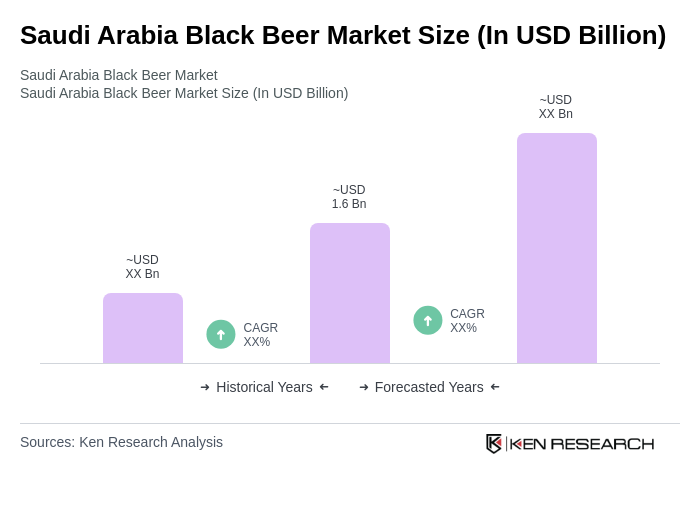
Saudi Arabia Black Beer Market is worth USD 1.6 Bn, fueled by rising craft beer demand, innovative products, and growth in hospitality sectors across urban areas.

Region:Middle East

Author(s):Dev

Product Code:KRAC4196

Pages:90

Published On:October 2025
About the Report

Base Year 2024

Saudi Arabia Black Beer Market Overview

  • The Saudi Arabia Black Beer Market is valued at USD 1.6 billion, based on a five-year historical analysis. This growth is primarily driven by the increasing popularity of craft beers and changing consumer preferences towards darker beer varieties, which are perceived as richer and more flavorful. The market has also benefited from a growing number of breweries and innovative product offerings that cater to diverse consumer tastes. Rising urbanization, premiumization trends, and the influence of global craft beer culture are further accelerating market expansion .
  • Key cities such as Riyadh, Jeddah, and Dammam dominate the black beer market due to their large urban populations and vibrant hospitality sectors. These cities have seen a rise in premium restaurants and specialty venues that offer a variety of black beer options, contributing to the overall market growth. Additionally, the increasing acceptance of craft beer culture and the emergence of non-alcoholic dark beer alternatives in these urban centers have further solidified their dominance in the market .
  • The Regulation of Alcoholic Beverages and Breweries Law, 2023 issued by the Saudi Food and Drug Authority, established mandatory licensing for breweries and set strict health, safety, and quality standards for the production and distribution of alcoholic and non-alcoholic beers. The regulation requires all producers and importers to comply with labeling, traceability, and periodic inspection protocols, supporting responsible consumption and ensuring product safety for consumers while fostering the growth of the local brewing industry .
Saudi Arabia Black Beer Market Size

Saudi Arabia Black Beer Market Segmentation

By Type:The black beer market can be segmented into various types, including Stout, Porter, Black Lager, and Specialty and Craft Black Beer Variants. Among these, Stout has emerged as the leading sub-segment due to its rich flavor profile and strong consumer preference for dark beers. The trend towards craft brewing has also led to a rise in the popularity of Specialty and Craft Black Beer Variants, appealing to consumers seeking unique and artisanal options. The expansion of microbreweries and the introduction of non-alcoholic dark ales are further diversifying the product landscape .
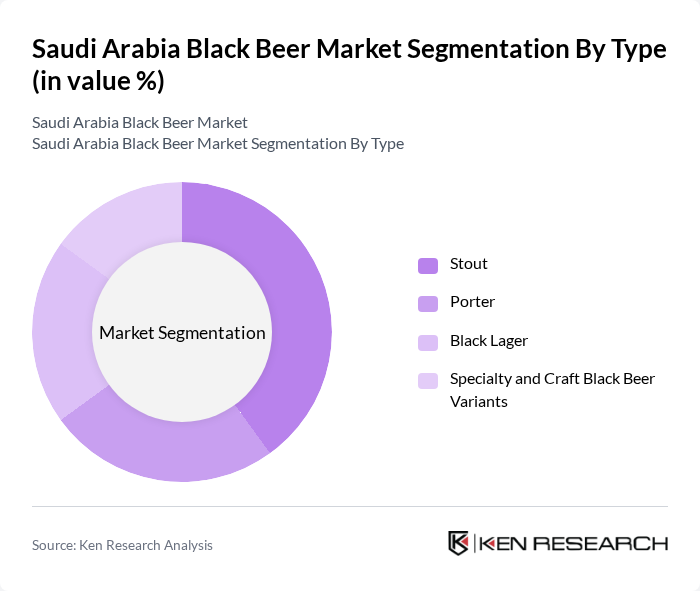
Saudi Arabia Black Beer Market segmentation by Type.

By Sales Channel:The sales channels for black beer include On-Trade (Restaurants, Hotels, Bars, Hospitality Venues) and Off-Trade (Retail, Supermarkets, Specialty Stores, Online). The On-Trade segment is currently leading the market, driven by the increasing number of premium establishments serving black beer and the growing trend of social drinking in hospitality venues. Off-Trade sales are also significant, as consumers increasingly purchase black beer for home consumption, supported by the expansion of specialty retail and online channels .
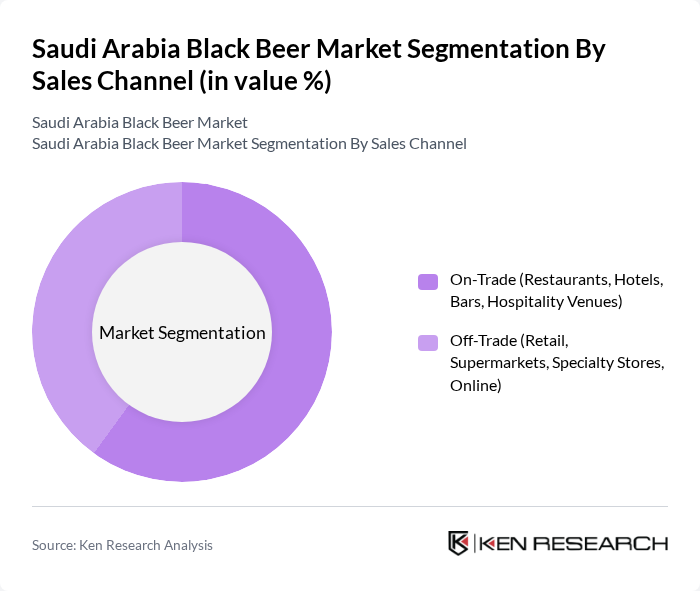
Saudi Arabia Black Beer Market segmentation by Sales Channel.

Saudi Arabia Black Beer Market Competitive Landscape

The Saudi Arabia Black Beer Market is characterized by a dynamic mix of regional and international players. Leading participants such as Anheuser-Busch InBev (AB InBev), Heineken N.V., Carlsberg Group, Diageo plc, Asahi Group Holdings, Kirin Holdings Company Limited, BrewDog, New Belgium Brewing Company, Phillips Brewing & Malting Co., Allagash Brewing Company, Hill Farmstead Brewery, Sapporo Breweries Ltd. contribute to innovation, geographic expansion, and service delivery in this space.

Anheuser-Busch InBev

2008

Leuven, Belgium

Heineken N.V.

1864

Amsterdam, Netherlands

Carlsberg Group

1847

Copenhagen, Denmark

Diageo plc

1997

London, United Kingdom

BrewDog

2007

Ellon, Scotland

Company

Establishment Year

Headquarters

Company Classification (Large Multinational, Regional Player, Craft Producer)

Revenue Growth Rate (Year-over-Year %)

Market Share and Geographic Penetration (%)

Customer Retention and Loyalty Metrics

Pricing Strategy and Premium Positioning

Distribution Density and Channel Efficiency

Saudi Arabia Black Beer Market Industry Analysis

Growth Drivers

  • Increasing Consumer Interest in Craft Beverages:The craft beverage sector in Saudi Arabia has seen a notable rise, with the number of craft breweries increasing by 30% in future. This surge is driven by a growing consumer base that seeks unique flavors and experiences. The craft beer segment, particularly black beer, is gaining traction among younger demographics, with 27% of consumers aged 18-34 expressing interest in trying new craft varieties, according to local industry reports.
  • Rising Disposable Income Among Affluent Demographics:Saudi Arabia's GDP per capita is projected to reach $27,000 in future, reflecting a 5% increase from previous estimates. This economic growth is contributing to higher disposable incomes, particularly among the affluent class. As a result, consumers are more willing to spend on premium products, including imported and craft black beers. The luxury beverage market is expected to expand, with black beer being a key segment due to its perceived quality and exclusivity.
  • Growth of the Hospitality and Tourism Sector:The Saudi government aims to increase tourism to 100 million visitors in future, which is expected to boost the hospitality sector significantly. In future, the number of hotels is projected to rise by 15%, creating a greater demand for diverse beverage offerings, including black beer. This growth in hospitality will provide craft breweries with opportunities to showcase their products, enhancing visibility and consumer access to black beer varieties.

Market Challenges

  • Stringent Regulations on Alcohol Production and Import:Saudi Arabia maintains strict regulations regarding alcohol, with a complete ban on production and sale. The enforcement of these laws creates significant barriers for black beer producers. In future, the government is expected to continue its rigorous monitoring of alcohol-related activities, which may hinder market entry for new brands and limit the growth potential of existing craft breweries.
  • Cultural and Religious Considerations Affecting Consumption:The cultural landscape in Saudi Arabia is heavily influenced by Islamic traditions, which discourage alcohol consumption. This cultural barrier poses a significant challenge for the black beer market, as many potential consumers may avoid alcoholic beverages due to societal pressures. In future, it is estimated that only 10% of the population will actively engage in alcohol consumption, limiting the market's growth potential.

Saudi Arabia Black Beer Market Future Outlook

The future of the black beer market in Saudi Arabia appears cautiously optimistic, driven by evolving consumer preferences and a gradual shift in cultural attitudes towards craft beverages. As disposable incomes rise and tourism expands, there is potential for increased demand for premium black beer products. Additionally, the growth of e-commerce and specialty retail channels may facilitate greater access to diverse black beer offerings, allowing consumers to explore new flavors and brands, thereby enhancing market dynamics.

Market Opportunities

  • Product Innovation in Craft Black Beer Variants:There is a significant opportunity for breweries to innovate by introducing unique black beer variants, such as those infused with local flavors or organic ingredients. This innovation can attract health-conscious consumers and those seeking novel experiences, potentially increasing market share and consumer loyalty.
  • Growth in Online and Specialty Retail Sales Channels:The rise of e-commerce platforms presents a valuable opportunity for black beer brands to reach a broader audience. By leveraging online sales channels, breweries can tap into the growing trend of home delivery and specialty retail, enhancing accessibility and convenience for consumers interested in exploring black beer options.

Scope of the Report

SegmentSub-Segments
By Type

Stout

Porter

Black Lager

Specialty and Craft Black Beer Variants

By Sales Channel

On-Trade (Restaurants, Hotels, Bars, Hospitality Venues)

Off-Trade (Retail, Supermarkets, Specialty Stores, Online)

By Distribution Channel

Supermarkets and Hypermarkets

Online Retail and E-commerce Platforms

Specialty Beer Stores and Wine Shops

Hospitality and Food Service Channels

By Packaging Type

Glass Bottles

Aluminum Cans

Kegs and Bulk Formats

By Price Segment

Premium and Ultra-Premium

Mid-Range

Economy and Value

By Consumer Occasion

Festivals and Special Events

Casual Dining and Social Gatherings

Celebrations and Premium Occasions

Key Target Audience

Investors and Venture Capitalist Firms

Government and Regulatory Bodies (e.g., Saudi Food and Drug Authority, Ministry of Commerce)

Manufacturers and Producers

Distributors and Retailers

Hospitality and Restaurant Chains

Importers and Exporters

Market Analysts and Industry Experts

Financial Institutions

Players Mentioned in the Report:

Anheuser-Busch InBev (AB InBev)

Heineken N.V.

Carlsberg Group

Diageo plc

Asahi Group Holdings

Kirin Holdings Company Limited

BrewDog

New Belgium Brewing Company

Phillips Brewing & Malting Co.

Allagash Brewing Company

Hill Farmstead Brewery

Sapporo Breweries Ltd.

Table of Contents

Market Assessment Phase

1. Executive Summary and Approach


2. Saudi Arabia Black Beer Market Overview

2.1 Key Insights and Strategic Recommendations

2.2 Saudi Arabia Black Beer Market Overview

2.3 Definition and Scope

2.4 Evolution of Market Ecosystem

2.5 Timeline of Key Regulatory Milestones

2.6 Value Chain & Stakeholder Mapping

2.7 Business Cycle Analysis

2.8 Policy & Incentive Landscape


3. Saudi Arabia Black Beer Market Analysis

3.1 Growth Drivers

3.1.1 Increasing consumer interest in craft beverages
3.1.2 Rising disposable income among affluent demographics
3.1.3 Growth of the hospitality and tourism sector
3.1.4 Expansion of retail distribution channels and e-commerce platforms

3.2 Market Challenges

3.2.1 Stringent regulations on alcohol production and import
3.2.2 Cultural and religious considerations affecting consumption
3.2.3 Limited consumer awareness of black beer varieties
3.2.4 Competition from non-alcoholic and premium beverages

3.3 Market Opportunities

3.3.1 Product innovation in craft black beer variants
3.3.2 Growth in online and specialty retail sales channels
3.3.3 Increasing demand for premium and imported black beer products
3.3.4 Opportunities for strategic partnerships with regional distributors

3.4 Market Trends

3.4.1 Rising popularity of craft and specialty black beer varieties
3.4.2 Shift towards sustainable and organic brewing practices
3.4.3 Growth of beer festivals, tastings, and experiential marketing events
3.4.4 Increasing influence of digital marketing and social media engagement

3.5 Government Regulation

3.5.1 Import licensing and approval requirements for alcohol products
3.5.2 Restrictions on advertising and retail placement of alcoholic beverages
3.5.3 Tariff structures and import duties on raw materials
3.5.4 Compliance with food safety, labeling, and health standards

4. SWOT Analysis


5. Stakeholder Analysis


6. Porter's Five Forces Analysis


7. Saudi Arabia Black Beer Market Size, 2019-2024

7.1 By Value

7.2 By Volume

7.3 By Average Selling Price


8. Saudi Arabia Black Beer Market Segmentation

8.1 By Type

8.1.1 Stout
8.1.2 Porter
8.1.3 Black Lager
8.1.4 Specialty and Craft Black Beer Variants

8.2 By Sales Channel

8.2.1 On-Trade (Restaurants, Hotels, Bars, Hospitality Venues)
8.2.2 Off-Trade (Retail, Supermarkets, Specialty Stores, Online)

8.3 By Distribution Channel

8.3.1 Supermarkets and Hypermarkets
8.3.2 Online Retail and E-commerce Platforms
8.3.3 Specialty Beer Stores and Wine Shops
8.3.4 Hospitality and Food Service Channels

8.4 By Packaging Type

8.4.1 Glass Bottles
8.4.2 Aluminum Cans
8.4.3 Kegs and Bulk Formats

8.5 By Price Segment

8.5.1 Premium and Ultra-Premium
8.5.2 Mid-Range
8.5.3 Economy and Value

8.6 By Consumer Occasion

8.6.1 Festivals and Special Events
8.6.2 Casual Dining and Social Gatherings
8.6.3 Celebrations and Premium Occasions

9. Saudi Arabia Black Beer Market Competitive Analysis

9.1 Market Share of Key Players

9.2 Cross Comparison of Key Players

9.2.1 Company Name and Market Position
9.2.2 Company Classification (Large Multinational, Regional Player, Craft Producer)
9.2.3 Revenue Growth Rate (Year-over-Year %)
9.2.4 Market Share and Geographic Penetration (%)
9.2.5 Customer Retention and Loyalty Metrics
9.2.6 Pricing Strategy and Premium Positioning
9.2.7 Distribution Density and Channel Efficiency
9.2.8 Brand Equity and Consumer Recognition Score
9.2.9 Product Innovation Frequency and SKU Portfolio Expansion
9.2.10 Net Promoter Score and Customer Satisfaction Metrics

9.3 SWOT Analysis of Top Players

9.4 Pricing Analysis

9.5 Detailed Profile of Major Companies

9.5.1 Anheuser-Busch InBev (AB InBev)
9.5.2 Heineken N.V.
9.5.3 Carlsberg Group
9.5.4 Diageo plc
9.5.5 Asahi Group Holdings
9.5.6 Kirin Holdings Company Limited
9.5.7 BrewDog
9.5.8 New Belgium Brewing Company
9.5.9 Phillips Brewing & Malting Co.
9.5.10 Allagash Brewing Company
9.5.11 Hill Farmstead Brewery
9.5.12 Sapporo Breweries Ltd.

10. Saudi Arabia Black Beer Market End-User Analysis

10.1 Regulatory and Trade Authority Engagement

10.1.1 General Authority of Foreign Trade
10.1.2 Ministry of Health
10.1.3 Saudi Tourism Authority

10.2 Commercial Investment in Hospitality and Retail

10.2.1 Investment in Distribution and Cold Chain Infrastructure
10.2.2 Retail Space Expansion in Premium Locations
10.2.3 Sustainability and Quality Assurance Initiatives

10.3 Pain Point Analysis by End-User Category

10.3.1 Import logistics and supply chain complexity
10.3.2 Product authentication and quality control standards
10.3.3 Regulatory compliance and documentation requirements

10.4 Consumer Readiness Assessment

10.4.1 Market awareness of black beer product categories
10.4.2 Consumer willingness to experiment with craft and premium variants
10.4.3 Geographic accessibility and distribution reach

10.5 Market Performance and Expansion Metrics

10.5.1 Sales growth tracking and revenue performance
10.5.2 Consumer feedback and market research mechanisms
10.5.3 Opportunities for portfolio expansion and variant introduction

11. Saudi Arabia Black Beer Market Future Size, 2025-2031

11.1 By Value (USD Billion)

11.2 By Volume (Million Units)

11.3 By Average Selling Price (USD per Unit)


Go-To-Market Strategy Phase

1. Whitespace Analysis + Business Model Canvas

1.1 Market Gaps and Underserved Segments Identification

1.2 Business Model Framework for Saudi Market Entry


2. Marketing and Positioning Recommendations

2.1 Localized Branding Strategies

2.2 Product Unique Selling Propositions


3. Distribution Plan

3.1 Premium Retail and Hospitality Channel Strategies

3.2 Online and Direct-to-Consumer Models


4. Channel & Pricing Optimization

4.1 High-Potential Distribution Routes

4.2 Premium and Competitive Pricing Strategy Bands


5. Unmet Demand & Latent Consumer Needs

5.1 Product Category Opportunities

5.2 Target Consumer Segments and Demographics


6. Customer Relationship and Engagement

6.1 Brand Loyalty and Community Building Programs

6.2 Premium Customer Service and Experience


7. Value Proposition

7.1 Sustainability and Ethical Sourcing Initiatives

7.2 Supply Chain Transparency and Quality Assurance


8. Key Activities

8.1 Regulatory Compliance and Import Management

8.2 Brand Building and Market Communication

8.3 Distribution Network Development


9. Entry Strategy Evaluation

9.1 Domestic Market Entry Strategy

9.1.1 Product Mix and Portfolio Considerations
9.1.2 Premium Pricing Band Strategy
9.1.3 Packaging Format Selection

9.2 Regional Expansion Strategy

9.2.1 Target GCC and Middle East Markets
9.2.2 Local Compliance and Regulatory Roadmap

10. Entry Mode Assessment

10.1 Strategic Partnerships and Joint Ventures

10.2 Greenfield Investment and Local Production

10.3 Mergers & Acquisitions of Local Distributors

10.4 Exclusive Distributor and Agent Models


11. Capital and Timeline Estimation

11.1 Capital Requirements for Market Entry

11.2 Phased Implementation Timeline


12. Control vs Risk Assessment

12.1 Ownership Structure vs Strategic Partnerships


13. Profitability Outlook and Financial Projections

13.1 Breakeven Analysis and ROI Timeline

13.2 Long-Term Market Sustainability and Growth Potential


14. Potential Partner and Distributor List

14.1 Regional Distribution Partners

14.2 Strategic Joint Venture Candidates

14.3 Acquisition Targets and Consolidation Opportunities


15. Execution Roadmap

15.1 Phased Market Entry Plan

15.1.1 Market Research and Regulatory Setup (Months 1-3)
15.1.2 Partnership Finalization and Logistics Setup (Months 4-6)
15.1.3 Market Launch and Initial Growth (Months 7-12)
15.1.4 Scale and Market Consolidation (Year 2+)

15.2 Key Performance Milestones and Tracking

15.2.1 Milestone Definition and Success Criteria
15.2.2 Quarterly Activity and KPI Monitoring

Research Methodology

ApproachModellingSample

Phase 1: Approach1

Desk Research

  • Analysis of market reports from local beverage associations and trade publications
  • Review of government publications on alcohol regulations and consumption statistics
  • Examination of consumer behavior studies and demographic data from Saudi Arabia

Primary Research

  • Interviews with industry experts, including brewers and distributors in the black beer segment
  • Surveys conducted with consumers to gauge preferences and purchasing habits
  • Focus groups with target demographics to understand brand perception and product appeal

Validation & Triangulation

  • Cross-validation of findings through multiple data sources, including sales data and consumer insights
  • Triangulation of qualitative insights from interviews with quantitative data from surveys
  • Sanity checks through expert panel reviews to ensure data reliability and relevance

Phase 2: Market Size Estimation1

Top-down Assessment

  • Estimation of total beverage market size in Saudi Arabia, focusing on the alcohol segment
  • Analysis of historical growth rates and trends in the black beer category
  • Incorporation of regulatory impacts on market accessibility and consumer demand

Bottom-up Modeling

  • Collection of sales data from key retailers and distributors of black beer
  • Estimation of average price points and volume sold per retail outlet
  • Calculation of market share based on product offerings and consumer preferences

Forecasting & Scenario Analysis

  • Development of growth scenarios based on changing consumer attitudes towards alcohol
  • Analysis of potential impacts from regulatory changes and market entry of new brands
  • Projections of market growth through 2030 under various economic conditions

Phase 3: CATI Sample Composition1

Scope Item/SegmentSample SizeTarget Respondent Profiles
Retail Outlets Selling Black Beer60Store Managers, Beverage Buyers
Consumers Aged 21-35120Young Adults, College Students
Distributors of Alcoholic Beverages50Sales Representatives, Distribution Managers
Market Analysts and Experts40Industry Analysts, Market Researchers
Event Organizers for Beer Festivals40Event Coordinators, Marketing Managers

Frequently Asked Questions

What is the current value of the Saudi Arabia Black Beer Market?

The Saudi Arabia Black Beer Market is valued at approximately USD 1.6 billion, reflecting a significant growth trend driven by increasing consumer interest in craft beers and diverse product offerings.

What factors are driving the growth of the black beer market in Saudi Arabia?

Which cities are the main hubs for black beer consumption in Saudi Arabia?

What types of black beer are popular in Saudi Arabia?

Other Regional/Country Reports

Indonesia Black Beer Market

Malaysia Black Beer Market

KSA Black Beer Market

APAC Black Beer Market

SEA Black Beer Market

Vietnam Black Beer Market

Why Buy From Us?

Refine Robust Result (RRR) Framework

What makes us stand out is that our consultants follow Robust, Refine and Result (RRR) methodology. Robust for clear definitions, approaches and sanity checking, Refine for differentiating respondents' facts and opinions, and Result for presenting data with story.

Our Reach Is Unmatched

We have set a benchmark in the industry by offering our clients with syndicated and customized market research reports featuring coverage of entire market as well as meticulous research and analyst insights.

Shifting the Research Paradigm

While we don't replace traditional research, we flip the method upside down. Our dual approach of Top Bottom & Bottom Top ensures quality deliverable by not just verifying company fundamentals but also looking at the sector and macroeconomic factors.

More Insights-Better Decisions

With one step in the future, our research team constantly tries to show you the bigger picture. We help with some of the tough questions you may encounter along the way: How is the industry positioned? Best marketing channel? KPI's of competitors? By aligning every element, we help maximize success.

Transparency and Trust

Our report gives you instant access to the answers and sources that other companies might choose to hide. We elaborate each steps of research methodology we have used and showcase you the sample size to earn your trust.

Round the Clock Support

If you need any support, we are here! We pride ourselves on universe strength, data quality, and quick, friendly, and professional service.

Why Clients Choose Us?

400000+
Reports in repository
150+
Consulting projects a year
100+
Analysts
8000+
Client Queries in 2022








