About the Report
Base Year 2024Saudi Arabia Construction Design Software Market Overview
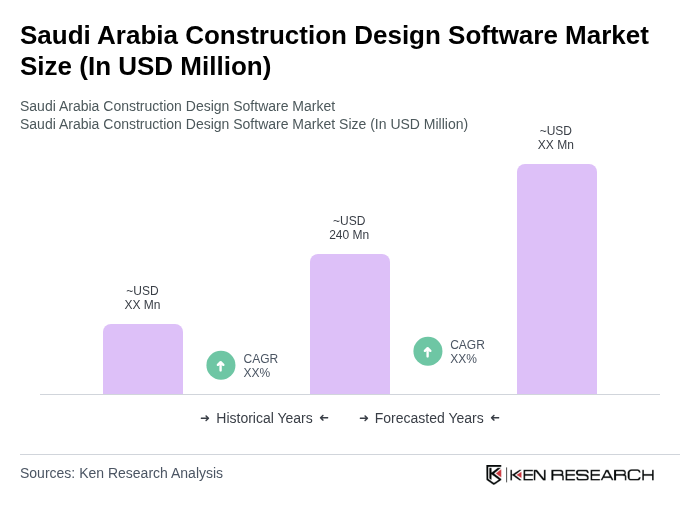
- The Saudi Arabia Construction Design Software Market is valued at USD 240 million, based on a five-year historical analysis. This growth is primarily driven by rapid urbanization, large-scale government investments in infrastructure under Vision 2030, and the increasing adoption of advanced digital technologies such as BIM, CAD, and integrated project collaboration platforms in construction processes. The demand for efficient project management, design, and cost-control solutions has surged as developers and contractors focus on delivering complex projects on time and within budget, in line with broader digital transformation trends in the Saudi construction industry.
- Key cities such as Riyadh, Jeddah, and Dammam dominate the market due to their significant construction activities and urban development projects. Riyadh, as the capital and the largest market for design and engineering tools, leads in government-led mega and giga projects, public infrastructure, and smart-city initiatives. Jeddah’s strategic role as a commercial and logistics hub on the Red Sea, together with major projects in the Western Region, attracts substantial private real estate and mixed-use development investments, while the Eastern Province (including Dammam and Dhahran) plays a crucial role due to its industrial base, energy-sector infrastructure, and related urban development.
- In 2023, the Saudi government continued to advance the National Industrial Development and Logistics Program (NIDLP), one of the key Vision 2030 programs aimed at transforming Saudi Arabia into a leading industrial and logistics hub and improving efficiency and competitiveness across construction and infrastructure projects through digital technologies. This program promotes the use of digital engineering tools, including construction design and project management software, to enhance productivity, safety, and sustainability in building practices and to support better planning, execution, and lifecycle asset management for major industrial, logistics, and urban development initiatives.
Saudi Arabia Construction Design Software Market Segmentation
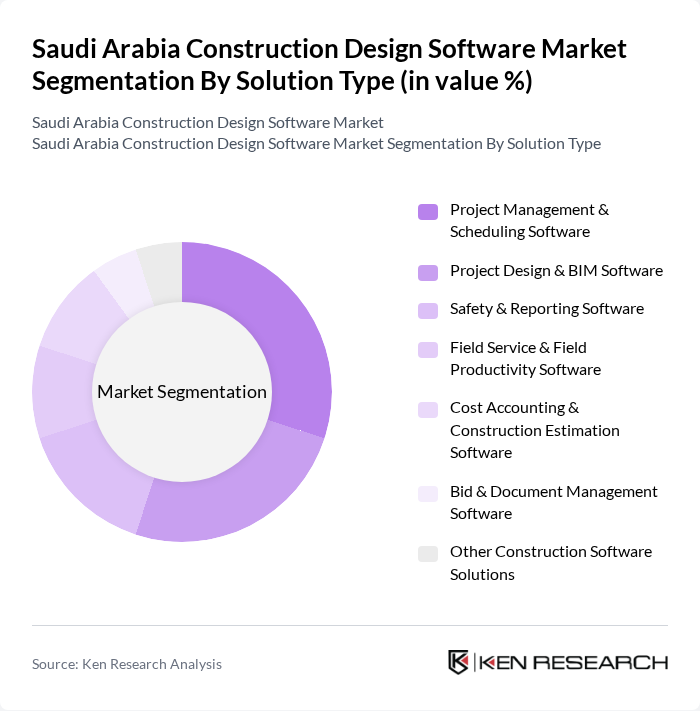
By Solution Type:The market is segmented into various solution types, including Project Management & Scheduling Software, Project Design & BIM Software, Safety & Reporting Software, Field Service & Field Productivity Software, Cost Accounting & Construction Estimation Software, Bid & Document Management Software, and Other Construction Software Solutions. Among these, Project Management & Scheduling Software is the leading segment due to its critical role in enhancing project efficiency, supporting multi-stakeholder coordination, and reducing delays and cost overruns on large and complex projects across Saudi Arabia.
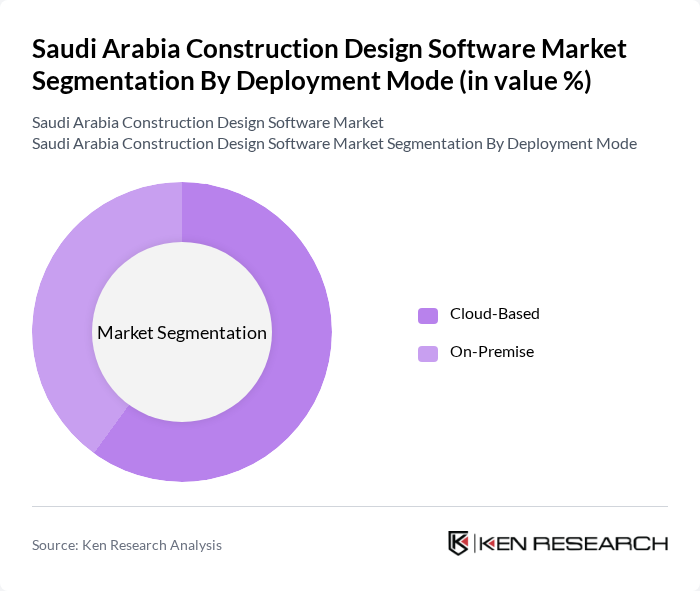
By Deployment Mode:The market is divided into Cloud-Based and On-Premise deployment modes. The Cloud-Based segment is gaining strong traction as construction firms in Saudi Arabia increasingly favor scalable, subscription-based solutions that support remote collaboration, multi-site access, and integration with other enterprise systems, making it the preferred choice for organizations seeking to streamline workflows and control upfront IT spending.
Saudi Arabia Construction Design Software Market Competitive Landscape
The Saudi Arabia Construction Design Software Market is characterized by a dynamic mix of regional and international players. Leading participants such as Autodesk, Bentley Systems, Trimble, Dassault Systèmes, Graphisoft (Nemetschek Group), Nemetschek Group, AVEVA, Procore Technologies, Bluebeam (Nemetschek Group), RIB Software (Schneider Electric), Hexagon, Oracle Construction and Engineering, CYPE Ingenieros, Bimobject, Local and Regional Players (e.g., Gulf-based SaaS Providers) contribute to innovation, geographic expansion, and service delivery in this space.
Saudi Arabia Construction Design Software Market Industry Analysis
Growth Drivers
- Increasing Urbanization:Saudi Arabia's urban population is projected to reach 36 million in the future, up from 30 million, according to the World Bank. This rapid urbanization drives demand for construction design software as cities expand and require modern infrastructure. The government's Vision 2030 initiative aims to enhance urban living standards, further fueling the need for innovative design solutions. As urban areas grow, the complexity of construction projects increases, necessitating advanced software tools for efficient planning and execution.
- Government Infrastructure Investments:The Saudi government allocated approximately $100 billion for infrastructure projects in the future, focusing on transportation, housing, and public services. This significant investment is part of the Vision 2030 plan, which aims to diversify the economy and reduce oil dependency. As these projects unfold, the demand for construction design software will rise, enabling efficient project management and design capabilities. The government's commitment to infrastructure development creates a robust market environment for software providers.
- Adoption of Advanced Technologies:The construction sector in Saudi Arabia is increasingly adopting advanced technologies, with an estimated 40% of firms integrating digital tools in the future. Technologies such as Building Information Modeling (BIM) and cloud-based solutions enhance collaboration and efficiency in design processes. The Saudi government encourages this transition through initiatives that promote innovation and technology adoption in construction. As firms seek to improve productivity, the demand for sophisticated design software will continue to grow.
Market Challenges
- High Initial Costs of Software:The initial investment required for advanced construction design software can exceed $50,000, which poses a significant barrier for small to medium-sized enterprises (SMEs) in Saudi Arabia. Many firms struggle to justify these costs, especially in a competitive market where profit margins are tight. This financial hurdle limits the widespread adoption of innovative software solutions, hindering overall market growth and technological advancement in the construction sector.
- Lack of Skilled Workforce:The construction industry in Saudi Arabia faces a shortage of skilled professionals proficient in modern design software. According to the Saudi Ministry of Education, only 20% of engineering graduates possess the necessary skills for advanced software applications. This skills gap hampers the effective implementation of new technologies and slows down project timelines. Addressing this challenge is crucial for maximizing the potential of construction design software in the market.
Saudi Arabia Construction Design Software Market Future Outlook
The future of the Saudi Arabia construction design software market appears promising, driven by ongoing urbanization and government initiatives. As the nation invests heavily in infrastructure and smart city projects, the demand for innovative design solutions will likely increase. Furthermore, the integration of artificial intelligence and machine learning into software applications is expected to enhance efficiency and accuracy in design processes. These trends indicate a dynamic market landscape, ripe for technological advancements and strategic partnerships.
Market Opportunities
- Growth in Smart City Projects:The Saudi government plans to invest $20 billion in smart city initiatives in the future, creating significant opportunities for construction design software. These projects require advanced design tools to integrate technology into urban planning, enhancing efficiency and sustainability. As smart cities develop, the demand for innovative software solutions will rise, providing a lucrative market for software providers.
- Expansion of Renewable Energy Initiatives:With a target of generating 58.7 GW of renewable energy in the future, the Saudi government is fostering growth in the renewable energy sector. This expansion necessitates specialized design software for efficient project planning and execution. As firms seek to capitalize on this trend, the demand for construction design software tailored to renewable energy projects will increase, presenting a valuable opportunity for market players.
Scope of the Report
| Segment | Sub-Segments |
|---|---|
| By Solution Type | Project Management & Scheduling Software Project Design & BIM Software Safety & Reporting Software Field Service & Field Productivity Software Cost Accounting & Construction Estimation Software Bid & Document Management Software Other Construction Software Solutions |
| By Deployment Mode | Cloud-Based On-Premise |
| By Application / End-User | General Contractors Architects & Engineers (AEC Firms) Real Estate Developers & Building Owners Government Agencies & Municipalities Specialty Contractors & Sub-Contractors Others |
| By Organization Size | Large Enterprises Small & Medium Enterprises (SMEs) |
| By Project Type | Residential Construction Commercial & Mixed-Use Construction Industrial & Manufacturing Facilities Infrastructure & Transportation Projects Energy & Utilities Projects Others |
| By Region | Riyadh Makkah Madinah Jeddah Eastern Province Rest of Saudi Arabia |
Key Target Audience
Investors and Venture Capitalist Firms
Government and Regulatory Bodies (e.g., Ministry of Municipal and Rural Affairs, Saudi Arabian General Investment Authority)
Construction Companies and Contractors
Architectural and Engineering Firms
Real Estate Developers
Building Material Suppliers
Technology Providers and Software Developers
Industry Associations and Trade Organizations
Players Mentioned in the Report:
Autodesk
Bentley Systems
Trimble
Dassault Systemes
Graphisoft (Nemetschek Group)
Nemetschek Group
AVEVA
Procore Technologies
Bluebeam (Nemetschek Group)
RIB Software (Schneider Electric)
Hexagon
Oracle Construction and Engineering
CYPE Ingenieros
Bimobject
Local and Regional Players (e.g., Gulf-based SaaS Providers)
Table of Contents
Market Assessment Phase
1. Executive Summary and Approach
2. Saudi Arabia Construction Design Software Market Overview
2.1 Key Insights and Strategic Recommendations
2.2 Saudi Arabia Construction Design Software Market Overview
2.3 Definition and Scope
2.4 Evolution of Market Ecosystem
2.5 Timeline of Key Regulatory Milestones
2.6 Value Chain & Stakeholder Mapping
2.7 Business Cycle Analysis
2.8 Policy & Incentive Landscape
3. Saudi Arabia Construction Design Software Market Analysis
3.1 Growth Drivers
3.1.1 Increasing Urbanization
3.1.2 Government Infrastructure Investments
3.1.3 Adoption of Advanced Technologies
3.1.4 Demand for Sustainable Building Solutions
3.2 Market Challenges
3.2.1 High Initial Costs of Software
3.2.2 Lack of Skilled Workforce
3.2.3 Resistance to Change in Traditional Practices
3.2.4 Regulatory Compliance Issues
3.3 Market Opportunities
3.3.1 Growth in Smart City Projects
3.3.2 Expansion of Renewable Energy Initiatives
3.3.3 Integration of AI and Machine Learning
3.3.4 Collaboration with International Firms
3.4 Market Trends
3.4.1 Shift Towards Cloud-Based Solutions
3.4.2 Increased Focus on BIM (Building Information Modeling)
3.4.3 Rise of Mobile Applications in Design
3.4.4 Emphasis on Cybersecurity in Software Solutions
3.5 Government Regulation
3.5.1 Building Code Compliance
3.5.2 Environmental Impact Assessments
3.5.3 Licensing Requirements for Software Providers
3.5.4 Data Protection Regulations
4. SWOT Analysis
5. Stakeholder Analysis
6. Porter's Five Forces Analysis
7. Saudi Arabia Construction Design Software Market Market Size, 2019-2024
7.1 By Value
7.2 By Volume
7.3 By Average Selling Price
8. Saudi Arabia Construction Design Software Market Segmentation
8.1 By Solution Type
8.1.1 Project Management & Scheduling Software
8.1.2 Project Design & BIM Software
8.1.3 Safety & Reporting Software
8.1.4 Field Service & Field Productivity Software
8.1.5 Cost Accounting & Construction Estimation Software
8.1.6 Bid & Document Management Software
8.1.7 Other Construction Software Solutions
8.2 By Deployment Mode
8.2.1 Cloud-Based
8.2.2 On-Premise
8.3 By Application / End-User
8.3.1 General Contractors
8.3.2 Architects & Engineers (AEC Firms)
8.3.3 Real Estate Developers & Building Owners
8.3.4 Government Agencies & Municipalities
8.3.5 Specialty Contractors & Sub-Contractors
8.3.6 Others
8.4 By Organization Size
8.4.1 Large Enterprises
8.4.2 Small & Medium Enterprises (SMEs)
8.5 By Project Type
8.5.1 Residential Construction
8.5.2 Commercial & Mixed-Use Construction
8.5.3 Industrial & Manufacturing Facilities
8.5.4 Infrastructure & Transportation Projects
8.5.5 Energy & Utilities Projects
8.5.6 Others
8.6 By Region
8.6.1 Riyadh
8.6.2 Makkah
8.6.3 Madinah
8.6.4 Jeddah
8.6.5 Eastern Province
8.6.6 Rest of Saudi Arabia
9. Saudi Arabia Construction Design Software Market Competitive Analysis
9.1 Market Share of Key Players
9.2 Cross Comparison of Key Players
9.2.1 Company Name
9.2.2 Company Size (Global Revenue Tier)
9.2.3 Saudi Arabia Construction Software Revenue (USD Mn)
9.2.4 3-Year CAGR in Saudi Arabia Construction Software Revenue
9.2.5 Number of Active Clients in Saudi Arabia
9.2.6 Number of Projects / Licenses Deployed in Saudi Arabia
9.2.7 Average Annual Revenue per Client (ARPC)
9.2.8 Win Rate in Competitive Bids (%)
9.2.9 Cloud vs On-Premise Revenue Mix (%)
9.2.10 R&D Spend as % of Global Revenue
9.2.11 Customer Retention / Renewal Rate (%)
9.2.12 Net Promoter Score (NPS)
9.3 SWOT Analysis of Top Players
9.4 Pricing Analysis
9.5 Detailed Profile of Major Companies
9.5.1 Autodesk
9.5.2 Bentley Systems
9.5.3 Trimble
9.5.4 Dassault Systèmes
9.5.5 Graphisoft (Nemetschek Group)
9.5.6 Nemetschek Group
9.5.7 AVEVA
9.5.8 Procore Technologies
9.5.9 Bluebeam (Nemetschek Group)
9.5.10 RIB Software (Schneider Electric)
9.5.11 Hexagon
9.5.12 Oracle Construction and Engineering
9.5.13 CYPE Ingenieros
9.5.14 Bimobject
9.5.15 Local and Regional Players (e.g., Gulf-based SaaS Providers)
10. Saudi Arabia Construction Design Software Market End-User Analysis
10.1 Procurement Behavior of Key Ministries
10.1.1 Ministry of Housing
10.1.2 Ministry of Municipal and Rural Affairs
10.1.3 Ministry of Transport
10.1.4 Ministry of Energy
10.2 Corporate Spend on Infrastructure & Energy
10.2.1 Major Infrastructure Projects
10.2.2 Energy Sector Investments
10.2.3 Public-Private Partnerships
10.2.4 Budget Allocations
10.3 Pain Point Analysis by End-User Category
10.3.1 Construction Firms
10.3.2 Engineering Consultancies
10.3.3 Government Agencies
10.3.4 Educational Institutions
10.4 User Readiness for Adoption
10.4.1 Training and Support Needs
10.4.2 Technology Familiarity
10.4.3 Infrastructure Readiness
10.4.4 Budget Constraints
10.5 Post-Deployment ROI and Use Case Expansion
10.5.1 Performance Metrics
10.5.2 User Feedback and Iteration
10.5.3 Scalability of Solutions
10.5.4 Long-term Cost Savings
11. Saudi Arabia Construction Design Software Market Future Size, 2025-2030
11.1 By Value
11.2 By Volume
11.3 By Average Selling Price
Go-To-Market Strategy Phase
1. Whitespace Analysis + Business Model Canvas
1.1 Market Gaps Identification
1.2 Value Proposition Development
1.3 Revenue Streams Analysis
1.4 Cost Structure Evaluation
1.5 Key Partnerships Exploration
1.6 Customer Segmentation
1.7 Channels of Distribution
2. Marketing and Positioning Recommendations
2.1 Branding Strategies
2.2 Product USPs
2.3 Target Audience Identification
2.4 Communication Strategy
2.5 Digital Marketing Tactics
2.6 Event Participation
2.7 Customer Engagement Initiatives
3. Distribution Plan
3.1 Urban Retail Strategies
3.2 Rural NGO Tie-ups
3.3 Online Distribution Channels
3.4 Direct Sales Approaches
3.5 Partnerships with Local Distributors
3.6 Logistics and Supply Chain Management
3.7 Customer Service Framework
4. Channel & Pricing Gaps
4.1 Underserved Routes
4.2 Pricing Bands Analysis
4.3 Competitor Pricing Comparison
4.4 Value-Based Pricing Strategies
4.5 Discount and Promotion Strategies
4.6 Customer Feedback on Pricing
4.7 Pricing Model Innovation
5. Unmet Demand & Latent Needs
5.1 Category Gaps Identification
5.2 Consumer Segments Analysis
5.3 Emerging Trends Exploration
5.4 Future Needs Assessment
5.5 Product Development Opportunities
5.6 Market Entry Barriers
5.7 Customer Pain Points
6. Customer Relationship
6.1 Loyalty Programs
6.2 After-sales Service
6.3 Customer Feedback Mechanisms
6.4 Community Engagement
6.5 Customer Education Initiatives
6.6 Relationship Management Tools
6.7 Customer Retention Strategies
7. Value Proposition
7.1 Sustainability Initiatives
7.2 Integrated Supply Chains
7.3 Unique Selling Points
7.4 Customer-Centric Innovations
7.5 Competitive Advantages
7.6 Market Differentiation Strategies
7.7 Value Delivery Mechanisms
8. Key Activities
8.1 Regulatory Compliance
8.2 Branding Initiatives
8.3 Distribution Setup
8.4 Training and Development
8.5 Market Research Activities
8.6 Partnership Development
8.7 Performance Monitoring
9. Entry Strategy Evaluation
9.1 Domestic Market Entry Strategy
9.1.1 Product Mix Considerations
9.1.2 Pricing Band Analysis
9.1.3 Packaging Strategies
9.2 Export Entry Strategy
9.2.1 Target Countries Identification
9.2.2 Compliance Roadmap Development
10. Entry Mode Assessment
10.1 Joint Ventures
10.2 Greenfield Investments
10.3 Mergers & Acquisitions
10.4 Distributor Model Evaluation
10.5 Risk Assessment
10.6 Strategic Fit Analysis
10.7 Long-term Viability Considerations
11. Capital and Timeline Estimation
11.1 Capital Requirements
11.2 Timelines for Implementation
11.3 Financial Projections
11.4 Funding Sources
11.5 Budget Allocation
11.6 Milestone Tracking
11.7 Risk Mitigation Strategies
12. Control vs Risk Trade-Off
12.1 Ownership Considerations
12.2 Partnership Dynamics
12.3 Risk Management Framework
12.4 Control Mechanisms
12.5 Strategic Alliances
12.6 Exit Strategies
12.7 Long-term Control Plans
13. Profitability Outlook
13.1 Breakeven Analysis
13.2 Long-term Sustainability
13.3 Profit Margin Projections
13.4 Cost Management Strategies
13.5 Revenue Growth Forecasts
13.6 Financial Health Indicators
13.7 Investment Returns
14. Potential Partner List
14.1 Distributors
14.2 Joint Ventures
14.3 Acquisition Targets
14.4 Strategic Collaborations
14.5 Technology Partners
14.6 Local Market Experts
14.7 Industry Associations
15. Execution Roadmap
15.1 Phased Plan for Market Entry
15.1.1 Market Setup
15.1.2 Market Entry
15.1.3 Growth Acceleration
15.1.4 Scale & Stabilize
15.2 Key Activities and Milestones
15.2.1 Initial Launch Activities
15.2.2 Performance Review Points
15.2.3 Expansion Plans
15.2.4 Long-term Goals
Research Methodology
Phase 1: Approach1
Desk Research
- Analysis of industry reports from local and international construction associations
- Review of government publications and regulations impacting construction software in Saudi Arabia
- Examination of market trends and forecasts from reputable market research firms
Primary Research
- Interviews with software developers and vendors specializing in construction design
- Surveys targeting project managers and architects using construction design software
- Focus groups with end-users to gather insights on software usability and features
Validation & Triangulation
- Cross-validation of findings through multiple data sources including trade publications and expert opinions
- Triangulation of market data with insights from industry experts and stakeholders
- Sanity checks through comparative analysis with similar markets in the GCC region
Phase 2: Market Size Estimation1
Top-down Assessment
- Estimation of total market size based on national construction expenditure data
- Segmentation of the market by software type, including BIM, CAD, and project management tools
- Incorporation of growth rates from government infrastructure initiatives and Vision 2030
Bottom-up Modeling
- Collection of sales data from leading construction software providers in the region
- Estimation of user adoption rates across different construction sectors
- Calculation of average revenue per user (ARPU) based on subscription and licensing models
Forecasting & Scenario Analysis
- Development of growth scenarios based on economic indicators and construction activity forecasts
- Scenario modeling considering potential impacts of regulatory changes and technological advancements
- Baseline, optimistic, and pessimistic forecasts through 2030 based on market dynamics
Phase 3: CATI Sample Composition1
| Scope Item/Segment | Sample Size | Target Respondent Profiles |
|---|---|---|
| Construction Design Software Users | 140 | Architects, Engineers, Project Managers |
| Software Vendors and Developers | 90 | Product Managers, Business Development Executives |
| Construction Firms Implementing Software | 110 | IT Managers, Operations Directors |
| Industry Experts and Consultants | 70 | Market Analysts, Industry Advisors |
| Government Regulatory Bodies | 40 | Policy Makers, Regulatory Affairs Managers |
Frequently Asked Questions
What is the current value of the Saudi Arabia Construction Design Software Market?
The Saudi Arabia Construction Design Software Market is valued at approximately USD 240 million, driven by rapid urbanization, government investments in infrastructure, and the adoption of advanced digital technologies like BIM and CAD.
What factors are driving growth in the Saudi Arabia Construction Design Software Market?
Which cities are the primary markets for construction design software in Saudi Arabia?
What are the main types of solutions offered in the Saudi Arabia Construction Design Software Market?
Other Regional/Country Reports
Indonesia Construction Design Software Market
Malaysia Construction Design Software Market
KSA Construction Design Software Market
APAC Construction Design Software Market
SEA Construction Design Software Market
Other Adjacent Reports
Belgium Building Information Modeling Market
KSA Computer-Aided Design Software Market
Belgium Construction Management Software Market
APAC project management software market report size, share, growth drivers, trends, opportunities & forecast 2025–2030Kuwait Architectural Design Software Market
Oman Infrastructure Development Software Market
Philippines Smart City Technology Market
Thailand Renewable Energy Software Market
Kuwait Urban Planning Software Market
Kuwait facility management software market report Size, Share, Growth Drivers, Trends, Opportunities & Forecast 2025–2030Why Buy From Us?

What makes us stand out is that our consultants follow Robust, Refine and Result (RRR) methodology. Robust for clear definitions, approaches and sanity checking, Refine for differentiating respondents' facts and opinions, and Result for presenting data with story.

We have set a benchmark in the industry by offering our clients with syndicated and customized market research reports featuring coverage of entire market as well as meticulous research and analyst insights.

While we don't replace traditional research, we flip the method upside down. Our dual approach of Top Bottom & Bottom Top ensures quality deliverable by not just verifying company fundamentals but also looking at the sector and macroeconomic factors.

With one step in the future, our research team constantly tries to show you the bigger picture. We help with some of the tough questions you may encounter along the way: How is the industry positioned? Best marketing channel? KPI's of competitors? By aligning every element, we help maximize success.

Our report gives you instant access to the answers and sources that other companies might choose to hide. We elaborate each steps of research methodology we have used and showcase you the sample size to earn your trust.

If you need any support, we are here! We pride ourselves on universe strength, data quality, and quick, friendly, and professional service.