About the Report
Base Year 2024Saudi Arabia Consumer IoT Market Overview
- The Saudi Arabia Consumer IoT Market is valued at USD 9.5 billion, based on a five-year historical analysis. This growth is primarily driven by the increasing adoption of smart devices, rapid expansion of 5G connectivity, and a growing consumer preference for automation and convenience in daily life. The market is also supported by significant investments in digital infrastructure, government-backed smart city initiatives such as NEOM and Riyadh Smart City, and the integration of artificial intelligence in IoT solutions, all of which foster technological innovation and digital transformation .
- Key cities such as Riyadh, Jeddah, and Dammam dominate the market due to their high population density, urbanization, and economic activities. Riyadh, as the capital, leads in technology adoption, while Jeddah and Dammam benefit from their strategic locations and roles as commercial hubs, making them attractive for IoT investments and deployments .
- The National IoT Strategy, issued by the Ministry of Communications and Information Technology in 2023, aims to enhance the country's IoT ecosystem through targeted investments in smart city projects and IoT infrastructure. This initiative mandates compliance with national IoT standards, promotes public-private partnerships, and requires licensed operators to ensure data security and interoperability, positioning Saudi Arabia as a regional leader in IoT innovation .

Saudi Arabia Consumer IoT Market Segmentation
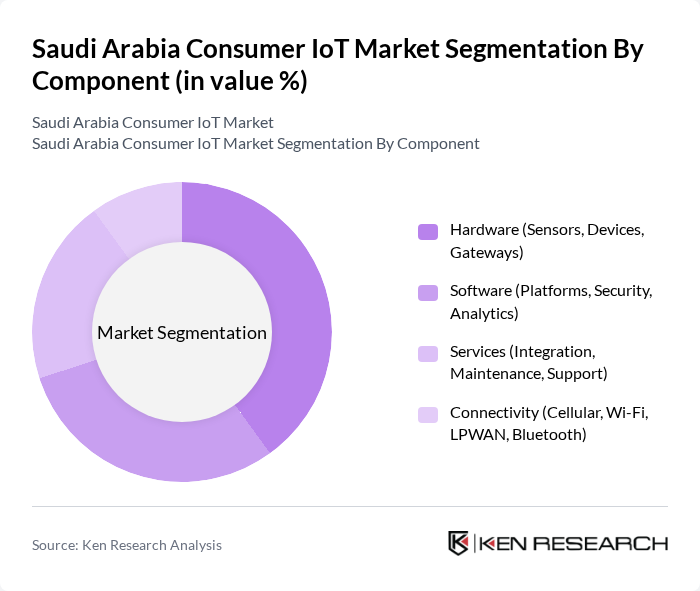
By Component:The segmentation by component includes Hardware, Software, Services, and Connectivity. Hardware encompasses sensors, devices, and gateways that form the backbone of IoT systems. Software includes platforms, security solutions, and analytics tools that enable data processing and management. Services cover integration, maintenance, and support, while connectivity refers to the various communication technologies used in IoT applications .
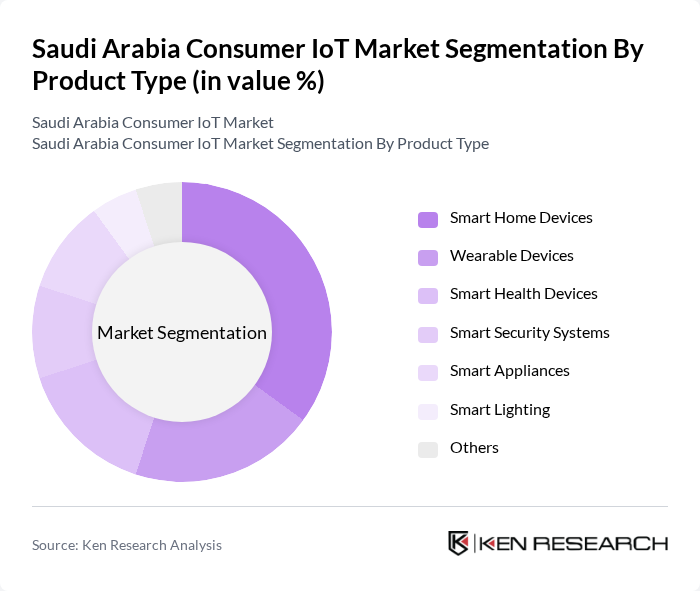
By Product Type:The product type segmentation includes Smart Home Devices, Wearable Devices, Smart Health Devices, Smart Security Systems, Smart Appliances, Smart Lighting, and Others. Smart Home Devices are increasingly popular due to their convenience and energy efficiency. Wearable Devices are gaining traction among health-conscious consumers, while Smart Health Devices are essential for remote monitoring and telehealth services. Smart Security Systems enhance safety, and Smart Appliances and Lighting contribute to energy management and automation .
Saudi Arabia Consumer IoT Market Competitive Landscape
The Saudi Arabia Consumer IoT Market is characterized by a dynamic mix of regional and international players. Leading participants such as STC Group (Saudi Telecom Company), Mobily (Etihad Etisalat Company), Zain KSA, Siemens Saudi Arabia, Cisco Systems Saudi Arabia, Honeywell Saudi Arabia, Samsung Electronics, LG Electronics, Signify (Philips Lighting), Amazon Web Services (AWS) Saudi Arabia, Google Cloud Saudi Arabia, IBM Saudi Arabia, Oracle Saudi Arabia, Huawei Technologies Saudi Arabia, Xiaomi, Legrand Saudi Arabia, Schneider Electric Saudi Arabia, Aqara (by Lumi United Technology), Fibaro (Nice Group), Ezviz (Hikvision) contribute to innovation, geographic expansion, and service delivery in this space .
Saudi Arabia Consumer IoT Market Industry Analysis
Growth Drivers
- Increasing Smartphone Penetration:As of future, smartphone penetration in Saudi Arabia is projected to reach approximately97%, with over30 millionsmartphone users. This surge in smartphone adoption is a critical driver for the Consumer IoT market, as smartphones serve as the primary interface for controlling smart devices. The high connectivity rates, supported by a mobile internet penetration of aroundover 98%, facilitate seamless integration of IoT devices into daily life, enhancing user engagement and driving market growth.
- Rising Demand for Smart Home Devices:The demand for smart home devices in Saudi Arabia is expected to exceedover 5 million unitsby the end of future. This growth is fueled by an increasing middle-class population, which is projected to reacharound 14 millionindividuals, and a growing interest in home automation solutions. The convenience, energy efficiency, and enhanced security offered by smart home devices are appealing to consumers, driving significant investments in this segment and contributing to the overall expansion of the Consumer IoT market.
- Government Initiatives for Digital Transformation:The Saudi government has allocated overUSD 500 milliontowards digital transformation initiatives as part of its Vision 2030 plan. This includes investments in smart city projects and IoT infrastructure development. By fostering a conducive environment for technology adoption, the government aims to enhance connectivity and innovation. These initiatives are expected to significantly boost the Consumer IoT market, encouraging both local and international companies to invest in IoT solutions and technologies.
Market Challenges
- Data Privacy Concerns:Data privacy remains a significant challenge in the Saudi Arabian Consumer IoT market, withover 70%of consumers expressing concerns about data security. The lack of robust data protection frameworks can deter users from adopting IoT devices, as they fear potential breaches and misuse of personal information. This challenge necessitates the development of stringent data protection regulations to build consumer trust and encourage wider adoption of IoT technologies.
- High Initial Investment Costs:The high initial investment required for IoT infrastructure poses a barrier to market growth. For instance, the average cost of setting up a smart home system can exceedUSD 2,000, which is prohibitive for many consumers. This financial hurdle limits the accessibility of IoT solutions, particularly among lower-income households. Addressing this challenge through affordable financing options and subsidies could enhance market penetration and consumer adoption rates.
Saudi Arabia Consumer IoT Market Future Outlook
The future of the Consumer IoT market in Saudi Arabia appears promising, driven by technological advancements and increasing consumer interest. The expansion of 5G networks is expected to enhance connectivity, enabling faster and more reliable IoT applications. Additionally, the integration of artificial intelligence with IoT devices will likely lead to smarter, more efficient solutions. As urbanization continues, the demand for innovative smart city solutions will further propel market growth, creating a dynamic landscape for IoT technologies in the region.
Market Opportunities
- Expansion of 5G Networks:The rollout of 5G networks in Saudi Arabia is anticipated to reachover 80%coverage by future. This expansion will significantly enhance the performance of IoT devices, enabling real-time data processing and improved connectivity. As a result, businesses and consumers will increasingly adopt IoT solutions, creating substantial growth opportunities in various sectors, including healthcare, transportation, and smart homes.
- Integration of AI with IoT:The integration of artificial intelligence with IoT technologies is projected to create a market worth overUSD 1 billionin future. This convergence will enable smarter decision-making and automation across various applications, from predictive maintenance in industrial settings to personalized experiences in smart homes. Companies that leverage AI-driven IoT solutions will likely gain a competitive edge, driving innovation and market growth.
Scope of the Report
| Segment | Sub-Segments |
|---|---|
| By Component | Hardware (Sensors, Devices, Gateways) Software (Platforms, Security, Analytics) Services (Integration, Maintenance, Support) Connectivity (Cellular, Wi-Fi, LPWAN, Bluetooth) |
| By Product Type | Smart Home Devices Wearable Devices Smart Health Devices Smart Security Systems Smart Appliances Smart Lighting Others |
| By Application | Home Automation Health Monitoring Security and Surveillance Energy Management Smart Cities Connected Cars Others |
| By End-User | Residential Commercial Industrial Government & Utilities Others |
| By Region | Central Region Eastern Region Western Region Southern Region |
| By Technology | Cloud-based IoT Solutions Edge Computing Artificial Intelligence Integration Machine Learning Applications Others |
| By Investment Source | Domestic Investment Foreign Direct Investment (FDI) Public-Private Partnerships (PPP) Government Schemes |
| By Policy Support | Subsidies for IoT Devices Tax Exemptions for IoT Companies Regulatory Support for Startups Others |
Key Target Audience
Investors and Venture Capitalist Firms
Government and Regulatory Bodies (e.g., Saudi Arabian Standards Organization, Communications and Information Technology Commission)
Manufacturers and Producers
Distributors and Retailers
Telecommunications Companies
Smart Home Device Manufacturers
Industry Associations (e.g., Saudi IoT Association)
Financial Institutions
Players Mentioned in the Report:
STC Group (Saudi Telecom Company)
Mobily (Etihad Etisalat Company)
Zain KSA
Siemens Saudi Arabia
Cisco Systems Saudi Arabia
Honeywell Saudi Arabia
Samsung Electronics
LG Electronics
Signify (Philips Lighting)
Amazon Web Services (AWS) Saudi Arabia
Google Cloud Saudi Arabia
IBM Saudi Arabia
Oracle Saudi Arabia
Huawei Technologies Saudi Arabia
Xiaomi
Legrand Saudi Arabia
Schneider Electric Saudi Arabia
Aqara (by Lumi United Technology)
Fibaro (Nice Group)
Ezviz (Hikvision)
Table of Contents
Market Assessment Phase
1. Executive Summary and Approach
2. Saudi Arabia Consumer IoT Market Overview
2.1 Key Insights and Strategic Recommendations
2.2 Saudi Arabia Consumer IoT Market Overview
2.3 Definition and Scope
2.4 Evolution of Market Ecosystem
2.5 Timeline of Key Regulatory Milestones
2.6 Value Chain & Stakeholder Mapping
2.7 Business Cycle Analysis
2.8 Policy & Incentive Landscape
3. Saudi Arabia Consumer IoT Market Analysis
3.1 Growth Drivers
3.1.1 Increasing smartphone penetration
3.1.2 Rising demand for smart home devices
3.1.3 Government initiatives for digital transformation
3.1.4 Growing awareness of IoT benefits
3.2 Market Challenges
3.2.1 Data privacy concerns
3.2.2 High initial investment costs
3.2.3 Lack of standardization
3.2.4 Limited consumer awareness
3.3 Market Opportunities
3.3.1 Expansion of 5G networks
3.3.2 Integration of AI with IoT
3.3.3 Increasing urbanization
3.3.4 Growth in e-commerce
3.4 Market Trends
3.4.1 Adoption of smart appliances
3.4.2 Rise of wearable technology
3.4.3 Focus on energy-efficient devices
3.4.4 Development of IoT security solutions
3.5 Government Regulation
3.5.1 Data protection laws
3.5.2 IoT device certification requirements
3.5.3 Incentives for smart city projects
3.5.4 Regulations on telecommunications
4. SWOT Analysis
5. Stakeholder Analysis
6. Porter's Five Forces Analysis
7. Saudi Arabia Consumer IoT Market Market Size, 2019-2024
7.1 By Value
7.2 By Volume
7.3 By Average Selling Price
8. Saudi Arabia Consumer IoT Market Segmentation
8.1 By Component
8.1.1 Hardware (Sensors, Devices, Gateways)
8.1.2 Software (Platforms, Security, Analytics)
8.1.3 Services (Integration, Maintenance, Support)
8.1.4 Connectivity (Cellular, Wi-Fi, LPWAN, Bluetooth)
8.2 By Product Type
8.2.1 Smart Home Devices
8.2.2 Wearable Devices
8.2.3 Smart Health Devices
8.2.4 Smart Security Systems
8.2.5 Smart Appliances
8.2.6 Smart Lighting
8.2.7 Others
8.3 By Application
8.3.1 Home Automation
8.3.2 Health Monitoring
8.3.3 Security and Surveillance
8.3.4 Energy Management
8.3.5 Smart Cities
8.3.6 Connected Cars
8.3.7 Others
8.4 By End-User
8.4.1 Residential
8.4.2 Commercial
8.4.3 Industrial
8.4.4 Government & Utilities
8.4.5 Others
8.5 By Region
8.5.1 Central Region
8.5.2 Eastern Region
8.5.3 Western Region
8.5.4 Southern Region
8.6 By Technology
8.6.1 Cloud-based IoT Solutions
8.6.2 Edge Computing
8.6.3 Artificial Intelligence Integration
8.6.4 Machine Learning Applications
8.6.5 Others
8.7 By Investment Source
8.7.1 Domestic Investment
8.7.2 Foreign Direct Investment (FDI)
8.7.3 Public-Private Partnerships (PPP)
8.7.4 Government Schemes
8.8 By Policy Support
8.8.1 Subsidies for IoT Devices
8.8.2 Tax Exemptions for IoT Companies
8.8.3 Regulatory Support for Startups
8.8.4 Others
9. Saudi Arabia Consumer IoT Market Competitive Analysis
9.1 Market Share of Key Players
9.2 KPIs for Cross Comparison of Key Players
9.2.1 Company Name
9.2.2 Group Size (Large, Medium, Small)
9.2.3 Revenue Growth Rate (YoY %)
9.2.4 Market Share (%)
9.2.5 Customer Acquisition Cost (SAR)
9.2.6 Market Penetration Rate (%)
9.2.7 Customer Retention Rate (%)
9.2.8 Average Revenue Per User (ARPU, SAR)
9.2.9 Product Innovation Index
9.2.10 Brand Awareness Score
9.2.11 Distribution Channel Coverage
9.2.12 Local Partnership Strength
9.2.13 Regulatory Compliance Score
9.3 SWOT Analysis of Top Players
9.4 Pricing Analysis
9.5 Detailed Profile of Major Companies
9.5.1 STC Group (Saudi Telecom Company)
9.5.2 Mobily (Etihad Etisalat Company)
9.5.3 Zain KSA
9.5.4 Siemens Saudi Arabia
9.5.5 Cisco Systems Saudi Arabia
9.5.6 Honeywell Saudi Arabia
9.5.7 Samsung Electronics
9.5.8 LG Electronics
9.5.9 Signify (Philips Lighting)
9.5.10 Amazon Web Services (AWS) Saudi Arabia
9.5.11 Google Cloud Saudi Arabia
9.5.12 IBM Saudi Arabia
9.5.13 Oracle Saudi Arabia
9.5.14 Huawei Technologies Saudi Arabia
9.5.15 Xiaomi
9.5.16 Legrand Saudi Arabia
9.5.17 Schneider Electric Saudi Arabia
9.5.18 Aqara (by Lumi United Technology)
9.5.19 Fibaro (Nice Group)
9.5.20 Ezviz (Hikvision)
10. Saudi Arabia Consumer IoT Market End-User Analysis
10.1 Procurement Behavior of Key Ministries
10.1.1 Ministry of Communications and Information Technology
10.1.2 Ministry of Interior
10.1.3 Ministry of Health
10.1.4 Ministry of Housing
10.2 Corporate Spend on Infrastructure & Energy
10.2.1 Investment in Smart Grids
10.2.2 Expenditure on Smart Buildings
10.2.3 Budget for IoT Solutions
10.2.4 Others
10.3 Pain Point Analysis by End-User Category
10.3.1 Residential Users
10.3.2 Commercial Users
10.3.3 Industrial Users
10.3.4 Government Users
10.4 User Readiness for Adoption
10.4.1 Awareness Levels
10.4.2 Technical Skills
10.4.3 Financial Readiness
10.4.4 Others
10.5 Post-Deployment ROI and Use Case Expansion
10.5.1 Measurement of ROI
10.5.2 Expansion of Use Cases
10.5.3 User Feedback Mechanisms
10.5.4 Others
11. Saudi Arabia Consumer IoT Market Future Size, 2025-2030
11.1 By Value
11.2 By Volume
11.3 By Average Selling Price
Go-To-Market Strategy Phase
1. Whitespace Analysis + Business Model Canvas
1.1 Market Gaps Identification
1.2 Business Model Development
2. Marketing and Positioning Recommendations
2.1 Branding Strategies
2.2 Product USPs
3. Distribution Plan
3.1 Urban Retail vs Rural NGO Tie-ups
4. Channel & Pricing Gaps
4.1 Underserved Routes
4.2 Pricing Bands
5. Unmet Demand & Latent Needs
5.1 Category Gaps
5.2 Consumer Segments
6. Customer Relationship
6.1 Loyalty Programs
6.2 After-sales Service
7. Value Proposition
7.1 Sustainability
7.2 Integrated Supply Chains
8. Key Activities
8.1 Regulatory Compliance
8.2 Branding
8.3 Distribution Setup
9. Entry Strategy Evaluation
9.1 Domestic Market Entry Strategy
9.1.1 Product Mix
9.1.2 Pricing Band
9.1.3 Packaging
9.2 Export Entry Strategy
9.2.1 Target Countries
9.2.2 Compliance Roadmap
10. Entry Mode Assessment
10.1 Joint Ventures
10.2 Greenfield Investments
10.3 Mergers & Acquisitions
10.4 Distributor Model
11. Capital and Timeline Estimation
11.1 Capital Requirements
11.2 Timelines
12. Control vs Risk Trade-Off
12.1 Ownership vs Partnerships
13. Profitability Outlook
13.1 Breakeven Analysis
13.2 Long-term Sustainability
14. Potential Partner List
14.1 Distributors
14.2 Joint Ventures
14.3 Acquisition Targets
15. Execution Roadmap
15.1 Phased Plan for Market Entry
15.1.1 Market Setup
15.1.2 Market Entry
15.1.3 Growth Acceleration
15.1.4 Scale & Stabilize
15.2 Key Activities and Milestones
15.2.1 Milestone Planning
15.2.2 Activity Tracking
Research Methodology
Phase 1: Approach1
Desk Research
- Analysis of market reports from government agencies and industry associations in Saudi Arabia
- Review of published articles and white papers on consumer IoT trends and adoption rates
- Examination of demographic and economic data from the Saudi Arabian Monetary Authority and other relevant sources
Primary Research
- Interviews with key stakeholders in the consumer electronics sector, including manufacturers and retailers
- Surveys targeting end-users to understand consumer preferences and usage patterns of IoT devices
- Focus group discussions with technology enthusiasts to gauge perceptions of IoT innovations
Validation & Triangulation
- Cross-validation of findings through multiple data sources, including sales data and consumer feedback
- Triangulation of insights from industry experts, market reports, and consumer surveys
- Sanity checks conducted through expert panel reviews to ensure data reliability
Phase 2: Market Size Estimation1
Top-down Assessment
- Estimation of the overall consumer electronics market size as a basis for IoT segment analysis
- Segmentation of the market by device type, including wearables, smart home devices, and connected appliances
- Incorporation of growth projections based on government initiatives promoting smart city developments
Bottom-up Modeling
- Collection of sales data from leading IoT device manufacturers operating in Saudi Arabia
- Estimation of average selling prices and unit sales across different IoT categories
- Analysis of consumer adoption rates and projected growth based on historical data
Forecasting & Scenario Analysis
- Utilization of time-series analysis to project future market growth based on current trends
- Scenario modeling based on varying levels of consumer adoption and technological advancements
- Development of baseline, optimistic, and pessimistic forecasts through 2030
Phase 3: CATI Sample Composition1
| Scope Item/Segment | Sample Size | Target Respondent Profiles |
|---|---|---|
| Smart Home Device Adoption | 120 | Homeowners, Tech-savvy Consumers |
| Wearable Technology Usage | 85 | Fitness Enthusiasts, Health-conscious Individuals |
| Connected Appliances Insights | 75 | Household Decision Makers, Appliance Retailers |
| Consumer Attitudes Towards IoT Security | 95 | General Consumers, Technology Adopters |
| Smart City Initiatives Feedback | 80 | Urban Residents, Community Leaders |
Frequently Asked Questions
What is the current value of the Saudi Arabia Consumer IoT Market?
The Saudi Arabia Consumer IoT Market is valued at approximately USD 9.5 billion, driven by the increasing adoption of smart devices, 5G connectivity, and consumer preferences for automation and convenience in daily life.
What are the key drivers of growth in the Saudi Arabia Consumer IoT Market?
Which cities are leading in the Saudi Arabia Consumer IoT Market?
What challenges does the Saudi Arabia Consumer IoT Market face?
Other Regional/Country Reports
Indonesia Consumer IoT Market
Malaysia Consumer IoT Market
APAC Consumer IoT Market
Other Adjacent Reports
UAE Smart Home Devices Market
Indonesia Wearable Devices Market Size, Share & Forecast, By Product Type, Application & Distribution Channel, 2026-2031Japan Smart Health Devices Market
Bahrain Smart Security Systems Market
India Smart Appliances Market Outlook to 2030Malaysia Smart Lighting Market
Brazil IoT Software Market
Brazil IoT Services Market
Philippines IoT Connectivity Market
Oman Cybersecurity Solutions Market
Why Buy From Us?

What makes us stand out is that our consultants follow Robust, Refine and Result (RRR) methodology. Robust for clear definitions, approaches and sanity checking, Refine for differentiating respondents' facts and opinions, and Result for presenting data with story.

We have set a benchmark in the industry by offering our clients with syndicated and customized market research reports featuring coverage of entire market as well as meticulous research and analyst insights.

While we don't replace traditional research, we flip the method upside down. Our dual approach of Top Bottom & Bottom Top ensures quality deliverable by not just verifying company fundamentals but also looking at the sector and macroeconomic factors.

With one step in the future, our research team constantly tries to show you the bigger picture. We help with some of the tough questions you may encounter along the way: How is the industry positioned? Best marketing channel? KPI's of competitors? By aligning every element, we help maximize success.

Our report gives you instant access to the answers and sources that other companies might choose to hide. We elaborate each steps of research methodology we have used and showcase you the sample size to earn your trust.

If you need any support, we are here! We pride ourselves on universe strength, data quality, and quick, friendly, and professional service.