Saudi Arabia Dairy Blends Market Size, Share, Growth Drivers, Trends, Opportunities & Forecast 2025–2030

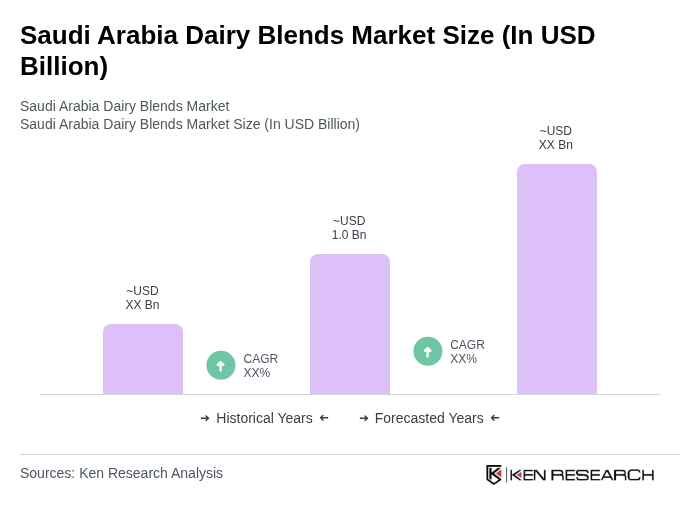
Saudi Arabia Dairy Blends Market, valued at USD 1.0 billion, grows due to rising health awareness, convenience foods, and innovations in low-fat, fortified blends for applications like bakery and dairy beverages.

Region:Middle East

Author(s):Shubham

Product Code:KRAD6742

Pages:94

Published On:December 2025
About the Report

Base Year 2024

Saudi Arabia Dairy Blends Market Overview

  • The Saudi Arabia Dairy Blends Market is valued at USD 1.0 billion, based on a five-year historical analysis, in the context of a broader dairy products market exceeding USD 5.5–6.0 billion in the country. This growth is primarily driven by increasing consumer demand for dairy products, rising health consciousness, and the growing use of dairy blends as cost?effective and functional ingredients in bakery, confectionery, beverages, and foodservice applications, in line with global dairy blends trends. The market has seen a notable uptick due to diversification of product offerings, expansion of low?fat, fortified and lactose?free options, and the introduction of innovative dairy blends that cater to health?oriented and convenience?seeking consumers.
  • Key cities such as Riyadh, Jeddah, and Dammam dominate the market due to their large populations, higher income levels, and advanced retail and HoReCa infrastructure, which drive higher consumption of dairy products and value?added dairy blends. The presence of major food manufacturers, dairy processors, and modern trade channels in these cities further enhances market growth, as they serve as central hubs for cold?chain logistics and distribution, facilitating easier access to a wide variety of dairy blends for both retail and foodservice segments.
  • In 2023, the Saudi Food and Drug Authority (SFDA) continued strengthening food safety and labeling standards in the dairy sector through instruments such as the Technical Regulation “GSO 9/2013 – Labeling of Prepackaged Foodstuffs” and related SFDA food labeling requirements, which mandate clear declaration of ingredients, allergen information, and nutritional data on prepackaged foods, including dairy blends. This framework aims to enhance transparency for dairy and dairy?blend products, protect consumer health, and support informed purchasing decisions by ensuring accurate labeling of fat content, added vegetable oils, fortification, and other compositional attributes.
Saudi Arabia Dairy Blends Market Size

Saudi Arabia Dairy Blends Market Segmentation

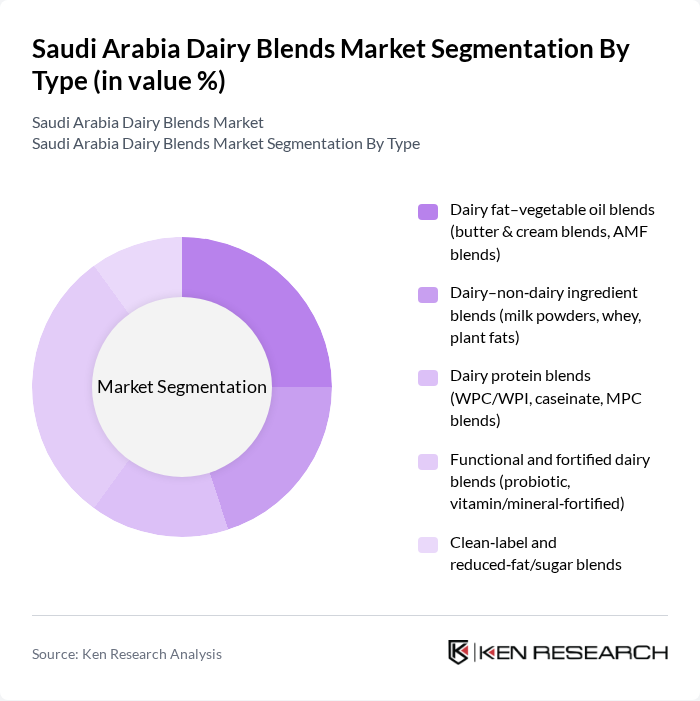
By Type:The market is segmented into various types of dairy blends, including Dairy fat–vegetable oil blends, Dairy–non-dairy ingredient blends, Dairy protein blends, Functional and fortified dairy blends, and Clean-label and reduced-fat/sugar blends. These subsegments reflect the industry’s shift toward cost optimization (through fat–oil blends and recombined powders), higher protein content, and value?added claims such as probiotic, vitamin/mineral fortification and cleaner ingredient lists, in line with trends seen in the global dairy blends and functional dairy markets.
Saudi Arabia Dairy Blends Market segmentation by Type.

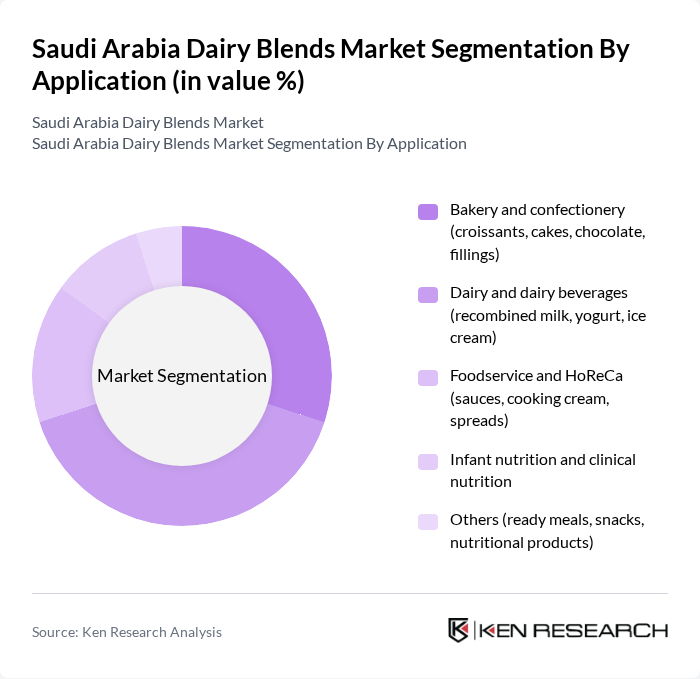
By Application:The applications of dairy blends in Saudi Arabia include Bakery and confectionery, Dairy and dairy beverages, Foodservice and HoReCa, Infant nutrition and clinical nutrition, and Others. This reflects the versatility of dairy blends as recombined milk and cream bases, fat?filled powders, and tailored functional systems used in bakery fats, chocolates, ice cream, yogurt drinks, ready meals, and nutritional products, supporting the broader growth of dairy snacks, convenience foods, and fortified beverages in the Kingdom.
Saudi Arabia Dairy Blends Market segmentation by Application.

Saudi Arabia Dairy Blends Market Competitive Landscape

The Saudi Arabia Dairy Blends Market is characterized by a dynamic mix of regional and international players. Leading participants such as Almarai Company, National Agricultural Development Company (NADEC), Saudia Dairy & Foodstuff Company (SADAFCO), Al Safi Danone Company, Almarai–PRIME Dairy Blends (industrial ingredients division), Arla Foods Saudi Arabia, Fonterra (Saudi Arabia operations), FrieslandCampina Middle East (Saudi Arabia), Kerry Group (Saudi Arabia taste & nutrition, dairy blends), Savola Foods Company (oils and fat–dairy blends for foodservice), Al Watania Dairy, Al Rawabi Dairy Company – KSA presence, United National Dairy Co. (UND), Al Jazeera Dairy Company, Al Ain Dairy – GCC exports to Saudi Arabia contribute to innovation, geographic expansion, and service delivery in this space, supported by strong investments in processing capacity, cold?chain distribution, and value?added dairy product development across the Kingdom.

Almarai Company

1977

Riyadh, Saudi Arabia

National Agricultural Development Company (NADEC)

1981

Riyadh, Saudi Arabia

Saudia Dairy & Foodstuff Company (SADAFCO)

1976

Jeddah, Saudi Arabia

Al Safi Danone Company

1997

Riyadh, Saudi Arabia

FrieslandCampina Middle East

1871

Amersfoort, Netherlands

Company

Establishment Year

Headquarters

Scale of operations in Saudi Arabia (processing capacity, number of plants/lines)

Saudi Arabia dairy blends revenue and 5?year CAGR

Market share in Saudi Arabia dairy blends

Geographic and channel coverage (regions served, B2B vs foodservice vs retail)

Product portfolio breadth (applications, fat levels, functional claims)

R&D and innovation intensity (new SKUs launched per year, patent/claim activity)

Saudi Arabia Dairy Blends Market Industry Analysis

Growth Drivers

  • Increasing Health Consciousness Among Consumers:The Saudi Arabian population is increasingly prioritizing health, with 60% of consumers actively seeking healthier food options. This trend is supported by the World Health Organization's report indicating a 20% rise in health-related spending in the region. As a result, dairy blends that offer nutritional benefits, such as fortified vitamins and probiotics, are gaining traction, driving market growth. The demand for low-fat and organic dairy blends is particularly notable, reflecting this health-conscious shift.
  • Rising Demand for Convenience Foods:The convenience food sector in Saudi Arabia is projected to reach SAR 35 billion by 2024, driven by busy lifestyles and urbanization. Consumers are increasingly opting for ready-to-eat and easy-to-prepare dairy blends, which cater to their fast-paced lives. This shift is further supported by a 25% increase in online grocery shopping, making dairy blends more accessible. The growing trend of meal replacements and on-the-go snacks is also contributing to the demand for innovative dairy blend products.
  • Expansion of Retail and Distribution Channels:The retail landscape in Saudi Arabia is evolving, with a 30% increase in modern trade outlets over the past three years. This expansion includes supermarkets, hypermarkets, and online platforms, enhancing the availability of dairy blends. The Saudi government’s investment in infrastructure, including logistics and cold chain facilities, is facilitating better distribution. As a result, consumers have greater access to a variety of dairy blend products, further stimulating market growth and competition among brands.

Market Challenges

  • Fluctuating Raw Material Prices:The dairy industry in Saudi Arabia faces significant challenges due to the volatility of raw material prices, particularly for milk and dairy ingredients. In future, the price of milk increased by 15% due to supply chain disruptions and global market fluctuations. This unpredictability affects production costs and profit margins for dairy blend manufacturers, making it difficult to maintain competitive pricing while ensuring product quality and sustainability.
  • Stringent Regulatory Requirements:The Saudi dairy sector is subject to rigorous regulatory standards, including food safety and quality compliance. The Saudi Food and Drug Authority (SFDA) has implemented strict guidelines that require extensive testing and certification for dairy products. In future, over 35% of dairy blend products faced delays in market entry due to compliance issues. These stringent regulations can hinder innovation and increase operational costs for manufacturers, posing a challenge to market growth.

Saudi Arabia Dairy Blends Market Future Outlook

The Saudi Arabia dairy blends market is poised for significant growth, driven by evolving consumer preferences and technological advancements. The increasing focus on health and wellness will likely lead to a surge in demand for fortified and organic dairy blends. Additionally, the expansion of e-commerce platforms will enhance product accessibility, allowing consumers to explore diverse offerings. As manufacturers innovate and adapt to these trends, the market is expected to witness a dynamic transformation, fostering competition and enhancing product variety.

Market Opportunities

  • Growing Trend of Plant-Based Diets:The rise in plant-based diets presents a significant opportunity for dairy blend manufacturers to innovate. With a 35% increase in consumers seeking plant-based alternatives, companies can develop dairy blends that incorporate plant proteins and non-dairy ingredients, catering to this growing demographic. This shift not only meets consumer demand but also aligns with global sustainability trends, enhancing brand appeal.
  • Innovations in Product Formulations:There is a notable opportunity for product innovation within the dairy blends market. With advancements in food technology, manufacturers can create unique formulations that enhance taste, texture, and nutritional value. The introduction of functional dairy blends, such as those enriched with probiotics or superfoods, can attract health-conscious consumers, driving sales and market share in a competitive landscape.

Scope of the Report

SegmentSub-Segments
By Type

Dairy fat–vegetable oil blends (butter & cream blends, AMF blends)

Dairy–non?dairy ingredient blends (milk powders, whey, plant fats)

Dairy protein blends (WPC/WPI, caseinate, MPC blends)

Functional and fortified dairy blends (probiotic, vitamin/mineral?fortified)

Clean?label and reduced?fat/sugar blends

By Application

Bakery and confectionery (croissants, cakes, chocolate, fillings)

Dairy and dairy beverages (recombined milk, yogurt, ice cream)

Foodservice and HoReCa (sauces, cooking cream, spreads)

Infant nutrition and clinical nutrition

Others (ready meals, snacks, nutritional products)

By Form

Powder blends

Liquid blends

Paste and spreadable blends

Concentrates

Others

By Distribution Channel

B2B ingredients (industrial users, food manufacturers)

Foodservice distributors

Modern retail (supermarkets/hypermarkets)

Online and direct-to-customer

Others

By Region

Central Region

Eastern Region

Western Region

Southern Region

By Consumer / Buyer Type

Large food & beverage manufacturers

SMEs and local processors

HoReCa and catering operators

Retail and private?label brands

By Nutritional / Functional Positioning

High protein and high solids blends

Low fat and low cholesterol blends

Sugar?reduced and lactose?modified blends

Fortified with vitamins, minerals, probiotics, or fibers

Key Target Audience

Investors and Venture Capitalist Firms

Government and Regulatory Bodies (e.g., Saudi Food and Drug Authority, Ministry of Environment, Water and Agriculture)

Dairy Product Manufacturers

Food and Beverage Distributors

Retail Chains and Supermarkets

Packaging Suppliers

Logistics and Supply Chain Companies

Health and Nutrition Organizations

Players Mentioned in the Report:

Almarai Company

National Agricultural Development Company (NADEC)

Saudia Dairy & Foodstuff Company (SADAFCO)

Al Safi Danone Company

AlmaraiPRIME Dairy Blends (industrial ingredients division)

Arla Foods Saudi Arabia

Fonterra (Saudi Arabia operations)

FrieslandCampina Middle East (Saudi Arabia)

Kerry Group (Saudi Arabia taste & nutrition, dairy blends)

Savola Foods Company (oils and fatdairy blends for foodservice)

Al Watania Dairy

Al Rawabi Dairy Company KSA presence

United National Dairy Co. (UND)

Al Jazeera Dairy Company

Al Ain Dairy GCC exports to Saudi Arabia

Table of Contents

Market Assessment Phase

1. Executive Summary and Approach


2. Saudi Arabia Dairy Blends Market Overview

2.1 Key Insights and Strategic Recommendations

2.2 Saudi Arabia Dairy Blends Market Overview

2.3 Definition and Scope

2.4 Evolution of Market Ecosystem

2.5 Timeline of Key Regulatory Milestones

2.6 Value Chain & Stakeholder Mapping

2.7 Business Cycle Analysis

2.8 Policy & Incentive Landscape


3. Saudi Arabia Dairy Blends Market Analysis

3.1 Growth Drivers

3.1.1 Increasing health consciousness among consumers
3.1.2 Rising demand for convenience foods
3.1.3 Expansion of retail and distribution channels
3.1.4 Government initiatives to boost dairy production

3.2 Market Challenges

3.2.1 Fluctuating raw material prices
3.2.2 Stringent regulatory requirements
3.2.3 Competition from alternative dairy products
3.2.4 Limited consumer awareness about dairy blends

3.3 Market Opportunities

3.3.1 Growing trend of plant-based diets
3.3.2 Innovations in product formulations
3.3.3 Expansion into untapped rural markets
3.3.4 Increasing export potential to neighboring regions

3.4 Market Trends

3.4.1 Rise in demand for organic dairy blends
3.4.2 Shift towards sustainable packaging solutions
3.4.3 Increasing use of technology in production
3.4.4 Growth of online retail channels

3.5 Government Regulation

3.5.1 Food safety standards and compliance
3.5.2 Labeling requirements for dairy products
3.5.3 Import regulations for dairy ingredients
3.5.4 Subsidies for local dairy producers

4. SWOT Analysis


5. Stakeholder Analysis


6. Porter's Five Forces Analysis


7. Saudi Arabia Dairy Blends Market Market Size, 2019-2024

7.1 By Value

7.2 By Volume

7.3 By Average Selling Price


8. Saudi Arabia Dairy Blends Market Segmentation

8.1 By Type

8.1.1 Dairy fat–vegetable oil blends (butter & cream blends, AMF blends)
8.1.2 Dairy–non?dairy ingredient blends (milk powders, whey, plant fats)
8.1.3 Dairy protein blends (WPC/WPI, caseinate, MPC blends)
8.1.4 Functional and fortified dairy blends (probiotic, vitamin/mineral?fortified)
8.1.5 Clean?label and reduced?fat/sugar blends

8.2 By Application

8.2.1 Bakery and confectionery (croissants, cakes, chocolate, fillings)
8.2.2 Dairy and dairy beverages (recombined milk, yogurt, ice cream)
8.2.3 Foodservice and HoReCa (sauces, cooking cream, spreads)
8.2.4 Infant nutrition and clinical nutrition
8.2.5 Others (ready meals, snacks, nutritional products)

8.3 By Form

8.3.1 Powder blends
8.3.2 Liquid blends
8.3.3 Paste and spreadable blends
8.3.4 Concentrates
8.3.5 Others

8.4 By Distribution Channel

8.4.1 B2B ingredients (industrial users, food manufacturers)
8.4.2 Foodservice distributors
8.4.3 Modern retail (supermarkets/hypermarkets)
8.4.4 Online and direct-to-customer
8.4.5 Others

8.5 By Region

8.5.1 Central Region
8.5.2 Eastern Region
8.5.3 Western Region
8.5.4 Southern Region

8.6 By Consumer / Buyer Type

8.6.1 Large food & beverage manufacturers
8.6.2 SMEs and local processors
8.6.3 HoReCa and catering operators
8.6.4 Retail and private?label brands

8.7 By Nutritional / Functional Positioning

8.7.1 High protein and high solids blends
8.7.2 Low fat and low cholesterol blends
8.7.3 Sugar?reduced and lactose?modified blends
8.7.4 Fortified with vitamins, minerals, probiotics, or fibers

9. Saudi Arabia Dairy Blends Market Competitive Analysis

9.1 Market Share of Key Players

9.2 Cross Comparison of Key Players

9.2.1 Company name and business segment focus (dairy blends/ingredients share of total revenue)
9.2.2 Scale of operations in Saudi Arabia (processing capacity, number of plants/lines)
9.2.3 Saudi Arabia dairy blends revenue and 5?year CAGR
9.2.4 Market share in Saudi Arabia dairy blends
9.2.5 Geographic and channel coverage (regions served, B2B vs foodservice vs retail)
9.2.6 Product portfolio breadth (applications, fat levels, functional claims)
9.2.7 R&D and innovation intensity (new SKUs launched per year, patent/claim activity)
9.2.8 Pricing and margin positioning (value, mainstream, premium)
9.2.9 Supply chain strength (import vs local sourcing, cold?chain/logistics reach)
9.2.10 Brand and customer relationship strength (key accounts, contract duration, churn)

9.3 SWOT Analysis of Top Players

9.4 Pricing Analysis

9.5 Detailed Profile of Major Companies

9.5.1 Almarai Company
9.5.2 National Agricultural Development Company (NADEC)
9.5.3 Saudia Dairy & Foodstuff Company (SADAFCO)
9.5.4 Al Safi Danone Company
9.5.5 Almarai–PRIME Dairy Blends (industrial ingredients division)
9.5.6 Arla Foods Saudi Arabia
9.5.7 Fonterra (Saudi Arabia operations)
9.5.8 FrieslandCampina Middle East (Saudi Arabia)
9.5.9 Kerry Group (Saudi Arabia taste & nutrition, dairy blends)
9.5.10 Savola Foods Company (oils and fat–dairy blends for foodservice)
9.5.11 Al Watania Dairy
9.5.12 Al Rawabi Dairy Company – KSA presence
9.5.13 United National Dairy Co. (UND)
9.5.14 Al Jazeera Dairy Company
9.5.15 Al Ain Dairy – GCC exports to Saudi Arabia

10. Saudi Arabia Dairy Blends Market End-User Analysis

10.1 Procurement Behavior of Key Ministries

10.1.1 Ministry of Health
10.1.2 Ministry of Education
10.1.3 Ministry of Agriculture
10.1.4 Others

10.2 Corporate Spend on Infrastructure & Energy

10.2.1 Investment in Dairy Processing Facilities
10.2.2 Expenditure on Supply Chain Optimization
10.2.3 Budget Allocation for R&D
10.2.4 Others

10.3 Pain Point Analysis by End-User Category

10.3.1 Quality Assurance Issues
10.3.2 Supply Chain Disruptions
10.3.3 Price Volatility
10.3.4 Others

10.4 User Readiness for Adoption

10.4.1 Awareness of Dairy Blend Benefits
10.4.2 Willingness to Pay for Quality
10.4.3 Availability of Products
10.4.4 Others

10.5 Post-Deployment ROI and Use Case Expansion

10.5.1 Measurement of Cost Savings
10.5.2 Customer Satisfaction Metrics
10.5.3 Market Expansion Opportunities
10.5.4 Others

11. Saudi Arabia Dairy Blends Market Future Size, 2025-2030

11.1 By Value

11.2 By Volume

11.3 By Average Selling Price


Go-To-Market Strategy Phase

1. Whitespace Analysis + Business Model Canvas

1.1 Market Gaps Identification

1.2 Business Model Framework


2. Marketing and Positioning Recommendations

2.1 Branding Strategies

2.2 Product USPs


3. Distribution Plan

3.1 Urban Retail vs Rural NGO Tie-ups


4. Channel & Pricing Gaps

4.1 Underserved Routes

4.2 Pricing Bands


5. Unmet Demand & Latent Needs

5.1 Category Gaps

5.2 Consumer Segments


6. Customer Relationship

6.1 Loyalty Programs

6.2 After-sales Service


7. Value Proposition

7.1 Sustainability

7.2 Integrated Supply Chains


8. Key Activities

8.1 Regulatory Compliance

8.2 Branding

8.3 Distribution Setup


9. Entry Strategy Evaluation

9.1 Domestic Market Entry Strategy

9.1.1 Product Mix
9.1.2 Pricing Band
9.1.3 Packaging

9.2 Export Entry Strategy

9.2.1 Target Countries
9.2.2 Compliance Roadmap

10. Entry Mode Assessment

10.1 JV

10.2 Greenfield

10.3 M&A

10.4 Distributor Model


11. Capital and Timeline Estimation

11.1 Capital Requirements

11.2 Timelines


12. Control vs Risk Trade-Off

12.1 Ownership vs Partnerships


13. Profitability Outlook

13.1 Breakeven Analysis

13.2 Long-term Sustainability


14. Potential Partner List

14.1 Distributors

14.2 JVs

14.3 Acquisition Targets


15. Execution Roadmap

15.1 Phased Plan for Market Entry

15.1.1 Market Setup
15.1.2 Market Entry
15.1.3 Growth Acceleration
15.1.4 Scale & Stabilize

15.2 Key Activities and Milestones

15.2.1 Milestone Planning
15.2.2 Activity Tracking

Research Methodology

ApproachModellingSample

Phase 1: Approach1

Desk Research

  • Analysis of industry reports from local and international dairy associations
  • Review of government publications and statistics from the Saudi Ministry of Environment, Water and Agriculture
  • Examination of market trends and consumer behavior studies published in academic journals

Primary Research

  • Interviews with key stakeholders in the dairy blends supply chain, including manufacturers and distributors
  • Surveys conducted with retailers and food service operators to gauge product demand and preferences
  • Focus group discussions with consumers to understand purchasing behavior and brand perception

Validation & Triangulation

  • Cross-validation of findings through comparison with historical sales data and market reports
  • Triangulation of insights from primary interviews with secondary data sources to ensure accuracy
  • Sanity checks performed by industry experts to validate assumptions and projections

Phase 2: Market Size Estimation1

Top-down Assessment

  • Estimation of total dairy market size in Saudi Arabia, segmented by product type and application
  • Analysis of consumption patterns and growth rates in the dairy blends segment
  • Incorporation of demographic and economic factors influencing dairy consumption

Bottom-up Modeling

  • Collection of sales data from major dairy blends manufacturers and distributors
  • Estimation of market share based on production capacity and sales volume
  • Calculation of average selling prices to derive revenue figures for the dairy blends market

Forecasting & Scenario Analysis

  • Development of growth forecasts based on historical trends and market drivers
  • Scenario analysis considering factors such as regulatory changes and shifts in consumer preferences
  • Creation of multiple forecast scenarios (baseline, optimistic, and pessimistic) through 2030

Phase 3: CATI Sample Composition1

Scope Item/SegmentSample SizeTarget Respondent Profiles
Retail Dairy Blends Sales150Store Managers, Category Buyers
Food Service Sector Insights100Restaurant Owners, Menu Planners
Consumer Preferences in Dairy Blends120Household Decision Makers, Health-Conscious Consumers
Distribution Channel Analysis80Logistics Managers, Supply Chain Coordinators
Market Trends and Innovations70Product Development Managers, Marketing Executives

Frequently Asked Questions

What is the current value of the Saudi Arabia Dairy Blends Market?

The Saudi Arabia Dairy Blends Market is valued at approximately USD 1.0 billion, contributing to a broader dairy products market exceeding USD 5.56.0 billion. This growth is driven by increasing consumer demand and health consciousness.

What factors are driving the growth of the Dairy Blends Market in Saudi Arabia?

Which cities are the primary consumers of dairy blends in Saudi Arabia?

What types of dairy blends are available in the Saudi market?

Other Regional/Country Reports

Indonesia Dairy Blends Market

Malaysia Dairy Blends Market

KSA Dairy Blends Market

APAC Dairy Blends Market

SEA Dairy Blends Market

Vietnam Dairy Blends Market

Other Adjacent Reports

UAE Dairy Products Market

UAE Functional Foods Market

Brazil Bakery Ingredients Market

UAE Confectionery Ingredients Market

Malaysia Beverage Ingredients Market

Belgium Foodservice Ingredients Market

Global infant nutrition market report Size, Share, Growth Drivers, Trends, Opportunities & Forecast 2025–2030Philippines clinical nutrition market report size, share, growth drivers, trends, opportunities & forecast 2025–2030

Belgium Plant-Based Alternatives Market

UAE Food Additives Market

Why Buy From Us?

Refine Robust Result (RRR) Framework

What makes us stand out is that our consultants follow Robust, Refine and Result (RRR) methodology. Robust for clear definitions, approaches and sanity checking, Refine for differentiating respondents' facts and opinions, and Result for presenting data with story.

Our Reach Is Unmatched

We have set a benchmark in the industry by offering our clients with syndicated and customized market research reports featuring coverage of entire market as well as meticulous research and analyst insights.

Shifting the Research Paradigm

While we don't replace traditional research, we flip the method upside down. Our dual approach of Top Bottom & Bottom Top ensures quality deliverable by not just verifying company fundamentals but also looking at the sector and macroeconomic factors.

More Insights-Better Decisions

With one step in the future, our research team constantly tries to show you the bigger picture. We help with some of the tough questions you may encounter along the way: How is the industry positioned? Best marketing channel? KPI's of competitors? By aligning every element, we help maximize success.

Transparency and Trust

Our report gives you instant access to the answers and sources that other companies might choose to hide. We elaborate each steps of research methodology we have used and showcase you the sample size to earn your trust.

Round the Clock Support

If you need any support, we are here! We pride ourselves on universe strength, data quality, and quick, friendly, and professional service.

Why Clients Choose Us?

400000+
Reports in repository
150+
Consulting projects a year
100+
Analysts
8000+
Client Queries in 2022








