Saudi Arabia Exfoliators Market

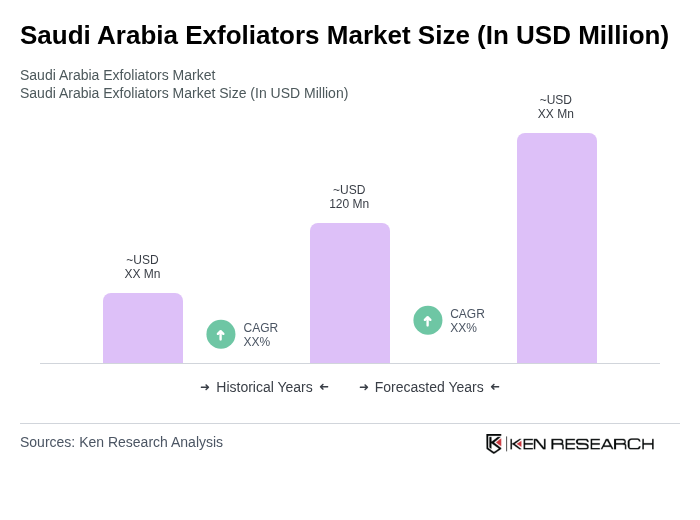
The Saudi Arabia exfoliators market, valued at USD 120 million, is growing due to rising skincare awareness, natural product demand, and innovations in chemical and enzymatic exfoliants.

Region:Middle East

Author(s):Geetanshi

Product Code:KRAD4816

Pages:82

Published On:December 2025
About the Report

Base Year 2024

Saudi Arabia Exfoliators Market Overview

  • The Saudi Arabia Exfoliators Market is valued at USD 120 million, based on a five-year historical analysis and triangulation with regional skincare and body scrub category data for the Middle East and Saudi Arabia. This growth is primarily driven by increasing consumer awareness regarding skincare, the rising popularity of beauty and personal care products, and the influence of social media and beauty influencers on skincare routines and trends. The market has seen a surge in demand for exfoliating products as consumers seek effective solutions for skin rejuvenation, brightening, and maintenance, including facial serums and scrubs with exfoliating actives.
  • Key cities such as Riyadh, Jeddah, and Dammam dominate the Saudi Arabia Exfoliators Market due to their high population density, higher disposable incomes, and concentration of modern retail outlets, pharmacies, and beauty specialty stores. These urban centers are also home to a growing number of beauty salons, aesthetic clinics, and dermatology practices, which further drive the demand for exfoliating products as part of professional and at-home skincare regimens. The affluent and increasingly beauty-conscious consumer base in these cities is investing more in premium and dermocosmetic skincare products, including exfoliating serums, masks, and scrubs, thereby contributing to market growth.
  • In 2023, the Saudi government implemented regulations to ensure the safety and efficacy of cosmetic products, including exfoliators, under the updated framework of the Saudi Food and Drug Authority (SFDA) and the technical regulation “SFDA.CO/GSO 1943:2021 – Safety Requirements of Cosmetics and Personal Care Products,” issued by the Saudi Food and Drug Authority. This regulation mandates that all skincare products undergo safety assessment, ingredient review, labeling compliance, and notification/registration through the SFDA electronic system before entering the market, with specific requirements on banned and restricted substances, heavy metals, and microbiological limits. The initiative aims to protect consumers and promote the use of safe and effective skincare solutions, thereby enhancing the overall quality and traceability of exfoliating products available in the Saudi market and aligning them with Gulf-wide cosmetic safety standards.
Saudi Arabia Exfoliators Market Size

Saudi Arabia Exfoliators Market Segmentation

By Product Form:The product form segmentation includes various types of exfoliators that cater to different consumer preferences and needs. The subsegments are Scrubs (gel, cream, and foaming scrubs), Peeling Solutions and Toners (AHA/BHA/PHA liquids), Masks and Peels (wash-off and peel-off), Pads, Wipes, and Sheets, and Others (sticks, powders, and multi-step kits). Among these, scrubs are currently dominating the market in mass and body-care channels due to their immediate visible results, sensorial experience, and ease of use, appealing to a wide range of consumers, while liquid peeling solutions and exfoliating serums are gaining share in facial skincare and dermocosmetic segments.
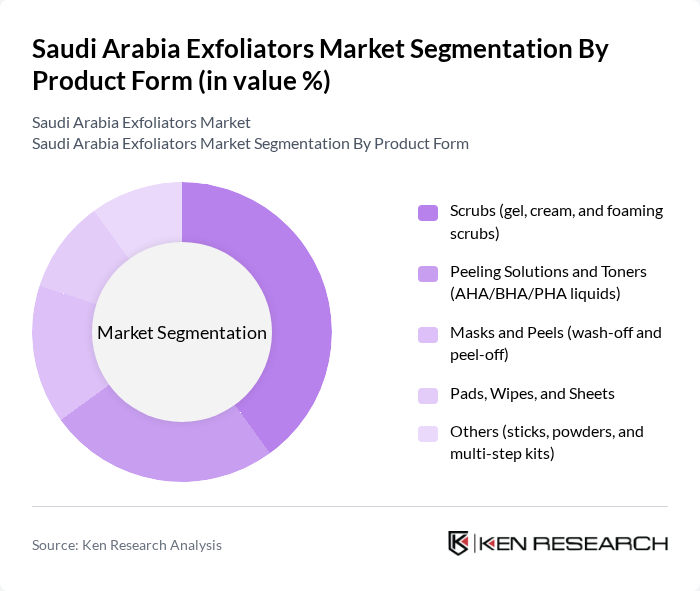
Saudi Arabia Exfoliators Market segmentation by Product Form.

By Exfoliation Mechanism:This segmentation focuses on the different methods used for exfoliation, which include Physical Exfoliators (scrubs, brushes, microbeads-free granules), Chemical Exfoliators (AHA, BHA, PHA), Enzymatic Exfoliators (fruit and botanical enzymes), and Combination / Hybrid Exfoliators. Chemical exfoliators are leading this segment within facial skincare due to their effectiveness in providing deeper skin renewal, targeting acne, pigmentation, and anti?aging concerns, and catering to various skin types through different acid strengths and pH levels, making them a preferred choice among informed consumers and dermatologists.
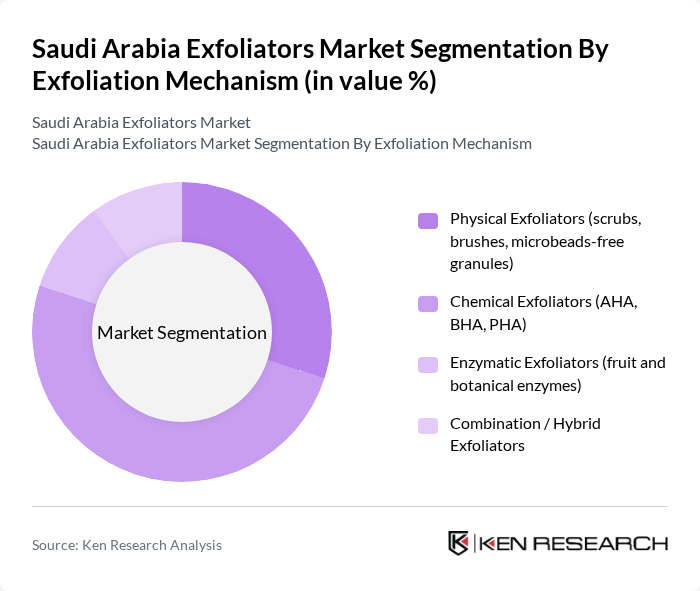
Saudi Arabia Exfoliators Market segmentation by Exfoliation Mechanism.

Saudi Arabia Exfoliators Market Competitive Landscape

The Saudi Arabia Exfoliators Market is characterized by a dynamic mix of regional and international players. Leading participants such as L'Oréal Middle East FZE (including brands such as L'Oréal Paris, Garnier, CeraVe, La Roche-Posay), Binzagr Lever Ltd (Unilever Arabia – including Dove, Pond's, St. Ives, Simple), Procter & Gamble Saudi Arabia (including Olay, SK-II), Beiersdorf AG (including Nivea, Eucerin), Estée Lauder Companies Inc. (including Clinique, Estée Lauder, Origins), Johnson & Johnson Consumer Saudi Arabia Ltd (including Neutrogena, Aveeno), Shiseido Middle East (including Shiseido, Anessa), The Body Shop Saudi Arabia (The Body Shop – through local franchise partners), Galderma Middle East (including Cetaphil, Benzac), Cantabria Labs / IFC Dermatology (including Heliocare, Neoretin), Beesline Apitherapy (Beesline – natural dermocosmetics), Revox B77 (Revox – active-ingredient-based skincare), Al-Dawaa Pharmacy Group (private label exfoliating and skincare lines), Nahdi Medical Company (Nahdi – private label dermocosmetic exfoliators), Modern Products Company / Biotech Gulf (regional distributor and brand owner for skincare and exfoliator lines) contribute to innovation, geographic expansion, and service delivery in this space.

L'Oréal Middle East FZE

2000

Dubai, UAE

Binzagr Lever Ltd

1954

Jeddah, Saudi Arabia

Procter & Gamble Saudi Arabia

1963

Jeddah, Saudi Arabia

Beiersdorf AG

1882

Hamburg, Germany

Estée Lauder Companies Inc.

1946

New York, USA

Company

Establishment Year

Headquarters

Presence in Saudi Arabia (years active and legal entity / distributor setup)

Exfoliator Portfolio Breadth (number of SKUs and formats)

Share of Exfoliators in Saudi Skincare Revenue Mix

Retail Footprint (number of doors and pharmacy / specialty listings)

E-commerce Performance (online share, ratings, and reviews count)

Revenue Growth Rate in Saudi Arabia Exfoliators Segment

Saudi Arabia Exfoliators Market Industry Analysis

Growth Drivers

  • Increasing Consumer Awareness about Skincare:The skincare market in Saudi Arabia is projected to reach SAR 5.5 billion in future, driven by heightened consumer awareness. This awareness is fueled by educational campaigns and increased access to information through digital platforms. As consumers become more informed about skincare benefits, the demand for exfoliators, which play a crucial role in skin health, is expected to rise significantly, contributing to overall market growth.
  • Rising Demand for Natural and Organic Products:The natural and organic skincare segment in Saudi Arabia is anticipated to grow to SAR 1.2 billion in future. This trend is largely driven by consumers' preference for products free from harmful chemicals. The increasing availability of organic ingredients and the growing number of brands offering natural exfoliators are key factors that support this demand, aligning with global trends towards sustainability and health-conscious choices.
  • Growth of the Beauty and Personal Care Industry:The beauty and personal care industry in Saudi Arabia is expected to expand to SAR 30 billion in future. This growth is attributed to rising disposable incomes and changing lifestyles, which encourage spending on personal grooming. As the industry flourishes, exfoliators are becoming essential products, with consumers seeking effective solutions for skin rejuvenation, thus driving market demand and innovation in formulations.

Market Challenges

  • High Competition among Local and International Brands:The Saudi exfoliators market faces intense competition, with over 150 brands vying for market share. This saturation leads to price wars and challenges in brand differentiation. Local brands struggle to compete with established international players who have greater resources for marketing and product development, making it difficult for new entrants to gain traction in this competitive landscape.
  • Regulatory Hurdles and Compliance Issues:The regulatory environment in Saudi Arabia poses significant challenges for exfoliator manufacturers. Compliance with the Saudi Food and Drug Authority (SFDA) regulations requires extensive documentation and testing, which can delay product launches. In future, it is estimated that compliance costs could account for up to 15% of total production expenses, impacting profitability and market entry for smaller companies.

Saudi Arabia Exfoliators Market Future Outlook

The Saudi Arabia exfoliators market is poised for dynamic growth, driven by evolving consumer preferences and technological advancements in product formulations. As consumers increasingly seek personalized skincare solutions, brands are likely to invest in research and development to create innovative products that cater to specific skin types. Additionally, the rise of e-commerce platforms will facilitate broader access to exfoliators, enhancing market penetration and consumer engagement in the coming years.

Market Opportunities

  • Expansion of E-commerce Platforms:The e-commerce sector in Saudi Arabia is projected to reach SAR 20 billion in future, providing a significant opportunity for exfoliator brands. Online sales channels allow for direct consumer engagement and targeted marketing strategies, enabling brands to reach a wider audience and enhance customer loyalty through personalized shopping experiences.
  • Introduction of Innovative Product Formulations:The demand for innovative exfoliator formulations, such as enzyme-based and chemical exfoliants, is on the rise. With the market expected to see a 25% increase in product launches in future, brands that invest in research and development to create unique, effective products will likely capture significant market share and meet evolving consumer needs.

Scope of the Report

SegmentSub-Segments
By Product Form

Scrubs (gel, cream, and foaming scrubs)

Peeling Solutions and Toners (AHA/BHA/PHA liquids)

Masks and Peels (wash-off and peel-off)

Pads, Wipes, and Sheets

Others (sticks, powders, and multi-step kits)

By Exfoliation Mechanism

Physical Exfoliators (scrubs, brushes, microbeads-free granules)

Chemical Exfoliators (AHA, BHA, PHA)

Enzymatic Exfoliators (fruit and botanical enzymes)

Combination / Hybrid Exfoliators

By Skin Type / Concern

Dry and Sensitive Skin

Oily and Acne-Prone Skin

Normal and Combination Skin

Hyperpigmentation / Brightening-Focused

Anti-Aging / Texture-Refining

By End-User

Women

Men

Unisex / Family Use

Professional Use (salons, spas, dermatology clinics)

By Distribution Channel

Modern Trade (hypermarkets, supermarkets)

Specialty Beauty and Pharmacy Retail

Brand-Owned Stores and Clinics

E-commerce Marketplaces

Direct-to-Consumer (D2C) Online Channels

Others (duty-free, salons’ retail corners, informal channels)

By Ingredient Positioning

Natural and Botanical-Based Exfoliators

Clean / Dermatologist-Recommended (dermocosmetic)

Conventional / Synthetic Actives

Halal-Certified and Alcohol-Free

By Price Tier

Mass / Economy

Masstige / Mid-Range

Premium

Prestige and Luxury

Key Target Audience

Investors and Venture Capitalist Firms

Government and Regulatory Bodies (e.g., Saudi Food and Drug Authority, Ministry of Health)

Manufacturers and Producers

Distributors and Retailers

Beauty and Personal Care Brands

Raw Material Suppliers

Industry Associations (e.g., Saudi Cosmetic and Personal Care Association)

Financial Institutions

Players Mentioned in the Report:

L'Oreal Middle East FZE (including brands such as L'Oreal Paris, Garnier, CeraVe, La Roche-Posay)

Binzagr Lever Ltd (Unilever Arabia including Dove, Pond's, St. Ives, Simple)

Procter & Gamble Saudi Arabia (including Olay, SK-II)

Beiersdorf AG (including Nivea, Eucerin)

Estee Lauder Companies Inc. (including Clinique, Estee Lauder, Origins)

Johnson & Johnson Consumer Saudi Arabia Ltd (including Neutrogena, Aveeno)

Shiseido Middle East (including Shiseido, Anessa)

The Body Shop Saudi Arabia (The Body Shop through local franchise partners)

Galderma Middle East (including Cetaphil, Benzac)

Cantabria Labs / IFC Dermatology (including Heliocare, Neoretin)

Beesline Apitherapy (Beesline natural dermocosmetics)

Revox B77 (Revox active-ingredient-based skincare)

Al-Dawaa Pharmacy Group (private label exfoliating and skincare lines)

Nahdi Medical Company (Nahdi private label dermocosmetic exfoliators)

Modern Products Company / Biotech Gulf (regional distributor and brand owner for skincare and exfoliator lines)

Table of Contents

Market Assessment Phase

1. Executive Summary and Approach


2. Saudi Arabia Exfoliators Market Overview

2.1 Key Insights and Strategic Recommendations

2.2 Saudi Arabia Exfoliators Market Overview

2.3 Definition and Scope

2.4 Evolution of Market Ecosystem

2.5 Timeline of Key Regulatory Milestones

2.6 Value Chain & Stakeholder Mapping

2.7 Business Cycle Analysis

2.8 Policy & Incentive Landscape


3. Saudi Arabia Exfoliators Market Analysis

3.1 Growth Drivers

3.1.1 Increasing consumer awareness about skincare
3.1.2 Rising demand for natural and organic products
3.1.3 Growth of the beauty and personal care industry
3.1.4 Influence of social media and beauty influencers

3.2 Market Challenges

3.2.1 High competition among local and international brands
3.2.2 Regulatory hurdles and compliance issues
3.2.3 Fluctuating raw material prices
3.2.4 Consumer skepticism towards product efficacy

3.3 Market Opportunities

3.3.1 Expansion of e-commerce platforms
3.3.2 Introduction of innovative product formulations
3.3.3 Collaborations with dermatologists and skincare experts
3.3.4 Growing interest in sustainable and eco-friendly products

3.4 Market Trends

3.4.1 Shift towards multi-functional skincare products
3.4.2 Increasing popularity of DIY skincare solutions
3.4.3 Rise in subscription-based beauty services
3.4.4 Focus on personalized skincare regimens

3.5 Government Regulation

3.5.1 Implementation of safety and quality standards
3.5.2 Regulations on labeling and advertising
3.5.3 Import tariffs on cosmetic ingredients
3.5.4 Guidelines for natural and organic product claims

4. SWOT Analysis


5. Stakeholder Analysis


6. Porter's Five Forces Analysis


7. Saudi Arabia Exfoliators Market Market Size, 2019-2024

7.1 By Value

7.2 By Volume

7.3 By Average Selling Price


8. Saudi Arabia Exfoliators Market Segmentation

8.1 By Product Form

8.1.1 Scrubs (gel, cream, and foaming scrubs)
8.1.2 Peeling Solutions and Toners (AHA/BHA/PHA liquids)
8.1.3 Masks and Peels (wash-off and peel-off)
8.1.4 Pads, Wipes, and Sheets
8.1.5 Others (sticks, powders, and multi-step kits)

8.2 By Exfoliation Mechanism

8.2.1 Physical Exfoliators (scrubs, brushes, microbeads-free granules)
8.2.2 Chemical Exfoliators (AHA, BHA, PHA)
8.2.3 Enzymatic Exfoliators (fruit and botanical enzymes)
8.2.4 Combination / Hybrid Exfoliators

8.3 By Skin Type / Concern

8.3.1 Dry and Sensitive Skin
8.3.2 Oily and Acne-Prone Skin
8.3.3 Normal and Combination Skin
8.3.4 Hyperpigmentation / Brightening-Focused
8.3.5 Anti-Aging / Texture-Refining

8.4 By End-User

8.4.1 Women
8.4.2 Men
8.4.3 Unisex / Family Use
8.4.4 Professional Use (salons, spas, dermatology clinics)

8.5 By Distribution Channel

8.5.1 Modern Trade (hypermarkets, supermarkets)
8.5.2 Specialty Beauty and Pharmacy Retail
8.5.3 Brand-Owned Stores and Clinics
8.5.4 E-commerce Marketplaces
8.5.5 Direct-to-Consumer (D2C) Online Channels
8.5.6 Others (duty-free, salons’ retail corners, informal channels)

8.6 By Ingredient Positioning

8.6.1 Natural and Botanical-Based Exfoliators
8.6.2 Clean / Dermatologist-Recommended (dermocosmetic)
8.6.3 Conventional / Synthetic Actives
8.6.4 Halal-Certified and Alcohol-Free

8.7 By Price Tier

8.7.1 Mass / Economy
8.7.2 Masstige / Mid-Range
8.7.3 Premium
8.7.4 Prestige and Luxury

9. Saudi Arabia Exfoliators Market Competitive Analysis

9.1 Market Share of Key Players

9.2 Cross Comparison of Key Players

9.2.1 Company Name
9.2.2 Presence in Saudi Arabia (years active and legal entity / distributor setup)
9.2.3 Exfoliator Portfolio Breadth (number of SKUs and formats)
9.2.4 Share of Exfoliators in Saudi Skincare Revenue Mix
9.2.5 Retail Footprint (number of doors and pharmacy / specialty listings)
9.2.6 E-commerce Performance (online share, ratings, and reviews count)
9.2.7 Revenue Growth Rate in Saudi Arabia Exfoliators Segment
9.2.8 Average Selling Price Positioning (mass, masstige, premium, luxury)
9.2.9 Marketing and Influencer Spend Intensity
9.2.10 New Product Launch Frequency (Saudi-relevant SKUs per year)
9.2.11 Dermatologist & Clinic Partnerships (number and depth of tie-ups)
9.2.12 Compliance & Certification Profile (SFDA approvals, halal/clean claims)

9.3 SWOT Analysis of Top Players

9.4 Pricing Analysis

9.5 Detailed Profile of Major Companies

9.5.1 L'Oréal Middle East FZE (including brands such as L'Oréal Paris, Garnier, CeraVe, La Roche-Posay)
9.5.2 Binzagr Lever Ltd (Unilever Arabia – including Dove, Pond's, St. Ives, Simple)
9.5.3 Procter & Gamble Saudi Arabia (including Olay, SK-II)
9.5.4 Beiersdorf AG (including Nivea, Eucerin)
9.5.5 Estée Lauder Companies Inc. (including Clinique, Estée Lauder, Origins)
9.5.6 Johnson & Johnson Consumer Saudi Arabia Ltd (including Neutrogena, Aveeno)
9.5.7 Shiseido Middle East (including Shiseido, Anessa)
9.5.8 The Body Shop Saudi Arabia (The Body Shop – through local franchise partners)
9.5.9 Galderma Middle East (including Cetaphil, Benzac)
9.5.10 Cantabria Labs / IFC Dermatology (including Heliocare, Neoretin)
9.5.11 Beesline Apitherapy (Beesline – natural dermocosmetics)
9.5.12 Revox B77 (Revox – active-ingredient-based skincare)
9.5.13 Al-Dawaa Pharmacy Group (private label exfoliating and skincare lines)
9.5.14 Nahdi Medical Company (Nahdi – private label dermocosmetic exfoliators)
9.5.15 Modern Products Company / Biotech Gulf (regional distributor and brand owner for skincare and exfoliator lines)

10. Saudi Arabia Exfoliators Market End-User Analysis

10.1 Procurement Behavior of Key Ministries

10.1.1 Government procurement policies
10.1.2 Budget allocation for skincare products
10.1.3 Supplier selection criteria
10.1.4 Contract management practices

10.2 Corporate Spend on Infrastructure & Energy

10.2.1 Investment in skincare infrastructure
10.2.2 Corporate partnerships with skincare brands
10.2.3 Spending trends in the beauty sector
10.2.4 Budgeting for employee wellness programs

10.3 Pain Point Analysis by End-User Category

10.3.1 Challenges faced by individual consumers
10.3.2 Issues in salon and spa operations
10.3.3 Concerns of dermatology clinics
10.3.4 Others

10.4 User Readiness for Adoption

10.4.1 Awareness of exfoliation benefits
10.4.2 Willingness to try new products
10.4.3 Accessibility of products
10.4.4 Others

10.5 Post-Deployment ROI and Use Case Expansion

10.5.1 Measuring effectiveness of exfoliators
10.5.2 Customer feedback and product improvement
10.5.3 Expansion into new markets
10.5.4 Others

11. Saudi Arabia Exfoliators Market Future Size, 2025-2030

11.1 By Value

11.2 By Volume

11.3 By Average Selling Price


Go-To-Market Strategy Phase

1. Whitespace Analysis + Business Model Canvas

1.1 Market gaps identification

1.2 Business model development


2. Marketing and Positioning Recommendations

2.1 Branding strategies

2.2 Product USPs


3. Distribution Plan

3.1 Urban retail vs rural NGO tie-ups


4. Channel & Pricing Gaps

4.1 Underserved routes

4.2 Pricing bands


5. Unmet Demand & Latent Needs

5.1 Category gaps

5.2 Consumer segments


6. Customer Relationship

6.1 Loyalty programs

6.2 After-sales service


7. Value Proposition

7.1 Sustainability

7.2 Integrated supply chains


8. Key Activities

8.1 Regulatory compliance

8.2 Branding

8.3 Distribution setup


9. Entry Strategy Evaluation

9.1 Domestic Market Entry Strategy

9.1.1 Product mix
9.1.2 Pricing band
9.1.3 Packaging

9.2 Export Entry Strategy

9.2.1 Target countries
9.2.2 Compliance roadmap

10. Entry Mode Assessment

10.1 JV

10.2 Greenfield

10.3 M&A

10.4 Distributor Model


11. Capital and Timeline Estimation

11.1 Capital requirements

11.2 Timelines


12. Control vs Risk Trade-Off

12.1 Ownership vs Partnerships


13. Profitability Outlook

13.1 Breakeven analysis

13.2 Long-term sustainability


14. Potential Partner List

14.1 Distributors

14.2 JVs

14.3 Acquisition targets


15. Execution Roadmap

15.1 Phased Plan for Market Entry

15.1.1 Market Setup
15.1.2 Market Entry
15.1.3 Growth Acceleration
15.1.4 Scale & Stabilize

15.2 Key Activities and Milestones

15.2.1 Milestone tracking
15.2.2 Activity scheduling

Research Methodology

ApproachModellingSample

Phase 1: Approach1

Desk Research

  • Analysis of market reports from industry associations and trade publications specific to the exfoliators market in Saudi Arabia
  • Review of government publications and statistics related to cosmetics and personal care products
  • Examination of consumer behavior studies and trends in skincare preferences within the region

Primary Research

  • Interviews with product development managers at leading skincare brands operating in Saudi Arabia
  • Surveys conducted with beauty consultants and dermatologists to gather insights on exfoliator usage and recommendations
  • Focus group discussions with consumers to understand preferences, purchasing behavior, and brand loyalty in exfoliators

Validation & Triangulation

  • Cross-validation of findings through comparison with international market trends and local consumer insights
  • Triangulation of data from primary interviews, surveys, and secondary research sources
  • Sanity checks through expert reviews from industry veterans and market analysts

Phase 2: Market Size Estimation1

Top-down Assessment

  • Estimation of the total market size based on national beauty and personal care expenditure data
  • Segmentation of the market by product type, including physical and chemical exfoliators
  • Incorporation of demographic factors influencing exfoliator consumption, such as age and gender

Bottom-up Modeling

  • Collection of sales data from key retailers and e-commerce platforms selling exfoliators
  • Estimation of average price points for various exfoliator products across different distribution channels
  • Volume estimates based on consumer purchase frequency and product usage rates

Forecasting & Scenario Analysis

  • Utilization of time series analysis to project future market growth based on historical data
  • Scenario modeling considering factors such as economic conditions, regulatory changes, and shifts in consumer preferences
  • Development of multiple growth scenarios (baseline, optimistic, and pessimistic) through 2030

Phase 3: CATI Sample Composition1

Scope Item/SegmentSample SizeTarget Respondent Profiles
Consumer Preferences in Exfoliators150Skincare Enthusiasts, General Consumers
Retail Insights on Exfoliator Sales100Store Managers, Beauty Advisors
Dermatological Recommendations80Dermatologists, Skincare Specialists
Market Trends from E-commerce Platforms120E-commerce Managers, Digital Marketing Specialists
Brand Perception Studies90Brand Managers, Marketing Executives

Frequently Asked Questions

What is the current value of the Saudi Arabia Exfoliators Market?

The Saudi Arabia Exfoliators Market is valued at approximately USD 120 million, reflecting a growing demand for skincare products driven by consumer awareness and trends influenced by social media and beauty influencers.

What factors are driving the growth of the exfoliators market in Saudi Arabia?

Which cities are the main hubs for the Saudi Arabia Exfoliators Market?

What types of exfoliators are popular in Saudi Arabia?

Other Regional/Country Reports

Bahrain Exfoliators Market

Indonesia Exfoliators Market

Malaysia Exfoliators Market

KSA Exfoliators Market

APAC Exfoliators Market

SEA Exfoliators Market

Why Buy From Us?

Refine Robust Result (RRR) Framework

What makes us stand out is that our consultants follow Robust, Refine and Result (RRR) methodology. Robust for clear definitions, approaches and sanity checking, Refine for differentiating respondents' facts and opinions, and Result for presenting data with story.

Our Reach Is Unmatched

We have set a benchmark in the industry by offering our clients with syndicated and customized market research reports featuring coverage of entire market as well as meticulous research and analyst insights.

Shifting the Research Paradigm

While we don't replace traditional research, we flip the method upside down. Our dual approach of Top Bottom & Bottom Top ensures quality deliverable by not just verifying company fundamentals but also looking at the sector and macroeconomic factors.

More Insights-Better Decisions

With one step in the future, our research team constantly tries to show you the bigger picture. We help with some of the tough questions you may encounter along the way: How is the industry positioned? Best marketing channel? KPI's of competitors? By aligning every element, we help maximize success.

Transparency and Trust

Our report gives you instant access to the answers and sources that other companies might choose to hide. We elaborate each steps of research methodology we have used and showcase you the sample size to earn your trust.

Round the Clock Support

If you need any support, we are here! We pride ourselves on universe strength, data quality, and quick, friendly, and professional service.

Why Clients Choose Us?

400000+
Reports in repository
150+
Consulting projects a year
100+
Analysts
8000+
Client Queries in 2022








