About the Report
Base Year 2024Saudi Arabia Pacific Carbon Dioxide Market Overview
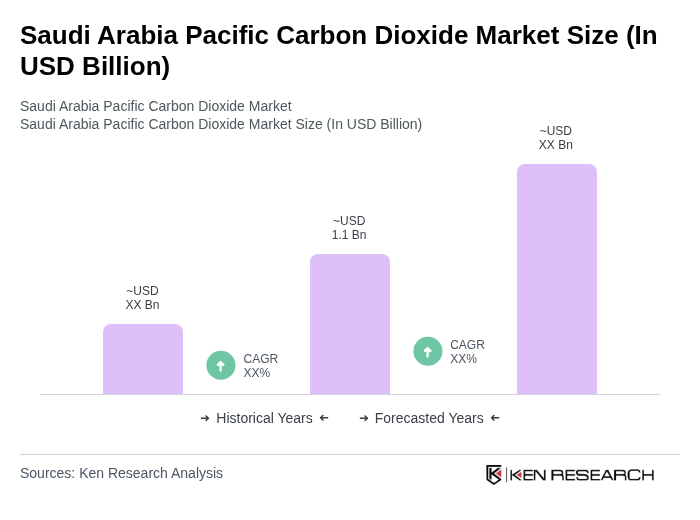
- The Saudi Arabia Pacific Carbon Dioxide Market is valued at USD 1.1 billion, based on a five-year historical analysis. This growth is primarily driven by increasing industrial activities, particularly in the oil and gas sector, and the rising demand for carbon dioxide in food and beverage applications, where carbonation, modified atmosphere packaging, and cold-chain logistics are key use cases. The market is also supported by government initiatives under Vision 2030 and the Saudi Green Initiative, which emphasize emissions reduction, large-scale carbon capture, utilization and storage (CCUS), and low?carbon industrial development.
- Key players in this market include major cities such as Riyadh, Jeddah, and Dammam, which dominate due to their strategic locations and robust industrial infrastructure. These cities are home to significant oil and gas operations, petrochemical complexes, industrial gases production, and food processing industries, all of which contribute to the high demand for carbon dioxide.
- In 2023, the Saudi Arabian government strengthened climate and industrial policy frameworks aligned with its nationally determined contribution (NDC) under the Paris Agreement, targeting annual reductions, avoidance, and removal of greenhouse gas emissions amounting to hundreds of millions of tons of CO? equivalent by 2040 from a 2019 baseline. Within this context, instruments such as the updated Nationally Determined Contribution submitted to the UNFCCC by the Government of Saudi Arabia in 2023, and implementation of Vision 2030 programs, encourage industries to deploy carbon capture, utilization, and storage technologies, thereby supporting additional demand for carbon dioxide in applications including enhanced oil recovery, urea and methanol production, beverages, and cold-chain preservation.
Saudi Arabia Pacific Carbon Dioxide Market Segmentation
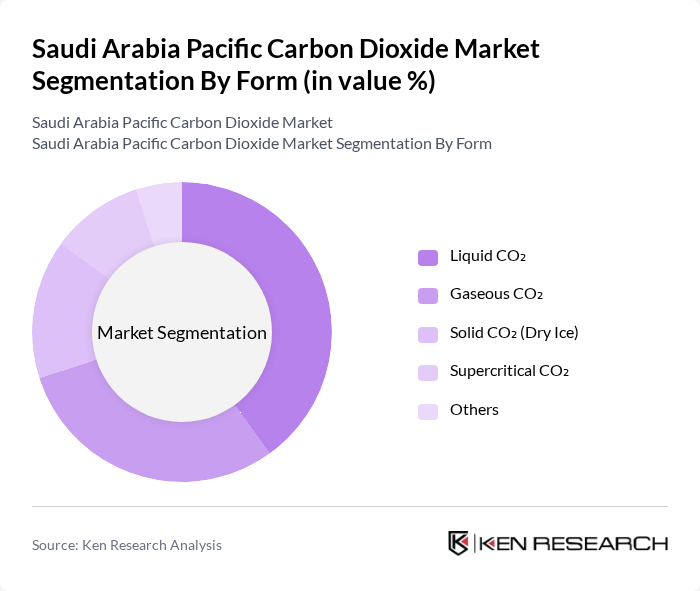
By Form:The market is segmented into various forms of carbon dioxide, including liquid, gaseous, solid (dry ice), supercritical, and others. Each form serves different industrial applications, with liquid CO? being widely used in food and beverage carbonation, pH control, and as a process gas in chemical and petrochemical facilities, while solid CO? is essential for refrigeration, cold chain logistics, and temperature?sensitive pharmaceutical and vaccine distribution. Gaseous CO? is primarily utilized in enhanced oil recovery processes, welding and metal fabrication, and as a shielding or inerting gas in various industrial operations.
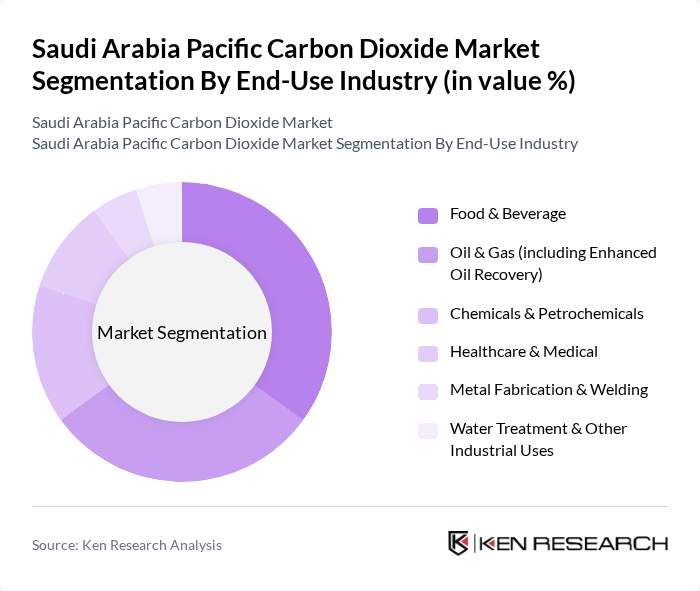
By End-Use Industry:The carbon dioxide market is further segmented by end-use industries, including food and beverage, oil and gas (including enhanced oil recovery), chemicals and petrochemicals, healthcare and medical, metal fabrication and welding, and water treatment. The food and beverage sector is a significant consumer due to carbonation in soft drinks and packaged water, modified atmosphere packaging for meat and fresh produce, and use in cold storage. The oil and gas industry utilizes CO? for enhanced oil recovery techniques and reservoir pressure maintenance, while the chemicals and petrochemicals segment consumes CO? in urea, methanol, and other synthesis processes. In healthcare and medical applications, high?purity CO? is used for minimally invasive surgeries, respiratory stimulation, and medical-grade dry ice, whereas metal fabrication relies on CO? for welding shielding gases, and water treatment uses CO? for pH control and remineralization in desalination and industrial water systems.
Saudi Arabia Pacific Carbon Dioxide Market Competitive Landscape
The Saudi Arabia Pacific Carbon Dioxide Market is characterized by a dynamic mix of regional and international players. Leading participants such as Saudi Aramco, SABIC, National Industrial Gases Company (GASCO), Air Products Qudra, Linde plc, Gulf Cryo, Air Liquide, Praxair Technology, Inc. (Linde), BOC Group (Linde), TAQA (Industrialization & Energy Services Company), Ma’aden (Saudi Arabian Mining Company), Al-Jubail Petrochemical Company (JUPC), The Dow Chemical Company, Occidental Petroleum Corporation, Carbon Clean Solutions contribute to innovation, geographic expansion, and service delivery in this space.
Saudi Arabia Pacific Carbon Dioxide Market Industry Analysis
Growth Drivers
- Increasing Industrial Demand for Carbon Dioxide:The industrial sector in Saudi Arabia is projected to consume approximately 1.5 million tons of carbon dioxide in future, driven by the food and beverage industry, which alone accounts for 60% of this demand. The growth in sectors such as oil refining and chemical manufacturing further fuels this trend, as companies seek to enhance production efficiency and reduce emissions. This rising demand is a significant driver for the carbon dioxide market in the region.
- Government Initiatives for Carbon Capture and Storage:The Saudi government has announced large-scale carbon capture and storage (CCS) initiatives, including plans centered around the Jubail Hub that aim to capture up to 44 million tons of CO2 annually in future as part of its net-zero strategy. This initiative aligns with Vision 2030, which emphasizes sustainability and environmental responsibility. The establishment of regulatory frameworks and financial incentives for CCS technologies is expected to bolster market growth, making it a key driver in the carbon dioxide sector.
- Rising Awareness of Environmental Sustainability:With a growing population of about 36 million people in Saudi Arabia, awareness of environmental issues is increasing, leading to a demand for sustainable practices. In future, a substantial share of consumers in Saudi Arabia is expected to prefer products from companies with sustainable practices. This shift is prompting industries to adopt carbon dioxide utilization strategies, enhancing the market's growth as businesses strive to meet consumer expectations and regulatory requirements.
Market Challenges
- High Initial Investment Costs:The capital required for establishing carbon dioxide capture and utilization facilities is substantial, often reaching several hundred million USD for large-scale industrial CCS projects. This high initial investment poses a significant barrier for many companies, particularly small and medium enterprises, limiting their ability to enter the market. As a result, the financial burden can hinder the overall growth of the carbon dioxide market in Saudi Arabia.
- Regulatory Compliance Complexities:Navigating the regulatory landscape in Saudi Arabia can be challenging, with multiple environmental, industrial, and emissions-related regulations impacting carbon dioxide emissions and utilization. Companies must invest considerable resources to ensure compliance, which can divert funds from innovation and operational efficiency. This complexity can deter new entrants and slow down the adoption of carbon dioxide technologies, posing a challenge to market growth.
Saudi Arabia Pacific Carbon Dioxide Market Future Outlook
The future of the Saudi Arabia Pacific Carbon Dioxide market appears promising, driven by increasing industrial demand and supportive government policies. As the nation invests in carbon capture technologies and sustainable practices, the market is expected to evolve significantly. The anticipated growth in renewable energy investments and the establishment of carbon trading markets will further enhance opportunities for innovation and collaboration, positioning Saudi Arabia as a leader in carbon dioxide utilization and sustainability efforts.
Market Opportunities
- Expansion of Carbon Dioxide Applications:The potential for carbon dioxide applications in sectors such as agriculture and enhanced oil recovery is significant. In future, the agricultural sector is expected to increasingly utilize CO2 for greenhouse cultivation, enhancing crop yields and sustainability. This expansion presents a lucrative opportunity for market players to diversify their offerings and tap into new revenue streams.
- Collaborations with International Firms:Partnerships with global technology leaders can facilitate knowledge transfer and innovation in carbon dioxide utilization. Saudi Arabia has announced several collaborations and memoranda of understanding with international energy and technology companies to advance carbon capture and related low-carbon technologies. In future, the country aims to expand such joint initiatives to enhance local capabilities and accelerate the adoption of advanced carbon capture technologies. This collaboration can significantly boost the market's growth potential and technological advancement.
Scope of the Report
| Segment | Sub-Segments |
|---|---|
| By Form | Liquid CO? Gaseous CO? Solid CO? (Dry Ice) Supercritical CO? Others |
| By End-Use Industry | Food & Beverage Oil & Gas (including Enhanced Oil Recovery) Chemicals & Petrochemicals Healthcare & Medical Metal Fabrication & Welding Water Treatment & Other Industrial Uses |
| By Application | Carbonation of Beverages Refrigeration, Cold Chain & Dry Ice Enhanced Oil Recovery & Reservoir Pressure Maintenance Greenhouse Agriculture & pH Control Carbon Capture, Utilization & Storage (CCUS) Others |
| By Source | Hydrogen-Based Production Ethyl Alcohol-Based Production Ethylene Oxide & Petrochemical Sources Substitute Natural Gas & Refinery Off-Gases Other Industrial Emissions & Natural Sources |
| By Delivery Mode | Tonnage Supply Bulk & Cylinder Supply Packaged Gases On-site Supply |
| By Region | Central Region Eastern Region Western Region Southern Region |
| By Quality Grade | Food Grade Industrial Grade Medical Grade Others |
Key Target Audience
Investors and Venture Capitalist Firms
Government and Regulatory Bodies (e.g., Saudi Arabian Ministry of Environment, Water and Agriculture)
Manufacturers and Producers of Carbon Capture Technologies
Energy Sector Companies
Environmental NGOs and Advocacy Groups
Carbon Trading Platforms and Exchanges
Infrastructure Development Agencies
Oil and Gas Industry Stakeholders
Players Mentioned in the Report:
Saudi Aramco
SABIC
National Industrial Gases Company (GASCO)
Air Products Qudra
Linde plc
Gulf Cryo
Air Liquide
Praxair Technology, Inc. (Linde)
BOC Group (Linde)
TAQA (Industrialization & Energy Services Company)
Maaden (Saudi Arabian Mining Company)
Al-Jubail Petrochemical Company (JUPC)
The Dow Chemical Company
Occidental Petroleum Corporation
Carbon Clean Solutions
Table of Contents
Market Assessment Phase
1. Executive Summary and Approach
2. Saudi Arabia Pacific Carbon Dioxide Market Overview
2.1 Key Insights and Strategic Recommendations
2.2 Saudi Arabia Pacific Carbon Dioxide Market Overview
2.3 Definition and Scope
2.4 Evolution of Market Ecosystem
2.5 Timeline of Key Regulatory Milestones
2.6 Value Chain & Stakeholder Mapping
2.7 Business Cycle Analysis
2.8 Policy & Incentive Landscape
3. Saudi Arabia Pacific Carbon Dioxide Market Analysis
3.1 Growth Drivers
3.1.1 Increasing industrial demand for carbon dioxide
3.1.2 Government initiatives for carbon capture and storage
3.1.3 Rising awareness of environmental sustainability
3.1.4 Technological advancements in carbon dioxide utilization
3.2 Market Challenges
3.2.1 High initial investment costs
3.2.2 Regulatory compliance complexities
3.2.3 Limited infrastructure for carbon dioxide distribution
3.2.4 Market competition from alternative solutions
3.3 Market Opportunities
3.3.1 Expansion of carbon dioxide applications in various industries
3.3.2 Collaborations with international firms for technology transfer
3.3.3 Development of carbon trading markets
3.3.4 Investment in research and development for innovative solutions
3.4 Market Trends
3.4.1 Growing focus on circular economy practices
3.4.2 Increasing investment in renewable energy sources
3.4.3 Adoption of carbon capture technologies
3.4.4 Shift towards sustainable industrial practices
3.5 Government Regulation
3.5.1 Implementation of carbon pricing mechanisms
3.5.2 Establishment of emission reduction targets
3.5.3 Incentives for carbon capture and storage projects
3.5.4 Regulations promoting sustainable industrial practices
4. SWOT Analysis
5. Stakeholder Analysis
6. Porter's Five Forces Analysis
7. Saudi Arabia Pacific Carbon Dioxide Market Market Size, 2019-2024
7.1 By Value
7.2 By Volume
7.3 By Average Selling Price
8. Saudi Arabia Pacific Carbon Dioxide Market Segmentation
8.1 By Form
8.1.1 Liquid CO?
8.1.2 Gaseous CO?
8.1.3 Solid CO? (Dry Ice)
8.1.4 Supercritical CO?
8.1.5 Others
8.2 By End-Use Industry
8.2.1 Food & Beverage
8.2.2 Oil & Gas (including Enhanced Oil Recovery)
8.2.3 Chemicals & Petrochemicals
8.2.4 Healthcare & Medical
8.2.5 Metal Fabrication & Welding
8.2.6 Water Treatment & Other Industrial Uses
8.3 By Application
8.3.1 Carbonation of Beverages
8.3.2 Refrigeration, Cold Chain & Dry Ice
8.3.3 Enhanced Oil Recovery & Reservoir Pressure Maintenance
8.3.4 Greenhouse Agriculture & pH Control
8.3.5 Carbon Capture, Utilization & Storage (CCUS)
8.3.6 Others
8.4 By Source
8.4.1 Hydrogen-Based Production
8.4.2 Ethyl Alcohol-Based Production
8.4.3 Ethylene Oxide & Petrochemical Sources
8.4.4 Substitute Natural Gas & Refinery Off-Gases
8.4.5 Other Industrial Emissions & Natural Sources
8.5 By Delivery Mode
8.5.1 Tonnage Supply
8.5.2 Bulk & Cylinder Supply
8.5.3 Packaged Gases
8.5.4 On-site Supply
8.6 By Region
8.6.1 Central Region
8.6.2 Eastern Region
8.6.3 Western Region
8.6.4 Southern Region
8.7 By Quality Grade
8.7.1 Food Grade
8.7.2 Industrial Grade
8.7.3 Medical Grade
8.7.4 Others
9. Saudi Arabia Pacific Carbon Dioxide Market Competitive Analysis
9.1 Market Share of Key Players
9.2 Cross Comparison of Key Players
9.2.1 Company Name
9.2.2 Group Size (Large, Medium, or Small as per industry convention)
9.2.3 Saudi Arabia CO? Revenue (Latest Fiscal Year, USD Million)
9.2.4 Saudi Arabia CO? Revenue CAGR (Last 3–5 Years, %)
9.2.5 EBITDA Margin from CO? Business (%)
9.2.6 Market Share in Saudi Arabia CO? Market (%)
9.2.7 Installed CO? Production / Capture Capacity (KTPA)
9.2.8 Capacity Utilization Rate (%)
9.2.9 Average Realized Price per Tonne (USD/tonne)
9.2.10 Capex Intensity (Capex / CO? Revenue, %)
9.2.11 R&D Spend Intensity for CO? & CCUS (% of Revenue)
9.2.12 Number of Long-term Offtake / Supply Contracts
9.2.13 Geographic & Sectoral Diversification Index
9.3 SWOT Analysis of Top Players
9.4 Pricing Analysis
9.5 Detailed Profile of Major Companies
9.5.1 Saudi Aramco
9.5.2 SABIC
9.5.3 National Industrial Gases Company (GASCO)
9.5.4 Air Products Qudra
9.5.5 Linde plc
9.5.6 Gulf Cryo
9.5.7 Air Liquide
9.5.8 Praxair Technology, Inc. (Linde)
9.5.9 BOC Group (Linde)
9.5.10 TAQA (Industrialization & Energy Services Company)
9.5.11 Ma’aden (Saudi Arabian Mining Company)
9.5.12 Al-Jubail Petrochemical Company (JUPC)
9.5.13 The Dow Chemical Company
9.5.14 Occidental Petroleum Corporation
9.5.15 Carbon Clean Solutions
10. Saudi Arabia Pacific Carbon Dioxide Market End-User Analysis
10.1 Procurement Behavior of Key Ministries
10.1.1 Ministry of Energy
10.1.2 Ministry of Environment, Water and Agriculture
10.1.3 Ministry of Industry and Mineral Resources
10.1.4 Others
10.2 Corporate Spend on Infrastructure & Energy
10.2.1 Investment in Carbon Capture Technologies
10.2.2 Budget Allocation for Sustainable Practices
10.2.3 Expenditure on Renewable Energy Projects
10.2.4 Others
10.3 Pain Point Analysis by End-User Category
10.3.1 Industrial Sector Challenges
10.3.2 Healthcare Sector Challenges
10.3.3 Agricultural Sector Challenges
10.3.4 Others
10.4 User Readiness for Adoption
10.4.1 Awareness of Carbon Dioxide Benefits
10.4.2 Financial Readiness
10.4.3 Technological Readiness
10.4.4 Others
10.5 Post-Deployment ROI and Use Case Expansion
10.5.1 Measurement of ROI in Industrial Applications
10.5.2 Expansion into New Markets
10.5.3 Long-term Sustainability Assessments
10.5.4 Others
11. Saudi Arabia Pacific Carbon Dioxide Market Future Size, 2025-2030
11.1 By Value
11.2 By Volume
11.3 By Average Selling Price
Go-To-Market Strategy Phase
1. Whitespace Analysis + Business Model Canvas
1.1 Market Gaps Identification
1.2 Business Model Development
2. Marketing and Positioning Recommendations
2.1 Branding Strategies
2.2 Product USPs
3. Distribution Plan
3.1 Urban Retail Strategies
3.2 Rural NGO Tie-ups
4. Channel & Pricing Gaps
4.1 Underserved Routes
4.2 Pricing Bands Analysis
5. Unmet Demand & Latent Needs
5.1 Category Gaps
5.2 Consumer Segments
6. Customer Relationship
6.1 Loyalty Programs
6.2 After-sales Service
7. Value Proposition
7.1 Sustainability Initiatives
7.2 Integrated Supply Chains
8. Key Activities
8.1 Regulatory Compliance
8.2 Branding Efforts
8.3 Distribution Setup
9. Entry Strategy Evaluation
9.1 Domestic Market Entry Strategy
9.1.1 Product Mix Considerations
9.1.2 Pricing Band Strategy
9.1.3 Packaging Solutions
9.2 Export Entry Strategy
9.2.1 Target Countries Identification
9.2.2 Compliance Roadmap Development
10. Entry Mode Assessment
10.1 Joint Ventures
10.2 Greenfield Investments
10.3 Mergers & Acquisitions
10.4 Distributor Model Evaluation
11. Capital and Timeline Estimation
11.1 Capital Requirements
11.2 Timelines for Implementation
12. Control vs Risk Trade-Off
12.1 Ownership Considerations
12.2 Partnerships Evaluation
13. Profitability Outlook
13.1 Breakeven Analysis
13.2 Long-term Sustainability Assessment
14. Potential Partner List
14.1 Distributors
14.2 Joint Ventures
14.3 Acquisition Targets
15. Execution Roadmap
15.1 Phased Plan for Market Entry
15.1.1 Market Setup
15.1.2 Market Entry
15.1.3 Growth Acceleration
15.1.4 Scale & Stabilize
15.2 Key Activities and Milestones
15.2.1 Milestone Planning
15.2.2 Activity Tracking
Research Methodology
Phase 1: Approach1
Desk Research
- Analysis of government publications and reports on carbon emissions and climate policies in Saudi Arabia
- Review of industry reports from environmental agencies and carbon market analysts
- Examination of academic journals and white papers focusing on carbon dioxide markets and sustainability initiatives
Primary Research
- Interviews with key stakeholders in the energy sector, including executives from oil and gas companies
- Surveys with environmental consultants and carbon market experts to gather insights on market dynamics
- Field interviews with regulatory bodies and policymakers involved in carbon trading frameworks
Validation & Triangulation
- Cross-validation of findings through multiple data sources, including trade statistics and market reports
- Triangulation of qualitative insights from interviews with quantitative data from market analysis
- Sanity checks conducted through expert panel reviews to ensure data accuracy and relevance
Phase 2: Market Size Estimation1
Top-down Assessment
- Estimation of the carbon dioxide market size based on national greenhouse gas emission targets and commitments
- Breakdown of market potential by sector, including industrial, transportation, and energy production
- Incorporation of international carbon pricing mechanisms and their impact on local market dynamics
Bottom-up Modeling
- Collection of firm-level data on carbon capture and storage (CCS) projects and their operational capacities
- Cost analysis of carbon offset projects and their financial viability in the Saudi market
- Volume estimates based on projected carbon emissions reductions and compliance requirements
Forecasting & Scenario Analysis
- Multi-factor regression analysis incorporating economic growth, energy transition trends, and regulatory changes
- Scenario modeling based on varying levels of government intervention and market adoption rates
- Development of baseline, optimistic, and pessimistic forecasts through 2030
Phase 3: CATI Sample Composition1
| Scope Item/Segment | Sample Size | Target Respondent Profiles |
|---|---|---|
| Energy Sector Carbon Management | 120 | Energy Analysts, Sustainability Managers |
| Industrial Emissions Reduction Strategies | 95 | Operations Managers, Environmental Compliance Officers |
| Government Policy Impact Assessment | 70 | Policy Makers, Regulatory Affairs Specialists |
| Carbon Trading and Offset Projects | 85 | Project Managers, Financial Analysts |
| Research Institutions and Academia | 55 | Researchers, Professors in Environmental Science |
Frequently Asked Questions
What is the current value of the Saudi Arabia Pacific Carbon Dioxide Market?
The Saudi Arabia Pacific Carbon Dioxide Market is valued at approximately USD 1.1 billion, driven by industrial activities, particularly in the oil and gas sector, and the demand for carbon dioxide in food and beverage applications.
What are the key drivers of growth in the Saudi Arabia Pacific Carbon Dioxide Market?
Which cities are major players in the Saudi Arabia Pacific Carbon Dioxide Market?
How does the Saudi government support the carbon dioxide market?
Other Regional/Country Reports
Indonesia Pacific Carbon Dioxide Market
Malaysia Pacific Carbon Dioxide Market
KSA Pacific Carbon Dioxide Market
APAC Pacific Carbon Dioxide Market
SEA Pacific Carbon Dioxide Market
Vietnam Pacific Carbon Dioxide Market
Other Adjacent Reports
Brazil Carbon Capture and Storage Market
Philippines Enhanced Oil Recovery Market
Global Petrochemicals Market Outlook to 2030South Korea Food and Beverage Packaging Market
Global Dry Ice Market Outlook 2030Mexico Welding Gases Market
United Arab Emirates Water Treatment Chemicals Market Report Size Share Growth Drivers Trends Opportunities & Forecast 2025–2030Middle East Medical Gases Market Size, Share, Growth Drivers, Trends, Opportunities & Forecast 2025–2030Kuwait Methanol Production Market
Why Buy From Us?

What makes us stand out is that our consultants follow Robust, Refine and Result (RRR) methodology. Robust for clear definitions, approaches and sanity checking, Refine for differentiating respondents' facts and opinions, and Result for presenting data with story.

We have set a benchmark in the industry by offering our clients with syndicated and customized market research reports featuring coverage of entire market as well as meticulous research and analyst insights.

While we don't replace traditional research, we flip the method upside down. Our dual approach of Top Bottom & Bottom Top ensures quality deliverable by not just verifying company fundamentals but also looking at the sector and macroeconomic factors.

With one step in the future, our research team constantly tries to show you the bigger picture. We help with some of the tough questions you may encounter along the way: How is the industry positioned? Best marketing channel? KPI's of competitors? By aligning every element, we help maximize success.

Our report gives you instant access to the answers and sources that other companies might choose to hide. We elaborate each steps of research methodology we have used and showcase you the sample size to earn your trust.

If you need any support, we are here! We pride ourselves on universe strength, data quality, and quick, friendly, and professional service.