Ksa Personal Lubricant Market Size, Share, Growth Drivers, Trends, Opportunities & Forecast 2025–2030

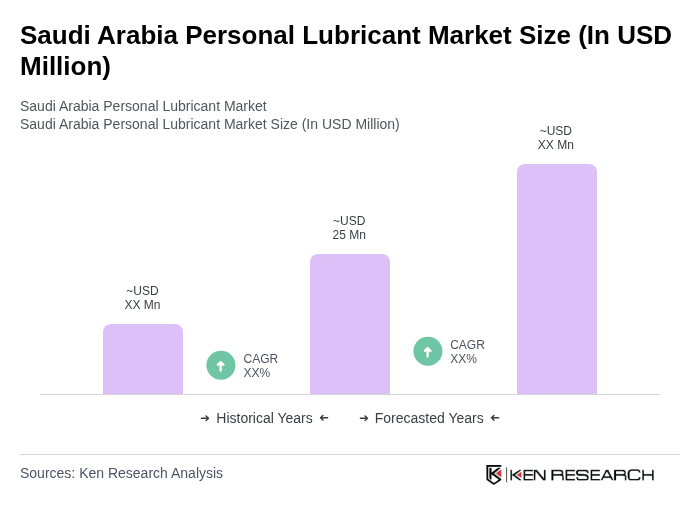
Saudi Arabia personal lubricant market, valued at USD 25 million, grows due to rising awareness, disposable incomes, and e-commerce, with dominance in Riyadh, Jeddah, and Dammam.

Region:Middle East

Author(s):Dev

Product Code:KRAD1725

Pages:94

Published On:November 2025
About the Report

Base Year 2024

Saudi Arabia Personal Lubricant Market Overview

  • The Saudi Arabia Personal Lubricant Market is valued at USD 25 million, based on a five-year historical analysis. This growth is primarily driven by increasing awareness of sexual health, rising disposable incomes, and a shift towards more open discussions about intimacy and sexual wellness among consumers. The market is also influenced by improved access to sexual health information and growing acceptance of personal lubricants for both wellness and medical purposes , .
  • Key cities such as Riyadh, Jeddah, and Dammam dominate the market due to their larger populations, urbanization, and higher purchasing power. These cities also have a more progressive attitude towards sexual wellness products, contributing to increased demand. The expansion of e-commerce and digital health platforms has further accelerated product accessibility in these urban centers .
  • In 2023, the Saudi government implemented regulations requiring all personal lubricants to be registered with the Saudi Food and Drug Authority (SFDA) before sale. This regulation aims to ensure product safety and efficacy, thereby enhancing consumer trust in personal lubricant products. The SFDA’s oversight includes mandatory compliance with safety, labeling, and quality standards for all lubricant products marketed in the country .
Saudi Arabia Personal Lubricant Market Size

Saudi Arabia Personal Lubricant Market Segmentation

By Type:The market is segmented into various types of lubricants, including water-based, silicone-based, oil-based, hybrid, and others such as specialty formulations. Water-based lubricants are currently the most popular due to their versatility, ease of use, and compatibility with condoms. Silicone-based lubricants are also gaining traction for their long-lasting properties, while oil-based options are preferred by some consumers for their natural feel. Specialty formulations, including warming and flavored lubricants, cater to niche markets, enhancing consumer experience.
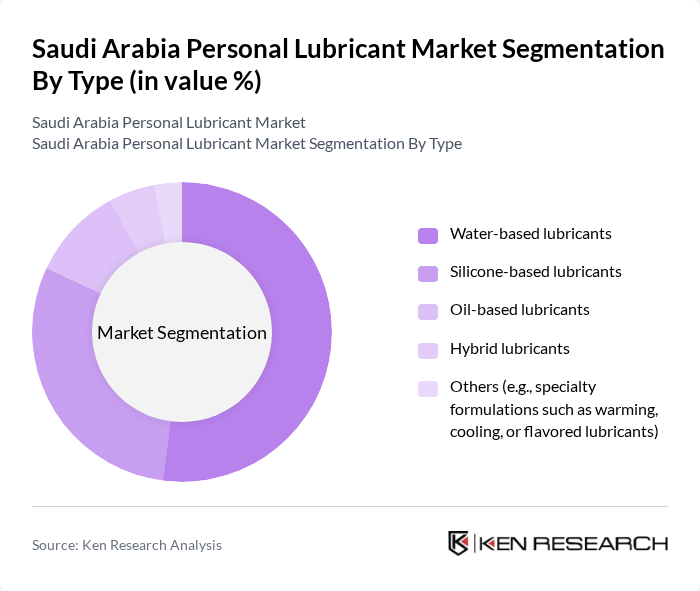
Saudi Arabia Personal Lubricant Market segmentation by Type.

By End-User:The end-user segmentation includes individual consumers, couples, healthcare professionals, and others such as wellness centers and pharmacies. Individual consumers represent the largest segment, driven by increasing awareness and acceptance of personal lubricants for enhancing sexual experiences. Couples also form a significant portion of the market, often seeking products to improve intimacy. Healthcare professionals are increasingly recommending lubricants for various medical conditions, further expanding the market. Wellness centers and pharmacies contribute to the market by providing access to a range of products.
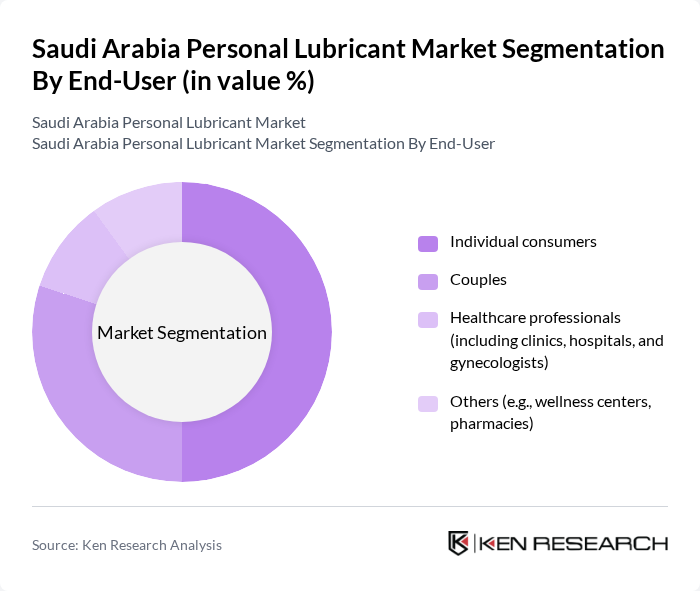
Saudi Arabia Personal Lubricant Market segmentation by End-User.

Saudi Arabia Personal Lubricant Market Competitive Landscape

The Saudi Arabia Personal Lubricant Market is characterized by a dynamic mix of regional and international players. Leading participants such as Durex (Reckitt Benckiser Group PLC), K-Y (Johnson & Johnson, now Reckitt Benckiser Group PLC), Astroglide (BioFilm Inc.), Pjur (pjur group Luxembourg S.A.), Wet (Trigg Laboratories, Inc.), ID Lubricants (Westridge Laboratories, Inc.), Sliquid (Sliquid, LLC), Good Clean Love (Good Clean Love, Inc.), System JO (United Consortium, Inc.), Lelo (LELOi AB), Kama Sutra (The Kama Sutra Company), Shunga (Shunga Erotic Art, Eau Zone Huiles & Fragrances Ltd.), Zestra (Innovus Pharmaceuticals, Inc.), Yes Organic (The Yes Yes Company Ltd.), Aloe Cadabra (Live Well Brands, Inc.), Überlube (Überlube, LLC), Lovehoney Group, Lifestyles Healthcare (LifeStyles Healthcare Pte Ltd.) contribute to innovation, geographic expansion, and service delivery in this space.

Durex

1929

Slough, United Kingdom

K-Y

1904

New Brunswick, New Jersey, USA

Astroglide

1991

Los Angeles, California, USA

Pjur

1995

Luxembourg City, Luxembourg

Wet

1980

Los Angeles, California, USA

Company

Establishment Year

Headquarters

Group Size (Large, Medium, or Small as per industry convention)

Revenue (USD million, Saudi Arabia)

Revenue Growth Rate (YoY %)

Market Share (%)

Market Penetration Rate (measured by number of retail/pharmacy points and online presence)

Distribution Channel Coverage (number and type of channels used)

Saudi Arabia Personal Lubricant Market Industry Analysis

Growth Drivers

  • Increasing Awareness of Sexual Health:The Saudi Arabian government has initiated various campaigns to promote sexual health awareness, leading to a notable increase in consumer education. In future, approximately 60% of the population is expected to have access to sexual health information, up from 45% in the past. This shift is crucial as it encourages individuals to consider personal lubricants as essential products for enhancing sexual well-being, thus driving market growth significantly.
  • Rising Disposable Income:The World Bank reports Saudi Arabia's GDP per capita is approximately USD 27,000, reflecting a steady increase in disposable income. As consumers have more financial resources, they are more likely to invest in personal care products, including lubricants. This trend is particularly evident among the younger demographic, who prioritize personal health and wellness, further propelling the demand for personal lubricants in the market.
  • Growth in E-commerce Platforms:The e-commerce sector in Saudi Arabia is estimated at over USD 12 billion, driven by increased internet penetration and smartphone usage. This growth facilitates easier access to personal lubricants, allowing consumers to purchase discreetly and conveniently. The rise of online retailing is crucial for expanding market reach, especially in urban areas where traditional retail options may be limited, thus enhancing overall market growth.

Market Challenges

  • Cultural Stigma Surrounding Personal Lubricants:Despite increasing awareness, cultural taboos regarding sexual health persist in Saudi Arabia. A survey indicated that 40% of individuals still feel uncomfortable discussing or purchasing personal lubricants openly. This stigma can hinder market penetration and limit the willingness of consumers to explore these products, posing a significant challenge for brands aiming to expand their customer base in the region.
  • Limited Distribution Channels:The distribution of personal lubricants in Saudi Arabia is often restricted to pharmacies and select retail outlets, which can limit consumer access. In future, it is estimated that only 30% of retail outlets will stock personal lubricants, compared to 50% for other personal care products. This limited availability can impede market growth, as consumers may not find these products easily, leading to missed sales opportunities for manufacturers.

Saudi Arabia Personal Lubricant Market Future Outlook

The Saudi Arabian personal lubricant market is poised for significant transformation, driven by evolving consumer attitudes and increasing health awareness. As the stigma surrounding sexual health continues to diminish, more individuals are likely to seek out personal lubricants. Additionally, the rise of e-commerce will facilitate broader access to these products, particularly among younger consumers. Companies that adapt to these trends and focus on product safety and natural ingredients will likely capture a larger market share, enhancing their competitive edge in the coming years.

Market Opportunities

  • Growth of Online Retailing:The expansion of online retailing presents a significant opportunity for personal lubricant brands. With e-commerce projected to grow rapidly, companies can leverage digital platforms to reach a wider audience, particularly in urban areas. This shift allows for targeted marketing strategies that can effectively engage consumers, ultimately driving sales and brand loyalty in the market.
  • Increasing Demand for Organic and Natural Products:As health-conscious consumers become more prevalent, the demand for organic and natural personal lubricants is expected to rise. In future, it is anticipated that 25% of consumers will prefer products made from natural ingredients. This trend offers manufacturers the chance to innovate and differentiate their offerings, catering to a growing segment of the market focused on sustainability and health.

Scope of the Report

SegmentSub-Segments
By Type

Water-based lubricants

Silicone-based lubricants

Oil-based lubricants

Hybrid lubricants

Others (e.g., specialty formulations such as warming, cooling, or flavored lubricants)

By End-User

Individual consumers

Couples

Healthcare professionals (including clinics, hospitals, and gynecologists)

Others (e.g., wellness centers, pharmacies)

By Distribution Channel

Online retail (e-commerce platforms, brand websites)

Pharmacies (chain and independent)

Supermarkets and hypermarkets

Specialty stores (sexual wellness, health stores)

Others (e.g., direct sales, clinics)

By Packaging Type

Bottles

Sachets

Tubes

Others (e.g., pump dispensers, single-use packs)

By Ingredient Type

Natural ingredients (e.g., aloe vera, plant-based)

Synthetic ingredients

Others (e.g., hybrid blends)

By Price Range

Premium

Mid-range

Economy

Others

By Brand Loyalty

Brand loyal consumers

Price-sensitive consumers

Others (e.g., first-time buyers, switchers)

Key Target Audience

Investors and Venture Capitalist Firms

Government and Regulatory Bodies (e.g., Saudi Food and Drug Authority, Ministry of Health)

Manufacturers and Producers

Distributors and Retailers

Pharmaceutical Companies

Health and Wellness Organizations

Industry Associations (e.g., Saudi Arabian Chemical Manufacturers Association)

Financial Institutions

Players Mentioned in the Report:

Durex (Reckitt Benckiser Group PLC)

K-Y (Johnson & Johnson, now Reckitt Benckiser Group PLC)

Astroglide (BioFilm Inc.)

Pjur (pjur group Luxembourg S.A.)

Wet (Trigg Laboratories, Inc.)

ID Lubricants (Westridge Laboratories, Inc.)

Sliquid (Sliquid, LLC)

Good Clean Love (Good Clean Love, Inc.)

System JO (United Consortium, Inc.)

Lelo (LELOi AB)

Kama Sutra (The Kama Sutra Company)

Shunga (Shunga Erotic Art, Eau Zone Huiles & Fragrances Ltd.)

Zestra (Innovus Pharmaceuticals, Inc.)

Yes Organic (The Yes Yes Company Ltd.)

Aloe Cadabra (Live Well Brands, Inc.)

Uberlube (Uberlube, LLC)

Lovehoney Group

Lifestyles Healthcare (LifeStyles Healthcare Pte Ltd.)

Table of Contents

Market Assessment Phase

1. Executive Summary and Approach


2. Saudi Arabia Personal Lubricant Market Overview

2.1 Key Insights and Strategic Recommendations

2.2 Saudi Arabia Personal Lubricant Market Overview

2.3 Definition and Scope

2.4 Evolution of Market Ecosystem

2.5 Timeline of Key Regulatory Milestones

2.6 Value Chain & Stakeholder Mapping

2.7 Business Cycle Analysis

2.8 Policy & Incentive Landscape


3. Saudi Arabia Personal Lubricant Market Analysis

3.1 Growth Drivers

3.1.1 Increasing awareness of sexual health
3.1.2 Rising disposable income
3.1.3 Growth in e-commerce platforms
3.1.4 Expanding product variety and availability

3.2 Market Challenges

3.2.1 Cultural stigma surrounding personal lubricants
3.2.2 Limited distribution channels
3.2.3 Regulatory restrictions on marketing
3.2.4 Competition from traditional alternatives

3.3 Market Opportunities

3.3.1 Growth of online retailing
3.3.2 Increasing demand for organic and natural products
3.3.3 Expansion into rural markets
3.3.4 Collaborations with healthcare providers

3.4 Market Trends

3.4.1 Rising popularity of flavored lubricants
3.4.2 Increased focus on product safety and ingredients
3.4.3 Growth in male grooming products
3.4.4 Shift towards discreet packaging

3.5 Government Regulation

3.5.1 Import regulations on personal lubricants
3.5.2 Advertising restrictions
3.5.3 Health and safety standards
3.5.4 Labeling requirements

4. SWOT Analysis


5. Stakeholder Analysis


6. Porter's Five Forces Analysis


7. Saudi Arabia Personal Lubricant Market Market Size, 2019-2024

7.1 By Value

7.2 By Volume

7.3 By Average Selling Price


8. Saudi Arabia Personal Lubricant Market Segmentation

8.1 By Type

8.1.1 Water-based lubricants
8.1.2 Silicone-based lubricants
8.1.3 Oil-based lubricants
8.1.4 Hybrid lubricants
8.1.5 Others (e.g., specialty formulations such as warming, cooling, or flavored lubricants)

8.2 By End-User

8.2.1 Individual consumers
8.2.2 Couples
8.2.3 Healthcare professionals (including clinics, hospitals, and gynecologists)
8.2.4 Others (e.g., wellness centers, pharmacies)

8.3 By Distribution Channel

8.3.1 Online retail (e-commerce platforms, brand websites)
8.3.2 Pharmacies (chain and independent)
8.3.3 Supermarkets and hypermarkets
8.3.4 Specialty stores (sexual wellness, health stores)
8.3.5 Others (e.g., direct sales, clinics)

8.4 By Packaging Type

8.4.1 Bottles
8.4.2 Sachets
8.4.3 Tubes
8.4.4 Others (e.g., pump dispensers, single-use packs)

8.5 By Ingredient Type

8.5.1 Natural ingredients (e.g., aloe vera, plant-based)
8.5.2 Synthetic ingredients
8.5.3 Others (e.g., hybrid blends)

8.6 By Price Range

8.6.1 Premium
8.6.2 Mid-range
8.6.3 Economy
8.6.4 Others

8.7 By Brand Loyalty

8.7.1 Brand loyal consumers
8.7.2 Price-sensitive consumers
8.7.3 Others (e.g., first-time buyers, switchers)

9. Saudi Arabia Personal Lubricant Market Competitive Analysis

9.1 Market Share of Key Players

9.2 Cross Comparison of Key Players

9.2.1 Company Name
9.2.2 Group Size (Large, Medium, or Small as per industry convention)
9.2.3 Revenue (USD million, Saudi Arabia)
9.2.4 Revenue Growth Rate (YoY %)
9.2.5 Market Share (%)
9.2.6 Market Penetration Rate (measured by number of retail/pharmacy points and online presence)
9.2.7 Distribution Channel Coverage (number and type of channels used)
9.2.8 Product Portfolio Breadth (number of SKUs, types of lubricants offered)
9.2.9 Pricing Strategy (premium, mid-range, economy)
9.2.10 Brand Recognition Score (survey-based or digital presence metrics)
9.2.11 Customer Satisfaction Index (NPS or equivalent)
9.2.12 Regulatory Compliance (MOH/SFDA approvals, certifications)

9.3 SWOT Analysis of Top Players

9.4 Pricing Analysis

9.5 Detailed Profile of Major Companies

9.5.1 Durex (Reckitt Benckiser Group PLC)
9.5.2 K-Y (Johnson & Johnson, now Reckitt Benckiser Group PLC)
9.5.3 Astroglide (BioFilm Inc.)
9.5.4 Pjur (pjur group Luxembourg S.A.)
9.5.5 Wet (Trigg Laboratories, Inc.)
9.5.6 ID Lubricants (Westridge Laboratories, Inc.)
9.5.7 Sliquid (Sliquid, LLC)
9.5.8 Good Clean Love (Good Clean Love, Inc.)
9.5.9 System JO (United Consortium, Inc.)
9.5.10 Lelo (LELOi AB)
9.5.11 Kama Sutra (The Kama Sutra Company)
9.5.12 Shunga (Shunga Erotic Art, Eau Zone Huiles & Fragrances Ltd.)
9.5.13 Zestra (Innovus Pharmaceuticals, Inc.)
9.5.14 Yes Organic (The Yes Yes Company Ltd.)
9.5.15 Aloe Cadabra (Live Well Brands, Inc.)
9.5.16 Überlube (Überlube, LLC)
9.5.17 Lovehoney Group
9.5.18 Lifestyles Healthcare (LifeStyles Healthcare Pte Ltd.)

10. Saudi Arabia Personal Lubricant Market End-User Analysis

10.1 Procurement Behavior of Key Ministries

10.1.1 Government procurement policies
10.1.2 Budget allocation for health and wellness
10.1.3 Supplier selection criteria
10.1.4 Contract management practices

10.2 Corporate Spend on Infrastructure & Energy

10.2.1 Investment in health and wellness initiatives
10.2.2 Corporate social responsibility spending
10.2.3 Partnerships with health organizations

10.3 Pain Point Analysis by End-User Category

10.3.1 Accessibility issues
10.3.2 Product awareness
10.3.3 Cultural barriers

10.4 User Readiness for Adoption

10.4.1 Attitudes towards personal lubricants
10.4.2 Willingness to try new products

10.5 Post-Deployment ROI and Use Case Expansion

10.5.1 Evaluation of product effectiveness
10.5.2 Feedback mechanisms for improvement

11. Saudi Arabia Personal Lubricant Market Future Size, 2025-2030

11.1 By Value

11.2 By Volume

11.3 By Average Selling Price


Go-To-Market Strategy Phase

1. Whitespace Analysis + Business Model Canvas

1.1 Market gaps identification

1.2 Business model development


2. Marketing and Positioning Recommendations

2.1 Branding strategies

2.2 Product USPs


3. Distribution Plan

3.1 Urban retail vs rural NGO tie-ups


4. Channel & Pricing Gaps

4.1 Underserved routes

4.2 Pricing bands


5. Unmet Demand & Latent Needs

5.1 Category gaps

5.2 Consumer segments


6. Customer Relationship

6.1 Loyalty programs

6.2 After-sales service


7. Value Proposition

7.1 Sustainability

7.2 Integrated supply chains


8. Key Activities

8.1 Regulatory compliance

8.2 Branding

8.3 Distribution setup


9. Entry Strategy Evaluation

9.1 Domestic Market Entry Strategy

9.1.1 Product mix
9.1.2 Pricing band
9.1.3 Packaging

9.2 Export Entry Strategy

9.2.1 Target countries
9.2.2 Compliance roadmap

10. Entry Mode Assessment

10.1 JV

10.2 Greenfield

10.3 M&A

10.4 Distributor Model


11. Capital and Timeline Estimation

11.1 Capital requirements

11.2 Timelines


12. Control vs Risk Trade-Off

12.1 Ownership vs Partnerships


13. Profitability Outlook

13.1 Breakeven analysis

13.2 Long-term sustainability


14. Potential Partner List

14.1 Distributors

14.2 JVs

14.3 Acquisition targets


15. Execution Roadmap

15.1 Phased Plan for Market Entry

15.1.1 Market Setup
15.1.2 Market Entry
15.1.3 Growth Acceleration
15.1.4 Scale & Stabilize

15.2 Key Activities and Milestones

15.2.1 Milestone tracking
15.2.2 Activity scheduling

Research Methodology

ApproachModellingSample

Phase 1: Approach1

Desk Research

  • Analysis of market reports from industry associations and trade publications specific to personal lubricants in Saudi Arabia
  • Review of demographic and consumer behavior data from government statistical agencies and market research firms
  • Examination of regulatory frameworks and health guidelines related to personal lubricants from Saudi health authorities

Primary Research

  • Interviews with product managers and marketing executives from leading personal lubricant brands operating in Saudi Arabia
  • Surveys conducted with pharmacists and healthcare professionals to understand consumer preferences and recommendations
  • Focus group discussions with end-users to gather insights on product usage, preferences, and purchasing behavior

Validation & Triangulation

  • Cross-validation of findings through comparison with international market trends and local consumer insights
  • Triangulation of data from primary interviews, surveys, and secondary research to ensure consistency and reliability
  • Sanity checks through expert panel reviews involving industry veterans and market analysts

Phase 2: Market Size Estimation1

Top-down Assessment

  • Estimation of market size based on national health and wellness spending trends and consumer expenditure on personal care products
  • Segmentation of the market by product type (water-based, silicone-based, oil-based) and distribution channel (online, retail) for a comprehensive overview
  • Incorporation of cultural factors and consumer acceptance levels influencing the market dynamics in Saudi Arabia

Bottom-up Modeling

  • Collection of sales data from key retailers and e-commerce platforms to establish baseline sales figures
  • Analysis of pricing strategies and average selling prices across different product categories
  • Volume estimates based on consumer purchasing patterns and frequency of use derived from primary research

Forecasting & Scenario Analysis

  • Multi-factor regression analysis incorporating variables such as population growth, urbanization rates, and changing social norms
  • Scenario modeling based on potential shifts in consumer behavior and regulatory changes affecting product availability
  • Development of baseline, optimistic, and pessimistic forecasts for market growth through 2030

Phase 3: CATI Sample Composition1

Scope Item/SegmentSample SizeTarget Respondent Profiles
Retail Sales of Personal Lubricants100Store Managers, Category Buyers
Healthcare Professional Insights80Pharmacists, General Practitioners
Consumer Preferences and Usage120End-users, Couples, Individuals
Market Trends and Innovations60Product Development Managers, Marketing Executives
Distribution Channel Effectiveness50E-commerce Managers, Retail Analysts

Frequently Asked Questions

What is the current value of the Saudi Arabia Personal Lubricant Market?

The Saudi Arabia Personal Lubricant Market is valued at approximately USD 25 million, reflecting a growing awareness of sexual health and increased disposable incomes among consumers, which has contributed to the market's expansion over recent years.

What factors are driving the growth of the personal lubricant market in Saudi Arabia?

Which cities are the primary markets for personal lubricants in Saudi Arabia?

What types of personal lubricants are available in the Saudi Arabian market?

Other Regional/Country Reports

Indonesia Personal Lubricant Market Size, Share, Growth Drivers, Trends, Opportunities & Forecast 2025–2030

Malaysia Personal Lubricant Market Size, Share, Growth Drivers, Trends, Opportunities & Forecast 2025–2030

KSA Personal Lubricant Market Size, Share, Growth Drivers, Trends, Opportunities & Forecast 2025–2030

APAC Personal Lubricant Market Size, Share, Growth Drivers, Trends, Opportunities & Forecast 2025–2030

SEA Personal Lubricant Market Size, Share, Growth Drivers, Trends, Opportunities & Forecast 2025–2030

Vietnam Personal Lubricant Market Size, Share, Growth Drivers, Trends, Opportunities & Forecast 2025–2030

Other Adjacent Reports

Bahrain Sexual Wellness Products Market

US contraceptives market size, share, growth drivers, trends, opportunities & forecast 2025–2030

Japan Adult Toys Market

Vietnam Intimate Hygiene Products Market

Brazil Fertility Treatment Market

UAE Menstrual Care Products Market

Philippines Massage Oils Market

Global Skin Care Products Market Report Size Share Growth Drivers Trends Opportunities & Forecast 2025–2030

Vietnam Pharmaceutical Lubricants Market

South Korea Health Supplements Market

Why Buy From Us?

Refine Robust Result (RRR) Framework

What makes us stand out is that our consultants follow Robust, Refine and Result (RRR) methodology. Robust for clear definitions, approaches and sanity checking, Refine for differentiating respondents' facts and opinions, and Result for presenting data with story.

Our Reach Is Unmatched

We have set a benchmark in the industry by offering our clients with syndicated and customized market research reports featuring coverage of entire market as well as meticulous research and analyst insights.

Shifting the Research Paradigm

While we don't replace traditional research, we flip the method upside down. Our dual approach of Top Bottom & Bottom Top ensures quality deliverable by not just verifying company fundamentals but also looking at the sector and macroeconomic factors.

More Insights-Better Decisions

With one step in the future, our research team constantly tries to show you the bigger picture. We help with some of the tough questions you may encounter along the way: How is the industry positioned? Best marketing channel? KPI's of competitors? By aligning every element, we help maximize success.

Transparency and Trust

Our report gives you instant access to the answers and sources that other companies might choose to hide. We elaborate each steps of research methodology we have used and showcase you the sample size to earn your trust.

Round the Clock Support

If you need any support, we are here! We pride ourselves on universe strength, data quality, and quick, friendly, and professional service.

Why Clients Choose Us?

400000+
Reports in repository
150+
Consulting projects a year
100+
Analysts
8000+
Client Queries in 2022








