Region:Middle East
Author(s):Dev
Product Code:KRAC3393
Pages:88
Published On:October 2025
By Type:
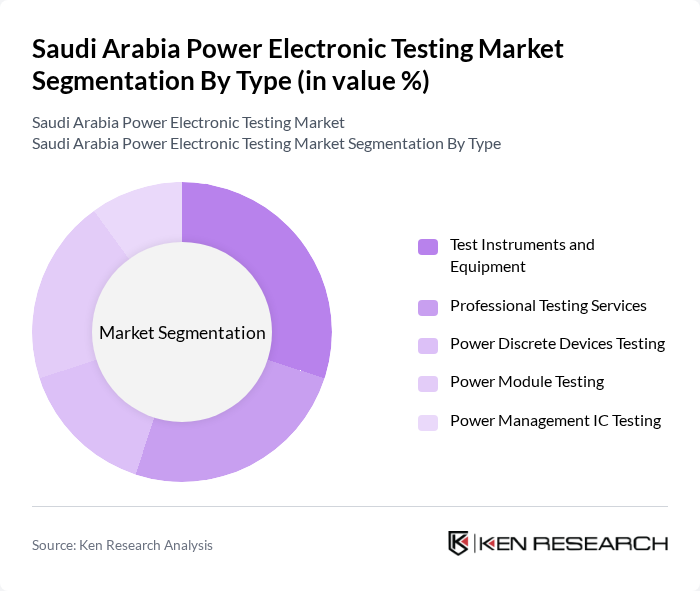
The Type segmentation of the market reveals thatTest Instruments and Equipmentis the leading sub-segment, accounting for a significant portion of the market share. This dominance is attributed to the increasing need for precise and reliable testing tools in applications such as automotive, renewable energy, and industrial automation. The growing complexity of power electronic systems, especially with the adoption of wide-bandgap materials like silicon carbide (SiC) and gallium nitride (GaN), necessitates advanced testing solutions. The trend toward automation and the integration of digital technologies in testing processes further strengthens the market position of this sub-segment .
By End-User:
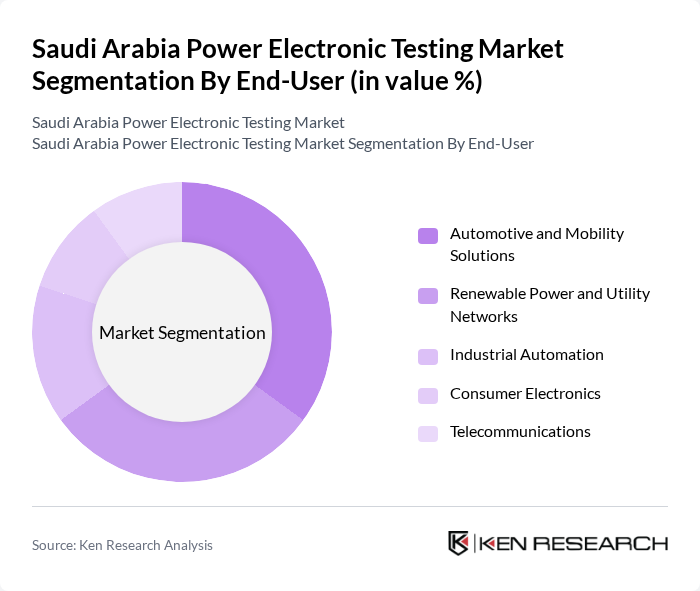
In the End-User segmentation,Automotive and Mobility Solutionsis the dominant sub-segment, reflecting the rapid growth of the electric vehicle market and the increasing focus on sustainable transportation in Saudi Arabia. Government incentives for electric vehicle adoption, along with substantial investments in EV infrastructure and renewable energy, have significantly boosted the demand for power electronic testing in this sector. The expansion of renewable energy initiatives, including solar and wind projects, has also led to increased testing requirements for grid interface electronics and related technologies, further establishing the automotive and utility sectors as leading end-users .
The Saudi Arabia Power Electronic Testing Market is characterized by a dynamic mix of regional and international players. Leading participants such as Siemens AG, Schneider Electric SE, ABB Ltd., Keysight Technologies, Inc., National Instruments Corporation, Fluke Corporation, Tektronix, Inc., Rohde & Schwarz GmbH & Co. KG, Anritsu Corporation, Yokogawa Electric Corporation, Megger Group Limited, DNV (Det Norske Veritas), Intertek Group plc, TÜV Rheinland AG, UL Solutions (UL LLC) contribute to innovation, geographic expansion, and service delivery in this space.
The future of the Saudi Arabia power electronic testing market appears promising, driven by the increasing integration of renewable energy sources and advancements in technology. As the government continues to invest in energy efficiency and smart grid initiatives, the demand for reliable testing solutions will rise. Additionally, the growing electric vehicle market and energy storage solutions will further enhance the need for sophisticated testing methodologies, ensuring the sector remains dynamic and responsive to emerging trends.
| Segment | Sub-Segments |
|---|---|
| By Type | Test Instruments and Equipment Professional Testing Services Power Discrete Devices Testing Power Module Testing Power Management IC Testing |
| By End-User | Automotive and Mobility Solutions Renewable Power and Utility Networks Industrial Automation Consumer Electronics Telecommunications |
| By Application | Electric Vehicles Renewable Energy Systems (Solar, Wind, Storage) Smart Grids and Grid Interface Electronics Industrial Power Control Aerospace and Defense |
| By Component | Test Equipment (Oscilloscopes, Signal Generators, Multimeters, Spectrum Analyzers) Software Solutions Services (Calibration, Maintenance, Consulting) |
| By Sales Channel | Direct Sales Distributors Online Platforms |
| By Distribution Mode | Offline Distribution Online Distribution |
| By Policy Support | Subsidies Tax Exemptions Grants Others |
| Scope Item/Segment | Sample Size | Target Respondent Profiles |
|---|---|---|
| Power Electronics Manufacturers | 100 | Product Managers, Technical Directors |
| Testing and Certification Labs | 60 | Lab Managers, Quality Assurance Officers |
| Renewable Energy Project Developers | 50 | Project Engineers, Operations Managers |
| Government Regulatory Bodies | 40 | Policy Makers, Regulatory Affairs Specialists |
| Academic and Research Institutions | 40 | Research Scientists, Professors in Electrical Engineering |
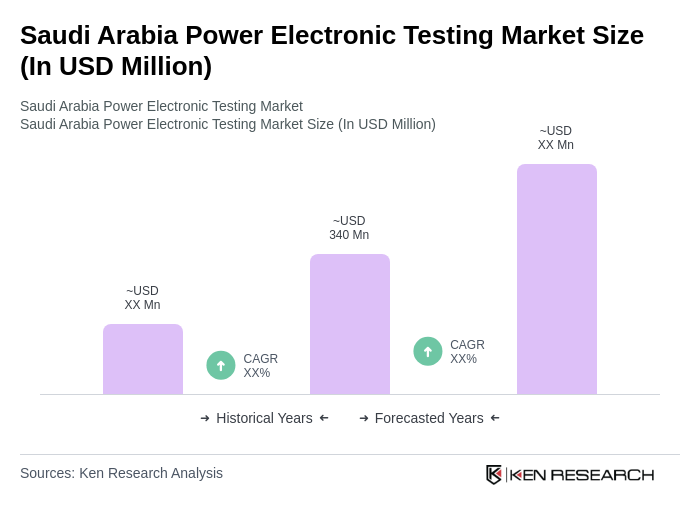
The Saudi Arabia Power Electronic Testing Market is valued at approximately USD 340 million, reflecting a significant growth driven by the increasing demand for power electronic devices across various sectors, including automotive and renewable energy.

What makes us stand out is that our consultants follow Robust, Refine and Result (RRR) methodology. Robust for clear definitions, approaches and sanity checking, Refine for differentiating respondents' facts and opinions, and Result for presenting data with story.

We have set a benchmark in the industry by offering our clients with syndicated and customized market research reports featuring coverage of entire market as well as meticulous research and analyst insights.

While we don't replace traditional research, we flip the method upside down. Our dual approach of Top Bottom & Bottom Top ensures quality deliverable by not just verifying company fundamentals but also looking at the sector and macroeconomic factors.

With one step in the future, our research team constantly tries to show you the bigger picture. We help with some of the tough questions you may encounter along the way: How is the industry positioned? Best marketing channel? KPI's of competitors? By aligning every element, we help maximize success.

Our report gives you instant access to the answers and sources that other companies might choose to hide. We elaborate each steps of research methodology we have used and showcase you the sample size to earn your trust.

If you need any support, we are here! We pride ourselves on universe strength, data quality, and quick, friendly, and professional service.













