About the Report
Base Year 2024Listen to the audio summary
Saudi Arabia Project Logistics Market Overview
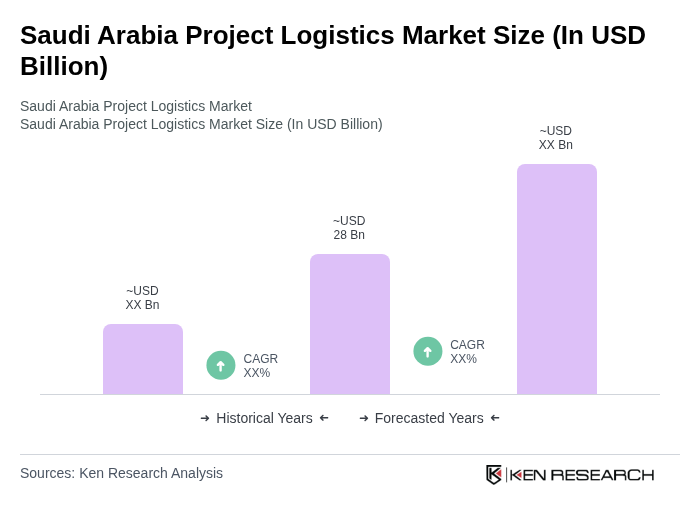
- The Saudi Arabia Project Logistics Market is valued at USD 28 billion, based on a five-year historical analysis. This growth is primarily driven by the country's ambitious infrastructure projects, including Vision 2030 initiatives, which aim to diversify the economy and enhance logistics capabilities. The increasing demand for efficient supply chain solutions in sectors such as oil and gas, construction, and renewable energy has significantly contributed to the market's expansion. Major infrastructure developments like NEOM, Red Sea Global, and extensive transportation network expansions are generating unprecedented logistics requirements, while public-private partnerships valued at over USD 50 billion are fostering innovation and private sector participation in critical infrastructure development .
- Key cities dominating the market include Riyadh, Jeddah, and Dammam. Riyadh serves as the political and administrative center, attracting numerous logistics companies due to its strategic location. Jeddah, being a major port city, facilitates international trade, while Dammam is pivotal for the oil and gas sector, making these cities critical hubs for project logistics activities .
- In 2023, the Saudi government implemented the Unified National Customs Platform (FASAH), issued by the Saudi Customs Authority, to enhance logistics efficiency by establishing a unified customs clearance system. This regulation streamlines customs processes, reduces delays, and improves the overall competitiveness of the logistics sector by integrating all stakeholders—importers, exporters, shipping agents, and government authorities—into a single digital platform, thereby supporting the growth of the project logistics market .
Saudi Arabia Project Logistics Market Segmentation
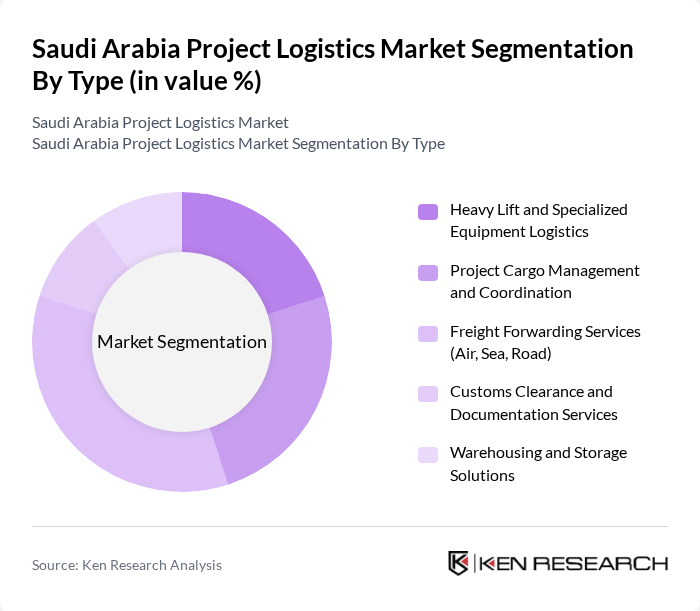
By Type:The market is segmented into various types, including Heavy Lift and Specialized Equipment Logistics, Project Cargo Management and Coordination, Freight Forwarding Services (Air, Sea, Road), Customs Clearance and Documentation Services, and Warehousing and Storage Solutions. Among these, Freight Forwarding Services are particularly dominant due to the increasing volume of international trade and the need for efficient transportation solutions. The demand for specialized logistics services is also rising, driven by the complexity of project requirements in sectors like construction and energy. Transportation services remain the top revenue generator, while warehousing and distribution are the fastest-growing segments, reflecting the sector's focus on supply chain efficiency and value-added services .
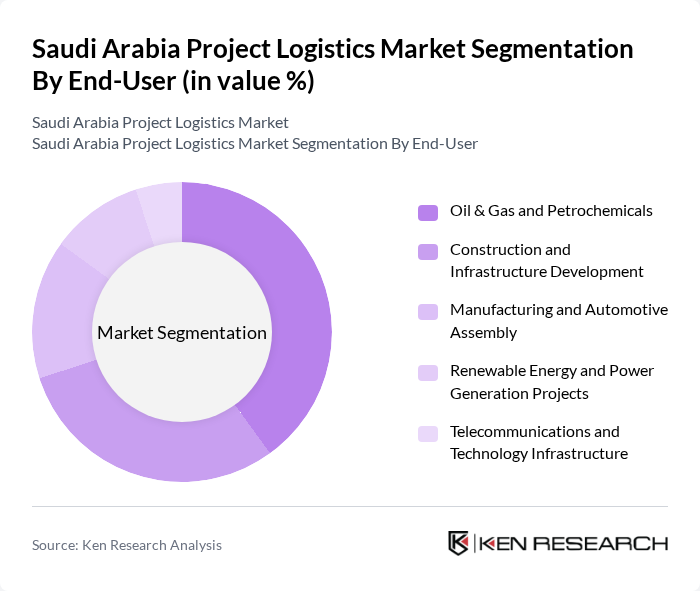
By End-User:The end-user segmentation includes Oil & Gas and Petrochemicals, Construction and Infrastructure Development, Manufacturing and Automotive Assembly, Renewable Energy and Power Generation Projects, and Telecommunications and Technology Infrastructure. The Oil & Gas sector is the leading end-user, driven by ongoing investments in energy projects and the need for specialized logistics services to handle complex cargo. The construction sector is also significant, fueled by large-scale infrastructure projects under Vision 2030. E-commerce, manufacturing, and renewable energy are emerging as important contributors to logistics demand, reflecting the Kingdom’s economic diversification strategy .
Saudi Arabia Project Logistics Market Competitive Landscape
The Saudi Arabia Project Logistics Market is characterized by a dynamic mix of regional and international players. Leading participants such as DB Schenker, Kuehne + Nagel, Agility Logistics, DHL Supply Chain, CEVA Logistics, GAC Group, Panalpina (Now Part of DSV), Al-Futtaim Logistics, Bahri (Saudi National Shipping Company), Aramex, Saudi Aramco Logistics (Aramco and DHL Joint Venture), Agility Project Logistics, Al-Muhaidib Group, Al-Jazira Group, Al-Rajhi Logistics contribute to innovation, geographic expansion, and service delivery in this space.
Saudi Arabia Project Logistics Market Industry Analysis
Growth Drivers
- Vision 2030 Infrastructure Development Initiatives:Saudi Arabia's Vision 2030 aims to diversify the economy, with an investment of approximately SAR 7 trillion (USD 1.87 trillion) in infrastructure projects in future. This includes the development of transport networks, logistics hubs, and urban infrastructure, which are expected to significantly enhance project logistics capabilities. The government has allocated SAR 1.5 trillion (USD 400 billion) specifically for infrastructure, creating a robust environment for logistics growth.
- Mega Project Logistics Requirements (NEOM, Red Sea Global):The NEOM project, with an estimated investment of USD 500 billion, is set to revolutionize logistics in the region. This mega project requires extensive logistics support, including transportation, warehousing, and supply chain management. Additionally, the Red Sea Global project, valued at USD 10 billion, will further drive demand for specialized logistics services, creating a significant market opportunity for logistics providers in Saudi Arabia.
- Government Logistics Zone Establishment (59 Planned Zones):The establishment of 59 logistics zones across Saudi Arabia is projected to enhance the efficiency of supply chains. These zones are expected to attract investments exceeding SAR 100 billion (USD 26.6 billion) in future. The zones will facilitate streamlined customs processes and improve connectivity, thereby bolstering the logistics sector and supporting the growth of project logistics in the country.
Market Challenges
- Infrastructure Limitations in Certain Regions:Despite significant investments, some regions in Saudi Arabia still face infrastructure challenges, particularly in rural areas. The World Bank reports that only 60% of rural roads are paved, which hampers logistics efficiency. This lack of infrastructure can lead to delays and increased costs for project logistics, affecting overall project timelines and profitability.
- Labor Shortages and Skill Gaps:The logistics sector in Saudi Arabia is experiencing a labor shortage, with an estimated 30% of logistics positions unfilled due to skill gaps. The Saudi Arabian General Authority for Statistics indicates that the unemployment rate among youth is around 12.5%, highlighting the need for targeted training programs. This shortage can hinder the growth of project logistics, as skilled labor is essential for efficient operations.
Saudi Arabia Project Logistics Market Future Outlook
The future of the Saudi Arabia project logistics market appears promising, driven by ongoing infrastructure investments and technological advancements. The integration of AI and IoT in logistics operations is expected to enhance efficiency and reduce costs. Additionally, the government's commitment to sustainability will likely lead to increased adoption of green logistics practices. As the market evolves, logistics providers must adapt to these trends to remain competitive and capitalize on emerging opportunities.
Market Opportunities
- Petrochemical and Energy Sector Project Logistics:The petrochemical sector is projected to grow by 4% annually, creating substantial demand for specialized logistics services. With investments exceeding USD 200 billion in energy projects, logistics providers can capitalize on this growth by offering tailored solutions that meet the unique needs of the sector.
- AI, IoT, and Digital Transformation in Logistics:The adoption of AI and IoT technologies in logistics is expected to increase operational efficiency by 20% in future. This digital transformation presents opportunities for logistics companies to enhance service delivery, optimize supply chains, and reduce costs, positioning them favorably in a competitive market.
Scope of the Report
| Segment | Sub-Segments |
|---|---|
| By Type | Heavy Lift and Specialized Equipment Logistics Project Cargo Management and Coordination Freight Forwarding Services (Air, Sea, Road) Customs Clearance and Documentation Services Warehousing and Storage Solutions |
| By End-User | Oil & Gas and Petrochemicals Construction and Infrastructure Development Manufacturing and Automotive Assembly Renewable Energy and Power Generation Projects Telecommunications and Technology Infrastructure |
| By Region | Central Region (Riyadh - 45% Market Share) Eastern Region (Industrial and Petrochemical Hub) Western Region (Jeddah and Red Sea Global) Southern Region |
| By Service Type | Transportation Services (59.29% Market Share) Warehousing and Distribution Services Value-Added Logistics Services Logistics Consulting and Project Management Customs and Compliance Services |
| By Mode of Transport | Road Transport (60% Market Share) Sea Transport (Port-Based Project Cargo) Air Transport (Time-Critical Shipments) Rail Transport (Emerging for Heavy Cargo) Multi-Modal Solutions |
| By Project Size | Small Scale Projects (Under $50 Million) Medium Scale Projects ($50-500 Million) Large Scale Projects ($500 Million - $5 Billion) Mega Projects (Over $5 Billion - NEOM, Red Sea Global) |
| By Policy Support | Government Subsidies for Logistics Infrastructure Tax Incentives and Free Zone Benefits Regulatory Support and Streamlined Customs Public-Private Partnership Opportunities |
Key Target Audience
Investors and Venture Capitalist Firms
Government and Regulatory Bodies (e.g., Saudi Arabian General Investment Authority, Ministry of Transport)
Construction and Infrastructure Companies
Oil and Gas Companies
Shipping and Freight Forwarding Companies
Logistics and Supply Chain Management Firms
Real Estate Developers
Public-Private Partnership Entities
Players Mentioned in the Report:
DB Schenker
Kuehne + Nagel
Agility Logistics
DHL Supply Chain
CEVA Logistics
GAC Group
Panalpina (Now Part of DSV)
Al-Futtaim Logistics
Bahri (Saudi National Shipping Company)
Aramex
Saudi Aramco Logistics (Aramco and DHL Joint Venture)
Agility Project Logistics
Al-Muhaidib Group
Al-Jazira Group
Al-Rajhi Logistics
Table of Contents
Market Assessment Phase
1. Executive Summary and Approach
2. Saudi Arabia Project Logistics Market Overview
2.1 Key Insights and Strategic Recommendations
2.2 Saudi Arabia Project Logistics Market Overview
2.3 Definition and Scope
2.4 Evolution of Market Ecosystem
2.5 Timeline of Key Regulatory Milestones
2.6 Value Chain & Stakeholder Mapping
2.7 Business Cycle Analysis
2.8 Policy & Incentive Landscape
3. Saudi Arabia Project Logistics Market Analysis
3.1 Growth Drivers
3.1.1 Vision 2030 Infrastructure Development Initiatives
3.1.2 Mega Project Logistics Requirements (NEOM, Red Sea Global)
3.1.3 Government Logistics Zone Establishment (59 Planned Zones)
3.1.4 Manufacturing and Automotive Sector Expansion
3.2 Market Challenges
3.2.1 Infrastructure Limitations in Certain Regions
3.2.2 Labor Shortages and Skill Gaps
3.2.3 Regulatory Complexities and Bureaucratic Hurdles
3.2.4 Fluctuating Fuel Prices and Global Economic Conditions
3.3 Market Opportunities
3.3.1 Petrochemical and Energy Sector Project Logistics
3.3.2 AI, IoT, and Digital Transformation in Logistics
3.3.3 Strategic Partnerships with Global Logistics Providers
3.3.4 Specialized Heavy Lift and Project Cargo Services
3.4 Market Trends
3.4.1 Digital Transformation and Technology Integration
3.4.2 Sustainability and Green Logistics Initiatives
3.4.3 Increased Automation in Warehousing and Distribution
3.4.4 Integrated Supply Chain Solutions for Complex Projects
3.5 Government Regulation
3.5.1 Local Content Requirements for Project Logistics
3.5.2 Environmental and Safety Standards Compliance
3.5.3 Customs and Border Regulations for Project Cargo
3.5.4 Tax Incentives for Logistics Infrastructure Investment
4. SWOT Analysis
5. Stakeholder Analysis
6. Porter's Five Forces Analysis
7. Saudi Arabia Project Logistics Market Market Size, 2019-2024
7.1 By Value
7.2 By Volume
7.3 By Average Selling Price
8. Saudi Arabia Project Logistics Market Segmentation
8.1 By Type
8.1.1 Heavy Lift and Specialized Equipment Logistics
8.1.2 Project Cargo Management and Coordination
8.1.3 Freight Forwarding Services (Air, Sea, Road)
8.1.4 Customs Clearance and Documentation Services
8.1.5 Warehousing and Storage Solutions
8.2 By End-User
8.2.1 Oil & Gas and Petrochemicals
8.2.2 Construction and Infrastructure Development
8.2.3 Manufacturing and Automotive Assembly
8.2.4 Renewable Energy and Power Generation Projects
8.2.5 Telecommunications and Technology Infrastructure
8.3 By Region
8.3.1 Central Region (Riyadh - 45% Market Share)
8.3.2 Eastern Region (Industrial and Petrochemical Hub)
8.3.3 Western Region (Jeddah and Red Sea Global)
8.3.4 Southern Region
8.4 By Service Type
8.4.1 Transportation Services (59.29% Market Share)
8.4.2 Warehousing and Distribution Services
8.4.3 Value-Added Logistics Services
8.4.4 Logistics Consulting and Project Management
8.4.5 Customs and Compliance Services
8.5 By Mode of Transport
8.5.1 Road Transport (60% Market Share)
8.5.2 Sea Transport (Port-Based Project Cargo)
8.5.3 Air Transport (Time-Critical Shipments)
8.5.4 Rail Transport (Emerging for Heavy Cargo)
8.5.5 Multi-Modal Solutions
8.6 By Project Size
8.6.1 Small Scale Projects (Under $50 Million)
8.6.2 Medium Scale Projects ($50-500 Million)
8.6.3 Large Scale Projects ($500 Million - $5 Billion)
8.6.4 Mega Projects (Over $5 Billion - NEOM, Red Sea Global)
8.7 By Policy Support
8.7.1 Government Subsidies for Logistics Infrastructure
8.7.2 Tax Incentives and Free Zone Benefits
8.7.3 Regulatory Support and Streamlined Customs
8.7.4 Public-Private Partnership Opportunities
9. Saudi Arabia Project Logistics Market Competitive Analysis
9.1 Market Share of Key Players
9.2 Cross Comparison of Key Players
9.2.1 Company Name
9.2.2 Group Size (Large, Medium, or Small as per industry convention)
9.2.3 Revenue Growth Rate (CAGR 2025-2030)
9.2.4 Project Delivery Success Rate
9.2.5 Operational Efficiency and On-Time Performance
9.2.6 Geographic Coverage and Regional Penetration
9.2.7 Pricing Competitiveness and Value Proposition
9.2.8 Service Portfolio Breadth (Heavy Lift, Customs, Warehousing)
9.2.9 Supply Chain Resilience and Risk Management
9.2.10 Technology Adoption Rate (AI, IoT, Digital Tracking)
9.3 SWOT Analysis of Top Players
9.4 Pricing Analysis
9.5 Detailed Profile of Major Companies
9.5.1 DB Schenker
9.5.2 Kuehne + Nagel
9.5.3 Agility Logistics
9.5.4 DHL Supply Chain
9.5.5 CEVA Logistics
9.5.6 GAC Group
9.5.7 Panalpina (Now Part of DSV)
9.5.8 Al-Futtaim Logistics
9.5.9 Bahri (Saudi National Shipping Company)
9.5.10 Aramex
9.5.11 Saudi Aramco Logistics (Aramco and DHL Joint Venture)
9.5.12 Agility Project Logistics
9.5.13 Al-Muhaidib Group
9.5.14 Al-Jazira Group
9.5.15 Al-Rajhi Logistics
10. Saudi Arabia Project Logistics Market End-User Analysis
10.1 Procurement Behavior of Key Ministries
10.1.1 Ministry of Energy (Oil & Gas Project Requirements)
10.1.2 Ministry of Transport (Infrastructure and Logistics Zones)
10.1.3 Ministry of Industry and Mineral Resources (Manufacturing Support)
10.1.4 Ministry of Housing (Construction Project Logistics)
10.2 Corporate Spend on Infrastructure & Energy
10.2.1 NEOM and Mega Project Investment Trends
10.2.2 Budget Allocations for Project Logistics
10.2.3 Public-Private Partnership Financing
10.2.4 Future Spending Projections (2025-2030)
10.3 Pain Point Analysis by End-User Category
10.3.1 Delays in Project Delivery and Customs Clearance
10.3.2 Cost Overruns and Fuel Price Volatility
10.3.3 Regulatory Compliance and Documentation Challenges
10.3.4 Quality Assurance and Safety Standards
10.4 User Readiness for Adoption
10.4.1 Technology Adoption Levels (Digital Tracking, AI)
10.4.2 Training and Development Needs for Logistics Teams
10.4.3 Infrastructure Readiness for Integrated Solutions
10.4.4 Investment in Innovation and Automation
10.5 Post-Deployment ROI and Use Case Expansion
10.5.1 Performance Metrics and KPIs
10.5.2 Case Studies of Successful Project Logistics Deployments
10.5.3 Long-term Benefits Analysis and Cost Savings
10.5.4 Future Use Case Opportunities in Emerging Sectors
11. Saudi Arabia Project Logistics Market Future Size, 2025-2030
11.1 By Value (Projected CAGR: 5.5-6.5%)
11.2 By Volume
11.3 By Average Selling Price
Go-To-Market Strategy Phase
1. Whitespace Analysis + Business Model Canvas
1.1 Market Gaps Identification
1.2 Value Proposition Development
1.3 Revenue Streams Analysis
1.4 Cost Structure Evaluation
1.5 Key Partnerships Exploration
1.6 Customer Segmentation
1.7 Competitive Advantage Assessment
2. Marketing and Positioning Recommendations
2.1 Branding Strategies
2.2 Product USPs
2.3 Target Market Identification
2.4 Communication Strategy
2.5 Digital Marketing Approaches
2.6 Customer Engagement Tactics
2.7 Performance Measurement
3. Distribution Plan
3.1 Regional Hub Strategy (Riyadh, Eastern Province, Jeddah)
3.2 Logistics Zone Network Integration
3.3 Logistics Network Optimization
3.4 Distribution Channel Selection
3.5 Last-Mile Delivery Solutions
3.6 Inventory Management Practices
3.7 Performance Tracking
4. Channel & Pricing Gaps
4.1 Underserved Routes Analysis
4.2 Pricing Bands Evaluation
4.3 Competitor Pricing Strategies
4.4 Customer Willingness to Pay
4.5 Price Sensitivity Assessment
4.6 Value-Based Pricing Models
4.7 Pricing Strategy Recommendations
5. Unmet Demand & Latent Needs
5.1 Category Gaps Identification
5.2 Consumer Segments Analysis
5.3 Emerging Trends Exploration
5.4 Customer Feedback Mechanisms
5.5 Market Research Insights
5.6 Future Demand Projections
5.7 Strategic Recommendations
6. Customer Relationship
6.1 Loyalty Programs Development
6.2 After-sales Service Enhancements
6.3 Customer Feedback Integration
6.4 Relationship Management Strategies
Research Methodology
Phase 1: Approach1
Desk Research
- Analysis of government publications and reports on logistics infrastructure in Saudi Arabia
- Review of industry reports from logistics associations and trade bodies
- Examination of market trends and forecasts from reputable economic research institutions
Primary Research
- Interviews with logistics managers at major Saudi Arabian companies across various sectors
- Surveys targeting supply chain experts and consultants familiar with the Saudi market
- Field interviews with operations managers at key logistics hubs and ports
Validation & Triangulation
- Cross-validation of findings through multiple data sources including trade statistics and expert opinions
- Triangulation of qualitative insights from interviews with quantitative data from desk research
- Sanity checks conducted through expert panel reviews to ensure data reliability
Phase 2: Market Size Estimation1
Top-down Assessment
- Estimation of total logistics market size based on national GDP and trade volume
- Segmentation of the market by key sectors such as retail, manufacturing, and e-commerce
- Incorporation of government initiatives aimed at enhancing logistics efficiency and capacity
Bottom-up Modeling
- Collection of operational data from leading logistics firms to establish baseline metrics
- Cost analysis based on service pricing models and operational expenditures
- Volume and cost calculations for different logistics services including warehousing and transportation
Forecasting & Scenario Analysis
- Development of forecasting models using historical growth rates and economic indicators
- Scenario analysis based on potential regulatory changes and market disruptions
- Projections for market growth under various economic conditions through 2030
Phase 3: CATI Sample Composition1
| Scope Item/Segment | Sample Size | Target Respondent Profiles |
|---|---|---|
| Retail Logistics Operations | 60 | Logistics Coordinators, Supply Chain Managers |
| Manufacturing Supply Chain | 50 | Production Managers, Procurement Specialists |
| E-commerce Fulfillment Strategies | 45 | eCommerce Operations Managers, Logistics Analysts |
| Cold Chain Logistics | 40 | Quality Assurance Managers, Distribution Supervisors |
| Freight Forwarding Services | 42 | Freight Managers, Customs Compliance Officers |
Frequently Asked Questions
What is the current value of the Saudi Arabia Project Logistics Market?
The Saudi Arabia Project Logistics Market is valued at approximately USD 28 billion, driven by significant infrastructure projects and initiatives under Vision 2030, which aim to diversify the economy and enhance logistics capabilities across various sectors.
What are the key drivers of growth in the Saudi Arabia Project Logistics Market?
Which cities are the main hubs for project logistics in Saudi Arabia?
How has the Saudi government improved logistics efficiency recently?
Other Regional/Country Reports
Indonesia Project Logistics Market
Malaysia Project Logistics Market
Other Adjacent Reports
Oman Freight Forwarding Services Market
Egypt Customs Clearance Services Market
Indonesia Warehousing and Storage Solutions Market
Bahrain Heavy Lift and Specialized Equipment Logistics Market
Kuwait Project Cargo Management Market
UAE Oil and Gas Logistics Market
Malaysia Construction and Infrastructure Logistics Market
KSA Renewable Energy Logistics Market
Vietnam Manufacturing and Automotive Logistics Market
Singapore Telecommunications Infrastructure Logistics Market
Why Buy From Us?

What makes us stand out is that our consultants follow Robust, Refine and Result (RRR) methodology. Robust for clear definitions, approaches and sanity checking, Refine for differentiating respondents' facts and opinions, and Result for presenting data with story.

We have set a benchmark in the industry by offering our clients with syndicated and customized market research reports featuring coverage of entire market as well as meticulous research and analyst insights.

While we don't replace traditional research, we flip the method upside down. Our dual approach of Top Bottom & Bottom Top ensures quality deliverable by not just verifying company fundamentals but also looking at the sector and macroeconomic factors.

With one step in the future, our research team constantly tries to show you the bigger picture. We help with some of the tough questions you may encounter along the way: How is the industry positioned? Best marketing channel? KPI's of competitors? By aligning every element, we help maximize success.

Our report gives you instant access to the answers and sources that other companies might choose to hide. We elaborate each steps of research methodology we have used and showcase you the sample size to earn your trust.

If you need any support, we are here! We pride ourselves on universe strength, data quality, and quick, friendly, and professional service.