About the Report
Base Year 2024Saudi Arabia Textile Market Overview
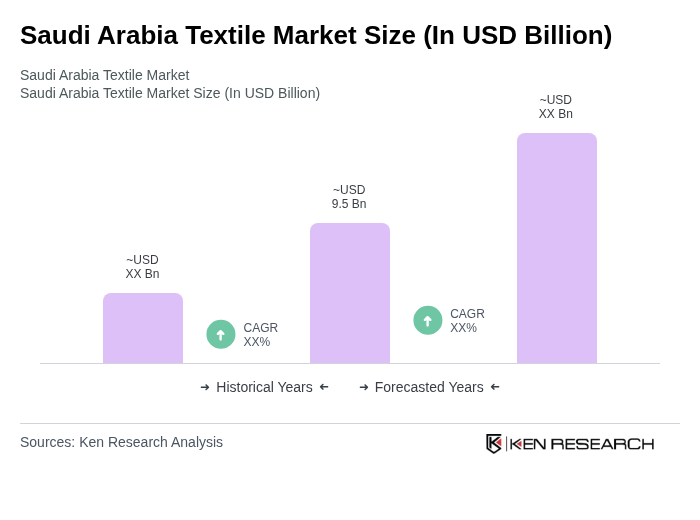
- The Saudi Arabia Textile Market is valued at USD 9.5 billion, based on a five-year historical analysis. This growth is primarily driven by increasing consumer demand for both traditional and modern textile products, alongside a growing focus on sustainability and eco-friendly materials. The market has seen a significant rise in investments in textile manufacturing and innovation under Vision 2030, including modern production facilities and advanced technologies, contributing to its overall expansion.
- Key cities such as Riyadh, Jeddah, and Dammam dominate the Saudi textile market due to their strategic locations, robust infrastructure, and access to a large consumer base, aligning with the major Northern and Central, Western, and Eastern regions that lead textile and home textile demand. These cities serve as major commercial hubs, facilitating trade and distribution, which enhances the market's growth potential. Additionally, the presence of established textile, home textile, and apparel players, as well as strong retail and e?commerce channels, in these regions further solidifies their dominance.
- In 2023, the Saudi government implemented a new regulation aimed at promoting sustainable practices within the textile industry. This regulation mandates that all textile manufacturers adhere to specific environmental standards, including waste management and resource conservation, under broader environmental compliance obligations such as those set out in the Saudi Environment Law issued by the Ministry of Environment, Water and Agriculture and the National Center for Environmental Compliance, which covers industrial emissions, waste handling, and resource efficiency for manufacturing facilities, including textiles. The initiative is part of the broader Vision 2030 strategy, which seeks to diversify the economy and reduce dependence on oil by fostering sustainable industries and encouraging cleaner industrial production in sectors such as textile manufacturing.
Saudi Arabia Textile Market Segmentation
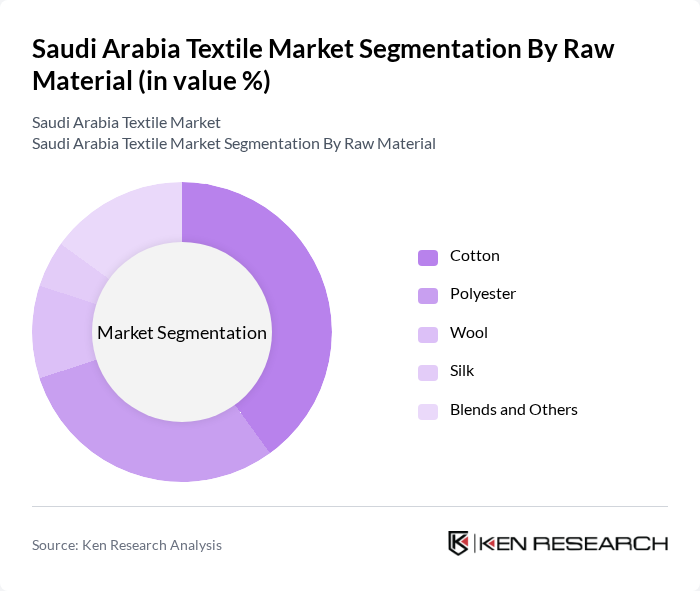
By Raw Material:The segmentation of the Saudi textile market by raw material includes various subsegments such as Cotton, Polyester, Wool, Silk, and Blends and Others. Cotton remains a dominant raw material due to its versatility and widespread use in apparel and home textiles, and it accounts for the largest raw material share in the Saudi textile market. Polyester is also gaining traction due to its durability and cost-effectiveness, appealing to both manufacturers and consumers, particularly in fashion and home furnishings where easy-care and performance fabrics are in demand. Wool and silk, while less prevalent, cater to niche markets focused on luxury and high-quality products, including premium apparel and high?end home textiles. Blends and others encompass a range of synthetic and natural fibers, reflecting the industry's trend towards innovative materials, performance textiles, and value-added finishes that respond to comfort, durability, and sustainability requirements.
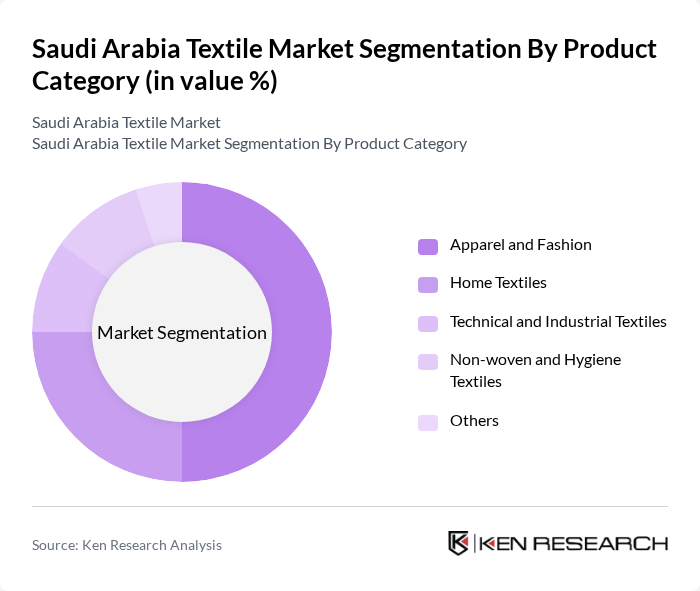
By Product Category:The product category segmentation includes Apparel and Fashion, Home Textiles, Technical and Industrial Textiles, Non-woven and Hygiene Textiles, and Others. Apparel and Fashion dominate the market, driven by a growing population, rising disposable income, and rapid expansion of e?commerce apparel channels that broaden access to both local and international brands. Home Textiles also hold a significant share, reflecting consumer preferences for quality and design in home furnishings and supported by strong growth in the residential and hospitality sectors linked to giga?projects such as NEOM, Qiddiya, and Red Sea developments. Technical and Industrial Textiles are gaining importance due to their applications in construction, automotive, filtration, and infrastructure projects associated with Vision 2030. Non-woven and Hygiene Textiles are essential for health and safety products, including medical disposables and personal care items, with demand reinforced by healthcare investments and heightened awareness of hygiene. Others include specialty and decorative textiles, niche fashion items, and customized products tailored to evolving consumer tastes.
Saudi Arabia Textile Market Competitive Landscape
The Saudi Arabia Textile Market is characterized by a dynamic mix of regional and international players. Leading participants such as Saudi Spinning & Weaving Mill Co., Saudi German Co. for Non-Woven Products (SOGE), Al Kifah Textile & Carpet Factory, Al-Majdouie Textiles, Al Abdullatif Industrial Investment Co., Al Sorayai Trading & Industrial Group, Naba Alsaha Textiles, Al-Jazira Textile & Towel Factory, Saudi Carpet Factory, Al-Mutlaq Furniture & Textile Group, Al Johani Textiles, Al Ghadeer Textile Factory, Riyadh Velvet & Textile Factory, Jeddah Weavers & Textiles, Eastern Province Textile Co. contribute to innovation, geographic expansion, and service delivery in this space.
Saudi Arabia Textile Market Industry Analysis
Growth Drivers
- Increasing Demand for Sustainable Textiles:The Saudi textile market is witnessing a significant shift towards sustainable textiles, driven by a growing consumer awareness of environmental issues. In future, the demand for eco-friendly textiles is projected to reach 1.3 million tons, reflecting a 15% increase from the previous year. This trend is supported by the Saudi Vision 2030 initiative, which emphasizes sustainability and aims to reduce carbon emissions by 30% by 2030, fostering a favorable environment for sustainable textile production.
- Government Initiatives Supporting Local Manufacturing:The Saudi government has implemented various initiatives to bolster local textile manufacturing, including the National Industrial Development and Logistics Program. In future, government funding for local textile projects is expected to exceed SAR 1.2 billion, aimed at enhancing production capabilities and reducing reliance on imports. This support is crucial as the local textile industry currently accounts for only 22% of the total market, indicating substantial room for growth and development.
- Rising Disposable Incomes and Consumer Spending:With Saudi Arabia's GDP per capita projected to reach SAR 48,000 in future, rising disposable incomes are driving increased consumer spending on textiles. The average household expenditure on clothing and textiles is expected to rise to SAR 9,000, reflecting a 10% increase from the previous year. This growth in consumer spending is fostering a more vibrant textile market, encouraging both local and international brands to expand their offerings in the region.
Market Challenges
- Competition from Imported Textiles:The Saudi textile market faces significant challenges from imported textiles, which account for approximately 78% of the total market share. In future, imports are expected to reach SAR 13 billion, driven by competitive pricing and diverse product offerings from countries like China and India. This heavy reliance on imports poses a challenge for local manufacturers, who struggle to compete on price and variety, impacting their market share and growth potential.
- Fluctuating Raw Material Prices:The textile industry in Saudi Arabia is heavily impacted by fluctuating raw material prices, particularly cotton and synthetic fibers. In future, cotton prices are projected to average SAR 6,000 per ton, a 20% increase from the previous year due to global supply chain disruptions. These price fluctuations can significantly affect production costs for local manufacturers, leading to reduced profit margins and potential price increases for consumers, ultimately impacting market stability.
Saudi Arabia Textile Market Future Outlook
The Saudi textile market is poised for transformative growth, driven by increasing consumer demand for sustainable and innovative products. As the government continues to support local manufacturing through substantial investments, the industry is expected to adapt to emerging trends such as digitalization and customization. Additionally, the rise of e-commerce platforms will facilitate broader market access, enabling local brands to reach international consumers. This dynamic environment presents a unique opportunity for growth and innovation in the textile sector.
Market Opportunities
- Growth in Eco-friendly Textile Products:The increasing consumer preference for eco-friendly textiles presents a lucrative opportunity for manufacturers. With the market for sustainable textiles projected to grow to SAR 2.5 billion in future, companies that invest in sustainable practices and materials can capture a significant share of this emerging segment, enhancing their brand reputation and market position.
- Development of Smart Textiles:The development of smart textiles, integrating technology with fabric, is gaining traction in Saudi Arabia. With an estimated market value of SAR 600 million in future, this segment offers opportunities for innovation and differentiation. Companies that focus on R&D in smart textiles can cater to niche markets, such as healthcare and sports, driving growth and enhancing consumer engagement.
Scope of the Report
| Segment | Sub-Segments |
|---|---|
| By Raw Material | Cotton Polyester Wool Silk Blends and Others |
| By Product Category | Apparel and Fashion Home Textiles Technical and Industrial Textiles Non-woven and Hygiene Textiles Others |
| By Manufacturing Process | Woven Fabrics Knitted Fabrics Non-woven Fabrics Technical Textile Processes Others |
| By End-Use Industry | Clothing and Fashion Retail Home and Hospitality Automotive and Transport Oil & Gas, Construction and Industrial Healthcare and Medical Others |
| By Distribution Channel | B2B (Manufacturers, Brands, Institutional Buyers) Modern Retail (Hypermarkets, Supermarkets, Specialty Stores) Traditional Retail E-commerce and Online Marketplaces Others |
| By Region | Central Region Western Region Eastern Region Northern Region Southern Region |
| By Sustainability Profile | Organic and Eco-friendly Textiles Recycled and Circular Textiles Conventional Textiles |
Key Target Audience
Investors and Venture Capitalist Firms
Government and Regulatory Bodies (e.g., Ministry of Industry and Mineral Resources, Saudi Standards, Metrology and Quality Organization)
Manufacturers and Producers
Distributors and Retailers
Textile Exporters
Raw Material Suppliers
Industry Associations (e.g., Saudi Textile and Apparel Association)
Financial Institutions
Players Mentioned in the Report:
Saudi Spinning & Weaving Mill Co.
Saudi German Co. for Non-Woven Products (SOGE)
Al Kifah Textile & Carpet Factory
Al-Majdouie Textiles
Al Abdullatif Industrial Investment Co.
Al Sorayai Trading & Industrial Group
Naba Alsaha Textiles
Al-Jazira Textile & Towel Factory
Saudi Carpet Factory
Al-Mutlaq Furniture & Textile Group
Al Johani Textiles
Al Ghadeer Textile Factory
Riyadh Velvet & Textile Factory
Jeddah Weavers & Textiles
Eastern Province Textile Co.
Table of Contents
Market Assessment Phase
1. Executive Summary and Approach
2. Saudi Arabia Textile Market Overview
2.1 Key Insights and Strategic Recommendations
2.2 Saudi Arabia Textile Market Overview
2.3 Definition and Scope
2.4 Evolution of Market Ecosystem
2.5 Timeline of Key Regulatory Milestones
2.6 Value Chain & Stakeholder Mapping
2.7 Business Cycle Analysis
2.8 Policy & Incentive Landscape
3. Saudi Arabia Textile Market Analysis
3.1 Growth Drivers
3.1.1 Increasing Demand for Sustainable Textiles
3.1.2 Government Initiatives Supporting Local Manufacturing
3.1.3 Rising Disposable Incomes and Consumer Spending
3.1.4 Expansion of E-commerce Platforms
3.2 Market Challenges
3.2.1 Competition from Imported Textiles
3.2.2 Fluctuating Raw Material Prices
3.2.3 Regulatory Compliance Costs
3.2.4 Limited Access to Advanced Technology
3.3 Market Opportunities
3.3.1 Growth in Eco-friendly Textile Products
3.3.2 Development of Smart Textiles
3.3.3 Expansion into International Markets
3.3.4 Collaborations with Fashion Brands
3.4 Market Trends
3.4.1 Shift Towards Digitalization in Textile Manufacturing
3.4.2 Increasing Popularity of Customization
3.4.3 Focus on Circular Economy Practices
3.4.4 Rise of Online Retailing in Textile Sales
3.5 Government Regulation
3.5.1 Import Tariffs on Textile Products
3.5.2 Standards for Textile Quality and Safety
3.5.3 Environmental Regulations for Textile Production
3.5.4 Labor Laws Affecting Textile Manufacturing
4. SWOT Analysis
5. Stakeholder Analysis
6. Porter's Five Forces Analysis
7. Saudi Arabia Textile Market Market Size, 2019-2024
7.1 By Value
7.2 By Volume
7.3 By Average Selling Price
8. Saudi Arabia Textile Market Segmentation
8.1 By Raw Material
8.1.1 Cotton
8.1.2 Polyester
8.1.3 Wool
8.1.4 Silk
8.1.5 Blends and Others
8.2 By Product Category
8.2.1 Apparel and Fashion
8.2.2 Home Textiles
8.2.3 Technical and Industrial Textiles
8.2.4 Non-woven and Hygiene Textiles
8.2.5 Others
8.3 By Manufacturing Process
8.3.1 Woven Fabrics
8.3.2 Knitted Fabrics
8.3.3 Non-woven Fabrics
8.3.4 Technical Textile Processes
8.3.5 Others
8.4 By End-Use Industry
8.4.1 Clothing and Fashion Retail
8.4.2 Home and Hospitality
8.4.3 Automotive and Transport
8.4.4 Oil & Gas, Construction and Industrial
8.4.5 Healthcare and Medical
8.4.6 Others
8.5 By Distribution Channel
8.5.1 B2B (Manufacturers, Brands, Institutional Buyers)
8.5.2 Modern Retail (Hypermarkets, Supermarkets, Specialty Stores)
8.5.3 Traditional Retail
8.5.4 E-commerce and Online Marketplaces
8.5.5 Others
8.6 By Region
8.6.1 Central Region
8.6.2 Western Region
8.6.3 Eastern Region
8.6.4 Northern Region
8.6.5 Southern Region
8.7 By Sustainability Profile
8.7.1 Organic and Eco-friendly Textiles
8.7.2 Recycled and Circular Textiles
8.7.3 Conventional Textiles
9. Saudi Arabia Textile Market Competitive Analysis
9.1 Market Share of Key Players
9.2 Cross Comparison of Key Players
9.2.1 Company Name
9.2.2 Saudi Textile Revenue (USD Million)
9.2.3 3-year CAGR in Textile Revenue
9.2.4 Share of Saudi Revenue in MENA Textile Portfolio (%)
9.2.5 EBITDA Margin (%)
9.2.6 Capacity Utilization Rate (%)
9.2.7 Capex Intensity (% of Revenue)
9.2.8 R&D and Innovation Spend (% of Revenue)
9.2.9 Export Intensity (% of Production Exported)
9.2.10 Working Capital Days
9.2.11 On-time Delivery Rate (%)
9.2.12 Customer Concentration (Top 5 Customers' % of Revenue)
9.3 SWOT Analysis of Top Players
9.4 Pricing Analysis
9.5 Detailed Profile of Major Companies
9.5.1 Saudi Spinning & Weaving Mill Co.
9.5.2 Saudi German Co. for Non-Woven Products (SOGE)
9.5.3 Al Kifah Textile & Carpet Factory
9.5.4 Al-Majdouie Textiles
9.5.5 Al Abdullatif Industrial Investment Co.
9.5.6 Al Sorayai Trading & Industrial Group
9.5.7 Naba Alsaha Textiles
9.5.8 Al-Jazira Textile & Towel Factory
9.5.9 Saudi Carpet Factory
9.5.10 Al-Mutlaq Furniture & Textile Group
9.5.11 Al Johani Textiles
9.5.12 Al Ghadeer Textile Factory
9.5.13 Riyadh Velvet & Textile Factory
9.5.14 Jeddah Weavers & Textiles
9.5.15 Eastern Province Textile Co.
10. Saudi Arabia Textile Market End-User Analysis
10.1 Procurement Behavior of Key Ministries
10.1.1 Ministry of Commerce
10.1.2 Ministry of Industry and Mineral Resources
10.1.3 Ministry of Finance
10.1.4 Ministry of Environment, Water and Agriculture
10.2 Corporate Spend on Infrastructure & Energy
10.2.1 Investment in Textile Manufacturing Facilities
10.2.2 Expenditure on Sustainable Practices
10.2.3 Budget Allocation for R&D
10.2.4 Spending on Workforce Training
10.3 Pain Point Analysis by End-User Category
10.3.1 Apparel Manufacturers
10.3.2 Home Textile Producers
10.3.3 Industrial Textile Users
10.3.4 Retailers
10.4 User Readiness for Adoption
10.4.1 Awareness of Sustainable Textiles
10.4.2 Willingness to Pay for Quality
10.4.3 Adoption of E-commerce Solutions
10.4.4 Readiness for Technological Integration
10.5 Post-Deployment ROI and Use Case Expansion
10.5.1 Measurement of Cost Savings
10.5.2 Evaluation of Customer Satisfaction
10.5.3 Analysis of Market Reach
10.5.4 Assessment of Brand Loyalty
11. Saudi Arabia Textile Market Future Size, 2025-2030
11.1 By Value
11.2 By Volume
11.3 By Average Selling Price
Go-To-Market Strategy Phase
1. Whitespace Analysis + Business Model Canvas
1.1 Market Gaps Identification
1.2 Business Model Development
2. Marketing and Positioning Recommendations
2.1 Branding Strategies
2.2 Product USPs
3. Distribution Plan
3.1 Urban Retail vs Rural NGO Tie-ups
4. Channel & Pricing Gaps
4.1 Underserved Routes
4.2 Pricing Bands
5. Unmet Demand & Latent Needs
5.1 Category Gaps
5.2 Consumer Segments
6. Customer Relationship
6.1 Loyalty Programs
6.2 After-sales Service
7. Value Proposition
7.1 Sustainability
7.2 Integrated Supply Chains
8. Key Activities
8.1 Regulatory Compliance
8.2 Branding
8.3 Distribution Setup
9. Entry Strategy Evaluation
9.1 Domestic Market Entry Strategy
9.1.1 Product Mix
9.1.2 Pricing Band
9.1.3 Packaging
9.2 Export Entry Strategy
9.2.1 Target Countries
9.2.2 Compliance Roadmap
10. Entry Mode Assessment
10.1 JV
10.2 Greenfield
10.3 M&A
10.4 Distributor Model
11. Capital and Timeline Estimation
11.1 Capital Requirements
11.2 Timelines
12. Control vs Risk Trade-Off
12.1 Ownership vs Partnerships
13. Profitability Outlook
13.1 Breakeven Analysis
13.2 Long-term Sustainability
14. Potential Partner List
14.1 Distributors
14.2 JVs
14.3 Acquisition Targets
15. Execution Roadmap
15.1 Phased Plan for Market Entry
15.1.1 Market Setup
15.1.2 Market Entry
15.1.3 Growth Acceleration
15.1.4 Scale & Stabilize
15.2 Key Activities and Milestones
15.2.1 Activity Planning
15.2.2 Milestone Tracking
Research Methodology
Phase 1: Approach1
Desk Research
- Analysis of industry reports from the Saudi Arabian Ministry of Commerce and Investment
- Review of textile import/export statistics from the Saudi Customs Authority
- Examination of market trends and consumer behavior studies published by local research firms
Primary Research
- Interviews with key stakeholders in textile manufacturing, including factory owners and production managers
- Surveys conducted with retailers and distributors to understand market dynamics and consumer preferences
- Focus group discussions with consumers to gauge brand perception and purchasing behavior
Validation & Triangulation
- Cross-validation of findings through comparison with historical market data and growth trends
- Triangulation of insights from primary interviews with secondary data sources
- Sanity checks through expert reviews from industry veterans and market analysts
Phase 2: Market Size Estimation1
Top-down Assessment
- Estimation of total market size based on national GDP contribution from the textile sector
- Segmentation of the market by product categories such as apparel, home textiles, and technical textiles
- Incorporation of government initiatives aimed at boosting local textile production and exports
Bottom-up Modeling
- Collection of sales data from leading textile manufacturers and retailers
- Estimation of average selling prices across different textile categories
- Calculation of market size based on production volumes and pricing strategies
Forecasting & Scenario Analysis
- Utilization of time-series analysis to project future market growth based on historical data
- Scenario modeling based on potential impacts of economic fluctuations and consumer trends
- Development of best-case, worst-case, and most-likely scenarios through 2030
Phase 3: CATI Sample Composition1
| Scope Item/Segment | Sample Size | Target Respondent Profiles |
|---|---|---|
| Textile Manufacturing Insights | 100 | Factory Owners, Production Managers |
| Retail Market Dynamics | 80 | Retail Managers, Merchandising Directors |
| Consumer Preferences in Apparel | 120 | End Consumers, Fashion Enthusiasts |
| Technical Textiles Applications | 70 | Product Development Engineers, R&D Managers |
| Export Market Trends | 60 | Export Managers, Trade Analysts |
Frequently Asked Questions
What is the current value of the Saudi Arabia Textile Market?
The Saudi Arabia Textile Market is valued at approximately USD 9.5 billion, reflecting a significant growth trend driven by increasing consumer demand for both traditional and modern textile products, as well as a focus on sustainability and eco-friendly materials.
What are the key cities driving the Saudi textile market?
How is the Saudi government promoting sustainability in the textile industry?
What are the main raw materials used in the Saudi textile market?
Other Regional/Country Reports
Other Adjacent Reports
Qatar Apparel Market
Global Fashion Market Size, Share & Forecast, By Product Category, Price Tier, Customer Type & Distribution Channel, 2026-2031Belgium Home Furnishings Market
United States Textile Chemicals Market Outlook to 2030: Size, Share, Growth and TrendsBahrain nonwoven fabrics market size, share, growth drivers, trends, opportunities & forecast 2025–2030Bahrain Carpet Market Report Size Share Growth Drivers Trends Opportunities & Forecast 2025–2030UAE Textile Machinery MarketOman Sustainable Materials Market
India Smart Textiles Market Outlook to 2030Malaysia Industrial Fabrics Market
Why Buy From Us?

What makes us stand out is that our consultants follow Robust, Refine and Result (RRR) methodology. Robust for clear definitions, approaches and sanity checking, Refine for differentiating respondents' facts and opinions, and Result for presenting data with story.

We have set a benchmark in the industry by offering our clients with syndicated and customized market research reports featuring coverage of entire market as well as meticulous research and analyst insights.

While we don't replace traditional research, we flip the method upside down. Our dual approach of Top Bottom & Bottom Top ensures quality deliverable by not just verifying company fundamentals but also looking at the sector and macroeconomic factors.

With one step in the future, our research team constantly tries to show you the bigger picture. We help with some of the tough questions you may encounter along the way: How is the industry positioned? Best marketing channel? KPI's of competitors? By aligning every element, we help maximize success.

Our report gives you instant access to the answers and sources that other companies might choose to hide. We elaborate each steps of research methodology we have used and showcase you the sample size to earn your trust.

If you need any support, we are here! We pride ourselves on universe strength, data quality, and quick, friendly, and professional service.