About the Report
Base Year 2024Saudi Arabia Tortilla Chips Market Overview
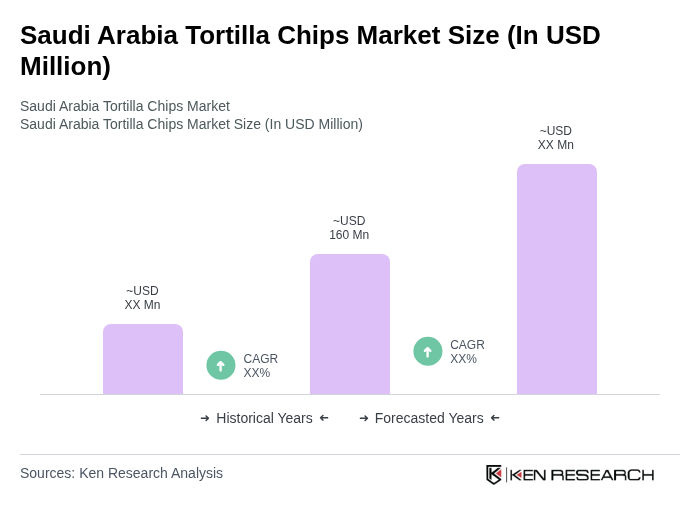
- The Saudi Arabia Tortilla Chips Market is valued at USD 160 million, based on a five-year historical analysis of the country’s tortilla category within the broader snack food and tortilla markets in the Middle East and Africa. This growth is primarily driven by the increasing popularity of snacking, particularly among younger demographics, the rising trend of casual dining experiences, and the expansion of Tex-Mex and international cuisine formats in urban centers. The market has seen a surge in demand for diverse flavors, spicy and localized seasonings, and healthier options such as baked, multigrain, and clean-label tortilla chips, reflecting changing consumer preferences towards convenience, quality, and better-for-you snacks.
- Key cities such as Riyadh, Jeddah, and Dammam dominate the market due to their large populations, higher disposable incomes, and advanced retail infrastructure. These cities are also hubs for modern grocery retail, convenience stores, and food service industries, which contribute significantly to the sales of tortilla chips through supermarkets, hypermarkets, cinemas, cafés, quick-service restaurants, and delivery platforms. The presence of international snack brands, regional manufacturers, and private-label products in these regions further enhances market growth through strong distribution networks, frequent promotions, and continuous flavor innovation.
- In 2023, the Saudi Food and Drug Authority (SFDA) strengthened nutrition labeling and front-of-pack information requirements for prepackaged foods, including snack products, under the “Technical Regulation for Nutrition Labelling of Prepackaged Food Products” issued by the Saudi Food and Drug Authority and Gulf Standardization Organization (GSO 9/2013, as updated). This regulation requires snack food manufacturers and importers to disclose detailed nutritional information on packaging, including energy, fat, saturated fat, sugars, and salt, and aligns with the SFDA’s front-of-pack labelling initiatives and sodium and sugar reduction programs. These measures aim to promote healthier eating habits among consumers, increase transparency in food labeling, and are influencing product reformulation and marketing strategies in the tortilla chips market, particularly for baked, low-sodium, and reduced-fat variants.
Saudi Arabia Tortilla Chips Market Segmentation
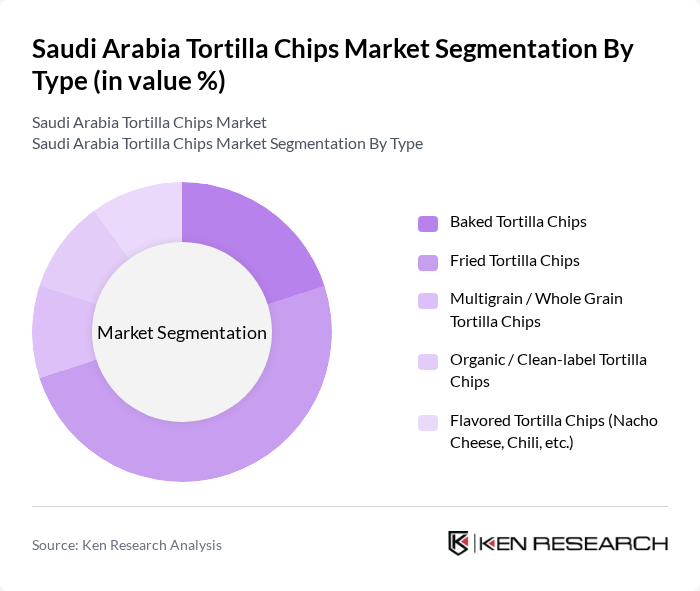
By Type:The market can be segmented into various types of tortilla chips, including Baked Tortilla Chips, Fried Tortilla Chips, Multigrain / Whole Grain Tortilla Chips, Organic / Clean-label Tortilla Chips, and Flavored Tortilla Chips. Fried Tortilla Chips continue to hold the largest share of consumption due to their traditional appeal, strong presence of mainstream brands, and widespread consumer acceptance, in line with global patterns where fried variants dominate volume. The preference for classic flavors and familiar crunchy textures drives their popularity, while the growing trend towards healthier snacking, front-of-pack labelling initiatives, and demand for low-fat, non-GMO, and gluten-free options is steadily increasing the uptake of Baked, Multigrain, and Organic / Clean-label varieties.
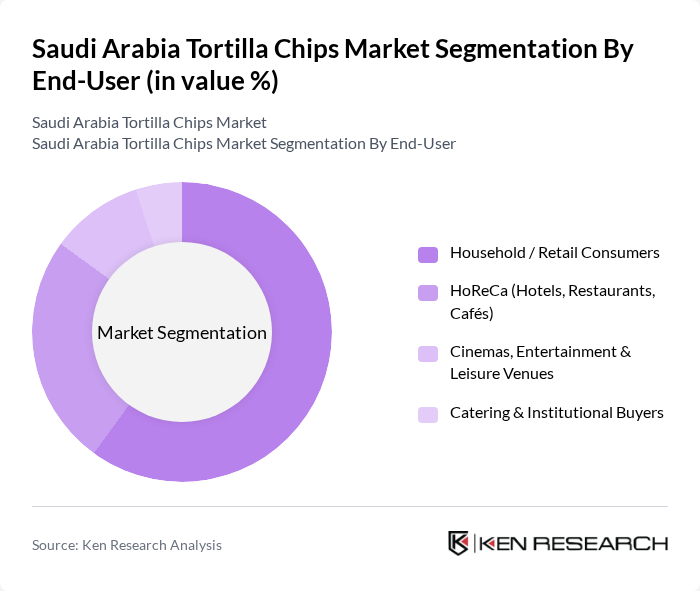
By End-User:The end-user segmentation includes Household / Retail Consumers, HoReCa (Hotels, Restaurants, Cafés), Cinemas, Entertainment & Leisure Venues, and Catering & Institutional Buyers. The Household / Retail Consumers segment leads the market, supported by increased in-home snacking, growth of modern grocery retail, and wider availability of tortilla chips in different pack sizes and flavor variants across supermarkets, hypermarkets, and online channels. The HoReCa segment is also significant, as quick-service restaurants, casual dining outlets, and cafés increasingly incorporate tortilla chips and nacho formats into their menus, while cinemas and entertainment venues use portioned tortilla chip offerings to serve rising demand for convenient, shareable snacks.
Saudi Arabia Tortilla Chips Market Competitive Landscape
The Saudi Arabia Tortilla Chips Market is characterized by a dynamic mix of regional and international players. Leading participants such as PepsiCo / Tasali Snack Foods, Frito-Lay (Doritos, other imported tortilla chips), Mission Foods (Gruma), Mondelez Arabia, Almunajem Foods, Savola Foods Company, Al-Rifai Roastery & Snack Foods, Saudia Dairy & Foodstuff Company (SADAFCO), Halwani Bros. Co., Americana Foods (Kuwait Food Company – Saudi operations), Private Label Brands (e.g., Carrefour, Lulu Hypermarket, Panda), Regional Tex-Mex Restaurant Chains (as bulk tortilla chips buyers), Emerging Local Snack Manufacturers (SMEs), Importers & Distributors of International Tortilla Chips Brands, Online-first Snack Brands & D2C Players contribute to innovation, geographic expansion, and service delivery in this space.
Saudi Arabia Tortilla Chips Market Industry Analysis
Growth Drivers
- Increasing Consumer Demand for Snacks:The Saudi Arabian snack market is projected to reach SAR 12 billion in future, driven by a growing population and urbanization. The youth demographic, comprising over 50% of the population, is particularly inclined towards snack consumption. This trend is further supported by the rise in disposable incomes, with an average increase of 3.5% annually, leading to higher spending on convenience foods, including tortilla chips.
- Rising Health Consciousness and Preference for Healthier Snacks:With 60% of the Saudi population actively seeking healthier snack options, the demand for tortilla chips made from organic and whole ingredients is surging. The health food segment is expected to grow by 8% annually, reflecting a shift towards low-calorie and gluten-free products. This trend is reinforced by government initiatives promoting healthier eating habits, which further boosts the tortilla chips market.
- Expansion of Retail and Distribution Channels:The retail landscape in Saudi Arabia is evolving, with over 1,200 new supermarkets and hypermarkets opening in the last two years. This expansion facilitates greater accessibility to tortilla chips, enhancing consumer reach. Additionally, the growth of modern trade channels, which accounted for 65% of snack sales in future, supports the distribution of diverse tortilla chip brands, catering to varying consumer preferences.
Market Challenges
- High Competition from Local and International Brands:The Saudi tortilla chips market is characterized by intense competition, with over 50 brands vying for market share. Major players like Frito-Lay and local brands are engaged in aggressive marketing strategies, leading to price wars. This competitive landscape can erode profit margins, making it challenging for new entrants to establish a foothold in the market.
- Fluctuating Raw Material Prices:The tortilla chips industry is significantly affected by the volatility of raw material prices, particularly corn and vegetable oils. In future, corn prices surged by 15% due to supply chain disruptions and climate-related issues. Such fluctuations can lead to increased production costs, impacting pricing strategies and profitability for manufacturers in the Saudi market.
Saudi Arabia Tortilla Chips Market Future Outlook
The Saudi Arabia tortilla chips market is poised for significant growth, driven by evolving consumer preferences and innovative product offerings. As health-conscious consumers increasingly seek organic and gluten-free options, manufacturers are likely to adapt their product lines accordingly. Additionally, the rise of e-commerce platforms is expected to enhance market accessibility, allowing brands to reach a broader audience. Collaborations with local eateries may also create new avenues for growth, further solidifying the market's expansion in the coming years.
Market Opportunities
- Introduction of Innovative Flavors and Product Lines:There is a growing opportunity for brands to introduce unique flavors and product variations, such as spicy or regional flavors, to cater to local tastes. This innovation can attract a diverse consumer base, potentially increasing market share and driving sales growth in the competitive landscape.
- Growth of E-commerce Platforms for Snack Sales:The e-commerce sector in Saudi Arabia is expected to grow by 20% annually, providing a significant opportunity for tortilla chip brands to expand their online presence. By leveraging digital marketing strategies and partnerships with online retailers, companies can enhance visibility and accessibility, tapping into the increasing trend of online shopping among consumers.
Scope of the Report
| Segment | Sub-Segments |
|---|---|
| By Type | Baked Tortilla Chips Fried Tortilla Chips Multigrain / Whole Grain Tortilla Chips Organic / Clean-label Tortilla Chips Flavored Tortilla Chips (Nacho Cheese, Chili, etc.) |
| By End-User | Household / Retail Consumers HoReCa (Hotels, Restaurants, Cafés) Cinemas, Entertainment & Leisure Venues Catering & Institutional Buyers |
| By Distribution Channel | Supermarkets and Hypermarkets Convenience Stores & Small Groceries (Bakalah) Online Grocery & E-commerce Platforms Wholesale & Cash-and-Carry Specialty & Gourmet Stores |
| By Packaging Type | Single-serve Bags Family-size / Multi-serve Bags Bulk / Foodservice Packs Assorted / Multipack Formats |
| By Flavor Profile | Salted / Original Chili & Spicy Variants Cheese-based Flavors Lime & Herb / Regional-inspired Flavors Other Experimental & Limited-edition Flavors |
| By Price Range | Economy Mainstream / Mid-Range Premium & Imported |
| By Region | Central Region (incl. Riyadh) Western Region (incl. Jeddah, Makkah, Madinah) Eastern Region (incl. Dammam, Al Khobar, Dhahran) Northern Region Southern Region |
Key Target Audience
Investors and Venture Capitalist Firms
Government and Regulatory Bodies (e.g., Saudi Food and Drug Authority, Ministry of Commerce)
Manufacturers and Producers
Distributors and Retailers
Food Service Operators
Importers and Exporters
Industry Associations (e.g., Saudi Arabian Snack Food Association)
Financial Institutions
Players Mentioned in the Report:
PepsiCo / Tasali Snack Foods
Frito-Lay (Doritos, other imported tortilla chips)
Mission Foods (Gruma)
Mondelez Arabia
Almunajem Foods
Savola Foods Company
Al-Rifai Roastery & Snack Foods
Saudia Dairy & Foodstuff Company (SADAFCO)
Halwani Bros. Co.
Americana Foods (Kuwait Food Company Saudi operations)
Private Label Brands (e.g., Carrefour, Lulu Hypermarket, Panda)
Regional Tex-Mex Restaurant Chains (as bulk tortilla chips buyers)
Emerging Local Snack Manufacturers (SMEs)
Importers & Distributors of International Tortilla Chips Brands
Online-first Snack Brands & D2C Players
Table of Contents
Market Assessment Phase
1. Executive Summary and Approach
2. Saudi Arabia Tortilla Chips Market Overview
2.1 Key Insights and Strategic Recommendations
2.2 Saudi Arabia Tortilla Chips Market Overview
2.3 Definition and Scope
2.4 Evolution of Market Ecosystem
2.5 Timeline of Key Regulatory Milestones
2.6 Value Chain & Stakeholder Mapping
2.7 Business Cycle Analysis
2.8 Policy & Incentive Landscape
3. Saudi Arabia Tortilla Chips Market Analysis
3.1 Growth Drivers
3.1.1 Increasing consumer demand for snacks
3.1.2 Rising health consciousness and preference for healthier snacks
3.1.3 Expansion of retail and distribution channels
3.1.4 Influence of Western food culture
3.2 Market Challenges
3.2.1 High competition from local and international brands
3.2.2 Fluctuating raw material prices
3.2.3 Regulatory hurdles and compliance issues
3.2.4 Limited consumer awareness about product varieties
3.3 Market Opportunities
3.3.1 Introduction of innovative flavors and product lines
3.3.2 Growth of e-commerce platforms for snack sales
3.3.3 Potential for export to neighboring regions
3.3.4 Collaborations with local restaurants and cafes
3.4 Market Trends
3.4.1 Increasing demand for organic and gluten-free options
3.4.2 Rise in private label brands
3.4.3 Focus on sustainable packaging solutions
3.4.4 Growth in on-the-go snacking habits
3.5 Government Regulation
3.5.1 Food safety standards and labeling requirements
3.5.2 Import tariffs on snack foods
3.5.3 Health regulations regarding additives and preservatives
3.5.4 Support for local manufacturing initiatives
4. SWOT Analysis
5. Stakeholder Analysis
6. Porter's Five Forces Analysis
7. Saudi Arabia Tortilla Chips Market Market Size, 2019-2024
7.1 By Value
7.2 By Volume
7.3 By Average Selling Price
8. Saudi Arabia Tortilla Chips Market Segmentation
8.1 By Type
8.1.1 Baked Tortilla Chips
8.1.2 Fried Tortilla Chips
8.1.3 Multigrain / Whole Grain Tortilla Chips
8.1.4 Organic / Clean-label Tortilla Chips
8.1.5 Flavored Tortilla Chips (Nacho Cheese, Chili, etc.)
8.2 By End-User
8.2.1 Household / Retail Consumers
8.2.2 HoReCa (Hotels, Restaurants, Cafés)
8.2.3 Cinemas, Entertainment & Leisure Venues
8.2.4 Catering & Institutional Buyers
8.3 By Distribution Channel
8.3.1 Supermarkets and Hypermarkets
8.3.2 Convenience Stores & Small Groceries (Bakalah)
8.3.3 Online Grocery & E-commerce Platforms
8.3.4 Wholesale & Cash-and-Carry
8.3.5 Specialty & Gourmet Stores
8.4 By Packaging Type
8.4.1 Single-serve Bags
8.4.2 Family-size / Multi-serve Bags
8.4.3 Bulk / Foodservice Packs
8.4.4 Assorted / Multipack Formats
8.5 By Flavor Profile
8.5.1 Salted / Original
8.5.2 Chili & Spicy Variants
8.5.3 Cheese-based Flavors
8.5.4 Lime & Herb / Regional-inspired Flavors
8.5.5 Other Experimental & Limited-edition Flavors
8.6 By Price Range
8.6.1 Economy
8.6.2 Mainstream / Mid-Range
8.6.3 Premium & Imported
8.7 By Region
8.7.1 Central Region (incl. Riyadh)
8.7.2 Western Region (incl. Jeddah, Makkah, Madinah)
8.7.3 Eastern Region (incl. Dammam, Al Khobar, Dhahran)
8.7.4 Northern Region
8.7.5 Southern Region
9. Saudi Arabia Tortilla Chips Market Competitive Analysis
9.1 Market Share of Key Players
9.2 Cross Comparison of Key Players
9.2.1 Company Name
9.2.2 Presence in Saudi Arabia (Years of Operation / Entry Year)
9.2.3 Estimated Saudi Arabia Tortilla Chips Revenue
9.2.4 Revenue Growth Rate in Saudi Arabia
9.2.5 Market Share in Saudi Arabia Tortilla Chips Segment
9.2.6 Numeric & Weighted Distribution Coverage
9.2.7 Share of Modern Trade vs Traditional Trade Sales
9.2.8 Average Selling Price Positioning
9.2.9 SKU Count & Flavor/Format Breadth
9.2.10 Marketing & Promotion Intensity (A&P Spend as % of Sales)
9.2.11 Innovation Pipeline (New Launches per Year)
9.2.12 Private Label / Co-manufacturing Exposure
9.3 SWOT Analysis of Top Players
9.4 Pricing Analysis
9.5 Detailed Profile of Major Companies
9.5.1 PepsiCo / Tasali Snack Foods
9.5.2 Frito-Lay (Doritos, other imported tortilla chips)
9.5.3 Mission Foods (Gruma)
9.5.4 Mondelez Arabia
9.5.5 Almunajem Foods
9.5.6 Savola Foods Company
9.5.7 Al-Rifai Roastery & Snack Foods
9.5.8 Saudia Dairy & Foodstuff Company (SADAFCO)
9.5.9 Halwani Bros. Co.
9.5.10 Americana Foods (Kuwait Food Company – Saudi operations)
9.5.11 Private Label Brands (e.g., Carrefour, Lulu Hypermarket, Panda)
9.5.12 Regional Tex-Mex Restaurant Chains (as bulk tortilla chips buyers)
9.5.13 Emerging Local Snack Manufacturers (SMEs)
9.5.14 Importers & Distributors of International Tortilla Chips Brands
9.5.15 Online-first Snack Brands & D2C Players
10. Saudi Arabia Tortilla Chips Market End-User Analysis
10.1 Procurement Behavior of Key Ministries
10.1.1 Ministry of Health
10.1.2 Ministry of Commerce
10.1.3 Ministry of Education
10.1.4 Ministry of Municipal and Rural Affairs
10.2 Corporate Spend on Infrastructure & Energy
10.2.1 Corporate Snack Procurement Trends
10.2.2 Budget Allocations for Snack Products
10.2.3 Investment in Local Snack Production
10.2.4 Others
10.3 Pain Point Analysis by End-User Category
10.3.1 Retail Consumers
10.3.2 Food Service Providers
10.3.3 Event Organizers
10.3.4 Others
10.4 User Readiness for Adoption
10.4.1 Awareness of Tortilla Chips
10.4.2 Willingness to Try New Flavors
10.4.3 Preference for Healthier Options
10.4.4 Others
10.5 Post-Deployment ROI and Use Case Expansion
10.5.1 Evaluation of Snack Performance
10.5.2 Customer Feedback Mechanisms
10.5.3 Opportunities for Product Line Expansion
10.5.4 Others
11. Saudi Arabia Tortilla Chips Market Future Size, 2025-2030
11.1 By Value
11.2 By Volume
11.3 By Average Selling Price
Go-To-Market Strategy Phase
1. Whitespace Analysis + Business Model Canvas
1.1 Market Gaps Identification
1.2 Business Model Development
2. Marketing and Positioning Recommendations
2.1 Branding Strategies
2.2 Product USPs
3. Distribution Plan
3.1 Urban Retail vs Rural NGO Tie-ups
4. Channel & Pricing Gaps
4.1 Underserved Routes
4.2 Pricing Bands
5. Unmet Demand & Latent Needs
5.1 Category Gaps
5.2 Consumer Segments
6. Customer Relationship
6.1 Loyalty Programs
6.2 After-sales Service
7. Value Proposition
7.1 Sustainability
7.2 Integrated Supply Chains
8. Key Activities
8.1 Regulatory Compliance
8.2 Branding
8.3 Distribution Setup
9. Entry Strategy Evaluation
9.1 Domestic Market Entry Strategy
9.1.1 Product Mix
9.1.2 Pricing Band
9.1.3 Packaging
9.2 Export Entry Strategy
9.2.1 Target Countries
9.2.2 Compliance Roadmap
10. Entry Mode Assessment
10.1 JV
10.2 Greenfield
10.3 M&A
10.4 Distributor Model
11. Capital and Timeline Estimation
11.1 Capital Requirements
11.2 Timelines
12. Control vs Risk Trade-Off
12.1 Ownership vs Partnerships
13. Profitability Outlook
13.1 Breakeven Analysis
13.2 Long-term Sustainability
14. Potential Partner List
14.1 Distributors
14.2 JVs
14.3 Acquisition Targets
15. Execution Roadmap
15.1 Phased Plan for Market Entry
15.1.1 Market Setup
15.1.2 Market Entry
15.1.3 Growth Acceleration
15.1.4 Scale & Stabilize
15.2 Key Activities and Milestones
15.2.1 Activity Planning
15.2.2 Milestone Tracking
Research Methodology
Phase 1: Approach1
Desk Research
- Analysis of market reports from industry associations and trade publications specific to the snack food sector in Saudi Arabia
- Review of government publications and trade statistics related to food imports and local production of tortilla chips
- Examination of consumer behavior studies and market trends published by local research firms
Primary Research
- Interviews with key stakeholders in the food distribution network, including wholesalers and retailers
- Surveys conducted with consumers to understand preferences, purchasing habits, and brand loyalty regarding tortilla chips
- Focus group discussions with food industry experts and culinary professionals to gather insights on flavor trends and product innovation
Validation & Triangulation
- Cross-validation of findings through comparison with historical sales data and market growth rates
- Triangulation of insights from consumer surveys, expert interviews, and secondary data sources
- Sanity checks through expert panel reviews to ensure the reliability of the data collected
Phase 2: Market Size Estimation1
Top-down Assessment
- Estimation of the total addressable market for tortilla chips based on overall snack food market size in Saudi Arabia
- Segmentation of the market by distribution channels, including supermarkets, convenience stores, and online platforms
- Incorporation of demographic data to assess potential market growth among different consumer segments
Bottom-up Modeling
- Collection of sales data from major tortilla chip manufacturers and distributors operating in the region
- Estimation of average retail prices and volume sold to derive revenue figures
- Analysis of production capacity and supply chain logistics to understand market dynamics
Forecasting & Scenario Analysis
- Utilization of time-series analysis to project future market growth based on historical trends
- Scenario modeling based on potential economic changes, consumer health trends, and competitive landscape shifts
- Development of multiple growth scenarios (baseline, optimistic, and pessimistic) through 2030
Phase 3: CATI Sample Composition1
| Scope Item/Segment | Sample Size | Target Respondent Profiles |
|---|---|---|
| Retail Sector Insights | 120 | Store Managers, Category Buyers |
| Consumer Preferences | 150 | Regular Snack Consumers, Health-Conscious Shoppers |
| Distribution Channel Analysis | 100 | Wholesalers, Distributors |
| Market Trends Evaluation | 80 | Food Industry Analysts, Market Researchers |
| Product Innovation Feedback | 70 | Culinary Experts, Food Product Developers |
Frequently Asked Questions
What is the current value of the Saudi Arabia Tortilla Chips Market?
The Saudi Arabia Tortilla Chips Market is valued at approximately USD 160 million, reflecting a growing demand for snack foods driven by urbanization and changing consumer preferences towards convenience and healthier options.
What factors are driving the growth of the tortilla chips market in Saudi Arabia?
Which cities are the main hubs for tortilla chip sales in Saudi Arabia?
What types of tortilla chips are popular in Saudi Arabia?
Other Regional/Country Reports
Indonesia Tortilla Chips Market
Malaysia Tortilla Chips Market
KSA Tortilla Chips Market
APAC Tortilla Chips Market
SEA Tortilla Chips Market
Other Adjacent Reports
Egypt Snack Foods Market
Vietnam Savory Snacks Market Size, Share, Growth Drivers, Trends, Opportunities & Forecast 2025–2030GCC Potato Chips Market Size Share Growth Drivers Trends Opportunities & Forecast 2025–2030Singapore Corn Products Market
Philippines healthy snacks market report Size, Share, Growth Drivers, Trends, Opportunities & Forecast 2025–2030South Korea Packaged Foods Market
KSA food packaging market size, share, growth drivers, trends, opportunities & forecast 2025–2030US Seasonings Market Report Size Share Growth Drivers Trends Opportunities & Forecast 2025–2030Kuwait Convenience Foods Market
Vietnam Ethnic Foods Market
Why Buy From Us?

What makes us stand out is that our consultants follow Robust, Refine and Result (RRR) methodology. Robust for clear definitions, approaches and sanity checking, Refine for differentiating respondents' facts and opinions, and Result for presenting data with story.

We have set a benchmark in the industry by offering our clients with syndicated and customized market research reports featuring coverage of entire market as well as meticulous research and analyst insights.

While we don't replace traditional research, we flip the method upside down. Our dual approach of Top Bottom & Bottom Top ensures quality deliverable by not just verifying company fundamentals but also looking at the sector and macroeconomic factors.

With one step in the future, our research team constantly tries to show you the bigger picture. We help with some of the tough questions you may encounter along the way: How is the industry positioned? Best marketing channel? KPI's of competitors? By aligning every element, we help maximize success.

Our report gives you instant access to the answers and sources that other companies might choose to hide. We elaborate each steps of research methodology we have used and showcase you the sample size to earn your trust.

If you need any support, we are here! We pride ourselves on universe strength, data quality, and quick, friendly, and professional service.