About the Report
Base Year 2024Saudi Arabia Veterinary 3D Printing Market Overview
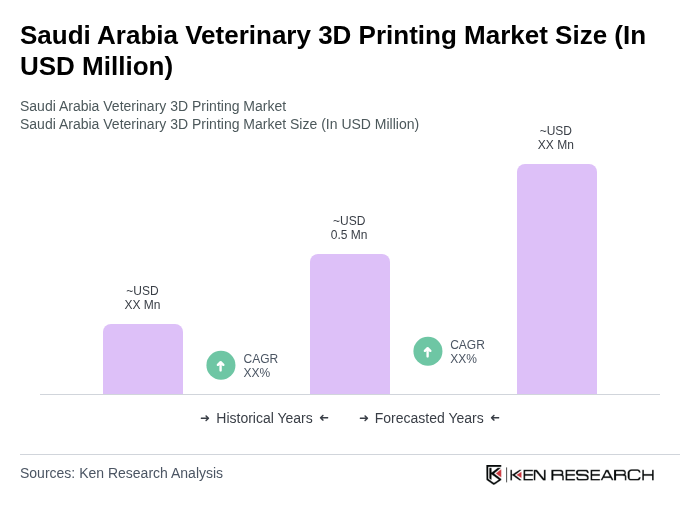
- The Saudi Arabia Veterinary 3D Printing Market is valued at USD 0.5 million, based on a five-year historical analysis. This growth is primarily driven by advancements in veterinary medicine, increasing adoption of 3D printing technologies for customized veterinary solutions such as surgical guides, prosthetics, and anatomical models, and a rising demand for innovative treatment options for animals. The market is also supported by growing awareness of animal health and welfare among pet owners and veterinary professionals, as well as broader expansion of 3D printing use in healthcare within Saudi Arabia.
- Key cities dominating the market include Riyadh, Jeddah, and Dammam. Riyadh serves as the capital and a central hub for veterinary services and education, hosting major universities and research centers such as King Saud University and King Abdulaziz City for Science and Technology that are active in 3D printing and biomedical research. Jeddah and Dammam are significant due to their strategic locations, higher concentration of specialty clinics, and access to tertiary care and referral hospitals, which increasingly collaborate with 3D printing facilities for patient?specific models and devices in both human and veterinary healthcare.
- In 2023, the Saudi Arabian government implemented regulations and initiatives to promote the use of 3D printing technologies in medical and associated applications, which extend to veterinary uses. A key framework is the Medical Devices Law and its Executive Regulations issued by the Saudi Food and Drug Authority (SFDA) in 2021, which sets requirements for registration, quality management, risk classification, and post?market surveillance of medical devices, including 3D?printed implants and instruments. In parallel, the National Industrial Development and Logistics Program (NIDLP) and the 3D Printing Strategy led by the Ministry of Industry and Mineral Resources encourage industrialization and safe deployment of additive manufacturing, including guidelines for design validation, material traceability, and facility licensing that are followed by healthcare and veterinary providers using 3D?printed medical devices. These measures aim to enhance the quality of care and foster innovation in both human and animal health.
Saudi Arabia Veterinary 3D Printing Market Segmentation
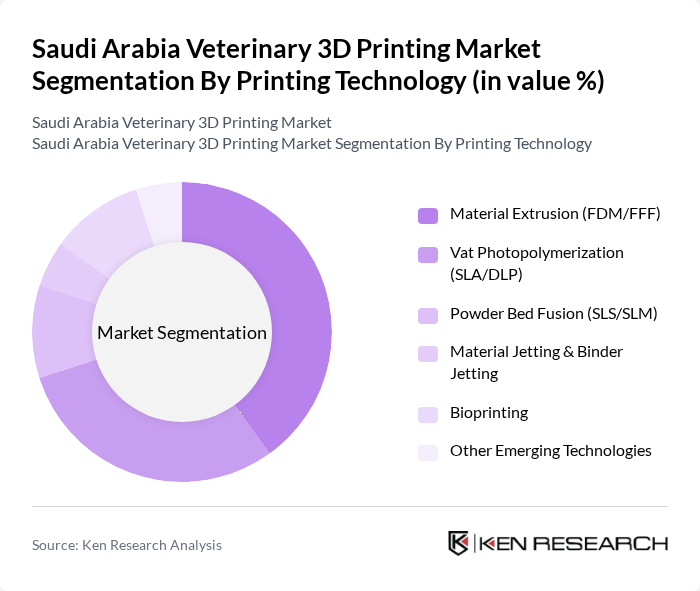
By Printing Technology:The market is segmented into various printing technologies, each offering unique advantages for veterinary applications. The dominant technologies include Material Extrusion (FDM/FFF) and Vat Photopolymerization (SLA/DLP), which are widely used globally for creating customized anatomical models, surgical guides, dental appliances, and some non?load?bearing implants in veterinary medicine due to their balance of cost, ease of use, and acceptable resolution. The choice of technology often depends on the specific requirements of veterinary practices, such as precision for complex surgical planning, availability of biocompatible materials, turnaround time, and cost?effectiveness, with powder bed fusion and emerging bioprinting gaining traction for more advanced orthopedic and tissue?engineering applications.
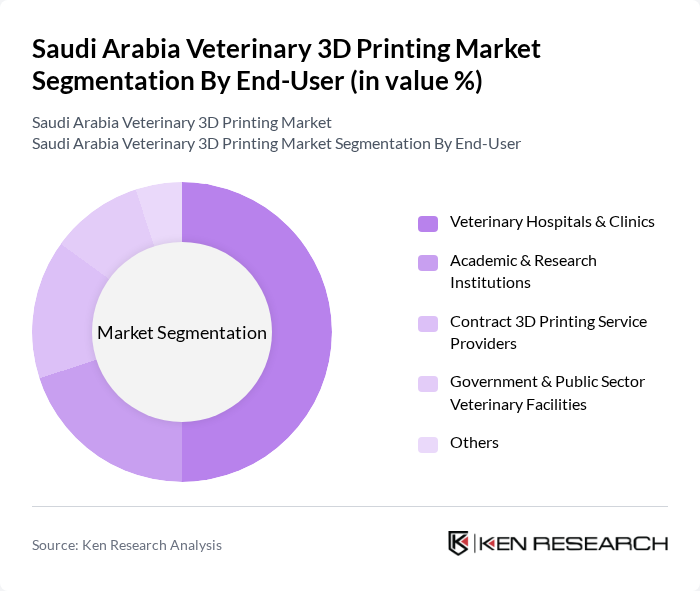
By End-User:The end-user segment includes various stakeholders in the veterinary field, such as veterinary hospitals and clinics, academic and research institutions, and contract 3D printing service providers. Veterinary hospitals and clinics are the leading end-users, in line with global trends where this segment accounts for the largest share of veterinary 3D printing revenues, driven by demand for patient?specific surgical models, orthopedic implants, and dental solutions for companion animals. The increasing collaboration between academic institutions, research centers, and veterinary practices in Saudi Arabia—often via university?affiliated 3D printing labs and healthcare 3D printing centers—also contributes to the growth of this segment and supports training, prototyping, and complex case planning.
Saudi Arabia Veterinary 3D Printing Market Competitive Landscape
The Saudi Arabia Veterinary 3D Printing Market is characterized by a dynamic mix of regional and international players. Leading participants such as 3D Systems Corporation, Stratasys Ltd., Materialise NV, EnvisionTEC GmbH (Desktop Health), EOS GmbH, Formlabs Inc., Protolabs Inc., Xometry Inc., bio3Dvet, Wimba SA, Vet3D (biofabrication solutions), 3D Veterinary Printing Solutions (3D VetPrint), Saudi Arabian Oil Company (Saudi Aramco) – Additive Manufacturing Center, King Saud University – Additive Manufacturing & Veterinary Applications, King Abdulaziz City for Science and Technology (KACST) – 3D Printing Programs contribute to innovation, geographic expansion, and service delivery in this space, aligning with the broader growth of the veterinary 3D printing market globally and increasing adoption in the Middle East.
Saudi Arabia Veterinary 3D Printing Market Industry Analysis
Growth Drivers
- Increasing Demand for Customized Veterinary Solutions:The Saudi Arabian veterinary sector is witnessing a surge in demand for customized solutions, driven by the growing pet population, which reached approximately 22 million. This increase in pet ownership correlates with a heightened need for personalized veterinary care, including tailored prosthetics and implants. The market for customized veterinary products is projected to grow significantly, supported by advancements in 3D printing technology that enable the production of bespoke solutions for individual animal needs.
- Advancements in 3D Printing Technology:The rapid evolution of 3D printing technology is a key driver for the veterinary market in Saudi Arabia. In future, the country is expected to invest over SAR 1.5 billion in 3D printing innovations, enhancing the capabilities of veterinary practices. These advancements allow for the creation of complex structures, such as anatomical models and surgical guides, which improve surgical outcomes and reduce recovery times for animals. This technological progress is crucial for the adoption of 3D printing in veterinary applications.
- Rising Awareness of Animal Health and Welfare:There is a growing awareness of animal health and welfare among pet owners and veterinary professionals in Saudi Arabia. Recently, the country saw a 20% increase in spending on veterinary services, reflecting a shift towards prioritizing animal well-being. This trend is fostering a demand for innovative solutions, including 3D printed medical devices and treatments that enhance the quality of care. As awareness continues to rise, the veterinary 3D printing market is expected to benefit significantly.
Market Challenges
- High Initial Investment Costs:One of the primary challenges facing the veterinary 3D printing market in Saudi Arabia is the high initial investment required for 3D printing equipment and materials. The cost of advanced 3D printers can exceed SAR 600,000, which poses a barrier for many veterinary clinics, particularly smaller practices. This financial hurdle limits the widespread adoption of 3D printing technologies, hindering the potential growth of the market despite its advantages.
- Limited Awareness Among Veterinary Professionals:Despite the potential benefits of 3D printing, there remains a significant knowledge gap among veterinary professionals in Saudi Arabia. A survey conducted recently indicated that only 35% of veterinarians were familiar with 3D printing applications in their field. This lack of awareness can lead to underutilization of available technologies, stalling innovation and limiting the market's growth potential. Educational initiatives are essential to bridge this gap and promote the technology's benefits.
Saudi Arabia Veterinary 3D Printing Market Future Outlook
The future of the veterinary 3D printing market in Saudi Arabia appears promising, driven by technological advancements and increasing demand for personalized veterinary care. As more veterinary clinics adopt 3D printing technologies, the market is likely to expand, supported by government initiatives aimed at fostering innovation. Additionally, collaborations between veterinary practices and educational institutions will enhance research and development, paving the way for new applications and materials that cater to the evolving needs of animal healthcare.
Market Opportunities
- Expansion of Veterinary Clinics Adopting 3D Printing:The increasing number of veterinary clinics in Saudi Arabia presents a significant opportunity for 3D printing adoption. With over 1,500 veterinary clinics operating in the country recently, the potential for integrating 3D printing technologies into their services is substantial. This expansion can lead to improved patient outcomes and increased revenue streams for clinics that embrace innovative solutions.
- Development of Biocompatible Materials for Veterinary Use:There is a growing opportunity for the development of biocompatible materials specifically designed for veterinary applications. As the demand for safe and effective 3D printed medical devices increases, research into new materials that meet regulatory standards will be crucial. This innovation can enhance the safety and efficacy of veterinary treatments, further driving the adoption of 3D printing technologies in the sector.
Scope of the Report
| Segment | Sub-Segments |
|---|---|
| By Printing Technology | Material Extrusion (FDM/FFF) Vat Photopolymerization (SLA/DLP) Powder Bed Fusion (SLS/SLM) Material Jetting & Binder Jetting Bioprinting Other Emerging Technologies |
| By End-User | Veterinary Hospitals & Clinics Academic & Research Institutions Contract 3D Printing Service Providers Government & Public Sector Veterinary Facilities Others |
| By Animal Type | Companion Animals (Canine, Feline) Equine Livestock (Bovine, Ovine, Caprine) Avian & Exotic Animals Others |
| By Application | Orthopedic Implants & Prosthetics Surgical Planning & Training Models Dental & Maxillofacial Applications Patient-Specific Surgical Guides Tissue Engineering & Bioprinting Others |
| By Material Type | Polymers & Resins Metals & Alloys Ceramics Biocompatible & Bio-ink Materials Others |
| By Distribution Channel | Direct Sales (OEM to End-User) Authorized Distributors & Value-Added Resellers Online Platforms & E-commerce Tender-Based & Institutional Procurement Others |
| By Region | Central Region (including Riyadh) Western Region (including Makkah, Madinah, Jeddah) Eastern Region (including Dammam, Dhahran, Al Khobar) Southern Region Northern Region |
Key Target Audience
Investors and Venture Capitalist Firms
Government and Regulatory Bodies (e.g., Saudi Food and Drug Authority, Ministry of Environment, Water and Agriculture)
Veterinary Clinics and Hospitals
Animal Health Product Manufacturers
3D Printing Technology Providers
Veterinary Research Institutions
Animal Welfare Organizations
Pharmaceutical Companies specializing in Veterinary Medicine
Players Mentioned in the Report:
3D Systems Corporation
Stratasys Ltd.
Materialise NV
EnvisionTEC GmbH (Desktop Health)
EOS GmbH
Formlabs Inc.
Protolabs Inc.
Xometry Inc.
bio3Dvet
Wimba SA
Vet3D (biofabrication solutions)
3D Veterinary Printing Solutions (3D VetPrint)
Saudi Arabian Oil Company (Saudi Aramco) Additive Manufacturing Center
King Saud University Additive Manufacturing & Veterinary Applications
King Abdulaziz City for Science and Technology (KACST) 3D Printing Programs
Table of Contents
Market Assessment Phase
1. Executive Summary and Approach
2. Saudi Arabia Veterinary 3D Printing Market Overview
2.1 Key Insights and Strategic Recommendations
2.2 Saudi Arabia Veterinary 3D Printing Market Overview
2.3 Definition and Scope
2.4 Evolution of Market Ecosystem
2.5 Timeline of Key Regulatory Milestones
2.6 Value Chain & Stakeholder Mapping
2.7 Business Cycle Analysis
2.8 Policy & Incentive Landscape
3. Saudi Arabia Veterinary 3D Printing Market Analysis
3.1 Growth Drivers
3.1.1 Increasing demand for customized veterinary solutions
3.1.2 Advancements in 3D printing technology
3.1.3 Rising awareness of animal health and welfare
3.1.4 Government support for veterinary innovations
3.2 Market Challenges
3.2.1 High initial investment costs
3.2.2 Limited awareness among veterinary professionals
3.2.3 Regulatory hurdles in 3D printed veterinary products
3.2.4 Competition from traditional veterinary practices
3.3 Market Opportunities
3.3.1 Expansion of veterinary clinics adopting 3D printing
3.3.2 Development of biocompatible materials for veterinary use
3.3.3 Collaborations with educational institutions for research
3.3.4 Growth in pet ownership and veterinary services
3.4 Market Trends
3.4.1 Increasing integration of AI in 3D printing processes
3.4.2 Custom prosthetics and implants for animals
3.4.3 Rise of on-demand printing services
3.4.4 Focus on sustainable and eco-friendly materials
3.5 Government Regulation
3.5.1 Standards for veterinary medical devices
3.5.2 Guidelines for 3D printing in veterinary applications
3.5.3 Compliance requirements for imported materials
3.5.4 Intellectual property regulations for 3D printed products
4. SWOT Analysis
5. Stakeholder Analysis
6. Porter's Five Forces Analysis
7. Saudi Arabia Veterinary 3D Printing Market Market Size, 2019-2024
7.1 By Value
7.2 By Volume
7.3 By Average Selling Price
8. Saudi Arabia Veterinary 3D Printing Market Segmentation
8.1 By Printing Technology
8.1.1 Material Extrusion (FDM/FFF)
8.1.2 Vat Photopolymerization (SLA/DLP)
8.1.3 Powder Bed Fusion (SLS/SLM)
8.1.4 Material Jetting & Binder Jetting
8.1.5 Bioprinting
8.1.6 Other Emerging Technologies
8.2 By End-User
8.2.1 Veterinary Hospitals & Clinics
8.2.2 Academic & Research Institutions
8.2.3 Contract 3D Printing Service Providers
8.2.4 Government & Public Sector Veterinary Facilities
8.2.5 Others
8.3 By Animal Type
8.3.1 Companion Animals (Canine, Feline)
8.3.2 Equine
8.3.3 Livestock (Bovine, Ovine, Caprine)
8.3.4 Avian & Exotic Animals
8.3.5 Others
8.4 By Application
8.4.1 Orthopedic Implants & Prosthetics
8.4.2 Surgical Planning & Training Models
8.4.3 Dental & Maxillofacial Applications
8.4.4 Patient-Specific Surgical Guides
8.4.5 Tissue Engineering & Bioprinting
8.4.6 Others
8.5 By Material Type
8.5.1 Polymers & Resins
8.5.2 Metals & Alloys
8.5.3 Ceramics
8.5.4 Biocompatible & Bio-ink Materials
8.5.5 Others
8.6 By Distribution Channel
8.6.1 Direct Sales (OEM to End-User)
8.6.2 Authorized Distributors & Value-Added Resellers
8.6.3 Online Platforms & E-commerce
8.6.4 Tender-Based & Institutional Procurement
8.6.5 Others
8.7 By Region
8.7.1 Central Region (including Riyadh)
8.7.2 Western Region (including Makkah, Madinah, Jeddah)
8.7.3 Eastern Region (including Dammam, Dhahran, Al Khobar)
8.7.4 Southern Region
8.7.5 Northern Region
9. Saudi Arabia Veterinary 3D Printing Market Competitive Analysis
9.1 Market Share of Key Players
9.2 Cross Comparison of Key Players
9.2.1 Company Presence in Saudi Arabia (Direct vs. Through Distributors)
9.2.2 Installed Base of 3D Printers in Veterinary Settings (Units in KSA)
9.2.3 Veterinary-Specific Revenue Share from Saudi Arabia
9.2.4 CAGR of Veterinary 3D Printing Revenue in Saudi Arabia (Last 3–5 Years)
9.2.5 Breadth of Veterinary Application Portfolio (Orthopedic, Dental, Surgical, Bioprinting)
9.2.6 Number of Veterinary Reference Sites & Key Accounts in KSA
9.2.7 Average System Selling Price & Material Cost per Case
9.2.8 Local Partnerships & Distribution Network Strength
9.2.9 Regulatory & Quality Approvals Relevant to KSA (SFDA, ISO, CE, FDA)
9.2.10 R&D Intensity in Veterinary 3D Printing (Patents, Pipelines, Collaborations)
9.2.11 After-Sales Service Coverage & Uptime Guarantees in Saudi Arabia
9.2.12 Training & Education Programs for Veterinary 3D Printing Users
9.3 SWOT Analysis of Top Players
9.4 Pricing Analysis
9.5 Detailed Profile of Major Companies
9.5.1 3D Systems Corporation
9.5.2 Stratasys Ltd.
9.5.3 Materialise NV
9.5.4 EnvisionTEC GmbH (Desktop Health)
9.5.5 EOS GmbH
9.5.6 Formlabs Inc.
9.5.7 Protolabs Inc.
9.5.8 Xometry Inc.
9.5.9 bio3Dvet
9.5.10 Wimba SA
9.5.11 Vet3D (biofabrication solutions)
9.5.12 3D Veterinary Printing Solutions (3D VetPrint)
9.5.13 Saudi Arabian Oil Company (Saudi Aramco) – Additive Manufacturing Center
9.5.14 King Saud University – Additive Manufacturing & Veterinary Applications
9.5.15 King Abdulaziz City for Science and Technology (KACST) – 3D Printing Programs
10. Saudi Arabia Veterinary 3D Printing Market End-User Analysis
10.1 Procurement Behavior of Key Ministries
10.1.1 Ministry of Environment, Water and Agriculture
10.1.2 Ministry of Health
10.1.3 Ministry of Education
10.1.4 Others
10.2 Corporate Spend on Infrastructure & Energy
10.2.1 Investment in Veterinary Facilities
10.2.2 Funding for Research and Development
10.2.3 Expenditure on Veterinary Equipment
10.2.4 Others
10.3 Pain Point Analysis by End-User Category
10.3.1 Veterinary Clinics
10.3.2 Animal Hospitals
10.3.3 Research Institutions
10.3.4 Others
10.4 User Readiness for Adoption
10.4.1 Awareness of 3D Printing Benefits
10.4.2 Training and Skill Development
10.4.3 Infrastructure Availability
10.4.4 Others
10.5 Post-Deployment ROI and Use Case Expansion
10.5.1 Cost Savings Analysis
10.5.2 Increased Efficiency Metrics
10.5.3 Expansion of Services Offered
10.5.4 Others
11. Saudi Arabia Veterinary 3D Printing Market Future Size, 2025-2030
11.1 By Value
11.2 By Volume
11.3 By Average Selling Price
Go-To-Market Strategy Phase
1. Whitespace Analysis + Business Model Canvas
1.1 Market Gaps Identification
1.2 Business Model Development
2. Marketing and Positioning Recommendations
2.1 Branding Strategies
2.2 Product USPs
3. Distribution Plan
3.1 Urban Retail vs Rural NGO Tie-ups
4. Channel & Pricing Gaps
4.1 Underserved Routes
4.2 Pricing Bands
5. Unmet Demand & Latent Needs
5.1 Category Gaps
5.2 Consumer Segments
6. Customer Relationship
6.1 Loyalty Programs
6.2 After-sales Service
7. Value Proposition
7.1 Sustainability
7.2 Integrated Supply Chains
8. Key Activities
8.1 Regulatory Compliance
8.2 Branding
8.3 Distribution Setup
9. Entry Strategy Evaluation
9.1 Domestic Market Entry Strategy
9.1.1 Product Mix
9.1.2 Pricing Band
9.1.3 Packaging
9.2 Export Entry Strategy
9.2.1 Target Countries
9.2.2 Compliance Roadmap
10. Entry Mode Assessment
10.1 JV
10.2 Greenfield
10.3 M&A
10.4 Distributor Model
11. Capital and Timeline Estimation
11.1 Capital Requirements
11.2 Timelines
12. Control vs Risk Trade-Off
12.1 Ownership vs Partnerships
13. Profitability Outlook
13.1 Breakeven Analysis
13.2 Long-term Sustainability
14. Potential Partner List
14.1 Distributors
14.2 JVs
14.3 Acquisition Targets
15. Execution Roadmap
15.1 Phased Plan for Market Entry
15.1.1 Market Setup
15.1.2 Market Entry
15.1.3 Growth Acceleration
15.1.4 Scale & Stabilize
15.2 Key Activities and Milestones
15.2.1 Activity Timeline
15.2.2 Milestone Tracking
Research Methodology
Phase 1: Approach1
Desk Research
- Analysis of industry reports from veterinary associations and 3D printing organizations in Saudi Arabia
- Review of academic journals and publications focusing on veterinary medicine and 3D printing technologies
- Examination of government publications and regulatory frameworks related to veterinary practices and 3D printing
Primary Research
- Interviews with veterinarians and veterinary clinic owners utilizing 3D printing technologies
- Surveys targeting manufacturers of veterinary 3D printing equipment and materials
- Field interviews with veterinary researchers and educators involved in 3D printing applications
Validation & Triangulation
- Cross-validation of findings through multiple data sources including market reports and expert opinions
- Triangulation of data from primary interviews and secondary research to ensure consistency
- Sanity checks conducted through expert panel reviews comprising industry specialists
Phase 2: Market Size Estimation1
Top-down Assessment
- Estimation of the overall veterinary market size in Saudi Arabia and its growth trends
- Segmentation of the market by application areas such as prosthetics, surgical models, and dental applications
- Incorporation of government initiatives promoting advanced veterinary practices and technology adoption
Bottom-up Modeling
- Collection of data on the number of veterinary clinics and hospitals adopting 3D printing technologies
- Estimation of average spending on 3D printing solutions per clinic based on interviews
- Volume and cost analysis of 3D printed products used in veterinary applications
Forecasting & Scenario Analysis
- Multi-factor regression analysis considering factors such as pet ownership rates and technological advancements
- Scenario modeling based on potential regulatory changes and market adoption rates
- Development of baseline, optimistic, and pessimistic forecasts through 2030
Phase 3: CATI Sample Composition1
| Scope Item/Segment | Sample Size | Target Respondent Profiles |
|---|---|---|
| Veterinary Clinics Utilizing 3D Printing | 100 | Veterinarians, Clinic Owners |
| Manufacturers of Veterinary 3D Printing Equipment | 40 | Product Managers, Sales Directors |
| Veterinary Research Institutions | 40 | Research Scientists, Academic Professors |
| Pet Owners Engaged in Advanced Veterinary Care | 120 | Pet Owners, Animal Welfare Advocates |
| Regulatory Bodies Overseeing Veterinary Practices | 40 | Policy Makers, Regulatory Officers |
Frequently Asked Questions
What is the current value of the Saudi Arabia Veterinary 3D Printing Market?
The Saudi Arabia Veterinary 3D Printing Market is valued at approximately USD 0.5 million, reflecting a growing interest in advanced veterinary solutions, including customized surgical guides and prosthetics, driven by technological advancements and increased awareness of animal health.
What are the key drivers of growth in the Saudi Arabia Veterinary 3D Printing Market?
Which cities are leading in the Saudi Arabia Veterinary 3D Printing Market?
What technologies are commonly used in veterinary 3D printing in Saudi Arabia?
Other Regional/Country Reports
Indonesia Veterinary 3D Printing Market
Malaysia Veterinary 3D Printing Market
KSA Veterinary 3D Printing Market
APAC Veterinary 3D Printing Market
Other Adjacent Reports
Belgium Veterinary Prosthetics Market
Bahrain Veterinary Orthopedics Market Size, Share, Growth Drivers, Trends, Opportunities & Forecast 2025–2030Canada Animal Healthcare MarketBahrain Medical 3D Printing Market
Vietnam Bioprinting Technology Market
KSA Veterinary Surgical Guides Market
Malaysia Additive Manufacturing Materials Market
Thailand Pet Wellness Market
Kuwait Biomedical Implants Market
Belgium Veterinary Dental Solutions Market
Why Buy From Us?

What makes us stand out is that our consultants follow Robust, Refine and Result (RRR) methodology. Robust for clear definitions, approaches and sanity checking, Refine for differentiating respondents' facts and opinions, and Result for presenting data with story.

We have set a benchmark in the industry by offering our clients with syndicated and customized market research reports featuring coverage of entire market as well as meticulous research and analyst insights.

While we don't replace traditional research, we flip the method upside down. Our dual approach of Top Bottom & Bottom Top ensures quality deliverable by not just verifying company fundamentals but also looking at the sector and macroeconomic factors.

With one step in the future, our research team constantly tries to show you the bigger picture. We help with some of the tough questions you may encounter along the way: How is the industry positioned? Best marketing channel? KPI's of competitors? By aligning every element, we help maximize success.

Our report gives you instant access to the answers and sources that other companies might choose to hide. We elaborate each steps of research methodology we have used and showcase you the sample size to earn your trust.

If you need any support, we are here! We pride ourselves on universe strength, data quality, and quick, friendly, and professional service.