Saudi Arabia Wealth Succession Tech Market

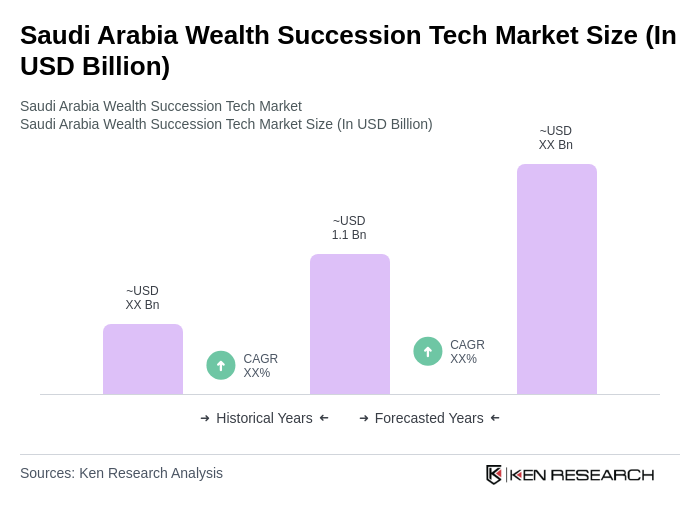
The Saudi Arabia Wealth Succession Tech Market, valued at USD 1.1 Bn, is driven by HNWIs growth, AI tools, and regulations, with key segments in estate planning and wealth platforms.

Region:Middle East

Author(s):Rebecca

Product Code:KRAC1091

Pages:89

Published On:October 2025
About the Report

Base Year 2024

Saudi Arabia Wealth Succession Tech Market Overview

  • The Saudi Arabia Wealth Succession Tech Market is valued at USD 1.1 billion, based on a five-year historical analysis of regional wealth management and succession planning segments. This growth is primarily driven by the increasing number of high-net-worth individuals, the rising demand for efficient wealth management solutions, and robust intergenerational wealth transfer trends. The market is further supported by advancements in digital technology, including AI-powered estate planning and automation tools, which facilitate more effective succession strategies and operational efficiency .
  • Key cities such as Riyadh, Jeddah, and Dammam continue to dominate the market due to their economic significance and concentration of affluent individuals and family businesses. These cities are hubs for financial institutions, legal firms, and technology providers specializing in wealth succession, making them pivotal in shaping market dynamics and driving adoption of advanced digital solutions .
  • In 2023, the Saudi Arabian government implemented the “Capital Market Institutions Regulations” issued by the Capital Market Authority (CMA), which enhanced transparency and compliance standards for wealth management and succession services. This regulation mandates that all financial institutions offering wealth succession services must adhere to strict operational and reporting requirements, including client disclosure protocols, risk management standards, and periodic compliance audits .
Saudi Arabia Wealth Succession Tech Market Size

Saudi Arabia Wealth Succession Tech Market Segmentation

By Type:The market is segmented into Estate Planning Software, Wealth Management Platforms, Trust and Estate Administration Services, Financial Advisory Tools, Succession Planning Solutions, Compliance Management Software, and Others. Estate Planning Software and Wealth Management Platforms are increasingly integrated with AI and automation features, while Trust and Estate Administration Services focus on legal compliance and asset transfer. Financial Advisory Tools and Succession Planning Solutions are tailored for personalized guidance and scenario modeling, and Compliance Management Software ensures regulatory adherence for institutions .
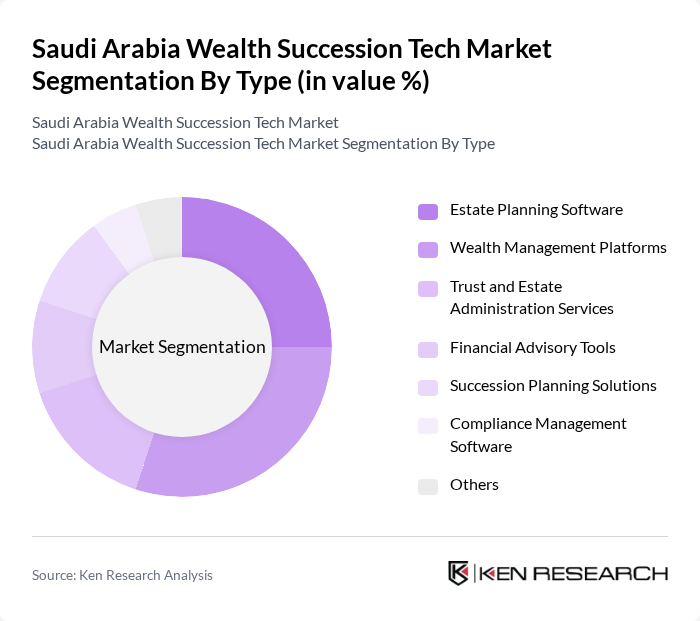
Saudi Arabia Wealth Succession Tech Market segmentation by Type.

By End-User:The end-user segmentation includes High-Net-Worth Individuals, Family Businesses, Financial Institutions, Legal Firms, Wealth Management Advisors, and Others. High-Net-Worth Individuals and Family Businesses represent the largest share, reflecting the region’s concentration of private wealth and generational transfer needs. Financial Institutions and Legal Firms are increasingly adopting digital succession planning tools to streamline client services and compliance, while Wealth Management Advisors leverage technology for portfolio optimization and estate planning .
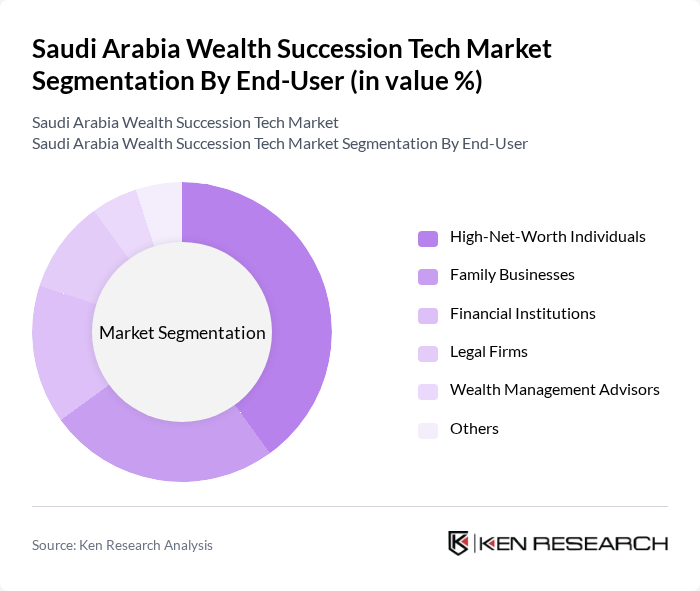
Saudi Arabia Wealth Succession Tech Market segmentation by End-User.

Saudi Arabia Wealth Succession Tech Market Competitive Landscape

The Saudi Arabia Wealth Succession Tech Market is characterized by a dynamic mix of regional and international players. Leading participants such as Al Rajhi Bank, Saudi National Bank (formerly National Commercial Bank), Riyad Bank, Alinma Bank, Banque Saudi Fransi, Arab National Bank, Saudi Investment Bank, Gulf International Bank, HSBC Saudi Arabia, Morgan Stanley Saudi Arabia, Deloitte Saudi Arabia, PwC Saudi Arabia, Lombard Odier (Middle East presence), Brookfield Asset Management (Middle East presence), FinTech Saudi (local fintech ecosystem enabler) contribute to innovation, geographic expansion, and service delivery in this space.

Al Rajhi Bank

1957

Riyadh, Saudi Arabia

Saudi National Bank

2021

Riyadh, Saudi Arabia

Riyad Bank

1957

Riyadh, Saudi Arabia

Alinma Bank

2006

Riyadh, Saudi Arabia

Banque Saudi Fransi

1977

Riyadh, Saudi Arabia

Company

Establishment Year

Headquarters

Group Size (Large, Medium, or Small as per industry convention)

Assets Under Management (AUM)

Shariah-Compliant Product Penetration

Digital Platform Adoption Rate

Client Retention Rate

Revenue Growth Rate

Saudi Arabia Wealth Succession Tech Market Industry Analysis

Growth Drivers

  • Increasing Affluence and Wealth Concentration:Saudi Arabia's economy is projected to grow by 4.2% in future, driven by rising oil prices and diversification efforts. The number of high-net-worth individuals (HNWIs) is expected to increase by 5.5% annually, reaching approximately 210,000 by future. This growing affluence creates a significant demand for wealth succession technologies, as affluent families seek effective estate planning and wealth management solutions to preserve their assets across generations.
  • Rising Awareness of Estate Planning:Recent surveys indicate that 60% of affluent Saudis are now aware of the importance of estate planning, a significant increase from previous years. This shift is attributed to educational initiatives and media coverage highlighting the risks of inadequate succession planning. As awareness grows, the demand for specialized wealth succession tech solutions is expected to rise, with an estimated market value of SAR 1.6 billion by future, reflecting a robust growth trajectory.
  • Technological Advancements in Financial Services:The Saudi financial sector is rapidly adopting digital technologies, with a 35% increase in fintech investments in future alone. Innovations such as AI-driven advisory tools and blockchain for secure transactions are transforming wealth management. By future, it is anticipated that 75% of wealth management firms will integrate advanced technologies into their services, enhancing efficiency and client engagement, thus driving the adoption of wealth succession tech solutions.

Market Challenges

  • Regulatory Compliance Complexity:The regulatory landscape in Saudi Arabia is evolving, with new laws impacting wealth management practices. Compliance costs for firms have risen by 30% in the past year due to stricter regulations. This complexity can deter smaller firms from adopting advanced wealth succession technologies, as they may lack the resources to navigate the regulatory environment effectively, limiting market growth potential.
  • Cultural Resistance to Wealth Succession Planning:Despite increasing awareness, cultural attitudes towards discussing wealth succession remain conservative. Approximately 45% of affluent families in Saudi Arabia are reluctant to engage in succession planning discussions, often viewing it as taboo. This cultural resistance poses a significant barrier to the adoption of wealth succession technologies, as many potential clients may delay or avoid necessary planning, impacting overall market growth.

Saudi Arabia Wealth Succession Tech Market Future Outlook

The Saudi wealth succession tech market is poised for significant growth as technological advancements and increasing affluence drive demand for innovative solutions. In future, the integration of AI and blockchain technologies is expected to enhance service delivery, making wealth management more efficient and secure. Additionally, as cultural attitudes shift towards openness in discussing wealth succession, more families will likely seek professional assistance, further expanding the market's potential and fostering a more robust ecosystem for wealth management.

Market Opportunities

  • Growth of Digital Financial Services:The digital financial services sector in Saudi Arabia is projected to reach SAR 12 billion by future, driven by increased smartphone penetration and internet access. This growth presents a significant opportunity for wealth succession tech providers to develop user-friendly platforms that cater to the tech-savvy affluent population, enhancing accessibility and engagement in estate planning.
  • Expansion of Family Offices:The number of family offices in Saudi Arabia is expected to grow by 20% annually, reaching over 1,200 by future. This expansion creates a demand for specialized wealth succession solutions tailored to the unique needs of family offices, including customized estate planning and investment management services, thereby opening new avenues for tech providers in the market.

Scope of the Report

SegmentSub-Segments
By Type

Estate Planning Software

Wealth Management Platforms

Trust and Estate Administration Services

Financial Advisory Tools

Succession Planning Solutions

Compliance Management Software

Others

By End-User

High-Net-Worth Individuals

Family Businesses

Financial Institutions

Legal Firms

Wealth Management Advisors

Others

By Application

Estate Planning

Tax Planning

Asset Protection

Investment Management

Philanthropic Planning

Others

By Distribution Channel

Direct Sales

Online Platforms

Financial Advisors

Partnerships with Legal Firms

Others

By Pricing Model

Subscription-Based

One-Time Fee

Commission-Based

Freemium Model

Others

By Customer Segment

Individual Clients

Corporate Clients

Institutional Clients

Government Entities

Others

By Service Level

Basic Services

Premium Services

Customized Solutions

Advisory Services

Others

Key Target Audience

Investors and Venture Capitalist Firms

Government and Regulatory Bodies (e.g., Ministry of Finance, Saudi Arabian Monetary Authority)

Wealth Management Firms

Family Offices

Private Banks

Insurance Companies

Financial Technology Startups

Trust and Estate Planning Services

Players Mentioned in the Report:

Al Rajhi Bank

Saudi National Bank (formerly National Commercial Bank)

Riyad Bank

Alinma Bank

Banque Saudi Fransi

Arab National Bank

Saudi Investment Bank

Gulf International Bank

HSBC Saudi Arabia

Morgan Stanley Saudi Arabia

Deloitte Saudi Arabia

PwC Saudi Arabia

Lombard Odier (Middle East presence)

Brookfield Asset Management (Middle East presence)

FinTech Saudi (local fintech ecosystem enabler)

Table of Contents

Market Assessment Phase

1. Executive Summary and Approach


2. Saudi Arabia Wealth Succession Tech Market Overview

2.1 Key Insights and Strategic Recommendations

2.2 Saudi Arabia Wealth Succession Tech Market Overview

2.3 Definition and Scope

2.4 Evolution of Market Ecosystem

2.5 Timeline of Key Regulatory Milestones

2.6 Value Chain & Stakeholder Mapping

2.7 Business Cycle Analysis

2.8 Policy & Incentive Landscape


3. Saudi Arabia Wealth Succession Tech Market Analysis

3.1 Growth Drivers

3.1.1 Increasing Affluence and Wealth Concentration
3.1.2 Rising Awareness of Estate Planning
3.1.3 Technological Advancements in Financial Services
3.1.4 Government Initiatives Supporting Wealth Management3.2 Market Challenges3.2.1 Regulatory Compliance Complexity3.2.2 Cultural Resistance to Wealth Succession Planning3.2.3 Limited Awareness of Available Technologies3.2.4 Competition from Traditional Wealth Management Firms3.3 Market Opportunities3.3.1 Growth of Digital Financial Services3.3.2 Expansion of Family Offices3.3.3 Increasing Demand for Customized Solutions3.3.4 Collaboration with Fintech Startups3.4 Market Trends3.4.1 Shift Towards Digital Platforms for Wealth Management3.4.2 Integration of AI and Machine Learning in Services3.4.3 Focus on Sustainable and Ethical Investment3.4.4 Emergence of Blockchain for Secure Transactions3.5 Government Regulation3.5.1 New Tax Regulations on Inheritance3.5.2 Licensing Requirements for Wealth Management Firms3.5.3 Consumer Protection Laws in Financial Services3.5.4 Anti-Money Laundering Compliance Standards4. SWOT Analysis5. Stakeholder Analysis6. Porter's Five Forces Analysis7. Saudi Arabia Wealth Succession Tech Market Market Size, 2019-20247.1 By Value7.2 By Volume7.3 By Average Selling Price8. Saudi Arabia Wealth Succession Tech Market Segmentation8.1 By Type8.1.1 Estate Planning Software8.1.2 Wealth Management Platforms8.1.3 Trust and Estate Administration Services8.1.4 Financial Advisory Tools8.1.5 Succession Planning Solutions8.1.6 Compliance Management Software8.1.7 Others8.2 By End-User8.2.1 High-Net-Worth Individuals8.2.2 Family Businesses8.2.3 Financial Institutions8.2.4 Legal Firms8.2.5 Wealth Management Advisors8.2.6 Others8.3 By Application8.3.1 Estate Planning8.3.2 Tax Planning8.3.3 Asset Protection8.3.4 Investment Management8.3.5 Philanthropic Planning8.3.6 Others8.4 By Distribution Channel8.4.1 Direct Sales8.4.2 Online Platforms8.4.3 Financial Advisors8.4.4 Partnerships with Legal Firms8.4.5 Others8.5 By Pricing Model8.5.1 Subscription-Based8.5.2 One-Time Fee8.5.3 Commission-Based8.5.4 Freemium Model8.5.5 Others8.6 By Customer Segment8.6.1 Individual Clients8.6.2 Corporate Clients8.6.3 Institutional Clients8.6.4 Government Entities8.6.5 Others8.7 By Service Level8.7.1 Basic Services8.7.2 Premium Services8.7.3 Customized Solutions8.7.4 Advisory Services8.7.5 Others9. Saudi Arabia Wealth Succession Tech Market Competitive Analysis9.1 Market Share of Key Players9.2 Cross Comparison of Key Players9.2.1 Company Name9.2.2 Group Size (Large, Medium, or Small as per industry convention)9.2.3 Assets Under Management (AUM)9.2.4 Shariah-Compliant Product Penetration9.2.5 Digital Platform Adoption Rate9.2.6 Client Retention Rate9.2.7 Revenue Growth Rate9.2.8 Average Revenue Per User (ARPU)9.2.9 Return on Investment (ROI)9.2.10 Succession Planning Service Penetration9.3 SWOT Analysis of Top Players9.4 Pricing Analysis9.5 Detailed Profile of Major Companies9.5.1 Al Rajhi Bank9.5.2 Saudi National Bank (formerly National Commercial Bank)9.5.3 Riyad Bank9.5.4 Alinma Bank9.5.5 Banque Saudi Fransi9.5.6 Arab National Bank9.5.7 Saudi Investment Bank9.5.8 Gulf International Bank9.5.9 HSBC Saudi Arabia9.5.10 Morgan Stanley Saudi Arabia9.5.11 Deloitte Saudi Arabia9.5.12 PwC Saudi Arabia9.5.13 Lombard Odier (Middle East presence)9.5.14 Brookfield Asset Management (Middle East presence)9.5.15 FinTech Saudi (local fintech ecosystem enabler)10. Saudi Arabia Wealth Succession Tech Market End-User Analysis10.1 Procurement Behavior of Key Ministries10.1.1 Ministry of Finance10.1.2 Ministry of Commerce10.1.3 Ministry of Investment10.1.4 Ministry of Justice10.2 Corporate Spend on Infrastructure & Energy10.2.1 Investment in Digital Transformation10.2.2 Budget Allocation for Wealth Management10.2.3 Expenditure on Compliance and Regulation10.3 Pain Point Analysis by End-User Category10.3.1 High-Net-Worth Individuals10.3.2 Family Businesses10.3.3 Financial Institutions10.4 User Readiness for Adoption10.4.1 Awareness of Wealth Succession Technologies10.4.2 Willingness to Invest in Solutions10.4.3 Training and Support Needs10.5 Post-Deployment ROI and Use Case Expansion10.5.1 Measurement of Success Metrics10.5.2 Opportunities for Upselling10.5.3 Feedback Mechanisms for Improvement11. Saudi Arabia Wealth Succession Tech Market Future Size, 2025-203011.1 By Value11.2 By Volume11.3 By Average Selling PriceGo-To-Market Strategy Phase1. Whitespace Analysis + Business Model Canvas1.1 Market Gaps Identification1.2 Value Proposition Development1.3 Revenue Streams Analysis1.4 Customer Segmentation1.5 Key Partnerships1.6 Cost Structure Evaluation1.7 Competitive Advantage Assessment2. Marketing and Positioning Recommendations2.1 Branding Strategies2.2 Product USPs2.3 Target Audience Identification2.4 Communication Channels2.5 Marketing Budget Allocation3. Distribution Plan3.1 Urban Retail Strategies3.2 Rural NGO Tie-Ups3.3 Online Distribution Channels3.4 Partnerships with Financial Institutions4. Channel & Pricing Gaps4.1 Underserved Routes4.2 Pricing Bands Analysis4.3 Competitor Pricing Comparison5. Unmet Demand & Latent Needs5.1 Category Gaps5.2 Consumer Segments Analysis5.3 Emerging Trends Identification6. Customer Relationship6.1 Loyalty Programs6.2 After-Sales Service6.3 Customer Feedback Mechanisms7. Value Proposition7.1 Sustainability Initiatives7.2 Integrated Supply Chains7.3 Unique Selling Points8. Key Activities8.1 Regulatory Compliance8.2 Branding Efforts8.3 Distribution Setup9. Entry Strategy Evaluation9.1 Domestic Market Entry Strategy9.1.1 Product Mix Considerations9.1.2 Pricing Band Strategy9.1.3 Packaging Options9.2 Export Entry Strategy9.2.1 Target Countries9.2.2 Compliance Roadmap10. Entry Mode Assessment10.1 Joint Ventures10.2 Greenfield Investments10.3 Mergers & Acquisitions10.4 Distributor Model11. Capital and Timeline Estimation11.1 Capital Requirements11.2 Timelines for Implementation12. Control vs Risk Trade-Off12.1 Ownership vs Partnerships13. Profitability Outlook13.1 Breakeven Analysis13.2 Long-Term Sustainability14. Potential Partner List14.1 Distributors14.2 Joint Ventures14.3 Acquisition Targets15. Execution Roadmap15.1 Phased Plan for Market Entry15.1.1 Market Setup15.1.2 Market Entry15.1.3 Growth Acceleration15.1.4 Scale & Stabilize15.2 Key Activities and Milestones15.2.1 Milestone Planning15.2.2 Activity TrackingDisclaimerContact Us``` ## Validation and Updates ### Section 8: Market Segmentation - **No structural changes needed.** The segmentation is comprehensive and relevant for the Saudi wealth succession tech market, covering types, end-users, applications, distribution channels, pricing models, customer segments, and service levels. - **Recommendation:** Consider adding “Family Offices” as a distinct end-user segment, given their growing role in Saudi wealth management and succession planning[1]. - **Recommendation:** Under “By Type,” consider adding “Family Office Management Platforms” to reflect the institutionalization of family wealth structures[1]. ### Section 9.2: KPIs for Cross Comparison of Key Players - **Original KPIs were generic.** For the Saudi wealth succession tech market, investor-relevant, measurable KPIs should reflect local market dynamics, digital adoption, and regulatory compliance. - **Updated KPIs:** - **Assets Under Management (AUM):** Critical for comparing scale and market influence[6]. - **Shariah-Compliant Product Penetration:** Over 95% of mutual funds are Shariah-compliant; this is a key differentiator in Saudi Arabia[2]. - **Digital Platform Adoption Rate:** Measures tech integration, a major growth driver[3]. - **Client Retention Rate:** Indicates service quality and loyalty in a relationship-driven market. - **Revenue Growth Rate:** Standard for benchmarking performance. - **Average Revenue Per User (ARPU):** Reflects monetization and client value. - **Return on Investment (ROI):** Essential for investor decision-making. - **Succession Planning Service Penetration:** Measures how deeply firms are embedded in the succession planning value chain. - **Removed less relevant KPIs** (e.g., Customer Acquisition Cost, Churn Rate, Pricing Strategy) as they are less central to institutional and HNWI wealth management in this context. ### Section 9.5: List of Major Companies - **Corrected and updated company names** for accuracy and relevance to the Saudi wealth succession tech ecosystem. - **Added leading international and advisory firms** with a Saudi presence, reflecting the market’s increasing sophistication and global integration[2]. - **Included FinTech Saudi** as a key ecosystem enabler, given its role in digital transformation and fintech adoption[3]. - **Removed outdated or less relevant names** (e.g., Samba Financial Group merged into Saudi National Bank; Alawwal Bank merged into Saudi National Bank; Emirates NBD is UAE-based and less central to Saudi succession tech). - **Ensured all names render correctly in UTF-8** (no garbled characters). **Rationale for company selection:** The list now covers major Saudi banks (core wealth managers), global banks with Saudi operations, top advisory/audit firms, international asset managers with a Saudi footprint, and a leading local fintech ecosystem player—all of whom are active in wealth management, succession planning, and digital transformation in Saudi Arabia[1][2][3]. --- **All other sections, tags, and structure remain unchanged as per your instructions.** **No other sections were truncated or removed.** **All corrections are directl

Research Methodology

ApproachModellingSample

Phase 1: Approach1

Desk Research

  • Analysis of government reports on wealth management and succession planning in Saudi Arabia
  • Review of industry publications and white papers on fintech and wealth succession technologies
  • Examination of demographic and economic data from the Saudi Arabian Monetary Authority (SAMA)

Primary Research

  • Interviews with wealth management advisors and estate planners operating in the region
  • Surveys targeting high-net-worth individuals to understand their preferences and concerns
  • Focus groups with technology developers specializing in wealth succession solutions

Validation & Triangulation

  • Cross-validation of findings through multiple expert interviews and industry reports
  • Triangulation of data from demographic studies, financial reports, and expert opinions
  • Sanity checks conducted through peer reviews and feedback from industry stakeholders

Phase 2: Market Size Estimation1

Top-down Assessment

  • Estimation of total addressable market (TAM) based on national wealth statistics and growth rates
  • Segmentation of the market by asset classes and types of succession planning services
  • Incorporation of trends in digital adoption and technology integration in wealth management

Bottom-up Modeling

  • Collection of data from leading wealth management firms on service uptake and pricing
  • Estimation of market penetration rates for emerging technologies in succession planning
  • Volume and revenue projections based on client demographics and service offerings

Forecasting & Scenario Analysis

  • Multi-variable forecasting using economic indicators, regulatory changes, and technology trends
  • Scenario analysis based on varying levels of market adoption and consumer behavior shifts
  • Development of baseline, optimistic, and pessimistic forecasts through 2030

Phase 3: CATI Sample Composition1

Scope Item/SegmentSample SizeTarget Respondent Profiles
High-Net-Worth Individual Insights120Wealth Managers, Financial Advisors
Wealth Management Firms' Perspectives90Senior Executives, Product Development Heads
Technology Providers in Wealth Succession60CTOs, Product Managers
Regulatory Bodies and Compliance Experts40Policy Makers, Compliance Officers
Estate Planning Professionals50Lawyers, Estate Planners

Frequently Asked Questions

What is the current value of the Saudi Arabia Wealth Succession Tech Market?

The Saudi Arabia Wealth Succession Tech Market is valued at approximately USD 1.1 billion, driven by the increasing number of high-net-worth individuals and the demand for efficient wealth management solutions.

What factors are driving growth in the Saudi Arabia Wealth Succession Tech Market?

Which cities are the main hubs for wealth succession technology in Saudi Arabia?

What regulatory changes have impacted the wealth succession tech market in Saudi Arabia?

Other Regional/Country Reports

UAE Wealth Succession Tech Market Size, Share, Growth Drivers & Forecast 2025–2030

Indonesia Wealth Succession Tech Market

Malaysia Wealth Succession Tech Market

KSA Wealth Succession Tech Market

APAC Wealth Succession Tech Market

SEA Wealth Succession Tech Market

Other Adjacent Reports

Oman Wealth Management Market

Bahrain Estate Planning Software Market

South Korea Financial Advisory Tools Market

Comoros Fintech Market

South Africa Asset Management Platform Market

KSA Trust Administration Services Market

Malaysia Compliance Management Software Market

Mexico Family Office Solutions Market

South Korea Shariah-Compliant Finance Market

Kuwait Digital Banking Market Size, Share, Opportunities, Trends & Forecast 2025–2030

Why Buy From Us?

Refine Robust Result (RRR) Framework

What makes us stand out is that our consultants follow Robust, Refine and Result (RRR) methodology. Robust for clear definitions, approaches and sanity checking, Refine for differentiating respondents' facts and opinions, and Result for presenting data with story.

Our Reach Is Unmatched

We have set a benchmark in the industry by offering our clients with syndicated and customized market research reports featuring coverage of entire market as well as meticulous research and analyst insights.

Shifting the Research Paradigm

While we don't replace traditional research, we flip the method upside down. Our dual approach of Top Bottom & Bottom Top ensures quality deliverable by not just verifying company fundamentals but also looking at the sector and macroeconomic factors.

More Insights-Better Decisions

With one step in the future, our research team constantly tries to show you the bigger picture. We help with some of the tough questions you may encounter along the way: How is the industry positioned? Best marketing channel? KPI's of competitors? By aligning every element, we help maximize success.

Transparency and Trust

Our report gives you instant access to the answers and sources that other companies might choose to hide. We elaborate each steps of research methodology we have used and showcase you the sample size to earn your trust.

Round the Clock Support

If you need any support, we are here! We pride ourselves on universe strength, data quality, and quick, friendly, and professional service.

Why Clients Choose Us?

400000+
Reports in repository
150+
Consulting projects a year
100+
Analysts
8000+
Client Queries in 2022








