CHAPTER 1 - MARKET SUMMARY
Market Overview
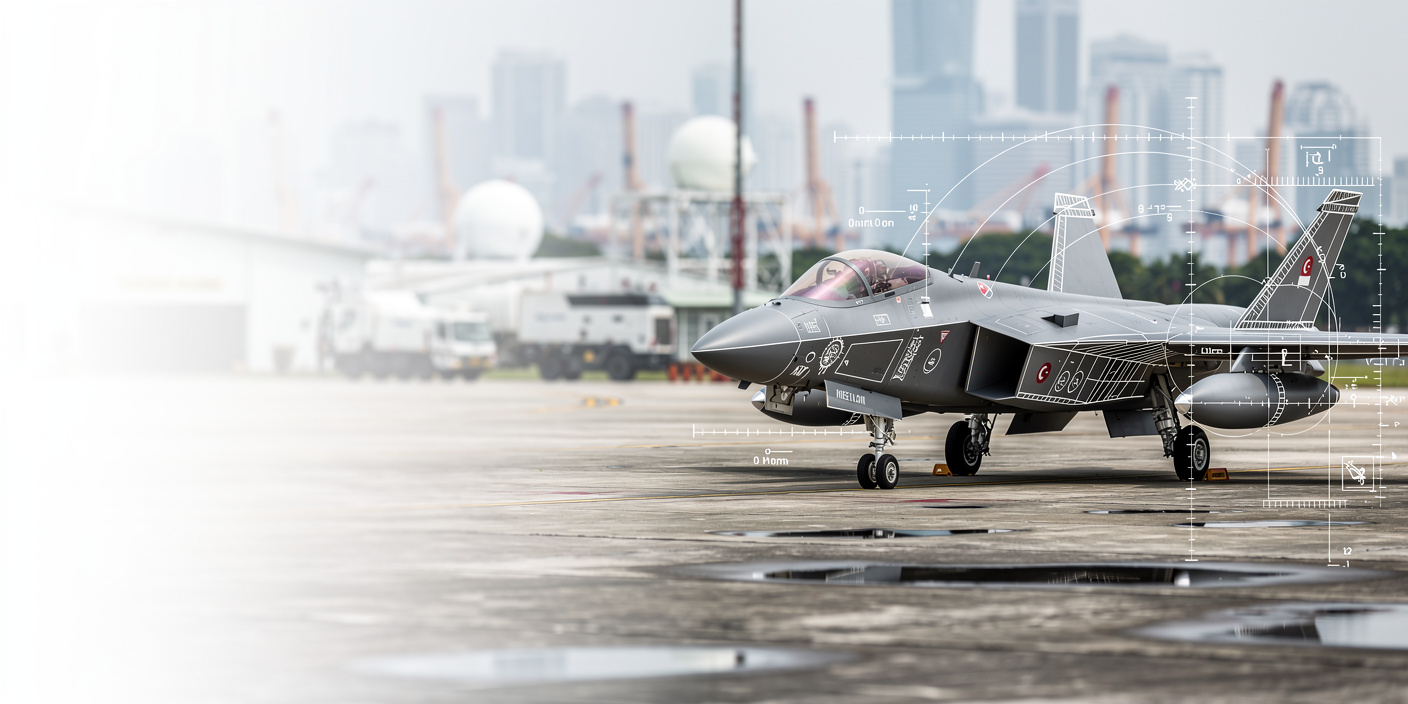
The Singapore Aerospace and Defense Market combines commercial aerospace manufacturing, maintenance, repair and overhaul, defense equipment, systems integration, space technologies, and mission-support services. Demand is anchored by Changi Airport activity, which handled about 70.0 million passengers in 2025, sustaining recurring engine, airframe, component, avionics, and fleet-availability work for airlines, lessors, original equipment manufacturers, and government agencies.
Operational capacity is concentrated around Seletar Aerospace Park, Loyang, Changi, and Paya Lebar, where high-value engine, component, and systems facilities create a dense supplier network. Singapore hosted more than 130 aerospace companies and a 22,000-person aerospace workforce by 2025, enabling rapid turnaround, certified repair capability, regional parts pooling, and coordinated access to Asia-Pacific airline fleets.
Market Value
USD 9,350 million
2025
Dominant Region
Seletar-Changi Aerospace Corridor
2025
Dominant Segment
MRO and Aftermarket
fastest growing
Total Number of Players
167
Future Outlook
The Singapore Aerospace and Defense Market is projected to expand from USD 9,350 million in 2025 to USD 17,980 million by 2031. The historical period recorded a 12.7% CAGR as aviation activity recovered, engine-shop demand intensified, and defense modernization remained protected. Forecast growth moderates to an 11.5% CAGR because the market is moving from rebound-led expansion toward capacity-led scaling, higher-value repair content, digital MRO, advanced manufacturing, autonomous systems, and mission software. Commercial aerospace remains the largest revenue pool, while secure communications, sensing, and unmanned technologies improve the mix of recurring and intellectual-property-intensive revenue.
Forecast execution depends on capacity additions, certified labor availability, parts supply, procurement timing, and the pace of Asia-Pacific fleet growth. Engine maintenance is expected to remain the strongest profit pool because shop visits require scarce tooling, approvals, and skilled technicians. Defense revenue should remain comparatively stable as expenditure stays near 3% of GDP, while the commercial cycle becomes more exposed to aircraft utilization and delivery constraints. The base case assumes volume growth of 8.7% and annual price-mix uplift of about 2.6%, taking the market to USD 17,980 million in 2031 without assuming a major geopolitical procurement surge.
11.5%
Forecast CAGR
$17,980 Mn
2030 Projection
Base Year
2025
Historical Period
2020-2025
Forecast Period
2026-2031
Historical CAGR
12.7%
CHAPTER 2 - SCOPE OF REPORT
Scope of the Market
CHAPTER 3 - Key Stakeholders
Key Target Audience
Key stakeholders who can leverage from this market analysis for investment, strategy, and operational planning.
Investors
CAGR, capacity utilization, cash conversion, capex risk
Corporates
turnaround time, contract mix, localization, supplier resilience
Government
readiness, export controls, skills, technology sovereignty
Operators
shop visits, fleet availability, tooling, technician productivity
Financial institutions
project finance, order visibility, covenants, utilization
CHAPTER 4 - Market Size & Growth
Market Size, Growth Forecast and Trends
This section evaluates the historical market size, analyzes year-over-year growth dynamics, and presents forecast projections supported by market performance indicators and demand-side drivers.
Historical & Projected Market Size ($ Million)
Year-over-Year Growth Rate (%)
Market Value vs Volume Growth (%)
Historical Market Performance (2020-2025)
The historical trough occurred in 2021, when market value declined 1.7% to USD 5,060 million after the sharper 2020 aviation shock. The inflection arrived in 2022 as deferred maintenance, engine removals, and airline capacity restoration released pent-up demand. Growth then remained above 15% for three consecutive years through 2025. Demand concentration shifted toward engine and component MRO, which benefited from older fleet utilization, new-engine durability issues, and limited global shop capacity. Defense programs provided a countercyclical revenue base and reduced exposure to passenger traffic volatility.
Forecast Market Outlook (2026-2031)
The forecast period is expected to deliver an 11.5% CAGR, taking market value to USD 17,980 million by 2031. Growth is supported by 8.7% annual volume expansion and approximately 2.6% annual price-mix uplift from more complex engine workscopes, advanced materials, digital inspection, secure electronics, and availability-based support. Annual growth stays near 11% before accelerating to 12.0% in 2031 as new capacity reaches utilization maturity. The most important execution constraints are technician supply, turnaround-time discipline, spare-part availability, and certification lead times for new repair processes.
ST Engineering Engine MRO Expansion
ST Engineering is expanding Singapore engine-maintenance capacity to more than 300 engines annually by 2027. The case illustrates how scarce engine-shop slots, regional fleet growth, and long certification cycles can justify capital-intensive expansion. The strategic lesson is to secure customer volume, tooling access, and technician pipelines before capacity commissioning, then use digital workflows to protect turnaround-time performance.
Rolls-Royce Seletar Integrated Campus
Rolls-Royce's 154,000 square metre Seletar campus integrates engine assembly, testing, fan-blade manufacturing, training, and technology. The model demonstrates Singapore's advantage in concentrating specialized capabilities within a reliable logistics and regulatory environment. The strategic lesson is that high-cost locations remain competitive when they combine unique intellectual property, automation, global mandates, and a dense ecosystem of skilled suppliers.
Safran Multi-Site Capability Expansion
Safran has expanded across landing systems, helicopter engines, electrical systems, production, engineering, and maintenance, with nearly 900 employees across five sites. The case shows how a diversified local footprint can cross-sell services, deepen customer proximity, and share certification infrastructure. The strategic lesson is to build adjacent capabilities around anchor customers rather than compete only on standalone repair rates.
CHAPTER 5 - Market Data
Market Breakdown
The Singapore Aerospace and Defense Market is moving from post-pandemic recovery toward structural capacity expansion. For CEOs and investors, the critical issue is whether engine-shop throughput, certified labor, defense program visibility, and digital productivity can convert strong regional demand into durable margins.
Year | Market Size (USD Mn) | YoY Growth (%) | Changi Aircraft Movements (000) | Aerospace Workforce (000) | Defense Expenditure (USD Mn) | Period |
|---|---|---|---|---|---|---|
| 2020 | $5,150 Mn | +- | 125 | 19.0 | Forecast | |
| 2021 | $5,060 Mn | +-1.7% | 109 | 18.2 | Forecast | |
| 2022 | $5,920 Mn | +17.0% | 219 | 18.8 | Forecast | |
| 2023 | $6,930 Mn | +17.1% | 328 | 20.0 | Forecast | |
| 2024 | $8,000 Mn | +15.4% | 366 | 21.2 | Forecast | |
| 2025 | $9,350 Mn | +16.9% | 374 | 22.0 | Forecast | |
| 2026F | $10,460 Mn | +11.9% | 389 | 22.8 | Forecast | |
| 2027F | $11,650 Mn | +11.4% | 406 | 23.6 | Forecast | |
| 2028F | $13,020 Mn | +11.8% | 425 | 24.5 | Forecast | |
| 2029F | $14,470 Mn | +11.1% | 445 | 25.4 | Forecast | |
| 2030F | $16,060 Mn | +11.0% | 466 | 26.3 | Forecast | |
| 2031F | $17,980 Mn | +12.0% | 488 | 27.2 | Forecast |
Changi Aircraft Movements
374,000 movements, 2025, Singapore. Higher movements increase maintenance events and component cycles. Terminal 5 is designed for 50 million additional annual passengers, widening the long-term airline and MRO demand base.
Aerospace Workforce
22,000 workers, 2025, Singapore. Labor depth supports certified engine, avionics, and component work, but technician scarcity can constrain throughput. More than 2,500 aerospace roles were expected from announced expansion projects.
Defense Expenditure
USD 17,700 million, 2025, Singapore. Stable spending supports multi-year platform sustainment and mission-system procurement. Defense expenditure has remained near 3% of GDP, reducing abrupt program volatility.
CHAPTER 6 - Segmentation
Market Segmentation Framework
Comprehensive analysis across key dimensions providing insights into market structure, consumer preferences, and distribution patterns.
No of Segments
7
Dominant Segment
Product Type
Fastest Growing Segment
Technology
Product Type
End-Use Industry
Application
Customer Type
Sales Channel
Technology
Operating Model
Key Segmentation Takeaways
Comprehensive analysis across all extracted segmentation dimensions providing insights into market structure, customer requirements, and route-to-market patterns.
Product Type
Commercial aircraft systems dominate because Singapore combines engine manufacturing, component repair, avionics support, and multi-fleet MRO for regional airlines. Defense platforms and systems provide a stable second revenue pool through sustainment and systems integration. The strongest Level-2 category is Commercial Aircraft Systems, where engine and propulsion content carries high certification barriers and recurring aftermarket economics.
Technology
Technology is the fastest-growing dimension as operators invest in predictive maintenance, automated inspection, additive repair, secure communications, and autonomous mission systems. Digital MRO and Predictive Analytics is the leading Level-2 growth category because it reduces turnaround time, improves asset availability, and expands data-driven service revenue without requiring proportional increases in hangar space or technician hours.
CHAPTER 7 - Regional Analysis
Regional Analysis
Singapore ranks first among selected Southeast Asian aerospace and defense peers by 2025 addressable market size, reflecting its high-value MRO specialization, defense technology base, and concentration of global OEM facilities. Its advantage is not the largest passenger market, but higher revenue per maintenance event, stronger certification depth, and sustained defense expenditure.
Regional Ranking
1st
Singapore Market Size (2025)
USD 9.35 Bn
Singapore CAGR (2025-2031)
11.5%
Regional Ranking
1st
Singapore Market Size (2025)
USD 9.35 Bn
Singapore CAGR (2025-2031)
11.5%
Regional Analysis (Current Year)
Market Position
Singapore ranks first among five peers at USD 9.35 billion in 2025, supported by more than 130 aerospace companies and approximately 10% of global MRO output.
Growth Advantage
Singapore's 11.5% forecast CAGR exceeds Malaysia's 9.8% and Thailand's 8.7%, positioning it as a growth leader through engine capacity, digital MRO, and defense electronics.
Competitive Strengths
A 22,000-person workforce, nearly 20% of global engine MRO output, and defense spending near 3% of GDP differentiate Singapore on skills, utilization, and procurement stability.
CHAPTER 8 - INDUSTRY ANALYSIS
Growth Drivers, Market Challenges & Market Opportunities
Comprehensive analysis of key factors shaping the Singapore Aerospace and Defense Market, including growth catalysts, operational challenges, and emerging opportunities across production, distribution, and customer segments.
Growth Drivers
Asia-Pacific Fleet Expansion and MRO Intensity
- Asia-Pacific is expected to receive nearly 50% of global new aircraft deliveries over two decades (2026 outlook, Asia-Pacific), increasing engine, component, and airframe work available to Singapore-based facilities.
- Changi handled 67.7 million passengers (2024, Singapore), restoring aircraft cycles and maintenance-event frequency for airline and leasing customers that value regional turnaround speed.
- Singapore generates close to 20% of global engine MRO output (2025, Singapore), giving engine shops pricing power and repeat work from long-term service agreements.
Stable Defense Modernization and Technology Procurement
- Defense expenditure has remained near 3% of GDP over the past decade (2025, Singapore), improving visibility for sustainment, secure communications, training, and mission-system suppliers.
- Operating expenditure represented 94.2% of the defense budget (FY2025, Singapore), supporting recurring maintenance, readiness, technology operations, and lifecycle services rather than only episodic platform purchases.
- The defense budget increased 12.4% year-on-year (FY2025, Singapore), widening the addressable pool for integrated systems, sustainment, simulation, and cyber-resilient capabilities.
Capacity Investment and Advanced Manufacturing
- More than 10 expansion projects (2022-2024, Singapore) covered engine MRO, components, advanced manufacturing, and innovation, broadening supplier depth and reducing single-facility bottlenecks.
- Planned projects were expected to create over 2,500 jobs within three to five years (2024 announcement, Singapore), increasing skilled capacity while intensifying competition for licensed engineers and technicians.
- ST Engineering's Singapore engine MRO expansion targets more than 300 annual engines by 2027 (Singapore), monetizing regional shop-visit backlogs and new-generation engine demand.
Market Challenges
Certified Talent and Productivity Constraints
- Announced hiring of more than 2,500 additional roles (2024-2028, Singapore) represents over 11% of the existing workforce, raising wage, retention, and instructor-capacity pressure.
- Type-specific approvals limit labor fungibility across a base of more than 130 aerospace companies (2025, Singapore), so understaffed bays can delay revenue despite strong order books.
- Singapore's 22,000-person aerospace workforce (2025, Singapore) must support premium work while lower-complexity tasks face cost competition from larger labor pools in neighboring markets.
Global Parts Shortages and Turnaround-Time Risk
- With nearly 50% of new aircraft deliveries expected in Asia-Pacific over two decades (2026 outlook), scarce castings, modules, and electronics can increase inventory and working-capital requirements.
- Facilities targeting more than 300 engine visits annually by 2027 (Singapore) require synchronized parts availability, or installed capacity may not convert into billable turnaround performance.
- Foreign affiliates account for more than 75% of Singapore trade (2024, Singapore), increasing exposure to export controls, logistics disruption, and cross-border component restrictions.
High Fixed Costs and Regulatory Entry Barriers
- A 154,000 square metre integrated campus (Singapore) illustrates the tooling, test-cell, training, and infrastructure scale needed for engine assembly and overhaul economics.
- Safran's planned 40% landing-systems MRO capacity increase (2026, Singapore) requires facility expansion, certification, and customer loading before returns can mature.
- A base of more than 130 aerospace companies (2025, Singapore) concentrates competition in approved niches, making generic greenfield entry less attractive than acquiring or partnering for certification.
Market Opportunities
Digital MRO and AI-Enabled Turnaround Reduction
- Monetizable services can layer predictive analytics and inspection software onto a market serving about 10% of global MRO output (2025, Singapore), expanding recurring revenue beyond labor hours.
- Airlines, lessors, and MRO providers can raise productivity across a 22,000-person workforce (2025, Singapore) by reducing rework, no-fault removals, and material-planning errors.
- Commercial scale requires interoperable data and certified automation, supported by 16 strategic aerospace investments and collaborations announced in 2026 (Singapore).
Engine and Landing-Gear Capacity Expansion
- Investors can target tooling, rotable pools, and specialized repairs tied to more than 300 annual engine visits by 2027 (Singapore), where capacity scarcity supports contracted utilization.
- OEMs and MRO operators benefit from Singapore's close to 20% share of global engine MRO output (2025), which attracts regional fleets and technical suppliers.
- Opportunity realization requires approvals and customer commitments, as Safran's expansion targets roughly 40% higher landing-systems MRO capacity (2026, Singapore).
Autonomous Systems, Secure Communications, and Space Services
- Mission software, sensor payloads, and cyber services can access a defense expenditure base of USD 17.7 billion (2025, Singapore) with higher recurring-content potential than hardware resale.
- Defense agencies and critical-infrastructure users benefit from technology as a force multiplier, supported by expenditure held near 3% of GDP over the past decade (Singapore).
- Commercial scale can emerge through partnerships across more than 130 aerospace companies (2025, Singapore), combining trusted integration, exportable intellectual property, and regional channels.
CHAPTER 9 - Competitive Landscape
Competitive Landscape Overview
Competition is moderately concentrated in high-value engine, component, and defense-system niches, where certification, security clearance, proprietary tooling, skilled labor, and long-term customer contracts create substantial entry barriers.
Market Share Distribution
Top 5 Players
Market Dynamics
8 new entrants in the past 5 years, indicating strong market attractiveness and growth potential.
Company Name | Market Share | Headquarters | Founding Year | Core Market Focus |
|---|---|---|---|---|
ST Engineering | - | Singapore | 1967 | Commercial aerospace MRO, defense platforms, mission systems, satcom |
SIA Engineering Company | - | Singapore | 1992 | Airframe, line, component, engine, and fleet-management services |
Rolls-Royce | - | London, United Kingdom | 1906 | Trent engine assembly, testing, fan-blade manufacturing, services |
Pratt & Whitney | - | East Hartford, United States | 1925 | Commercial engine MRO, components, coatings, and repair technologies |
GE Aerospace | - | Evendale, United States | 2024 | Engine repair, component services, AI-enabled MRO, regional support |
Safran | - | Paris, France | 2005 | Landing systems, helicopter engines, electrical systems, defense electronics |
Airbus | - | Leiden, Netherlands | 1970 | Aircraft support, training, fleet services, helicopters, defense and space |
Boeing | - | Arlington, United States | 1916 | Commercial services, training, fleet support, defense customer engagement |
Collins Aerospace | - | Charlotte, United States | 2018 | Avionics, interiors, actuation, power systems, component MRO |
Thales | - | Paris, France | 2000 | Avionics, air traffic systems, secure communications, defense electronics |
Cross Comparison Parameters
The report provides detailed cross-comparison of key players across 10 performance parameters to identify competitive strengths and weaknesses.
Engine Shop Visit Capacity
Aircraft Maintenance Turnaround Time
Singapore Sector Revenue Growth
EBITDA Margin
Analysis Covered
Market Share Analysis:
Estimates local revenue pools across aerospace and defense activities
Cross Comparison Matrix:
Benchmarks capacity, turnaround, growth, and profitability across competitors
SWOT Analysis:
Assesses capabilities, vulnerabilities, partnerships, and expansion readiness by player
Pricing Strategy Analysis:
Compares contract models, rate structures, and value-based pricing
Company Profiles:
Reviews local footprint, capabilities, customers, investments, and strategic priorities
CHAPTER 10 - REPORT TOC
Market Report Structure
Comprehensive coverage across three strategic phases — Market Assessment, Go-To-Market Strategy, and Survey — delivering end-to-end insights from market analysis and execution roadmap to customer demand validation.
Market Assessment Phase
Supply-side and competitive intelligence covering market sizing, segmentation, competitive dynamics, regulatory landscape, and future forecasts.
Go-To-Market Strategy Phase
15 chapters
Entry strategy evaluation, execution roadmap, partner recommendations, and profitability outlook.
Survey Phase
8 chapters
Demand-side primary research conducted through structured interviews and online surveys with end users across priority metros and Tier 2/3 cities to capture consumption behavior, unmet needs, and purchase drivers.
Complete Report Coverage
201+ detailed sections covering every aspect of the market
143
Assessment Sections
58
Strategy Sections
CHAPTER 11 - Our Approach
Research Methodology
Desk Research
- Review aerospace output and workforce
- Map defense expenditure and programs
- Assess aviation traffic and capacity
- Analyze company filings and investments
Primary Research
- Interview MRO operations directors
- Consult defense procurement managers
- Engage aerospace supply-chain leaders
- Survey airline engineering executives
Validation and Triangulation
- Validate with 245 industry respondents
- Reconcile revenue and workload indicators
- Cross-check customer spending allocations
- Test forecast scenarios and sensitivities
CHAPTER 12 - FAQ
FAQs
Still have questions?
Our research team is here to help you find the right solution
CHAPTER 13 - Related Research
Explore Related Reports
Expand your market intelligence with complementary research across regions and adjacent markets.
Regional/Country ReportsRelated market analysis across key regions
Related market analysis across key regions
- Japan Aerospace and Defense Market Size, Share & Forecast, By Sector, Platform & Service Type, 2026–2031
- Indonesia Aerospace and Defense Market
- Vietnam Aerospace and Defense Market
- Thailand Aerospace and Defense Market
- Malaysia Aerospace and Defense Market
Adjacent ReportsRelated markets and complementary research
Related markets and complementary research
- Egypt Commercial Aerospace Manufacturing Market
- Qatar Aerospace MRO Services Market
- Brazil Defense Equipment Market
- Thailand Space Technologies Market
- Singapore Avionics Systems Market
500+
Market Research Reports
50+
Countries Covered
15+
Industry Verticals