South Africa FinTech Remittances Market

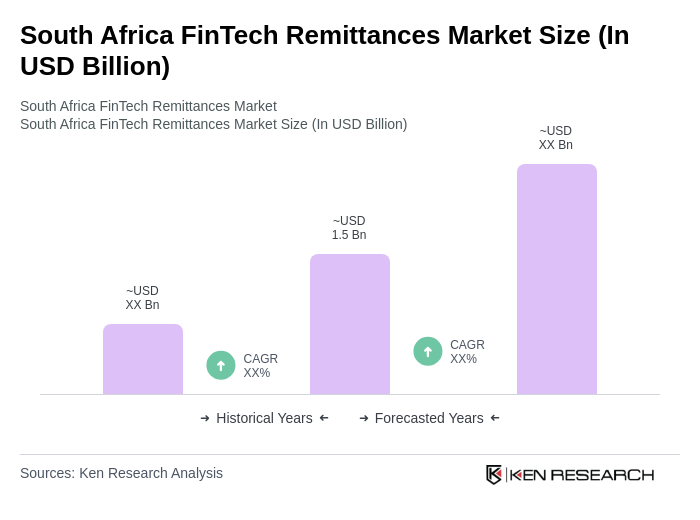
The South Africa FinTech Remittances Market, valued at USD 1.5 billion, is growing due to efficient digital solutions, high smartphone adoption, and increasing remittance inflows from the diaspora.

Region:Africa

Author(s):Shubham

Product Code:KRAB5087

Pages:80

Published On:October 2025
About the Report

Base Year 2024

South Africa FinTech Remittances Market Overview

  • The South Africa FinTech Remittances Market is valued at USD 1.5 billion, based on a five-year historical analysis. This growth is primarily driven by the increasing demand for efficient and cost-effective remittance solutions, as well as the rise of digital financial services that cater to both local and international transactions.
  • Key players in this market include Johannesburg, Cape Town, and Durban, which dominate due to their robust financial infrastructure, high population density, and significant expatriate communities. These cities serve as major hubs for remittance services, facilitating transactions between South Africa and various countries, particularly in Africa and Europe.
  • In 2023, the South African government implemented the Financial Sector Regulation Act, which aims to enhance consumer protection and promote competition in the financial services sector. This regulation mandates that all remittance service providers must be registered and comply with strict anti-money laundering and consumer protection standards, ensuring a safer environment for users.
South Africa FinTech Remittances Market Size

South Africa FinTech Remittances Market Segmentation

By Type:The segmentation by type includes various methods through which remittances are processed. The subsegments are Digital Wallets, Mobile Money Transfers, Bank Transfers, Cash Pickup Services, Remittance Aggregators, Cryptocurrency Transfers, and Others. Each of these methods caters to different consumer preferences and technological advancements, influencing their adoption rates.
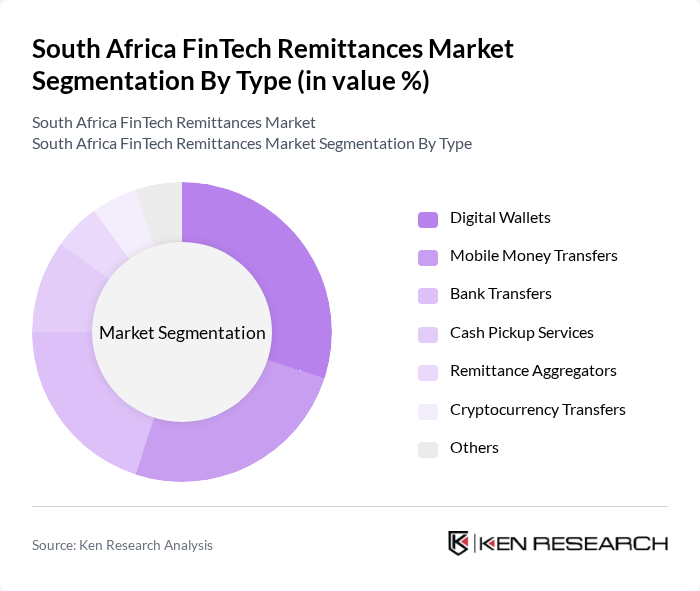
South Africa FinTech Remittances Market segmentation by Type.

By End-User:The end-user segmentation includes Individual Consumers, Small and Medium Enterprises (SMEs), Corporates, and Non-Governmental Organizations (NGOs). Each segment has unique needs and preferences, influencing the choice of remittance services and methods.
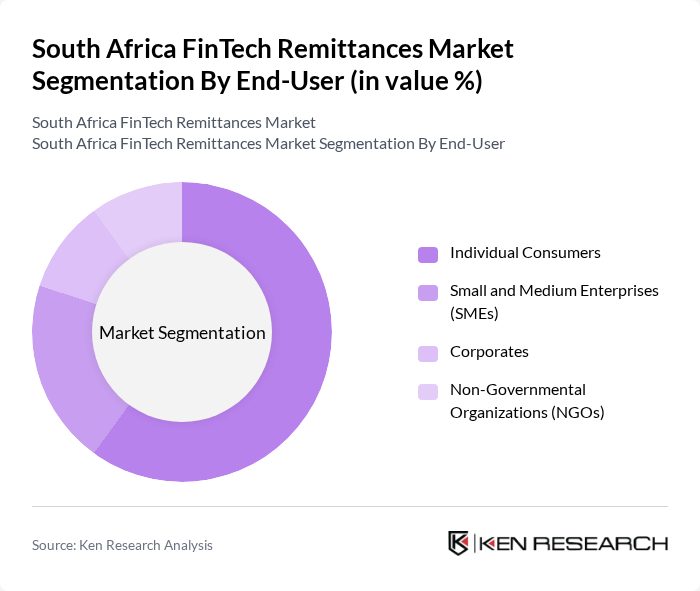
South Africa FinTech Remittances Market segmentation by End-User.

South Africa FinTech Remittances Market Competitive Landscape

The South Africa FinTech Remittances Market is characterized by a dynamic mix of regional and international players. Leading participants such as PayFast, SendMoney, WorldRemit, Remitly, MoneyGram, Western Union, TransferWise, Xoom, FNB (First National Bank), Standard Bank, Absa Bank, Capitec Bank, MTN Mobile Money, Vodacom M-Pesa, PayU contribute to innovation, geographic expansion, and service delivery in this space.

PayFast

2007

Cape Town, South Africa

WorldRemit

2010

London, United Kingdom

MoneyGram

1940

Dallas, Texas, USA

Western Union

1851

Englewood, Colorado, USA

MTN Mobile Money

2009

Johannesburg, South Africa

Company

Establishment Year

Headquarters

Group Size (Large, Medium, or Small as per industry convention)

Customer Acquisition Cost

Transaction Volume Growth Rate

Average Revenue Per User (ARPU)

Customer Retention Rate

Pricing Strategy

South Africa FinTech Remittances Market Industry Analysis

Growth Drivers

  • Increasing Smartphone Penetration:As of future, South Africa boasts a smartphone penetration rate of approximately 90%, with over 55 million users. This widespread access to mobile technology facilitates the adoption of FinTech solutions, enabling users to send and receive remittances conveniently. The growth in mobile internet subscriptions, projected to reach 110 million in future, further supports this trend, allowing for seamless transactions and enhancing user engagement in the remittance market.
  • Rise of Digital Banking Solutions:The digital banking sector in South Africa is experiencing rapid growth, with over 18 million active digital banking users reported in future. This shift towards digital platforms is driven by the increasing demand for convenient financial services. The introduction of user-friendly apps and online banking features has made it easier for consumers to manage their finances, including remittances, thus contributing to the overall growth of the FinTech remittance market.
  • Growing Remittance Inflows from the Diaspora:In future, remittance inflows to South Africa are expected to exceed $8 billion, reflecting a significant increase from previous years. This growth is largely attributed to the South African diaspora, which is estimated to be around 4.5 million people. The increasing economic stability in host countries and the desire to support families back home are key factors driving these inflows, thereby boosting the FinTech remittance market.

Market Challenges

  • High Transaction Costs:Transaction costs for remittances in South Africa remain a significant barrier, averaging around $22 per transaction. This figure is notably higher than the global average of $8. The high costs are primarily due to fees charged by intermediaries and traditional banking systems, which can deter users from utilizing FinTech solutions for remittances, ultimately limiting market growth and accessibility.
  • Regulatory Compliance Complexities:The regulatory landscape for FinTech in South Africa is intricate, with over 35 regulations impacting the remittance sector. Compliance with these regulations, including the Financial Intelligence Centre Act (FICA), poses challenges for new entrants and existing players. The costs associated with ensuring compliance can be substantial, often exceeding $120,000 annually for smaller firms, which may hinder innovation and market participation.

South Africa FinTech Remittances Market Future Outlook

The South African FinTech remittances market is poised for significant transformation, driven by technological advancements and evolving consumer preferences. The increasing integration of artificial intelligence for fraud detection and the rise of peer-to-peer platforms are expected to enhance user experience and security. Additionally, as regulatory frameworks become more supportive of innovation, the market will likely see a surge in new entrants, fostering competition and improving service offerings for consumers in the coming years.

Market Opportunities

  • Expansion of Cross-Border Payment Solutions:With remittance inflows projected to grow, there is a significant opportunity for FinTech companies to develop cross-border payment solutions. By leveraging technology to reduce transaction times and costs, these solutions can cater to the needs of the diaspora, enhancing user satisfaction and market penetration.
  • Partnerships with Local Businesses:Collaborating with local businesses presents a unique opportunity for FinTech firms to expand their reach. By integrating remittance services into local retail and service platforms, companies can tap into existing customer bases, driving adoption and increasing transaction volumes in the remittance market.

Scope of the Report

SegmentSub-Segments
By Type

Digital Wallets

Mobile Money Transfers

Bank Transfers

Cash Pickup Services

Remittance Aggregators

Cryptocurrency Transfers

Others

By End-User

Individual Consumers

Small and Medium Enterprises (SMEs)

Corporates

Non-Governmental Organizations (NGOs)

By Payment Method

Credit/Debit Cards

Bank Transfers

Cash Payments

Mobile Payments

By Transaction Size

Small Transactions

Medium Transactions

Large Transactions

By Frequency of Transactions

Daily Transactions

Weekly Transactions

Monthly Transactions

By Geographic Reach

Domestic Remittances

International Remittances

By Customer Segment

Low-Income Customers

Middle-Income Customers

High-Income Customers

Key Target Audience

Investors and Venture Capitalist Firms

Government and Regulatory Bodies (e.g., South African Reserve Bank, Financial Sector Conduct Authority)

Payment Service Providers

Telecommunications Companies

Remittance Service Operators

Financial Technology Startups

Non-Governmental Organizations (NGOs) focused on financial inclusion

International Development Agencies

Players Mentioned in the Report:

PayFast

SendMoney

WorldRemit

Remitly

MoneyGram

Western Union

TransferWise

Xoom

FNB (First National Bank)

Standard Bank

Absa Bank

Capitec Bank

MTN Mobile Money

Vodacom M-Pesa

PayU

Table of Contents

Market Assessment Phase

1. Executive Summary and Approach


2. South Africa FinTech Remittances Market Overview

2.1 Key Insights and Strategic Recommendations

2.2 South Africa FinTech Remittances Market Overview

2.3 Definition and Scope

2.4 Evolution of Market Ecosystem

2.5 Timeline of Key Regulatory Milestones

2.6 Value Chain & Stakeholder Mapping

2.7 Business Cycle Analysis

2.8 Policy & Incentive Landscape


3. South Africa FinTech Remittances Market Analysis

3.1 Growth Drivers

3.1.1 Increasing smartphone penetration
3.1.2 Rise of digital banking solutions
3.1.3 Growing remittance inflows from the diaspora
3.1.4 Enhanced regulatory support for FinTech innovations

3.2 Market Challenges

3.2.1 High transaction costs
3.2.2 Regulatory compliance complexities
3.2.3 Limited financial literacy among users
3.2.4 Competition from traditional banking systems

3.3 Market Opportunities

3.3.1 Expansion of cross-border payment solutions
3.3.2 Partnerships with local businesses
3.3.3 Development of niche remittance services
3.3.4 Adoption of blockchain technology for secure transactions

3.4 Market Trends

3.4.1 Increasing use of AI for fraud detection
3.4.2 Growth of peer-to-peer remittance platforms
3.4.3 Shift towards mobile-first financial services
3.4.4 Emergence of social remittance platforms

3.5 Government Regulation

3.5.1 Implementation of the Financial Intelligence Centre Act (FICA)
3.5.2 Compliance with the Payment Systems Act
3.5.3 Licensing requirements for payment service providers
3.5.4 Anti-Money Laundering (AML) regulations

4. SWOT Analysis


5. Stakeholder Analysis


6. Porter's Five Forces Analysis


7. South Africa FinTech Remittances Market Market Size, 2019-2024

7.1 By Value

7.2 By Volume

7.3 By Average Selling Price


8. South Africa FinTech Remittances Market Segmentation

8.1 By Type

8.1.1 Digital Wallets
8.1.2 Mobile Money Transfers
8.1.3 Bank Transfers
8.1.4 Cash Pickup Services
8.1.5 Remittance Aggregators
8.1.6 Cryptocurrency Transfers
8.1.7 Others

8.2 By End-User

8.2.1 Individual Consumers
8.2.2 Small and Medium Enterprises (SMEs)
8.2.3 Corporates
8.2.4 Non-Governmental Organizations (NGOs)

8.3 By Payment Method

8.3.1 Credit/Debit Cards
8.3.2 Bank Transfers
8.3.3 Cash Payments
8.3.4 Mobile Payments

8.4 By Transaction Size

8.4.1 Small Transactions
8.4.2 Medium Transactions
8.4.3 Large Transactions

8.5 By Frequency of Transactions

8.5.1 Daily Transactions
8.5.2 Weekly Transactions
8.5.3 Monthly Transactions

8.6 By Geographic Reach

8.6.1 Domestic Remittances
8.6.2 International Remittances

8.7 By Customer Segment

8.7.1 Low-Income Customers
8.7.2 Middle-Income Customers
8.7.3 High-Income Customers

9. South Africa FinTech Remittances Market Competitive Analysis

9.1 Market Share of Key Players

9.2 Cross Comparison of Key Players

9.2.1 Company Name
9.2.2 Group Size (Large, Medium, or Small as per industry convention)
9.2.3 Customer Acquisition Cost
9.2.4 Transaction Volume Growth Rate
9.2.5 Average Revenue Per User (ARPU)
9.2.6 Customer Retention Rate
9.2.7 Pricing Strategy
9.2.8 Market Penetration Rate
9.2.9 Operational Efficiency Ratio
9.2.10 Net Promoter Score (NPS)

9.3 SWOT Analysis of Top Players

9.4 Pricing Analysis

9.5 Detailed Profile of Major Companies

9.5.1 PayFast
9.5.2 SendMoney
9.5.3 WorldRemit
9.5.4 Remitly
9.5.5 MoneyGram
9.5.6 Western Union
9.5.7 TransferWise
9.5.8 Xoom
9.5.9 FNB (First National Bank)
9.5.10 Standard Bank
9.5.11 Absa Bank
9.5.12 Capitec Bank
9.5.13 MTN Mobile Money
9.5.14 Vodacom M-Pesa
9.5.15 PayU

10. South Africa FinTech Remittances Market End-User Analysis

10.1 Procurement Behavior of Key Ministries

10.1.1 Budget Allocation for Remittance Services
10.1.2 Evaluation Criteria for Service Providers
10.1.3 Frequency of Procurement Cycles

10.2 Corporate Spend on Infrastructure & Energy

10.2.1 Investment in Digital Infrastructure
10.2.2 Spending on Compliance and Security
10.2.3 Budget for Customer Support Services

10.3 Pain Point Analysis by End-User Category

10.3.1 High Fees for Transactions
10.3.2 Delays in Fund Transfers
10.3.3 Lack of Transparency in Pricing

10.4 User Readiness for Adoption

10.4.1 Awareness of Digital Remittance Options
10.4.2 Trust in Digital Financial Services
10.4.3 Accessibility of Technology

10.5 Post-Deployment ROI and Use Case Expansion

10.5.1 Measurement of Cost Savings
10.5.2 User Satisfaction Metrics
10.5.3 Opportunities for Service Expansion

11. South Africa FinTech Remittances Market Future Size, 2025-2030

11.1 By Value

11.2 By Volume

11.3 By Average Selling Price


Go-To-Market Strategy Phase

1. Whitespace Analysis + Business Model Canvas

1.1 Market Gaps Identification

1.2 Value Proposition Development

1.3 Revenue Streams Analysis

1.4 Cost Structure Evaluation

1.5 Key Partnerships Exploration

1.6 Customer Segmentation Insights

1.7 Channels for Delivery


2. Marketing and Positioning Recommendations

2.1 Branding Strategies

2.2 Product USPs

2.3 Target Audience Engagement

2.4 Digital Marketing Tactics

2.5 Offline Marketing Strategies

2.6 Customer Feedback Mechanisms


3. Distribution Plan

3.1 Urban Retail Strategies

3.2 Rural NGO Tie-Ups

3.3 Online Distribution Channels

3.4 Partnerships with Local Agents

3.5 Logistics and Delivery Mechanisms


4. Channel & Pricing Gaps

4.1 Underserved Routes

4.2 Pricing Bands Analysis

4.3 Competitor Pricing Comparison

4.4 Customer Willingness to Pay

4.5 Value-Based Pricing Strategies


5. Unmet Demand & Latent Needs

5.1 Category Gaps Identification

5.2 Consumer Segments Analysis

5.3 Emerging Trends in Consumer Behavior

5.4 Innovations in Service Delivery


6. Customer Relationship

6.1 Loyalty Programs Development

6.2 After-Sales Service Enhancements

6.3 Customer Engagement Strategies

6.4 Feedback and Improvement Loops


7. Value Proposition

7.1 Sustainability Initiatives

7.2 Integrated Supply Chains

7.3 Customer-Centric Innovations

7.4 Competitive Differentiation


8. Key Activities

8.1 Regulatory Compliance

8.2 Branding Initiatives

8.3 Distribution Setup

8.4 Training and Development


9. Entry Strategy Evaluation

9.1 Domestic Market Entry Strategy

9.1.1 Product Mix Considerations
9.1.2 Pricing Band Strategies
9.1.3 Packaging Options

9.2 Export Entry Strategy

9.2.1 Target Countries Identification
9.2.2 Compliance Roadmap Development

10. Entry Mode Assessment

10.1 Joint Ventures

10.2 Greenfield Investments

10.3 Mergers & Acquisitions

10.4 Distributor Model Evaluation


11. Capital and Timeline Estimation

11.1 Capital Requirements Analysis

11.2 Timelines for Implementation


12. Control vs Risk Trade-Off

12.1 Ownership vs Partnerships

12.2 Risk Mitigation Strategies


13. Profitability Outlook

13.1 Breakeven Analysis

13.2 Long-Term Sustainability Strategies


14. Potential Partner List

14.1 Distributors Identification

14.2 Joint Ventures Opportunities

14.3 Acquisition Targets


15. Execution Roadmap

15.1 Phased Plan for Market Entry

15.1.1 Market Setup
15.1.2 Market Entry
15.1.3 Growth Acceleration
15.1.4 Scale & Stabilize

15.2 Key Activities and Milestones

15.2.1 Milestone Planning
15.2.2 Activity Tracking

Research Methodology

ApproachModellingSample

Phase 1: Approach1

Desk Research

  • Analysis of remittance flow data from the South African Reserve Bank and World Bank
  • Review of industry reports and white papers from FinTech associations and regulatory bodies
  • Examination of demographic and economic data from Statistics South Africa to understand target markets

Primary Research

  • Interviews with executives from leading FinTech remittance companies operating in South Africa
  • Surveys with consumers utilizing remittance services to gather insights on preferences and pain points
  • Focus groups with community leaders in key remittance-receiving demographics to assess service impact

Validation & Triangulation

  • Cross-validation of findings through comparison with international remittance trends and local economic indicators
  • Triangulation of data from consumer surveys, expert interviews, and industry reports
  • Sanity checks through feedback from a panel of industry experts and stakeholders

Phase 2: Market Size Estimation1

Top-down Assessment

  • Estimation of total remittance inflows to South Africa based on global remittance data
  • Segmentation of remittance flows by country of origin and purpose (e.g., family support, investment)
  • Incorporation of macroeconomic factors such as exchange rates and economic growth rates

Bottom-up Modeling

  • Collection of transaction volume data from major remittance service providers
  • Analysis of average transaction fees and service charges across different platforms
  • Calculation of total market size based on transaction volume multiplied by average fees

Forecasting & Scenario Analysis

  • Multi-factor regression analysis incorporating variables such as migration trends and economic conditions
  • Scenario modeling based on potential regulatory changes and technological advancements in FinTech
  • Development of baseline, optimistic, and pessimistic forecasts for the remittance market through 2030

Phase 3: CATI Sample Composition1

Scope Item/SegmentSample SizeTarget Respondent Profiles
Consumer Remittance Users150Individuals aged 18-65 who regularly send money abroad
FinTech Service Providers100CEOs, Product Managers, and Marketing Directors of remittance companies
Regulatory Bodies50Policy Makers and Compliance Officers in financial regulation
Community Leaders40Leaders from immigrant communities and NGOs focused on financial inclusion
Financial Analysts30Analysts specializing in remittances and financial technology sectors

Frequently Asked Questions

What is the current value of the South Africa FinTech Remittances Market?

The South Africa FinTech Remittances Market is valued at approximately USD 1.5 billion, reflecting a significant growth driven by the demand for efficient remittance solutions and the rise of digital financial services for both local and international transactions.

Which cities are the main hubs for remittance services in South Africa?

What regulatory changes have impacted the South Africa FinTech Remittances Market?

What are the main types of remittance services available in South Africa?

Other Regional/Country Reports

Indonesia FinTech Remittances Market

Malaysia FinTech Remittances Market

KSA FinTech Remittances Market

APAC FinTech Remittances Market

SEA FinTech Remittances Market

Vietnam FinTech Remittances Market

Other Adjacent Reports

Bahrain Digital Payments MarketGlobal Mobile Money Market Outlook to 2030GCC Cross-Border Payments Market Size, Share, Trends, Growth Drivers & Forecast 2025–2030

KSA Cryptocurrency Remittances Market

Philippines Blockchain Finance Market

Philippines Financial Inclusion Market

India Peer-to-Peer Lending Market Outlook to 2030

Egypt E-Wallet Services Market

Brazil International Money Transfer Market

South Korea FinTech Regulatory Services Market

Why Buy From Us?

Refine Robust Result (RRR) Framework

What makes us stand out is that our consultants follow Robust, Refine and Result (RRR) methodology. Robust for clear definitions, approaches and sanity checking, Refine for differentiating respondents' facts and opinions, and Result for presenting data with story.

Our Reach Is Unmatched

We have set a benchmark in the industry by offering our clients with syndicated and customized market research reports featuring coverage of entire market as well as meticulous research and analyst insights.

Shifting the Research Paradigm

While we don't replace traditional research, we flip the method upside down. Our dual approach of Top Bottom & Bottom Top ensures quality deliverable by not just verifying company fundamentals but also looking at the sector and macroeconomic factors.

More Insights-Better Decisions

With one step in the future, our research team constantly tries to show you the bigger picture. We help with some of the tough questions you may encounter along the way: How is the industry positioned? Best marketing channel? KPI's of competitors? By aligning every element, we help maximize success.

Transparency and Trust

Our report gives you instant access to the answers and sources that other companies might choose to hide. We elaborate each steps of research methodology we have used and showcase you the sample size to earn your trust.

Round the Clock Support

If you need any support, we are here! We pride ourselves on universe strength, data quality, and quick, friendly, and professional service.

Why Clients Choose Us?

400000+
Reports in repository
150+
Consulting projects a year
100+
Analysts
8000+
Client Queries in 2022








