Thailand Beverage Filling Capping Machine Market Report Size Share Growth Drivers Trends Opportunities & Forecast 2025–2030

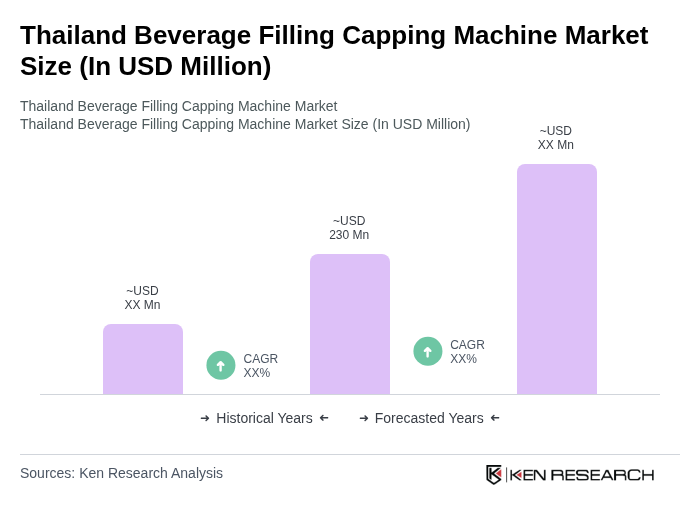
Thailand beverage filling capping machine market, valued at USD 230 Mn, grows with rising packaged beverage demand, automation, and health trends in non-alcoholic drinks.

Region:Asia

Author(s):Geetanshi

Product Code:KRAA4054

Pages:85

Published On:January 2026
About the Report

Base Year 2024

Thailand Beverage Filling Capping Machine Market Overview

  • The Thailand Beverage Filling Capping Machine Market is valued at USD 230 million, based on a five-year historical analysis. This market size aligns with the sustained expansion of Thailand’s beverage industry, which is largely driven by domestic consumption, rising output of non-alcoholic drinks such as bottled water and carbonated beverages, and continuous investments by both local and multinational beverage producers in modern production lines. The increasing demand for packaged beverages, together with advancements in automation and process control technologies in Thai filling plants, supports higher production efficiency and throughput. The rise in consumer preference for convenience, ready-to-drink products, and health-oriented beverages (including low/zero sugar and functional drinks) has further stimulated investments in sophisticated filling and capping solutions.
  • Key players in this market are concentrated in and around major industrial and consumption hubs, with Bangkok and nearby central provinces such as Nakhon Pathom, Pathum Thani, Samut Sakhon, Chonburi, and Ayutthaya hosting a high density of beverage manufacturing facilities. These areas dominate due to robust logistics and port infrastructure, high population density, and proximity to both retail channels and export gateways. The presence of numerous non-alcoholic and alcoholic beverage producers in these provinces drives demand for efficient and reliable filling and capping machinery to support capacity expansions, line upgrades, and format diversification.
  • The Thai beverage industry operates under a defined food safety and factory-control framework that impacts filling and capping operations. The Food Act B.E. 2522 (1979), issued by the Ministry of Public Health, establishes the fundamental requirements for food safety, hygiene, labeling, and quality control for all food and beverage products placed on the market, obliging manufacturers to implement sanitary production conditions, safe packaging, and compliance with prescribed standards. In parallel, the Factory Act B.E. 2535 (1992) and its subsequent amendments, administered by the Ministry of Industry, set licensing and operating criteria for beverage production facilities, including requirements linked to plant capacity and environmental and safety controls, which extend to the design and operation of automated filling and packaging lines. These instruments collectively reinforce hygiene and quality control measures in bottling, filling, and capping processes and support higher confidence in domestically produced beverages.
Thailand Beverage Filling Capping Machine Market Size

Thailand Beverage Filling Capping Machine Market Segmentation

By Machine Type:The market is segmented into various machine types, including Filling Machines, Capping Machines, Integrated Filling & Capping Monoblocs, Ancillary Packaging Equipment, and Others. Filling Machines are the most dominant due to their essential role at the core of beverage processing and packaging lines across categories such as bottled water, carbonated soft drinks, ready-to-drink teas, functional beverages, and juices. The increasing diversification of beverage portfolios in Thailand, including low/zero sugar drinks, functional beverages, kombucha, and plant-based products, has led to greater adoption of advanced filling technologies that can handle multiple viscosities, carbonation levels, and hygienic or aseptic requirements. Capping Machines also play a crucial role by ensuring secure closures, product integrity, and shelf life across PET, glass, and carton formats. Integrated Filling & Capping Monoblocs are gaining traction, particularly among larger bottlers and contract packers, for their ability to combine rinsing, filling, and capping in compact, highly automated blocks that reduce footprint, minimize handling, and improve line efficiency. Ancillary Packaging Equipment, including conveyors, labelling, inspection, and case-packing systems, supports end-to-end line integration, while the Others category typically includes specialized or customized systems tailored to niche beverage applications.
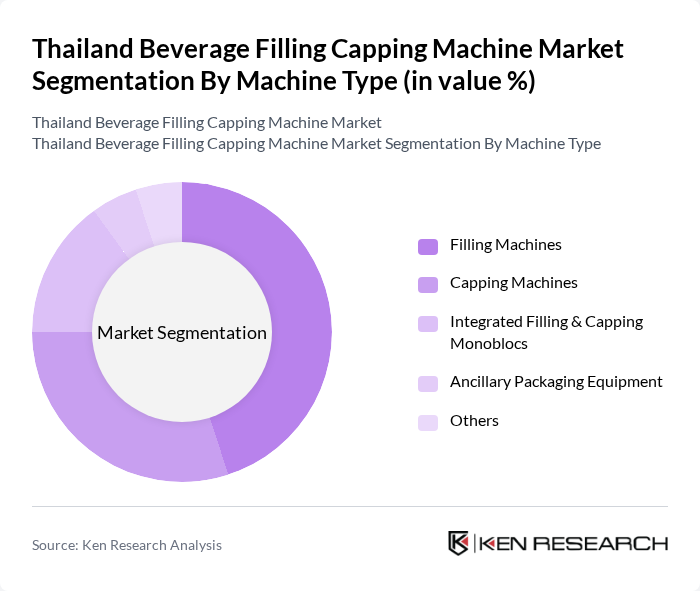
Thailand Beverage Filling Capping Machine Market segmentation by Machine Type.

By Automation Level:The market is categorized into Fully Automatic, Semi-Automatic, Manual / Low-Automation Systems, and Retrofit & Upgraded Lines. Fully Automatic systems dominate the market as Thai beverage producers increasingly invest in high-speed, digitally controlled lines to improve productivity, reduce unit production costs, and address labor availability and cost pressures. The push towards Industry 4.0, data-driven monitoring, and higher hygiene standards in bottling plants further supports the shift toward fully automated filling and capping solutions. Semi-Automatic systems remain relevant among small and medium-sized producers, regional brands, and start-ups that need cost-effective, scalable solutions, particularly in emerging segments such as craft beverages and functional drinks. Manual / Low-Automation Systems are used mainly in micro-scale or niche production where flexibility and low initial capital expenditure outweigh throughput requirements. Retrofit & Upgraded Lines are increasingly adopted as existing plants modernize by integrating new control systems, more efficient filling valves, changeover solutions, and energy-saving components into legacy equipment to meet evolving quality, sustainability, and product diversification demands.
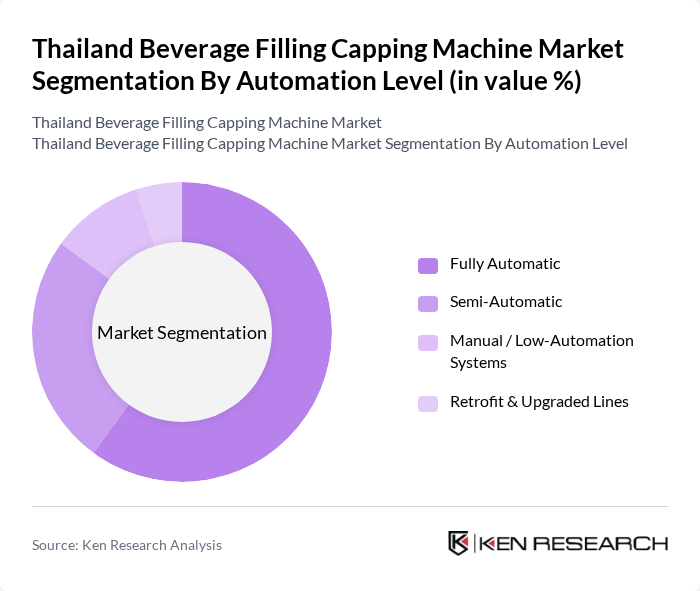
Thailand Beverage Filling Capping Machine Market segmentation by Automation Level.

Thailand Beverage Filling Capping Machine Market Competitive Landscape

The Thailand Beverage Filling Capping Machine Market is characterized by a dynamic mix of regional and international players. Leading participants such as Krones AG, Sidel Group, Tetra Pak, Syntegon Technology GmbH (formerly Bosch Packaging Technology), GEA Group, Sacmi Imola S.C., AROL S.p.A., ABE Beverage Equipment, CFT S.p.A., Aseptic Technologies, APT (Advanced Packaging Technologies), M.A.R. S.r.l., Mettler-Toledo International Inc., KHS GmbH, Coesia S.p.A. contribute to innovation, geographic expansion, and service delivery in this space. These companies support Thai beverage producers with turnkey bottling lines, high-speed fillers and cappers, aseptic systems, monitoring and inspection solutions, and after-sales services that enable higher efficiency, quality, and flexibility in a market increasingly shaped by health, convenience, and premiumization trends.

Krones AG

1951

Neutraubling, Germany

Sidel Group

1965

Octeville-sur-Mer, France

Tetra Pak

1951

Lund, Sweden

Syntegon Technology GmbH

1969

Waiblingen, Germany

GEA Group

1881

Düsseldorf, Germany

Company

Establishment Year

Headquarters

Group Size (Large, Medium, or Small as per industry convention)

Thailand Revenue (Latest Year, USD Million)

3-Year Revenue CAGR in Thailand (%)

Installed Base of Filling & Capping Lines in Thailand (Number of Lines)

Order Intake / Backlog (Latest Year, USD Million)

EBITDA Margin (%) – Thailand / APAC Beverage Segment

Thailand Beverage Filling Capping Machine Market Industry Analysis

Growth Drivers

  • Increasing Demand for Packaged Beverages:The Thai beverage market is projected to reach THB 1.2 trillion in future, driven by a growing consumer preference for convenience and portability. The rise in disposable income, which is expected to increase by 5% annually, has led to higher spending on packaged beverages. This trend is further supported by the increasing urbanization rate, which is projected to reach 50% in future, creating a larger consumer base for beverage manufacturers.
  • Technological Advancements in Filling and Capping:The integration of advanced technologies in filling and capping machinery is enhancing production efficiency. In future, the adoption of automated systems is expected to increase by 30%, driven by the need for higher output and reduced labor costs. Additionally, the introduction of smart technology, such as IoT-enabled machines, is projected to improve operational monitoring, leading to a 20% reduction in downtime for manufacturers, thus boosting overall productivity.
  • Expansion of the Beverage Industry in Thailand:The beverage industry in Thailand is experiencing robust growth, with a projected annual growth rate of 6% in future. This expansion is fueled by the increasing variety of beverage offerings, including health drinks and functional beverages, which are gaining popularity. The government’s support for the food and beverage sector, including tax incentives and infrastructure development, is expected to further stimulate market growth, creating a favorable environment for filling and capping machine manufacturers.

Market Challenges

  • High Initial Investment Costs:The capital required for acquiring advanced filling and capping machines can be a significant barrier for small and medium-sized enterprises (SMEs). The average cost of high-tech machinery ranges from THB 5 million to THB 15 million, which can deter new entrants. Additionally, the need for ongoing maintenance and upgrades adds to the financial burden, making it challenging for SMEs to compete with larger manufacturers who can absorb these costs more effectively.
  • Stringent Regulatory Requirements:Compliance with food safety and quality standards poses a challenge for manufacturers in Thailand. The Thai Food and Drug Administration (FDA) enforces strict regulations that require manufacturers to adhere to specific safety protocols, which can be costly and time-consuming. In future, the expected increase in regulatory scrutiny may lead to additional compliance costs, estimated at THB 2 million annually for mid-sized companies, impacting their operational efficiency and profitability.

Thailand Beverage Filling Capping Machine Market Future Outlook

The Thailand beverage filling capping machine market is poised for significant growth, driven by technological innovations and evolving consumer preferences. As manufacturers increasingly adopt automation and smart technologies, operational efficiencies are expected to improve, leading to enhanced production capabilities. Furthermore, the shift towards sustainable practices and eco-friendly packaging solutions will likely shape the market landscape, encouraging investments in advanced machinery that meets these new standards. Overall, the market is set to evolve in response to both consumer demands and regulatory pressures.

Market Opportunities

  • Growth in the Health Beverage Segment:The health beverage segment is projected to grow by 15% annually, driven by increasing consumer awareness of health and wellness. This trend presents an opportunity for manufacturers to invest in specialized filling and capping machines tailored for health-focused products, enhancing their market competitiveness and meeting consumer demands for quality and safety.
  • Adoption of Eco-Friendly Packaging Solutions:With rising environmental concerns, the demand for eco-friendly packaging is expected to increase significantly. Manufacturers can capitalize on this trend by developing machines that support biodegradable and recyclable materials, aligning with consumer preferences and regulatory requirements. This shift could lead to a 25% increase in market share for companies that prioritize sustainable practices in their operations.

Scope of the Report

SegmentSub-Segments
By Machine Type

Filling Machines

Capping Machines

Integrated Filling & Capping Monoblocs

Ancillary Packaging Equipment

Others

By Automation Level

Fully Automatic

Semi-Automatic

Manual / Low-Automation Systems

Retrofit & Upgraded Lines

By Beverage Type

Carbonated Soft Drinks

Bottled Water

Juices & Nutritional Drinks

Dairy & Functional Beverages

Alcoholic Beverages (Beer, Spirits, RTDs)

Others

By Line Capacity (Bottles/Containers per Hour)

Up to 5,000 BPH

,001 – 15,000 BPH

Above 15,000 BPH

Others

By Packaging Format

PET Bottles

Glass Bottles

Metal Cans

Cartons & Pouches

Others

By End-User

Large-Scale Beverage Producers

Medium & Regional Bottlers

Contract Packaging Organizations (CPOs)

Emerging & Craft Beverage Players

Others

By Region

Central Thailand

Northern Thailand

Southern Thailand

Eastern Thailand

Others

Key Target Audience

Investors and Venture Capitalist Firms

Government and Regulatory Bodies (e.g., Ministry of Industry, Food and Drug Administration Thailand)

Manufacturers and Producers of Beverage Filling Capping Machines

Distributors and Retailers of Beverage Packaging Equipment

Packaging Material Suppliers

Food and Beverage Manufacturers

Industry Associations (e.g., Thai Beverage Industry Association)

Financial Institutions and Banks

Players Mentioned in the Report:

Krones AG

Sidel Group

Tetra Pak

Syntegon Technology GmbH (formerly Bosch Packaging Technology)

GEA Group

Sacmi Imola S.C.

AROL S.p.A.

ABE Beverage Equipment

CFT S.p.A.

Aseptic Technologies

APT (Advanced Packaging Technologies)

M.A.R. S.r.l.

Mettler-Toledo International Inc.

KHS GmbH

Coesia S.p.A.

Table of Contents

Market Assessment Phase

1. Executive Summary and Approach


2. Thailand Beverage Filling Capping Machine Market Overview

2.1 Key Insights and Strategic Recommendations

2.2 Thailand Beverage Filling Capping Machine Market Overview

2.3 Definition and Scope

2.4 Evolution of Market Ecosystem

2.5 Timeline of Key Regulatory Milestones

2.6 Value Chain & Stakeholder Mapping

2.7 Business Cycle Analysis

2.8 Policy & Incentive Landscape


3. Thailand Beverage Filling Capping Machine Market Analysis

3.1 Growth Drivers

3.1.1 Increasing demand for packaged beverages
3.1.2 Technological advancements in filling and capping
3.1.3 Rising consumer preference for convenience
3.1.4 Expansion of the beverage industry in Thailand

3.2 Market Challenges

3.2.1 High initial investment costs
3.2.2 Stringent regulatory requirements
3.2.3 Competition from low-cost manufacturers
3.2.4 Supply chain disruptions

3.3 Market Opportunities

3.3.1 Growth in the health beverage segment
3.3.2 Adoption of eco-friendly packaging solutions
3.3.3 Expansion into emerging markets
3.3.4 Customization of machines for niche markets

3.4 Market Trends

3.4.1 Automation and smart technology integration
3.4.2 Shift towards sustainable manufacturing practices
3.4.3 Increasing focus on energy-efficient machines
3.4.4 Growth of e-commerce in beverage distribution

3.5 Government Regulation

3.5.1 Compliance with food safety standards
3.5.2 Environmental regulations on packaging waste
3.5.3 Import/export regulations for machinery
3.5.4 Labor laws affecting manufacturing operations

4. SWOT Analysis


5. Stakeholder Analysis


6. Porter's Five Forces Analysis


7. Thailand Beverage Filling Capping Machine Market Market Size, 2019-2024

7.1 By Value

7.2 By Volume

7.3 By Average Selling Price


8. Thailand Beverage Filling Capping Machine Market Segmentation

8.1 By Machine Type

8.1.1 Filling Machines
8.1.2 Capping Machines
8.1.3 Integrated Filling & Capping Monoblocs
8.1.4 Ancillary Packaging Equipment
8.1.5 Others

8.2 By Automation Level

8.2.1 Fully Automatic
8.2.2 Semi-Automatic
8.2.3 Manual / Low-Automation Systems
8.2.4 Retrofit & Upgraded Lines

8.3 By Beverage Type

8.3.1 Carbonated Soft Drinks
8.3.2 Bottled Water
8.3.3 Juices & Nutritional Drinks
8.3.4 Dairy & Functional Beverages
8.3.5 Alcoholic Beverages (Beer, Spirits, RTDs)
8.3.6 Others

8.4 By Line Capacity (Bottles/Containers per Hour)

8.4.1 Up to 5,000 BPH
8.4.2 5,001 – 15,000 BPH
8.4.3 Above 15,000 BPH
8.4.4 Others

8.5 By Packaging Format

8.5.1 PET Bottles
8.5.2 Glass Bottles
8.5.3 Metal Cans
8.5.4 Cartons & Pouches
8.5.5 Others

8.6 By End-User

8.6.1 Large-Scale Beverage Producers
8.6.2 Medium & Regional Bottlers
8.6.3 Contract Packaging Organizations (CPOs)
8.6.4 Emerging & Craft Beverage Players
8.6.5 Others

8.7 By Region

8.7.1 Central Thailand
8.7.2 Northern Thailand
8.7.3 Southern Thailand
8.7.4 Eastern Thailand
8.7.5 Others

9. Thailand Beverage Filling Capping Machine Market Competitive Analysis

9.1 Market Share of Key Players

9.2 Cross Comparison of Key Players

9.2.1 Company Name
9.2.2 Group Size (Large, Medium, or Small as per industry convention)
9.2.3 Thailand Revenue (Latest Year, USD Million)
9.2.4 3-Year Revenue CAGR in Thailand (%)
9.2.5 Installed Base of Filling & Capping Lines in Thailand (Number of Lines)
9.2.6 Order Intake / Backlog (Latest Year, USD Million)
9.2.7 EBITDA Margin (%) – Thailand / APAC Beverage Segment
9.2.8 Market Share in Thailand Beverage Filling & Capping Segment (%)
9.2.9 Average Line Throughput Supplied (Bottles per Hour)
9.2.10 Service & After-Sales Coverage (Number of Local Service Centers / Technicians)
9.2.11 R&D Intensity (% of Revenue Spent on R&D)
9.2.12 Key Strategic Partnerships / Local Integrator Tie-Ups

9.3 SWOT Analysis of Top Players

9.4 Pricing Analysis

9.5 Detailed Profile of Major Companies

9.5.1 Krones AG
9.5.2 Sidel Group
9.5.3 Tetra Pak
9.5.4 Syntegon Technology GmbH (formerly Bosch Packaging Technology)
9.5.5 GEA Group
9.5.6 Sacmi Imola S.C.
9.5.7 AROL S.p.A.
9.5.8 ABE Beverage Equipment
9.5.9 CFT S.p.A.
9.5.10 Aseptic Technologies
9.5.11 APT (Advanced Packaging Technologies)
9.5.12 M.A.R. S.r.l.
9.5.13 Mettler-Toledo International Inc.
9.5.14 KHS GmbH
9.5.15 Coesia S.p.A.

10. Thailand Beverage Filling Capping Machine Market End-User Analysis

10.1 Procurement Behavior of Key Ministries

10.1.1 Budget Allocation Trends
10.1.2 Decision-Making Processes
10.1.3 Supplier Selection Criteria
10.1.4 Contract Management Practices

10.2 Corporate Spend on Infrastructure & Energy

10.2.1 Investment Trends in Beverage Production
10.2.2 Spending on Automation Technologies
10.2.3 Budgeting for Sustainability Initiatives
10.2.4 Others

10.3 Pain Point Analysis by End-User Category

10.3.1 Equipment Downtime
10.3.2 Maintenance Costs
10.3.3 Compliance Challenges
10.3.4 Others

10.4 User Readiness for Adoption

10.4.1 Training and Skill Development Needs
10.4.2 Technology Acceptance Levels
10.4.3 Investment Readiness
10.4.4 Others

10.5 Post-Deployment ROI and Use Case Expansion

10.5.1 Performance Metrics Tracking
10.5.2 Case Studies of Successful Implementations
10.5.3 Future Expansion Plans
10.5.4 Others

11. Thailand Beverage Filling Capping Machine Market Future Size, 2025-2030

11.1 By Value

11.2 By Volume

11.3 By Average Selling Price


Go-To-Market Strategy Phase

1. Whitespace Analysis + Business Model Canvas

1.1 Market Gaps Identification

1.2 Value Proposition Development

1.3 Revenue Streams Analysis

1.4 Cost Structure Evaluation

1.5 Key Partnerships Exploration

1.6 Customer Segmentation

1.7 Channels of Distribution


2. Marketing and Positioning Recommendations

2.1 Branding Strategies

2.2 Product USPs

2.3 Target Market Identification

2.4 Communication Strategies

2.5 Digital Marketing Approaches


3. Distribution Plan

3.1 Urban Retail Strategies

3.2 Rural NGO Tie-ups

3.3 E-commerce Integration

3.4 Logistics and Supply Chain Management


4. Channel & Pricing Gaps

4.1 Underserved Routes

4.2 Pricing Bands Analysis

4.3 Competitor Pricing Strategies


5. Unmet Demand & Latent Needs

5.1 Category Gaps Identification

5.2 Consumer Segments Analysis

5.3 Product Development Opportunities


6. Customer Relationship

6.1 Loyalty Programs

6.2 After-sales Service Enhancements

6.3 Customer Feedback Mechanisms


7. Value Proposition

7.1 Sustainability Initiatives

7.2 Integrated Supply Chains

7.3 Competitive Advantages


8. Key Activities

8.1 Regulatory Compliance

8.2 Branding Initiatives

8.3 Distribution Setup


9. Entry Strategy Evaluation

9.1 Domestic Market Entry Strategy

9.1.1 Product Mix Considerations
9.1.2 Pricing Band Strategies
9.1.3 Packaging Innovations

9.2 Export Entry Strategy

9.2.1 Target Countries Analysis
9.2.2 Compliance Roadmap Development

10. Entry Mode Assessment

10.1 Joint Ventures

10.2 Greenfield Investments

10.3 Mergers & Acquisitions

10.4 Distributor Model Evaluation


11. Capital and Timeline Estimation

11.1 Capital Requirements Analysis

11.2 Timelines for Market Entry


12. Control vs Risk Trade-Off

12.1 Ownership vs Partnerships

12.2 Risk Mitigation Strategies


13. Profitability Outlook

13.1 Breakeven Analysis

13.2 Long-term Sustainability Strategies


14. Potential Partner List

14.1 Distributors

14.2 Joint Ventures

14.3 Acquisition Targets


15. Execution Roadmap

15.1 Phased Plan for Market Entry

15.1.1 Market Setup
15.1.2 Market Entry
15.1.3 Growth Acceleration
15.1.4 Scale & Stabilize

15.2 Key Activities and Milestones

15.2.1 Milestone Planning
15.2.2 Activity Tracking

Research Methodology

ApproachModellingSample

Phase 1: Approach1

Desk Research

  • Industry reports from Thai Beverage Association and relevant trade organizations
  • Market analysis from government publications and economic surveys
  • Academic journals and white papers focusing on beverage manufacturing technologies

Primary Research

  • Interviews with production managers at leading beverage manufacturers in Thailand
  • Surveys with equipment suppliers and distributors in the beverage sector
  • Field visits to manufacturing plants to observe filling and capping processes

Validation & Triangulation

  • Cross-validation of data through multiple industry sources and expert opinions
  • Triangulation of market size estimates from production, sales, and import/export data
  • Sanity checks conducted through feedback from industry experts and stakeholders

Phase 2: Market Size Estimation1

Top-down Assessment

  • Analysis of national beverage consumption trends and growth rates
  • Segmentation of the market by beverage type (e.g., soft drinks, alcoholic beverages)
  • Incorporation of government initiatives promoting local beverage production

Bottom-up Modeling

  • Volume estimates based on production capacities of major beverage companies
  • Cost analysis of filling and capping machinery based on supplier pricing
  • Estimation of market share for different types of filling and capping technologies

Forecasting & Scenario Analysis

  • Multi-variable regression analysis considering economic growth and consumer preferences
  • Scenario planning based on potential regulatory changes and market disruptions
  • Development of baseline, optimistic, and pessimistic forecasts through 2030

Phase 3: CATI Sample Composition1

Scope Item/SegmentSample SizeTarget Respondent Profiles
Soft Drink Manufacturers120Production Managers, Quality Control Supervisors
Alcoholic Beverage Producers90Operations Directors, Equipment Procurement Officers
Bottling Equipment Suppliers70Sales Managers, Technical Support Engineers
Packaging Consultants50Industry Analysts, Product Development Managers
Regulatory Bodies40Compliance Officers, Policy Makers

Frequently Asked Questions

What is the current value of the Thailand Beverage Filling Capping Machine Market?

The Thailand Beverage Filling Capping Machine Market is valued at approximately USD 230 million, reflecting the growth of the beverage industry driven by domestic consumption and investments in modern production lines.

What factors are driving the growth of the Thailand Beverage Filling Capping Machine Market?

Which regions in Thailand are most significant for beverage manufacturing?

What types of machines are included in the Thailand Beverage Filling Capping Machine Market?

Other Adjacent Reports

Japan Beverage Packaging Machinery Market

UAE Aseptic Processing Equipment Market

Qatar Bottling Line Automation Market

Indonesia Labeling Machine Market

United Arab Emirates Conveyor Systems Market Size Share Growth Drivers Trends Opportunities & Forecast 2025–2030UAE food processing equipment market size, share, growth drivers, trends, opportunities & forecast 2025–2030

Brazil Packaging Inspection Systems Market

Vietnam Sustainable Packaging Solutions Market

Vietnam Industrial Automation Systems Market

Egypt Beverage Production Line Market

Why Buy From Us?

Refine Robust Result (RRR) Framework

What makes us stand out is that our consultants follow Robust, Refine and Result (RRR) methodology. Robust for clear definitions, approaches and sanity checking, Refine for differentiating respondents' facts and opinions, and Result for presenting data with story.

Our Reach Is Unmatched

We have set a benchmark in the industry by offering our clients with syndicated and customized market research reports featuring coverage of entire market as well as meticulous research and analyst insights.

Shifting the Research Paradigm

While we don't replace traditional research, we flip the method upside down. Our dual approach of Top Bottom & Bottom Top ensures quality deliverable by not just verifying company fundamentals but also looking at the sector and macroeconomic factors.

More Insights-Better Decisions

With one step in the future, our research team constantly tries to show you the bigger picture. We help with some of the tough questions you may encounter along the way: How is the industry positioned? Best marketing channel? KPI's of competitors? By aligning every element, we help maximize success.

Transparency and Trust

Our report gives you instant access to the answers and sources that other companies might choose to hide. We elaborate each steps of research methodology we have used and showcase you the sample size to earn your trust.

Round the Clock Support

If you need any support, we are here! We pride ourselves on universe strength, data quality, and quick, friendly, and professional service.

Why Clients Choose Us?

400000+
Reports in repository
150+
Consulting projects a year
100+
Analysts
8000+
Client Queries in 2022








