About the Report
Base Year 2024Thailand Breakfast Restaurants Market Overview
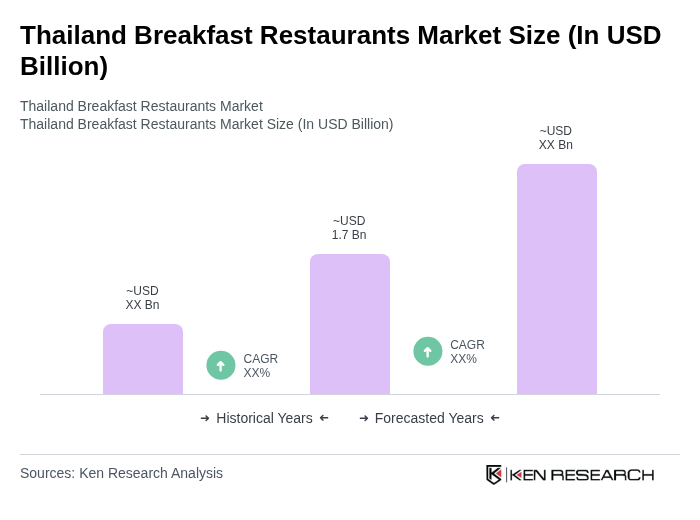
- The Thailand Breakfast Restaurants Market is valued at USD 1.7 billion, based on a five-year historical analysis and its proportional share within the broader Thailand foodservice market, which is estimated at over USD 32 billion in recent assessments. This growth is primarily driven by increasing urbanization, rising disposable incomes, and changing consumer preferences towards dining out and on?the?go consumption, especially among working professionals and younger demographics in major cities. The market has seen a surge in demand for diverse breakfast options, including traditional Thai dishes such as rice porridge, noodles, and soy milk, alongside international items like bakery products, coffee-based beverages, and Western breakfast sets, catering to both local residents and a steady flow of tourists.
- Key cities such as Bangkok, Chiang Mai, and Phuket dominate the breakfast restaurant market due to their high population density, vibrant tourism, and growing expatriate and white-collar communities. Bangkok, as the capital, serves as a hub for culinary innovation and international food trends, with a particularly strong café and specialty coffee culture that increasingly emphasizes breakfast and brunch occasions, while Chiang Mai and Phuket attract both local and international tourists, further boosting the demand for breakfast dining experiences in hotels, cafés, QSR chains, and street food venues.
- In 2023, the Thai government continued to strengthen regulations to promote food safety and hygiene standards in the restaurant industry under instruments such as the Food Act B.E. 2522 (1979) issued by the Ministry of Public Health and subsequent Ministerial Notifications and standards, which set requirements for licensing, sanitary facilities, food handling practices, and labeling. This framework is complemented in practice by mandatory or strongly encouraged food handler training programs, periodic inspections by local health authorities, and implementation of Good Manufacturing Practice (GMP) and Hazard Analysis and Critical Control Point (HACCP) principles in many foodservice operations, aiming to enhance consumer confidence and improve the overall quality of food service in breakfast restaurants across the country.
Thailand Breakfast Restaurants Market Segmentation
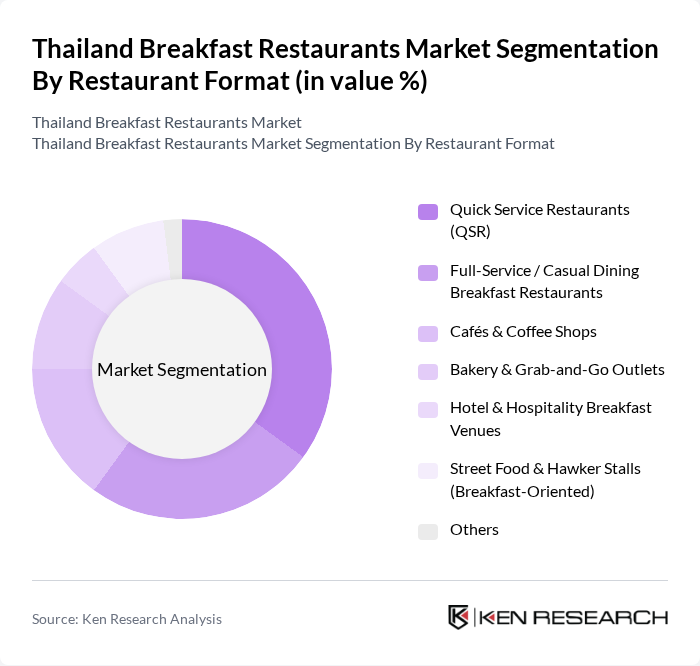
By Restaurant Format:The restaurant format segmentation includes various types of establishments catering to breakfast consumers. The subsegments are Quick Service Restaurants (QSR), Full-Service / Casual Dining Breakfast Restaurants, Cafés & Coffee Shops, Bakery & Grab-and-Go Outlets, Hotel & Hospitality Breakfast Venues, Street Food & Hawker Stalls (Breakfast-Oriented), and Others. Among these, Quick Service Restaurants (QSR) are leading the organized market due to their convenience, standardized menus, and affordability, appealing to busy urban consumers seeking quick breakfast options and to tourists looking for familiar brands. At the same time, cafés and coffee shops, as well as bakery and grab?and?go outlets, are gaining share in key metropolitan areas as Thailand’s coffee culture deepens and demand rises for premium beverages, pastries, and light breakfast meals.
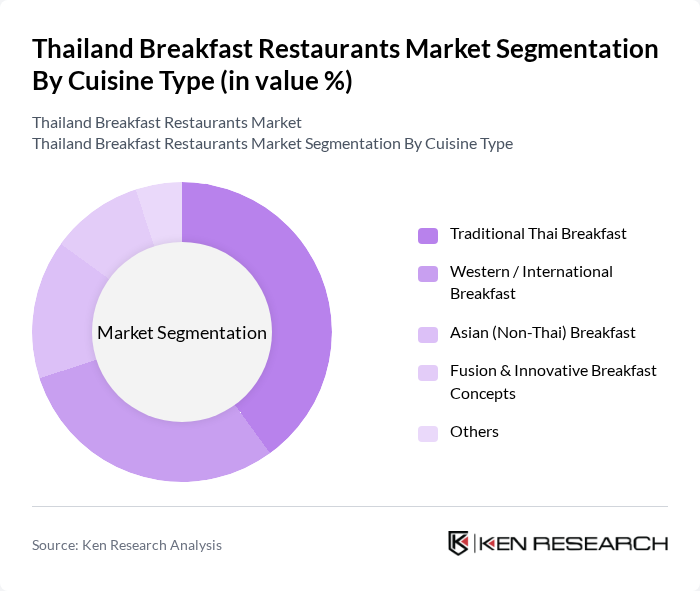
By Cuisine Type:The cuisine type segmentation encompasses various culinary styles offered in breakfast restaurants. The subsegments include Traditional Thai Breakfast, Western / International Breakfast, Asian (Non-Thai) Breakfast, Fusion & Innovative Breakfast Concepts, and Others. Traditional Thai Breakfast is the dominant subsegment in terms of volume, as it resonates strongly with local tastes and price expectations and is widely available across street vendors, small eateries, and chained concepts. At the same time, Western and broader Asian breakfast offerings, including café?style brunch menus and Japanese or Korean?influenced items, are expanding rapidly in urban and tourist locations, supported by tourism recovery, expatriate communities, and growing consumer interest in global cuisines and fusion concepts.
Thailand Breakfast Restaurants Market Competitive Landscape
The Thailand Breakfast Restaurants Market is characterized by a dynamic mix of regional and international players. Leading participants such as McDonald's Thailand, Starbucks Coffee (Thailand) Co., Ltd., The Coffee Club Thailand, Black Canyon (Thailand) Co., Ltd., Au Bon Pain Thailand, S&P Syndicate Public Company Limited, Minor Food Group Public Company Limited, Yum! Restaurants International (Thailand) Co., Ltd. (KFC, Pizza Hut, Taco Bell), A&W Restaurants Thailand, Central Restaurants Group Co., Ltd., MK Restaurant Group Public Company Limited, The Mall Group Co., Ltd. (Food Destinations & Cafés), Central Food Retail Company Limited (Including Tops & Central Food Hall Cafés), Local Independent Breakfast & Café Chains (Representative Examples), Others (Emerging and Niche Breakfast Concepts) contribute to innovation, geographic expansion, and service delivery in this space.
Thailand Breakfast Restaurants Market Industry Analysis
Growth Drivers
- Increasing Urbanization:Thailand's urban population is projected to reach 51 million in future, up from 48 million in 2020, according to the World Bank. This urbanization trend drives demand for breakfast restaurants, as city dwellers seek convenient dining options. Urban areas typically have higher foot traffic, leading to increased patronage of breakfast establishments. Additionally, urban lifestyles often prioritize quick meal solutions, further boosting the breakfast restaurant sector's growth potential.
- Rising Disposable Incomes:The average disposable income in Thailand is expected to rise to approximately 32,000 THB per month in future, up from 27,000 THB in 2020, as reported by the National Economic and Social Development Council. This increase allows consumers to spend more on dining out, including breakfast options. As disposable incomes grow, consumers are more likely to indulge in dining experiences, thus benefiting breakfast restaurants that offer diverse and appealing menus.
- Health Consciousness Among Consumers:A survey by the Thai Health Promotion Foundation indicates that 66% of Thais are increasingly concerned about their health and nutrition. This trend is driving demand for healthier breakfast options, such as whole grains and fresh fruits. As consumers prioritize health, breakfast restaurants that adapt their menus to include nutritious offerings are likely to attract a larger customer base, capitalizing on this growing health consciousness.
Market Challenges
- Fluctuating Food Prices:The Thai Ministry of Commerce reported that food prices have seen an average increase of 6% annually over the past three years. This volatility can significantly impact the operational costs of breakfast restaurants, forcing them to adjust menu prices or absorb costs, which may deter customers. Such fluctuations can lead to reduced profit margins, making it challenging for restaurants to maintain financial stability in a competitive market.
- Changing Consumer Preferences:According to a report by Euromonitor International, 42% of Thai consumers have shifted towards plant-based diets in recent years. This shift poses a challenge for traditional breakfast restaurants that may not have adapted their menus accordingly. Failure to meet evolving consumer preferences can result in decreased patronage, as customers seek establishments that align with their dietary choices and lifestyle changes, impacting overall market growth.
Thailand Breakfast Restaurants Market Future Outlook
The Thailand breakfast restaurant market is poised for significant transformation as consumer preferences evolve and urbanization continues. With a growing emphasis on health and sustainability, restaurants that innovate their menus to include plant-based and organic options are likely to thrive. Additionally, the integration of technology in ordering and delivery services will enhance customer convenience, further driving market growth. As the sector adapts to these trends, it will create new opportunities for businesses to engage with health-conscious consumers and capitalize on the demand for convenience.
Market Opportunities
- Expansion of Delivery Services:The online food delivery market in Thailand is projected to reach 55 billion THB in future, according to Statista. This growth presents a significant opportunity for breakfast restaurants to expand their reach and cater to consumers who prefer dining at home. By enhancing delivery services, restaurants can tap into a broader customer base, increasing sales and brand visibility in a competitive landscape.
- Introduction of Health-Oriented Menus:With 66% of consumers prioritizing health, breakfast restaurants can capitalize on this trend by introducing health-oriented menus. Offering options like low-calorie, gluten-free, and organic items can attract health-conscious customers. This strategic menu diversification not only meets consumer demand but also positions restaurants as leaders in the health-focused dining segment, potentially increasing customer loyalty and market share.
Scope of the Report
| Segment | Sub-Segments |
|---|---|
| By Restaurant Format | Quick Service Restaurants (QSR) Full-Service / Casual Dining Breakfast Restaurants Cafés & Coffee Shops Bakery & Grab-and-Go Outlets Hotel & Hospitality Breakfast Venues Street Food & Hawker Stalls (Breakfast-Oriented) Others |
| By Cuisine Type | Traditional Thai Breakfast Western / International Breakfast Asian (Non-Thai) Breakfast Fusion & Innovative Breakfast Concepts Others |
| By Service Model | Dine-In Takeaway Delivery (Own Fleet / Aggregators) Drive-Thru Others |
| By Location Type | High-Street / Standalone Outlets Shopping Malls & Retail Complexes Transit Hubs (BTS/MRT, Airports, Bus & Train Stations) Office & Business Districts Tourist Destinations Others |
| By Price Range | Economy / Budget Mid-Range Premium Luxury / Fine Breakfast Concepts Others |
| By Customer Segment | Local Residents Office Workers & Professionals Students Tourists & Expatriates Families with Children Others |
| By Dietary & Health Preference | Standard / Regular Menu Healthy & Functional (Low-Calorie, High-Protein, Organic) Vegetarian Vegan Gluten-Free & Other Special Diets Others |
Key Target Audience
Investors and Venture Capitalist Firms
Government and Regulatory Bodies (e.g., Ministry of Tourism and Sports, Food and Drug Administration Thailand)
Manufacturers and Producers of Breakfast Food Products
Distributors and Retailers of Food and Beverage Supplies
Franchise Operators and Business Owners
Food Service Equipment Suppliers
Industry Associations (e.g., Thai Restaurant Association)
Financial Institutions and Banks
Players Mentioned in the Report:
McDonald's Thailand
Starbucks Coffee (Thailand) Co., Ltd.
The Coffee Club Thailand
Black Canyon (Thailand) Co., Ltd.
Au Bon Pain Thailand
S&P Syndicate Public Company Limited
Minor Food Group Public Company Limited
Yum! Restaurants International (Thailand) Co., Ltd. (KFC, Pizza Hut, Taco Bell)
A&W Restaurants Thailand
Central Restaurants Group Co., Ltd.
MK Restaurant Group Public Company Limited
The Mall Group Co., Ltd. (Food Destinations & Cafes)
Central Food Retail Company Limited (Including Tops & Central Food Hall Cafes)
Local Independent Breakfast & Cafe Chains (Representative Examples)
Others (Emerging and Niche Breakfast Concepts)
Table of Contents
Market Assessment Phase
1. Executive Summary and Approach
2. Thailand Breakfast Restaurants Market Overview
2.1 Key Insights and Strategic Recommendations
2.2 Thailand Breakfast Restaurants Market Overview
2.3 Definition and Scope
2.4 Evolution of Market Ecosystem
2.5 Timeline of Key Regulatory Milestones
2.6 Value Chain & Stakeholder Mapping
2.7 Business Cycle Analysis
2.8 Policy & Incentive Landscape
3. Thailand Breakfast Restaurants Market Analysis
3.1 Growth Drivers
3.1.1 Increasing Urbanization
3.1.2 Rising Disposable Incomes
3.1.3 Growing Demand for Convenience
3.1.4 Health Consciousness Among Consumers
3.2 Market Challenges
3.2.2 Fluctuating Food Prices
3.2.3 Regulatory Compliance Issues
3.2.4 Changing Consumer Preferences
3.3 Market Opportunities
3.3.1 Expansion of Delivery Services
3.3.2 Introduction of Health-Oriented Menus
3.3.3 Collaborations with Local Farmers
3.3.4 Growth of Digital Marketing Strategies
3.4 Market Trends
3.4.1 Rise of Plant-Based Breakfast Options
3.4.2 Increasing Popularity of All-Day Breakfast
3.4.3 Integration of Technology in Ordering
3.4.4 Focus on Sustainable Practices
3.5 Government Regulation
3.5.1 Food Safety Standards
3.5.2 Labor Laws and Employment Regulations
3.5.3 Tax Incentives for Local Sourcing
3.5.4 Health and Hygiene Regulations
4. SWOT Analysis
5. Stakeholder Analysis
6. Porter's Five Forces Analysis
7. Thailand Breakfast Restaurants Market Size, 2019-2024
7.1 By Value
7.2 By Volume
7.3 By Average Selling Price
8. Thailand Breakfast Restaurants Market Segmentation
8.1 By Restaurant Format
8.1.1 Quick Service Restaurants (QSR)
8.1.2 Full-Service / Casual Dining Breakfast Restaurants
8.1.3 Cafés & Coffee Shops
8.1.4 Bakery & Grab-and-Go Outlets
8.1.5 Hotel & Hospitality Breakfast Venues
8.1.6 Street Food & Hawker Stalls (Breakfast-Oriented)
8.1.7 Others
8.2 By Cuisine Type
8.2.1 Traditional Thai Breakfast
8.2.2 Western / International Breakfast
8.2.3 Asian (Non-Thai) Breakfast
8.2.4 Fusion & Innovative Breakfast Concepts
8.2.5 Others
8.3 By Service Model
8.3.1 Dine-In
8.3.2 Takeaway
8.3.3 Delivery (Own Fleet / Aggregators)
8.3.4 Drive-Thru
8.3.5 Others
8.4 By Location Type
8.4.1 High-Street / Standalone Outlets
8.4.2 Shopping Malls & Retail Complexes
8.4.3 Transit Hubs (BTS/MRT, Airports, Bus & Train Stations)
8.4.4 Office & Business Districts
8.4.5 Tourist Destinations
8.4.6 Others
8.5 By Price Range
8.5.1 Economy / Budget
8.5.2 Mid-Range
8.5.3 Premium
8.5.4 Luxury / Fine Breakfast Concepts
8.5.5 Others
8.6 By Customer Segment
8.6.1 Local Residents
8.6.2 Office Workers & Professionals
8.6.3 Students
8.6.4 Tourists & Expatriates
8.6.5 Families with Children
8.6.6 Others
8.7 By Dietary & Health Preference
8.7.1 Standard / Regular Menu
8.7.2 Healthy & Functional (Low-Calorie, High-Protein, Organic)
8.7.3 Vegetarian
8.7.4 Vegan
8.7.5 Gluten-Free & Other Special Diets
8.7.6 Others
9. Thailand Breakfast Restaurants Market Competitive Analysis
9.1 Market Share of Key Players
9.2 Cross Comparison of Key Players
9.2.1 Company Name
9.2.2 Ownership / Group Size (Local Chain, International Chain, Independent)
9.2.3 Number of Outlets in Thailand
9.2.4 Same-Store Sales Growth (SSSG)
9.2.5 Average Daily Transactions per Outlet
9.2.6 Average Ticket Size / Average Order Value (AOV)
9.2.7 Breakfast Daypart Revenue Share (% of Total Sales)
9.2.8 Revenue CAGR (3–5 Years)
9.2.9 EBITDA Margin / Outlet-Level Margin
9.2.10 Customer Retention / Repeat Visit Rate
9.2.11 Digital Order Penetration (% Online & App Orders)
9.2.12 Delivery Channel Mix (Own App vs Aggregators)
9.2.13 Brand Awareness / Brand Preference Index
9.2.14 Outlet Expansion Pipeline (Planned New Stores)
9.3 SWOT Analysis of Top Players
9.4 Pricing Analysis
9.5 Detailed Profile of Major Companies
9.5.1 McDonald's Thailand
9.5.2 Starbucks Coffee (Thailand) Co., Ltd.
9.5.3 The Coffee Club Thailand
9.5.4 Black Canyon (Thailand) Co., Ltd.
9.5.5 Au Bon Pain Thailand
9.5.6 S&P Syndicate Public Company Limited
9.5.7 Minor Food Group Public Company Limited
9.5.8 Yum! Restaurants International (Thailand) Co., Ltd. (KFC, Pizza Hut, Taco Bell)
9.5.9 A&W Restaurants Thailand
9.5.10 Central Restaurants Group Co., Ltd.
9.5.11 MK Restaurant Group Public Company Limited
9.5.12 The Mall Group Co., Ltd. (Food Destinations & Cafés)
9.5.13 Central Food Retail Company Limited (Including Tops & Central Food Hall Cafés)
9.5.14 Local Independent Breakfast & Café Chains (Representative Examples)
9.5.15 Others (Emerging and Niche Breakfast Concepts)
10. Thailand Breakfast Restaurants Market End-User Analysis
10.1 Procurement Behavior of Key Ministries
10.1.1 Government Contracts
10.1.2 Budget Allocations
10.1.3 Supplier Selection Criteria
10.1.4 Others
10.2 Corporate Spend on Infrastructure & Energy
10.2.1 Investment in Breakfast Facilities
10.2.2 Budget for Employee Meals
10.2.3 Partnerships with Local Restaurants
10.2.4 Others
10.3 Pain Point Analysis by End-User Category
10.3.1 Quality of Ingredients
10.3.2 Service Speed
10.3.3 Menu Variety
10.3.4 Others
10.4 User Readiness for Adoption
10.4.1 Awareness of Breakfast Options
10.4.2 Willingness to Pay
10.4.3 Feedback Mechanisms
10.4.4 Others
10.5 Post-Deployment ROI and Use Case Expansion
10.5.1 Customer Feedback Analysis
10.5.2 Repeat Business Metrics
10.5.3 Menu Performance Evaluation
10.5.4 Others
11. Thailand Breakfast Restaurants Market Future Size, 2025-2030
11.1 By Value
11.2 By Volume
11.3 By Average Selling Price
Go-To-Market Strategy Phase
1. Whitespace Analysis + Business Model Canvas
1.1 Market Gaps Identification
1.2 Business Model Development
2. Marketing and Positioning Recommendations
2.1 Branding Strategies
2.2 Product USPs
3. Distribution Plan
3.1 Urban Retail vs Rural NGO Tie-Ups
4. Channel & Pricing Gaps
4.1 Underserved Routes
4.2 Pricing Bands
5. Unmet Demand & Latent Needs
5.1 Category Gaps
5.2 Consumer Segments
6. Customer Relationship
6.1 Loyalty Programs
6.2 After-Sales Service
7. Value Proposition
7.1 Sustainability
7.2 Integrated Supply Chains
8. Key Activities
8.1 Regulatory Compliance
8.2 Branding
8.3 Distribution Setup
9. Entry Strategy Evaluation
9.1 Domestic Market Entry Strategy
9.1.1 Product Mix
9.1.2 Pricing Band
9.1.3 Packaging
9.2 Export Entry Strategy
9.2.1 Target Countries
9.2.2 Compliance Roadmap
10. Entry Mode Assessment
10.1 JV
10.2 Greenfield
10.3 M&A
10.4 Distributor Model
11. Capital and Timeline Estimation
11.1 Capital Requirements
11.2 Timelines
12. Control vs Risk Trade-Off
12.1 Ownership vs Partnerships
13. Profitability Outlook
13.1 Breakeven Analysis
13.2 Long-Term Sustainability
14. Potential Partner List
14.1 Distributors
14.2 JVs
14.3 Acquisition Targets
15. Execution Roadmap
15.1 Phased Plan for Market Entry
15.1.1 Market Setup
15.1.2 Market Entry
15.1.3 Growth Acceleration
15.1.4 Scale & Stabilize
15.2 Key Activities and Milestones
15.2.1 Activity Planning
15.2.2 Milestone Tracking
Research Methodology
Phase 1: Approach1
Desk Research
- Analysis of industry reports from Thai tourism and hospitality associations
- Review of government publications on food and beverage regulations in Thailand
- Examination of market trends through online food delivery platforms and restaurant review sites
Primary Research
- Interviews with owners and managers of popular breakfast restaurants across Thailand
- Surveys targeting customers to understand preferences and spending habits
- Focus groups with food industry experts and culinary influencers
Validation & Triangulation
- Cross-validation of findings with data from local food suppliers and distributors
- Triangulation of consumer insights with sales data from breakfast restaurant chains
- Sanity checks through expert panel reviews involving chefs and food critics
Phase 2: Market Size Estimation1
Top-down Assessment
- Estimation of market size based on national food service revenue statistics
- Segmentation by breakfast menu categories and consumer demographics
- Incorporation of tourism data to assess impact on breakfast dining
Bottom-up Modeling
- Collection of sales data from a sample of breakfast restaurants across major cities
- Analysis of average transaction values and customer footfall
- Volume estimates based on menu item popularity and pricing strategies
Forecasting & Scenario Analysis
- Multi-factor regression analysis incorporating economic indicators and consumer trends
- Scenario modeling based on potential changes in tourism and local dining habits
- Baseline, optimistic, and pessimistic forecasts through 2028
Phase 3: CATI Sample Composition1
| Scope Item/Segment | Sample Size | Target Respondent Profiles |
|---|---|---|
| Urban Breakfast Restaurant Owners | 60 | Restaurant Owners, Franchise Managers |
| Breakfast Menu Item Consumers | 120 | Regular Diners, Food Enthusiasts |
| Food Delivery Service Users | 80 | Online Shoppers, App Users |
| Tourists Dining Preferences | 70 | International Tourists, Travel Bloggers |
| Culinary Experts and Influencers | 40 | Chefs, Food Critics, Bloggers |
Frequently Asked Questions
What is the current value of the Thailand Breakfast Restaurants Market?
The Thailand Breakfast Restaurants Market is valued at approximately USD 1.7 billion, representing a significant segment of the broader foodservice market in Thailand, which exceeds USD 32 billion.
What factors are driving the growth of breakfast restaurants in Thailand?
Which cities are the main hubs for breakfast restaurants in Thailand?
What types of breakfast restaurant formats are popular in Thailand?
Other Regional/Country Reports
Other Adjacent Reports
Thailand Coffee Shops Market
India Bakery Products Market Size, Share & Forecast, By Product Type, Distribution Channel & Price Tier, 2026-2031Europe Quick Service Restaurants Market Size, Share & Forecast, By Service Type, Customer Type & Distribution Channel, 2026-2031South Africa Food Delivery Services Market
Kuwait Health Food Market
UAE Beverage MarketBrazil Casual Dining Restaurants Market
Brazil Street Food Market
Belgium Hotel Foodservice Market
Egypt Fusion Cuisine Market
Why Buy From Us?

What makes us stand out is that our consultants follow Robust, Refine and Result (RRR) methodology. Robust for clear definitions, approaches and sanity checking, Refine for differentiating respondents' facts and opinions, and Result for presenting data with story.

We have set a benchmark in the industry by offering our clients with syndicated and customized market research reports featuring coverage of entire market as well as meticulous research and analyst insights.

While we don't replace traditional research, we flip the method upside down. Our dual approach of Top Bottom & Bottom Top ensures quality deliverable by not just verifying company fundamentals but also looking at the sector and macroeconomic factors.

With one step in the future, our research team constantly tries to show you the bigger picture. We help with some of the tough questions you may encounter along the way: How is the industry positioned? Best marketing channel? KPI's of competitors? By aligning every element, we help maximize success.

Our report gives you instant access to the answers and sources that other companies might choose to hide. We elaborate each steps of research methodology we have used and showcase you the sample size to earn your trust.

If you need any support, we are here! We pride ourselves on universe strength, data quality, and quick, friendly, and professional service.