About the Report
Base Year 2024Australia Breakfast Restaurants Market Overview
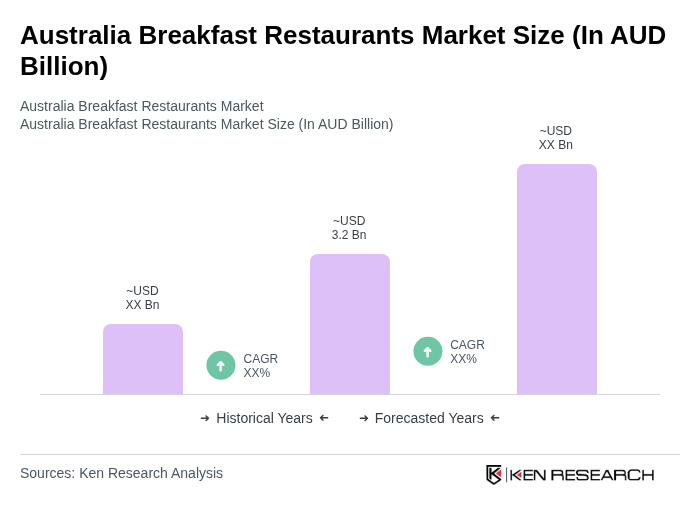
- The Australia Breakfast Restaurants Market is valued at AUD 3.2 billion, based on a five-year historical analysis anchored in the broader restaurants and foodservice industry and the proportion of breakfast-focused trade within it. This growth is primarily driven by the increasing demand for breakfast and brunch occasions, evolving consumer preferences towards healthier eating, and the rise of all-day brunch culture in urban centers. The market has seen a significant shift towards diverse menu offerings, including high-protein, plant-based, and functional options, as well as premium specialty coffee, catering to various dietary needs and preferences and further fueling its expansion.
- Key cities dominating the market include Sydney, Melbourne, and Brisbane. These urban centers are characterized by a high concentration of cafes and restaurants, a vibrant food and coffee culture, and a diverse population that strongly embraces out-of-home breakfast and brunch dining. The presence of a large number of domestic and international tourists and business travelers in these cities, combined with dense office districts and weekend leisure traffic, contributes to robust demand for breakfast dining options throughout the week.
- In 2023, the Australian government continued to enforce and strengthen food safety and hygiene standards in the restaurant industry through instruments such as the Australia New Zealand Food Standards Code, administered by Food Standards Australia New Zealand, and state-based laws including the Food Regulation 2015 under the Food Act 2003 (New South Wales). These frameworks include mandatory food safety programs, requirements for accredited food safety supervisors or trained food handlers, and regular inspections by local councils or state authorities to ensure compliance with health regulations. Such measures are designed to enhance consumer confidence and ensure the safety and hygiene of food served in breakfast restaurants across the country.
Australia Breakfast Restaurants Market Segmentation
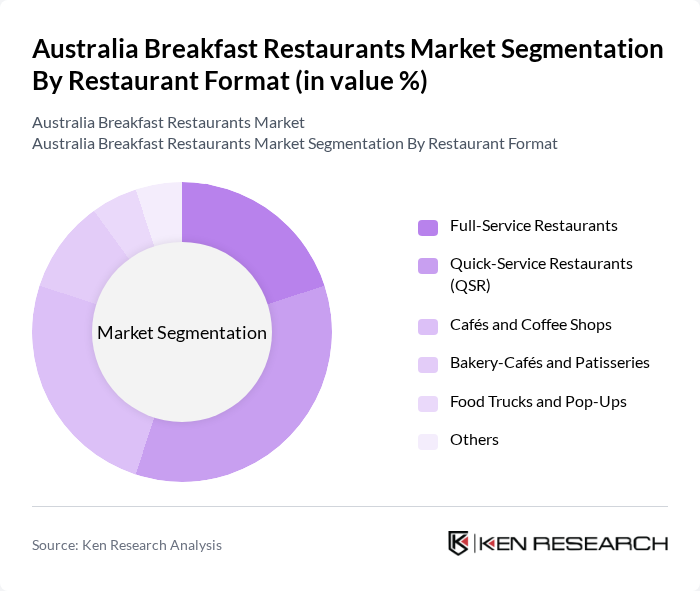
By Restaurant Format:The restaurant format segmentation includes various types of establishments catering to breakfast dining. The subsegments are Full-Service Restaurants, Quick-Service Restaurants (QSR), Cafés and Coffee Shops, Bakery-Cafés and Patisseries, Food Trucks and Pop-Ups, and Others. Quick-Service Restaurants (QSR) and café-style formats are increasingly important in the morning daypart, with QSR chains benefiting from convenience, speed of service, drive-thru and takeaway, while independent and chain cafés and coffee shops capture a substantial share of sit-down and premium brunch occasions in major cities.
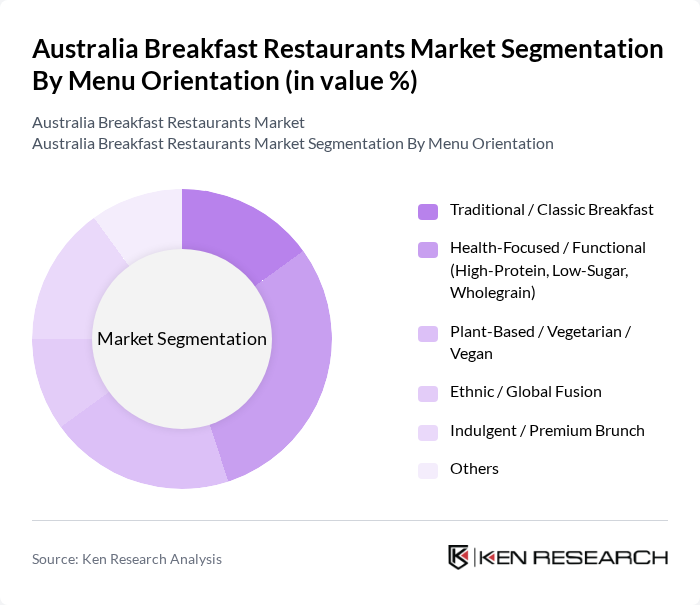
By Menu Orientation:The menu orientation segmentation includes Traditional / Classic Breakfast, Health-Focused / Functional (High-Protein, Low-Sugar, Wholegrain), Plant-Based / Vegetarian / Vegan, Ethnic / Global Fusion, Indulgent / Premium Brunch, and Others. The Health-Focused / Functional and Plant-Based / Vegetarian / Vegan segments are expanding rapidly, supported by rising health consciousness, interest in high-protein and low-sugar options, and growing adoption of flexitarian and vegan diets, while traditional classics and indulgent premium brunch remain core revenue generators for many operators.
Australia Breakfast Restaurants Market Competitive Landscape
The Australia Breakfast Restaurants Market is characterized by a dynamic mix of regional and international players. Leading participants such as The Coffee Club, Bills (Sydney), Pancake Parlour, Surry Hills’ Cafés (Representative Leading Outlets), The Pancake Parlour, Caffe Cherry Beans, The Little Snail, The Hardware Société, Café Sydney, The Grounds of Alexandria, The Brunch Club, The Breakfast Club, Top Paddock, Three Blue Ducks, Local Independent Breakfast Restaurants (Representative Sample) contribute to innovation, geographic expansion, specialization in breakfast and brunch occasions, and continuous enhancement of menu quality and service delivery in this space.
Australia Breakfast Restaurants Market Industry Analysis
Growth Drivers
- Increasing Demand for Healthy Breakfast Options:The Australian breakfast restaurant sector is witnessing a surge in demand for healthy breakfast choices, driven by a growing health-conscious population. In future, the health food market in Australia is projected to reach AUD 3.9 billion, reflecting a 12% increase from the previous year. This trend is supported by the Australian Bureau of Statistics, which reported that 70% of Australians are actively seeking healthier food options, influencing breakfast menus across the country.
- Rise in Brunch Culture:The brunch culture in Australia has gained significant traction, with the brunch market expected to generate AUD 1.4 billion in future. This growth is attributed to changing social habits, where 50% of Australians prefer dining out for brunch on weekends. The increasing popularity of brunch has led to a diversification of breakfast offerings, encouraging restaurants to innovate and attract a broader customer base, thus enhancing overall market growth.
- Expansion of Café Chains:The expansion of café chains across Australia is a key growth driver for the breakfast restaurant market. In future, the number of café establishments is projected to exceed 21,000, marking a 6% increase from the previous year. This expansion is fueled by consumer preferences for convenient dining options and the rise of specialty coffee culture, with 80% of Australians visiting cafés at least once a week, thereby boosting breakfast sales significantly.
Market Challenges
- High Competition Among Local Establishments:The breakfast restaurant market in Australia faces intense competition, with over 16,000 establishments vying for consumer attention. This saturation leads to price wars and reduced profit margins, as restaurants strive to differentiate themselves. According to IBISWorld, the industry’s profit margin is projected to decline to 4.8% in future, highlighting the challenges local establishments face in maintaining profitability amidst fierce competition.
- Fluctuating Food Prices:Fluctuating food prices pose a significant challenge for breakfast restaurants in Australia. In future, food inflation is expected to reach 5.0%, driven by supply chain disruptions and climate-related impacts on agriculture. This volatility affects cost management for restaurants, forcing them to either absorb costs or pass them onto consumers, which can lead to decreased customer loyalty and reduced sales in a price-sensitive market.
Australia Breakfast Restaurants Market Future Outlook
The future of the breakfast restaurant market in Australia appears promising, driven by evolving consumer preferences and innovative dining experiences. As health trends continue to shape menu offerings, restaurants are likely to focus on incorporating organic and locally sourced ingredients. Additionally, the integration of technology in ordering and payment systems will enhance customer convenience, while the rise of experiential dining will attract new clientele, ensuring sustained growth in the sector.
Market Opportunities
- Introduction of Plant-Based Menu Options:The growing trend towards plant-based diets presents a significant opportunity for breakfast restaurants. With 1 in 4 Australians identifying as flexitarians, introducing plant-based menu items can attract a broader customer base and enhance brand loyalty, potentially increasing sales by 18% in the future.
- Expansion into Delivery and Takeaway Services:The demand for delivery and takeaway services is on the rise, with online food delivery sales projected to reach AUD 2.1 billion in future. By expanding into these services, breakfast restaurants can tap into a growing market segment, catering to busy consumers and increasing overall revenue by an estimated 25% within the future.
Scope of the Report
| Segment | Sub-Segments |
|---|---|
| By Restaurant Format | Full-Service Restaurants Quick-Service Restaurants (QSR) Cafés and Coffee Shops Bakery-Cafés and Patisseries Food Trucks and Pop-Ups Others |
| By Menu Orientation | Traditional / Classic Breakfast Health-Focused / Functional (High-Protein, Low-Sugar, Wholegrain) Plant-Based / Vegetarian / Vegan Ethnic / Global Fusion Indulgent / Premium Brunch Others |
| By Service Mode | On-Premise Dine-In Takeaway Delivery (First-Party) Delivery via Aggregators (Uber Eats, DoorDash, Menulog, etc.) Drive-Through Others |
| By Time of Day | Early Breakfast (Before 8 AM) Standard Breakfast (8 AM – 10 AM) Late Breakfast / Brunch (10 AM – 2 PM) All-Day Breakfast |
| By Customer Segment | Families with Children Young Professionals Students Tourists and Business Travellers Remote Workers / Freelancers Others |
| By Price Positioning | Value / Budget Mass / Mid-Range Premium Luxury / Fine-Casual Brunch |
| By Geography | New South Wales & Australian Capital Territory Victoria & Tasmania Queensland Western Australia South Australia & Northern Territory |
Key Target Audience
Investors and Venture Capitalist Firms
Government and Regulatory Bodies (e.g., Australian Competition and Consumer Commission, Food Standards Australia New Zealand)
Manufacturers and Producers of Breakfast Food Products
Distributors and Retailers of Food and Beverage Supplies
Franchise Operators and Owners
Food Service Equipment Suppliers
Industry Associations (e.g., Restaurant and Catering Australia)
Financial Institutions and Banks
Players Mentioned in the Report:
The Coffee Club
Bills (Sydney)
Pancake Parlour
Surry Hills Cafes (Representative Leading Outlets)
The Pancake Parlour
Caffe Cherry Beans
The Little Snail
The Hardware Societe
Cafe Sydney
The Grounds of Alexandria
The Brunch Club
The Breakfast Club
Top Paddock
Three Blue Ducks
Local Independent Breakfast Restaurants (Representative Sample)
Table of Contents
Market Assessment Phase
1. Executive Summary and Approach
2. Australia Breakfast Restaurants Market Overview
2.1 Key Insights and Strategic Recommendations
2.2 Australia Breakfast Restaurants Market Overview
2.3 Definition and Scope
2.4 Evolution of Market Ecosystem
2.5 Timeline of Key Regulatory Milestones
2.6 Value Chain & Stakeholder Mapping
2.7 Business Cycle Analysis
2.8 Policy & Incentive Landscape
3. Australia Breakfast Restaurants Market Analysis
3.1 Growth Drivers
3.1.1 Increasing Demand for Healthy Breakfast Options
3.1.2 Rise in Brunch Culture
3.1.3 Expansion of Café Chains
3.1.4 Growth in Tourism and Hospitality Sector
3.2 Market Challenges
3.2.1 High Competition Among Local Establishments
3.2.2 Fluctuating Food Prices
3.2.3 Labor Shortages in the Hospitality Sector
3.2.4 Regulatory Compliance Costs
3.3 Market Opportunities
3.3.1 Introduction of Plant-Based Menu Options
3.3.2 Expansion into Delivery and Takeaway Services
3.3.3 Collaborations with Local Farmers
3.3.4 Development of Unique Dining Experiences
3.4 Market Trends
3.4.1 Focus on Sustainability and Eco-Friendly Practices
3.4.2 Integration of Technology in Ordering Systems
3.4.3 Customization of Menu Offerings
3.4.4 Rise of Social Media Influencer Marketing
3.5 Government Regulation
3.5.1 Food Safety Standards Compliance
3.5.2 Employment Regulations
3.5.3 Health and Nutrition Guidelines
3.5.4 Licensing and Permitting Requirements
4. SWOT Analysis
5. Stakeholder Analysis
6. Porter's Five Forces Analysis
7. Australia Breakfast Restaurants Market Market Size, 2019-2024
7.1 By Value
7.2 By Volume
7.3 By Average Selling Price
8. Australia Breakfast Restaurants Market Segmentation
8.1 By Restaurant Format
8.1.1 Full-Service Restaurants
8.1.2 Quick-Service Restaurants (QSR)
8.1.3 Cafés and Coffee Shops
8.1.4 Bakery-Cafés and Patisseries
8.1.5 Food Trucks and Pop-Ups
8.1.6 Others
8.2 By Menu Orientation
8.2.1 Traditional / Classic Breakfast
8.2.2 Health-Focused / Functional (High-Protein, Low-Sugar, Wholegrain)
8.2.3 Plant-Based / Vegetarian / Vegan
8.2.4 Ethnic / Global Fusion
8.2.5 Indulgent / Premium Brunch
8.2.6 Others
8.3 By Service Mode
8.3.1 On-Premise Dine-In
8.3.2 Takeaway
8.3.3 Delivery (First-Party)
8.3.4 Delivery via Aggregators (Uber Eats, DoorDash, Menulog, etc.)
8.3.5 Drive-Through
8.3.6 Others
8.4 By Time of Day
8.4.1 Early Breakfast (Before 8 AM)
8.4.2 Standard Breakfast (8 AM – 10 AM)
8.4.3 Late Breakfast / Brunch (10 AM – 2 PM)
8.4.4 All-Day Breakfast
8.5 By Customer Segment
8.5.1 Families with Children
8.5.2 Young Professionals
8.5.3 Students
8.5.4 Tourists and Business Travellers
8.5.5 Remote Workers / Freelancers
8.5.6 Others
8.6 By Price Positioning
8.6.1 Value / Budget
8.6.2 Mass / Mid-Range
8.6.3 Premium
8.6.4 Luxury / Fine-Casual Brunch
8.7 By Geography
8.7.1 New South Wales & Australian Capital Territory
8.7.2 Victoria & Tasmania
8.7.3 Queensland
8.7.4 Western Australia
8.7.5 South Australia & Northern Territory
9. Australia Breakfast Restaurants Market Competitive Analysis
9.1 Market Share of Key Players
9.2 Cross Comparison of Key Players
9.2.1 Company Name
9.2.2 Group Size (Large, Medium, or Small as per industry convention)
9.2.3 Number of Outlets (Australia)
9.2.4 Systemwide Sales (AUD Million, Latest FY)
9.2.5 Same-Store Sales Growth (%)
9.2.6 Average Daily Covers per Store
9.2.7 Average Transaction Value (AUD)
9.2.8 Breakfast / Brunch Revenue Share of Total Sales (%)
9.2.9 EBITDA Margin (%)
9.2.10 Seat Utilisation / Table Turnover Rate (Breakfast Daypart)
9.2.11 Digital Order Penetration (% of Orders via App / Aggregators)
9.2.12 Loyalty Program Penetration (% of Transactions from Members)
9.2.13 Social Media Reach and Engagement (Followers, Engagement Rate)
9.3 SWOT Analysis of Top Players
9.4 Pricing Analysis
9.5 Detailed Profile of Major Companies
9.5.1 The Coffee Club
9.5.2 Bills (Sydney)
9.5.3 Pancake Parlour
9.5.4 Surry Hills’ Cafés (Representative Leading Outlets)
9.5.5 The Pancake Parlour
9.5.6 Caffe Cherry Beans
9.5.7 The Little Snail
9.5.8 The Hardware Société
9.5.9 Café Sydney
9.5.10 The Grounds of Alexandria
9.5.11 The Brunch Club
9.5.12 The Breakfast Club
9.5.13 Top Paddock
9.5.14 Three Blue Ducks
9.5.15 Local Independent Breakfast Restaurants (Representative Sample)
10. Australia Breakfast Restaurants Market End-User Analysis
10.1 Procurement Behavior of Key Ministries
10.1.1 Government Contracts for Catering Services
10.1.2 Budget Allocations for Public Events
10.1.3 Partnerships with Local Businesses
10.1.4 Others
10.2 Corporate Spend on Infrastructure & Energy
10.2.1 Investment in Sustainable Practices
10.2.2 Budget for Employee Wellness Programs
10.2.3 Expenditure on Local Sourcing
10.2.4 Others
10.3 Pain Point Analysis by End-User Category
10.3.1 Quality of Ingredients
10.3.2 Service Speed
10.3.3 Menu Variety
10.3.4 Others
10.4 User Readiness for Adoption
10.4.1 Awareness of Healthy Options
10.4.2 Willingness to Pay for Quality
10.4.3 Interest in New Dining Experiences
10.4.4 Others
10.5 Post-Deployment ROI and Use Case Expansion
10.5.1 Customer Feedback Mechanisms
10.5.2 Repeat Business Metrics
10.5.3 Expansion into New Markets
10.5.4 Others
11. Australia Breakfast Restaurants Market Future Size, 2025-2030
11.1 By Value
11.2 By Volume
11.3 By Average Selling Price
Go-To-Market Strategy Phase
1. Whitespace Analysis + Business Model Canvas
1.1 Market Gaps Identification
1.2 Business Model Development
2. Marketing and Positioning Recommendations
2.1 Branding Strategies
2.2 Product USPs
3. Distribution Plan
3.1 Urban Retail vs Rural NGO Tie-Ups
4. Channel & Pricing Gaps
4.1 Underserved Routes
4.2 Pricing Bands
5. Unmet Demand & Latent Needs
5.1 Category Gaps
5.2 Consumer Segments
6. Customer Relationship
6.1 Loyalty Programs
6.2 After-Sales Service
7. Value Proposition
7.1 Sustainability
7.2 Integrated Supply Chains
8. Key Activities
8.1 Regulatory Compliance
8.2 Branding
8.3 Distribution Setup
9. Entry Strategy Evaluation
9.1 Domestic Market Entry Strategy
9.1.1 Product Mix
9.1.2 Pricing Band
9.1.3 Packaging
9.2 Export Entry Strategy
9.2.1 Target Countries
9.2.2 Compliance Roadmap
10. Entry Mode Assessment
10.1 JV
10.2 Greenfield
10.3 M&A
10.4 Distributor Model
11. Capital and Timeline Estimation
11.1 Capital Requirements
11.2 Timelines
12. Control vs Risk Trade-Off
12.1 Ownership vs Partnerships
13. Profitability Outlook
13.1 Breakeven Analysis
13.2 Long-Term Sustainability
14. Potential Partner List
14.1 Distributors
14.2 JVs
14.3 Acquisition Targets
15. Execution Roadmap
15.1 Phased Plan for Market Entry
15.1.1 Market Setup
15.1.2 Market Entry
15.1.3 Growth Acceleration
15.1.4 Scale & Stabilize
15.2 Key Activities and Milestones
15.2.1 Activity Planning
15.2.2 Milestone Tracking
Research Methodology
Phase 1: Approach1
Desk Research
- Analysis of industry reports from Australian food and beverage associations
- Review of government publications on restaurant industry regulations and trends
- Examination of market studies and consumer behavior reports specific to breakfast dining
Primary Research
- Interviews with owners and managers of leading breakfast restaurants across major Australian cities
- Surveys targeting customers to understand preferences and dining habits related to breakfast
- Focus groups with food industry experts to gather insights on emerging trends in breakfast offerings
Validation & Triangulation
- Cross-validation of findings through comparison with historical sales data from industry reports
- Triangulation of consumer insights with operational data from restaurant management systems
- Sanity checks conducted through expert panel reviews involving chefs and culinary consultants
Phase 2: Market Size Estimation1
Top-down Assessment
- Estimation of total breakfast restaurant revenue based on national dining expenditure statistics
- Segmentation of market size by geographic regions and types of breakfast offerings
- Incorporation of trends in consumer spending on breakfast dining experiences
Bottom-up Modeling
- Collection of sales data from a representative sample of breakfast restaurants
- Analysis of average transaction values and customer footfall metrics
- Calculation of market size based on aggregated data from various restaurant segments
Forecasting & Scenario Analysis
- Utilization of time series analysis to project future growth based on historical trends
- Scenario modeling based on potential impacts of economic changes and consumer preferences
- Development of optimistic, pessimistic, and baseline forecasts through 2028
Phase 3: CATI Sample Composition1
| Scope Item/Segment | Sample Size | Target Respondent Profiles |
|---|---|---|
| Urban Breakfast Restaurant Owners | 90 | Restaurant Owners, Franchise Operators |
| Breakfast Menu Development Experts | 60 | Culinary Chefs, Menu Planners |
| Breakfast Dining Customers | 140 | Regular Breakfast Diners, Food Bloggers |
| Food Supply Chain Managers | 55 | Suppliers, Distributors |
| Market Analysts in Food & Beverage | 45 | Market Researchers, Industry Analysts |
Frequently Asked Questions
What is the current value of the Australia Breakfast Restaurants Market?
The Australia Breakfast Restaurants Market is valued at approximately AUD 3.2 billion, reflecting a significant portion of the broader restaurants and foodservice industry, driven by increasing demand for breakfast and brunch options.
Which cities are the main hubs for breakfast restaurants in Australia?
What are the main drivers of growth in the Australia Breakfast Restaurants Market?
What challenges do breakfast restaurants in Australia face?
Other Regional/Country Reports
Other Adjacent Reports
Mexico Cafe Market
United States Coffee Shop Market Size, Share, Trends & Forecast, 2026–2032Singapore Quick-Service Restaurant Market
Belgium Full-Service Restaurant Market
UAE Bakery Market
Global Food Truck Market Outlook 2030South Africa Plant-Based Food Market
Vietnam Health Food Market
UAE Food Delivery Market
Belgium Specialty Coffee Market
Why Buy From Us?

What makes us stand out is that our consultants follow Robust, Refine and Result (RRR) methodology. Robust for clear definitions, approaches and sanity checking, Refine for differentiating respondents' facts and opinions, and Result for presenting data with story.

We have set a benchmark in the industry by offering our clients with syndicated and customized market research reports featuring coverage of entire market as well as meticulous research and analyst insights.

While we don't replace traditional research, we flip the method upside down. Our dual approach of Top Bottom & Bottom Top ensures quality deliverable by not just verifying company fundamentals but also looking at the sector and macroeconomic factors.

With one step in the future, our research team constantly tries to show you the bigger picture. We help with some of the tough questions you may encounter along the way: How is the industry positioned? Best marketing channel? KPI's of competitors? By aligning every element, we help maximize success.

Our report gives you instant access to the answers and sources that other companies might choose to hide. We elaborate each steps of research methodology we have used and showcase you the sample size to earn your trust.

If you need any support, we are here! We pride ourselves on universe strength, data quality, and quick, friendly, and professional service.