Region:Asia
Author(s):Geetanshi
Product Code:KRAE0524
Pages:83
Published On:February 2026
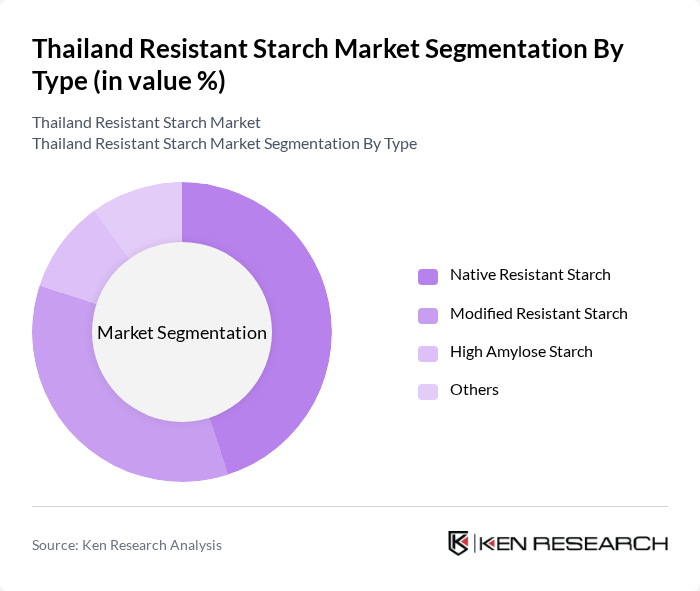
By Type:The market is segmented into various types of resistant starch, including Native Resistant Starch, Modified Resistant Starch, High Amylose Starch, and Others. Among these, Native Resistant Starch is gaining traction due to its natural properties and minimal processing, appealing to health-conscious consumers. Modified Resistant Starch is also significant, as it offers enhanced functionalities for food manufacturers, making it a preferred choice in various applications.
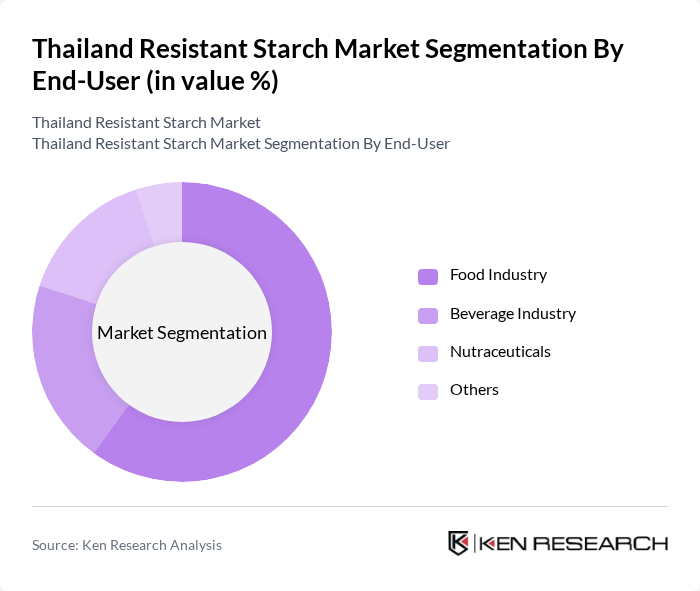
By End-User:The resistant starch market is utilized across various end-user segments, including the Food Industry, Beverage Industry, Nutraceuticals, and Others. The Food Industry is the leading segment, driven by the increasing incorporation of resistant starch in bakery and dairy products. The Beverage Industry is also growing, as manufacturers seek to enhance the nutritional profile of drinks, while Nutraceuticals are gaining attention for their health benefits.
The Thailand Resistant Starch Market is characterized by a dynamic mix of regional and international players. Leading participants such as Thai Flour Industry Co., Ltd., Cargill Thailand, Ingredion (Thailand) Ltd., Roquette Frères, Tate & Lyle PLC, Beneo GmbH, Emsland Group, Archer Daniels Midland Company (ADM), Univar Solutions, Sensus, KMC Ingredients, Novozymes A/S, Axiom Foods, Inc., Naturex, DuPont de Nemours, Inc. contribute to innovation, geographic expansion, and service delivery in this space.
The future of the resistant starch market in Thailand appears promising, driven by increasing health awareness and a growing demand for functional foods. Innovations in food technology are expected to enhance the application of resistant starch in various products, particularly in bakery and gluten-free segments. Additionally, the rise of e-commerce platforms is likely to facilitate greater access to health-oriented products, further expanding market reach and consumer engagement in the coming years.
| Segment | Sub-Segments |
|---|---|
| By Type | Native Resistant Starch Modified Resistant Starch High Amylose Starch Others |
| By End-User | Food Industry Beverage Industry Nutraceuticals Others |
| By Application | Bakery Products Dairy Products Snacks and Confectionery Others |
| By Distribution Channel | Online Retail Supermarkets/Hypermarkets Specialty Stores Others |
| By Region | Central Thailand Northern Thailand Southern Thailand Northeastern Thailand |
| By Consumer Demographics | Age Group (Children, Adults, Seniors) Income Level (Low, Middle, High) Lifestyle (Active, Sedentary) Others |
| By Product Form | Powdered Form Granulated Form Liquid Form Others |
| Scope Item/Segment | Sample Size | Target Respondent Profiles |
|---|---|---|
| Food Manufacturers Utilizing Resistant Starch | 100 | Production Managers, R&D Heads |
| Health and Nutrition Experts | 75 | Dieticians, Nutrition Researchers |
| Retailers of Health Foods | 60 | Store Managers, Product Buyers |
| Agricultural Producers of Starch Sources | 50 | Farm Owners, Crop Specialists |
| Consumers Focused on Health and Wellness | 85 | Health-Conscious Shoppers, Fitness Enthusiasts |
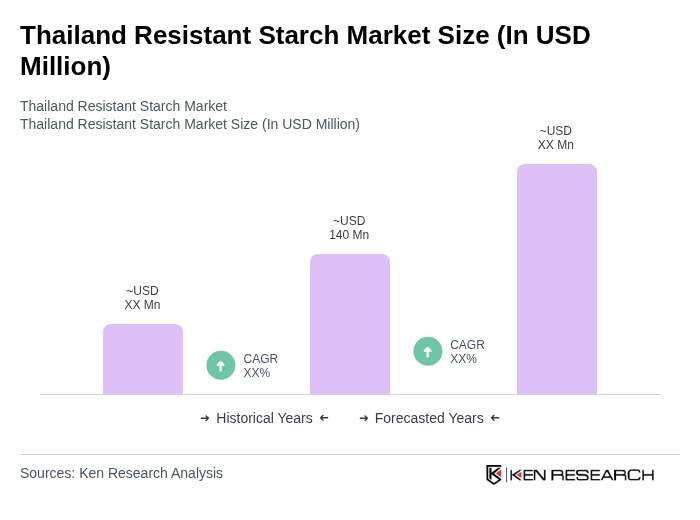
The Thailand Resistant Starch Market is valued at approximately USD 140 million, reflecting a growing trend towards health-conscious eating and the demand for functional foods that support digestive health and weight management.

What makes us stand out is that our consultants follow Robust, Refine and Result (RRR) methodology. Robust for clear definitions, approaches and sanity checking, Refine for differentiating respondents' facts and opinions, and Result for presenting data with story.

We have set a benchmark in the industry by offering our clients with syndicated and customized market research reports featuring coverage of entire market as well as meticulous research and analyst insights.

While we don't replace traditional research, we flip the method upside down. Our dual approach of Top Bottom & Bottom Top ensures quality deliverable by not just verifying company fundamentals but also looking at the sector and macroeconomic factors.

With one step in the future, our research team constantly tries to show you the bigger picture. We help with some of the tough questions you may encounter along the way: How is the industry positioned? Best marketing channel? KPI's of competitors? By aligning every element, we help maximize success.

Our report gives you instant access to the answers and sources that other companies might choose to hide. We elaborate each steps of research methodology we have used and showcase you the sample size to earn your trust.

If you need any support, we are here! We pride ourselves on universe strength, data quality, and quick, friendly, and professional service.













