Ken Research Logo

Uae Auto Catalyst Market Size, Share, Growth Drivers, Trends, Opportunities & Forecast 2025–2030

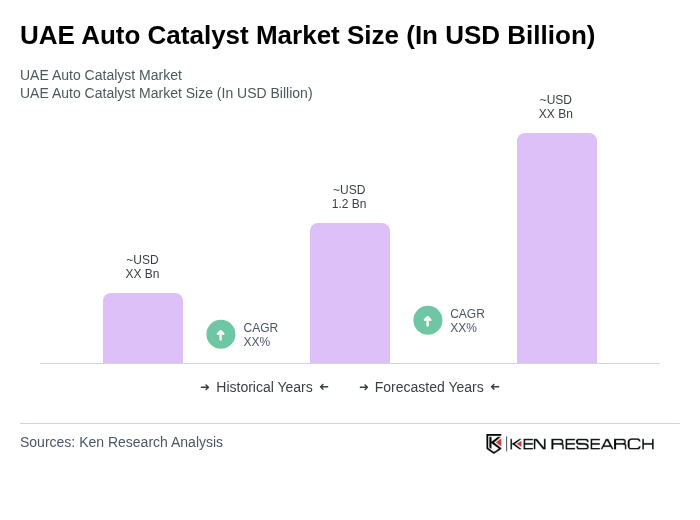
The UAE Auto Catalyst Market, valued at USD 1.2 billion, grows due to strict emissions standards, vehicle production, and environmental awareness.

Region:Middle East

Author(s):Geetanshi

Product Code:KRAD3737

Pages:97

Published On:November 2025
About the Report

Base Year 2024

UAE Auto Catalyst Market Overview

  • The UAE Auto Catalyst Market is valued at USD 1.2 billion, based on a five-year historical analysis. This growth is primarily driven by the increasing demand for vehicles, stringent emission regulations, and the rising awareness of environmental sustainability. The automotive sector's expansion, the rising popularity of hybrid vehicles, and ongoing investments in advanced catalytic converter technologies to improve durability and recyclability have significantly contributed to the market's growth. Additionally, rapid urbanization and government policies promoting cleaner transportation further support market expansion .
  • Key cities such as Dubai and Abu Dhabi dominate the UAE Auto Catalyst Market due to their status as major economic hubs with a high concentration of automotive manufacturers and consumers. The presence of robust infrastructure, rapid economic diversification, and government initiatives to promote cleaner technologies have further solidified their position in the market .
  • The UAE government enforces vehicle emission standards under the Ministerial Resolution No. 37 of 2016 issued by the Ministry of Climate Change and Environment, which mandates that all new vehicles must comply with Euro 5 emission standards. This regulation aims to reduce harmful emissions and promote the use of advanced catalytic converters, thereby driving the demand for high-performance auto catalysts in the region. The regulation covers all new light vehicles and requires manufacturers to meet specific emission thresholds before vehicles can be registered and sold in the UAE .
UAE Auto Catalyst Market Size

UAE Auto Catalyst Market Segmentation

By Catalyst Material:This segmentation includes various materials used in the production of auto catalysts, which are essential for reducing harmful emissions from vehicles. The primary materials are Platinum-based Catalysts, Palladium-based Catalysts, Rhodium-based Catalysts, and Others. Each material has unique properties that influence its effectiveness and cost, impacting consumer choices and market dynamics.
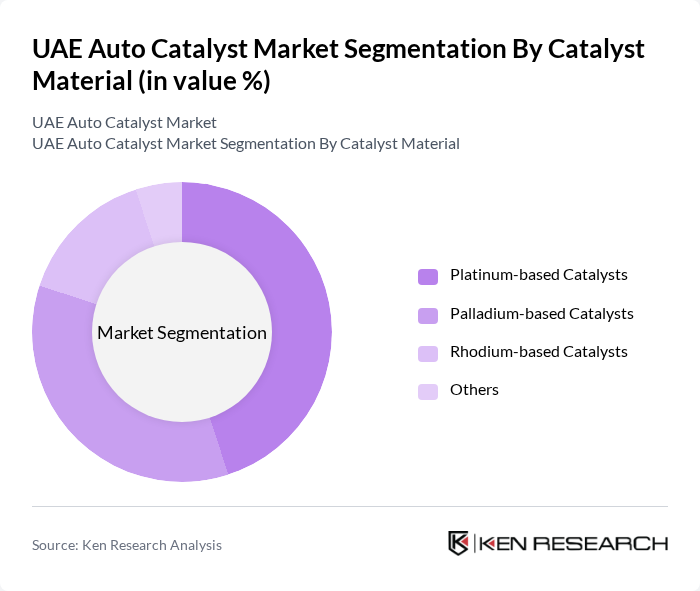
UAE Auto Catalyst Market segmentation by Catalyst Material.

The Platinum-based Catalysts segment leads the market due to their high efficiency in converting harmful gases into less harmful emissions. The increasing adoption of these catalysts in luxury and high-performance vehicles, coupled with their effectiveness in meeting stringent emission standards, has solidified their dominance. Palladium-based Catalysts are also gaining traction, particularly in mid-range vehicles, due to their cost-effectiveness and performance balance .

By Catalyst Type:This segmentation categorizes auto catalysts based on their functional design. The main types include Two-Way Catalysts, Three-Way Catalysts, Four-Way Catalysts, and Selective Catalytic Reduction (SCR). Each type serves a specific purpose in the emission control process, influencing their application in various vehicle models.
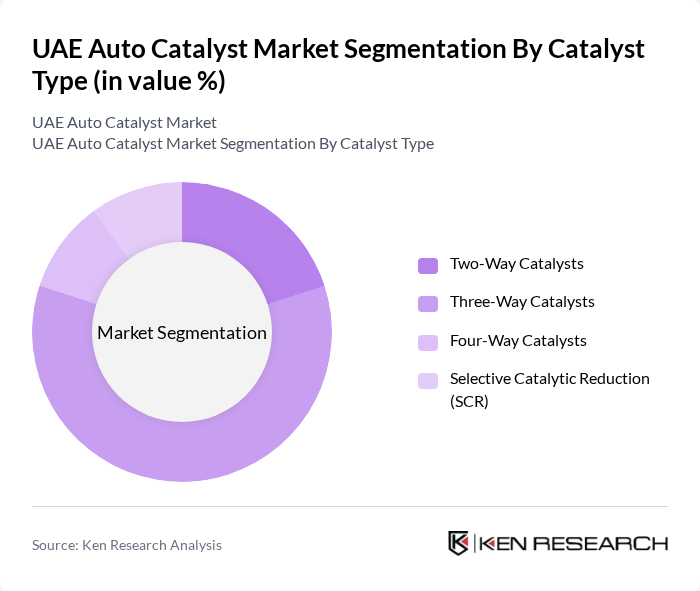
UAE Auto Catalyst Market segmentation by Catalyst Type.

The Three-Way Catalysts segment dominates the market due to their ability to simultaneously reduce nitrogen oxides, carbon monoxide, and unburned hydrocarbons, making them essential for gasoline engines. The increasing regulatory pressure for lower emissions has led to a higher adoption of these catalysts in new vehicles. Two-Way Catalysts are primarily used in older gasoline and some diesel engines, while SCR technology is gaining popularity for its effectiveness in reducing NOx emissions in heavy-duty vehicles .

UAE Auto Catalyst Market Competitive Landscape

The UAE Auto Catalyst Market is characterized by a dynamic mix of regional and international players. Leading participants such as BASF SE, Johnson Matthey, Umicore, Heraeus, Clariant, NGK Insulators, Tenneco Inc., Delphi Technologies, Denso Corporation, Eberspächer, Faurecia, Yutaka Giken, Calsonic Kansei, Aisin Seiki, Magneti Marelli contribute to innovation, geographic expansion, and service delivery in this space.

BASF SE

1865

Ludwigshafen, Germany

Johnson Matthey

1817

London, UK

Umicore

1805

Brussels, Belgium

Heraeus

1851

Hanau, Germany

Clariant

1995

Muttenz, Switzerland

Company

Establishment Year

Headquarters

Company Size (Large, Medium, or Small)

Revenue Growth Rate (%)

Market Share in UAE (%)

Product Portfolio Breadth (Catalyst Types Offered)

Geographic Presence (Regional Coverage)

R&D Investment as % of Revenue

UAE Auto Catalyst Market Industry Analysis

Growth Drivers

  • Increasing Vehicle Production:The UAE's vehicle production reached approximately 200,000 units in future, driven by a growing automotive sector. The government’s initiatives to boost local manufacturing, including the UAE Vision 2021, aim to increase this figure by 15% annually. This surge in production directly correlates with the demand for auto catalysts, as each vehicle requires catalytic converters to meet emission standards, thereby propelling market growth significantly.
  • Stringent Emission Regulations:The UAE has implemented strict emission regulations, with the Ministry of Climate Change and Environment enforcing standards that align with Euro 5 and Euro 6 norms. As of future, over 80% of vehicles in the UAE are required to comply with these regulations, leading to an increased demand for advanced catalytic converters. This regulatory environment is expected to drive the auto catalyst market, as manufacturers seek compliant solutions to avoid penalties.
  • Rising Environmental Awareness:Public awareness regarding environmental issues has surged, with 70% of UAE residents expressing concern over air quality in a recent survey. This heightened awareness has prompted both consumers and manufacturers to prioritize eco-friendly vehicles, leading to a projected increase in demand for catalytic converters. The UAE government’s commitment to sustainability, including the Clean Energy Strategy 2050, further supports this trend, enhancing the market for auto catalysts.

Market Challenges

  • High Cost of Raw Materials:The cost of key raw materials for catalysts, such as platinum, palladium, and rhodium, has seen significant fluctuations, with prices increasing by over 30% in the past year. This volatility poses a challenge for manufacturers, as it directly impacts production costs and profit margins. The reliance on these precious metals makes the market susceptible to global supply chain disruptions, further complicating pricing strategies.
  • Competition from Alternative Technologies:The rise of alternative technologies, such as electric vehicles (EVs) and hydrogen fuel cells, presents a significant challenge to the auto catalyst market. In future, EV sales in the UAE increased by 25%, indicating a shift in consumer preference. This trend could potentially reduce the demand for traditional internal combustion engine vehicles, thereby impacting the market for auto catalysts as manufacturers pivot towards cleaner technologies.

UAE Auto Catalyst Market Future Outlook

The UAE auto catalyst market is poised for significant transformation, driven by advancements in technology and a shift towards sustainable automotive solutions. As the government continues to enforce stringent emission regulations, manufacturers will increasingly invest in research and development to create more efficient catalytic technologies. Additionally, the expansion of the electric vehicle market will necessitate innovative approaches to catalyst design, ensuring compliance with evolving environmental standards while addressing consumer demand for cleaner transportation options.

Market Opportunities

  • Expansion of Electric Vehicle Market:The UAE's electric vehicle market is projected to grow significantly, with sales expected to reach 50,000 units by future. This growth presents an opportunity for manufacturers to develop specialized catalysts that cater to hybrid and electric vehicles, enhancing their market presence and aligning with global sustainability trends.
  • Development of Advanced Catalytic Technologies:There is a growing demand for advanced catalytic technologies that improve efficiency and reduce emissions. Investments in R&D are expected to exceed AED 500 million in future, allowing companies to innovate and create next-generation catalysts that meet stringent regulations, thus capturing a larger market share.

Scope of the Report

SegmentSub-Segments
By Catalyst Material

Platinum-based Catalysts

Palladium-based Catalysts

Rhodium-based Catalysts

Others

By Catalyst Type

Two-Way Catalysts

Three-Way Catalysts

Four-Way Catalysts

Selective Catalytic Reduction (SCR)

By Vehicle Type

Passenger Cars

Light Commercial Vehicles

Heavy Commercial Vehicles

Others

By Fuel Type

Gasoline Vehicles

Diesel Vehicles

Hybrid Vehicles

Hydrogen Fuel Cell Vehicles

By Distribution Channel

OEM (Original Equipment Manufacturer)

Aftermarket

Others

By Geography

Abu Dhabi

Dubai

Sharjah

Ajman

Fujairah

Ras Al Khaimah

Umm Al Quwain

Key Target Audience

Investors and Venture Capitalist Firms

Government and Regulatory Bodies (e.g., Ministry of Climate Change and Environment, Emirates Authority for Standardization and Metrology)

Manufacturers and Producers

Distributors and Retailers

Automotive OEMs (Original Equipment Manufacturers)

Aftermarket Service Providers

Environmental NGOs and Advocacy Groups

Financial Institutions

Players Mentioned in the Report:

BASF SE

Johnson Matthey

Umicore

Heraeus

Clariant

NGK Insulators

Tenneco Inc.

Delphi Technologies

Denso Corporation

Eberspacher

Faurecia

Yutaka Giken

Calsonic Kansei

Aisin Seiki

Magneti Marelli

Table of Contents

Market Assessment Phase

1. Executive Summary and Approach


2. UAE Auto Catalyst Market Overview

2.1 Key Insights and Strategic Recommendations

2.2 UAE Auto Catalyst Market Overview

2.3 Definition and Scope

2.4 Evolution of Market Ecosystem

2.5 Timeline of Key Regulatory Milestones

2.6 Value Chain & Stakeholder Mapping

2.7 Business Cycle Analysis

2.8 Policy & Incentive Landscape


3. UAE Auto Catalyst Market Analysis

3.1 Growth Drivers

3.1.1 Increasing Vehicle Production
3.1.2 Stringent Emission Regulations
3.1.3 Rising Environmental Awareness
3.1.4 Technological Advancements in Catalysts

3.2 Market Challenges

3.2.1 High Cost of Raw Materials
3.2.2 Competition from Alternative Technologies
3.2.3 Regulatory Compliance Costs
3.2.4 Market Volatility

3.3 Market Opportunities

3.3.1 Expansion of Electric Vehicle Market
3.3.2 Development of Advanced Catalytic Technologies
3.3.3 Government Incentives for Clean Technologies
3.3.4 Growing Demand for Aftermarket Catalysts

3.4 Market Trends

3.4.1 Shift Towards Sustainable Automotive Solutions
3.4.2 Increasing Investment in R&D
3.4.3 Adoption of Digital Technologies in Manufacturing
3.4.4 Focus on Recycling and Reuse of Catalysts

3.5 Government Regulation

3.5.1 Emission Standards Compliance
3.5.2 Incentives for Low-Emission Vehicles
3.5.3 Regulations on Catalyst Recycling
3.5.4 Import Tariffs on Raw Materials

4. SWOT Analysis


5. Stakeholder Analysis


6. Porter's Five Forces Analysis


7. UAE Auto Catalyst Market Market Size, 2019-2024

7.1 By Value

7.2 By Volume

7.3 By Average Selling Price


8. UAE Auto Catalyst Market Segmentation

8.1 By Catalyst Material

8.1.1 Platinum-based Catalysts
8.1.2 Palladium-based Catalysts
8.1.3 Rhodium-based Catalysts
8.1.4 Others

8.2 By Catalyst Type

8.2.1 Two-Way Catalysts
8.2.2 Three-Way Catalysts
8.2.3 Four-Way Catalysts
8.2.4 Selective Catalytic Reduction (SCR)

8.3 By Vehicle Type

8.3.1 Passenger Cars
8.3.2 Light Commercial Vehicles
8.3.3 Heavy Commercial Vehicles
8.3.4 Others

8.4 By Fuel Type

8.4.1 Gasoline Vehicles
8.4.2 Diesel Vehicles
8.4.3 Hybrid Vehicles
8.4.4 Hydrogen Fuel Cell Vehicles

8.5 By Distribution Channel

8.5.1 OEM (Original Equipment Manufacturer)
8.5.2 Aftermarket
8.5.3 Others

8.6 By Geography

8.6.1 Abu Dhabi
8.6.2 Dubai
8.6.3 Sharjah
8.6.4 Ajman
8.6.5 Fujairah
8.6.6 Ras Al Khaimah
8.6.7 Umm Al Quwain

9. UAE Auto Catalyst Market Competitive Analysis

9.1 Market Share of Key Players

9.2 Cross Comparison of Key Players

9.2.1 Company Name
9.2.2 Company Size (Large, Medium, or Small)
9.2.3 Revenue Growth Rate (%)
9.2.4 Market Share in UAE (%)
9.2.5 Product Portfolio Breadth (Catalyst Types Offered)
9.2.6 Geographic Presence (Regional Coverage)
9.2.7 R&D Investment as % of Revenue
9.2.8 OEM vs Aftermarket Revenue Mix
9.2.9 Certifications & Compliance Standards
9.2.10 Supply Chain Resilience Score

9.3 SWOT Analysis of Top Players

9.4 Pricing Analysis

9.5 Detailed Profile of Major Companies

9.5.1 BASF SE
9.5.2 Johnson Matthey
9.5.3 Umicore
9.5.4 Heraeus
9.5.5 Clariant
9.5.6 NGK Insulators
9.5.7 Tenneco Inc.
9.5.8 Delphi Technologies
9.5.9 Denso Corporation
9.5.10 Eberspächer
9.5.11 Faurecia
9.5.12 Yutaka Giken
9.5.13 Calsonic Kansei
9.5.14 Aisin Seiki
9.5.15 Magneti Marelli

10. UAE Auto Catalyst Market End-User Analysis

10.1 Procurement Behavior of Key Stakeholders

10.1.1 Ministry of Energy and Infrastructure
10.1.2 Ministry of Climate Change and Environment
10.1.3 Ministry of Economy
10.1.4 Others

10.2 Corporate Spend on Automotive Components

10.2.1 Automotive Manufacturers
10.2.2 Component Suppliers
10.2.3 Government Agencies
10.2.4 Others

10.3 Pain Point Analysis by End-User Category

10.3.1 OEMs
10.3.2 Aftermarket Suppliers
10.3.3 Regulatory Bodies
10.3.4 Others

10.4 User Readiness for Adoption

10.4.1 Awareness of Emission Standards
10.4.2 Availability of Technology
10.4.3 Financial Incentives
10.4.4 Others

10.5 Post-Deployment ROI and Use Case Expansion

10.5.1 Performance Metrics
10.5.2 Cost Savings
10.5.3 Environmental Impact
10.5.4 Others

11. UAE Auto Catalyst Market Future Size, 2025-2030

11.1 By Value

11.2 By Volume

11.3 By Average Selling Price


Go-To-Market Strategy Phase

1. Whitespace Analysis + Business Model Canvas

1.1 Market Gaps Identification

1.2 Value Proposition Development

1.3 Revenue Streams Analysis

1.4 Cost Structure Evaluation

1.5 Key Partnerships

1.6 Customer Segmentation

1.7 Channels of Distribution


2. Marketing and Positioning Recommendations

2.1 Branding Strategies

2.2 Product USPs

2.3 Target Market Identification

2.4 Communication Strategy

2.5 Digital Marketing Approach

2.6 Customer Engagement Tactics

2.7 Performance Metrics


3. Distribution Plan

3.1 Urban Retail Strategies

3.2 Rural NGO Tie-ups

3.3 E-commerce Integration

3.4 Logistics and Supply Chain Management

3.5 Distribution Partnerships

3.6 Inventory Management

3.7 Performance Tracking


4. Channel & Pricing Gaps

4.1 Underserved Routes

4.2 Pricing Bands Analysis

4.3 Competitor Pricing Strategies

4.4 Customer Willingness to Pay

4.5 Value-Based Pricing

4.6 Discount Strategies

4.7 Pricing Optimization


5. Unmet Demand & Latent Needs

5.1 Category Gaps

5.2 Consumer Segments

5.3 Emerging Trends

5.4 Customer Feedback Analysis

5.5 Market Research Insights

5.6 Product Development Opportunities

5.7 Future Demand Projections


6. Customer Relationship

6.1 Loyalty Programs

6.2 After-sales Service

6.3 Customer Support Strategies

6.4 Feedback Mechanisms

6.5 Community Engagement

6.6 Relationship Management Tools

6.7 Performance Metrics


7. Value Proposition

7.1 Sustainability Initiatives

7.2 Integrated Supply Chains

7.3 Customer-Centric Solutions

7.4 Competitive Advantages

7.5 Market Differentiation

7.6 Value Delivery Mechanisms

7.7 Performance Metrics


8. Key Activities

8.1 Regulatory Compliance

8.2 Branding Initiatives

8.3 Distribution Setup

8.4 Marketing Campaigns

8.5 Training and Development

8.6 Performance Monitoring

8.7 Continuous Improvement


9. Entry Strategy Evaluation

9.1 Domestic Market Entry Strategy

9.1.1 Product Mix
9.1.2 Pricing Band
9.1.3 Packaging

9.2 Export Entry Strategy

9.2.1 Target Countries
9.2.2 Compliance Roadmap

10. Entry Mode Assessment

10.1 Joint Ventures

10.2 Greenfield Investments

10.3 Mergers & Acquisitions

10.4 Distributor Model


Research Methodology

ApproachModellingSample

Phase 1: Approach1

Desk Research

  • Industry reports from the UAE Ministry of Economy and relevant automotive associations
  • Market analysis publications from trade journals focusing on automotive and catalyst technologies
  • Statistical data from government databases on vehicle registrations and emissions regulations

Primary Research

  • Interviews with automotive manufacturers and suppliers of catalytic converters
  • Surveys with environmental regulatory bodies and industry experts
  • Field interviews with automotive service centers and repair shops

Validation & Triangulation

  • Cross-validation of data from multiple industry sources and expert opinions
  • Triangulation of market size estimates using sales data and regulatory frameworks
  • Sanity checks through feedback from a panel of automotive industry experts

Phase 2: Market Size Estimation1

Top-down Assessment

  • Analysis of total automotive market size in the UAE and its growth trajectory
  • Segmentation of the market by vehicle type and catalyst application
  • Incorporation of government policies promoting emissions reduction and sustainability

Bottom-up Modeling

  • Volume estimates based on production data from local automotive manufacturers
  • Cost analysis of catalytic converters and their installation across different vehicle types
  • Estimation of replacement rates and lifecycle management of catalysts

Forecasting & Scenario Analysis

  • Multi-variable regression analysis considering factors like fuel prices and environmental regulations
  • Scenario modeling based on potential shifts in consumer preferences towards electric vehicles
  • Baseline, optimistic, and pessimistic forecasts through 2030 based on market dynamics

Phase 3: CATI Sample Composition1

Scope Item/SegmentSample SizeTarget Respondent Profiles
Automotive Manufacturers45Product Managers, R&D Engineers
Aftermarket Suppliers52Sales Directors, Supply Chain Managers
Environmental Regulatory Bodies28Policy Analysts, Compliance Officers
Automotive Repair Shops48Service Managers, Technicians
Academic and Research Institutions27Research Scholars, Professors in Automotive Engineering

Frequently Asked Questions

What is the current value of the UAE Auto Catalyst Market?

The UAE Auto Catalyst Market is valued at approximately USD 1.2 billion, driven by increasing vehicle demand, stringent emission regulations, and a growing focus on environmental sustainability.

What factors are driving the growth of the UAE Auto Catalyst Market?

Which cities are the primary markets for auto catalysts in the UAE?

What are the main types of catalysts used in the UAE Auto Catalyst Market?

Other Regional/Country Reports

Indonesia Auto Catalyst Market Size, Share, Growth Drivers, Trends, Opportunities & Forecast 2025–2030

Malaysia Auto Catalyst Market Size, Share, Growth Drivers, Trends, Opportunities & Forecast 2025–2030

KSA Auto Catalyst Market Size, Share, Growth Drivers, Trends, Opportunities & Forecast 2025–2030

APAC Auto Catalyst Market Size, Share, Growth Drivers, Trends, Opportunities & Forecast 2025–2030

SEA Auto Catalyst Market Size, Share, Growth Drivers, Trends, Opportunities & Forecast 2025–2030

Vietnam Auto Catalyst Market Size, Share, Growth Drivers, Trends, Opportunities & Forecast 2025–2030

Other Adjacent Reports

Qatar automotive exhaust systems market Size, Share, Growth Drivers, Trends, Opportunities & Forecast 2025–2030

Germany Emission Control Technologies Market

Philippines Precious Metals Market Size, Share, Growth Drivers, Trends, Opportunities & Forecast 2025–2030

UAE Vehicle Manufacturing Market

Qatar Air Pollution Control Market

Brazil Hybrid Vehicle Components Market

Singapore Diesel Particulate Filter Market

Egypt Automotive Aftermarket Market

Philippines Catalytic Converter Recycling Market

Oman Environmental Compliance Services Market

Why Buy From Us?

Refine Robust Result (RRR) Framework

What makes us stand out is that our consultants follow Robust, Refine and Result (RRR) methodology. Robust for clear definitions, approaches and sanity checking, Refine for differentiating respondents' facts and opinions, and Result for presenting data with story.

Our Reach Is Unmatched

We have set a benchmark in the industry by offering our clients with syndicated and customized market research reports featuring coverage of entire market as well as meticulous research and analyst insights.

Shifting the Research Paradigm

While we don't replace traditional research, we flip the method upside down. Our dual approach of Top Bottom & Bottom Top ensures quality deliverable by not just verifying company fundamentals but also looking at the sector and macroeconomic factors.

More Insights-Better Decisions

With one step in the future, our research team constantly tries to show you the bigger picture. We help with some of the tough questions you may encounter along the way: How is the industry positioned? Best marketing channel? KPI's of competitors? By aligning every element, we help maximize success.

Transparency and Trust

Our report gives you instant access to the answers and sources that other companies might choose to hide. We elaborate each steps of research methodology we have used and showcase you the sample size to earn your trust.

Round the Clock Support

If you need any support, we are here! We pride ourselves on universe strength, data quality, and quick, friendly, and professional service.

Why Clients Choose Us?

400000+
Reports in repository
150+
Consulting projects a year
100+
Analysts
8000+
Client Queries in 2022








