About the Report
Base Year 2024UAE Designer Clothing Retail Market Overview
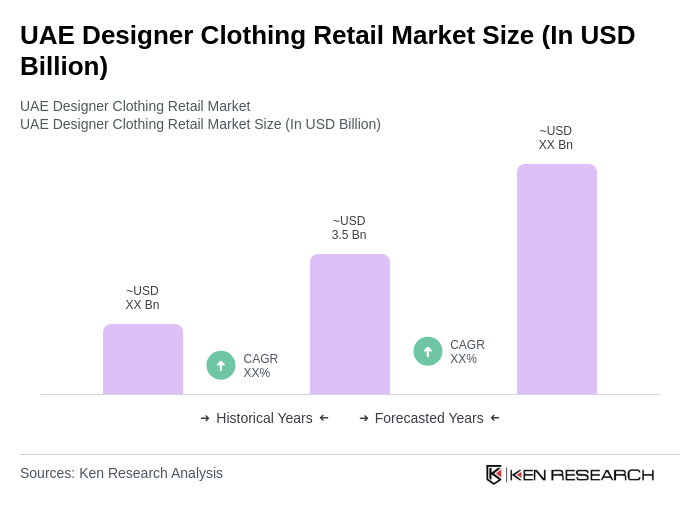
- The UAE Designer Clothing Retail Market is valued at USD 3.5 billion, based on a five-year historical analysis. This growth is primarily driven by the increasing disposable income of consumers, a growing preference for luxury and designer brands, and the rise of e-commerce platforms that facilitate access to high-end fashion. The market has seen a significant uptick in demand for both local and international designer labels, reflecting a shift in consumer behavior towards premium products.
- Dubai and Abu Dhabi are the dominant cities in the UAE Designer Clothing Retail Market, primarily due to their status as luxury shopping destinations. These cities attract a high volume of tourists and expatriates, contributing to a vibrant retail environment. The presence of numerous high-end shopping malls and boutiques, along with a strong cultural inclination towards fashion, further solidifies their dominance in the market.
- In 2023, the UAE government implemented a new regulation aimed at promoting sustainable fashion practices within the retail sector. This regulation mandates that all designer clothing retailers must adhere to specific sustainability standards, including the use of eco-friendly materials and ethical labor practices. The initiative is part of the UAE's broader strategy to enhance environmental sustainability and reduce the fashion industry's carbon footprint.
UAE Designer Clothing Retail Market Segmentation
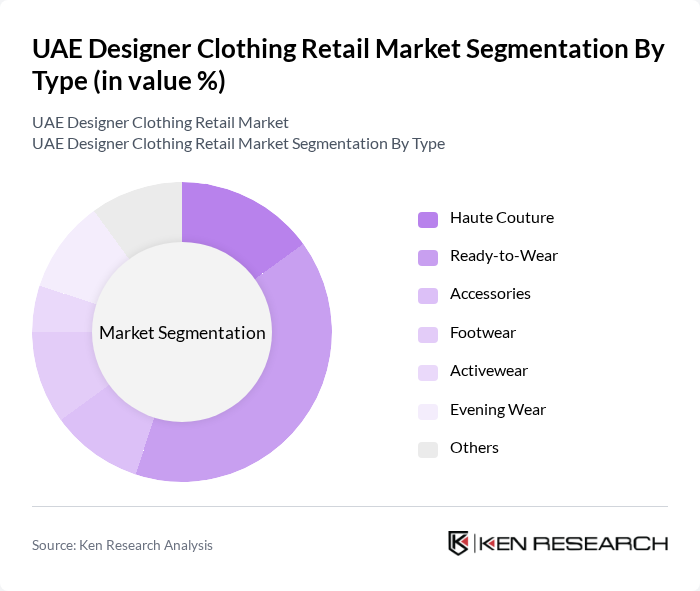
By Type:The designer clothing retail market can be segmented into various types, including Haute Couture, Ready-to-Wear, Accessories, Footwear, Activewear, Evening Wear, and Others. Among these, Ready-to-Wear has emerged as the leading subsegment due to its accessibility and appeal to a broader consumer base. The trend towards casual and versatile fashion has driven demand for ready-to-wear collections, making it a preferred choice for many shoppers.
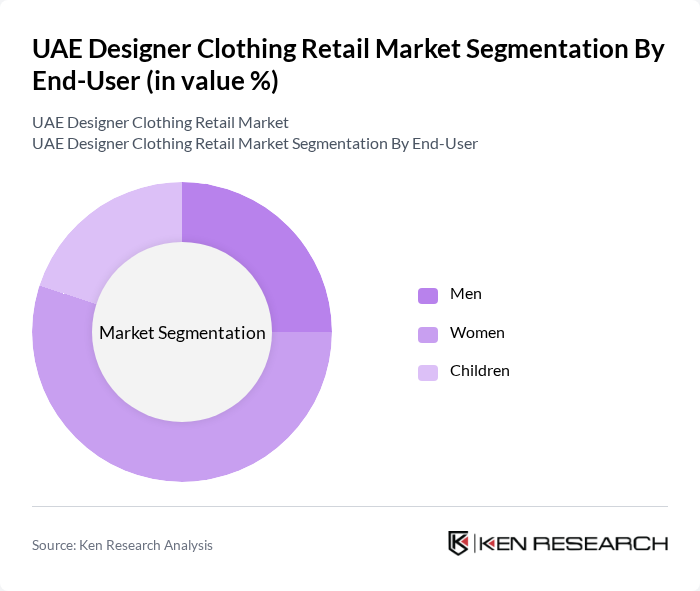
By End-User:The market can also be segmented by end-user categories, which include Men, Women, and Children. The Women’s segment dominates the market, driven by a higher inclination towards fashion and luxury among female consumers. Women are more likely to invest in designer clothing, leading to a significant market share for this segment. The increasing number of women entering the workforce and their growing purchasing power further contribute to this trend.
UAE Designer Clothing Retail Market Competitive Landscape
The UAE Designer Clothing Retail Market is characterized by a dynamic mix of regional and international players. Leading participants such as Al Haramain, Ounass, Level Shoes, Boutique 1, The Luxury Closet, Bloomingdale's Dubai, Harvey Nichols Dubai, Galeries Lafayette, Maison de Mode, Damas, Areej, S*uce, Madiyah Al Sharqi, Rami Al Ali, Amato Couture contribute to innovation, geographic expansion, and service delivery in this space.
UAE Designer Clothing Retail Market Industry Analysis
Growth Drivers
- Increasing Disposable Income:The UAE's GDP per capita is projected to reach approximately $45,000 in future, reflecting a robust economic environment. This increase in disposable income allows consumers to allocate more funds towards luxury and designer clothing. As a result, the retail sector is expected to benefit significantly, with luxury goods sales anticipated to rise by 14% annually, driven by affluent consumers seeking high-quality fashion options.
- Rising Demand for Luxury Brands:The luxury goods market in the UAE is expected to grow to $9 billion in future, fueled by a growing population of high-net-worth individuals. This demand is particularly strong among expatriates and tourists, who contribute significantly to the retail landscape. The influx of international luxury brands into the UAE market further enhances consumer choice, driving sales and brand loyalty among discerning shoppers.
- Growth of E-commerce Platforms:E-commerce sales in the UAE are projected to reach $30 billion in future, representing a significant shift in consumer purchasing behavior. The convenience of online shopping, coupled with the rise of mobile commerce, is reshaping the retail landscape. Major designer brands are increasingly investing in their online presence, leading to a 32% increase in online sales for luxury apparel, thus expanding their market reach and accessibility.
Market Challenges
- Intense Competition Among Retailers:The UAE designer clothing market is characterized by fierce competition, with over 1,200 retail outlets vying for consumer attention. This saturation leads to price wars and aggressive marketing strategies, which can erode profit margins. Retailers must continuously innovate and differentiate their offerings to maintain market share, making it challenging for smaller brands to compete effectively against established players.
- Fluctuating Currency Exchange Rates:The UAE dirham is pegged to the US dollar, but fluctuations in global currency markets can impact the cost of imported luxury goods. In future, the volatility of currencies like the euro and pound may lead to increased prices for European brands, potentially reducing consumer demand. Retailers must navigate these challenges to maintain competitive pricing while ensuring profitability in a dynamic market environment.
UAE Designer Clothing Retail Market Future Outlook
The UAE designer clothing retail market is poised for significant transformation, driven by evolving consumer preferences and technological advancements. As sustainability becomes a priority, brands that adopt eco-friendly practices are likely to attract a growing segment of environmentally conscious consumers. Additionally, the integration of augmented reality and virtual fitting rooms is expected to enhance the shopping experience, making it more interactive and personalized. These trends will shape the future landscape of the market, fostering innovation and growth.
Market Opportunities
- Expansion of Online Retail Channels:With e-commerce projected to account for 25% of total retail sales in future, brands have a significant opportunity to enhance their online presence. Investing in user-friendly platforms and targeted digital marketing can attract a broader audience, particularly among younger consumers who prefer online shopping, thus driving sales growth.
- Collaborations with Local Designers:Collaborating with local designers can create unique offerings that resonate with the UAE's diverse consumer base. Such partnerships not only promote local talent but also enhance brand authenticity. This strategy can lead to increased customer loyalty and a competitive edge in a market that values cultural relevance and innovation.
Scope of the Report
| Segment | Sub-Segments |
|---|---|
| By Type | Haute Couture Ready-to-Wear Accessories Footwear Activewear Evening Wear Others |
| By End-User | Men Women Children |
| By Sales Channel | Online Retail Brick-and-Mortar Stores Department Stores |
| By Price Range | Luxury Premium Mid-Range |
| By Brand Origin | Local Brands International Brands |
| By Occasion | Casual Wear Formal Wear Sportswear |
| By Distribution Mode | Direct Sales Wholesale Franchise |
Key Target Audience
Investors and Venture Capitalist Firms
Government and Regulatory Bodies (e.g., Ministry of Economy, Department of Economic Development)
Manufacturers and Producers
Distributors and Retailers
Luxury Brand Representatives
Fashion Industry Trade Associations
Real Estate Developers (focused on retail spaces)
Financial Institutions (providing funding for retail ventures)
Players Mentioned in the Report:
Al Haramain
Ounass
Level Shoes
Boutique 1
The Luxury Closet
Bloomingdale's Dubai
Harvey Nichols Dubai
Galeries Lafayette
Maison de Mode
Damas
Areej
S*uce
Madiyah Al Sharqi
Rami Al Ali
Amato Couture
Table of Contents
Market Assessment Phase
1. Executive Summary and Approach
2. UAE Designer Clothing Retail Market Overview
2.1 Key Insights and Strategic Recommendations
2.2 UAE Designer Clothing Retail Market Overview
2.3 Definition and Scope
2.4 Evolution of Market Ecosystem
2.5 Timeline of Key Regulatory Milestones
2.6 Value Chain & Stakeholder Mapping
2.7 Business Cycle Analysis
2.8 Policy & Incentive Landscape
3. UAE Designer Clothing Retail Market Analysis
3.1 Growth Drivers
3.1.1 Increasing disposable income
3.1.2 Rising demand for luxury brands
3.1.3 Growth of e-commerce platforms
3.1.4 Influence of social media and fashion trends
3.2 Market Challenges
3.2.1 Intense competition among retailers
3.2.2 Fluctuating currency exchange rates
3.2.3 Supply chain disruptions
3.2.4 Changing consumer preferences
3.3 Market Opportunities
3.3.1 Expansion of online retail channels
3.3.2 Collaborations with local designers
3.3.3 Increasing tourism and expatriate population
3.3.4 Sustainable fashion initiatives
3.4 Market Trends
3.4.1 Customization and personalization of products
3.4.2 Growth of rental and resale markets
3.4.3 Focus on sustainability and ethical sourcing
3.4.4 Integration of technology in retail experiences
3.5 Government Regulation
3.5.1 Import tariffs on luxury goods
3.5.2 Consumer protection laws
3.5.3 Regulations on advertising and marketing
3.5.4 Compliance with labor laws
4. SWOT Analysis
5. Stakeholder Analysis
6. Porter's Five Forces Analysis
7. UAE Designer Clothing Retail Market Market Size, 2019-2024
7.1 By Value
7.2 By Volume
7.3 By Average Selling Price
8. UAE Designer Clothing Retail Market Segmentation
8.1 By Type
8.1.1 Haute Couture
8.1.2 Ready-to-Wear
8.1.3 Accessories
8.1.4 Footwear
8.1.5 Activewear
8.1.6 Evening Wear
8.1.7 Others
8.2 By End-User
8.2.1 Men
8.2.2 Women
8.2.3 Children
8.3 By Sales Channel
8.3.1 Online Retail
8.3.2 Brick-and-Mortar Stores
8.3.3 Department Stores
8.4 By Price Range
8.4.1 Luxury
8.4.2 Premium
8.4.3 Mid-Range
8.5 By Brand Origin
8.5.1 Local Brands
8.5.2 International Brands
8.6 By Occasion
8.6.1 Casual Wear
8.6.2 Formal Wear
8.6.3 Sportswear
8.7 By Distribution Mode
8.7.1 Direct Sales
8.7.2 Wholesale
8.7.3 Franchise
9. UAE Designer Clothing Retail Market Competitive Analysis
9.1 Market Share of Key Players
9.2 Cross Comparison of Key Players
9.2.1 Company Name
9.2.2 Group Size (Large, Medium, or Small as per industry convention)
9.2.3 Revenue Growth Rate
9.2.4 Customer Acquisition Cost
9.2.5 Average Order Value
9.2.6 Customer Retention Rate
9.2.7 Market Penetration Rate
9.2.8 Pricing Strategy
9.2.9 Brand Loyalty Index
9.2.10 Inventory Turnover Ratio
9.3 SWOT Analysis of Top Players
9.4 Pricing Analysis
9.5 Detailed Profile of Major Companies
9.5.1 Al Haramain
9.5.2 Ounass
9.5.3 Level Shoes
9.5.4 Boutique 1
9.5.5 The Luxury Closet
9.5.6 Bloomingdale's Dubai
9.5.7 Harvey Nichols Dubai
9.5.8 Galeries Lafayette
9.5.9 Maison de Mode
9.5.10 Damas
9.5.11 Areej
9.5.12 S*uce
9.5.13 Madiyah Al Sharqi
9.5.14 Rami Al Ali
9.5.15 Amato Couture
10. UAE Designer Clothing Retail Market End-User Analysis
10.1 Procurement Behavior of Key Ministries
10.1.1 Government contracts for events
10.1.2 Procurement policies for local designers
10.1.3 Budget allocation for fashion events
10.2 Corporate Spend on Infrastructure & Energy
10.2.1 Investment in retail infrastructure
10.2.2 Corporate sponsorships for fashion shows
10.3 Pain Point Analysis by End-User Category
10.3.1 Sizing and fit issues
10.3.2 Availability of exclusive designs
10.3.3 Price sensitivity among consumers
10.4 User Readiness for Adoption
10.4.1 Awareness of designer brands
10.4.2 Willingness to pay premium prices
10.5 Post-Deployment ROI and Use Case Expansion
10.5.1 Customer feedback and satisfaction
10.5.2 Repeat purchase rates
11. UAE Designer Clothing Retail Market Future Size, 2025-2030
11.1 By Value
11.2 By Volume
11.3 By Average Selling Price
Go-To-Market Strategy Phase
1. Whitespace Analysis + Business Model Canvas
1.1 Market gaps and opportunities
2. Marketing and Positioning Recommendations
2.1 Branding strategies and Product USPs
3. Distribution Plan
3.1 Urban retail vs rural NGO tie-ups
4. Channel & Pricing Gaps
4.1 Underserved routes and Pricing bands
5. Unmet Demand & Latent Needs
5.1 Category gaps and Consumer segments
6. Customer Relationship
6.1 Loyalty programs and After-sales service
7. Value Proposition
7.1 Sustainability and Integrated supply chains
8. Key Activities
8.1 Regulatory compliance and Branding
9. Entry Strategy Evaluation
9.1 Domestic Market Entry Strategy
9.1.1 Product mix and Pricing band
9.2 Export Entry Strategy
9.2.1 Target countries and Compliance roadmap
10. Entry Mode Assessment
10.1 JV, Greenfield, M&A, Distributor Model
11. Capital and Timeline Estimation
11.1 Capital requirements and Timelines
12. Control vs Risk Trade-Off
12.1 Ownership vs Partnerships
13. Profitability Outlook
13.1 Breakeven analysis and Long-term sustainability
14. Potential Partner List
14.1 Distributors, JVs, Acquisition targets
15. Execution Roadmap
15.1 Phased Plan for Market Entry
15.1.1 Market Setup ? Market Entry ? Growth Acceleration ? Scale & Stabilize
15.2 Key Activities and Milestones
15.2.1 Milestone tracking and Activity scheduling
Research Methodology
Phase 1: Approach1
Desk Research
- Analysis of industry reports from local trade associations and market research firms
- Review of government publications and economic data from the UAE Ministry of Economy
- Examination of consumer behavior studies and fashion trend reports from regional fashion institutes
Primary Research
- Interviews with key stakeholders in the designer clothing retail sector, including store managers and brand representatives
- Surveys targeting consumers to understand purchasing preferences and brand loyalty
- Focus group discussions with fashion influencers and stylists to gauge market trends and consumer sentiment
Validation & Triangulation
- Cross-validation of findings through multiple data sources, including sales data and consumer feedback
- Triangulation of insights from primary interviews with secondary data trends
- Sanity checks conducted through expert panel reviews comprising industry veterans and market analysts
Phase 2: Market Size Estimation1
Top-down Assessment
- Estimation of total market size based on national retail sales data and fashion industry growth rates
- Segmentation of the market by product categories, including luxury, contemporary, and streetwear
- Incorporation of demographic trends and consumer spending patterns in the UAE
Bottom-up Modeling
- Collection of sales data from leading designer clothing retailers in the UAE
- Estimation of average transaction values and customer footfall in retail outlets
- Analysis of online sales channels and their contribution to overall market revenue
Forecasting & Scenario Analysis
- Development of growth projections based on historical sales data and economic indicators
- Scenario analysis considering factors such as economic fluctuations, consumer trends, and global fashion influences
- Creation of baseline, optimistic, and pessimistic forecasts through 2028
Phase 3: CATI Sample Composition1
| Scope Item/Segment | Sample Size | Target Respondent Profiles |
|---|---|---|
| Luxury Designer Retail | 150 | Store Managers, Brand Executives |
| Contemporary Fashion Brands | 100 | Marketing Managers, Retail Buyers |
| Streetwear Market Insights | 80 | Fashion Influencers, Trend Analysts |
| Consumer Preferences in Online Shopping | 120 | Online Shoppers, E-commerce Managers |
| Market Trends and Future Outlook | 90 | Industry Experts, Fashion Consultants |
Frequently Asked Questions
What is the current value of the UAE Designer Clothing Retail Market?
The UAE Designer Clothing Retail Market is valued at approximately USD 3.5 billion, reflecting a robust growth driven by increasing disposable income, a preference for luxury brands, and the expansion of e-commerce platforms.
Which cities dominate the UAE Designer Clothing Retail Market?
What are the key growth drivers for the UAE Designer Clothing Retail Market?
How has the UAE government influenced the designer clothing market?
Other Regional/Country Reports
Indonesia Designer Clothing Retail Market
Malaysia Designer Clothing Retail Market
KSA Designer Clothing Retail Market
APAC Designer Clothing Retail Market
SEA Designer Clothing Retail Market
Vietnam Designer Clothing Retail Market
Other Adjacent Reports
UAE Luxury Accessories Market
Mexico High-End Footwear Market
Singapore Fashion E-Commerce Market
Egypt Sustainable Fashion Market
Bahrain Luxury Jewelry Market Report Size, Share, Growth Drivers, Trends, Opportunities & Forecast 2025–2030Oman Beauty and Cosmetics Market
Germany Retail Technology Market
UAE Fashion Logistics Market
Italy Textile Manufacturing MarketSingapore Apparel Wholesale Market
Why Buy From Us?

What makes us stand out is that our consultants follow Robust, Refine and Result (RRR) methodology. Robust for clear definitions, approaches and sanity checking, Refine for differentiating respondents' facts and opinions, and Result for presenting data with story.

We have set a benchmark in the industry by offering our clients with syndicated and customized market research reports featuring coverage of entire market as well as meticulous research and analyst insights.

While we don't replace traditional research, we flip the method upside down. Our dual approach of Top Bottom & Bottom Top ensures quality deliverable by not just verifying company fundamentals but also looking at the sector and macroeconomic factors.

With one step in the future, our research team constantly tries to show you the bigger picture. We help with some of the tough questions you may encounter along the way: How is the industry positioned? Best marketing channel? KPI's of competitors? By aligning every element, we help maximize success.

Our report gives you instant access to the answers and sources that other companies might choose to hide. We elaborate each steps of research methodology we have used and showcase you the sample size to earn your trust.

If you need any support, we are here! We pride ourselves on universe strength, data quality, and quick, friendly, and professional service.