About the Report
Base Year 2024United Arab Emirates Fire Safety Equipment Market Overview
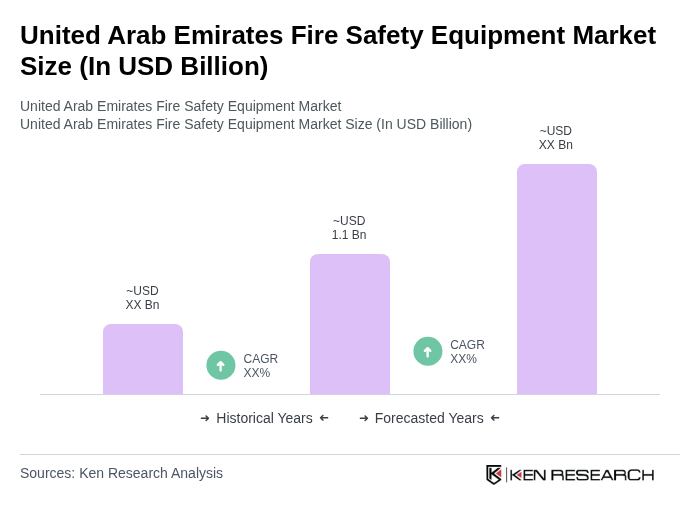
- The United Arab Emirates Fire Safety Equipment Market is valued at USD 1.1 billion, based on a five-year historical analysis of UAE’s contribution within the wider GCC and Middle East fire safety equipment market and its share of GCC fire safety equipment demand. This growth is primarily driven by increasing urbanization, sustained construction activity, and stringent safety regulations enforced by civil defence authorities, alongside a rising awareness of fire safety among businesses and consumers. The market has seen a surge in demand for advanced fire safety solutions such as intelligent detection, addressable alarm systems, and automatic suppression systems, particularly in commercial, industrial, and high?risk sectors, as organizations prioritize safety, insurance compliance, and business continuity.
- Key cities such as Dubai and Abu Dhabi dominate the market due to their rapid infrastructure development, concentration of high?rise and mixed?use developments, industrial clusters, and a growing number of commercial and hospitality establishments. The UAE's strategic position as a regional business, aviation, and logistics hub in the Middle East further enhances its attractiveness for fire safety equipment suppliers, leading to increased investments in local manufacturing, tender-driven supply to civil defence and government entities, and the deployment of technologically advanced solutions, including integrated fire and life safety systems with building management platforms.
- Fire safety in the UAE is governed by binding instruments such as the UAE Fire and Life Safety Code of Practice, issued by the UAE Civil Defence under the Ministry of Interior, which sets comprehensive requirements for fire detection, alarm, emergency lighting, and firefighting systems across residential, commercial, industrial, and critical infrastructure projects. This Code emphasizes mandatory installation, testing, and maintenance of approved fire detection and suppression systems, performance-based design for complex buildings, product certification, and third?party inspection, ensuring that new constructions and major refurbishments comply with updated safety standards and thereby driving sustained demand for fire safety equipment in the region.
United Arab Emirates Fire Safety Equipment Market Segmentation
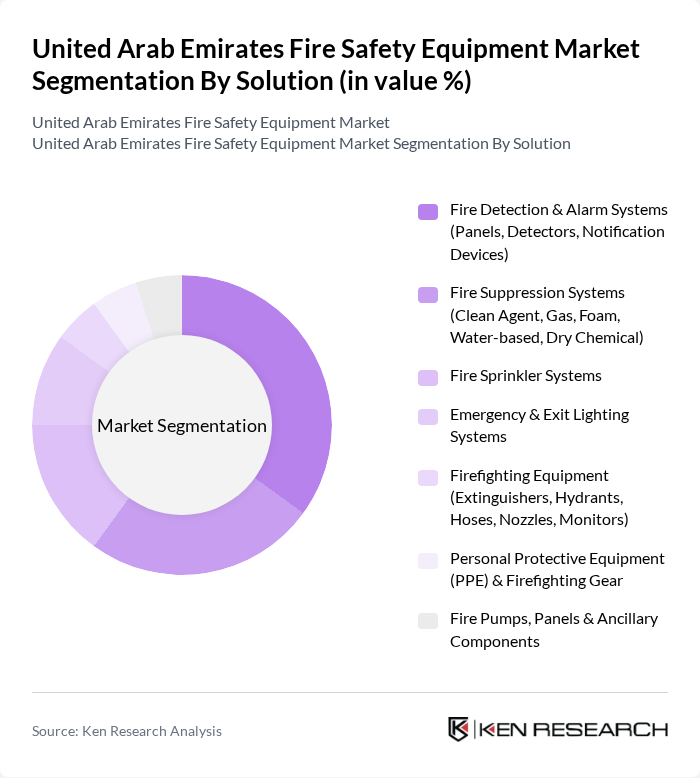
By Solution:The fire safety equipment market can be segmented into various solutions, including fire detection and alarm systems, fire suppression systems, fire sprinkler systems, emergency and exit lighting systems, firefighting equipment, personal protective equipment (PPE), and fire pumps and ancillary components. Among these, fire detection and alarm systems are currently leading the market due to their critical role in early fire detection and prevention and their mandatory deployment in most building typologies under the UAE Fire and Life Safety Code of Practice, which makes them essential for safeguarding lives, property, and ensuring regulatory compliance.
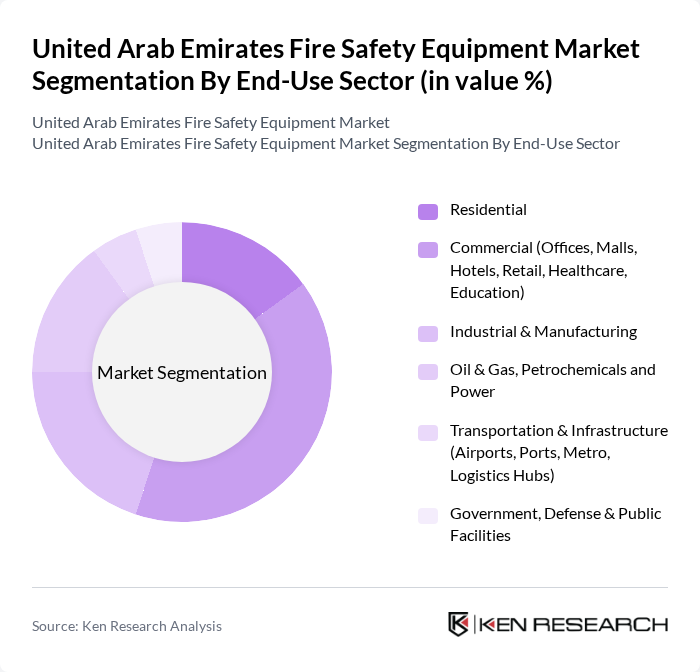
By End-Use Sector:The market can also be segmented by end-use sectors, including residential, commercial, industrial and manufacturing, oil and gas, transportation and infrastructure, and government and public facilities. The commercial sector is currently the largest segment, driven by the increasing number of shopping malls, offices, hotels, healthcare and education facilities, and mixed?use developments, along with strict enforcement of fire safety codes, insurance requirements, and the need to protect high?value assets, which collectively support higher penetration of integrated fire detection, suppression, and emergency lighting systems in this segment.
United Arab Emirates Fire Safety Equipment Market Competitive Landscape
The United Arab Emirates Fire Safety Equipment Market is characterized by a dynamic mix of regional and international players. Leading participants such as Johnson Controls (Tyco, Simplex, Ansul), Honeywell International Inc., Siemens AG, Carrier Global Corporation (Kidde), NAFFCO (National Fire Fighting Manufacturing FZCO), SFFECO Global, Bosch Building Technologies (Bosch Security Systems), Minimax Viking Group, Firetrace International, UTC Fire & Security (Legacy Brands), Emirates Fire Fighting Equipment Factory (FIREX), Gulf Fire & Safety, Al Shams Fire Fighting, Emirates Safety Laboratory & Certification Bodies (Key Ecosystem Players), Other Prominent Local System Integrators and Distributors contribute to innovation, geographic expansion, and service delivery in this space through localization of manufacturing, adherence to UAE Civil Defence approvals, and participation in both government and private sector projects.
United Arab Emirates Fire Safety Equipment Market Industry Analysis
Growth Drivers
- Increasing Regulatory Compliance:The United Arab Emirates has seen a significant rise in regulatory compliance, with the government implementing over 60 fire safety codes and standards since 2018. This regulatory framework mandates the installation of fire safety equipment in commercial and residential buildings, leading to an estimated increase in demand for fire safety equipment by 12% annually. The UAE's commitment to safety is further evidenced by the allocation of AED 1.8 billion for fire safety initiatives in future.
- Rising Awareness of Fire Safety:Public awareness campaigns have significantly increased fire safety consciousness among residents and businesses. In future, over 80% of UAE residents reported being aware of fire safety measures, a rise from 50% in 2020. This heightened awareness has led to a surge in demand for fire safety equipment, with sales projected to reach AED 900 million in future. Educational programs and community workshops have played a crucial role in this growth.
- Growth in Construction and Infrastructure Development:The UAE's construction sector is projected to grow by 7% in future, driven by major projects like Expo 2020 and the ongoing development of smart cities. This growth translates to increased demand for fire safety equipment, as new buildings must comply with stringent fire safety regulations. The construction sector's investment in fire safety is expected to exceed AED 1.2 billion, reflecting the importance of safety in modern infrastructure.
Market Challenges
- High Initial Investment Costs:The fire safety equipment market faces challenges due to high initial investment costs, which can deter small and medium-sized enterprises (SMEs) from compliance. The average cost of installing a comprehensive fire safety system in a commercial building can exceed AED 600,000. This financial barrier limits market penetration, particularly among SMEs, which represent over 90% of the UAE's business landscape, thus hindering overall market growth.
- Lack of Skilled Workforce:The fire safety equipment sector is grappling with a shortage of skilled professionals, with an estimated 25% of positions in fire safety management remaining unfilled. This skills gap is exacerbated by the rapid technological advancements in fire safety equipment, which require specialized training. The UAE's workforce development initiatives aim to address this issue, but the current lack of qualified personnel poses a significant challenge to market expansion.
United Arab Emirates Fire Safety Equipment Market Future Outlook
The future of the UAE fire safety equipment market appears promising, driven by technological advancements and increased regulatory scrutiny. The integration of smart technologies, such as IoT-enabled fire detection systems, is expected to enhance safety measures significantly. Additionally, the government's commitment to improving fire safety standards will likely lead to further investments in fire safety infrastructure, ensuring that both residential and commercial sectors remain compliant and safe in future.
Market Opportunities
- Expansion of Smart Fire Safety Solutions:The growing trend towards smart fire safety solutions presents a significant opportunity for market players. With an estimated 30% of new installations in future expected to incorporate smart technologies, companies that innovate in this space can capture a larger market share and meet evolving consumer demands for efficiency and reliability.
- Increasing Demand from Industrial Sectors:The industrial sector in the UAE is projected to grow by 6% in future, leading to increased demand for fire safety equipment. Industries such as oil and gas, manufacturing, and logistics are prioritizing fire safety, creating opportunities for suppliers to provide tailored solutions that meet specific regulatory and operational needs, potentially increasing sales by AED 400 million.
Scope of the Report
| Segment | Sub-Segments |
|---|---|
| By Solution | Fire Detection & Alarm Systems (Panels, Detectors, Notification Devices) Fire Suppression Systems (Clean Agent, Gas, Foam, Water-based, Dry Chemical) Fire Sprinkler Systems Emergency & Exit Lighting Systems Firefighting Equipment (Extinguishers, Hydrants, Hoses, Nozzles, Monitors) Personal Protective Equipment (PPE) & Firefighting Gear Fire Pumps, Panels & Ancillary Components |
| By End-Use Sector | Residential Commercial (Offices, Malls, Hotels, Retail, Healthcare, Education) Industrial & Manufacturing Oil & Gas, Petrochemicals and Power Transportation & Infrastructure (Airports, Ports, Metro, Logistics Hubs) Government, Defense & Public Facilities |
| By Application | Detection & Monitoring Active Fire Suppression Evacuation & Life Safety System Integration, Maintenance & Retrofit |
| By Distribution Channel | Direct Sales (Projects / Key Accounts) System Integrators & EPC Contractors Distributors & Dealers Online & E-Procurement Platforms |
| By Emirate | Abu Dhabi Dubai Sharjah Ras Al Khaimah, Fujairah, Ajman, Umm Al Quwain |
| By System Technology | Conventional Systems Addressable / Intelligent Systems Networked & Integrated Systems (BMS / SCADA) Wireless & IoT-Enabled Systems |
| By Service Type | Design & Engineering Installation & Commissioning Inspection, Testing & Maintenance (ITM) Retrofits, Upgrades & AMC Contracts |
Key Target Audience
Investors and Venture Capitalist Firms
Government and Regulatory Bodies (e.g., Ministry of Interior, Civil Defence Authority)
Manufacturers and Producers
Distributors and Retailers
Fire Safety Equipment Installers and Service Providers
Industry Associations (e.g., UAE Fire Safety Association)
Insurance Companies
Construction and Real Estate Developers
Players Mentioned in the Report:
Johnson Controls (Tyco, Simplex, Ansul)
Honeywell International Inc.
Siemens AG
Carrier Global Corporation (Kidde)
NAFFCO (National Fire Fighting Manufacturing FZCO)
SFFECO Global
Bosch Building Technologies (Bosch Security Systems)
Minimax Viking Group
Firetrace International
UTC Fire & Security (Legacy Brands)
Emirates Fire Fighting Equipment Factory (FIREX)
Gulf Fire & Safety
Al Shams Fire Fighting
Emirates Safety Laboratory & Certification Bodies (Key Ecosystem Players)
Other Prominent Local System Integrators and Distributors
Table of Contents
Market Assessment Phase
1. Executive Summary and Approach
2. United Arab Emirates Fire Safety Equipment Market Overview
2.1 Key Insights and Strategic Recommendations
2.2 United Arab Emirates Fire Safety Equipment Market Overview
2.3 Definition and Scope
2.4 Evolution of Market Ecosystem
2.5 Timeline of Key Regulatory Milestones
2.6 Value Chain & Stakeholder Mapping
2.7 Business Cycle Analysis
2.8 Policy & Incentive Landscape
3. United Arab Emirates Fire Safety Equipment Market Analysis
3.1 Growth Drivers
3.1.1 Increasing Regulatory Compliance
3.1.2 Rising Awareness of Fire Safety
3.1.3 Growth in Construction and Infrastructure Development
3.1.4 Technological Advancements in Fire Safety Equipment
3.2 Market Challenges
3.2.1 High Initial Investment Costs
3.2.2 Lack of Skilled Workforce
3.2.3 Stringent Regulatory Requirements
3.2.4 Competition from Low-Cost Alternatives
3.3 Market Opportunities
3.3.1 Expansion of Smart Fire Safety Solutions
3.3.2 Increasing Demand from Industrial Sectors
3.3.3 Government Initiatives for Fire Safety Awareness
3.3.4 Growth in Tourism and Hospitality Sector
3.4 Market Trends
3.4.1 Integration of IoT in Fire Safety Equipment
3.4.2 Shift Towards Eco-Friendly Fire Safety Solutions
3.4.3 Increased Focus on Fire Safety Training Programs
3.4.4 Adoption of Advanced Fire Detection Technologies
3.5 Government Regulation
3.5.1 Implementation of Fire Safety Codes
3.5.2 Mandatory Fire Safety Audits
3.5.3 Regulations on Fire Equipment Standards
3.5.4 Incentives for Fire Safety Equipment Manufacturers
4. SWOT Analysis
5. Stakeholder Analysis
6. Porter's Five Forces Analysis
7. United Arab Emirates Fire Safety Equipment Market Market Size, 2019-2024
7.1 By Value
7.2 By Volume
7.3 By Average Selling Price
8. United Arab Emirates Fire Safety Equipment Market Segmentation
8.1 By Solution
8.1.1 Fire Detection & Alarm Systems (Panels, Detectors, Notification Devices)
8.1.2 Fire Suppression Systems (Clean Agent, Gas, Foam, Water-based, Dry Chemical)
8.1.3 Fire Sprinkler Systems
8.1.4 Emergency & Exit Lighting Systems
8.1.5 Firefighting Equipment (Extinguishers, Hydrants, Hoses, Nozzles, Monitors)
8.1.6 Personal Protective Equipment (PPE) & Firefighting Gear
8.1.7 Fire Pumps, Panels & Ancillary Components
8.2 By End-Use Sector
8.2.1 Residential
8.2.2 Commercial (Offices, Malls, Hotels, Retail, Healthcare, Education)
8.2.3 Industrial & Manufacturing
8.2.4 Oil & Gas, Petrochemicals and Power
8.2.5 Transportation & Infrastructure (Airports, Ports, Metro, Logistics Hubs)
8.2.6 Government, Defense & Public Facilities
8.3 By Application
8.3.1 Detection & Monitoring
8.3.2 Active Fire Suppression
8.3.3 Evacuation & Life Safety
8.3.4 System Integration, Maintenance & Retrofit
8.4 By Distribution Channel
8.4.1 Direct Sales (Projects / Key Accounts)
8.4.2 System Integrators & EPC Contractors
8.4.3 Distributors & Dealers
8.4.4 Online & E-Procurement Platforms
8.5 By Emirate
8.5.1 Abu Dhabi
8.5.2 Dubai
8.5.3 Sharjah
8.5.4 Ras Al Khaimah, Fujairah, Ajman, Umm Al Quwain
8.6 By System Technology
8.6.1 Conventional Systems
8.6.2 Addressable / Intelligent Systems
8.6.3 Networked & Integrated Systems (BMS / SCADA)
8.6.4 Wireless & IoT-Enabled Systems
8.7 By Service Type
8.7.1 Design & Engineering
8.7.2 Installation & Commissioning
8.7.3 Inspection, Testing & Maintenance (ITM)
8.7.4 Retrofits, Upgrades & AMC Contracts
9. United Arab Emirates Fire Safety Equipment Market Competitive Analysis
9.1 Market Share of Key Players(Micro, Small, Medium, Large Enterprises)
9.2 Cross Comparison of Key Players
9.2.1 Company Name
9.2.2 Group Size (Large, Medium, or Small as per industry convention)
9.2.3 UAE Fire Safety Equipment Revenue (Latest Year, USD Million)
9.2.4 3-Year CAGR in UAE Fire Safety Revenue
9.2.5 Market Share in UAE Fire Safety Equipment (%)
9.2.6 Order Book / Backlog Coverage (Months of Revenue)
9.2.7 EBITDA Margin (%) – Fire Safety Segment
9.2.8 R&D and Product Innovation Intensity (% of Revenue)
9.2.9 Project Win Rate in Competitive Tenders (%)
9.2.10 Average Contract Size and Project Mix (Capex vs Retrofit)
9.2.11 Geographic Footprint within UAE (No. of Active Projects / Emirates Covered)
9.2.12 Key Strategic Partnerships and Certifications (e.g., Civil Defense, LPCB, UL)
9.3 SWOT Analysis of Top Players
9.4 Pricing Analysis(By Class and Payload)
9.5 Detailed Profile of Major Companies
9.5.1 Johnson Controls (Tyco, Simplex, Ansul)
9.5.2 Honeywell International Inc.
9.5.3 Siemens AG
9.5.4 Carrier Global Corporation (Kidde)
9.5.5 NAFFCO (National Fire Fighting Manufacturing FZCO)
9.5.6 SFFECO Global
9.5.7 Bosch Building Technologies (Bosch Security Systems)
9.5.8 Minimax Viking Group
9.5.9 Firetrace International
9.5.10 UTC Fire & Security (Legacy Brands)
9.5.11 Emirates Fire Fighting Equipment Factory (FIREX)
9.5.12 Gulf Fire & Safety
9.5.13 Al Shams Fire Fighting
9.5.14 Emirates Safety Laboratory & Certification Bodies (Key Ecosystem Players)
9.5.15 Other Prominent Local System Integrators and Distributors
10. United Arab Emirates Fire Safety Equipment Market End-User Analysis
10.1 Procurement Behavior of Key Ministries
10.1.1 Budget Allocation Trends
10.1.2 Procurement Processes
10.1.3 Supplier Selection Criteria
10.1.4 Contract Management Practices
10.2 Corporate Spend on Infrastructure & Energy
10.2.1 Investment Trends in Fire Safety
10.2.2 Budgeting for Fire Safety Equipment
10.2.3 Cost-Benefit Analysis Practices
10.2.4 Long-term Financial Commitments
10.3 Pain Point Analysis by End-User Category
10.3.1 Common Challenges Faced
10.3.2 Equipment Reliability Issues
10.3.3 Maintenance and Support Concerns
10.3.4 Compliance with Regulations
10.4 User Readiness for Adoption
10.4.1 Training and Education Needs
10.4.2 Technology Adoption Barriers
10.4.3 Awareness of Fire Safety Solutions
10.4.4 Readiness for Smart Solutions
10.5 Post-Deployment ROI and Use Case Expansion
10.5.1 Measurement of ROI
10.5.2 Expansion of Use Cases
10.5.3 Feedback Mechanisms
10.5.4 Long-term Value Assessment
11. United Arab Emirates Fire Safety Equipment Market Future Size, 2025-2030
11.1 By Value
11.2 By Volume
11.3 By Average Selling Price
Go-To-Market Strategy Phase
1. Whitespace Analysis + Business Model Canvas
1.1 Market Gaps Identification
1.2 Business Model Framework
1.3 Value Proposition Development
1.4 Revenue Streams Analysis
1.5 Cost Structure Evaluation
1.6 Key Partnerships Exploration
1.7 Customer Segmentation Insights
2. Marketing and Positioning Recommendations
2.1 Branding Strategies
2.2 Product USPs
2.3 Target Market Positioning
2.4 Communication Strategies
2.5 Digital Marketing Approaches
2.6 Customer Engagement Tactics
2.7 Performance Metrics
3. Distribution Plan
3.1 Urban Retail Strategies
3.2 Rural NGO Tie-ups
3.3 E-commerce Integration
3.4 Direct Sales Channels
3.5 Distribution Partnerships
3.6 Logistics and Supply Chain Management
3.7 Performance Tracking
4. Channel & Pricing Gaps
4.1 Underserved Routes
4.2 Pricing Bands Analysis
4.3 Competitor Pricing Strategies
4.4 Customer Price Sensitivity
4.5 Value-Based Pricing Models
4.6 Discounting Strategies
4.7 Pricing Optimization Techniques
5. Unmet Demand & Latent Needs
5.1 Category Gaps Identification
5.2 Consumer Segments Analysis
5.3 Emerging Trends Exploration
5.4 Product Development Opportunities
5.5 Customer Feedback Integration
5.6 Market Research Insights
5.7 Future Demand Projections
6. Customer Relationship
6.1 Loyalty Programs
6.2 After-sales Service
6.3 Customer Feedback Mechanisms
6.4 Relationship Management Strategies
6.5 Customer Retention Techniques
6.6 Engagement Platforms
6.7 Performance Metrics
7. Value Proposition
7.1 Sustainability Initiatives
7.2 Integrated Supply Chains
7.3 Unique Selling Points
7.4 Customer-Centric Innovations
7.5 Competitive Advantages
7.6 Market Differentiation Strategies
7.7 Value Communication
8. Key Activities
8.1 Regulatory Compliance
8.2 Branding Initiatives
8.3 Distribution Setup
8.4 Training and Development
8.5 Marketing Campaigns
8.6 Performance Monitoring
8.7 Stakeholder Engagement
9. Entry Strategy Evaluation
9.1 Domestic Market Entry Strategy
9.1.1 Product Mix Considerations
9.1.2 Pricing Band Analysis
9.1.3 Packaging Strategies
9.2 Export Entry Strategy
9.2.1 Target Countries Identification
9.2.2 Compliance Roadmap Development
10. Entry Mode Assessment
10.1 Joint Ventures
10.2 Greenfield Investments
10.3 Mergers & Acquisitions
10.4 Distributor Model Evaluation
10.5 Risk Assessment
10.6 Strategic Partnerships
10.7 Market Entry Challenges
11. Capital and Timeline Estimation
11.1 Capital Requirements
11.2 Timelines for Market Entry
11.3 Financial Projections
11.4 Funding Sources
11.5 Budget Allocation
11.6 Risk Management Strategies
12. Control vs Risk Trade-Off
12.1 Ownership Considerations
12.2 Partnership Dynamics
12.3 Risk Mitigation Strategies
12.4 Control Mechanisms
12.5 Performance Monitoring
12.6 Decision-Making Frameworks
13. Profitability Outlook
13.1 Breakeven Analysis
13.2 Long-term Sustainability
13.3 Profit Margin Projections
13.4 Revenue Growth Strategies
13.5 Cost Management Techniques
13.6 Financial Health Indicators
14. Potential Partner List
14.1 Distributors
14.2 Joint Ventures
14.3 Acquisition Targets
14.4 Strategic Alliances
14.5 Industry Collaborations
14.6 Supplier Partnerships
14.7 Networking Opportunities
15. Execution Roadmap
15.1 Phased Plan for Market Entry
15.1.1 Market Setup
15.1.2 Market Entry
15.1.3 Growth Acceleration
15.1.4 Scale & Stabilize
15.2 Key Activities and Milestones
15.2.1 Activity Planning
15.2.2 Milestone Tracking
15.2.3 Performance Evaluation
Research Methodology
Phase 1: Approach1
Desk Research
- Analysis of industry reports from local fire safety associations and regulatory bodies
- Review of market trends and statistics from government publications and trade journals
- Examination of safety standards and compliance regulations from the UAE Civil Defence
Primary Research
- Interviews with fire safety equipment manufacturers and distributors in the UAE
- Surveys with facility managers and safety officers across various sectors
- Field interviews with fire safety consultants and regulatory experts
Validation & Triangulation
- Cross-validation of findings through multiple data sources including trade publications and expert opinions
- Triangulation of market data with historical sales figures and regulatory changes
- Sanity checks conducted through expert panel reviews and feedback sessions
Phase 2: Market Size Estimation1
Top-down Assessment
- Estimation of market size based on national fire safety expenditure and infrastructure development
- Segmentation by end-user industries such as construction, hospitality, and manufacturing
- Incorporation of government initiatives and funding for fire safety improvements
Bottom-up Modeling
- Collection of sales data from leading fire safety equipment suppliers in the UAE
- Operational cost analysis based on product pricing and installation services
- Volume estimates derived from historical sales trends and projected growth rates
Forecasting & Scenario Analysis
- Multi-factor regression analysis incorporating economic growth, urbanization rates, and safety regulations
- Scenario modeling based on potential changes in fire safety legislation and market demand
- Development of baseline, optimistic, and pessimistic forecasts through 2030
Phase 3: CATI Sample Composition1
| Scope Item/Segment | Sample Size | Target Respondent Profiles |
|---|---|---|
| Commercial Building Fire Safety | 120 | Facility Managers, Safety Compliance Officers |
| Industrial Fire Safety Equipment | 90 | Operations Managers, Safety Engineers |
| Residential Fire Safety Solutions | 70 | Homeowners, Property Managers |
| Fire Safety Training Programs | 60 | Training Coordinators, HR Managers |
| Fire Safety Equipment Distribution | 80 | Distributors, Sales Managers |
Frequently Asked Questions
What is the current value of the United Arab Emirates Fire Safety Equipment Market?
The United Arab Emirates Fire Safety Equipment Market is valued at approximately USD 1.1 billion. This valuation reflects the country's significant contribution to the wider GCC and Middle East fire safety equipment market, driven by urbanization and stringent safety regulations.
What factors are driving the growth of the fire safety equipment market in the UAE?
Which cities in the UAE are leading in fire safety equipment demand?
What are the main segments of the UAE Fire Safety Equipment Market?
Other Regional/Country Reports
Other Adjacent Reports
Philippines Building Automation Market
KSA Security Systems Market
Southeast Asia Personal Protective Equipment Market Outlook to 2030: Size, Share, Growth and TrendsEurope Construction Equipment Market Size, Share & Forecast, By Equipment Type, Propulsion & End-Use Industry, 2026-2032Qatar Industrial Safety Equipment Market
KSA Oil and Gas Equipment Market
GCC emergency lighting market report Size, Share, Growth Drivers, Trends, Opportunities & Forecast 2025–2030KSA Smart Building Technologies Market
Global Fire Suppression Systems Market Size, Share & Forecast, By System Type, Suppression Agent & End-Use Industry, 2026-2031Thailand Fire Detection Systems Market
Why Buy From Us?

What makes us stand out is that our consultants follow Robust, Refine and Result (RRR) methodology. Robust for clear definitions, approaches and sanity checking, Refine for differentiating respondents' facts and opinions, and Result for presenting data with story.

We have set a benchmark in the industry by offering our clients with syndicated and customized market research reports featuring coverage of entire market as well as meticulous research and analyst insights.

While we don't replace traditional research, we flip the method upside down. Our dual approach of Top Bottom & Bottom Top ensures quality deliverable by not just verifying company fundamentals but also looking at the sector and macroeconomic factors.

With one step in the future, our research team constantly tries to show you the bigger picture. We help with some of the tough questions you may encounter along the way: How is the industry positioned? Best marketing channel? KPI's of competitors? By aligning every element, we help maximize success.

Our report gives you instant access to the answers and sources that other companies might choose to hide. We elaborate each steps of research methodology we have used and showcase you the sample size to earn your trust.

If you need any support, we are here! We pride ourselves on universe strength, data quality, and quick, friendly, and professional service.