About the Report
Base Year 2024United States Coal Market Overview
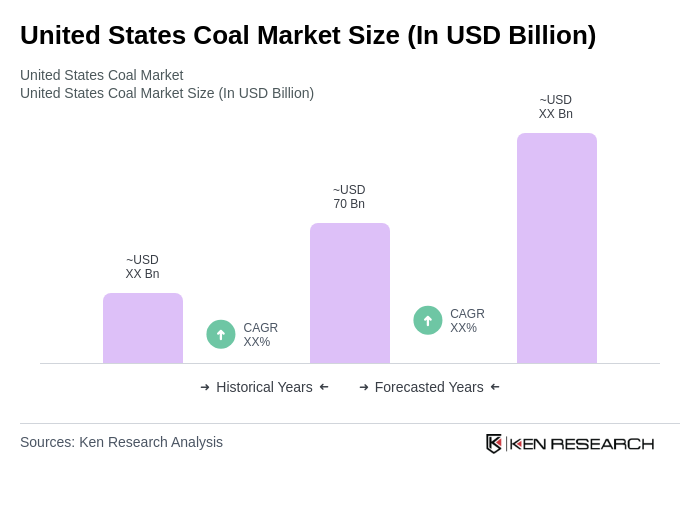
- The United States Coal Market is valued at USD 70 billion, based on a five-year historical analysis. This value reflects demand from electricity generation and industrial uses, alongside sustained demand for metallurgical coal in steelmaking . The market has experienced volatility due to fuel price competition with natural gas and renewables, environmental regulations, and shifts in utility generation mix .
- Key production regions include the Appalachian region (noted for higher-energy bituminous coal), the Illinois Basin (high-sulfur bituminous), and the Powder River Basin (low-sulfur, low-cost subbituminous), which dominate due to scale, rail access, and long-established mining infrastructure .
- In 2023, the Environmental Protection Agency advanced stricter Clean Air Act standards affecting coal-fired plants, including updated limits on pollutants and greenhouse gases, which are influencing coal generation economics and dispatch patterns .
United States Coal Market Segmentation
By Type:The coal market can be segmented into various types, including Bituminous Coal, Sub-Bituminous Coal, Lignite, Anthracite, and Metallurgical (Coking) Coal. Each type serves different industrial needs. Bituminous and subbituminous coals are the primary fuels for U.S. power generation, while metallurgical coal is essential for blast-furnace steel production; lignite is used in a limited number of mine-mouth power plants; anthracite is used in niche industrial and heating applications .

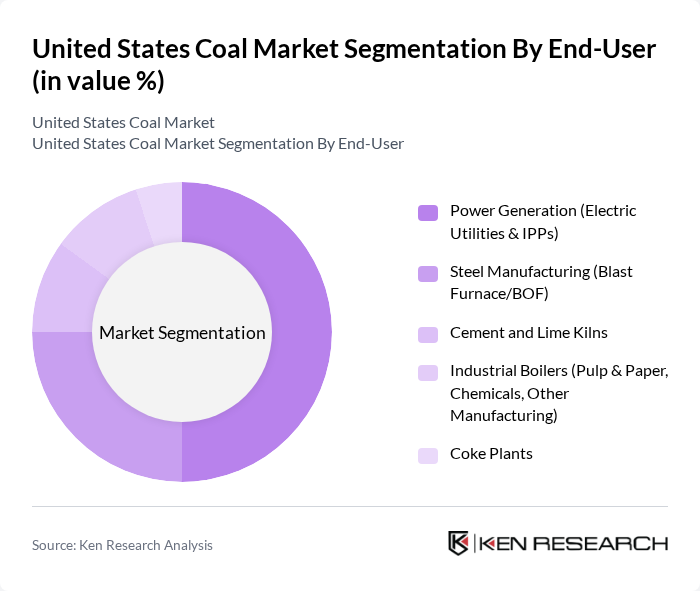
By End-User:The end-user segmentation includes Power Generation (Electric Utilities & IPPs), Steel Manufacturing (Blast Furnace/BOF), Cement and Lime Kilns, Industrial Boilers (Pulp & Paper, Chemicals, Other Manufacturing), and Coke Plants. Power generation remains the largest consumer of coal in the U.S., with the electric power sector typically accounting for the vast majority of domestic coal consumption in recent quarters .
United States Coal Market Competitive Landscape
The United States Coal Market is characterized by a dynamic mix of regional and international players. Leading participants such as Peabody Energy Corporation, Arch Resources, Inc., CONSOL Energy Inc., Alliance Resource Partners, L.P., Warrior Met Coal, Inc., Ramaco Resources, Inc., Alpha Metallurgical Resources, Inc., Corsa Coal Corp., Coronado Global Resources Inc., American Consolidated Natural Resources Inc. (formerly Murray Energy), Westmoreland Mining LLC, Signal Peak Energy, LLC, Navajo Transitional Energy Company (NTEC), Foresight Energy, LP, Hallador Energy Company contribute to innovation, geographic expansion, and service delivery in this space.
United States Coal Market Industry Analysis
Growth Drivers
- Increased Energy Demand:The U.S. coal market is bolstered by a projected energy demand increase of 1.5% annually, driven by population growth and industrial expansion. The U.S. Energy Information Administration (EIA) anticipates that electricity consumption will rise to 4,200 billion kilowatt-hours in future. This surge in demand is expected to maintain coal's role in energy generation, particularly in states like Wyoming and West Virginia, where coal remains a primary energy source, contributing significantly to local economies.
- Export Opportunities:The U.S. coal export market is projected to reach 100 million short tons in future, driven by increasing demand from Asia, particularly China and India. The U.S. Geological Survey reported that coal exports rose by 20% in 2023, highlighting the potential for further growth. This trend is supported by favorable trade agreements and the need for energy security in importing countries, positioning the U.S. as a key player in the global coal market.
- Technological Advancements in Mining:Innovations in mining technology are enhancing productivity and safety, with investments in automation expected to exceed $2 billion in future. The National Mining Association reports that advanced techniques, such as remote monitoring and automated machinery, have increased coal extraction efficiency by 15%. These advancements not only reduce operational costs but also improve environmental compliance, making coal production more sustainable and competitive in the energy market.
Market Challenges
- Environmental Regulations:The coal industry faces stringent environmental regulations, particularly under the Clean Air Act, which mandates reductions in sulfur dioxide and nitrogen oxides emissions. Compliance costs are projected to reach $1.5 billion annually in future, impacting profitability. Additionally, states are implementing their own regulations, further complicating operational frameworks and increasing the financial burden on coal producers, which may hinder growth prospects in the sector.
- Competition from Renewable Energy:The rise of renewable energy sources, particularly solar and wind, poses a significant challenge to the coal market. In 2023, renewable energy accounted for 25% of the U.S. electricity generation mix, with projections indicating a rise to 30% in future. This shift is driven by declining costs and government incentives for clean energy, which threaten coal's market share and compel coal producers to adapt or face declining demand.
United States Coal Market Future Outlook
The future of the U.S. coal market is shaped by a complex interplay of demand dynamics and regulatory pressures. While energy demand is expected to rise, the coal industry must navigate stringent environmental regulations and increasing competition from renewables. However, advancements in clean coal technologies and potential international market expansion present avenues for growth. Strategic partnerships and investments in sustainable practices will be crucial for coal producers to remain competitive and relevant in the evolving energy landscape.
Market Opportunities
- Carbon Capture Technologies:The development of carbon capture and storage (CCS) technologies presents a significant opportunity for the coal industry. With investments projected to reach $1 billion in future, CCS can reduce emissions by up to 90%, making coal a more viable option in a carbon-constrained world. This technology not only enhances coal's sustainability but also aligns with global climate goals, potentially opening new markets for coal-based energy.
- International Market Expansion:Expanding into emerging markets, particularly in Southeast Asia and Africa, offers substantial growth potential for U.S. coal producers. With demand for energy expected to increase by 3% annually in these regions, U.S. coal exports could significantly benefit. Strategic partnerships with local governments and energy companies can facilitate market entry, allowing U.S. producers to capitalize on the growing need for reliable energy sources in developing economies.
Scope of the Report
| Segment | Sub-Segments |
|---|---|
| By Type | Bituminous Coal Sub-Bituminous Coal Lignite Anthracite Metallurgical (Coking) Coal |
| By End-User | Power Generation (Electric Utilities & IPPs) Steel Manufacturing (Blast Furnace/BOF) Cement and Lime Kilns Industrial Boilers (Pulp & Paper, Chemicals, Other Manufacturing) Coke Plants |
| By Application | Electricity Generation Metallurgy (Coke Making, Ironmaking) Industrial Process Heat Coal Exports (Thermal and Met Coal) |
| By Distribution Channel | Direct Offtake Contracts (Utility/Industrial) Traders and Brokers Rail and Barge Logistics Providers Export Terminals (Seaborne) |
| By Region | Appalachian Region Illinois Basin Powder River Basin Uinta Basin and Western Interior |
| By Quality | Thermal Coal (Steam Coal) Metallurgical Coal (Hard, PCI, Semi-soft) Low-Sulfur vs High-Sulfur Grades |
| By Policy Impact | Emissions Standards (MATS, NSPS) Mine Reclamation and Land Permitting (SMCRA) Federal Tax and IRA-Related Impacts |
Key Target Audience
Investors and Venture Capitalist Firms
Government and Regulatory Bodies (e.g., U.S. Department of Energy, U.S. Environmental Protection Agency)
Coal Mining Companies
Energy Utility Companies
Coal Transportation and Logistics Firms
Environmental Advocacy Groups
Energy Policy Makers
Commodity Traders and Brokers
Players Mentioned in the Report:
Peabody Energy Corporation
Arch Resources, Inc.
CONSOL Energy Inc.
Alliance Resource Partners, L.P.
Warrior Met Coal, Inc.
Ramaco Resources, Inc.
Alpha Metallurgical Resources, Inc.
Corsa Coal Corp.
Coronado Global Resources Inc.
American Consolidated Natural Resources Inc. (formerly Murray Energy)
Westmoreland Mining LLC
Signal Peak Energy, LLC
Navajo Transitional Energy Company (NTEC)
Foresight Energy, LP
Hallador Energy Company
Table of Contents
Market Assessment Phase
1. Executive Summary and Approach
2. United States Coal Market Overview
2.1 Key Insights and Strategic Recommendations
2.2 United States Coal Market Overview
2.3 Definition and Scope
2.4 Evolution of Market Ecosystem
2.5 Timeline of Key Regulatory Milestones
2.6 Value Chain & Stakeholder Mapping
2.7 Business Cycle Analysis
2.8 Policy & Incentive Landscape
3. United States Coal Market Analysis
3.1 Growth Drivers
3.1.1 Increased Energy Demand
3.1.2 Export Opportunities
3.1.3 Technological Advancements in Mining
3.1.4 Government Support for Coal Industry
3.2 Market Challenges
3.2.1 Environmental Regulations
3.2.2 Competition from Renewable Energy
3.2.3 Declining Domestic Demand
3.2.4 Market Volatility
3.3 Market Opportunities
3.3.1 Carbon Capture Technologies
3.3.2 International Market Expansion
3.3.3 Strategic Partnerships
3.3.4 Diversification into By-Products
3.4 Market Trends
3.4.1 Shift Towards Cleaner Coal Technologies
3.4.2 Increased Automation in Mining
3.4.3 Focus on Sustainability Practices
3.4.4 Rising Coal Prices
3.5 Government Regulation
3.5.1 Clean Air Act Compliance
3.5.2 Surface Mining Control and Reclamation Act
3.5.3 Coal Ash Management Regulations
3.5.4 Federal and State Tax Incentives
4. SWOT Analysis
5. Stakeholder Analysis
6. Porter's Five Forces Analysis
7. United States Coal Market Market Size, 2019-2024
7.1 By Value
7.2 By Volume
7.3 By Average Selling Price
8. United States Coal Market Segmentation
8.1 By Type
8.1.1 Bituminous Coal
8.1.2 Sub-Bituminous Coal
8.1.3 Lignite
8.1.4 Anthracite
8.1.5 Metallurgical (Coking) Coal
8.2 By End-User
8.2.1 Power Generation (Electric Utilities & IPPs)
8.2.2 Steel Manufacturing (Blast Furnace/BOF)
8.2.3 Cement and Lime Kilns
8.2.4 Industrial Boilers (Pulp & Paper, Chemicals, Other Manufacturing)
8.2.5 Coke Plants
8.3 By Application
8.3.1 Electricity Generation
8.3.2 Metallurgy (Coke Making, Ironmaking)
8.3.3 Industrial Process Heat
8.3.4 Coal Exports (Thermal and Met Coal)
8.4 By Distribution Channel
8.4.1 Direct Offtake Contracts (Utility/Industrial)
8.4.2 Traders and Brokers
8.4.3 Rail and Barge Logistics Providers
8.4.4 Export Terminals (Seaborne)
8.5 By Region
8.5.1 Appalachian Region
8.5.2 Illinois Basin
8.5.3 Powder River Basin
8.5.4 Uinta Basin and Western Interior
8.6 By Quality
8.6.1 Thermal Coal (Steam Coal)
8.6.2 Metallurgical Coal (Hard, PCI, Semi-soft)
8.6.3 Low-Sulfur vs High-Sulfur Grades
8.7 By Policy Impact
8.7.1 Emissions Standards (MATS, NSPS)
8.7.2 Mine Reclamation and Land Permitting (SMCRA)
8.7.3 Federal Tax and IRA-Related Impacts
9. United States Coal Market Competitive Analysis
9.1 Market Share of Key Players
9.2 Cross Comparison of Key Players
9.2.1 Company Name
9.2.2 Group Size (Large, Medium, or Small as per industry convention)
9.2.3 U.S. Coal Sales Volume (MMst, latest FY)
9.2.4 Metallurgical vs Thermal Mix (% of sales)
9.2.5 Average Realized Coal Price (USD/ton, thermal; met)
9.2.6 Production Capacity (MMst/year)
9.2.7 Reserve Life (years at current production)
9.2.8 EBITDA Margin (%)
9.2.9 Export Share of Shipments (%)
9.2.10 Contract Coverage (forward sales hedged, % of next 12 months)
9.2.11 Safety Performance (TRIR/MSHA citations)
9.2.12 ESG/Compliance (methane abatement, MATS/CCR adherence)
9.2.13 Logistics Footprint (owned rail/barges/port access)
9.3 SWOT Analysis of Top Players
9.4 Pricing Analysis
9.5 Detailed Profile of Major Companies
9.5.1 Peabody Energy Corporation
9.5.2 Arch Resources, Inc.
9.5.3 CONSOL Energy Inc.
9.5.4 Alliance Resource Partners, L.P.
9.5.5 Warrior Met Coal, Inc.
9.5.6 Ramaco Resources, Inc.
9.5.7 Alpha Metallurgical Resources, Inc.
9.5.8 Corsa Coal Corp.
9.5.9 Coronado Global Resources Inc.
9.5.10 American Consolidated Natural Resources Inc. (formerly Murray Energy)
9.5.11 Westmoreland Mining LLC
9.5.12 Signal Peak Energy, LLC
9.5.13 Navajo Transitional Energy Company (NTEC)
9.5.14 Foresight Energy, LP
9.5.15 Hallador Energy Company
10. United States Coal Market End-User Analysis
10.1 Procurement Behavior of Key Ministries
10.1.1 Federal Energy Procurement Strategies
10.1.2 State-Level Coal Procurement Policies
10.1.3 Budget Allocations for Coal Projects
10.2 Corporate Spend on Infrastructure & Energy
10.2.1 Investment in Coal Infrastructure
10.2.2 Energy Procurement Trends
10.2.3 Budgeting for Coal Supply Contracts
10.3 Pain Point Analysis by End-User Category
10.3.1 Cost Management Challenges
10.3.2 Regulatory Compliance Issues
10.3.3 Supply Chain Disruptions
10.4 User Readiness for Adoption
10.4.1 Adoption of Cleaner Coal Technologies
10.4.2 Training and Skill Development Needs
10.5 Post-Deployment ROI and Use Case Expansion
10.5.1 Measuring ROI from Coal Investments
10.5.2 Expansion into New Applications
11. United States Coal Market Future Size, 2025-2030
11.1 By Value
11.2 By Volume
11.3 By Average Selling Price
Go-To-Market Strategy Phase
1. Whitespace Analysis + Business Model Canvas
1.1 Identification of Market Gaps
1.2 Business Model Development
2. Marketing and Positioning Recommendations
2.1 Branding Strategies
2.2 Product USPs
3. Distribution Plan
3.1 Urban Retail Strategies
3.2 Rural NGO Tie-Ups
4. Channel & Pricing Gaps
4.1 Underserved Routes
4.2 Pricing Bands
5. Unmet Demand & Latent Needs
5.1 Category Gaps
5.2 Consumer Segments
6. Customer Relationship
6.1 Loyalty Programs
6.2 After-Sales Service
7. Value Proposition
7.1 Sustainability Initiatives
7.2 Integrated Supply Chains
8. Key Activities
8.1 Regulatory Compliance
8.2 Branding Efforts
8.3 Distribution Setup
9. Entry Strategy Evaluation
9.1 Domestic Market Entry Strategy
9.1.1 Product Mix Considerations
9.1.2 Pricing Band Analysis
9.1.3 Packaging Strategies
9.2 Export Entry Strategy
9.2.1 Target Countries
9.2.2 Compliance Roadmap
10. Entry Mode Assessment
10.1 Joint Ventures
10.2 Greenfield Investments
10.3 Mergers & Acquisitions
10.4 Distributor Model
11. Capital and Timeline Estimation
11.1 Capital Requirements
11.2 Timelines for Market Entry
12. Control vs Risk Trade-Off
12.1 Ownership vs Partnerships
13. Profitability Outlook
13.1 Breakeven Analysis
13.2 Long-Term Sustainability
14. Potential Partner List
14.1 Distributors
14.2 Joint Ventures
14.3 Acquisition Targets
15. Execution Roadmap
15.1 Phased Plan for Market Entry
15.1.1 Market Setup
15.1.2 Market Entry
15.1.3 Growth Acceleration
15.1.4 Scale & Stabilize
15.2 Key Activities and Milestones
15.2.1 Milestone Planning
Research Methodology
Phase 1: Approach1
Desk Research
- Analysis of coal production and consumption data from the U.S. Energy Information Administration (EIA)
- Review of industry reports and publications from the National Mining Association and other relevant organizations
- Examination of regulatory frameworks and policies impacting the coal market from the Environmental Protection Agency (EPA)
Primary Research
- Interviews with executives from major coal mining companies to gather insights on production strategies
- Surveys with energy analysts and market experts to understand demand trends and pricing dynamics
- Field interviews with coal transportation and logistics managers to assess supply chain challenges
Validation & Triangulation
- Cross-validation of data through multiple sources including government reports and industry publications
- Triangulation of findings from primary interviews with secondary data to ensure consistency
- Sanity checks through expert panel reviews comprising industry veterans and academic researchers
Phase 2: Market Size Estimation1
Top-down Assessment
- Estimation of total coal market size based on national energy consumption statistics
- Segmentation of market size by coal type (thermal, metallurgical) and end-use sectors (power generation, steel production)
- Incorporation of state-level regulations and their impact on coal demand and supply
Bottom-up Modeling
- Collection of production data from leading coal mines to establish baseline output levels
- Operational cost analysis based on mining, transportation, and processing expenses
- Volume and pricing analysis to derive revenue estimates for different coal segments
Forecasting & Scenario Analysis
- Multi-factor regression analysis incorporating variables such as natural gas prices, renewable energy adoption, and regulatory changes
- Scenario modeling based on potential shifts in energy policy and market demand through 2030
- Development of baseline, optimistic, and pessimistic forecasts to capture market volatility
Phase 3: CATI Sample Composition1
| Scope Item/Segment | Sample Size | Target Respondent Profiles |
|---|---|---|
| Coal Mining Operations | 120 | Mine Managers, Operations Directors |
| Energy Sector Coal Consumption | 90 | Energy Analysts, Utility Executives |
| Coal Transportation Logistics | 70 | Logistics Coordinators, Supply Chain Managers |
| Regulatory Impact Assessment | 60 | Policy Makers, Environmental Consultants |
| Coal Market Investment Insights | 80 | Investment Analysts, Financial Advisors |
Frequently Asked Questions
What is the current value of the United States coal market?
The United States coal market is valued at approximately USD 70 billion, reflecting demand primarily from electricity generation and industrial uses, alongside a sustained need for metallurgical coal in steelmaking.
What are the main production regions for coal in the U.S.?
How do environmental regulations impact the coal market?
What types of coal are produced in the United States?
Other Regional/Country Reports
Malaysia Coal Market
KSA Coal Market
APAC Coal Market
SEA Coal Market
Why Buy From Us?

What makes us stand out is that our consultants follow Robust, Refine and Result (RRR) methodology. Robust for clear definitions, approaches and sanity checking, Refine for differentiating respondents' facts and opinions, and Result for presenting data with story.

We have set a benchmark in the industry by offering our clients with syndicated and customized market research reports featuring coverage of entire market as well as meticulous research and analyst insights.

While we don't replace traditional research, we flip the method upside down. Our dual approach of Top Bottom & Bottom Top ensures quality deliverable by not just verifying company fundamentals but also looking at the sector and macroeconomic factors.

With one step in the future, our research team constantly tries to show you the bigger picture. We help with some of the tough questions you may encounter along the way: How is the industry positioned? Best marketing channel? KPI's of competitors? By aligning every element, we help maximize success.

Our report gives you instant access to the answers and sources that other companies might choose to hide. We elaborate each steps of research methodology we have used and showcase you the sample size to earn your trust.

If you need any support, we are here! We pride ourselves on universe strength, data quality, and quick, friendly, and professional service.