Region:North America
Author(s):Rebecca
Product Code:KRAA4614
Pages:88
Published On:September 2025
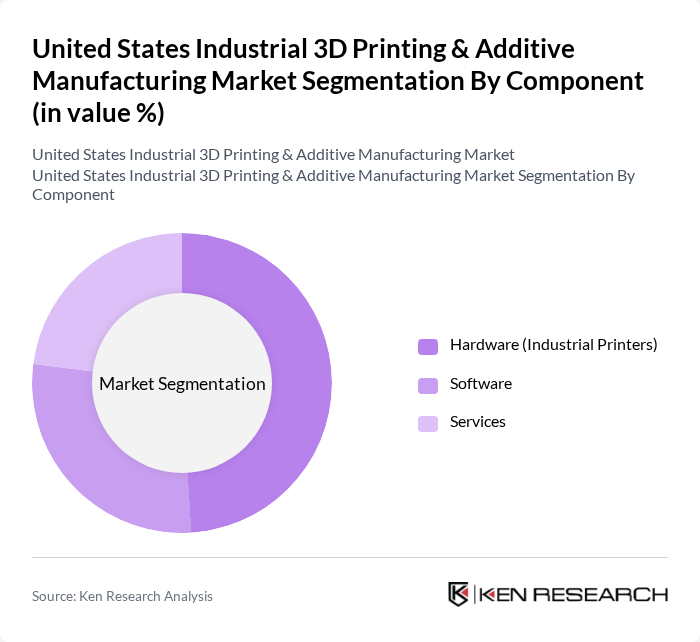
By Component:The market is segmented into Hardware (Industrial Printers), Software, and Services. Hardware, particularly industrial printers, is the leading segment due to the increasing demand for high-quality and efficient printing solutions. Software solutions are gaining traction as they enhance the functionality and usability of 3D printers, while services are essential for maintenance and support. The hardware segment accounts for the largest share, reflecting the industry’s focus on scaling up production capacity and integrating advanced printer models for industrial applications.
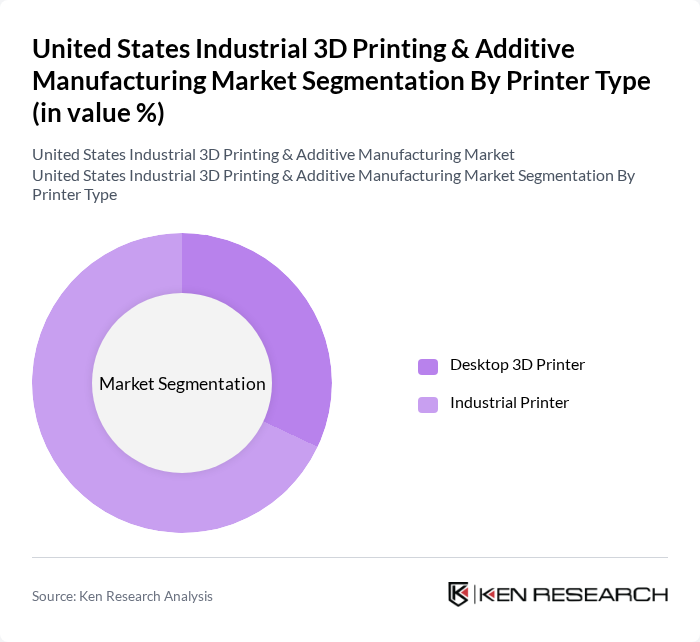
By Printer Type:The market is divided into Desktop 3D Printers and Industrial Printers. Industrial printers dominate the market due to their ability to produce high-volume, high-quality parts for various applications, including aerospace and automotive. Desktop printers are popular among hobbyists and small businesses, but their market share is significantly lower compared to industrial counterparts. Industrial printers are increasingly integrated into large-scale production lines, supporting cost-effective and on-demand manufacturing.
The United States Industrial 3D Printing & Additive Manufacturing Market is characterized by a dynamic mix of regional and international players. Leading participants such as Stratasys Ltd., 3D Systems Corporation, HP Inc., GE Additive, EOS GmbH, Materialise NV, Renishaw plc, SLM Solutions Group AG, Desktop Metal, Inc., Formlabs, Inc., Xometry, Inc., Carbon, Inc., Ultimaker B.V., Markforged, Inc., Arcam AB, Protolabs, Inc., Velo3D, Inc., ExOne Company, 3D Hubs (now part of Protolabs), BCN3D Technologies contribute to innovation, geographic expansion, and service delivery in this space.
The future of the U.S. industrial 3D printing market appears promising, driven by technological advancements and increasing integration with digital technologies. As companies continue to innovate, the adoption of 3D printing is expected to expand across various sectors, including aerospace and healthcare. Furthermore, the focus on sustainability will likely lead to the development of eco-friendly materials and processes, enhancing the industry's appeal. Overall, the market is poised for significant growth as it adapts to evolving consumer demands and technological capabilities.
| Segment | Sub-Segments |
|---|---|
| By Component | Hardware (Industrial Printers) Software Services |
| By Printer Type | Desktop 3D Printer Industrial Printer |
| By Technology | Stereolithography (SLA) Fused Deposition Modeling (FDM) Selective Laser Sintering (SLS) Direct Metal Laser Sintering (DMLS) PolyJet Printing Electron Beam Melting (EBM) Digital Light Processing (DLP) Others |
| By Material | Polymer Metal Ceramic Composite Others |
| By Process | Binder Jetting Material Extrusion Material Jetting Powder Bed Fusion Vat Photopolymerization Others |
| By Application | Prototyping Tooling Production Parts Customization Others |
| By Industry Vertical | Aerospace & Defense Automotive Healthcare Consumer Electronics Education Power & Energy Others |
| By Region | New England Mideast Great Lakes Plains Southeast Southwest Rocky Mountain Far West Others |
| Scope Item/Segment | Sample Size | Target Respondent Profiles |
|---|---|---|
| Aerospace Additive Manufacturing | 100 | Manufacturing Engineers, Production Managers |
| Healthcare 3D Printing Applications | 80 | Medical Device Developers, Hospital Procurement Officers |
| Automotive Parts Production | 90 | Supply Chain Managers, Design Engineers |
| Consumer Goods Prototyping | 60 | Product Development Managers, Marketing Directors |
| Industrial Equipment Manufacturing | 50 | Operations Managers, Quality Assurance Specialists |
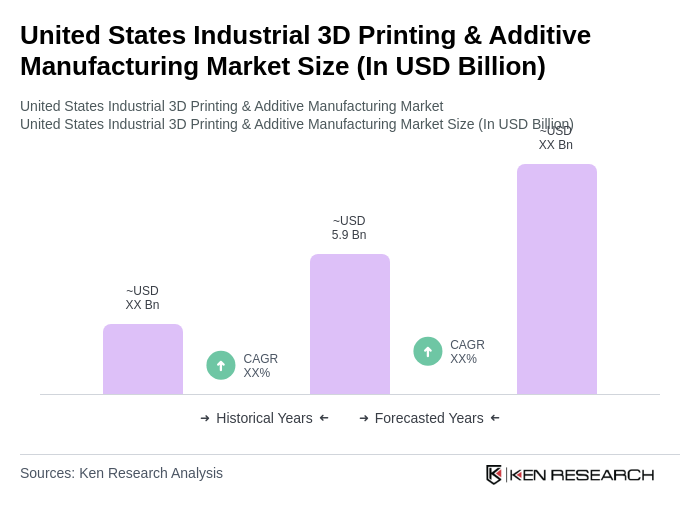
The United States Industrial 3D Printing & Additive Manufacturing Market is valued at approximately USD 5.9 billion, reflecting significant growth driven by advancements in technology and increased adoption across various industries such as automotive, aerospace, and healthcare.

What makes us stand out is that our consultants follow Robust, Refine and Result (RRR) methodology. Robust for clear definitions, approaches and sanity checking, Refine for differentiating respondents' facts and opinions, and Result for presenting data with story.

We have set a benchmark in the industry by offering our clients with syndicated and customized market research reports featuring coverage of entire market as well as meticulous research and analyst insights.

While we don't replace traditional research, we flip the method upside down. Our dual approach of Top Bottom & Bottom Top ensures quality deliverable by not just verifying company fundamentals but also looking at the sector and macroeconomic factors.

With one step in the future, our research team constantly tries to show you the bigger picture. We help with some of the tough questions you may encounter along the way: How is the industry positioned? Best marketing channel? KPI's of competitors? By aligning every element, we help maximize success.

Our report gives you instant access to the answers and sources that other companies might choose to hide. We elaborate each steps of research methodology we have used and showcase you the sample size to earn your trust.

If you need any support, we are here! We pride ourselves on universe strength, data quality, and quick, friendly, and professional service.













