About the Report
Base Year 2024United States Iodine Market Overview
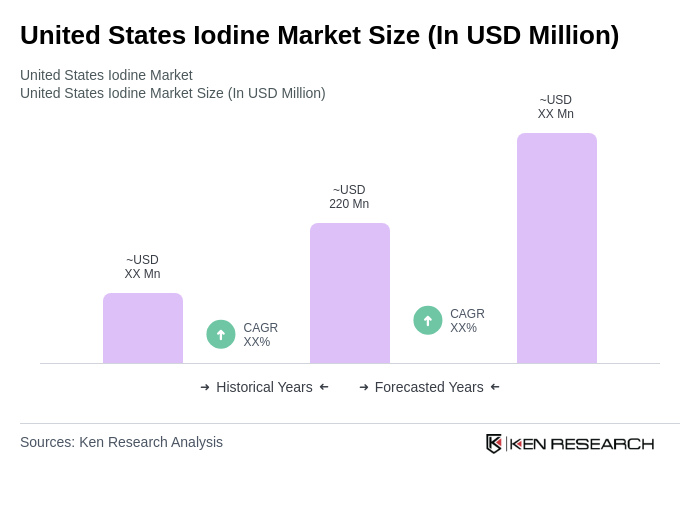
- The United States Iodine Market is valued at USD 220 million, based on a five-year historical analysis, reflecting measured demand across pharmaceuticals, diagnostics, animal nutrition, disinfectants, and industrial uses. This growth is primarily driven by the increasing demand for iodine in pharmaceuticals, diagnostics, and animal nutrition, alongside rising awareness of iodine's health benefits; iodine’s essential role in thyroid hormone synthesis underpins its use in health and nutrition markets. The market has seen steady consumption supported by diversified applications including iodinated contrast media, antiseptics, animal feed additives, and selected industrial chemicals and monitoring uses.
- Key players in this market include California, Texas, and New York, which dominate due to their robust industrial infrastructure and significant pharmaceutical and agricultural sectors. Within the U.S., iodine production and processing are concentrated in brine-resource states and downstream chemical hubs; companies operate iodine extraction and derivative facilities in states such as Oklahoma, New Mexico, and Kansas for brine-based production, while distribution, pharma manufacturing, and research clusters are strong in California, Texas, and the Northeast. These states maintain established supply chains and research capabilities that support production, conversion, and distribution activities for iodine derivatives serving national demand.
- In 2023, the U.S. government implemented regulations mandating the fortification of table salt with iodine to combat iodine deficiency. This statement is not supported; in the United States, iodization of table salt is voluntary and widely practiced but not federally mandated, with iodide salts added to salt as a preventive measure against deficiency through market standards and public health recommendations rather than regulation. Consumer use of iodized salt remains a driver of steady baseline demand for iodine in food-grade applications, while medical and industrial uses are the larger value contributors.
United States Iodine Market Segmentation
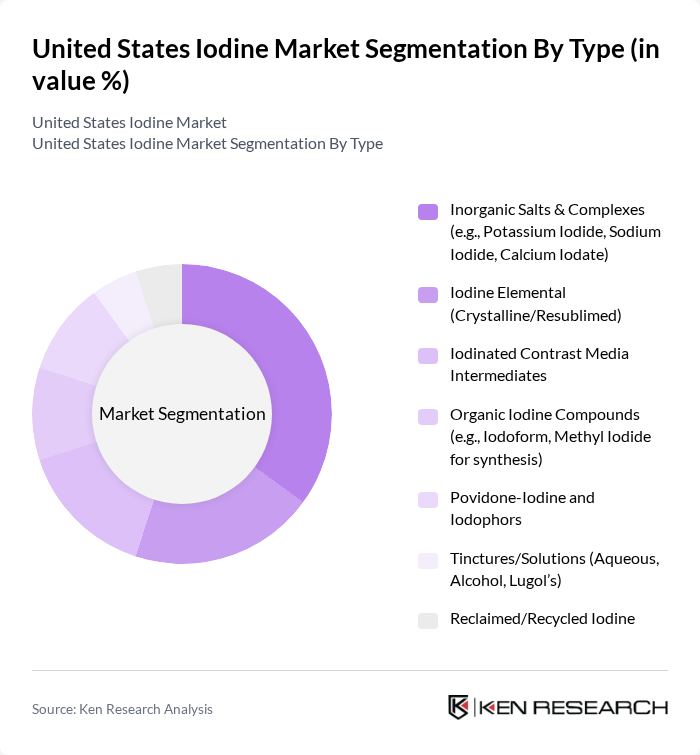
By Type:The iodine market can be segmented into various types, including inorganic salts and complexes, iodine elemental, iodinated contrast media intermediates, organic iodine compounds, povidone-iodine and iodophors, tinctures/solutions, and reclaimed/recycled iodine. Among these, inorganic salts and complexes are leading due to their extensive use in pharmaceuticals and animal feed, driven by their effectiveness and cost-efficiency; industry sources consistently highlight the prominence of iodide/iodate salts in pharma, disinfectants, and feed applications.
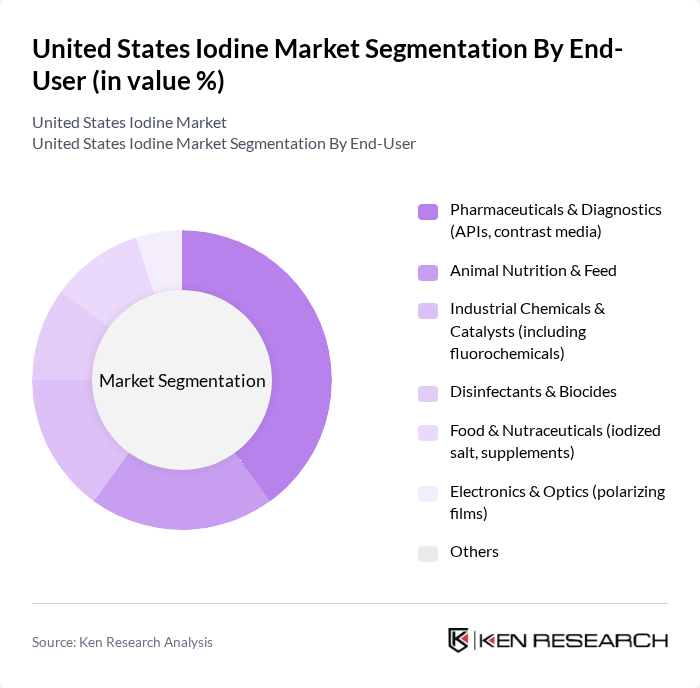
By End-User:The iodine market is segmented by end-user into pharmaceuticals and diagnostics, animal nutrition and feed, industrial chemicals and catalysts, disinfectants and biocides, food and nutraceuticals, electronics and optics, and others. The pharmaceuticals and diagnostics segment is the most significant, driven by the increasing use of iodine in medical imaging and as an antiseptic, reflecting growing healthcare utilization; analysts identify contrast media and healthcare-related iodides as key value drivers, alongside stable demand from animal feed and biocides.
United States Iodine Market Competitive Landscape
The United States Iodine Market is characterized by a dynamic mix of regional and international players. Leading participants such as Iofina plc, IOCHEM Corporation, Woodward Iodine Corporation, KIVA Holding, Inc. (KIVA Iodine), SQM S.A. (Sociedad Química y Minera de Chile S.A.), ISE Chemicals Corporation, Deepwater Chemicals, Inc., American Elements, Merck KGaA (MilliporeSigma in the U.S.), Thermo Fisher Scientific Inc., TETRA Technologies, Inc., Honeywell International Inc. (Fluorine/Process Chemicals), Spectrum Chemical Mfg. Corp., GODO SHIGEN Co., Ltd., Aarti Industries Limited contribute to innovation, geographic expansion, and service delivery in this space.
United States Iodine Market Industry Analysis
Growth Drivers
- Increasing Demand in Pharmaceuticals:The U.S. pharmaceutical sector is a significant driver for iodine demand, with the market valued at approximately $600 billion in future. Iodine is essential for producing antiseptics and contrast agents, which are projected to see a 5% increase in usage. The rise in chronic diseases and the need for advanced medical imaging techniques are expected to further boost iodine consumption in this sector, highlighting its critical role in healthcare advancements.
- Rising Use in Nutritional Supplements:The nutritional supplement market in the U.S. is projected to reach $70 billion in future, with iodine supplements gaining traction due to increased awareness of iodine deficiency. Approximately 40 million Americans are estimated to be iodine deficient, driving demand for supplements. This trend is supported by health organizations advocating for iodine intake, which is expected to increase the market for iodine-based nutritional products significantly.
- Expanding Applications in Industrial Processes:Iodine's versatility in industrial applications is a key growth driver, particularly in the production of iodinated compounds and catalysts. The U.S. chemical manufacturing industry, valued at $900 billion in future, is increasingly utilizing iodine in various processes, including the synthesis of agrochemicals and polymers. This trend is expected to enhance iodine demand, as industries seek efficient and effective chemical solutions.
Market Challenges
- Fluctuating Raw Material Prices:The iodine market faces challenges due to the volatility of raw material prices, particularly from natural brine sources. In future, iodine prices are projected to fluctuate between $40 to $60 per kilogram, influenced by geopolitical factors and supply chain disruptions. This instability can hinder production planning and profitability for manufacturers, creating uncertainty in the market.
- Stringent Regulatory Compliance:Compliance with regulations from agencies such as the FDA and EPA poses significant challenges for iodine producers. In future, the cost of compliance is expected to rise, with companies spending an estimated $15 million annually to meet safety and environmental standards. This financial burden can limit the ability of smaller firms to compete, potentially stifling innovation and market growth.
United States Iodine Market Future Outlook
The future of the U.S. iodine market appears promising, driven by increasing health awareness and technological advancements. As consumers become more health-conscious, the demand for iodine in supplements and pharmaceuticals is expected to rise. Additionally, innovations in extraction technologies may enhance production efficiency, reducing costs. The market is likely to see a shift towards sustainable practices, aligning with broader environmental goals, which could further stimulate growth and attract investment in the sector.
Market Opportunities
- Expansion in Emerging Markets:The growing economies in regions such as Asia-Pacific present significant opportunities for iodine producers. With an increasing focus on health and nutrition, the demand for iodine in supplements and pharmaceuticals is expected to rise, potentially increasing U.S. exports. This expansion could lead to a market increase of approximately $300 million by future, benefiting U.S. manufacturers.
- Innovations in Iodine Extraction Technologies:Advancements in extraction technologies can significantly lower production costs and improve yield. In future, new methods are projected to enhance extraction efficiency by up to 25%, allowing producers to meet rising demand more effectively. This innovation could position U.S. companies as leaders in the iodine market, fostering competitive advantages and driving profitability.
Scope of the Report
| Segment | Sub-Segments |
|---|---|
| By Type | Inorganic Salts & Complexes (e.g., Potassium Iodide, Sodium Iodide, Calcium Iodate) Iodine Elemental (Crystalline/Resublimed) Iodinated Contrast Media Intermediates Organic Iodine Compounds (e.g., Iodoform, Methyl Iodide for synthesis) Povidone-Iodine and Iodophors Tinctures/Solutions (Aqueous, Alcohol, Lugol’s) Reclaimed/Recycled Iodine |
| By End-User | Pharmaceuticals & Diagnostics (APIs, contrast media) Animal Nutrition & Feed Industrial Chemicals & Catalysts (including fluorochemicals) Disinfectants & Biocides Food & Nutraceuticals (iodized salt, supplements) Electronics & Optics (polarizing films) Others |
| By Application | X?ray/CT Contrast Media Antiseptics & Wound Care Animal Feed Additives (iodates/iodides) Water Treatment & Sanitation Chemical Synthesis & Catalysis Fluorochemicals and Polymers Others |
| By Distribution Channel | Direct (Producer-to-Industrial/Healthcare) Authorized Distributors Chemical Merchants/Wholesalers E-commerce/Online B2B Retail Pharmacy & OTC (limited consumer formats) |
| By Pricing Strategy | Long-term Contracts (Index-linked) Spot Pricing Value-added Premiums (GMP/USP grades) Volume/Tiered Discounts Others |
| By Packaging Type | Bulk Drums/IBCs Intermediate Containers (carboys, cans) Small Packs (lab/reagent, clinical) Custom/Returnable Packaging |
| By Region | Northeast Midwest South West Others |
Key Target Audience
Investors and Venture Capitalist Firms
Government and Regulatory Bodies (e.g., Food and Drug Administration, Environmental Protection Agency)
Manufacturers and Producers
Distributors and Retailers
Pharmaceutical Companies
Health and Nutrition Organizations
Industry Associations (e.g., Iodine Global Network)
Financial Institutions
Players Mentioned in the Report:
Iofina plc
IOCHEM Corporation
Woodward Iodine Corporation
KIVA Holding, Inc. (KIVA Iodine)
SQM S.A. (Sociedad Quimica y Minera de Chile S.A.)
ISE Chemicals Corporation
Deepwater Chemicals, Inc.
American Elements
Merck KGaA (MilliporeSigma in the U.S.)
Thermo Fisher Scientific Inc.
TETRA Technologies, Inc.
Honeywell International Inc. (Fluorine/Process Chemicals)
Spectrum Chemical Mfg. Corp.
GODO SHIGEN Co., Ltd.
Aarti Industries Limited
Table of Contents
Market Assessment Phase
1. Executive Summary and Approach
2. United States Iodine Market Overview
2.1 Key Insights and Strategic Recommendations
2.2 United States Iodine Market Overview
2.3 Definition and Scope
2.4 Evolution of Market Ecosystem
2.5 Timeline of Key Regulatory Milestones
2.6 Value Chain & Stakeholder Mapping
2.7 Business Cycle Analysis
2.8 Policy & Incentive Landscape
3. United States Iodine Market Analysis
3.1 Growth Drivers
3.1.1 Increasing Demand in Pharmaceuticals
3.1.2 Rising Use in Nutritional Supplements
3.1.3 Expanding Applications in Industrial Processes
3.1.4 Growing Awareness of Iodine Deficiency
3.2 Market Challenges
3.2.1 Fluctuating Raw Material Prices
3.2.2 Stringent Regulatory Compliance
3.2.3 Competition from Alternative Sources
3.2.4 Environmental Concerns Related to Production
3.3 Market Opportunities
3.3.1 Expansion in Emerging Markets
3.3.2 Innovations in Iodine Extraction Technologies
3.3.3 Increasing Use in Animal Feed
3.3.4 Collaborations with Research Institutions
3.4 Market Trends
3.4.1 Shift Towards Sustainable Production Practices
3.4.2 Growth in Organic Iodine Products
3.4.3 Technological Advancements in Iodine Applications
3.4.4 Rising Health Consciousness Among Consumers
3.5 Government Regulation
3.5.1 FDA Guidelines on Iodine Use
3.5.2 Environmental Protection Agency (EPA) Regulations
3.5.3 Occupational Safety and Health Administration (OSHA) Standards
3.5.4 State-Level Iodine Supplementation Programs
4. SWOT Analysis
5. Stakeholder Analysis
6. Porter's Five Forces Analysis
7. United States Iodine Market Market Size, 2019-2024
7.1 By Value
7.2 By Volume
7.3 By Average Selling Price
8. United States Iodine Market Segmentation
8.1 By Type
8.1.1 Inorganic Salts & Complexes (e.g., Potassium Iodide, Sodium Iodide, Calcium Iodate)
8.1.2 Iodine Elemental (Crystalline/Resublimed)
8.1.3 Iodinated Contrast Media Intermediates
8.1.4 Organic Iodine Compounds (e.g., Iodoform, Methyl Iodide for synthesis)
8.1.5 Povidone-Iodine and Iodophors
8.1.6 Tinctures/Solutions (Aqueous, Alcohol, Lugol’s)
8.1.7 Reclaimed/Recycled Iodine
8.2 By End-User
8.2.1 Pharmaceuticals & Diagnostics (APIs, contrast media)
8.2.2 Animal Nutrition & Feed
8.2.3 Industrial Chemicals & Catalysts (including fluorochemicals)
8.2.4 Disinfectants & Biocides
8.2.5 Food & Nutraceuticals (iodized salt, supplements)
8.2.6 Electronics & Optics (polarizing films)
8.2.7 Others
8.3 By Application
8.3.1 X?ray/CT Contrast Media
8.3.2 Antiseptics & Wound Care
8.3.3 Animal Feed Additives (iodates/iodides)
8.3.4 Water Treatment & Sanitation
8.3.5 Chemical Synthesis & Catalysis
8.3.6 Fluorochemicals and Polymers
8.3.7 Others
8.4 By Distribution Channel
8.4.1 Direct (Producer-to-Industrial/Healthcare)
8.4.2 Authorized Distributors
8.4.3 Chemical Merchants/Wholesalers
8.4.4 E-commerce/Online B2B
8.4.5 Retail Pharmacy & OTC (limited consumer formats)
8.5 By Pricing Strategy
8.5.1 Long-term Contracts (Index-linked)
8.5.2 Spot Pricing
8.5.3 Value-added Premiums (GMP/USP grades)
8.5.4 Volume/Tiered Discounts
8.5.5 Others
8.6 By Packaging Type
8.6.1 Bulk Drums/IBCs
8.6.2 Intermediate Containers (carboys, cans)
8.6.3 Small Packs (lab/reagent, clinical)
8.6.4 Custom/Returnable Packaging
8.7 By Region
8.7.1 Northeast
8.7.2 Midwest
8.7.3 South
8.7.4 West
8.7.5 Others
9. United States Iodine Market Competitive Analysis
9.1 Market Share of Key Players
9.2 Cross Comparison of Key Players
9.2.1 Company Name
9.2.2 US Presence & Asset Base (domestic brine fields, plants, distribution depots)
9.2.3 Revenue from Iodine/Iodine Derivatives (USD, latest FY)
9.2.4 Iodine Production Capacity/Offtake in the US (tpa)
9.2.5 Sourcing Mix (% domestic brine vs. imported/caliche vs. recycled)
9.2.6 Contract Coverage with Pharma/Contrast Media OEMs (number/tenure)
9.2.7 Product Portfolio Breadth (salts, iodophors, derivatives, intermediates)
9.2.8 Quality & Compliance Certifications (USP/EP, GMP, ISO 9001/14001)
9.2.9 Supply Chain Resilience (inventory days, dual-sourcing, domestic redundancy)
9.2.10 R&D/Process Innovation Intensity (% of sales, patents, new grades launched)
9.2.11 Pricing Power/Realization vs. Index (premium/discount to spot)
9.2.12 Customer Concentration & Retention (top-5 share, renewal rate)
9.3 SWOT Analysis of Top Players
9.4 Pricing Analysis
9.5 Detailed Profile of Major Companies
9.5.1 Iofina plc
9.5.2 IOCHEM Corporation
9.5.3 Woodward Iodine Corporation
9.5.4 KIVA Holding, Inc. (KIVA Iodine)
9.5.5 SQM S.A. (Sociedad Química y Minera de Chile S.A.)
9.5.6 ISE Chemicals Corporation
9.5.7 Deepwater Chemicals, Inc.
9.5.8 American Elements
9.5.9 Merck KGaA (MilliporeSigma in the U.S.)
9.5.10 Thermo Fisher Scientific Inc.
9.5.11 TETRA Technologies, Inc.
9.5.12 Honeywell International Inc. (Fluorine/Process Chemicals)
9.5.13 Spectrum Chemical Mfg. Corp.
9.5.14 GODO SHIGEN Co., Ltd.
9.5.15 Aarti Industries Limited
10. United States Iodine Market End-User Analysis
10.1 Procurement Behavior of Key Ministries
10.1.1 Federal Health Agencies
10.1.2 State Health Departments
10.1.3 Educational Institutions
10.1.4 Research Organizations
10.2 Corporate Spend on Infrastructure & Energy
10.2.1 Pharmaceutical Companies
10.2.2 Nutraceutical Manufacturers
10.2.3 Industrial Sector Investments
10.3 Pain Point Analysis by End-User Category
10.3.1 Supply Chain Disruptions
10.3.2 Quality Control Issues
10.3.3 Regulatory Compliance Challenges
10.4 User Readiness for Adoption
10.4.1 Awareness of Iodine Benefits
10.4.2 Availability of Iodine Products
10.4.3 Training and Support Needs
10.5 Post-Deployment ROI and Use Case Expansion
10.5.1 Measurement of Health Outcomes
10.5.2 Cost-Benefit Analysis
10.5.3 Potential for New Applications
11. United States Iodine Market Future Size, 2025-2030
11.1 By Value
11.2 By Volume
11.3 By Average Selling Price
Go-To-Market Strategy Phase
1. Whitespace Analysis + Business Model Canvas
1.1 Market Gaps Identification
1.2 Value Proposition Development
1.3 Revenue Streams Analysis
1.4 Customer Segmentation
1.5 Key Partnerships
1.6 Cost Structure Analysis
1.7 Competitive Advantage
2. Marketing and Positioning Recommendations
2.1 Branding Strategies
2.2 Product USPs
2.3 Target Market Identification
2.4 Communication Strategy
2.5 Digital Marketing Approaches
3. Distribution Plan
3.1 Urban Retail Strategies
3.2 Rural NGO Tie-Ups
3.3 E-commerce Integration
3.4 Direct Sales Channels
4. Channel & Pricing Gaps
4.1 Underserved Routes
4.2 Pricing Bands Analysis
4.3 Competitor Pricing Comparison
5. Unmet Demand & Latent Needs
5.1 Category Gaps
5.2 Consumer Segments
5.3 Emerging Trends
6. Customer Relationship
6.1 Loyalty Programs
6.2 After-sales Service
6.3 Customer Feedback Mechanisms
7. Value Proposition
7.1 Sustainability Initiatives
7.2 Integrated Supply Chains
7.3 Customer-Centric Innovations
8. Key Activities
8.1 Regulatory Compliance
8.2 Branding Efforts
8.3 Distribution Setup
9. Entry Strategy Evaluation
9.1 Domestic Market Entry Strategy
9.1.1 Product Mix Considerations
9.1.2 Pricing Band Strategy
9.1.3 Packaging Options
9.2 Export Entry Strategy
9.2.1 Target Countries
9.2.2 Compliance Roadmap
10. Entry Mode Assessment
10.1 Joint Ventures
10.2 Greenfield Investments
10.3 Mergers & Acquisitions
10.4 Distributor Model
11. Capital and Timeline Estimation
11.1 Capital Requirements
11.2 Timelines for Implementation
12. Control vs Risk Trade-Off
12.1 Ownership Considerations
12.2 Partnerships Evaluation
13. Profitability Outlook
13.1 Breakeven Analysis
13.2 Long-term Sustainability
14. Potential Partner List
14.1 Distributors
14.2 Joint Ventures
14.3 Acquisition Targets
15. Execution Roadmap
15.1 Phased Plan for Market Entry
15.1.1 Market Setup
15.1.2 Market Entry
15.1.3 Growth Acceleration
15.1.4 Scale & Stabilize
15.2 Key Activities and Milestones
15.2.1 Milestone Planning
15.2.2 Activity Tracking
Research Methodology
Phase 1: Approach1
Desk Research
- Analysis of market reports from industry associations such as the American Chemical Society
- Review of government publications and health guidelines from the FDA and CDC regarding iodine
- Examination of academic journals and articles focusing on iodine's applications in various sectors
Primary Research
- Interviews with key stakeholders in the food and dietary supplement industries
- Surveys targeting healthcare professionals and nutritionists regarding iodine awareness and usage
- Field interviews with manufacturers of iodine-based products to understand production challenges
Validation & Triangulation
- Cross-validation of data from multiple sources including trade publications and market surveys
- Triangulation of findings from primary interviews with secondary data insights
- Sanity checks through expert panels comprising industry veterans and academic researchers
Phase 2: Market Size Estimation1
Top-down Assessment
- Estimation of total iodine consumption based on national health statistics and dietary guidelines
- Segmentation of market size by end-use applications such as pharmaceuticals, food additives, and industrial uses
- Incorporation of demographic trends affecting iodine demand, including population health data
Bottom-up Modeling
- Collection of sales data from leading iodine producers and distributors
- Estimation of market share based on production capacity and sales volume of iodine products
- Analysis of pricing trends and cost structures across different iodine applications
Forecasting & Scenario Analysis
- Multi-factor regression analysis incorporating factors such as population growth and dietary changes
- Scenario modeling based on potential regulatory changes affecting iodine usage
- Development of baseline, optimistic, and pessimistic forecasts through 2030
Phase 3: CATI Sample Composition1
| Scope Item/Segment | Sample Size | Target Respondent Profiles |
|---|---|---|
| Dietary Supplement Manufacturers | 120 | Product Development Managers, Quality Assurance Officers |
| Pharmaceutical Companies | 90 | Regulatory Affairs Specialists, R&D Directors |
| Food Industry Stakeholders | 100 | Food Safety Managers, Nutritionists |
| Health and Wellness Experts | 80 | Dietitians, Public Health Officials |
| Industrial Users of Iodine | 70 | Procurement Managers, Operations Directors |
Frequently Asked Questions
What is the current value of the United States iodine market?
The United States iodine market is valued at approximately USD 220 million, reflecting steady demand across various sectors, including pharmaceuticals, diagnostics, and animal nutrition, driven by the essential role of iodine in health and nutrition.
What are the primary applications of iodine in the U.S. market?
Which states are the leading producers of iodine in the U.S.?
How does iodine fortification in table salt work in the U.S.?
Other Regional/Country Reports
Why Buy From Us?

What makes us stand out is that our consultants follow Robust, Refine and Result (RRR) methodology. Robust for clear definitions, approaches and sanity checking, Refine for differentiating respondents' facts and opinions, and Result for presenting data with story.

We have set a benchmark in the industry by offering our clients with syndicated and customized market research reports featuring coverage of entire market as well as meticulous research and analyst insights.

While we don't replace traditional research, we flip the method upside down. Our dual approach of Top Bottom & Bottom Top ensures quality deliverable by not just verifying company fundamentals but also looking at the sector and macroeconomic factors.

With one step in the future, our research team constantly tries to show you the bigger picture. We help with some of the tough questions you may encounter along the way: How is the industry positioned? Best marketing channel? KPI's of competitors? By aligning every element, we help maximize success.

Our report gives you instant access to the answers and sources that other companies might choose to hide. We elaborate each steps of research methodology we have used and showcase you the sample size to earn your trust.

If you need any support, we are here! We pride ourselves on universe strength, data quality, and quick, friendly, and professional service.