About the Report
Base Year 2024United States Pos Terminals Market Overview
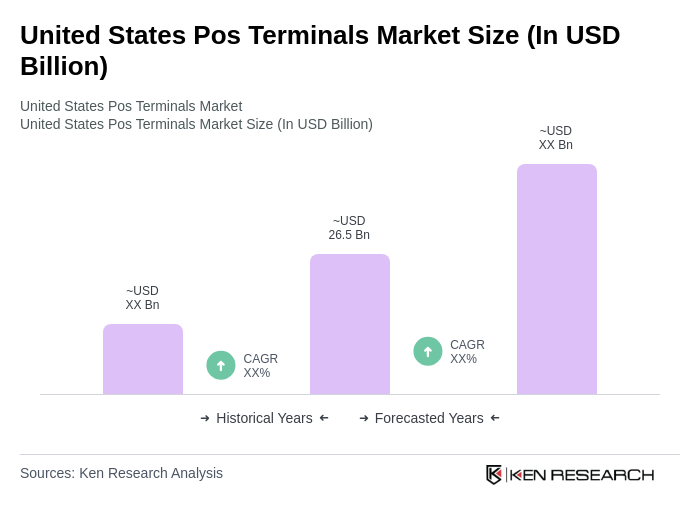
- The United States POS Terminals Market is valued at USD 26.5 billion, based on a five-year historical analysis. This growth is primarily driven by the increasing adoption of digital payment solutions, the rise of e-commerce, and the demand for contactless payment options, especially in the wake of the COVID-19 pandemic, which accelerated the shift towards cashless transactions.
- Key cities such as New York, Los Angeles, and Chicago dominate the market due to their high population density, robust retail environments, and significant technological infrastructure. These urban centers are also home to numerous businesses that require advanced payment solutions, further driving the demand for POS terminals.
- EMV liability shift policies drove EMV adoption over the past several years through card network rules rather than a new federal mandate in 2023; current U.S. payment security requirements are largely driven by EMVCo standards and PCI DSS compliance adopted by networks and merchants. There was no new 2023 U.S. government regulation mandating EMV terminals, though EMV and contactless have continued to expand to reduce fraud and protect consumer data.
United States Pos Terminals Market Segmentation
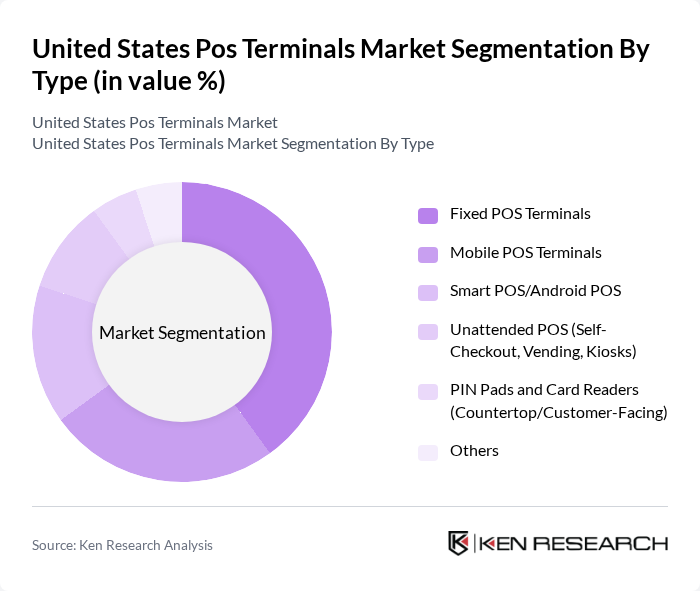
By Type:The segmentation by type includes Fixed POS Terminals, Mobile POS Terminals, Smart POS/Android POS, Unattended POS (Self-Checkout, Vending, Kiosks), PIN Pads and Card Readers (Countertop/Customer-Facing), and Others. Among these, Fixed POS Terminals are the most widely used due to their reliability and integration capabilities in retail environments. Mobile POS Terminals are gaining traction, especially in small businesses and service-oriented sectors, due to their flexibility and ease of use.
By End-User:The end-user segmentation includes Retail, Hospitality (Restaurants, Bars, Hotels), Healthcare, Transportation & Fuel (C-stores, Gas Stations), Entertainment & Gaming (Stadiums, Theaters, Casinos), and Others. The Retail sector is the largest end-user of POS terminals, driven by the need for efficient transaction processing and inventory management. The Hospitality sector is also significant, as restaurants and hotels increasingly adopt advanced payment solutions to enhance customer experience.

United States Pos Terminals Market Competitive Landscape
The United States Pos Terminals Market is characterized by a dynamic mix of regional and international players. Leading participants such as Block, Inc. (Square), Clover Network, LLC (Fiserv), Toast, Inc., Verifone, Inc., Ingenico (Worldline), PAX Technology, Inc., NCR Voyix Corporation, Fiserv, Inc. (including First Data), PayPal Holdings, Inc. (Zettle), Adyen N.V., Worldpay, LLC (FIS/GTCR), Diebold Nixdorf, Incorporated, Shopify Inc. (Shopify POS), Lightspeed Commerce Inc., Revel Systems, Inc. contribute to innovation, geographic expansion, and service delivery in this space.
United States Pos Terminals Market Industry Analysis
Growth Drivers
- Increasing Adoption of Contactless Payments:The United States has seen a significant rise in contactless payment adoption, with over 50% of consumers using contactless cards in future. This trend is driven by the convenience and speed of transactions, particularly in urban areas. According to the Federal Reserve, contactless payments accounted for approximately $100 billion in transactions in future, reflecting a growing consumer preference for quick and secure payment methods, which is expected to continue into future.
- Rise in E-commerce Transactions:E-commerce sales in the United States reached $1 trillion in future, marking a 15% increase from the previous year. This surge is propelling the demand for advanced POS terminals that can handle online and in-store transactions seamlessly. The U.S. Census Bureau reported that e-commerce now represents 15% of total retail sales, indicating a robust shift towards digital shopping, which is expected to drive further investment in POS technology in future.
- Demand for Enhanced Customer Experience:Businesses are increasingly focusing on improving customer experience, with 70% of companies prioritizing customer satisfaction initiatives in future. Enhanced POS systems that offer features like loyalty programs and personalized promotions are becoming essential. According to a recent industry report, companies that invest in customer experience see a 20% increase in sales, highlighting the critical role of advanced POS solutions in meeting consumer expectations and driving revenue growth.
Market Challenges
- High Initial Investment Costs:The initial costs associated with deploying advanced POS systems can be substantial, often exceeding $10,000 for small businesses. This financial barrier can deter many potential adopters, particularly among small and medium enterprises (SMEs). According to the National Small Business Association, 30% of SMEs cite high technology costs as a significant challenge, which may hinder the overall growth of the POS terminal market in the United States.
- Security Concerns Related to Data Breaches:Data breaches have become a critical concern, with the Identity Theft Resource Center reporting over 1,800 data breaches in future alone. The financial impact of these breaches can be severe, averaging $4.35 million per incident. As businesses increasingly rely on digital payment systems, the risk of cyberattacks poses a significant challenge, necessitating robust security measures that can increase operational costs and complicate compliance efforts.
United States Pos Terminals Market Future Outlook
The future of the United States POS terminals market appears promising, driven by technological advancements and evolving consumer preferences. As businesses increasingly adopt cloud-based solutions, the flexibility and scalability of these systems will likely enhance operational efficiency. Additionally, the integration of AI and machine learning into POS systems is expected to provide valuable insights into consumer behavior, enabling businesses to tailor their offerings. This trend, combined with the growing emphasis on sustainability, will shape the market landscape in the coming years.
Market Opportunities
- Expansion of Mobile Payment Solutions:The mobile payment market is projected to reach $1.5 trillion by future, driven by increasing smartphone penetration and consumer preference for mobile transactions. This presents a significant opportunity for POS terminal providers to integrate mobile payment capabilities, enhancing convenience and attracting a broader customer base.
- Integration of AI and Machine Learning:The incorporation of AI and machine learning into POS systems can revolutionize customer interactions. By analyzing transaction data, businesses can offer personalized promotions and improve inventory management. This technological integration is expected to enhance operational efficiency and customer satisfaction, creating a competitive edge in the market.
Scope of the Report
| Segment | Sub-Segments |
|---|---|
| By Type | Fixed POS Terminals Mobile POS Terminals Smart POS/Android POS Unattended POS (Self-Checkout, Vending, Kiosks) PIN Pads and Card Readers (Countertop/Customer-Facing) Others |
| By End-User | Retail Hospitality (Restaurants, Bars, Hotels) Healthcare Transportation & Fuel (C-stores, Gas Stations) Entertainment & Gaming (Stadiums, Theaters, Casinos) Others |
| By Sales Channel | Direct Sales (OEM/ISV) Online Sales Distributors Value-Added Resellers (VARs/ISOs) |
| By Payment Method | EMV Chip & Swipe (Credit/Debit Cards) NFC/Contactless (Apple Pay, Google Pay) QR/Scan-to-Pay ACH/Bank Transfers |
| By Industry Vertical | Grocery & Supermarkets Foodservice & Quick Service Restaurants Apparel & Specialty Retail Electronics & Home Improvement Pharmacies & Healthcare Providers |
| By Deployment Mode | On-Premises Cloud-Managed |
| By Customer Size | Micro & Small Businesses Mid-Market Large Enterprises |
Key Target Audience
Investors and Venture Capitalist Firms
Government and Regulatory Bodies (e.g., Federal Communications Commission, Consumer Financial Protection Bureau)
Manufacturers and Producers
Distributors and Retailers
Payment Processors
Technology Providers
Industry Associations (e.g., National Retail Federation, Electronic Transactions Association)
Financial Institutions
Players Mentioned in the Report:
Block, Inc. (Square)
Clover Network, LLC (Fiserv)
Toast, Inc.
Verifone, Inc.
Ingenico (Worldline)
PAX Technology, Inc.
NCR Voyix Corporation
Fiserv, Inc. (including First Data)
PayPal Holdings, Inc. (Zettle)
Adyen N.V.
Worldpay, LLC (FIS/GTCR)
Diebold Nixdorf, Incorporated
Shopify Inc. (Shopify POS)
Lightspeed Commerce Inc.
Revel Systems, Inc.
Table of Contents
Market Assessment Phase
1. Executive Summary and Approach
2. United States Pos Terminals Market Overview
2.1 Key Insights and Strategic Recommendations
2.2 United States Pos Terminals Market Overview
2.3 Definition and Scope
2.4 Evolution of Market Ecosystem
2.5 Timeline of Key Regulatory Milestones
2.6 Value Chain & Stakeholder Mapping
2.7 Business Cycle Analysis
2.8 Policy & Incentive Landscape
3. United States Pos Terminals Market Analysis
3.1 Growth Drivers
3.1.1 Increasing Adoption of Contactless Payments
3.1.2 Rise in E-commerce Transactions
3.1.3 Demand for Enhanced Customer Experience
3.1.4 Technological Advancements in Payment Solutions
3.2 Market Challenges
3.2.1 High Initial Investment Costs
3.2.2 Security Concerns Related to Data Breaches
3.2.3 Rapidly Changing Technology Landscape
3.2.4 Regulatory Compliance Issues
3.3 Market Opportunities
3.3.1 Expansion of Mobile Payment Solutions
3.3.2 Integration of AI and Machine Learning
3.3.3 Growth in Small and Medium Enterprises
3.3.4 Increasing Demand for Multi-Functional POS Systems
3.4 Market Trends
3.4.1 Shift Towards Cloud-Based POS Systems
3.4.2 Emergence of Subscription-Based Pricing Models
3.4.3 Focus on Sustainability and Eco-Friendly Solutions
3.4.4 Rise of Integrated Payment Solutions
3.5 Government Regulation
3.5.1 PCI Compliance Requirements
3.5.2 EMV Chip Mandate
3.5.3 Data Protection Regulations
3.5.4 Taxation Policies on Digital Transactions
4. SWOT Analysis
5. Stakeholder Analysis
6. Porter's Five Forces Analysis
7. United States Pos Terminals Market Market Size, 2019-2024
7.1 By Value
7.2 By Volume
7.3 By Average Selling Price
8. United States Pos Terminals Market Segmentation
8.1 By Type
8.1.1 Fixed POS Terminals
8.1.2 Mobile POS Terminals
8.1.3 Smart POS/Android POS
8.1.4 Unattended POS (Self-Checkout, Vending, Kiosks)
8.1.5 PIN Pads and Card Readers (Countertop/Customer-Facing)
8.1.6 Others
8.2 By End-User
8.2.1 Retail
8.2.2 Hospitality (Restaurants, Bars, Hotels)
8.2.3 Healthcare
8.2.4 Transportation & Fuel (C-stores, Gas Stations)
8.2.5 Entertainment & Gaming (Stadiums, Theaters, Casinos)
8.2.6 Others
8.3 By Sales Channel
8.3.1 Direct Sales (OEM/ISV)
8.3.2 Online Sales
8.3.3 Distributors
8.3.4 Value-Added Resellers (VARs/ISOs)
8.4 By Payment Method
8.4.1 EMV Chip & Swipe (Credit/Debit Cards)
8.4.2 NFC/Contactless (Apple Pay, Google Pay)
8.4.3 QR/Scan-to-Pay
8.4.4 ACH/Bank Transfers
8.5 By Industry Vertical
8.5.1 Grocery & Supermarkets
8.5.2 Foodservice & Quick Service Restaurants
8.5.3 Apparel & Specialty Retail
8.5.4 Electronics & Home Improvement
8.5.5 Pharmacies & Healthcare Providers
8.6 By Deployment Mode
8.6.1 On-Premises
8.6.2 Cloud-Managed
8.7 By Customer Size
8.7.1 Micro & Small Businesses
8.7.2 Mid-Market
8.7.3 Large Enterprises
9. United States Pos Terminals Market Competitive Analysis
9.1 Market Share of Key Players
9.2 Cross Comparison of Key Players
9.2.1 Company Name
9.2.2 Company Scale (SMB-focused, Mid-Market, Enterprise, or Multi-Segment)
9.2.3 U.S. POS Hardware Shipments (Units, YoY%)
9.2.4 U.S. Merchant Locations Served (Count, YoY%)
9.2.5 Gross Payment Volume (GPV) or Transaction Volume (USD, YoY%)
9.2.6 Take Rate/Blended Payment Margin (%)
9.2.7 Average Revenue per Merchant (ARPM) or ARPU (USD)
9.2.8 Software Subscription Revenue Mix (% of total)
9.2.9 Net Revenue Retention (NRR, %)
9.2.10 Terminal Certification Coverage (EMV, NFC, PCI PTS versions)
9.2.11 Product Release Velocity (Major releases per year)
9.2.12 Customer Support SLAs (Uptime %, Response/Resolution times)
9.3 SWOT Analysis of Top Players
9.4 Pricing Analysis
9.5 Detailed Profile of Major Companies
9.5.1 Block, Inc. (Square)
9.5.2 Clover Network, LLC (Fiserv)
9.5.3 Toast, Inc.
9.5.4 Verifone, Inc.
9.5.5 Ingenico (Worldline)
9.5.6 PAX Technology, Inc.
9.5.7 NCR Voyix Corporation
9.5.8 Fiserv, Inc. (including First Data)
9.5.9 PayPal Holdings, Inc. (Zettle)
9.5.10 Adyen N.V.
9.5.11 Worldpay, LLC (FIS/GTCR)
9.5.12 Diebold Nixdorf, Incorporated
9.5.13 Shopify Inc. (Shopify POS)
9.5.14 Lightspeed Commerce Inc.
9.5.15 Revel Systems, Inc.
10. United States Pos Terminals Market End-User Analysis
10.1 Procurement Behavior of Key Ministries
10.1.1 Budget Allocation Trends
10.1.2 Decision-Making Processes
10.1.3 Vendor Selection Criteria
10.2 Corporate Spend on Infrastructure & Energy
10.2.1 Investment Priorities
10.2.2 Spending Patterns
10.2.3 Budget Constraints
10.3 Pain Point Analysis by End-User Category
10.3.1 Integration Challenges
10.3.2 User Training Needs
10.3.3 Maintenance and Support Issues
10.4 User Readiness for Adoption
10.4.1 Technology Familiarity
10.4.2 Training and Support Requirements
10.4.3 Change Management Strategies
10.5 Post-Deployment ROI and Use Case Expansion
10.5.1 Performance Metrics
10.5.2 Customer Feedback Mechanisms
10.5.3 Future Use Case Development
11. United States Pos Terminals Market Future Size, 2025-2030
11.1 By Value
11.2 By Volume
11.3 By Average Selling Price
Go-To-Market Strategy Phase
1. Whitespace Analysis + Business Model Canvas
1.1 Market Gaps Identification
1.2 Value Proposition Development
1.3 Revenue Streams Analysis
1.4 Cost Structure Evaluation
1.5 Key Partnerships Exploration
1.6 Customer Segmentation
1.7 Channels and Customer Relationships
2. Marketing and Positioning Recommendations
2.1 Branding Strategies
2.2 Product USPs
2.3 Target Audience Identification
2.4 Communication Strategies
2.5 Digital Marketing Approaches
3. Distribution Plan
3.1 Urban Retail Strategies
3.2 Rural NGO Tie-Ups
3.3 E-commerce Distribution
3.4 Direct Sales Channels
4. Channel & Pricing Gaps
4.1 Underserved Routes
4.2 Pricing Bands Analysis
4.3 Competitive Pricing Strategies
5. Unmet Demand & Latent Needs
5.1 Category Gaps
5.2 Consumer Segments
5.3 Emerging Trends
6. Customer Relationship
6.1 Loyalty Programs
6.2 After-Sales Service
6.3 Customer Engagement Strategies
7. Value Proposition
7.1 Sustainability Initiatives
7.2 Integrated Supply Chains
7.3 Unique Selling Points
8. Key Activities
8.1 Regulatory Compliance
8.2 Branding Efforts
8.3 Distribution Setup
9. Entry Strategy Evaluation
9.1 Domestic Market Entry Strategy
9.1.1 Product Mix Considerations
9.1.2 Pricing Band Strategy
9.1.3 Packaging Approaches
9.2 Export Entry Strategy
9.2.1 Target Countries
9.2.2 Compliance Roadmap
10. Entry Mode Assessment
10.1 Joint Ventures
10.2 Greenfield Investments
10.3 Mergers & Acquisitions
10.4 Distributor Model
11. Capital and Timeline Estimation
11.1 Capital Requirements
11.2 Timelines for Implementation
12. Control vs Risk Trade-Off
12.1 Ownership vs Partnerships
13. Profitability Outlook
13.1 Breakeven Analysis
13.2 Long-Term Sustainability
14. Potential Partner List
14.1 Distributors
14.2 Joint Ventures
14.3 Acquisition Targets
15. Execution Roadmap
15.1 Phased Plan for Market Entry
15.1.1 Market Setup
15.1.2 Market Entry
15.1.3 Growth Acceleration
15.1.4 Scale & Stabilize
15.2 Key Activities and Milestones
15.2.1 Milestone Planning
15.2.2 Activity Tracking
Research Methodology
Phase 1: Approach1
Desk Research
- Analysis of industry reports from the National Retail Federation and payment processing associations
- Review of market trends and forecasts from financial publications and trade journals
- Examination of regulatory frameworks and compliance guidelines from the Federal Reserve and payment networks
Primary Research
- Interviews with executives from leading POS terminal manufacturers and distributors
- Surveys targeting retail managers and IT decision-makers regarding POS system adoption
- Field interviews with end-users in various sectors, including retail, hospitality, and healthcare
Validation & Triangulation
- Cross-validation of data through multiple industry sources and expert opinions
- Triangulation of findings from primary interviews with secondary data insights
- Sanity checks conducted through expert panel discussions and feedback loops
Phase 2: Market Size Estimation1
Top-down Assessment
- Estimation of total market size based on national retail sales data and payment transaction volumes
- Segmentation of the market by industry verticals and geographic regions
- Incorporation of growth rates from emerging payment technologies and consumer behavior trends
Bottom-up Modeling
- Collection of sales data from key POS terminal vendors and service providers
- Estimation of average selling prices and unit sales across different terminal types
- Volume and revenue projections based on historical sales data and market penetration rates
Forecasting & Scenario Analysis
- Multi-variable forecasting using economic indicators, technological advancements, and consumer preferences
- Scenario analysis based on potential regulatory changes and market disruptions
- Development of baseline, optimistic, and pessimistic forecasts through 2030
Phase 3: CATI Sample Composition1
| Scope Item/Segment | Sample Size | Target Respondent Profiles |
|---|---|---|
| Retail POS Terminal Usage | 150 | Store Managers, IT Directors |
| Hospitality Sector Payment Solutions | 100 | Operations Managers, Front Desk Supervisors |
| Healthcare Payment Processing | 80 | Billing Managers, IT Administrators |
| Mobile Payment Adoption Trends | 70 | Marketing Managers, Product Development Leads |
| Emerging Payment Technologies | 90 | Technology Officers, Innovation Managers |
Frequently Asked Questions
What is the current value of the United States POS terminals market?
The United States POS terminals market is valued at approximately USD 26.5 billion, reflecting significant growth driven by the increasing adoption of digital payment solutions and the demand for contactless payment options, particularly accelerated by the COVID-19 pandemic.
What are the main types of POS terminals available in the U.S. market?
Which sectors are the largest end-users of POS terminals in the U.S.?
What factors are driving the growth of the POS terminals market in the U.S.?
Other Regional/Country Reports
Indonesia Pos Terminals Market
Malaysia Pos Terminals Market
KSA Pos Terminals Market
APAC Pos Terminals Market
Why Buy From Us?

What makes us stand out is that our consultants follow Robust, Refine and Result (RRR) methodology. Robust for clear definitions, approaches and sanity checking, Refine for differentiating respondents' facts and opinions, and Result for presenting data with story.

We have set a benchmark in the industry by offering our clients with syndicated and customized market research reports featuring coverage of entire market as well as meticulous research and analyst insights.

While we don't replace traditional research, we flip the method upside down. Our dual approach of Top Bottom & Bottom Top ensures quality deliverable by not just verifying company fundamentals but also looking at the sector and macroeconomic factors.

With one step in the future, our research team constantly tries to show you the bigger picture. We help with some of the tough questions you may encounter along the way: How is the industry positioned? Best marketing channel? KPI's of competitors? By aligning every element, we help maximize success.

Our report gives you instant access to the answers and sources that other companies might choose to hide. We elaborate each steps of research methodology we have used and showcase you the sample size to earn your trust.

If you need any support, we are here! We pride ourselves on universe strength, data quality, and quick, friendly, and professional service.