About the Report
Base Year 2024United States Spirits Market Overview
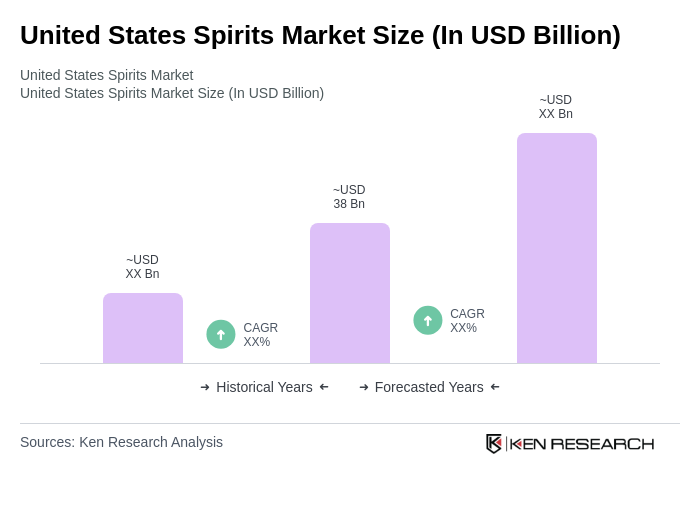
- The United States Spirits Market is valued at USD 38 billion, based on a five-year historical analysis. This valuation aligns with industry reporting that placed total U.S. spirits supplier revenues near the upper thirties in recent years, supported by volumes exceeding 300 million 9-liter cases and a continued premiumization trend.
- Key players in this market include major cities such as New York, Los Angeles, and Chicago, which dominate due to their vibrant nightlife, diverse populations, and strong tourism sectors. These urban centers anchor on-premise demand and serve as hubs for brand activations, distribution, and experiential marketing across bars, restaurants, and events.
- In 2023, the United States government implemented stricter regulations on the labeling and marketing of alcoholic beverages, mandating clearer information on health risks and responsible drinking. Regulatory scrutiny on alcohol labeling and health claims has intensified, with federal agencies emphasizing consumer protection and truthful marketing practices, influencing how spirits brands communicate with their audience.
United States Spirits Market Segmentation
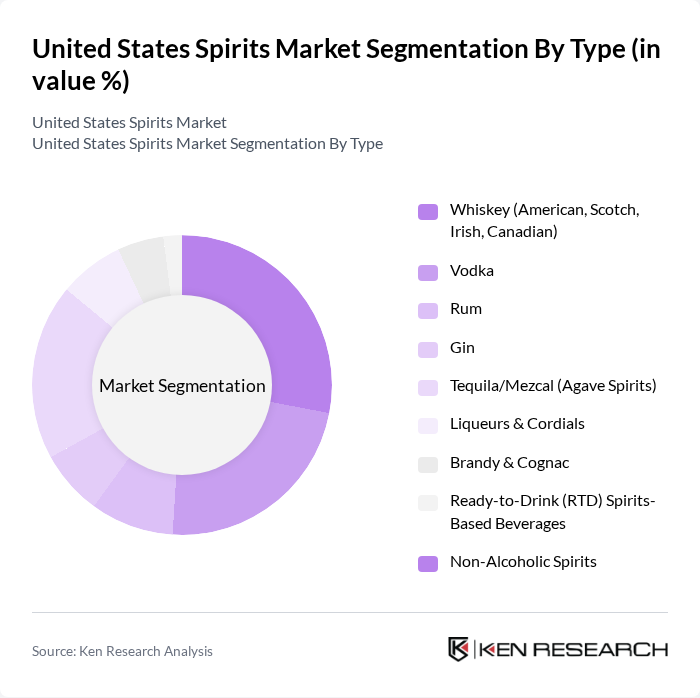
By Type:The spirits market is segmented into various types, including whiskey, vodka, rum, gin, tequila/mezcal, liqueurs & cordials, brandy & cognac, ready-to-drink (RTD) spirits-based beverages, and non-alcoholic spirits. Among these, whiskey has emerged as a dominant segment, driven by its rich heritage and increasing popularity among consumers seeking premium and craft options. The trend towards whiskey cocktails and the rise of craft distilleries have further bolstered its market presence; at a regional level, whiskey has led revenue share, while agave-based spirits have been the key growth driver in recent periods.
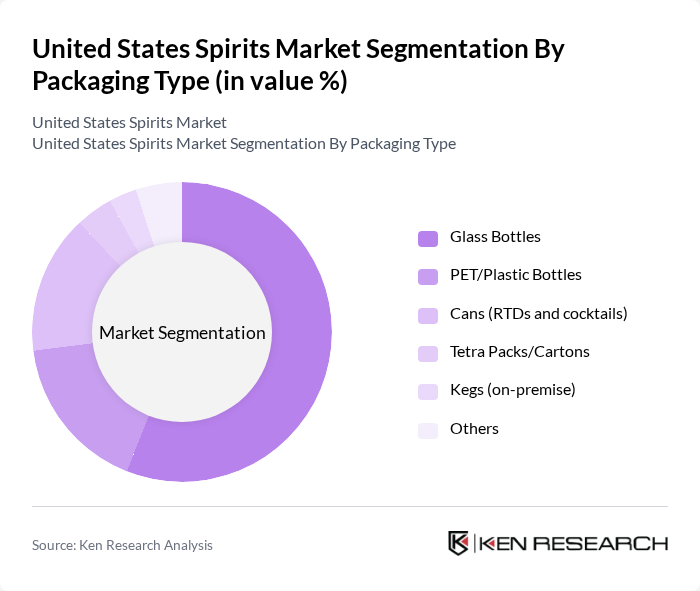
By Packaging Type:The packaging segment includes glass bottles, PET/plastic bottles, cans (RTDs and cocktails), tetra packs/cartons, kegs (on-premise), and others. Glass bottles dominate the market due to their premium appeal and preservation of product integrity, while sustainability initiatives are driving lighter-weight glass, recycled content, and refill concepts; cans are growing within spirits-based RTDs through convenience and portion control.
United States Spirits Market Competitive Landscape
The United States Spirits Market is characterized by a dynamic mix of regional and international players. Leading participants such as Diageo plc, Pernod Ricard SA, Brown-Forman Corporation, Bacardi Limited, Constellation Brands, Inc., Beam Suntory Inc. (Suntory Global Spirits), E. & J. Gallo Winery (Spirits Division), Moët Hennessy (LVMH), Davide Campari-Milano N.V. (Campari Group), William Grant & Sons Ltd., Sazerac Company, Inc., Rémy Cointreau SA, Stoli Group, The Boston Beer Company, Inc. (Dogfish Head Distilling; spirits-based RTDs), Distilled Spirits Council of the United States (DISCUS) contribute to innovation, geographic expansion, and service delivery in this space.
United States Spirits Market Industry Analysis
Growth Drivers
- Increasing Consumer Preference for Premium Spirits:The U.S. spirits market has seen a significant shift towards premium products, with sales of high-end spirits reaching approximately $27 billion in future. This trend is driven by consumers willing to spend more on quality, with 62% of spirit drinkers indicating a preference for premium brands. The rise in disposable income, projected to increase by 4% in future, further supports this growth, as consumers prioritize quality over quantity in their purchasing decisions.
- Rise in Craft Distilleries:The craft distillery segment has expanded rapidly, with over 2,700 craft distilleries operating in the U.S. as of future, a 25% increase from the previous year. This growth is fueled by consumer interest in locally produced and unique spirits, with craft spirits accounting for nearly $5 billion in sales. The trend is expected to continue, supported by a 6% annual increase in consumer spending on craft beverages, reflecting a shift towards artisanal and small-batch production.
- Growth of E-commerce and Online Sales:E-commerce has transformed the spirits market, with online sales projected to reach $12 billion in future, up from $8 billion in future. This growth is driven by the convenience of online shopping and the increasing number of states allowing direct-to-consumer shipping. Additionally, 45% of consumers reported purchasing spirits online in future, highlighting a significant shift in buying behavior that is expected to continue as digital platforms expand their offerings and reach.
Market Challenges
- Stringent Regulations and Compliance Issues:The spirits industry faces complex regulatory challenges, with over 55 federal and state regulations governing production, distribution, and sales. Compliance costs can exceed $1.2 million annually for larger distilleries, impacting profitability. Additionally, the Federal Alcohol Administration Act imposes strict labeling and advertising requirements, which can hinder marketing efforts and limit brand visibility, particularly for new entrants in the market.
- High Competition Among Brands:The U.S. spirits market is highly competitive, with over 1,800 brands vying for consumer attention. This saturation leads to aggressive pricing strategies and marketing campaigns, increasing the cost of customer acquisition. In future, the average marketing spend per brand was approximately $2.5 million, which can strain resources, especially for smaller distilleries. The intense competition also pressures profit margins, making it challenging for brands to differentiate themselves effectively.
United States Spirits Market Future Outlook
The future of the U.S. spirits market appears promising, driven by evolving consumer preferences and innovative product offerings. As the demand for organic and natural spirits continues to rise, brands are likely to invest in sustainable practices and eco-friendly packaging. Additionally, the increasing popularity of ready-to-drink cocktails is expected to reshape product lines, catering to convenience-seeking consumers. Overall, the market is poised for growth, with a focus on quality, sustainability, and consumer engagement through digital platforms.
Market Opportunities
- Expansion into Emerging Markets:U.S. spirits brands have significant opportunities to expand into emerging markets, particularly in Asia and Latin America, where alcohol consumption is on the rise. With a projected increase in middle-class consumers, brands can tap into new demographics, potentially increasing sales by over $6 billion in these regions by future.
- Innovations in Product Offerings:The introduction of non-alcoholic spirit alternatives is gaining traction, with sales expected to reach $1.2 billion by future. This trend caters to health-conscious consumers seeking flavorful options without alcohol. Brands that innovate and diversify their product lines to include these alternatives can capture a growing segment of the market, enhancing their competitive edge.
Scope of the Report
| Segment | Sub-Segments |
|---|---|
| By Type | Whiskey (American, Scotch, Irish, Canadian) Vodka Rum Gin Tequila/Mezcal (Agave Spirits) Liqueurs & Cordials Brandy & Cognac Ready-to-Drink (RTD) Spirits-Based Beverages Non-Alcoholic Spirits |
| By Packaging Type | Glass Bottles PET/Plastic Bottles Cans (RTDs and cocktails) Tetra Packs/Cartons Kegs (on-premise) Others |
| By Distribution Channel | On-trade (Bars, Restaurants, Hotels) Off-trade (Liquor Stores, Supermarkets, Club Stores) E-commerce/Direct-to-Consumer (where permitted) Control States vs. License States (state-run vs private retail) Duty-Free Shops Others |
| By Price Range | Value/Standard Premium Super-Premium Ultra-Premium/Luxury |
| By Consumer Demographics | Age Group (21-29, 30-39, 40-54, 55+) Gender Income Level Ethnicity/Cultural Affinity (e.g., Hispanic, African American, Asian American) Lifestyle/Consumption Occasion Segments (e.g., cocktail-forward, at-home entertainers) |
| By Occasion | Celebrations & Holidays Casual Gatherings & At-Home Consumption On-premise Social/Cocktail Occasions Gifting & Collecting Others |
| By Brand Loyalty | Brand Loyal Consumers Brand Switchers/Explorers New-to-Category Private Label vs. Branded Preference |
Key Target Audience
Investors and Venture Capitalist Firms
Government and Regulatory Bodies (e.g., Alcohol and Tobacco Tax and Trade Bureau, Food and Drug Administration)
Manufacturers and Producers
Distributors and Retailers
Importers and Exporters
Industry Associations (e.g., Distilled Spirits Council of the United States)
Financial Institutions
Marketing and Advertising Agencies
Players Mentioned in the Report:
Diageo plc
Pernod Ricard SA
Brown-Forman Corporation
Bacardi Limited
Constellation Brands, Inc.
Beam Suntory Inc. (Suntory Global Spirits)
E. & J. Gallo Winery (Spirits Division)
Moet Hennessy (LVMH)
Davide Campari-Milano N.V. (Campari Group)
William Grant & Sons Ltd.
Sazerac Company, Inc.
Remy Cointreau SA
Stoli Group
The Boston Beer Company, Inc. (Dogfish Head Distilling; spirits-based RTDs)
Distilled Spirits Council of the United States (DISCUS)
Table of Contents
Market Assessment Phase
1. Executive Summary and Approach
2. United States Spirits Market Overview
2.1 Key Insights and Strategic Recommendations
2.2 United States Spirits Market Overview
2.3 Definition and Scope
2.4 Evolution of Market Ecosystem
2.5 Timeline of Key Regulatory Milestones
2.6 Value Chain & Stakeholder Mapping
2.7 Business Cycle Analysis
2.8 Policy & Incentive Landscape
3. United States Spirits Market Analysis
3.1 Growth Drivers
3.1.1 Increasing consumer preference for premium spirits
3.1.2 Rise in craft distilleries
3.1.3 Growth of e-commerce and online sales
3.1.4 Expanding cocktail culture
3.2 Market Challenges
3.2.1 Stringent regulations and compliance issues
3.2.2 High competition among brands
3.2.3 Changing consumer preferences towards health-conscious options
3.2.4 Economic fluctuations affecting disposable income
3.3 Market Opportunities
3.3.1 Expansion into emerging markets
3.3.2 Innovations in product offerings
3.3.3 Collaborations with bars and restaurants
3.3.4 Growth in non-alcoholic spirit alternatives
3.4 Market Trends
3.4.1 Increasing demand for organic and natural spirits
3.4.2 Popularity of ready-to-drink cocktails
3.4.3 Rise of sustainable and eco-friendly packaging
3.4.4 Digital marketing and social media influence
3.5 Government Regulation
3.5.1 Federal Alcohol Administration Act (FAA)
3.5.2 State-level distribution laws
3.5.3 Labeling and advertising regulations
3.5.4 Taxation policies on alcoholic beverages
4. SWOT Analysis
5. Stakeholder Analysis
6. Porter's Five Forces Analysis
7. United States Spirits Market Market Size, 2019-2024
7.1 By Value
7.2 By Volume
7.3 By Average Selling Price
8. United States Spirits Market Segmentation
8.1 By Type
8.1.1 Whiskey (American, Scotch, Irish, Canadian)
8.1.2 Vodka
8.1.3 Rum
8.1.4 Gin
8.1.5 Tequila/Mezcal (Agave Spirits)
8.1.6 Liqueurs & Cordials
8.1.7 Brandy & Cognac
8.1.8 Ready-to-Drink (RTD) Spirits-Based Beverages
8.1.9 Non-Alcoholic Spirits
8.2 By Packaging Type
8.2.1 Glass Bottles
8.2.2 PET/Plastic Bottles
8.2.3 Cans (RTDs and cocktails)
8.2.4 Tetra Packs/Cartons
8.2.5 Kegs (on-premise)
8.2.6 Others
8.3 By Distribution Channel
8.3.1 On-trade (Bars, Restaurants, Hotels)
8.3.2 Off-trade (Liquor Stores, Supermarkets, Club Stores)
8.3.3 E-commerce/Direct-to-Consumer (where permitted)
8.3.4 Control States vs. License States (state-run vs private retail)
8.3.5 Duty-Free Shops
8.3.6 Others
8.4 By Price Range
8.4.1 Value/Standard
8.4.2 Premium
8.4.3 Super-Premium
8.4.4 Ultra-Premium/Luxury
8.5 By Consumer Demographics
8.5.1 Age Group (21-29, 30-39, 40-54, 55+)
8.5.2 Gender
8.5.3 Income Level
8.5.4 Ethnicity/Cultural Affinity (e.g., Hispanic, African American, Asian American)
8.5.5 Lifestyle/Consumption Occasion Segments (e.g., cocktail-forward, at-home entertainers)
8.6 By Occasion
8.6.1 Celebrations & Holidays
8.6.2 Casual Gatherings & At-Home Consumption
8.6.3 On-premise Social/Cocktail Occasions
8.6.4 Gifting & Collecting
8.6.5 Others
8.7 By Brand Loyalty
8.7.1 Brand Loyal Consumers
8.7.2 Brand Switchers/Explorers
8.7.3 New-to-Category
8.7.4 Private Label vs. Branded Preference
9. United States Spirits Market Competitive Analysis
9.1 Market Share of Key Players
9.2 Cross Comparison of Key Players
9.2.1 Company Name
9.2.2 Group Size (Global, Regional, or Domestic)
9.2.3 US Spirits Net Sales (latest fiscal year)
9.2.4 3-Year US Revenue CAGR
9.2.5 US Volume Share by Category (e.g., tequila, whiskey, vodka)
9.2.6 Portfolio Premium Mix (% premium/super-premium sales)
9.2.7 Average Realized Price per 9L Case (USD)
9.2.8 Distribution Footprint (states covered; control vs license exposure)
9.2.9 On-premise vs Off-premise Mix (%)
9.2.10 RTD Participation (share of sales; growth rate)
9.2.11 Innovation Velocity (new SKUs launched/year)
9.2.12 Marketing Efficiency (A&P spend as % of sales)
9.2.13 Brand Equity Proxy (top brand awareness/index or IRI/Nielsen rank)
9.2.14 Digital/E-commerce Penetration (% of US sales)
9.2.15 Sustainability Metrics (recycled glass %, renewable energy use)
9.3 SWOT Analysis of Top Players
9.4 Pricing Analysis
9.5 Detailed Profile of Major Companies
9.5.1 Diageo plc
9.5.2 Pernod Ricard SA
9.5.3 Brown-Forman Corporation
9.5.4 Bacardi Limited
9.5.5 Constellation Brands, Inc.
9.5.6 Beam Suntory Inc. (Suntory Global Spirits)
9.5.7 E. & J. Gallo Winery (Spirits Division)
9.5.8 Moët Hennessy (LVMH)
9.5.9 Davide Campari-Milano N.V. (Campari Group)
9.5.10 William Grant & Sons Ltd.
9.5.11 Sazerac Company, Inc.
9.5.12 Rémy Cointreau SA
9.5.13 Stoli Group
9.5.14 The Boston Beer Company, Inc. (Dogfish Head Distilling; spirits-based RTDs)
9.5.15 Distilled Spirits Council of the United States (DISCUS)
10. United States Spirits Market End-User Analysis
10.1 Procurement Behavior of Key Ministries
10.1.1 Government procurement policies
10.1.2 Budget allocation for spirits
10.1.3 Supplier selection criteria
10.1.4 Compliance with regulations
10.2 Corporate Spend on Infrastructure & Energy
10.2.1 Investment in distillation facilities
10.2.2 Spending on marketing and branding
10.2.3 Budget for sustainability initiatives
10.3 Pain Point Analysis by End-User Category
10.3.1 Supply chain disruptions
10.3.2 Regulatory compliance challenges
10.3.3 Quality control issues
10.4 User Readiness for Adoption
10.4.1 Awareness of new products
10.4.2 Willingness to try premium brands
10.4.3 Acceptance of online purchasing
10.5 Post-Deployment ROI and Use Case Expansion
10.5.1 Measurement of sales growth
10.5.2 Customer feedback and satisfaction
10.5.3 Opportunities for product line expansion
11. United States Spirits Market Future Size, 2025-2030
11.1 By Value
11.2 By Volume
11.3 By Average Selling Price
Go-To-Market Strategy Phase
1. Whitespace Analysis + Business Model Canvas
1.1 Market gaps identification
1.2 Value proposition development
1.3 Revenue model exploration
1.4 Customer segments analysis
1.5 Key partnerships identification
1.6 Cost structure analysis
1.7 Channels of distribution
2. Marketing and Positioning Recommendations
2.1 Branding strategies
2.2 Product USPs
2.3 Target audience identification
2.4 Marketing channels selection
2.5 Promotional tactics
3. Distribution Plan
3.1 Urban retail vs rural NGO tie-ups
3.2 Distribution channel optimization
3.3 Logistics and supply chain management
3.4 Partnership with distributors
4. Channel & Pricing Gaps
4.1 Underserved routes
4.2 Pricing bands
4.3 Competitive pricing analysis
4.4 Value-based pricing strategies
5. Unmet Demand & Latent Needs
5.1 Category gaps
5.2 Consumer segments
5.3 Product development opportunities
6. Customer Relationship
6.1 Loyalty programs
6.2 After-sales service
6.3 Customer engagement strategies
7. Value Proposition
7.1 Sustainability
7.2 Integrated supply chains
7.3 Unique selling points
8. Key Activities
8.1 Regulatory compliance
8.2 Branding
8.3 Distribution setup
9. Entry Strategy Evaluation
9.1 Domestic Market Entry Strategy
9.1.1 Product mix
9.1.2 Pricing band
9.1.3 Packaging
9.2 Export Entry Strategy
9.2.1 Target countries
9.2.2 Compliance roadmap
10. Entry Mode Assessment
10.1 JV
10.2 Greenfield
10.3 M&A
10.4 Distributor Model
11. Capital and Timeline Estimation
11.1 Capital requirements
11.2 Timelines
12. Control vs Risk Trade-Off
12.1 Ownership vs Partnerships
13. Profitability Outlook
13.1 Breakeven analysis
13.2 Long-term sustainability
14. Potential Partner List
14.1 Distributors
14.2 JVs
14.3 Acquisition targets
15. Execution Roadmap
15.1 Phased Plan for Market Entry
15.1.1 Market Setup
15.1.2 Market Entry
15.1.3 Growth Acceleration
15.1.4 Scale & Stabilize
15.2 Key Activities and Milestones
15.2.1 Milestone tracking
15.2.2 Activity scheduling
Research Methodology
Phase 1: Approach1
Desk Research
- Analysis of industry reports from the Distilled Spirits Council of the United States
- Review of market trends and consumer behavior studies published by the Beverage Marketing Corporation
- Examination of government publications and regulatory frameworks affecting the spirits industry
Primary Research
- Interviews with distillery owners and operators to gather insights on production trends
- Surveys with bartenders and mixologists to understand consumer preferences and cocktail trends
- Focus groups with consumers to explore brand loyalty and purchasing behavior
Validation & Triangulation
- Cross-validation of findings through multiple data sources, including sales data and consumer surveys
- Triangulation of insights from industry experts, market analysts, and consumer feedback
- Sanity checks through expert panel reviews to ensure data accuracy and relevance
Phase 2: Market Size Estimation1
Top-down Assessment
- Estimation of total market size based on national alcohol consumption statistics
- Segmentation of the market by spirit type (e.g., whiskey, vodka, rum) and distribution channel
- Incorporation of demographic trends and shifts in consumer preferences
Bottom-up Modeling
- Collection of sales data from leading spirits manufacturers and distributors
- Estimation of average price points across different spirit categories
- Volume estimates based on production capacities and sales forecasts
Forecasting & Scenario Analysis
- Multi-factor regression analysis incorporating economic indicators and consumer spending patterns
- Scenario modeling based on potential regulatory changes and market disruptions
- Development of baseline, optimistic, and pessimistic forecasts through 2030
Phase 3: CATI Sample Composition1
| Scope Item/Segment | Sample Size | Target Respondent Profiles |
|---|---|---|
| Retail Spirits Sales | 150 | Store Managers, Beverage Buyers |
| On-Premise Consumption Trends | 100 | Bar Owners, Restaurant Managers |
| Consumer Preferences in Spirits | 140 | Spirits Consumers, Cocktail Enthusiasts |
| Distribution Channel Insights | 80 | Wholesalers, Distributors |
| Market Entry Strategies | 60 | Market Analysts, Business Development Managers |
Frequently Asked Questions
What is the current value of the United States Spirits Market?
The United States Spirits Market is valued at approximately USD 38 billion, based on a five-year historical analysis. This valuation reflects strong supplier revenues and a trend towards premiumization in consumer preferences.
Which cities are key players in the United States Spirits Market?
What recent regulations have impacted the spirits industry in the U.S.?
What types of spirits are most popular in the U.S. market?
Other Regional/Country Reports
Indonesia Spirits Market
Malaysia Spirits Market
APAC Spirits Market
Why Buy From Us?

What makes us stand out is that our consultants follow Robust, Refine and Result (RRR) methodology. Robust for clear definitions, approaches and sanity checking, Refine for differentiating respondents' facts and opinions, and Result for presenting data with story.

We have set a benchmark in the industry by offering our clients with syndicated and customized market research reports featuring coverage of entire market as well as meticulous research and analyst insights.

While we don't replace traditional research, we flip the method upside down. Our dual approach of Top Bottom & Bottom Top ensures quality deliverable by not just verifying company fundamentals but also looking at the sector and macroeconomic factors.

With one step in the future, our research team constantly tries to show you the bigger picture. We help with some of the tough questions you may encounter along the way: How is the industry positioned? Best marketing channel? KPI's of competitors? By aligning every element, we help maximize success.

Our report gives you instant access to the answers and sources that other companies might choose to hide. We elaborate each steps of research methodology we have used and showcase you the sample size to earn your trust.

If you need any support, we are here! We pride ourselves on universe strength, data quality, and quick, friendly, and professional service.