About the Report
Base Year 2024United States Ultra Thin Glass Market Overview
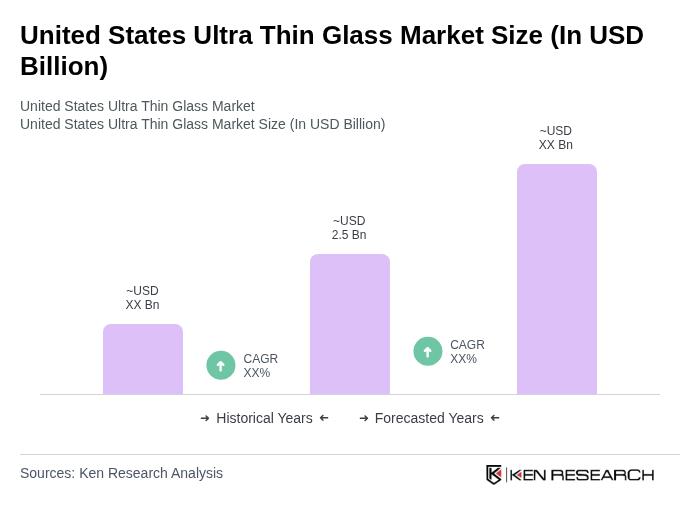
- The United States Ultra Thin Glass Market is valued at USD 2.5 billion, based on a five-year historical analysis. This growth is primarily driven by the increasing demand for lightweight and durable materials in consumer electronics, automotive, and renewable energy sectors. The rise in technological advancements, such as flexible displays, advanced automotive HUDs, and high-efficiency solar panels, along with the need for high-performance glass in various applications, have significantly contributed to the market's expansion. The market is further supported by investments in semiconductor fabrication and the adoption of foldable smartphones and wearable devices .
- Key players in this market benefit from regional innovation hubs such as San Jose, California, and Austin, Texas, which are centers for technology and advanced manufacturing. The presence of leading electronics manufacturers, semiconductor fabrication facilities, and automotive companies in these regions fosters a conducive environment for the growth of ultra-thin glass applications, making them dominant contributors to market development .
- The Inflation Reduction Act, 2022, issued by the U.S. Congress, includes provisions that incentivize the use of sustainable materials in manufacturing, including advanced glass products. The Act provides tax credits and grants for companies adopting energy-efficient and recyclable materials, such as ultra-thin glass, in their products. This regulatory framework aims to enhance energy efficiency, reduce carbon emissions, and accelerate the transition to greener technologies in U.S. manufacturing .
United States Ultra Thin Glass Market Segmentation
By Type:The ultra-thin glass market can be segmented into various types, including Flat Panel Display Glass, Semiconductor Glass, Automotive Glazing Glass, Solar Glass, and Specialty & Others. Each of these subsegments plays a crucial role in the overall market dynamics, driven by specific industry needs and technological advancements. Flat Panel Display Glass remains the largest segment, reflecting strong demand from consumer electronics and display panel manufacturers. Semiconductor Glass is increasingly important due to the growth of advanced chip packaging and interposers. Automotive Glazing Glass is gaining traction with the adoption of lightweight and energy-efficient vehicle designs. Solar Glass is essential for high-transmittance and durable photovoltaic modules, while Specialty & Others covers applications in medical devices, sensors, and industrial equipment .
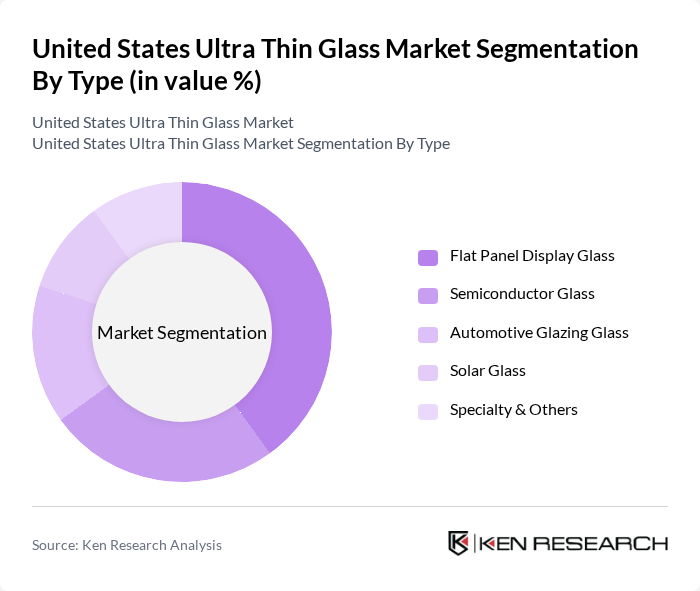
The Flat Panel Display Glass segment dominates the ultra-thin glass market due to the increasing demand for high-resolution displays in consumer electronics such as smartphones, tablets, and televisions. The trend towards larger screens, thinner designs, and flexible displays has led manufacturers to seek ultra-thin glass solutions that offer enhanced durability and optical clarity. Additionally, advancements in display technologies, including OLED and LCD, further drive the need for specialized glass products .
By End-User:The ultra-thin glass market is segmented by end-users, including Consumer Electronics, Automotive, Construction & Architecture, Healthcare & Medical Devices, Energy & Solar, and Industrial & Others. Each end-user segment has unique requirements and applications that influence the demand for ultra-thin glass products. Consumer Electronics leads due to the proliferation of smartphones, tablets, wearable devices, and smart displays. Automotive applications are expanding with the integration of head-up displays, lightweight glazing, and advanced infotainment panels. Construction & Architecture utilizes ultra-thin glass for smart windows and energy-efficient facades. Healthcare & Medical Devices benefit from biocompatible and high-precision glass components. Energy & Solar and Industrial & Others cover specialized uses in renewable energy and manufacturing .
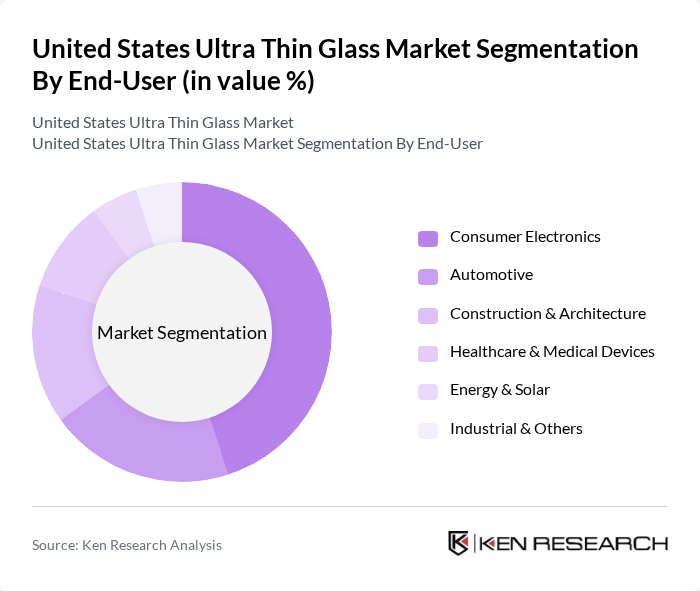
The Consumer Electronics segment is the leading end-user of ultra-thin glass, driven by the rapid growth of smartphones, tablets, and other portable devices. The demand for sleek, lightweight, and durable materials in electronic devices has propelled manufacturers to adopt ultra-thin glass solutions. Additionally, the trend towards smart devices, IoT applications, and flexible electronics further enhances the need for advanced glass technologies in this sector .
United States Ultra Thin Glass Market Competitive Landscape
The United States Ultra Thin Glass Market is characterized by a dynamic mix of regional and international players. Leading participants such as Corning Incorporated, AGC Inc. (Asahi Glass Company), SCHOTT AG, Nippon Sheet Glass Co., Ltd. (NSG Group), Saint-Gobain S.A., Guardian Glass LLC, Xinyi Glass Holdings Limited, Euroglas GmbH, Pilkington Group Limited, Trulite Glass & Aluminum Solutions, LLC, PPG Industries, Inc., Vitro Architectural Glass, CSG Holding Co., Ltd., Taiwan Glass Ind. Corp., NEG (Nippon Electric Glass Co., Ltd.) contribute to innovation, geographic expansion, and service delivery in this space.
United States Ultra Thin Glass Market Industry Analysis
Growth Drivers
- Increasing Demand for Lightweight and Durable Materials:The United States is witnessing a significant shift towards lightweight materials, with the lightweight materials market projected to reach $150 billion in value in future. This trend is driven by industries such as aerospace and automotive, where reducing weight can enhance fuel efficiency. Ultra thin glass, known for its strength and lightweight properties, is increasingly favored, particularly in applications requiring durability without compromising on weight, thus supporting its market growth.
- Growth in Consumer Electronics and Display Technologies:The consumer electronics sector in the U.S. is expected to generate over $400 billion in revenue in future, with display technologies being a key driver. Ultra thin glass is essential for high-resolution displays in smartphones, tablets, and televisions. As manufacturers seek to produce sleeker devices, the demand for ultra thin glass is anticipated to rise, bolstered by innovations in display technology that require thinner, more resilient materials.
- Advancements in Manufacturing Processes:The ultra thin glass manufacturing sector is benefiting from technological advancements, with production efficiency improving by 30% over the past few years. Innovations such as automated glass cutting and coating processes have reduced waste and enhanced product quality. These advancements not only lower production costs but also enable manufacturers to meet the increasing demand for ultra thin glass in various applications, further driving market growth.
Market Challenges
- High Production Costs:The production of ultra thin glass involves complex processes that contribute to high costs, estimated at $15 per square meter in future. This is significantly higher than traditional glass, which costs around $8 per square meter. The high costs can deter potential buyers, particularly in price-sensitive markets, limiting the overall market growth and making it challenging for manufacturers to maintain competitive pricing.
- Vulnerability to Market Fluctuations:The ultra thin glass market is susceptible to fluctuations in demand, particularly from the consumer electronics sector, which can experience rapid changes. For instance, a decline in smartphone sales in recent periods led to a noticeable drop in ultra thin glass orders. Such volatility can create uncertainty for manufacturers, impacting production planning and financial stability, thus posing a significant challenge to sustained market growth.
United States Ultra Thin Glass Market Future Outlook
The future of the ultra thin glass market in the United States appears promising, driven by increasing applications in emerging technologies and a growing emphasis on sustainability. As industries adopt eco-friendly practices, the demand for sustainable materials is expected to rise. Additionally, the integration of smart technologies in various sectors will likely create new opportunities for ultra thin glass, positioning it as a critical component in future innovations across multiple applications.
Market Opportunities
- Expansion in Renewable Energy Applications:The renewable energy sector is projected to reach $1 trillion in future, with ultra thin glass playing a vital role in solar panel manufacturing. Its lightweight and durable properties make it ideal for enhancing solar panel efficiency, presenting a significant opportunity for growth in this market segment.
- Increasing Adoption in Smart Glass Technologies:The smart glass market is expected to grow to $5 billion in future, driven by demand in architectural and automotive applications. Ultra thin glass is essential for smart glass technologies, which offer energy efficiency and privacy solutions, thus providing a lucrative opportunity for manufacturers to expand their product offerings in this innovative field.
Scope of the Report
| Segment | Sub-Segments |
|---|---|
| By Type | Flat Panel Display Glass Semiconductor Glass Automotive Glazing Glass Solar Glass Specialty & Others |
| By End-User | Consumer Electronics Automotive Construction & Architecture Healthcare & Medical Devices Energy & Solar Industrial & Others |
| By Application | Displays (Flexible, Rigid, Mobile, Television) Touch Panels & Sensors Automotive HUDs & Glazing Photovoltaic Modules & Solar Panels Medical & Pharmaceutical Packaging Others |
| By Thickness | Below 0.1 mm mm to 0.5 mm mm to 1 mm Above 1 mm |
| By Coating Type | Anti-Reflective Coating Conductive Coating Protective Coating Others |
| By Distribution Channel | Direct Sales Online Retail Distributors Others |
| By Region | Northeast Midwest South West |
Key Target Audience
Investors and Venture Capitalist Firms
Government and Regulatory Bodies (e.g., U.S. Department of Commerce, U.S. Environmental Protection Agency)
Manufacturers and Producers
Distributors and Retailers
Technology Providers
Industry Associations (e.g., Glass Association of North America)
Financial Institutions
Construction and Architectural Firms
Players Mentioned in the Report:
Corning Incorporated
AGC Inc. (Asahi Glass Company)
SCHOTT AG
Nippon Sheet Glass Co., Ltd. (NSG Group)
Saint-Gobain S.A.
Guardian Glass LLC
Xinyi Glass Holdings Limited
Euroglas GmbH
Pilkington Group Limited
Trulite Glass & Aluminum Solutions, LLC
PPG Industries, Inc.
Vitro Architectural Glass
CSG Holding Co., Ltd.
Taiwan Glass Ind. Corp.
NEG (Nippon Electric Glass Co., Ltd.)
Table of Contents
Market Assessment Phase
1. Executive Summary and Approach
2. United States Ultra Thin Glass Market Overview
2.1 Key Insights and Strategic Recommendations
2.2 United States Ultra Thin Glass Market Overview
2.3 Definition and Scope
2.4 Evolution of Market Ecosystem
2.5 Timeline of Key Regulatory Milestones
2.6 Value Chain & Stakeholder Mapping
2.7 Business Cycle Analysis
2.8 Policy & Incentive Landscape
3. United States Ultra Thin Glass Market Analysis
3.1 Growth Drivers
3.1.1 Increasing demand for lightweight and durable materials
3.1.2 Growth in consumer electronics and display technologies
3.1.3 Advancements in manufacturing processes
3.1.4 Rising applications in automotive and construction sectors
3.2 Market Challenges
3.2.1 High production costs
3.2.2 Vulnerability to market fluctuations
3.2.3 Limited availability of raw materials
3.2.4 Competition from alternative materials
3.3 Market Opportunities
3.3.1 Expansion in renewable energy applications
3.3.2 Increasing adoption in smart glass technologies
3.3.3 Growth in the automotive sector
3.3.4 Potential in medical and pharmaceutical applications
3.4 Market Trends
3.4.1 Shift towards sustainable and eco-friendly materials
3.4.2 Integration of IoT in glass manufacturing
3.4.3 Customization and personalization in product offerings
3.4.4 Rise of online sales channels
3.5 Government Regulation
3.5.1 Environmental regulations on manufacturing processes
3.5.2 Safety standards for glass products
3.5.3 Trade policies affecting imports and exports
3.5.4 Incentives for using sustainable materials
4. SWOT Analysis
5. Stakeholder Analysis
6. Porter's Five Forces Analysis
7. United States Ultra Thin Glass Market Market Size, 2019-2024
7.1 By Value
7.2 By Volume
7.3 By Average Selling Price
8. United States Ultra Thin Glass Market Segmentation
8.1 By Type
8.1.1 Flat Panel Display Glass
8.1.2 Semiconductor Glass
8.1.3 Automotive Glazing Glass
8.1.4 Solar Glass
8.1.5 Specialty & Others
8.2 By End-User
8.2.1 Consumer Electronics
8.2.2 Automotive
8.2.3 Construction & Architecture
8.2.4 Healthcare & Medical Devices
8.2.5 Energy & Solar
8.2.6 Industrial & Others
8.3 By Application
8.3.1 Displays (Flexible, Rigid, Mobile, Television)
8.3.2 Touch Panels & Sensors
8.3.3 Automotive HUDs & Glazing
8.3.4 Photovoltaic Modules & Solar Panels
8.3.5 Medical & Pharmaceutical Packaging
8.3.6 Others
8.4 By Thickness
8.4.1 Below 0.1 mm
8.4.2 0.1 mm to 0.5 mm
8.4.3 0.5 mm to 1 mm
8.4.4 Above 1 mm
8.5 By Coating Type
8.5.1 Anti-Reflective Coating
8.5.2 Conductive Coating
8.5.3 Protective Coating
8.5.4 Others
8.6 By Distribution Channel
8.6.1 Direct Sales
8.6.2 Online Retail
8.6.3 Distributors
8.6.4 Others
8.7 By Region
8.7.1 Northeast
8.7.2 Midwest
8.7.3 South
8.7.4 West
9. United States Ultra Thin Glass Market Competitive Analysis
9.1 Market Share of Key Players
9.2 Cross Comparison of Key Players
9.2.1 Company Name
9.2.2 Group Size (Large, Medium, or Small as per industry convention)
9.2.3 Revenue (USD Million, US Market)
9.2.4 Revenue Growth Rate (US Market, % CAGR)
9.2.5 Market Share (%)
9.2.6 Product Portfolio Breadth (Number of Ultra Thin Glass SKUs/Types)
9.2.7 R&D Investment (% of Revenue)
9.2.8 Number of US Manufacturing Sites
9.2.9 Key End-Markets Served (Electronics, Automotive, Solar, etc.)
9.2.10 Strategic Partnerships & Supply Agreements (Number/Key Partners)
9.2.11 Patent Filings (Ultra Thin Glass, US)
9.2.12 Sustainability Initiatives (e.g., % Recycled Content, Energy Use Reduction)
9.3 SWOT Analysis of Top Players
9.4 Pricing Analysis
9.5 Detailed Profile of Major Companies
9.5.1 Corning Incorporated
9.5.2 AGC Inc. (Asahi Glass Company)
9.5.3 SCHOTT AG
9.5.4 Nippon Sheet Glass Co., Ltd. (NSG Group)
9.5.5 Saint-Gobain S.A.
9.5.6 Guardian Glass LLC
9.5.7 Xinyi Glass Holdings Limited
9.5.8 Euroglas GmbH
9.5.9 Pilkington Group Limited
9.5.10 Trulite Glass & Aluminum Solutions, LLC
9.5.11 PPG Industries, Inc.
9.5.12 Vitro Architectural Glass
9.5.13 CSG Holding Co., Ltd.
9.5.14 Taiwan Glass Ind. Corp.
9.5.15 NEG (Nippon Electric Glass Co., Ltd.)
10. United States Ultra Thin Glass Market End-User Analysis
10.1 Procurement Behavior of Key Ministries
10.1.1 Government procurement policies
10.1.2 Budget allocation for infrastructure projects
10.1.3 Preference for local suppliers
10.1.4 Sustainability considerations in procurement
10.2 Corporate Spend on Infrastructure & Energy
10.2.1 Investment trends in construction
10.2.2 Spending on energy-efficient solutions
10.2.3 Budgeting for technology upgrades
10.2.4 Corporate social responsibility initiatives
10.3 Pain Point Analysis by End-User Category
10.3.1 Cost constraints
10.3.2 Quality assurance issues
10.3.3 Supply chain disruptions
10.3.4 Regulatory compliance challenges
10.4 User Readiness for Adoption
10.4.1 Awareness of ultra-thin glass benefits
10.4.2 Training and support needs
10.4.3 Financial readiness for investment
10.4.4 Technological infrastructure
10.5 Post-Deployment ROI and Use Case Expansion
10.5.1 Measurement of performance metrics
10.5.2 Case studies of successful implementations
10.5.3 Feedback mechanisms for improvement
10.5.4 Opportunities for scaling applications
11. United States Ultra Thin Glass Market Future Size, 2025-2030
11.1 By Value
11.2 By Volume
11.3 By Average Selling Price
Go-To-Market Strategy Phase
1. Whitespace Analysis + Business Model Canvas
1.1 Market gaps identification
1.2 Value proposition development
1.3 Revenue model exploration
1.4 Customer segmentation analysis
1.5 Competitive landscape assessment
1.6 Key partnerships identification
1.7 Resource allocation strategy
2. Marketing and Positioning Recommendations
2.1 Branding strategies
2.2 Product USPs
2.3 Target audience definition
2.4 Communication channels selection
2.5 Marketing budget allocation
2.6 Performance metrics establishment
2.7 Feedback and iteration process
3. Distribution Plan
3.1 Urban retail strategies
3.2 Rural NGO tie-ups
3.3 E-commerce integration
3.4 Logistics and supply chain management
3.5 Distribution partnerships
3.6 Inventory management practices
3.7 Customer service protocols
4. Channel & Pricing Gaps
4.1 Underserved routes analysis
4.2 Pricing bands evaluation
4.3 Competitor pricing strategies
4.4 Customer willingness to pay
4.5 Price elasticity assessment
4.6 Discounting strategies
4.7 Value-based pricing models
5. Unmet Demand & Latent Needs
5.1 Category gaps identification
5.2 Consumer segments analysis
5.3 Emerging trends exploration
5.4 Product development opportunities
5.5 Market entry barriers
5.6 Customer feedback incorporation
5.7 Future demand forecasting
6. Customer Relationship
6.1 Loyalty programs design
6.2 After-sales service strategies
6.3 Customer engagement initiatives
6.4 Feedback collection methods
6.5 Relationship management tools
6.6 Community building efforts
6.7 Customer education programs
7. Value Proposition
7.1 Sustainability initiatives
7.2 Integrated supply chains
7.3 Unique selling points
7.4 Customer-centric approach
7.5 Competitive advantages
7.6 Long-term value creation
7.7 Brand loyalty enhancement
8. Key Activities
8.1 Regulatory compliance
8.2 Branding efforts
8.3 Distribution setup
8.4 Market research activities
8.5 Training and development
8.6 Performance monitoring
8.7 Stakeholder engagement
9. Entry Strategy Evaluation
9.1 Domestic Market Entry Strategy
9.1.1 Product mix considerations
9.1.2 Pricing band analysis
9.1.3 Packaging strategies
9.2 Export Entry Strategy
9.2.1 Target countries selection
9.2.2 Compliance roadmap development
10. Entry Mode Assessment
10.1 Joint Ventures
10.2 Greenfield Investments
10.3 Mergers & Acquisitions
10.4 Distributor Model
10.5 Risk assessment
10.6 Strategic fit evaluation
10.7 Long-term partnership considerations
11. Capital and Timeline Estimation
11.1 Capital requirements analysis
11.2 Timelines for market entry
11.3 Funding sources identification
11.4 Financial projections
11.5 Risk management strategies
11.6 Milestone tracking
11.7 Resource allocation planning
12. Control vs Risk Trade-Off
12.1 Ownership considerations
12.2 Partnership dynamics
12.3 Risk mitigation strategies
12.4 Control mechanisms
12.5 Long-term sustainability
12.6 Exit strategies
12.7 Stakeholder alignment
13. Profitability Outlook
13.1 Breakeven analysis
13.2 Long-term sustainability strategies
13.3 Profit margin optimization
13.4 Revenue diversification
13.5 Cost management practices
13.6 Financial health monitoring
13.7 Investment return assessment
14. Potential Partner List
14.1 Distributors
14.2 Joint Ventures
14.3 Acquisition targets
14.4 Strategic alliances
14.5 Industry collaborations
14.6 Research partnerships
14.7 Community engagement initiatives
15. Execution Roadmap
15.1 Phased Plan for Market Entry
15.1.1 Market Setup
15.1.2 Market Entry
15.1.3 Growth Acceleration
15.1.4 Scale & Stabilize
15.2 Key Activities and Milestones
1
Research Methodology
Phase 1: Approach1
Desk Research
- Industry reports from Glass Association of North America and relevant trade publications
- Market statistics from the U.S. Census Bureau and other governmental databases
- Analysis of technological advancements in ultra-thin glass production from academic journals
Primary Research
- Interviews with key stakeholders in the ultra-thin glass manufacturing sector
- Surveys targeting architects and designers utilizing ultra-thin glass in projects
- Field interviews with engineers and product managers in glass fabrication companies
Validation & Triangulation
- Cross-validation of data through multiple industry sources and expert opinions
- Triangulation of market trends with sales data and production capacity reports
- Sanity checks conducted through expert panel discussions and feedback sessions
Phase 2: Market Size Estimation1
Top-down Assessment
- Analysis of overall glass market size and segmentation by ultra-thin glass applications
- Evaluation of growth drivers including construction trends and consumer electronics demand
- Incorporation of macroeconomic indicators affecting the glass industry
Bottom-up Modeling
- Estimation of production volumes from leading ultra-thin glass manufacturers
- Cost analysis based on raw material prices and manufacturing processes
- Volume x price modeling to derive revenue projections for the ultra-thin glass segment
Forecasting & Scenario Analysis
- Multi-variable forecasting using historical growth rates and market trends
- Scenario analysis based on potential regulatory changes and technological innovations
- Development of baseline, optimistic, and pessimistic market forecasts through 2030
Phase 3: CATI Sample Composition1
| Scope Item/Segment | Sample Size | Target Respondent Profiles |
|---|---|---|
| Architectural Applications | 100 | Architects, Project Managers |
| Consumer Electronics | 70 | Product Designers, R&D Engineers |
| Automotive Industry | 60 | Automotive Engineers, Procurement Managers |
| Solar Panel Manufacturing | 50 | Manufacturing Managers, Sustainability Officers |
| Retail Display Solutions | 80 | Retail Managers, Visual Merchandisers |
Frequently Asked Questions
What is the current value of the United States Ultra Thin Glass Market?
The United States Ultra Thin Glass Market is valued at approximately USD 2.5 billion, reflecting significant growth driven by demand in consumer electronics, automotive, and renewable energy sectors, alongside advancements in technology and manufacturing processes.
What are the main applications of ultra-thin glass?
Which sectors are driving the growth of the ultra-thin glass market?
What are the key types of ultra-thin glass?
Other Regional/Country Reports
Indonesia Ultra Thin Glass Market
Malaysia Ultra Thin Glass Market
KSA Ultra Thin Glass Market
APAC Ultra Thin Glass Market
SEA Ultra Thin Glass Market
Other Adjacent Reports
Japan Flat Panel Display Market
Vietnam semiconductor packaging market report size, share, growth drivers, trends, opportunities & forecast 2025–2030Qatar Automotive Glazing Market
India Solar Photovoltaic MarketKSA Consumer Electronics Display Market
Belgium Smart Glass Technology Market
Europe Flexible Electronics Market Size, Share & Forecast, By Product Type, Application & End-Use Industry, 2026-2031UAE Wearable Device Market
South Korea Advanced Materials Market
Global Architectural Glass Market Size, Share & Forecast, By Product Type, Application, End-Use Industry & Technology, 2026-2031Why Buy From Us?

What makes us stand out is that our consultants follow Robust, Refine and Result (RRR) methodology. Robust for clear definitions, approaches and sanity checking, Refine for differentiating respondents' facts and opinions, and Result for presenting data with story.

We have set a benchmark in the industry by offering our clients with syndicated and customized market research reports featuring coverage of entire market as well as meticulous research and analyst insights.

While we don't replace traditional research, we flip the method upside down. Our dual approach of Top Bottom & Bottom Top ensures quality deliverable by not just verifying company fundamentals but also looking at the sector and macroeconomic factors.

With one step in the future, our research team constantly tries to show you the bigger picture. We help with some of the tough questions you may encounter along the way: How is the industry positioned? Best marketing channel? KPI's of competitors? By aligning every element, we help maximize success.

Our report gives you instant access to the answers and sources that other companies might choose to hide. We elaborate each steps of research methodology we have used and showcase you the sample size to earn your trust.

If you need any support, we are here! We pride ourselves on universe strength, data quality, and quick, friendly, and professional service.