About the Report
Base Year 2024Listen to the audio summary
US Bus Market Overview
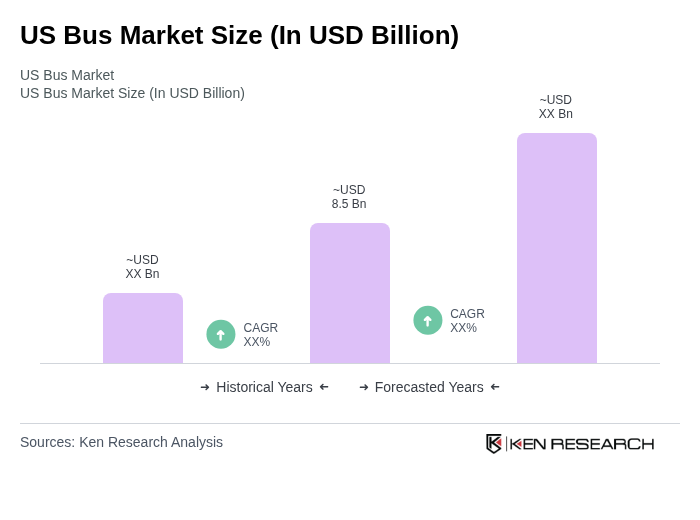
- The US Bus Market is valued at USD 8.5 billion, based on a five-year historical analysis. This valuation aligns with the United States being the largest contributor within the North America bus market, which is estimated at around USD 7.5–8.5 billion for the region, with the US accounting for the dominant share of public transit, intercity, and school bus activity. Growth is primarily driven by increasing urbanization, sustained government investments in public transportation infrastructure, and a rising demand for eco-friendly transportation solutions. The market has seen a pronounced shift towards electric and hybrid buses, supported by federal and state incentives and programs such as the Federal Transit Administration’s Low-No Emission Vehicle Program and the EPA’s Clean School Bus Program, reflecting a broader trend towards sustainability in public transport.
- Key cities dominating the US Bus Market include New York, Los Angeles, and Chicago, which host some of the largest and most heavily used transit bus systems in the country through agencies such as MTA, LA Metro, and CTA. These cities have extensive public transit networks and high population densities, driving strong demand for fixed-route transit, BRT, and feeder bus services. Their long-term commitments to improving public transportation infrastructure and reducing carbon emissions—through zero?emission fleet targets, dedicated bus lanes, and large-scale procurement of electric buses—further solidify their dominance in the market.
- In 2021, the US government enacted the Infrastructure Investment and Jobs Act, commonly referred to as the Bipartisan Infrastructure Law, which provides approximately USD 39 billion in new funding for public transit over a multi?year period, in addition to ongoing formula programs. This federal law aims to enhance the safety, reliability, and accessibility of public transportation systems across the country and includes dedicated programs that support the purchase of low? and zero?emission transit and school buses, charging infrastructure, and depot upgrades, thereby promoting the adoption of cleaner and more efficient bus technologies.
US Bus Market Segmentation
By Vehicle Type:The vehicle type segmentation includes various categories such as Transit Buses (Urban & Suburban), School Buses, Intercity / Coach Buses, Shuttle & Commuter Buses, and Others. Among these, Transit Buses (Urban & Suburban) dominate the market in value terms due to their essential role in municipal and regional public transportation systems, carrying large volumes of daily commuters in dense urban corridors. The increasing focus on reducing traffic congestion, expanding bus rapid transit (BRT) corridors, and promoting mode shift from private cars to public transport has led to higher demand for these buses, including a growing share of battery?electric and hybrid units. School Buses also hold a significant share, underpinned by the United States operating nearly half a million school buses daily, the largest student transportation system globally, and by strong funding for fleet renewal and electrification via the EPA Clean School Bus Program. The Intercity / Coach Buses segment is recovering and growing as tourism, charter services, and long-distance bus travel rebound post?pandemic, with operators increasingly investing in fuel?efficient and comfort?enhanced coaches as an alternative to short?haul air travel.

By End-User:The end-user segmentation encompasses Public Transit Agencies, School Districts & Educational Institutions, Private Fleet Operators (Charter & Tour), Corporate & Institutional Fleets, and Others. Public Transit Agencies are the leading end-users, as they oversee city and regional bus services and account for the largest share of transit bus procurements supported by federal programs such as FTA formula grants and Low-No Emission grants. Increasing government funding for public transit, combined with policy commitments to electrify municipal fleets, has further bolstered this segment. School Districts & Educational Institutions also represent a significant portion of the market, driven by the need for safe and reliable student transportation and accelerated replacement of older diesel fleets with cleaner technologies under the EPA’s Clean School Bus Program. Private Fleet Operators (charter, tour, and intercity operators) are gaining traction as more individuals and businesses seek flexible group travel options, supported by the strong economic contribution of the US motorcoach industry to tourism and intercity mobility.

US Bus Market Competitive Landscape
The US Bus Market is characterized by a dynamic mix of regional and international players. Leading participants such as New Flyer of America Inc. (NFI Group), Gillig LLC, Proterra Inc., Daimler Buses (Mercedes-Benz / Setra), Blue Bird Corporation, Thomas Built Buses (Daimler Truck North America), Navistar International Corporation (IC Bus), BYD Motors Inc., ENC (ElDorado National California), Lion Electric Company, REV Group (Collins Bus, Capacity & Other Brands), Alexander Dennis Inc. (North America), Nova Bus (A Volvo Group Company), Van Hool (North America Operations), MCI – Motor Coach Industries (NFI Group) contribute to innovation, geographic expansion, and service delivery in this space.
US Bus Market Industry Analysis
Growth Drivers
- Increasing Urbanization:The US urban population is projected to remain below 90% in future, but urban areas already house more than 80% of the US population, driving demand for efficient public transport solutions. Urban areas, which house over 80% of the US population, are experiencing significant congestion, with traffic delays costing the economy approximately $166 billion annually. This urbanization trend necessitates enhanced bus services to accommodate growing commuter needs, leading to increased investments in bus infrastructure and services.
- Government Investment in Public Transport:In future, federal and state governments are expected to allocate over $100 billion towards public transportation projects, including bus systems. This funding is part of a broader initiative to improve public transport accessibility and efficiency. The Bipartisan Infrastructure Law has earmarked approximately $39 billion specifically for public transit, which will significantly enhance bus networks across urban and rural areas, fostering growth in the bus market.
- Rising Environmental Concerns:With the US aiming for a 50% reduction in greenhouse gas emissions by 2030, the shift towards sustainable transport is accelerating. The Environmental Protection Agency (EPA) reported that transportation accounts for approximately 29% of total emissions. Consequently, there is a growing push for electric and hybrid buses, with several thousand electric buses projected to be in operation in future, significantly contributing to market growth and environmental sustainability.
Market Challenges
- High Initial Capital Investment:The average cost of a new bus can exceed $500,000, with electric buses costing in the range of $700,000 to $900,000. This high initial investment poses a significant barrier for many transit agencies, particularly smaller ones. Additionally, the need for infrastructure upgrades to support new technologies further exacerbates financial constraints, limiting the ability to expand and modernize bus fleets effectively.
- Competition from Alternative Transport Modes:The rise of ride-sharing services, such as Uber and Lyft, has created stiff competition for traditional bus services. In future, ride-sharing is expected to account for approximately 20% of urban transport, drawing riders away from public buses. This shift challenges bus operators to innovate and improve service offerings to retain and attract passengers, impacting overall market growth.
US Bus Market Future Outlook
The US bus market is poised for transformative growth driven by technological advancements and a commitment to sustainability. As electric bus adoption increases, infrastructure development will play a crucial role in supporting this transition. Additionally, the integration of smart technologies will enhance operational efficiency and passenger experience. With government backing and rising environmental awareness, the market is expected to evolve, focusing on innovative solutions that meet the demands of modern urban mobility.
Market Opportunities
- Expansion of Electric Bus Infrastructure:The development of charging stations and maintenance facilities for electric buses is critical. With over $2 billion allocated for electric vehicle infrastructure in future, this opportunity will facilitate the transition to cleaner transport, enhancing operational efficiency and reducing emissions, thus attracting more riders to public bus services.
- Partnerships with Ride-Sharing Services:Collaborations between bus operators and ride-sharing platforms can create integrated transport solutions. In future, such partnerships could enhance service coverage and convenience, potentially increasing ridership by 15%. This synergy can optimize routes and improve overall public transport accessibility, making bus services more competitive against alternative modes.
Scope of the Report
| Segment | Sub-Segments |
|---|---|
| By Vehicle Type | Transit Buses (Urban & Suburban) School Buses Intercity / Coach Buses Shuttle & Commuter Buses Others |
| By End-User | Public Transit Agencies School Districts & Educational Institutions Private Fleet Operators (Charter & Tour) Corporate & Institutional Fleets Others |
| By Seating Capacity | Up to 30 Seats –50 Seats More Than 50 Seats Articulated / High-Capacity Configurations Others |
| By Propulsion / Fuel Type | Diesel Gasoline Hybrid (Diesel / Gasoline-Electric) Battery Electric Alternative Fuels (CNG, LNG, Hydrogen, Others) |
| By Application | Urban & Suburban Transit Intercity & Long-Distance Transport School Transportation Airport, Campus & Corporate Shuttle Tour and Charter Services |
| By Ownership Model | Public Ownership Private Ownership Leasing & Fleet Management Contracted / Outsourced Operations Others |
| By Technology & Connectivity Level | Basic Connected Buses (GPS & Telematics) Advanced Driver Assistance Systems (ADAS) Smart Fare & Contactless Payment Systems Real-Time Passenger Information & Fleet Management Emerging Autonomous & Highly Automated Buses |
Key Target Audience
Investors and Venture Capitalist Firms
Government and Regulatory Bodies (e.g., Federal Transit Administration, Environmental Protection Agency)
Bus Manufacturers and Producers
Public Transportation Authorities
Fleet Management Companies
Bus Component Suppliers
Industry Associations (e.g., American Public Transportation Association)
Financial Institutions and Banks
Players Mentioned in the Report:
New Flyer of America Inc. (NFI Group)
Gillig LLC
Proterra Inc.
Daimler Buses (Mercedes-Benz / Setra)
Blue Bird Corporation
Thomas Built Buses (Daimler Truck North America)
Navistar International Corporation (IC Bus)
BYD Motors Inc.
ENC (ElDorado National California)
Lion Electric Company
REV Group (Collins Bus, Capacity & Other Brands)
Alexander Dennis Inc. (North America)
Nova Bus (A Volvo Group Company)
Van Hool (North America Operations)
MCI Motor Coach Industries (NFI Group)
Table of Contents
Market Assessment Phase
1. Executive Summary and Approach
2. US Bus Market Overview
2.1 Key Insights and Strategic Recommendations
2.2 US Bus Market Overview
2.3 Definition and Scope
2.4 Evolution of Market Ecosystem
2.5 Timeline of Key Regulatory Milestones
2.6 Value Chain & Stakeholder Mapping
2.7 Business Cycle Analysis
2.8 Policy & Incentive Landscape
3. US Bus Market Analysis
3.1 Growth Drivers
3.1.1 Increasing Urbanization
3.1.2 Government Investment in Public Transport
3.1.3 Rising Environmental Concerns
3.1.4 Technological Advancements in Bus Manufacturing
3.2 Market Challenges
3.2.1 High Initial Capital Investment
3.2.2 Competition from Alternative Transport Modes
3.2.3 Regulatory Compliance Costs
3.2.4 Fluctuating Fuel Prices
3.3 Market Opportunities
3.3.1 Expansion of Electric Bus Infrastructure
3.3.2 Partnerships with Ride-Sharing Services
3.3.3 Development of Smart Bus Systems
3.3.4 Increased Focus on Sustainable Transport Solutions
3.4 Market Trends
3.4.1 Shift Towards Electrification
3.4.2 Integration of AI and IoT in Bus Operations
3.4.3 Growing Demand for On-Demand Bus Services
3.4.4 Enhanced Passenger Experience through Technology
3.5 Government Regulation
3.5.1 Emission Standards Compliance
3.5.2 Funding Programs for Public Transit
3.5.3 Safety Regulations for Bus Operations
3.5.4 Accessibility Standards for Public Transport
4. SWOT Analysis
5. Stakeholder Analysis
6. Porter's Five Forces Analysis
7. US Bus Market Market Size, 2019-2024
7.1 By Value
7.2 By Volume
7.3 By Average Selling Price
8. US Bus Market Segmentation
8.1 By Vehicle Type
8.1.1 Transit Buses (Urban & Suburban)
8.1.2 School Buses
8.1.3 Intercity / Coach Buses
8.1.4 Shuttle & Commuter Buses
8.1.5 Others
8.2 By End-User
8.2.1 Public Transit Agencies
8.2.2 School Districts & Educational Institutions
8.2.3 Private Fleet Operators (Charter & Tour)
8.2.4 Corporate & Institutional Fleets
8.2.5 Others
8.3 By Seating Capacity
8.3.1 Up to 30 Seats
8.3.2 31–50 Seats
8.3.3 More Than 50 Seats
8.3.4 Articulated / High-Capacity Configurations
8.3.5 Others
8.4 By Propulsion / Fuel Type
8.4.1 Diesel
8.4.2 Gasoline
8.4.3 Hybrid (Diesel / Gasoline-Electric)
8.4.4 Battery Electric
8.4.5 Alternative Fuels (CNG, LNG, Hydrogen, Others)
8.5 By Application
8.5.1 Urban & Suburban Transit
8.5.2 Intercity & Long-Distance Transport
8.5.3 School Transportation
8.5.4 Airport, Campus & Corporate Shuttle
8.5.5 Tour and Charter Services
8.6 By Ownership Model
8.6.1 Public Ownership
8.6.2 Private Ownership
8.6.3 Leasing & Fleet Management
8.6.4 Contracted / Outsourced Operations
8.6.5 Others
8.7 By Technology & Connectivity Level
8.7.1 Basic Connected Buses (GPS & Telematics)
8.7.2 Advanced Driver Assistance Systems (ADAS)
8.7.3 Smart Fare & Contactless Payment Systems
8.7.4 Real-Time Passenger Information & Fleet Management
8.7.5 Emerging Autonomous & Highly Automated Buses
9. US Bus Market Competitive Analysis
9.1 Market Share of Key Players
9.2 Cross Comparison of Key Players
9.2.1 Company Name
9.2.2 Group Size (Global, Regional, or Niche Player)
9.2.3 US Bus Segment Revenue (Latest Year)
9.2.4 Revenue CAGR in US Bus Market
9.2.5 US Market Share by Volume
9.2.6 Order Backlog / Confirmed Orders in US
9.2.7 Installed Fleet Size in Operation (US)
9.2.8 Average Selling Price per Bus (US Portfolio)
9.2.9 R&D Spend as % of Revenue (Bus Segment)
9.2.10 Zero-Emission Buses as % of Deliveries (US)
9.2.11 Manufacturing & Assembly Footprint in US
9.2.12 Key US Transit & School Bus Customers Covered
9.3 SWOT Analysis of Top Players
9.4 Pricing Analysis
9.5 Detailed Profile of Major Companies
9.5.1 New Flyer of America Inc. (NFI Group)
9.5.2 Gillig LLC
9.5.3 Proterra Inc.
9.5.4 Daimler Buses (Mercedes-Benz / Setra)
9.5.5 Blue Bird Corporation
9.5.6 Thomas Built Buses (Daimler Truck North America)
9.5.7 Navistar International Corporation (IC Bus)
9.5.8 BYD Motors Inc.
9.5.9 ENC (ElDorado National California)
9.5.10 Lion Electric Company
9.5.11 REV Group (Collins Bus, Capacity & Other Brands)
9.5.12 Alexander Dennis Inc. (North America)
9.5.13 Nova Bus (A Volvo Group Company)
9.5.14 Van Hool (North America Operations)
9.5.15 MCI – Motor Coach Industries (NFI Group)
10. US Bus Market End-User Analysis
10.1 Procurement Behavior of Key Ministries
10.1.1 Budget Allocation Trends
10.1.2 Decision-Making Processes
10.1.3 Supplier Selection Criteria
10.1.4 Contracting Practices
10.2 Corporate Spend on Infrastructure & Energy
10.2.1 Investment Priorities
10.2.2 Budgeting Cycles
10.2.3 Cost-Benefit Analysis Practices
10.2.4 Funding Sources
10.3 Pain Point Analysis by End-User Category
10.3.1 Operational Inefficiencies
10.3.2 Maintenance Challenges
10.3.3 Compliance Issues
10.3.4 Customer Experience Concerns
10.4 User Readiness for Adoption
10.4.1 Technology Adoption Rates
10.4.2 Training and Support Needs
10.4.3 Infrastructure Readiness
10.4.4 Financial Preparedness
10.5 Post-Deployment ROI and Use Case Expansion
10.5.1 Performance Metrics
10.5.2 User Feedback Mechanisms
10.5.3 Scalability Potential
10.5.4 Long-Term Sustainability Considerations
11. US Bus Market Future Size, 2025-2030
11.1 By Value
11.2 By Volume
11.3 By Average Selling Price
Go-To-Market Strategy Phase
1. Whitespace Analysis + Business Model Canvas
1.1 Market Gaps Identification
1.2 Value Proposition Development
1.3 Revenue Streams Analysis
1.4 Cost Structure Evaluation
1.5 Key Partnerships Exploration
1.6 Customer Segmentation Insights
1.7 Channels and Customer Relationships
2. Marketing and Positioning Recommendations
2.1 Branding Strategies
2.2 Product USPs
3. Distribution Plan
3.1 Urban Retail vs Rural NGO Tie-ups
4. Channel & Pricing Gaps
4.1 Underserved Routes
4.2 Pricing Bands
5. Unmet Demand & Latent Needs
5.1 Category Gaps
5.2 Consumer Segments
6. Customer Relationship
6.1 Loyalty Programs
6.2 After-sales Service
7. Value Proposition
7.1 Sustainability
7.2 Integrated Supply Chains
8. Key Activities
8.1 Regulatory Compliance
8.2 Branding
8.3 Distribution Setup
9. Entry Strategy Evaluation
9.1 Domestic Market Entry Strategy
9.1.1 Product Mix
9.1.2 Pricing Band
9.1.3 Packaging
9.2 Export Entry Strategy
9.2.1 Target Countries
9.2.2 Compliance Roadmap
10. Entry Mode Assessment
10.1 JV
10.2 Greenfield
10.3 M&A
10.4 Distributor Model
11. Capital and Timeline Estimation
11.1 Capital Requirements
11.2 Timelines
12. Control vs Risk Trade-Off
12.1 Ownership vs Partnerships
13. Profitability Outlook
13.1 Breakeven Analysis
13.2 Long-term Sustainability
14. Potential Partner List
14.1 Distributors
14.2 JVs
14.3 Acquisition Targets
15. Execution Roadmap
15.1 Phased Plan for Market Entry
15.1.1 Market Setup
15.1.2 Market Entry
15.1.3 Growth Acceleration
15.1.4 Scale & Stabilize
15.2 Key Activities and Milestones
15.2.1 Milestone Planning
15.2.2 Activity Tracking
Research Methodology
Phase 1: Approach1
Desk Research
- Analysis of industry reports from the American Public Transportation Association (APTA)
- Review of government transportation statistics from the Federal Transit Administration (FTA)
- Examination of market trends and forecasts from the Bureau of Transportation Statistics (BTS)
Primary Research
- Interviews with executives from major bus manufacturing companies
- Surveys with transit agency managers regarding operational challenges and needs
- Focus groups with end-users, including commuters and transit advocates
Validation & Triangulation
- Cross-validation of findings with data from industry associations and government reports
- Triangulation of insights from primary interviews with secondary data trends
- Sanity checks through expert panel discussions with transportation economists
Phase 2: Market Size Estimation1
Top-down Assessment
- Estimation of total public transportation spending and its allocation to bus services
- Analysis of demographic trends influencing bus ridership across urban and rural areas
- Incorporation of federal and state funding initiatives for public transit improvements
Bottom-up Modeling
- Volume estimates based on ridership data from major metropolitan transit authorities
- Cost analysis of bus operations, including maintenance, fuel, and labor
- Revenue projections based on fare structures and subsidy models
Forecasting & Scenario Analysis
- Multi-variable regression analysis incorporating economic indicators and urbanization rates
- Scenario modeling based on potential shifts in public policy and environmental regulations
- Baseline, optimistic, and pessimistic forecasts through 2035
Phase 3: CATI Sample Composition1
| Scope Item/Segment | Sample Size | Target Respondent Profiles |
|---|---|---|
| Urban Bus Transit Systems | 140 | Transit Agency Directors, Operations Managers |
| School Bus Services | 110 | School District Transportation Coordinators, Fleet Managers |
| Charter and Tour Bus Operators | 90 | Business Owners, Marketing Managers |
| Electric Bus Adoption | 80 | Fleet Sustainability Officers, Procurement Specialists |
| Rural Bus Services | 60 | Community Transit Directors, Local Government Officials |
Frequently Asked Questions
What is the current value of the US Bus Market?
The US Bus Market is valued at approximately USD 8.5 billion, making it the largest contributor within the North American bus market, which is estimated to be around USD 7.58.5 billion for the region.
What factors are driving growth in the US Bus Market?
Which cities dominate the US Bus Market?
What is the impact of the Bipartisan Infrastructure Law on the bus market?
Other Regional/Country Reports
Indonesia Bus Market Report Size, Share, Growth Drivers, Trends, Opportunities & Forecast 2025–2030
Malaysia Bus Market Report Size, Share, Growth Drivers, Trends, Opportunities & Forecast 2025–2030
KSA Bus Market Report Size, Share, Growth Drivers, Trends, Opportunities & Forecast 2025–2030
APAC Bus Market Report Size, Share, Growth Drivers, Trends, Opportunities & Forecast 2025–2030
SEA Bus Market Report Size, Share, Growth Drivers, Trends, Opportunities & Forecast 2025–2030
Vietnam Bus Market Report Size, Share, Growth Drivers, Trends, Opportunities & Forecast 2025–2030
Other Adjacent Reports
Brazil Transit Bus Market
Kuwait Coach Bus Market
Qatar Hybrid Bus Market
Brazil Bus Manufacturing Market
Vietnam Bus Parts Market
Canada Fleet Management Market Size, Share & Forecast, By Solution Type, Deployment Model & End-Use Industry, 2025-2032Middle East Public Transportation Market Size, Share & Forecast, By Mode of Transport, Service Type & Customer Type, 2026-2031Mexico Sustainable Mobility Market
Why Buy From Us?

What makes us stand out is that our consultants follow Robust, Refine and Result (RRR) methodology. Robust for clear definitions, approaches and sanity checking, Refine for differentiating respondents' facts and opinions, and Result for presenting data with story.

We have set a benchmark in the industry by offering our clients with syndicated and customized market research reports featuring coverage of entire market as well as meticulous research and analyst insights.

While we don't replace traditional research, we flip the method upside down. Our dual approach of Top Bottom & Bottom Top ensures quality deliverable by not just verifying company fundamentals but also looking at the sector and macroeconomic factors.

With one step in the future, our research team constantly tries to show you the bigger picture. We help with some of the tough questions you may encounter along the way: How is the industry positioned? Best marketing channel? KPI's of competitors? By aligning every element, we help maximize success.

Our report gives you instant access to the answers and sources that other companies might choose to hide. We elaborate each steps of research methodology we have used and showcase you the sample size to earn your trust.

If you need any support, we are here! We pride ourselves on universe strength, data quality, and quick, friendly, and professional service.