About the Report
Base Year 2024US Electric Vehicle Aftermarket Overview
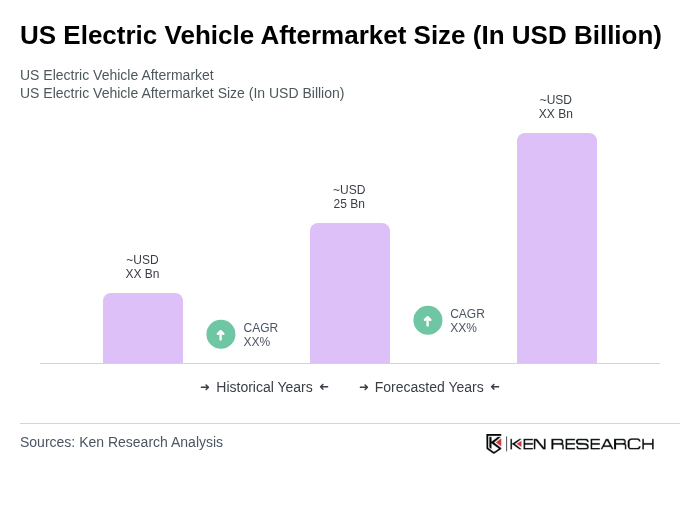
- The US Electric Vehicle Aftermarket is valued at USD 25 billion, based on a five-year historical analysis. This growth is primarily driven by the increasing adoption of electric vehicles, advancements in battery technology, and a growing emphasis on sustainability. The aftermarket segment is benefiting from the rising demand for replacement parts, accessories, and maintenance services as the number of electric vehicles on the road continues to expand.
- Key players in this market include California, Texas, and New York, which dominate due to their large populations, progressive environmental policies, and substantial investments in EV infrastructure. These states have established themselves as leaders in electric vehicle adoption, supported by government incentives and a robust charging network, making them attractive markets for aftermarket services and products.
- In 2023, the US government implemented the Inflation Reduction Act, which includes provisions for tax credits and incentives for electric vehicle purchases and infrastructure development. This regulation aims to accelerate the transition to electric mobility by making EVs more affordable for consumers and encouraging the expansion of charging networks across the country.
US Electric Vehicle Aftermarket Segmentation
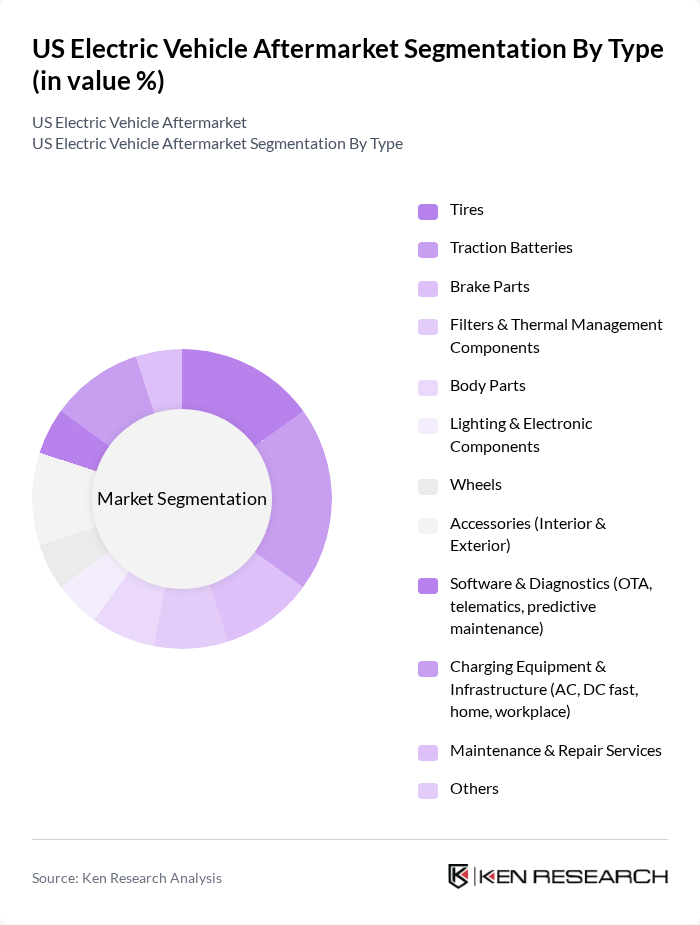
By Type:The aftermarket for electric vehicles can be segmented into various types, including Tires, Traction Batteries, Brake Parts, Filters & Thermal Management Components, Body Parts, Lighting & Electronic Components, Wheels, Accessories (Interior & Exterior), Software & Diagnostics (OTA, telematics, predictive maintenance), Charging Equipment & Infrastructure (AC, DC fast, home, workplace), Maintenance & Repair Services, and Others. Each of these subsegments plays a crucial role in supporting the growing electric vehicle ecosystem.
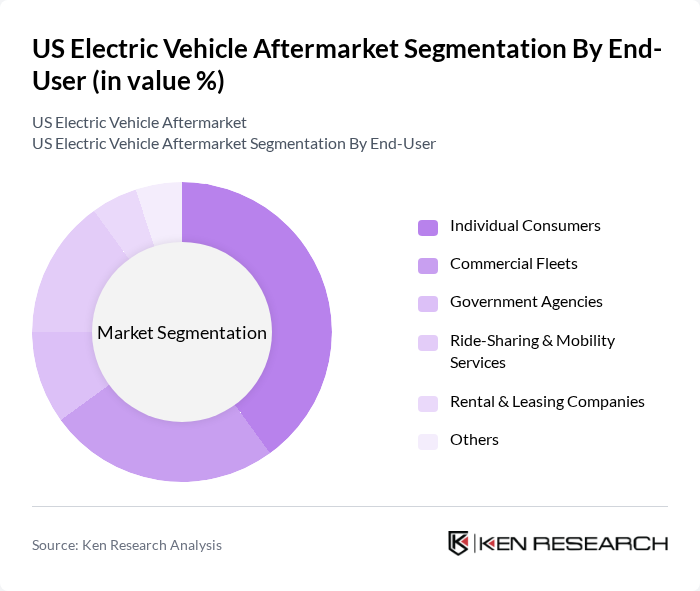
By End-User:The end-user segmentation of the electric vehicle aftermarket includes Individual Consumers, Commercial Fleets, Government Agencies, Ride-Sharing & Mobility Services, Rental & Leasing Companies, and Others. Each of these segments has unique needs and purchasing behaviors that influence the types of products and services they require.
US Electric Vehicle Aftermarket Competitive Landscape
The US Electric Vehicle Aftermarket market is characterized by a dynamic mix of regional and international players. Leading participants such as Tesla, Inc. (Service, parts, charging network), General Motors Company (Ultium-based EV service and parts ecosystem), Ford Motor Company (Model e-aligned EV service and dealer network), Stellantis N.V. (Chrysler, Jeep, Ram and other brand EV aftermarket in the US), ChargePoint Holdings, Inc., Blink Charging Co., EVgo Inc., Electrify America, LLC, Rivian Automotive, Inc. (service network and charging), Lucid Group, Inc. (service, software, over-the-air upgrades), Bosch Automotive Aftermarket (EV components, diagnostics, and workshop equipment), ZF Aftermarket (e-mobility components and systems), NAPA Auto Parts (US EV replacement parts and service network), AutoZone, Inc. (EV-compatible aftermarket parts and accessories), and O’Reilly Automotive, Inc. (EV-related parts and service support) contribute to product innovation, charging- and service-network expansion, software-enabled maintenance solutions, and new service models such as mobile repair and over-the-air feature deployment. Competition is increasingly shaped not only by physical parts availability but also by software platforms, data analytics, diagnostic tools, and partnerships between vehicle manufacturers, independent service providers, and charging-network operators.
US Electric Vehicle Aftermarket Industry Analysis
Growth Drivers
- Increasing Consumer Demand for Sustainable Transportation:The US electric vehicle (EV) market is projected to reach 8 million units sold in the future, driven by a growing consumer preference for sustainable transportation. According to the International Energy Agency, the number of electric cars on the road in the US surpassed 2.4 million in the future, reflecting a 33% increase from the previous year. This shift towards eco-friendly vehicles is supported by rising environmental awareness and a commitment to reducing carbon footprints.
- Expansion of Charging Infrastructure:The US government plans to invest $10 billion in EV charging infrastructure in the future, significantly enhancing the availability of charging stations. As of the future, there were approximately 160,000 public charging outlets across the country, a number expected to double in the future. This expansion is crucial for alleviating range anxiety among consumers and encouraging the adoption of electric vehicles, thereby boosting the aftermarket for EV components and services.
- Technological Advancements in Battery Technology:The average cost of lithium-ion batteries has decreased to $100 per kWh in the future, down from $1,200 per kWh in 2010, according to BloombergNEF. This reduction is expected to continue, making electric vehicles more affordable and appealing to consumers. Enhanced battery technologies, such as solid-state batteries, are anticipated to improve vehicle range and performance, further driving demand for EVs and their aftermarket services.
Market Challenges
- High Initial Purchase Costs:The average price of an electric vehicle in the US was approximately $58,000 in the future, which remains a significant barrier for many consumers. Despite government incentives, such as the federal tax credit of up to $7,500, the high upfront costs deter potential buyers. This challenge is compounded by the perception that EVs are still a luxury rather than a viable alternative to traditional vehicles, limiting market penetration.
- Limited Availability of Replacement Parts:The aftermarket for electric vehicle parts is still developing, with many manufacturers focusing on new vehicle production rather than parts supply. As of the future, only 35% of EV owners reported easy access to replacement parts, according to industry surveys. This scarcity can lead to longer repair times and increased costs, discouraging consumers from choosing electric vehicles and impacting the overall aftermarket growth.
US Electric Vehicle Aftermarket Future Outlook
The US electric vehicle aftermarket is poised for significant growth, driven by increasing consumer adoption and advancements in technology. As charging infrastructure expands and battery technologies improve, the market will likely see a surge in demand for aftermarket services and products. Additionally, the focus on sustainability will encourage manufacturers to innovate and adapt to changing consumer preferences. Overall, the landscape is evolving, presenting both challenges and opportunities for stakeholders in the electric vehicle aftermarket.
Market Opportunities
- Growth in Fleet Electrification:The electrification of commercial fleets is gaining momentum, with companies like Amazon committing to 150,000 electric delivery vans in the future. This shift presents a substantial opportunity for aftermarket services, as fleet operators will require maintenance and parts for their electric vehicles, driving demand in the sector.
- Development of Smart Charging Solutions:The rise of smart charging technologies, which optimize charging times and costs, is expected to create new business opportunities. In the future, the smart charging market is projected to reach $5 billion, offering aftermarket players a chance to innovate and provide integrated solutions that enhance the EV ownership experience.
Scope of the Report
| Segment | Sub-Segments |
|---|---|
| By Type | Tires Traction Batteries Brake Parts Filters & Thermal Management Components Body Parts Lighting & Electronic Components Wheels Accessories (Interior & Exterior) Software & Diagnostics (OTA, telematics, predictive maintenance) Charging Equipment & Infrastructure (AC, DC fast, home, workplace) Maintenance & Repair Services Others |
| By End-User | Individual Consumers Commercial Fleets Government Agencies Ride-Sharing & Mobility Services Rental & Leasing Companies Others |
| By Vehicle Type | Passenger Cars (Sedans, Hatchbacks) SUVs & Crossovers Pickup Trucks & Vans Buses & Medium/Heavy Commercial Vehicles Two- & Three-Wheelers Luxury & Performance EVs Others |
| By Charging Infrastructure | Residential/Home Charging Workplace & Destination Charging Public Level 2 Charging DC Fast Charging & Ultra-Fast Hubs Fleet & Depot Charging Solutions Others |
| By Distribution Channel | Authorized Service Centers (OEM) Premium Multi-Brand Service Centers Independent Workshops Digital Aggregators / Online Retail Direct Sales Others |
| By Geographic Region | West Coast (e.g., California, Washington, Oregon) Mountain & Southwest Midwest Northeast South & Southeast Others |
| By Policy Support | Federal Tax Credits & Incentives State-Level EV & Infrastructure Programs Utility & Local Government Initiatives ZEV, Emissions, and Right-to-Repair Regulations Others |
Key Target Audience
Investors and Venture Capitalist Firms
Government and Regulatory Bodies (e.g., U.S. Department of Energy, Environmental Protection Agency)
Automotive Parts Manufacturers
Electric Vehicle Charging Infrastructure Providers
Fleet Operators and Management Companies
Automotive Service and Repair Shops
Battery Manufacturers and Suppliers
Insurance Companies and Underwriters
Players Mentioned in the Report:
Tesla, Inc. (Service, parts, Supercharger network)
General Motors Company (Ultium platform, EV service & parts)
Ford Motor Company (Model e, EV service and dealer network)
Stellantis N.V. (Chrysler, Jeep, Ram EV aftermarket in US)
ChargePoint Holdings, Inc.
Blink Charging Co.
EVgo Inc.
Electrify America, LLC
Rivian Automotive, Inc. (Service network & charging)
Lucid Group, Inc. (Service, software, and upgrades)
Bosch Automotive Aftermarket (EV components, diagnostics, and equipment)
ZF Aftermarket (e-mobility components and systems)
NAPA Auto Parts (U.S. EV replacement parts & service network)
AutoZone, Inc. (EV-compatible aftermarket parts and accessories)
OReilly Automotive, Inc. (EV-related parts and service support)
Table of Contents
Market Assessment Phase
1. Executive Summary and Approach
2. US Electric Vehicle Aftermarket Overview
2.1 Key Insights and Strategic Recommendations
2.2 US Electric Vehicle Aftermarket Overview
2.3 Definition and Scope
2.4 Evolution of Market Ecosystem
2.5 Timeline of Key Regulatory Milestones
2.6 Value Chain & Stakeholder Mapping
2.7 Business Cycle Analysis
2.8 Policy & Incentive Landscape
3. US Electric Vehicle Aftermarket Analysis
3.1 Growth Drivers
3.1.1 Increasing Consumer Demand for Sustainable Transportation
3.1.2 Expansion of Charging Infrastructure
3.1.3 Technological Advancements in Battery Technology
3.1.4 Government Incentives and Subsidies
3.2 Market Challenges
3.2.1 High Initial Purchase Costs
3.2.2 Limited Availability of Replacement Parts
3.2.3 Consumer Awareness and Education Gaps
3.2.4 Competition from Traditional Vehicle Aftermarket
3.3 Market Opportunities
3.3.1 Growth in Fleet Electrification
3.3.2 Development of Smart Charging Solutions
3.3.3 Expansion into Rural Markets
3.3.4 Partnerships with Technology Providers
3.4 Market Trends
3.4.1 Rise of Subscription Services for EV Maintenance
3.4.2 Increased Focus on Sustainability in Supply Chains
3.4.3 Adoption of Advanced Analytics for Customer Insights
3.4.4 Growth of Online Sales Channels
3.5 Government Regulation
3.5.1 Emission Standards and Compliance Requirements
3.5.2 Incentives for EV Purchases
3.5.3 Regulations on Charging Infrastructure Development
3.5.4 Safety Standards for EV Components
4. SWOT Analysis
5. Stakeholder Analysis
6. Porter's Five Forces Analysis
7. US Electric Vehicle Aftermarket Market Size, 2019-2024
7.1 By Value
7.2 By Volume
7.3 By Average Selling Price
8. US Electric Vehicle Aftermarket Segmentation
8.1 By Type
8.1.1 Tires
8.1.2 Traction Batteries
8.1.3 Brake Parts
8.1.4 Filters & Thermal Management Components
8.1.5 Body Parts
8.1.6 Lighting & Electronic Components
8.1.7 Wheels
8.1.8 Accessories (Interior & Exterior)
8.1.9 Software & Diagnostics (OTA, telematics, predictive maintenance)
8.1.10 Charging Equipment & Infrastructure (AC, DC fast, home, workplace)
8.1.11 Maintenance & Repair Services
8.1.12 Others
8.2 By End-User
8.2.1 Individual Consumers
8.2.2 Commercial Fleets
8.2.3 Government Agencies
8.2.4 Ride-Sharing & Mobility Services
8.2.5 Rental & Leasing Companies
8.2.6 Others
8.3 By Vehicle Type
8.3.1 Passenger Cars (Sedans, Hatchbacks)
8.3.2 SUVs & Crossovers
8.3.3 Pickup Trucks & Vans
8.3.4 Buses & Medium/Heavy Commercial Vehicles
8.3.5 Two- & Three-Wheelers
8.3.6 Luxury & Performance EVs
8.3.7 Others
8.4 By Charging Infrastructure
8.4.1 Residential/Home Charging
8.4.2 Workplace & Destination Charging
8.4.3 Public Level 2 Charging
8.4.4 DC Fast Charging & Ultra-Fast Hubs
8.4.5 Fleet & Depot Charging Solutions
8.4.6 Others
8.5 By Distribution Channel
8.5.1 Authorized Service Centers (OEM)
8.5.2 Premium Multi-Brand Service Centers
8.5.3 Independent Workshops
8.5.4 Digital Aggregators / Online Retail
8.5.5 Direct Sales
8.5.6 Others
8.6 By Geographic Region
8.6.1 West Coast (e.g., California, Washington, Oregon)
8.6.2 Mountain & Southwest
8.6.3 Midwest
8.6.4 Northeast
8.6.5 South & Southeast
8.6.6 Others
8.7 By Policy Support
8.7.1 Federal Tax Credits & Incentives
8.7.2 State-Level EV & Infrastructure Programs
8.7.3 Utility & Local Government Initiatives
8.7.4 ZEV, Emissions, and Right-to-Repair Regulations
8.7.5 Others
9. US Electric Vehicle Aftermarket Competitive Analysis
9.1 Market Share of Key Players
9.2 Cross Comparison of Key Players
9.2.1 Company Name
9.2.2 EV Aftermarket Revenue (USD, US operations)
9.2.3 EV Aftermarket Revenue CAGR (3–5 years)
9.2.4 Share of EV Aftermarket in Total Revenue (%)
9.2.5 Installed Base of Charging Points / Service Locations (US)
9.2.6 Active EV Service & Warranty Contracts (Number of vehicles covered)
9.2.7 Average Revenue per EV in Service (ARPU)
9.2.8 Product & Service Breadth Index (parts, software, charging, services)
9.2.9 Network Coverage Index (states / metros served)
9.2.10 Customer Satisfaction / Net Promoter Score (EV owners and fleet clients)
9.2.11 Partnership & OEM Integration Score (OEM, utility, fleet, and software alliances)
9.3 SWOT Analysis of Top Players
9.4 Pricing Analysis
9.5 Detailed Profile of Major Companies
9.5.1 Tesla, Inc. (Service, parts, Supercharger network)
9.5.2 General Motors Company (Ultium platform, EV service & parts)
9.5.3 Ford Motor Company (Model e, EV service and dealer network)
9.5.4 Stellantis N.V. (Chrysler, Jeep, Ram EV aftermarket in US)
9.5.5 ChargePoint Holdings, Inc.
9.5.6 Blink Charging Co.
9.5.7 EVgo Inc.
9.5.8 Electrify America, LLC
9.5.9 Rivian Automotive, Inc. (Service network & charging)
9.5.10 Lucid Group, Inc. (Service, software, and upgrades)
9.5.11 Bosch Automotive Aftermarket (EV components, diagnostics, and equipment)
9.5.12 ZF Aftermarket (e-mobility components and systems)
9.5.13 NAPA Auto Parts (U.S. EV replacement parts & service network)
9.5.14 AutoZone, Inc. (EV-compatible aftermarket parts and accessories)
9.5.15 O’Reilly Automotive, Inc. (EV-related parts and service support)
10. US Electric Vehicle Aftermarket End-User Analysis
10.1 Procurement Behavior of Key Ministries
10.1.1 Budget Allocation for EV Infrastructure
10.1.2 Decision-Making Processes
10.1.3 Supplier Selection Criteria
10.1.4 Contracting Practices
10.2 Corporate Spend on Infrastructure & Energy
10.2.1 Investment Trends in EV Charging Stations
10.2.2 Budgeting for Fleet Electrification
10.2.3 Energy Management Strategies
10.2.4 Others
10.3 Pain Point Analysis by End-User Category
10.3.1 Challenges Faced by Individual Consumers
10.3.2 Issues for Commercial Fleets
10.3.3 Government Agency Concerns
10.3.4 Others
10.4 User Readiness for Adoption
10.4.1 Awareness of EV Benefits
10.4.2 Availability of Charging Infrastructure
10.4.3 Financial Incentives
10.4.4 Others
10.5 Post-Deployment ROI and Use Case Expansion
10.5.1 Metrics for Evaluating ROI
10.5.2 Use Cases for Fleet Management
10.5.3 Expansion into New Markets
10.5.4 Others
11. US Electric Vehicle Aftermarket Future Size, 2025-2030
11.1 By Value
11.2 By Volume
11.3 By Average Selling Price
Go-To-Market Strategy Phase
1. Whitespace Analysis + Business Model Canvas
1.1 Market Gaps Identification
1.2 Business Model Development
2. Marketing and Positioning Recommendations
2.1 Branding Strategies
2.2 Product USPs
3. Distribution Plan
3.1 Urban Retail vs Rural NGO Tie-Ups
4. Channel & Pricing Gaps
4.1 Underserved Routes
4.2 Pricing Bands
5. Unmet Demand & Latent Needs
5.1 Category Gaps
5.2 Consumer Segments
6. Customer Relationship
6.1 Loyalty Programs
6.2 After-Sales Service
7. Value Proposition
7.1 Sustainability
7.2 Integrated Supply Chains
8. Key Activities
8.1 Regulatory Compliance
8.2 Branding
8.3 Distribution Setup
9. Entry Strategy Evaluation
9.1 Domestic Market Entry Strategy
9.1.1 Product Mix
9.1.2 Pricing Band
9.1.3 Packaging
9.2 Export Entry Strategy
9.2.1 Target Countries
9.2.2 Compliance Roadmap
10. Entry Mode Assessment
10.1 JV
10.2 Greenfield
10.3 M&A
10.4 Distributor Model
11. Capital and Timeline Estimation
11.1 Capital Requirements
11.2 Timelines
12. Control vs Risk Trade-Off
12.1 Ownership vs Partnerships
13. Profitability Outlook
13.1 Breakeven Analysis
13.2 Long-Term Sustainability
14. Potential Partner List
14.1 Distributors
14.2 JVs
14.3 Acquisition Targets
15. Execution Roadmap
15.1 Phased Plan for Market Entry
15.1.1 Market Setup
15.1.2 Market Entry
15.1.3 Growth Acceleration
15.1.4 Scale & Stabilize
15.2 Key Activities and Milestones
15.2.1 Milestone Tracking
15.2.2 Activity Scheduling
Research Methodology
Phase 1: Approach1
Desk Research
- Analysis of industry reports from organizations such as the Electric Vehicle Association and the Department of Energy
- Review of market trends and forecasts from automotive aftermarket publications and databases
- Examination of regulatory frameworks and incentives for electric vehicles from federal and state government sources
Primary Research
- Interviews with key stakeholders in the electric vehicle aftermarket, including parts manufacturers and distributors
- Surveys targeting automotive service providers and repair shops specializing in electric vehicles
- Focus groups with electric vehicle owners to gather insights on aftermarket needs and preferences
Validation & Triangulation
- Cross-validation of findings through comparison with existing market data and expert opinions
- Triangulation of insights from primary interviews with secondary data sources to ensure consistency
- Sanity checks conducted through expert panel reviews to validate assumptions and conclusions
Phase 2: Market Size Estimation1
Top-down Assessment
- Estimation of the total addressable market for electric vehicle aftermarket based on national EV sales data
- Segmentation of the market by product categories such as batteries, charging equipment, and maintenance services
- Incorporation of growth rates from government initiatives promoting electric vehicle adoption
Bottom-up Modeling
- Collection of sales data from leading aftermarket suppliers and retailers in the electric vehicle sector
- Estimation of average transaction values and frequency of purchases for various aftermarket products
- Analysis of regional variations in market demand based on electric vehicle penetration rates
Forecasting & Scenario Analysis
- Development of forecasting models using historical sales data and projected electric vehicle adoption rates
- Scenario analysis based on potential changes in consumer behavior and technological advancements
- Creation of multiple growth scenarios (baseline, optimistic, and pessimistic) through 2030
Phase 3: CATI Sample Composition1
| Scope Item/Segment | Sample Size | Target Respondent Profiles |
|---|---|---|
| Electric Vehicle Parts Retailers | 120 | Store Managers, Product Buyers |
| Charging Station Operators | 90 | Operations Managers, Business Development Leads |
| Automotive Repair Shops | 110 | Service Managers, Technicians |
| Electric Vehicle Owners | 140 | Individual Consumers, Fleet Managers |
| Aftermarket Service Providers | 80 | Business Owners, Service Advisors |
Frequently Asked Questions
What is the current value of the US Electric Vehicle Aftermarket?
The US Electric Vehicle Aftermarket is valued at approximately USD 25 billion, driven by the increasing adoption of electric vehicles, advancements in battery technology, and a growing emphasis on sustainability, which boosts demand for replacement parts and maintenance services.
Which states are leading in the US Electric Vehicle Aftermarket?
How does the Inflation Reduction Act impact electric vehicle purchases?
What are the main types of products in the electric vehicle aftermarket?
Other Regional/Country Reports
Indonesia Electric Vehicle Aftermarket Industry Report
Malaysia Electric Vehicle Aftermarket Industry Report
KSA Electric Vehicle Aftermarket Industry Report
APAC Electric Vehicle Aftermarket Industry Report
SEA Electric Vehicle Aftermarket Industry Report
Vietnam Electric Vehicle Aftermarket Industry Report
Other Adjacent Reports
South Africa Electric Powertrain Components Market
Philippines Vehicle Maintenance Services Market
Brazil Sustainable Mobility Market
Egypt Fleet Management Solutions MarketKSA Smart Grid Technology Market
Vietnam Automotive Accessories Market
Why Buy From Us?

What makes us stand out is that our consultants follow Robust, Refine and Result (RRR) methodology. Robust for clear definitions, approaches and sanity checking, Refine for differentiating respondents' facts and opinions, and Result for presenting data with story.

We have set a benchmark in the industry by offering our clients with syndicated and customized market research reports featuring coverage of entire market as well as meticulous research and analyst insights.

While we don't replace traditional research, we flip the method upside down. Our dual approach of Top Bottom & Bottom Top ensures quality deliverable by not just verifying company fundamentals but also looking at the sector and macroeconomic factors.

With one step in the future, our research team constantly tries to show you the bigger picture. We help with some of the tough questions you may encounter along the way: How is the industry positioned? Best marketing channel? KPI's of competitors? By aligning every element, we help maximize success.

Our report gives you instant access to the answers and sources that other companies might choose to hide. We elaborate each steps of research methodology we have used and showcase you the sample size to earn your trust.

If you need any support, we are here! We pride ourselves on universe strength, data quality, and quick, friendly, and professional service.