Us Exascale Computing Market Report Size, Share, Growth Drivers, Trends, Opportunities & Forecast 2025–2030

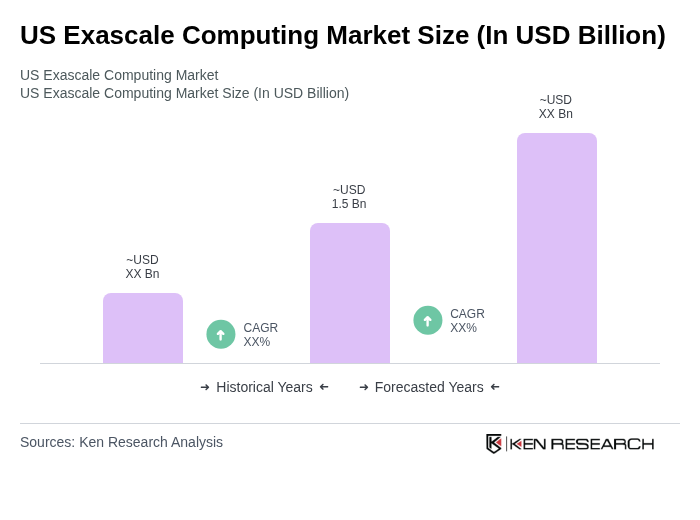
The US Exascale Computing Market, valued at USD 1.5 billion, is propelled by HPC demands in sectors like healthcare and finance, supported by DOE initiatives and AI advancements.

Region:North America

Author(s):Rebecca

Product Code:KRAD6102

Pages:84

Published On:December 2025
About the Report

Base Year 2024

US Exascale Computing Market Overview

  • The US Exascale Computing Market is valued at USD 1.5 billion, based on a five-year historical analysis. This growth is primarily driven by the increasing demand for high-performance computing in various sectors, including scientific research, national defense, advanced manufacturing, healthcare and life sciences, and financial services, where exascale-class systems support complex simulations, AI/ML workloads, and large-scale data analytics. The need for faster data processing and analysis capabilities has led to significant investments in exascale technologies, including energy?efficient processors, accelerators, and high?performance interconnects, enhancing computational power and efficiency across US government laboratories, universities, and hyperscale data centers.
  • The United States dominates the Exascale Computing Market, with North America holding the leading regional share of global exascale revenues, supported by a strong concentration of technology vendors, national labs, and cloud providers in hubs such as California (Silicon Valley and the broader Bay Area), Texas, and the Northeast corridor. This dominance is attributed to the presence of leading technology companies, research institutions, and government agencies that prioritize innovation in high?performance computing, including Department of Energy (DOE) national laboratories such as Oak Ridge, Argonne, and Lawrence Livermore, which host flagship exascale and pre?exascale systems. The collaboration between academia, national laboratories, and industry—often structured through federally funded programs and public?private partnerships—further strengthens the market's growth and accelerates commercialization of exascale?class technologies.
  • The US federal government supports exascale development through long?running high?performance computing programs under the Department of Energy’s Office of Science and National Nuclear Security Administration, including the Exascale Computing Project (ECP) launched to deliver exascale?capable systems, software, and applications for scientific research, national security, and economic competitiveness. Under these initiatives, multi?year funding in the order of more than USD 100 million has been allocated to exascale hardware, software, and application development at major US leadership computing facilities, supporting systems such as Frontier, Aurora, and El Capitan and ensuring that the US remains a leader in high?performance computing technologies.
US Exascale Computing Market Size

US Exascale Computing Market Segmentation

By Type:The Exascale Computing Market can be segmented into four main types: Exascale Supercomputers, Pre-exascale and Petascale Systems, Heterogeneous / Accelerator-based Architectures, and Exascale-Oriented Cloud and As-a-Service Offerings. Exascale Supercomputers, deployed at US leadership computing facilities and major research centers, are a core segment because of their ability to perform on the order of a quintillion calculations per second, enabling complex multiphysics simulations, AI?driven scientific discovery, and large?scale national security workloads. Pre-exascale and petascale systems remain critical for broader academic, industrial, and regional HPC centers that require high performance but do not operate flagship leadership systems. Heterogeneous / accelerator-based architectures (such as CPU+GPU and CPU+specialized accelerators) are gaining share as US installations increasingly rely on GPU and accelerator?rich nodes to reach exascale performance with improved energy efficiency, particularly for AI, ML, and data analytics workloads. Exascale-oriented cloud and as-a-service offerings are expanding as major US cloud providers integrate exascale?class GPUs, high?bandwidth networks, and HPC software stacks into managed services, allowing enterprises and research organizations to access exascale?scale resources without owning on?premises supercomputers.
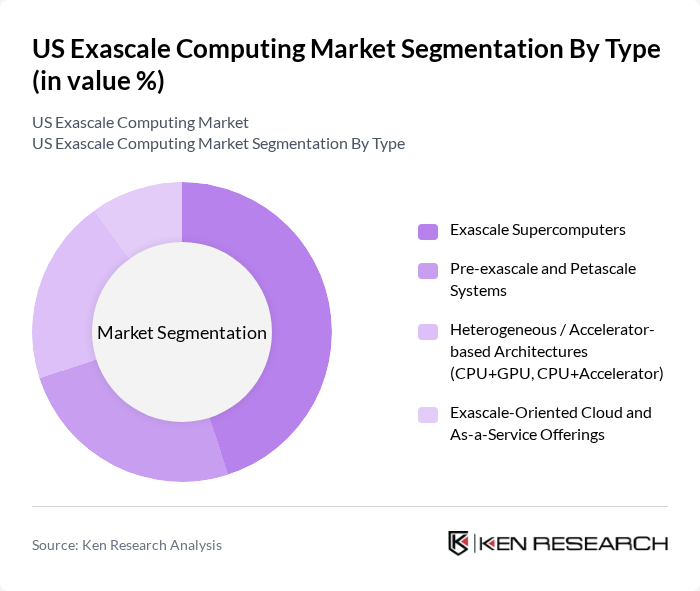
US Exascale Computing Market segmentation by Type.

By Component:The market can also be segmented by components, including Hardware, System Software & Middleware, Application Software & Tools, and Services. Hardware, which encompasses processors, accelerators, interconnects, and storage, is the dominant segment because US exascale systems rely on advanced CPUs, GPUs, high?bandwidth memory, and low?latency interconnects to reach required performance and energy?efficiency targets. System software and middleware—including operating systems, resource managers, compilers, and communication libraries—are increasingly optimized for extreme scalability, resilience, and heterogeneous architectures to fully utilize exascale hardware. Application software and tools such as simulation codes, AI/ML frameworks, and performance analysis tools are being refactored for massive parallelism and accelerator usage under US exascale programs to support domains like climate modeling, materials science, genomics, and fusion energy. Services (integration, consulting, managed & support services) form a growing component as US enterprises and research organizations rely on specialized providers for system design, deployment, optimization, and ongoing operations of complex exascale and near?exascale environments.
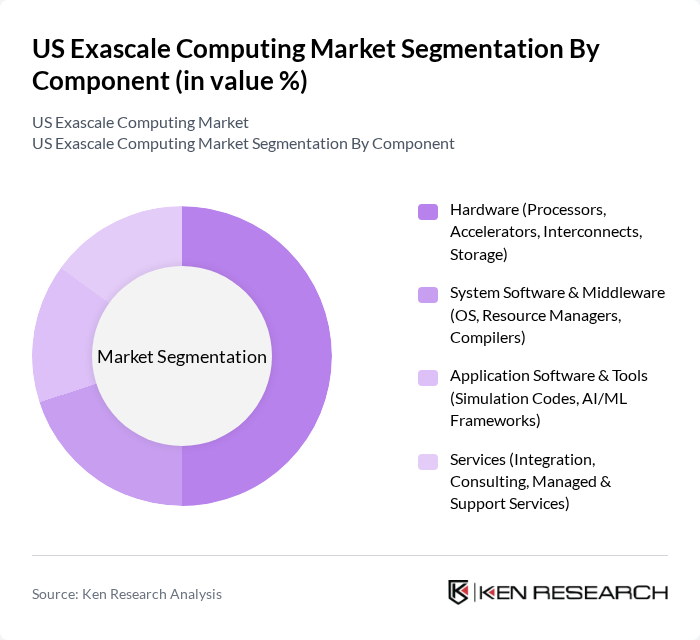
US Exascale Computing Market segmentation by Component.

US Exascale Computing Market Competitive Landscape

The US Exascale Computing Market is characterized by a dynamic mix of regional and international players. Leading participants such as Hewlett Packard Enterprise (HPE), Advanced Micro Devices, Inc. (AMD), NVIDIA Corporation, Intel Corporation, International Business Machines Corporation (IBM), Dell Technologies Inc., Microsoft Azure (Microsoft Corporation), Amazon Web Services, Inc. (AWS), Google Cloud (Google LLC), Oracle Cloud Infrastructure (Oracle Corporation), Lenovo Group Limited, Atos SE (Eviden High Performance Computing), Fujitsu Limited, Lawrence Livermore National Laboratory (LLNL), Oak Ridge National Laboratory (ORNL) contribute to innovation, geographic expansion, and service delivery in this space.

Hewlett Packard Enterprise (HPE)

1939

San Jose, California

Advanced Micro Devices, Inc. (AMD)

1969

Santa Clara, California

NVIDIA Corporation

1993

Santa Clara, California

Intel Corporation

1968

Santa Clara, California

International Business Machines Corporation (IBM)

1911

Armonk, New York

Company

Establishment Year

Headquarters

Segment Focus (Systems OEM, Processor/Accelerator, Cloud/HPC-as-a-Service, Software/Tools)

Exascale-Related Revenue (US$ Million, Latest Year Available)

3-Year Exascale / HPC Revenue CAGR (Estimated)

Installed Base in US Leadership Systems (Number of Deployments / Design Wins)

Share of US TOP500 / Exascale Nodes Using Company Technology

Average System Contract Value in US (Capex per Deal)

US Exascale Computing Market Industry Analysis

Growth Drivers

  • Increasing Demand for High-Performance Computing:The US exascale computing market is driven by a significant rise in demand for high-performance computing (HPC) solutions, particularly in sectors like healthcare and finance. In future, the US is projected to allocate approximately $11.5 billion towards HPC initiatives, reflecting a 15% increase from the previous year. This funding is essential for developing systems capable of processing vast datasets, which is crucial for advancements in research and innovation across various industries.
  • Government Funding and Initiatives:The US government has committed substantial resources to bolster exascale computing capabilities, with an estimated $2 billion earmarked for the Department of Energy's exascale initiative in future. This funding supports the development of next-generation supercomputers, enhancing the nation's competitiveness in global technology. Such initiatives are vital for maintaining leadership in scientific research and national security, driving further investment in the exascale computing sector.
  • Advancements in AI and Machine Learning:The integration of artificial intelligence (AI) and machine learning (ML) technologies is a key growth driver for the exascale computing market. In future, the AI market in the US is expected to reach $140 billion, up from $100 billion in the previous year. This surge in AI investment necessitates powerful computing resources, as organizations seek to leverage exascale systems for complex data analysis, predictive modeling, and real-time decision-making, thereby fueling demand for advanced computing solutions.

Market Challenges

  • High Costs of Exascale Systems:One of the primary challenges facing the US exascale computing market is the high cost associated with developing and maintaining exascale systems. The average cost of an exascale supercomputer can exceed $250 million, which poses a significant barrier for many organizations. This financial hurdle limits access to cutting-edge technology, particularly for smaller enterprises and research institutions, potentially stifling innovation and collaboration in the sector.
  • Complexity of Integration with Existing Systems:Integrating exascale computing systems with existing IT infrastructure presents a considerable challenge. Many organizations face difficulties in adapting their legacy systems to accommodate new technologies, which can lead to increased operational costs and extended implementation timelines. In future, it is estimated that 65% of organizations will struggle with integration issues, hindering their ability to fully leverage the capabilities of exascale computing and slowing down overall market growth.

US Exascale Computing Market Future Outlook

The future of the US exascale computing market appears promising, driven by ongoing advancements in technology and increasing investments from both public and private sectors. As organizations continue to prioritize data-driven decision-making, the demand for exascale systems is expected to rise. Furthermore, the integration of AI and machine learning will enhance the capabilities of these systems, enabling more efficient data processing and analysis. The focus on sustainability and energy efficiency will also shape future developments, ensuring that exascale computing remains a vital component of technological progress.

Market Opportunities

  • Expansion in Cloud Computing Services:The growth of cloud computing services presents a significant opportunity for the exascale computing market. In future, the US cloud computing market is projected to reach $600 billion, providing a platform for exascale solutions. This expansion allows organizations to access powerful computing resources without the need for substantial capital investment, facilitating broader adoption of exascale technologies across various sectors.
  • Collaborations with Research Institutions:Collaborations between technology companies and research institutions are poised to drive innovation in the exascale computing market. In future, partnerships are expected to increase by 30%, fostering the development of cutting-edge applications and solutions. These collaborations will enhance knowledge sharing and resource allocation, ultimately accelerating advancements in computing technologies and their applications in scientific research and industry.

Scope of the Report

SegmentSub-Segments
By Type

Exascale Supercomputers

Pre-exascale and Petascale Systems

Heterogeneous / Accelerator-based Architectures (CPU+GPU, CPU+Accelerator)

Exascale-Oriented Cloud and As-a-Service Offerings

By Component

Hardware (Processors, Accelerators, Interconnects, Storage)

System Software & Middleware (OS, Resource Managers, Compilers)

Application Software & Tools (Simulation Codes, AI/ML Frameworks)

Services (Integration, Consulting, Managed & Support Services)

By Application

Climate and Weather Modeling

National Security, Defense and Nuclear Simulation

Life Sciences, Genomics and Drug Discovery

Financial Services, Risk Analytics and Trading

Advanced Manufacturing, Energy and Materials Science

AI at Scale (Large-Scale Training and Inference)

By Deployment Model

On-Premises Exascale Systems (National Labs, Agencies, Universities)

Cloud-Based / HPC-as-a-Service

Hybrid and Federated Exascale Environments

By End-User

Federal Government & Defense Agencies

National Laboratories & Research Institutions

Universities and Academic Consortia

Large Enterprises (Energy, Manufacturing, Finance, Technology)

Healthcare & Biosciences Organizations

By Performance Tier

Leadership-Class Exascale Systems (>1 EFLOPS peak)

Pre-Exascale / Near-Exascale Systems (0.1–1 EFLOPS)

High-Performance Computing Clusters (<0.1 EFLOPS)

By Policy & Funding Support

U.S. Department of Energy Exascale Computing Initiative Funding

Federal R&D Programs (NSF, DARPA, DoD, NASA)

State & Regional Innovation Grants for HPC Infrastructure

Public–Private Partnerships and Strategic Consortia

Key Target Audience

Investors and Venture Capitalist Firms

Government and Regulatory Bodies (e.g., Department of Energy, National Science Foundation)

Manufacturers and Producers of High-Performance Computing Systems

Cloud Service Providers

Defense and National Security Agencies (e.g., Department of Defense)

Research Laboratories and National Laboratories

Technology Providers and Software Developers

Telecommunications Companies

Players Mentioned in the Report:

Hewlett Packard Enterprise (HPE)

Advanced Micro Devices, Inc. (AMD)

NVIDIA Corporation

Intel Corporation

International Business Machines Corporation (IBM)

Dell Technologies Inc.

Microsoft Azure (Microsoft Corporation)

Amazon Web Services, Inc. (AWS)

Google Cloud (Google LLC)

Oracle Cloud Infrastructure (Oracle Corporation)

Lenovo Group Limited

Atos SE (Eviden High Performance Computing)

Fujitsu Limited

Lawrence Livermore National Laboratory (LLNL)

Oak Ridge National Laboratory (ORNL)

Table of Contents

Market Assessment Phase

1. Executive Summary and Approach


2. US Exascale Computing Market Overview

2.1 Key Insights and Strategic Recommendations

2.2 US Exascale Computing Market Overview

2.3 Definition and Scope

2.4 Evolution of Market Ecosystem

2.5 Timeline of Key Regulatory Milestones

2.6 Value Chain & Stakeholder Mapping

2.7 Business Cycle Analysis

2.8 Policy & Incentive Landscape


3. US Exascale Computing Market Analysis

3.1 Growth Drivers

3.1.1 Increasing demand for high-performance computing
3.1.2 Government funding and initiatives
3.1.3 Advancements in AI and machine learning
3.1.4 Rising need for data analytics and processing

3.2 Market Challenges

3.2.1 High costs of exascale systems
3.2.2 Complexity of integration with existing systems
3.2.3 Limited skilled workforce
3.2.4 Cybersecurity concerns

3.3 Market Opportunities

3.3.1 Expansion in cloud computing services
3.3.2 Collaborations with research institutions
3.3.3 Development of energy-efficient technologies
3.3.4 Growth in defense and national security applications

3.4 Market Trends

3.4.1 Shift towards heterogeneous computing architectures
3.4.2 Increasing focus on sustainability in computing
3.4.3 Rise of open-source software in HPC
3.4.4 Enhanced focus on quantum computing integration

3.5 Government Regulation

3.5.1 Federal funding programs for HPC
3.5.2 Regulations on data privacy and security
3.5.3 Standards for energy efficiency in computing
3.5.4 Export controls on advanced computing technologies

4. SWOT Analysis


5. Stakeholder Analysis


6. Porter's Five Forces Analysis


7. US Exascale Computing Market Market Size, 2019-2024

7.1 By Value

7.2 By Volume

7.3 By Average Selling Price


8. US Exascale Computing Market Segmentation

8.1 By Type

8.1.1 Exascale Supercomputers
8.1.2 Pre-exascale and Petascale Systems
8.1.3 Heterogeneous / Accelerator-based Architectures (CPU+GPU, CPU+Accelerator)
8.1.4 Exascale-Oriented Cloud and As-a-Service Offerings

8.2 By Component

8.2.1 Hardware (Processors, Accelerators, Interconnects, Storage)
8.2.2 System Software & Middleware (OS, Resource Managers, Compilers)
8.2.3 Application Software & Tools (Simulation Codes, AI/ML Frameworks)
8.2.4 Services (Integration, Consulting, Managed & Support Services)

8.3 By Application

8.3.1 Climate and Weather Modeling
8.3.2 National Security, Defense and Nuclear Simulation
8.3.3 Life Sciences, Genomics and Drug Discovery
8.3.4 Financial Services, Risk Analytics and Trading
8.3.5 Advanced Manufacturing, Energy and Materials Science
8.3.6 AI at Scale (Large-Scale Training and Inference)

8.4 By Deployment Model

8.4.1 On-Premises Exascale Systems (National Labs, Agencies, Universities)
8.4.2 Cloud-Based / HPC-as-a-Service
8.4.3 Hybrid and Federated Exascale Environments

8.5 By End-User

8.5.1 Federal Government & Defense Agencies
8.5.2 National Laboratories & Research Institutions
8.5.3 Universities and Academic Consortia
8.5.4 Large Enterprises (Energy, Manufacturing, Finance, Technology)
8.5.5 Healthcare & Biosciences Organizations

8.6 By Performance Tier

8.6.1 Leadership-Class Exascale Systems (>1 EFLOPS peak)
8.6.2 Pre-Exascale / Near-Exascale Systems (0.1–1 EFLOPS)
8.6.3 High-Performance Computing Clusters (<0.1 EFLOPS)

8.7 By Policy & Funding Support

8.7.1 U.S. Department of Energy Exascale Computing Initiative Funding
8.7.2 Federal R&D Programs (NSF, DARPA, DoD, NASA)
8.7.3 State & Regional Innovation Grants for HPC Infrastructure
8.7.4 Public–Private Partnerships and Strategic Consortia

9. US Exascale Computing Market Competitive Analysis

9.1 Market Share of Key Players

9.2 Cross Comparison of Key Players

9.2.1 Company Name
9.2.2 Segment Focus (Systems OEM, Processor/Accelerator, Cloud/HPC-as-a-Service, Software/Tools)
9.2.3 Exascale-Related Revenue (US$ Million, Latest Year Available)
9.2.4 3-Year Exascale / HPC Revenue CAGR (Estimated)
9.2.5 Installed Base in US Leadership Systems (Number of Deployments / Design Wins)
9.2.6 Share of US TOP500 / Exascale Nodes Using Company Technology
9.2.7 Average System Contract Value in US (Capex per Deal)
9.2.8 R&D Intensity for Exascale (% of Revenue Spent on HPC/Exascale R&D)
9.2.9 Energy Efficiency Metrics (Performance per Watt / PUE in Flagship Deployments)
9.2.10 Time-to-Deployment for Large-Scale US Installations
9.2.11 Strategic Partnerships with US National Labs & Federal Agencies

9.3 SWOT Analysis of Top Players

9.4 Pricing Analysis

9.5 Detailed Profile of Major Companies

9.5.1 Hewlett Packard Enterprise (HPE)
9.5.2 Advanced Micro Devices, Inc. (AMD)
9.5.3 NVIDIA Corporation
9.5.4 Intel Corporation
9.5.5 International Business Machines Corporation (IBM)
9.5.6 Dell Technologies Inc.
9.5.7 Microsoft Azure (Microsoft Corporation)
9.5.8 Amazon Web Services, Inc. (AWS)
9.5.9 Google Cloud (Google LLC)
9.5.10 Oracle Cloud Infrastructure (Oracle Corporation)
9.5.11 Lenovo Group Limited
9.5.12 Atos SE (Eviden High Performance Computing)
9.5.13 Fujitsu Limited
9.5.14 Lawrence Livermore National Laboratory (LLNL)
9.5.15 Oak Ridge National Laboratory (ORNL)

10. US Exascale Computing Market End-User Analysis

10.1 Procurement Behavior of Key Ministries

10.1.1 Budget Allocation Trends
10.1.2 Decision-Making Processes
10.1.3 Vendor Selection Criteria
10.1.4 Contracting Practices

10.2 Corporate Spend on Infrastructure & Energy

10.2.1 Investment Trends in Computing Infrastructure
10.2.2 Energy Consumption Patterns
10.2.3 Budgeting for Upgrades
10.2.4 Cost-Benefit Analysis

10.3 Pain Point Analysis by End-User Category

10.3.1 Performance Limitations
10.3.2 Integration Challenges
10.3.3 Support and Maintenance Issues
10.3.4 Others

10.4 User Readiness for Adoption

10.4.1 Training and Skill Development Needs
10.4.2 Infrastructure Readiness
10.4.3 Change Management Strategies
10.4.4 Others

10.5 Post-Deployment ROI and Use Case Expansion

10.5.1 Measurement of Success Metrics
10.5.2 Scalability of Solutions
10.5.3 User Feedback and Iteration
10.5.4 Others

11. US Exascale Computing Market Future Size, 2025-2030

11.1 By Value

11.2 By Volume

11.3 By Average Selling Price


Go-To-Market Strategy Phase

1. Whitespace Analysis + Business Model Canvas

1.1 Market Gaps Identification

1.2 Business Model Framework


2. Marketing and Positioning Recommendations

2.1 Branding Strategies

2.2 Product USPs


3. Distribution Plan

3.1 Urban Retail Strategies

3.2 Rural NGO Tie-Ups


4. Channel & Pricing Gaps

4.1 Underserved Routes

4.2 Pricing Bands


5. Unmet Demand & Latent Needs

5.1 Category Gaps

5.2 Consumer Segments


6. Customer Relationship

6.1 Loyalty Programs

6.2 After-Sales Service


7. Value Proposition

7.1 Sustainability Initiatives

7.2 Integrated Supply Chains


8. Key Activities

8.1 Regulatory Compliance

8.2 Branding Efforts

8.3 Distribution Setup


9. Entry Strategy Evaluation

9.1 Domestic Market Entry Strategy

9.1.1 Product Mix
9.1.2 Pricing Band
9.1.3 Packaging

9.2 Export Entry Strategy

9.2.1 Target Countries
9.2.2 Compliance Roadmap

10. Entry Mode Assessment

10.1 Joint Ventures

10.2 Greenfield Investments

10.3 Mergers & Acquisitions

10.4 Distributor Model


11. Capital and Timeline Estimation

11.1 Capital Requirements

11.2 Timelines


12. Control vs Risk Trade-Off

12.1 Ownership vs Partnerships


13. Profitability Outlook

13.1 Breakeven Analysis

13.2 Long-Term Sustainability


14. Potential Partner List

14.1 Distributors

14.2 Joint Ventures

14.3 Acquisition Targets


15. Execution Roadmap

15.1 Phased Plan for Market Entry

15.1.1 Market Setup
15.1.2 Market Entry
15.1.3 Growth Acceleration
15.1.4 Scale & Stabilize

15.2 Key Activities and Milestones

15.2.1 Milestone Planning
15.2.2 Activity Tracking

Research Methodology

ApproachModellingSample

Phase 1: Approach1

Desk Research

  • Analysis of government reports and white papers on exascale computing initiatives
  • Review of industry publications and market analysis reports from technology research firms
  • Examination of academic journals and conference proceedings related to high-performance computing

Primary Research

  • Interviews with CTOs and R&D heads at leading technology firms involved in exascale computing
  • Surveys with data center managers and cloud service providers to understand infrastructure needs
  • Focus groups with academic researchers and government officials on funding and policy impacts

Validation & Triangulation

  • Cross-validation of findings through multiple data sources, including market reports and expert opinions
  • Triangulation of quantitative data with qualitative insights from industry experts
  • Sanity checks through peer reviews and expert panel discussions to ensure data reliability

Phase 2: Market Size Estimation1

Top-down Assessment

  • Estimation of total addressable market (TAM) based on federal and state funding for exascale projects
  • Segmentation of market size by application areas such as healthcare, climate modeling, and AI
  • Incorporation of growth trends in supercomputing and big data analytics sectors

Bottom-up Modeling

  • Collection of firm-level data from key players in the exascale computing ecosystem
  • Cost analysis of hardware, software, and operational expenditures associated with exascale systems
  • Volume estimates based on projected sales of exascale computing systems and services

Forecasting & Scenario Analysis

  • Multi-variable forecasting using historical growth rates and emerging technology trends
  • Scenario modeling based on potential shifts in government policy and funding availability
  • Development of baseline, optimistic, and pessimistic forecasts through 2030

Phase 3: CATI Sample Composition1

Scope Item/SegmentSample SizeTarget Respondent Profiles
Government Funding Agencies50Policy Makers, Program Directors
Academic Research Institutions40Research Professors, Lab Directors
Cloud Service Providers45Infrastructure Managers, Product Development Leads
High-Performance Computing Vendors35Sales Executives, Technical Account Managers
End-User Industries (Healthcare, Finance)40IT Managers, Data Scientists

Frequently Asked Questions

What is the current value of the US Exascale Computing Market?

The US Exascale Computing Market is valued at approximately USD 1.5 billion, driven by the increasing demand for high-performance computing across various sectors, including scientific research, national defense, and healthcare.

What are the main drivers of growth in the US Exascale Computing Market?

Which sectors are primarily benefiting from exascale computing?

How does the US government support exascale computing development?

Other Regional/Country Reports

Indonesia Exascale Computing Market

Malaysia Exascale Computing Market

KSA Exascale Computing Market

APAC Exascale Computing Market

SEA Exascale Computing Market

Vietnam Exascale Computing Market

Other Adjacent Reports

Why Buy From Us?

Refine Robust Result (RRR) Framework

What makes us stand out is that our consultants follow Robust, Refine and Result (RRR) methodology. Robust for clear definitions, approaches and sanity checking, Refine for differentiating respondents' facts and opinions, and Result for presenting data with story.

Our Reach Is Unmatched

We have set a benchmark in the industry by offering our clients with syndicated and customized market research reports featuring coverage of entire market as well as meticulous research and analyst insights.

Shifting the Research Paradigm

While we don't replace traditional research, we flip the method upside down. Our dual approach of Top Bottom & Bottom Top ensures quality deliverable by not just verifying company fundamentals but also looking at the sector and macroeconomic factors.

More Insights-Better Decisions

With one step in the future, our research team constantly tries to show you the bigger picture. We help with some of the tough questions you may encounter along the way: How is the industry positioned? Best marketing channel? KPI's of competitors? By aligning every element, we help maximize success.

Transparency and Trust

Our report gives you instant access to the answers and sources that other companies might choose to hide. We elaborate each steps of research methodology we have used and showcase you the sample size to earn your trust.

Round the Clock Support

If you need any support, we are here! We pride ourselves on universe strength, data quality, and quick, friendly, and professional service.

Why Clients Choose Us?

400000+
Reports in repository
150+
Consulting projects a year
100+
Analysts
8000+
Client Queries in 2022








