Us Hospitality Point Of Sale Software Market Size, Share, Growth Drivers, Trends, Opportunities & Forecast 2025–2030

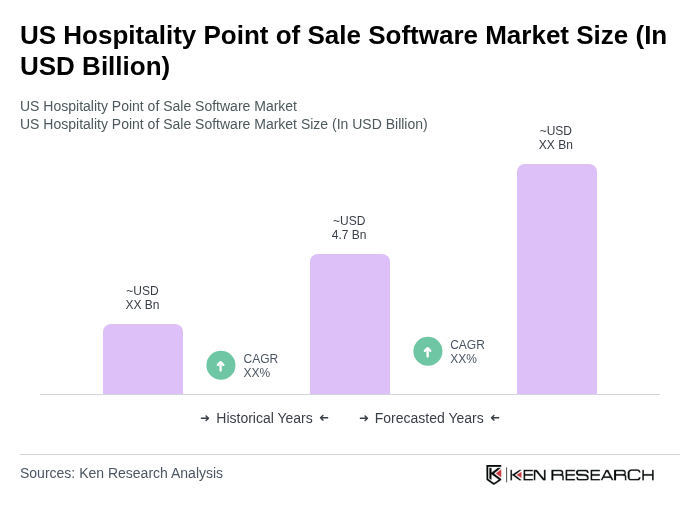
The US Hospitality Point of Sale Software Market, valued at USD 4.7 billion, grows with contactless payments, mobile ordering, and AI-driven analytics for hospitality efficiency.

Region:North America

Author(s):Geetanshi

Product Code:KRAD8155

Pages:84

Published On:December 2025
About the Report

Base Year 2024

US Hospitality Point of Sale Software Market Overview

  • The US Hospitality Point of Sale Software Market is valued at USD 4.7 billion, based on a five-year historical analysis. This growth is primarily driven by the increasing adoption of digital payment solutions, the rise of e-commerce in the hospitality sector, the demand for enhanced customer experience through technology integration, integration of mobile ordering and contactless payment features, adoption of AI-driven sales forecasting and inventory management tools, and the shift towards cloud-based solutions, which offer flexibility and scalability for businesses.
  • Key regions in this market include major cities such as New York, Los Angeles, and Chicago, which dominate due to their high concentration of hotels, restaurants, and entertainment venues. The vibrant tourism industry in these cities, coupled with a diverse range of hospitality services, creates a robust demand for advanced POS systems that streamline operations and improve customer service.
  • Hospitality businesses must comply with the Payment Card Industry Data Security Standard (PCI DSS), 2004 issued by the PCI Security Standards Council. This standard requires all entities handling cardholder data to maintain a secure network, protect cardholder data, implement strong access controls, encrypt data transmission, use anti-malware software, develop secure systems, restrict access to data by business need, and conduct regular security testing and monitoring, thereby fostering trust in digital payment solutions.
US Hospitality Point of Sale Software Market Size

US Hospitality Point of Sale Software Market Segmentation

By Deployment Type:The deployment type segmentation includes Cloud-Based Solutions, On-Premise Solutions, and Hybrid Solutions. Cloud-based solutions are gaining traction due to their scalability and cost-effectiveness, enabling real-time data access and remote management capabilities, while on-premise solutions are preferred by businesses that require complete control over their systems. Hybrid solutions offer a blend of both, catering to diverse business needs.
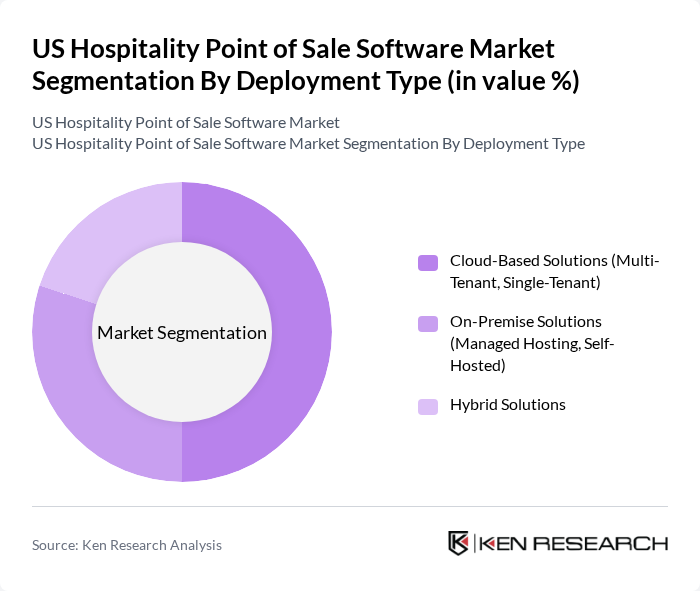
US Hospitality Point of Sale Software Market segmentation by Deployment Type.

By Property Category:This segmentation includes Full-Service Hotels, Limited-Service Hotels, Luxury Hotels, Restaurants and Food Service, and Cafes and Bars. Full-service hotels dominate the market due to their extensive operational needs, while restaurants and food service establishments are rapidly adopting POS systems to enhance customer engagement, streamline operations, and integrate with third-party delivery aggregators and online ordering portals.
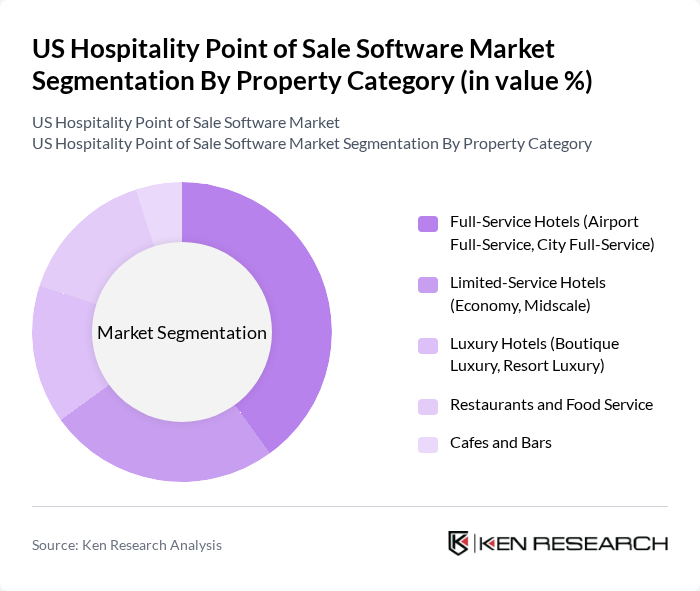
US Hospitality Point of Sale Software Market segmentation by Property Category.

US Hospitality Point of Sale Software Market Competitive Landscape

The US Hospitality Point of Sale Software Market is characterized by a dynamic mix of regional and international players. Leading participants such as Square, Inc., Toast, Inc., Lightspeed POS, Clover (Fiserv), TouchBistro, Revel Systems, NCR Corporation, Oracle Hospitality, Agilysys, Inc., ShopKeep (Lightspeed), Zomato, Micros Systems (Oracle), MarginEdge, Toast Marketplace Partners, Plate IQ contribute to innovation, geographic expansion, and service delivery in this space.

Square, Inc.

2009

San Francisco, CA

Toast, Inc.

2011

Boston, MA

Lightspeed POS

2005

Montreal, Canada

Clover (Fiserv)

2010

Brookfield, WI

TouchBistro

2010

Toronto, Canada

Company

Establishment Year

Headquarters

Enterprise Size Classification (Large, Medium, or Small)

Cloud Adoption Rate (%)

Customer Retention Rate (%)

Average Revenue Per User (ARPU)

Monthly Recurring Revenue (MRR) Growth Rate

Pricing Model (Subscription, Perpetual License, Hybrid)

US Hospitality Point of Sale Software Market Industry Analysis

Growth Drivers

  • Increasing Demand for Contactless Payments:The US has seen a significant rise in contactless payment transactions, with a reported 200% increase recently, reaching approximately $2 trillion. This trend is driven by consumer preferences for convenience and safety, particularly post-pandemic. According to the Federal Reserve, 50% of consumers now prefer contactless payments, prompting hospitality businesses to adopt POS systems that support these transactions, thereby enhancing customer satisfaction and operational efficiency.
  • Integration with Mobile Ordering Systems:The mobile ordering market in the US is projected to reach $300 billion in the near future, driven by consumer demand for convenience. Hospitality businesses are increasingly integrating POS systems with mobile ordering platforms to streamline operations and improve customer service. This integration allows for real-time order processing and inventory management, which can reduce wait times and enhance the overall dining experience, making it a crucial growth driver in the sector.
  • Enhanced Customer Experience through Data Analytics:The use of data analytics in the hospitality sector is expected to grow, with the market for analytics solutions projected to reach $15 billion in the near future. POS systems equipped with advanced analytics capabilities enable businesses to gather insights on customer preferences and behaviors. This data-driven approach allows for personalized marketing strategies and improved service offerings, ultimately leading to increased customer loyalty and revenue growth in the hospitality industry.

Market Challenges

  • High Initial Investment Costs:The average cost of implementing a comprehensive POS system in the hospitality sector can range from $15,000 to $60,000, depending on the complexity and features required. This high initial investment can deter smaller establishments from upgrading their systems. Additionally, ongoing maintenance and software updates can add to the financial burden, making it a significant challenge for many businesses in the industry.
  • Data Security Concerns:With the increasing reliance on digital payment systems, data security has become a pressing issue. Recently, the hospitality sector experienced over 1,200 data breaches, exposing millions of customer records. Compliance with regulations such as PCI DSS is mandatory, yet many businesses struggle to implement adequate security measures. This challenge not only affects customer trust but also leads to potential financial penalties, making it a critical concern for the industry.

US Hospitality Point of Sale Software Market Future Outlook

The US hospitality POS software market is poised for significant transformation, driven by technological advancements and evolving consumer preferences. As businesses increasingly adopt integrated payment solutions and AI-driven analytics, operational efficiencies will improve. Furthermore, the shift towards subscription-based pricing models will provide flexibility for smaller establishments. Sustainability initiatives will also gain traction, influencing software development and operational practices, ultimately shaping a more resilient and customer-centric industry landscape.

Market Opportunities

  • Expansion into Emerging Markets:The growing middle class in emerging markets presents a lucrative opportunity for US hospitality businesses. By leveraging POS systems tailored to local preferences, companies can tap into new customer bases, driving revenue growth. The World Bank projects that emerging economies will see a 6% growth rate in the near future, making this an attractive avenue for expansion.
  • Development of AI-Driven Solutions:The integration of AI in POS systems can enhance operational efficiency and customer engagement. AI-driven analytics can provide actionable insights, enabling businesses to optimize inventory and personalize customer experiences. As the AI market in hospitality is expected to reach $5 billion in the near future, investing in these technologies can significantly improve competitive advantage and profitability.

Scope of the Report

SegmentSub-Segments
By Deployment Type

Cloud-Based Solutions (Multi-Tenant, Single-Tenant)

On-Premise Solutions (Managed Hosting, Self-Hosted)

Hybrid Solutions

By Property Category

Full-Service Hotels (Airport Full-Service, City Full-Service)

Limited-Service Hotels (Economy, Midscale)

Luxury Hotels (Boutique Luxury, Resort Luxury)

Restaurants and Food Service

Cafes and Bars

By Enterprise Size

Small Enterprises

Medium Enterprises

Large Enterprises

By Service Model

Licensed (Perpetual License, Subscription License)

Software as a Service (SaaS)

By System Type

Integrated Systems

Standalone Systems

By Payment Method

Credit/Debit Cards

Mobile Wallets

Contactless Payments

Cash

By Feature Set

Inventory Management

Customer Relationship Management

Employee Management

Reporting and Analytics

Mobile Ordering Integration

Third-Party Delivery Integration

Key Target Audience

Investors and Venture Capitalist Firms

Government and Regulatory Bodies (e.g., Federal Trade Commission, Department of Commerce)

Hospitality Business Owners and Operators

Point of Sale Software Developers

Payment Processing Companies

Hospitality Technology Integrators

Industry Associations (e.g., National Restaurant Association, American Hotel and Lodging Association)

Financial Institutions and Banks

Players Mentioned in the Report:

Square, Inc.

Toast, Inc.

Lightspeed POS

Clover (Fiserv)

TouchBistro

Revel Systems

NCR Corporation

Oracle Hospitality

Agilysys, Inc.

ShopKeep (Lightspeed)

Zomato

Micros Systems (Oracle)

MarginEdge

Toast Marketplace Partners

Plate IQ

Table of Contents

Market Assessment Phase

1. Executive Summary and Approach


2. US Hospitality Point of Sale Software Market Overview

2.1 Key Insights and Strategic Recommendations

2.2 US Hospitality Point of Sale Software Market Overview

2.3 Definition and Scope

2.4 Evolution of Market Ecosystem

2.5 Timeline of Key Regulatory Milestones

2.6 Value Chain & Stakeholder Mapping

2.7 Business Cycle Analysis

2.8 Policy & Incentive Landscape


3. US Hospitality Point of Sale Software Market Analysis

3.1 Growth Drivers

3.1.1 Increasing Demand for Contactless Payments
3.1.2 Integration with Mobile Ordering Systems
3.1.3 Enhanced Customer Experience through Data Analytics
3.1.4 Rising Adoption of Cloud-Based Solutions

3.2 Market Challenges

3.2.1 High Initial Investment Costs
3.2.2 Rapid Technological Changes
3.2.3 Data Security Concerns
3.2.4 Limited Technical Expertise among Staff

3.3 Market Opportunities

3.3.1 Expansion into Emerging Markets
3.3.2 Development of AI-Driven Solutions
3.3.3 Partnerships with Delivery Services
3.3.4 Customization for Niche Markets

3.4 Market Trends

3.4.1 Shift Towards Integrated Payment Solutions
3.4.2 Growth of Subscription-Based Pricing Models
3.4.3 Increasing Focus on Sustainability
3.4.4 Rise of Omnichannel Retailing

3.5 Government Regulation

3.5.1 Compliance with PCI DSS Standards
3.5.2 Data Protection Regulations (e.g., GDPR, CCPA)
3.5.3 Labor Laws Affecting Employee Scheduling
3.5.4 Health and Safety Regulations in Food Service

4. SWOT Analysis


5. Stakeholder Analysis


6. Porter's Five Forces Analysis


7. US Hospitality Point of Sale Software Market Size, 2019-2024

7.1 By Value

7.2 By Volume

7.3 By Average Selling Price


8. US Hospitality Point of Sale Software Market Segmentation

8.1 By Deployment Type

8.1.1 Cloud-Based Solutions (Multi-Tenant, Single-Tenant)
8.1.2 On-Premise Solutions (Managed Hosting, Self-Hosted)
8.1.3 Hybrid Solutions

8.2 By Property Category

8.2.1 Full-Service Hotels (Airport Full-Service, City Full-Service)
8.2.2 Limited-Service Hotels (Economy, Midscale)
8.2.3 Luxury Hotels (Boutique Luxury, Resort Luxury)
8.2.4 Restaurants and Food Service
8.2.5 Cafes and Bars

8.3 By Enterprise Size

8.3.1 Small Enterprises
8.3.2 Medium Enterprises
8.3.3 Large Enterprises

8.4 By Service Model

8.4.1 Licensed (Perpetual License, Subscription License)
8.4.2 Software as a Service (SaaS)

8.5 By System Type

8.5.1 Integrated Systems
8.5.2 Standalone Systems

8.6 By Payment Method

8.6.1 Credit/Debit Cards
8.6.2 Mobile Wallets
8.6.3 Contactless Payments
8.6.4 Cash

8.7 By Feature Set

8.7.1 Inventory Management
8.7.2 Customer Relationship Management
8.7.3 Employee Management
8.7.4 Reporting and Analytics
8.7.5 Mobile Ordering Integration
8.7.6 Third-Party Delivery Integration

9. US Hospitality Point of Sale Software Market Competitive Analysis

9.1 Market Share of Key Players

9.2 Cross Comparison of Key Players

9.2.1 Company Name
9.2.2 Enterprise Size Classification (Large, Medium, or Small)
9.2.3 Cloud Adoption Rate (%)
9.2.4 Customer Retention Rate (%)
9.2.5 Average Revenue Per User (ARPU)
9.2.6 Monthly Recurring Revenue (MRR) Growth Rate
9.2.7 Pricing Model (Subscription, Perpetual License, Hybrid)
9.2.8 Customer Churn Rate (%)
9.2.9 Market Penetration Rate by Property Type (%)
9.2.10 Net Promoter Score (NPS)

9.3 SWOT Analysis of Top Players

9.4 Pricing Analysis

9.5 Detailed Profile of Major Companies

9.5.1 Square, Inc.
9.5.2 Toast, Inc.
9.5.3 Lightspeed POS
9.5.4 Clover (Fiserv)
9.5.5 TouchBistro
9.5.6 Revel Systems
9.5.7 NCR Corporation
9.5.8 Oracle Hospitality
9.5.9 Agilysys, Inc.
9.5.10 ShopKeep (Lightspeed)
9.5.11 Zomato
9.5.12 Micros Systems (Oracle)
9.5.13 MarginEdge
9.5.14 Toast Marketplace Partners
9.5.15 Plate IQ

10. US Hospitality Point of Sale Software Market End-User Analysis

10.1 Procurement Behavior of Key End-Users

10.1.1 Budget Allocation Trends
10.1.2 Decision-Making Processes
10.1.3 Vendor Selection Criteria
10.1.4 Contract Management Practices

10.2 Corporate Spend on Technology Infrastructure

10.2.1 Investment Trends in POS Technology
10.2.2 Budgeting for Software Solutions
10.2.3 Cost-Benefit Analysis Practices
10.2.4 Long-term Financial Planning

10.3 Pain Point Analysis by End-User Category

10.3.1 Operational Inefficiencies
10.3.2 Integration Challenges with Legacy Systems
10.3.3 Customer Experience Issues
10.3.4 Compliance and Regulatory Hurdles

10.4 User Readiness for Adoption

10.4.1 Training and Support Needs
10.4.2 Technology Familiarity
10.4.3 Change Management Strategies
10.4.4 Feedback Mechanisms

10.5 Post-Deployment ROI and Use Case Expansion

10.5.1 Performance Metrics Tracking
10.5.2 User Satisfaction Surveys
10.5.3 Case Studies of Successful Implementations
10.5.4 Future Expansion Plans

11. US Hospitality Point of Sale Software Market Future Size, 2025-2030

11.1 By Value

11.2 By Volume

11.3 By Average Selling Price


Go-To-Market Strategy Phase

1. Whitespace Analysis + Business Model Canvas

1.1 Market Gaps Identification

1.2 Value Proposition Development

1.3 Revenue Streams Analysis

1.4 Cost Structure Evaluation

1.5 Key Partnerships Exploration

1.6 Customer Segmentation

1.7 Channels of Distribution


2. Marketing and Positioning Recommendations

2.1 Branding Strategies

2.2 Product USPs

2.3 Target Audience Identification

2.4 Marketing Channels Selection

2.5 Messaging and Communication


3. Distribution Plan

3.1 Direct Sales to Hospitality Chains

3.2 Partnerships with Hospitality Technology Consultants

3.3 Online Distribution Channels

3.4 Integration with Payment Processors

3.5 Partnership with Hospitality Equipment Distributors


4. Channel & Pricing Gaps

4.1 Underserved Market Segments

4.2 Pricing Bands Analysis

4.3 Competitor Pricing Comparison

4.4 Customer Willingness to Pay

4.5 Value-Based Pricing Strategies


5. Unmet Demand & Latent Needs

5.1 Category Gaps Identification

5.2 Consumer Segments Analysis

5.3 Emerging Trends Exploration

5.4 Future Needs Assessment

5.5 Product Development Opportunities


6. Customer Relationship

6.1 Loyalty Programs Design

6.2 After-sales Service Strategies

6.3 Customer Feedback Mechanisms

6.4 Community Engagement Initiatives

6.5 Customer Education Programs


7. Value Proposition

7.1 Operational Efficiency Improvements

7.2 Integrated Payment and Ordering Solutions

7.3 Unique Selling Points

7.4 Customer-Centric Innovations

7.5 Competitive Differentiation


8. Key Activities

8.1 Regulatory Compliance (PCI DSS, CCPA)

8.2 Branding Initiatives

8.3 Distribution Setup

8.4 Training and Development

8.5 Performance Monitoring


9. Entry Strategy Evaluation

9.1 Domestic Market Entry Strategy

9.1.1 Product Mix Considerations
9.1.2 Pricing Band Strategy
9.1.3 Deployment Options (Cloud vs. On-Premise)

9.2 Regional Expansion Strategy

9.2.1 Target Regions Identification
9.2.2 Compliance Roadmap Development

10. Entry Mode Assessment

10.1 Joint Ventures with Hospitality Groups

10.2 Greenfield Investments

10.3 Mergers & Acquisitions

10.4 Distributor Model Evaluation


11. Capital and Timeline Estimation


Research Methodology

ApproachModellingSample

Phase 1: Approach1

Desk Research

  • Analysis of industry reports from hospitality associations and market research firms
  • Review of financial statements and annual reports from leading POS software providers
  • Examination of market trends and forecasts published in trade journals and online platforms

Primary Research

  • Interviews with IT managers and decision-makers in hotels and restaurants
  • Surveys targeting end-users of POS systems to gather feedback on features and usability
  • Focus groups with hospitality consultants to discuss market needs and software trends

Validation & Triangulation

  • Cross-validation of findings through multiple data sources, including sales data and user reviews
  • Triangulation of insights from primary interviews with secondary data trends
  • Sanity checks conducted through expert panel discussions with industry veterans

Phase 2: Market Size Estimation1

Top-down Assessment

  • Estimation of total market size based on overall revenue from the US hospitality sector
  • Segmentation of market size by type of establishment (e.g., hotels, restaurants, bars)
  • Incorporation of growth rates from historical data and projected trends in technology adoption

Bottom-up Modeling

  • Collection of data on the number of POS systems installed across various hospitality segments
  • Estimation of average revenue per user (ARPU) based on pricing models of leading software
  • Calculation of market size by multiplying the number of installations by ARPU

Forecasting & Scenario Analysis

  • Utilization of time-series analysis to project future market growth based on historical data
  • Scenario modeling based on potential impacts of economic conditions and technological advancements
  • Development of best-case, worst-case, and most-likely scenarios through 2030

Phase 3: CATI Sample Composition1

Scope Item/SegmentSample SizeTarget Respondent Profiles
Hotel Management Systems120General Managers, IT Directors
Restaurant POS Solutions95Owners, Operations Managers
Bar and Nightclub Software75Bar Managers, Financial Controllers
Mobile POS Systems65Product Managers, Customer Experience Managers
Integrated Payment Solutions85Payment Processing Managers, CFOs

Frequently Asked Questions

What is the current value of the US Hospitality Point of Sale Software Market?

The US Hospitality Point of Sale Software Market is valued at approximately USD 4.7 billion, reflecting significant growth driven by the adoption of digital payment solutions and technology integration in the hospitality sector.

What are the key growth drivers for the US Hospitality Point of Sale Software Market?

Which regions dominate the US Hospitality Point of Sale Software Market?

What are the compliance requirements for hospitality businesses using POS systems?

Other Regional/Country Reports

Indonesia Hospitality Point Of Sale Software Market

Malaysia Hospitality Point Of Sale Software Market

KSA Hospitality Point Of Sale Software Market

APAC Hospitality Point Of Sale Software Market

SEA Hospitality Point Of Sale Software Market

Vietnam Hospitality Point Of Sale Software Market

Other Adjacent Reports

Vietnam restaurant management software market size, share, growth drivers, trends, opportunities & forecast 2025–2030

Thailand Hotel Management Software Market

UAE Payment Processing Software Market

Bahrain inventory management software market report Size, Share, Growth Drivers, Trends, Opportunities & Forecast 2025–2030

Egypt Customer Relationship Management Software Market

Germany Mobile Ordering Software Market

Japan Cloud-Based POS Solutions Market

South Africa AI-Driven Analytics Software Market

Brazil Contactless Payment Technology Market

Vietnam E-commerce Integration Software Market

Why Buy From Us?

Refine Robust Result (RRR) Framework

What makes us stand out is that our consultants follow Robust, Refine and Result (RRR) methodology. Robust for clear definitions, approaches and sanity checking, Refine for differentiating respondents' facts and opinions, and Result for presenting data with story.

Our Reach Is Unmatched

We have set a benchmark in the industry by offering our clients with syndicated and customized market research reports featuring coverage of entire market as well as meticulous research and analyst insights.

Shifting the Research Paradigm

While we don't replace traditional research, we flip the method upside down. Our dual approach of Top Bottom & Bottom Top ensures quality deliverable by not just verifying company fundamentals but also looking at the sector and macroeconomic factors.

More Insights-Better Decisions

With one step in the future, our research team constantly tries to show you the bigger picture. We help with some of the tough questions you may encounter along the way: How is the industry positioned? Best marketing channel? KPI's of competitors? By aligning every element, we help maximize success.

Transparency and Trust

Our report gives you instant access to the answers and sources that other companies might choose to hide. We elaborate each steps of research methodology we have used and showcase you the sample size to earn your trust.

Round the Clock Support

If you need any support, we are here! We pride ourselves on universe strength, data quality, and quick, friendly, and professional service.

Why Clients Choose Us?

400000+
Reports in repository
150+
Consulting projects a year
100+
Analysts
8000+
Client Queries in 2022








