About the Report
Base Year 2024Us Investment Banking Market Overview
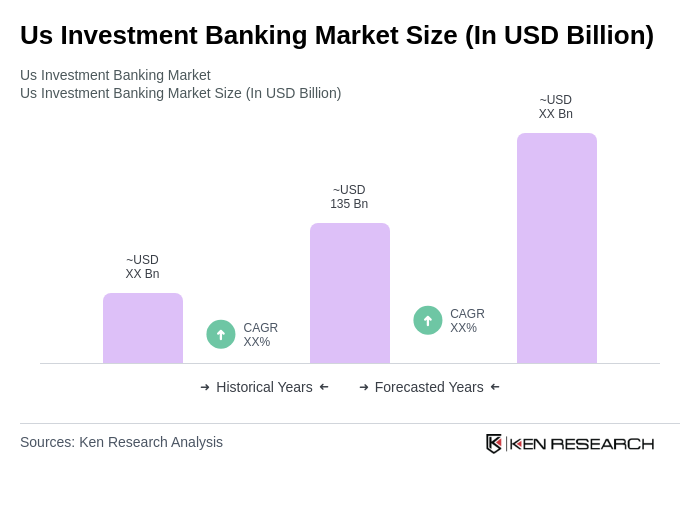
- The US Investment Banking Market is valued at USD 135 billion, based on a five-year historical analysis. This level aligns with multiple industry assessments of the U.S. investment banking fee/revenue pool around the mid–one-hundred-billion range, supported by recent benchmarks indicating the market at about USD 134.4 billion in the U.S. context and low one-hundreds globally, with M&A and underwriting as primary fee drivers . This growth is primarily driven by increased corporate mergers and acquisitions, robust capital market activities, and a surge in private equity and private credit investments that sustain deal-making and capital solutions mandates . The market has seen a significant uptick in advisory services, particularly in M&A and capital raising, as companies seek to optimize their financial strategies amid recovering IPO activity, sponsor-led take-privates, and renewed leveraged finance issuance .
- Key players in this market include New York, San Francisco, and Chicago, which dominate due to their established financial ecosystems, access to a diverse client base, and proximity to major corporations and institutional investors. New York, in particular, remains the global financial hub for investment banking and capital markets activity, underpinned by dense concentrations of banks, funds, and advisory firms facilitating high-value transactions across sectors .
- The Dodd-Frank Wall Street Reform and Consumer Protection Act was enacted following the global financial crisis and continues to shape the regulatory framework with mandates for transparency, capital, liquidity, stress testing, living wills, and risk management across systemically important institutions; it was not newly implemented in 2023, though ongoing rulemakings and supervisory guidance keep compliance requirements stringent for investment banking activities .
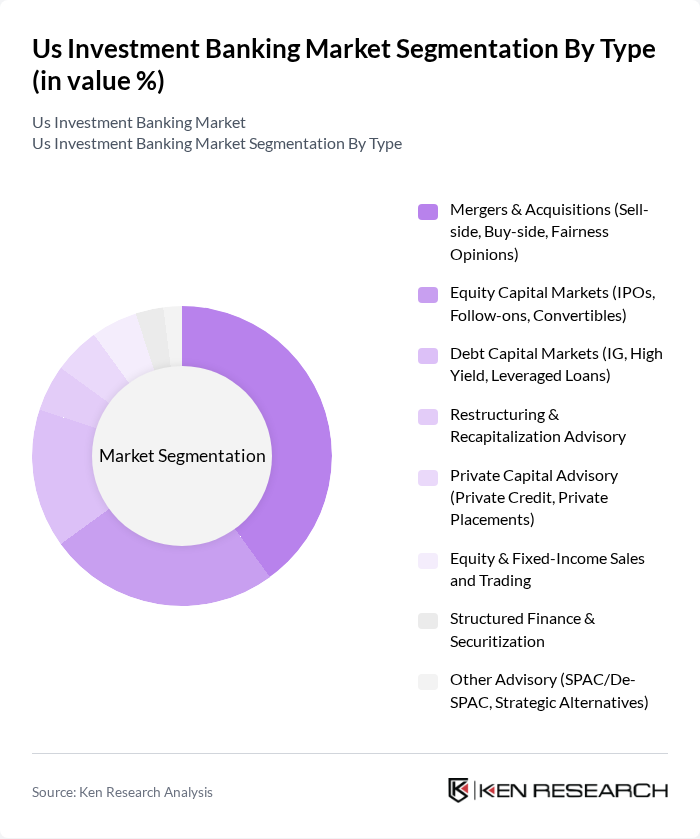
Us Investment Banking Market Segmentation
By Type:The US Investment Banking Market is segmented into various types, including Mergers & Acquisitions, Equity Capital Markets, Debt Capital Markets, Restructuring & Recapitalization Advisory, Private Capital Advisory, Equity & Fixed-Income Sales and Trading, Structured Finance & Securitization, and Other Advisory services. Among these, Mergers & Acquisitions (M&A) is the leading segment, supported by the continued dominance of M&A advisory in fee pools and recent data indicating M&A led with the largest share of mandates, while ECM has benefited from a recovering IPO window and convertibles issuance, and DCM/leveraged finance has improved alongside better credit markets . The demand for advisory services in M&A has been bolstered by favorable market liquidity, strong sponsor activity, and strategic consolidation across technology, healthcare, energy transition, and infrastructure-related sectors .
By End-User:The end-user segmentation of the US Investment Banking Market includes Public Corporations, Private/Founder-Owned Companies, Financial Sponsors, Institutional Investors, Government & Public Sector Entities, and Family Offices & Ultra-High-Net-Worth Clients. Public Corporations dominate this segment, as they frequently engage in capital raising and M&A activities to enhance their market position and drive growth, while financial sponsors (private equity and increasingly private credit managers) generate substantial deal flow through acquisitions, exits, and capital solutions that utilize ECM, DCM, and advisory services . The increasing trend of public companies seeking strategic acquisitions to expand market share, coupled with opportunistic carve-outs and portfolio rebalancing, has significantly contributed to the growth of this segment .

Us Investment Banking Market Competitive Landscape
The US Investment Banking Market is characterized by a dynamic mix of regional and international players. Leading participants such as Goldman Sachs Group, Inc., Morgan Stanley, JPMorgan Chase & Co., Bank of America, Citigroup Inc., Barclays PLC, Deutsche Bank AG, UBS Group AG, Wells Fargo & Company, Evercore Inc., Lazard Ltd, Moelis & Company, Houlihan Lokey, Inc., Jefferies Financial Group Inc., PJT Partners Inc. contribute to innovation, geographic expansion, and service delivery in this space, with bulge bracket banks dominating the fee wallet and elite boutiques maintaining strong M&A franchises .
Us Investment Banking Market Industry Analysis
Growth Drivers
- Increased M&A Activity:The US investment banking sector has seen a significant uptick in mergers and acquisitions, with over 16,000 deals valued at approximately $1.9 trillion. This surge is driven by favorable economic conditions, including a projected GDP growth of 2.1% in future, which encourages companies to pursue strategic consolidations. Additionally, low-interest rates have facilitated financing, making M&A a viable growth strategy for many firms, thus bolstering investment banking revenues.
- Rising Demand for Capital Markets Services:In future, the US capital markets are expected to witness an influx of $800 billion in new equity and debt issuances, reflecting a robust demand for capital raising services. This demand is fueled by companies seeking to finance expansion and innovation amid a recovering economy. The increase in IPOs, with over 200 expected in future, further underscores the necessity for investment banks to provide advisory and underwriting services, enhancing their market position.
- Technological Advancements in Financial Services:The integration of advanced technologies in investment banking is transforming service delivery. In future, firms are projected to invest over $30 billion in fintech solutions, enhancing operational efficiency and client engagement. Technologies such as AI and blockchain are streamlining processes, reducing costs, and improving transaction speeds. This technological shift not only attracts new clients but also retains existing ones, driving growth in the investment banking sector.
Market Challenges
- Regulatory Compliance Costs:The investment banking sector faces escalating regulatory compliance costs, which are projected to exceed $15 billion. Compliance with regulations such as the Dodd-Frank Act and Basel III imposes significant financial burdens on firms, diverting resources from core business activities. These costs can hinder profitability and limit the ability of banks to invest in growth initiatives, posing a substantial challenge to the industry.
- Market Volatility:The US investment banking market is increasingly susceptible to market volatility, with the VIX index indicating heightened uncertainty. In future, fluctuations in interest rates and geopolitical tensions are expected to contribute to a 20% increase in market volatility. This unpredictability can deter potential clients from engaging in M&A or capital raising activities, adversely affecting investment banking revenues and overall market stability.
Us Investment Banking Market Future Outlook
The future of the US investment banking market appears promising, driven by ongoing technological advancements and a strong focus on sustainable finance. As firms increasingly adopt digital transformation strategies, the integration of data analytics and AI will enhance decision-making processes and client interactions. Furthermore, the growing emphasis on environmental, social, and governance (ESG) criteria will likely reshape investment strategies, positioning banks to capitalize on emerging trends and client demands in the coming years.
Market Opportunities
- Growth in Emerging Markets:Investment banks have a significant opportunity to expand into emerging markets, where GDP growth rates are projected to exceed 4% in future. This expansion can lead to increased deal flow and new client acquisition, as businesses in these regions seek capital and advisory services to support their growth ambitions.
- Increased Focus on ESG Investments:The rising demand for ESG investments presents a lucrative opportunity for investment banks. In future, ESG assets are expected to reach $53 trillion globally, prompting banks to develop specialized services and products that cater to socially responsible investors, thereby enhancing their competitive edge in the market.
Scope of the Report
| Segment | Sub-Segments |
|---|---|
| By Type | Mergers & Acquisitions (Sell-side, Buy-side, Fairness Opinions) Equity Capital Markets (IPOs, Follow-ons, Convertibles) Debt Capital Markets (IG, High Yield, Leveraged Loans) Restructuring & Recapitalization Advisory Private Capital Advisory (Private Credit, Private Placements) Equity & Fixed-Income Sales and Trading Structured Finance & Securitization Other Advisory (SPAC/De-SPAC, Strategic Alternatives) |
| By End-User | Public Corporations Private/Founder-Owned Companies Financial Sponsors (Private Equity, Venture Capital) Institutional Investors (Pension, Sovereign, Insurance) Government & Public Sector Entities Family Offices & Ultra-High-Net-Worth Clients |
| By Service Type | Underwriting & Bookrunning Syndication & Distribution Research & Analytics (Equity/ Credit Research) Risk Management & Hedging (Derivatives, FX, Rates) Market Making & Execution Prime Brokerage & Financing |
| By Transaction Size | Sub-$100 Million $100 Million–$1 Billion $1 Billion–$5 Billion Above $5 Billion (Mega Deals) |
| By Geographic Focus | Domestic (U.S.-Only) Transactions Cross-Border – Inbound Cross-Border – Outbound Multiregional/Global Mandates |
| By Client Type | Large-Cap (>$10B market cap) Mid-Cap ($2B–$10B) Small-Cap & Emerging Growth (<$2B) Sponsor-Backed vs. Non-Sponsor |
| By Capital Source | Public Markets (NYSE/Nasdaq, SEC-Registered) Private Markets (Private Credit, PE, Venture) Bank Balance Sheet & Loan Syndications Government/Agency Programs (e.g., muni, GSEs) |
Key Target Audience
Investors and Venture Capitalist Firms
Government and Regulatory Bodies (e.g., Securities and Exchange Commission, Federal Reserve)
Private Equity Firms
Corporate Treasurers and Finance Departments
Investment Funds and Hedge Funds
Wealth Management Firms
Insurance Companies
Pension Funds
Players Mentioned in the Report:
Goldman Sachs Group, Inc.
Morgan Stanley
JPMorgan Chase & Co.
Bank of America
Citigroup Inc.
Barclays PLC
Deutsche Bank AG
UBS Group AG
Wells Fargo & Company
Evercore Inc.
Lazard Ltd
Moelis & Company
Houlihan Lokey, Inc.
Jefferies Financial Group Inc.
PJT Partners Inc.
Table of Contents
Market Assessment Phase
1. Executive Summary and Approach
2. Us Investment Banking Market Overview
2.1 Key Insights and Strategic Recommendations
2.2 Us Investment Banking Market Overview
2.3 Definition and Scope
2.4 Evolution of Market Ecosystem
2.5 Timeline of Key Regulatory Milestones
2.6 Value Chain & Stakeholder Mapping
2.7 Business Cycle Analysis
2.8 Policy & Incentive Landscape
3. Us Investment Banking Market Analysis
3.1 Growth Drivers
3.1.1 Increased M&A Activity
3.1.2 Rising Demand for Capital Markets Services
3.1.3 Expansion of Private Equity Investments
3.1.4 Technological Advancements in Financial Services
3.2 Market Challenges
3.2.1 Regulatory Compliance Costs
3.2.2 Market Volatility
3.2.3 Competition from Non-Bank Financial Institutions
3.2.4 Talent Retention Issues
3.3 Market Opportunities
3.3.1 Growth in Emerging Markets
3.3.2 Digital Transformation Initiatives
3.3.3 Sustainable Finance Trends
3.3.4 Increased Focus on ESG Investments
3.4 Market Trends
3.4.1 Rise of Fintech Partnerships
3.4.2 Shift Towards Remote Advisory Services
3.4.3 Increased Use of Data Analytics
3.4.4 Focus on Client-Centric Solutions
3.5 Government Regulation
3.5.1 Dodd-Frank Act Compliance
3.5.2 Basel III Requirements
3.5.3 SEC Regulations on Disclosure
3.5.4 Anti-Money Laundering (AML) Regulations
4. SWOT Analysis
5. Stakeholder Analysis
6. Porter's Five Forces Analysis
7. Us Investment Banking Market Market Size, 2019-2024
7.1 By Value
7.2 By Volume
7.3 By Average Selling Price
8. Us Investment Banking Market Segmentation
8.1 By Type
8.1.1 Mergers & Acquisitions (Sell-side, Buy-side, Fairness Opinions)
8.1.2 Equity Capital Markets (IPOs, Follow-ons, Convertibles)
8.1.3 Debt Capital Markets (IG, High Yield, Leveraged Loans)
8.1.4 Restructuring & Recapitalization Advisory
8.1.5 Private Capital Advisory (Private Credit, Private Placements)
8.1.6 Equity & Fixed-Income Sales and Trading
8.1.7 Structured Finance & Securitization
8.1.8 Other Advisory (SPAC/De-SPAC, Strategic Alternatives)
8.2 By End-User
8.2.1 Public Corporations
8.2.2 Private/Founder-Owned Companies
8.2.3 Financial Sponsors (Private Equity, Venture Capital)
8.2.4 Institutional Investors (Pension, Sovereign, Insurance)
8.2.5 Government & Public Sector Entities
8.2.6 Family Offices & Ultra-High-Net-Worth Clients
8.3 By Service Type
8.3.1 Underwriting & Bookrunning
8.3.2 Syndication & Distribution
8.3.3 Research & Analytics (Equity/ Credit Research)
8.3.4 Risk Management & Hedging (Derivatives, FX, Rates)
8.3.5 Market Making & Execution
8.3.6 Prime Brokerage & Financing
8.4 By Transaction Size
8.4.1 Sub-$100 Million
8.4.2 $100 Million–$1 Billion
8.4.3 $1 Billion–$5 Billion
8.4.4 Above $5 Billion (Mega Deals)
8.5 By Geographic Focus
8.5.1 Domestic (U.S.-Only) Transactions
8.5.2 Cross-Border – Inbound
8.5.3 Cross-Border – Outbound
8.5.4 Multiregional/Global Mandates
8.6 By Client Type
8.6.1 Large-Cap (>$10B market cap)
8.6.2 Mid-Cap ($2B–$10B)
8.6.3 Small-Cap & Emerging Growth (<$2B)
8.6.4 Sponsor-Backed vs. Non-Sponsor
8.7 By Capital Source
8.7.1 Public Markets (NYSE/Nasdaq, SEC-Registered)
8.7.2 Private Markets (Private Credit, PE, Venture)
8.7.3 Bank Balance Sheet & Loan Syndications
8.7.4 Government/Agency Programs (e.g., muni, GSEs)
9. Us Investment Banking Market Competitive Analysis
9.1 Market Share of Key Players
9.2 Cross Comparison of Key Players
9.2.1 Firm Name
9.2.2 Group Size (Bulge Bracket, Elite Boutique, Middle Market)
9.2.3 U.S. IB Fee Wallet Share (%)
9.2.4 Revenue Growth Rate (YoY)
9.2.5 M&A Advisory League Table Rank (U.S.)
9.2.6 ECM League Table Rank (U.S.)
9.2.7 DCM/Leveraged Finance League Table Rank (U.S.)
9.2.8 Average Deal Size (Last 12 Months, USD)
9.2.9 Number of Completed Deals (LTM)
9.2.10 Client Retention/Repeat Mandate Rate (%)
9.2.11 Cross-Border Deal Mix (%)
9.2.12 Return on Equity (ROE) – IB Segment
9.2.13 Productivity (IB Revenue per Banker, USD)
9.2.14 Pricing/Take Rate (Avg. Fee % by Product)
9.3 SWOT Analysis of Top Players
9.4 Pricing Analysis
9.5 Detailed Profile of Major Companies
9.5.1 Goldman Sachs Group, Inc.
9.5.2 Morgan Stanley
9.5.3 JPMorgan Chase & Co.
9.5.4 Bank of America
9.5.5 Citigroup Inc.
9.5.6 Barclays PLC
9.5.7 Deutsche Bank AG
9.5.8 UBS Group AG
9.5.9 Wells Fargo & Company
9.5.10 Evercore Inc.
9.5.11 Lazard Ltd
9.5.12 Moelis & Company
9.5.13 Houlihan Lokey, Inc.
9.5.14 Jefferies Financial Group Inc.
9.5.15 PJT Partners Inc.
10. Us Investment Banking Market End-User Analysis
10.1 Procurement Behavior of Key Ministries
10.1.1 Budget Allocation Trends
10.1.2 Decision-Making Processes
10.1.3 Preferred Service Providers
10.1.4 Compliance Requirements
10.2 Corporate Spend on Infrastructure & Energy
10.2.1 Investment Priorities
10.2.2 Funding Sources
10.2.3 Project Types
10.3 Pain Point Analysis by End-User Category
10.3.1 Regulatory Challenges
10.3.2 Cost Management Issues
10.3.3 Access to Capital
10.4 User Readiness for Adoption
10.4.1 Technology Adoption Rates
10.4.2 Training and Support Needs
10.5 Post-Deployment ROI and Use Case Expansion
10.5.1 Performance Metrics
10.5.2 Case Studies of Successful Implementations
10.5.3 Future Investment Plans
11. Us Investment Banking Market Future Size, 2025-2030
11.1 By Value
11.2 By Volume
11.3 By Average Selling Price
Go-To-Market Strategy Phase
1. Whitespace Analysis + Business Model Canvas
1.1 Market Gaps Identification
1.2 Value Proposition Development
1.3 Revenue Streams Analysis
1.4 Cost Structure Evaluation
1.5 Key Partnerships Exploration
1.6 Customer Segmentation
1.7 Channels of Distribution
2. Marketing and Positioning Recommendations
2.1 Branding Strategies
2.2 Product USPs
2.3 Target Market Identification
2.4 Communication Strategies
2.5 Digital Marketing Approaches
2.6 Customer Engagement Tactics
3. Distribution Plan
3.1 Urban Retail Strategies
3.2 Rural NGO Tie-Ups
3.3 Online Distribution Channels
3.4 Direct Sales Approaches
3.5 Partnership Opportunities
4. Channel & Pricing Gaps
4.1 Underserved Routes
4.2 Pricing Bands Analysis
4.3 Competitor Pricing Strategies
4.4 Customer Willingness to Pay
5. Unmet Demand & Latent Needs
5.1 Category Gaps Identification
5.2 Consumer Segments Analysis
5.3 Emerging Trends Exploration
6. Customer Relationship
6.1 Loyalty Programs
6.2 After-Sales Service
6.3 Customer Feedback Mechanisms
7. Value Proposition
7.1 Sustainability Initiatives
7.2 Integrated Supply Chains
7.3 Unique Selling Points
8. Key Activities
8.1 Regulatory Compliance
8.2 Branding Efforts
8.3 Distribution Setup
9. Entry Strategy Evaluation
9.1 Domestic Market Entry Strategy
9.1.1 Product Mix Considerations
9.1.2 Pricing Band Strategy
9.1.3 Packaging Options
9.2 Export Entry Strategy
9.2.1 Target Countries
9.2.2 Compliance Roadmap
10. Entry Mode Assessment
10.1 Joint Ventures
10.2 Greenfield Investments
10.3 Mergers & Acquisitions
10.4 Distributor Model
11. Capital and Timeline Estimation
11.1 Capital Requirements
11.2 Timelines for Implementation
12. Control vs Risk Trade-Off
12.1 Ownership vs Partnerships
13. Profitability Outlook
13.1 Breakeven Analysis
13.2 Long-Term Sustainability
14. Potential Partner List
14.1 Distributors
14.2 Joint Ventures
14.3 Acquisition Targets
15. Execution Roadmap
15.1 Phased Plan for Market Entry
15.1.1 Market Setup
15.1.2 Market Entry
15.1.3 Growth Acceleration
15.1.4 Scale & Stabilize
15.2 Key Activities and Milestones
15.2.1 Milestone Planning
15.2.2 Activity Tracking
Research Methodology
Phase 1: Approach1
Desk Research
- Analysis of industry reports from financial institutions and market research firms
- Review of regulatory frameworks and compliance guidelines from the SEC and FINRA
- Examination of historical market data and trends from financial databases and publications
Primary Research
- Interviews with investment bankers and analysts from leading firms
- Surveys targeting corporate finance executives and CFOs
- Focus groups with institutional investors and private equity professionals
Validation & Triangulation
- Cross-validation of findings through multiple data sources, including financial statements and market surveys
- Triangulation of qualitative insights from interviews with quantitative data from market reports
- Sanity checks conducted through expert panel reviews and feedback sessions
Phase 2: Market Size Estimation1
Top-down Assessment
- Estimation of total market size based on historical revenue data from major investment banks
- Segmentation of the market by service lines such as M&A advisory, underwriting, and asset management
- Incorporation of macroeconomic indicators and trends affecting investment banking activities
Bottom-up Modeling
- Collection of firm-level revenue data from top investment banks to establish benchmarks
- Analysis of transaction volumes and fees associated with various investment banking services
- Estimation of growth rates based on historical performance and market dynamics
Forecasting & Scenario Analysis
- Multi-factor regression analysis incorporating economic growth, interest rates, and market volatility
- Scenario modeling based on potential regulatory changes and shifts in investor sentiment
- Development of baseline, optimistic, and pessimistic forecasts through 2030
Phase 3: CATI Sample Composition1
| Scope Item/Segment | Sample Size | Target Respondent Profiles |
|---|---|---|
| M&A Advisory Services | 120 | Investment Bankers, Corporate Development Executives |
| Equity Underwriting | 90 | Equity Analysts, Syndicate Managers |
| Debt Capital Markets | 80 | Debt Analysts, Treasury Managers |
| Asset Management | 70 | Portfolio Managers, Wealth Advisors |
| Private Equity Investments | 60 | Private Equity Analysts, Fund Managers |
Frequently Asked Questions
What is the current value of the US Investment Banking Market?
The US Investment Banking Market is valued at approximately USD 135 billion, reflecting a robust fee/revenue pool primarily driven by mergers and acquisitions (M&A) and underwriting activities, as well as increased private equity investments.
What are the primary drivers of growth in the US Investment Banking Market?
Which cities dominate the US Investment Banking Market?
How does the Dodd-Frank Act impact the US Investment Banking Market?
Other Regional/Country Reports
Why Buy From Us?

What makes us stand out is that our consultants follow Robust, Refine and Result (RRR) methodology. Robust for clear definitions, approaches and sanity checking, Refine for differentiating respondents' facts and opinions, and Result for presenting data with story.

We have set a benchmark in the industry by offering our clients with syndicated and customized market research reports featuring coverage of entire market as well as meticulous research and analyst insights.

While we don't replace traditional research, we flip the method upside down. Our dual approach of Top Bottom & Bottom Top ensures quality deliverable by not just verifying company fundamentals but also looking at the sector and macroeconomic factors.

With one step in the future, our research team constantly tries to show you the bigger picture. We help with some of the tough questions you may encounter along the way: How is the industry positioned? Best marketing channel? KPI's of competitors? By aligning every element, we help maximize success.

Our report gives you instant access to the answers and sources that other companies might choose to hide. We elaborate each steps of research methodology we have used and showcase you the sample size to earn your trust.

If you need any support, we are here! We pride ourselves on universe strength, data quality, and quick, friendly, and professional service.