About the Report
Base Year 2024US Online Trading Platform Market Overview
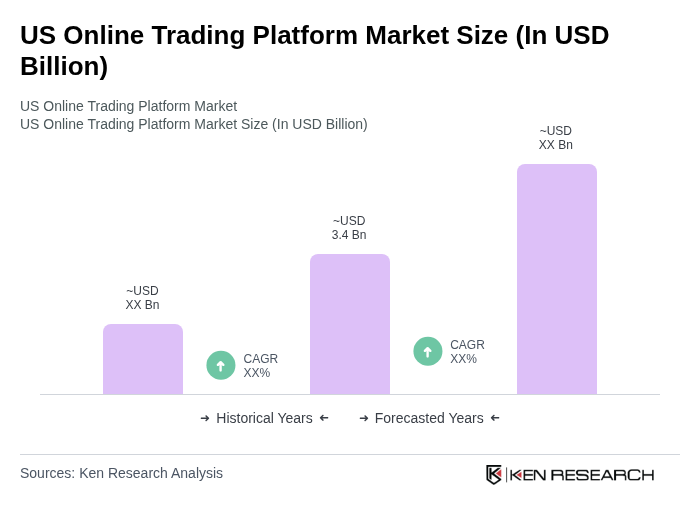
- The US Online Trading Platform Market is valued at USD 3.4 billion, based on a five-year historical analysis. This growth is primarily driven by the increasing adoption of digital trading solutions and mobile-first platforms, the rise of retail investors (particularly millennials and Gen Z), and advancements in technology such as AI-driven analytics, robo-advisory, and algorithmic trading that enhance trading experiences. The proliferation of mobile trading applications, zero-commission models, and demand for low-cost trading options, along with expanding access to cryptocurrencies and alternative assets, have further fueled market expansion.
- Key players in this market include major financial hubs such as New York City and San Francisco, which dominate due to their established financial ecosystems, deep capital markets, proximity to leading brokerages and asset managers, strong technology and fintech clusters, and a high concentration of investment firms and trading venues. The presence of a large number of retail investors, institutional clients, and fintech startups in these cities also contributes to their market leadership.
- In 2023, the US government implemented regulations aimed at enhancing transparency in online trading platforms. The Securities and Exchange Commission (SEC) adopted amendments to Rule 605 of Regulation NMS (Order Execution Transparency) in 2023, requiring expanded execution quality disclosures across more order types and venues, and introduced further reporting granularity to help investors understand how their trades are executed. In parallel, the SEC proposed Regulation Best Execution and issued enhanced guidance on payment for order flow and conflicts of interest, building on existing disclosure obligations under Rule 606 of Regulation NMS, so that brokers provide clearer information on routing practices and potential conflicts related to payment for order flow arrangements.
US Online Trading Platform Market Segmentation
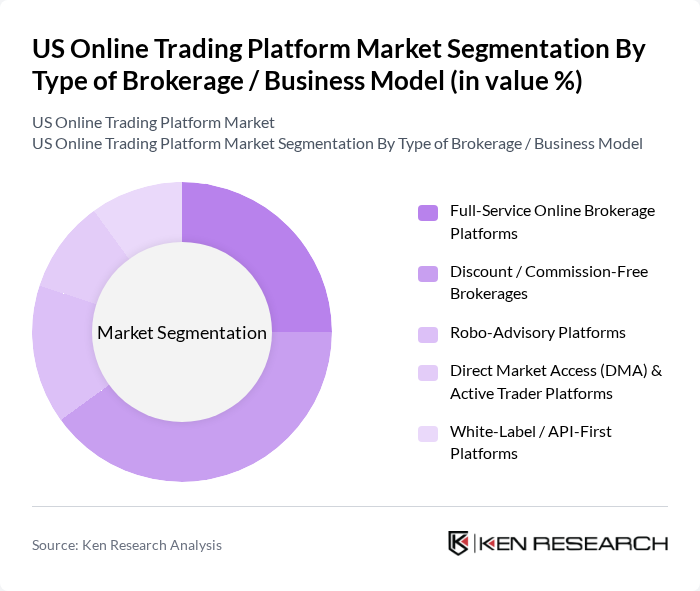
By Type of Brokerage / Business Model:This segmentation includes various business models that cater to different investor needs and preferences. The subsegments are Full-Service Online Brokerage Platforms, Discount / Commission-Free Brokerages, Robo-Advisory Platforms, Direct Market Access (DMA) & Active Trader Platforms, and White-Label / API-First Platforms. Each of these models serves distinct market segments, with varying levels of service and cost structures. Full-service platforms typically bundle research, advice, and planning tools; discount and commission-free brokerages focus on low-cost execution and mobile-first experiences; robo-advisory platforms automate portfolio management using algorithms; DMA and active trader platforms emphasize advanced tools, speed, and sophisticated order types; and white-label / API-first platforms enable financial institutions and fintechs to embed trading capabilities into their own branded offerings.
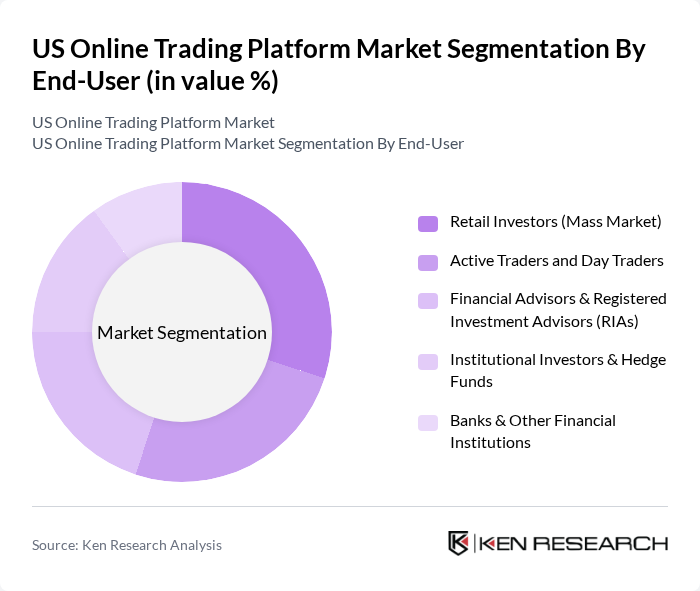
By End-User:This segmentation focuses on the different types of users engaging with online trading platforms. The subsegments include Retail Investors (Mass Market), Active Traders and Day Traders, Financial Advisors & Registered Investment Advisors (RIAs), Institutional Investors & Hedge Funds, and Banks & Other Financial Institutions. Each user group has unique trading behaviors and requirements, influencing the design and functionality of trading platforms. Retail investors generally seek intuitive interfaces, educational content, fractional investing, and low account minimums; active traders and day traders demand advanced charting, real-time data, and low-latency execution; financial advisors and RIAs require integrated portfolio management, compliance and reporting tools; institutional investors and hedge funds focus on robust order management systems, multi-asset connectivity, and risk controls; while banks and other financial institutions often integrate trading within broader digital banking, wealth management, and custody offerings.
US Online Trading Platform Market Competitive Landscape
The US Online Trading Platform Market is characterized by a dynamic mix of regional and international players. Leading participants such as Charles Schwab, TD Ameritrade (a Charles Schwab Company), E*TRADE from Morgan Stanley, Robinhood Markets, Inc., Fidelity Investments, Interactive Brokers Group, Inc., Webull Financial LLC, Ally Invest (Ally Financial Inc.), Merrill Edge (Bank of America Corporation), SoFi Invest (SoFi Technologies, Inc.), TradeStation Group, Inc., Zacks Trade, tastytrade, Inc. (formerly tastyworks), Acorns Grow Inc., Public Holdings, Inc. (Public.com) contribute to innovation, geographic expansion, and service delivery in this space.
US Online Trading Platform Market Industry Analysis
Growth Drivers
- Increasing Retail Investor Participation:The number of retail investors in the U.S. has surged, with approximately 10 million new brokerage accounts opened in 2020 alone, according to the Financial Industry Regulatory Authority (FINRA). This trend has continued, driven by the pandemic and increased accessibility to trading platforms. As of in future, retail trading volume is projected to account for over 27% of total market volume, reflecting a significant shift in market dynamics and investor engagement.
- Advancements in Technology and Trading Platforms:The U.S. online trading platform market has seen substantial technological advancements, with over 72% of platforms now offering advanced trading tools and analytics. The integration of cloud computing and big data analytics has enhanced trading efficiency and decision-making. By in future, it is estimated that 62% of traders will utilize algorithmic trading strategies, showcasing the growing reliance on technology in trading practices.
- Rise of Mobile Trading Applications:Mobile trading applications have revolutionized the trading landscape, with over 52% of retail investors using mobile apps for trading as of in future. The convenience of trading on-the-go has led to a 42% increase in trading frequency among mobile users. By in future, mobile trading is expected to represent 72% of all retail trading activity, highlighting the importance of mobile platforms in attracting new investors.
Market Challenges
- Regulatory Compliance and Changes:The U.S. online trading platform market faces significant challenges due to evolving regulatory frameworks. In in future, the SEC proposed new rules aimed at enhancing transparency and investor protection, which could impose additional compliance costs on platforms. As of in future, firms may need to allocate up to 16% of their operational budgets to meet these regulatory requirements, impacting profitability and operational efficiency.
- Market Volatility and Economic Uncertainty:Economic fluctuations and market volatility pose substantial risks to online trading platforms. In in future, the S&P 500 experienced a 21% decline during periods of economic uncertainty, leading to decreased trading volumes. As of in future, analysts predict continued volatility due to geopolitical tensions and inflationary pressures, which could deter new investors and reduce overall market activity, challenging platform growth.
US Online Trading Platform Market Future Outlook
The future of the U.S. online trading platform market appears promising, driven by technological innovations and evolving investor preferences. As platforms increasingly adopt AI and machine learning, they will enhance user experiences and trading efficiencies. Additionally, the shift towards commission-free trading is likely to attract more retail investors, further expanding the market. However, platforms must navigate regulatory challenges and market volatility to sustain growth and maintain investor trust in this dynamic environment.
Market Opportunities
- Expansion into Emerging Markets:U.S. online trading platforms have significant opportunities to expand into emerging markets, where internet penetration is increasing rapidly. By in future, regions like Southeast Asia are expected to see a 32% growth in online trading participation, providing platforms with a new customer base and revenue streams.
- Integration of AI and Machine Learning:The integration of AI and machine learning technologies presents a lucrative opportunity for online trading platforms. By in future, it is projected that 52% of trading platforms will utilize AI-driven analytics to enhance trading strategies, improve risk management, and personalize user experiences, leading to increased customer satisfaction and retention.
Scope of the Report
| Segment | Sub-Segments |
|---|---|
| By Type of Brokerage / Business Model | Full-Service Online Brokerage Platforms Discount / Commission-Free Brokerages Robo-Advisory Platforms Direct Market Access (DMA) & Active Trader Platforms White-Label / API-First Platforms |
| By End-User | Retail Investors (Mass Market) Active Traders and Day Traders Financial Advisors & Registered Investment Advisors (RIAs) Institutional Investors & Hedge Funds Banks & Other Financial Institutions |
| By Account Type | Taxable Brokerage Accounts Individual Retirement Accounts (IRAs) Employer-Sponsored Retirement & Stock Plan Accounts Margin & Options-Enabled Accounts Custodial & Trust / Estate Accounts |
| By Asset Class Traded | Equities ETFs & Mutual Funds Options & Other Derivatives Fixed Income & Money Market Instruments Forex, Crypto & Other Alternative Assets |
| By Trading Style & Order Type | Buy-and-Hold / Long-Term Investing Active / Swing Trading High-Frequency & Algorithmic Trading Social & Copy Trading Fractional & Micro-Investing |
| By Deployment & Interface | Cloud-Based Platforms On-Premises / Proprietary In-House Platforms Mobile App–First Platforms Desktop & Web-Based Platforms Hybrid / Multi-Device Platforms |
| By Key Feature Set | Advanced Charting & Analytics Tools Integrated Research & Market Data Educational Content & Investor Tools API Access & Algo-Trading Support Customer Support & Advisory Services |
Key Target Audience
Investors and Venture Capitalist Firms
Government and Regulatory Bodies (e.g., Securities and Exchange Commission, Commodity Futures Trading Commission)
Brokerage Firms
Financial Technology (FinTech) Companies
Market Makers and Liquidity Providers
Payment Processors
Insurance Companies
Wealth Management Firms
Players Mentioned in the Report:
Charles Schwab
TD Ameritrade (a Charles Schwab Company)
E*TRADE from Morgan Stanley
Robinhood Markets, Inc.
Fidelity Investments
Interactive Brokers Group, Inc.
Webull Financial LLC
Ally Invest (Ally Financial Inc.)
Merrill Edge (Bank of America Corporation)
SoFi Invest (SoFi Technologies, Inc.)
TradeStation Group, Inc.
Zacks Trade
tastytrade, Inc. (formerly tastyworks)
Acorns Grow Inc.
Public Holdings, Inc. (Public.com)
Table of Contents
Market Assessment Phase
1. Executive Summary and Approach
2. US Online Trading Platform Market Overview
2.1 Key Insights and Strategic Recommendations
2.2 US Online Trading Platform Market Overview
2.3 Definition and Scope
2.4 Evolution of Market Ecosystem
2.5 Timeline of Key Regulatory Milestones
2.6 Value Chain & Stakeholder Mapping
2.7 Business Cycle Analysis
2.8 Policy & Incentive Landscape
3. US Online Trading Platform Market Analysis
3.1 Growth Drivers
3.1.1 Increasing Retail Investor Participation
3.1.2 Advancements in Technology and Trading Platforms
3.1.3 Rise of Mobile Trading Applications
3.1.4 Growing Demand for Low-Cost Trading Solutions
3.2 Market Challenges
3.2.1 Regulatory Compliance and Changes
3.2.2 Market Volatility and Economic Uncertainty
3.2.3 Cybersecurity Threats
3.2.4 High Competition Among Platforms
3.3 Market Opportunities
3.3.1 Expansion into Emerging Markets
3.3.2 Integration of AI and Machine Learning
3.3.3 Development of Educational Resources for Investors
3.3.4 Partnerships with Financial Institutions
3.4 Market Trends
3.4.1 Shift Towards Commission-Free Trading
3.4.2 Increased Focus on User Experience and Interface Design
3.4.3 Growth of Social Trading Features
3.4.4 Emphasis on Sustainable and Ethical Investing
3.5 Government Regulation
3.5.1 SEC Regulations on Trading Practices
3.5.2 FINRA Guidelines for Broker-Dealers
3.5.3 Anti-Money Laundering (AML) Compliance
3.5.4 Data Protection and Privacy Laws
4. SWOT Analysis
5. Stakeholder Analysis
6. Porter's Five Forces Analysis
7. US Online Trading Platform Market Size, 2019-2024
7.1 By Value
7.2 By Volume
7.3 By Average Selling Price
8. US Online Trading Platform Market Segmentation
8.1 By Type of Brokerage / Business Model
8.1.1 Full-Service Online Brokerage Platforms
8.1.2 Discount / Commission-Free Brokerages
8.1.3 Robo-Advisory Platforms
8.1.4 Direct Market Access (DMA) & Active Trader Platforms
8.1.5 White-Label / API-First Platforms
8.2 By End-User
8.2.1 Retail Investors (Mass Market)
8.2.2 Active Traders and Day Traders
8.2.3 Financial Advisors & Registered Investment Advisors (RIAs)
8.2.4 Institutional Investors & Hedge Funds
8.2.5 Banks & Other Financial Institutions
8.3 By Account Type
8.3.1 Taxable Brokerage Accounts
8.3.2 Individual Retirement Accounts (IRAs)
8.3.3 Employer-Sponsored Retirement & Stock Plan Accounts
8.3.4 Margin & Options-Enabled Accounts
8.3.5 Custodial & Trust / Estate Accounts
8.4 By Asset Class Traded
8.4.1 Equities
8.4.2 ETFs & Mutual Funds
8.4.3 Options & Other Derivatives
8.4.4 Fixed Income & Money Market Instruments
8.4.5 Forex, Crypto & Other Alternative Assets
8.5 By Trading Style & Order Type
8.5.1 Buy-and-Hold / Long-Term Investing
8.5.2 Active / Swing Trading
8.5.3 High-Frequency & Algorithmic Trading
8.5.4 Social & Copy Trading
8.5.5 Fractional & Micro-Investing
8.6 By Deployment & Interface
8.6.1 Cloud-Based Platforms
8.6.2 On-Premises / Proprietary In-House Platforms
8.6.3 Mobile App–First Platforms
8.6.4 Desktop & Web-Based Platforms
8.6.5 Hybrid / Multi-Device Platforms
8.7 By Key Feature Set
8.7.1 Advanced Charting & Analytics Tools
8.7.2 Integrated Research & Market Data
8.7.3 Educational Content & Investor Tools
8.7.4 API Access & Algo-Trading Support
8.7.5 Customer Support & Advisory Services
9. US Online Trading Platform Market Competitive Analysis
9.1 Market Share of Key Players
9.2 Cross Comparison of Key Players
9.2.1 Company Name
9.2.2 Platform Scale (Active Accounts / AUM Tier)
9.2.3 Customer Acquisition Cost (CAC) per Funded Account
9.2.4 Average Revenue Per User (ARPU)
9.2.5 Monthly / Annual Trading Volume & Growth Rate
9.2.6 Customer Retention & Churn Rate
9.2.7 Pricing & Monetization Model (Commissions, PFOF, Subscriptions)
9.2.8 Net Promoter Score (NPS) & App Store Ratings
9.2.9 Market Penetration in US Retail & Active Trader Segments
9.2.10 User Engagement (Trading Frequency, Time-in-App, Feature Adoption)
9.3 SWOT Analysis of Top Players
9.4 Pricing Analysis
9.5 Detailed Profile of Major Companies
9.5.1 Charles Schwab
9.5.2 TD Ameritrade (a Charles Schwab Company)
9.5.3 E*TRADE from Morgan Stanley
9.5.4 Robinhood Markets, Inc.
9.5.5 Fidelity Investments
9.5.6 Interactive Brokers Group, Inc.
9.5.7 Webull Financial LLC
9.5.8 Ally Invest (Ally Financial Inc.)
9.5.9 Merrill Edge (Bank of America Corporation)
9.5.10 SoFi Invest (SoFi Technologies, Inc.)
9.5.11 TradeStation Group, Inc.
9.5.12 Zacks Trade
9.5.13 tastytrade, Inc. (formerly tastyworks)
9.5.14 Acorns Grow Inc.
9.5.15 Public Holdings, Inc. (Public.com)
10. US Online Trading Platform Market End-User Analysis
10.1 Procurement Behavior of Key Ministries
10.1.1 Investment Strategies
10.1.2 Budget Allocation
10.1.3 Risk Management Practices
10.1.4 Compliance Requirements
10.2 Corporate Spend on Infrastructure & Energy
10.2.1 Investment in Trading Technology
10.2.2 Budget for Training and Development
10.2.3 Expenditure on Security Measures
10.2.4 Allocation for Marketing and Customer Acquisition
10.3 Pain Point Analysis by End-User Category
10.3.1 Lack of User-Friendly Interfaces
10.3.2 High Fees and Commissions
10.3.3 Limited Access to Research Tools
10.3.4 Concerns Over Data Security
10.4 User Readiness for Adoption
10.4.1 Familiarity with Digital Platforms
10.4.2 Willingness to Invest
10.4.3 Understanding of Market Dynamics
10.4.4 Access to Financial Education
10.5 Post-Deployment ROI and Use Case Expansion
10.5.1 Measurement of Trading Performance
10.5.2 User Feedback and Satisfaction
10.5.3 Opportunities for Upselling
10.5.4 Long-term Engagement Strategies
11. US Online Trading Platform Market Future Size, 2025-2030
11.1 By Value
11.2 By Volume
11.3 By Average Selling Price
Go-To-Market Strategy Phase
1. Whitespace Analysis + Business Model Canvas
1.1 Market Gaps Identification
1.2 Value Proposition Development
1.3 Revenue Streams Analysis
1.4 Cost Structure Evaluation
1.5 Key Partnerships Exploration
1.6 Customer Segmentation
1.7 Channels of Distribution
2. Marketing and Positioning Recommendations
2.1 Branding Strategies
2.2 Product USPs
2.3 Target Audience Identification
2.4 Communication Strategy
2.5 Digital Marketing Tactics
2.6 Customer Engagement Plans
2.7 Performance Metrics
3. Distribution Plan
3.1 Urban Retail Strategies
3.2 Rural NGO Tie-ups
3.3 Online Distribution Channels
3.4 Partnerships with Financial Institutions
3.5 Logistics and Supply Chain Management
3.6 Customer Service Framework
3.7 Feedback Mechanisms
4. Channel & Pricing Gaps
4.1 Underserved Routes
4.2 Pricing Bands Analysis
4.3 Competitor Pricing Comparison
4.4 Customer Willingness to Pay
4.5 Value-Based Pricing Strategies
4.6 Discount and Promotion Strategies
4.7 Pricing Model Innovation
5. Unmet Demand & Latent Needs
5.1 Category Gaps Identification
5.2 Consumer Segments Analysis
5.3 Emerging Trends Exploration
5.4 Customer Pain Points Assessment
5.5 Future Needs Forecasting
5.6 Product Development Opportunities
5.7 Market Entry Strategies
6. Customer Relationship
6.1 Loyalty Programs Design
6.2 After-sales Service Framework
6.3 Customer Feedback Collection
6.4 Relationship Management Strategies
6.5 Community Building Initiatives
6.6 Customer Education Programs
6.7 Retention Strategies
7. Value Proposition
7.1 Sustainability Initiatives
7.2 Integrated Supply Chains
7.3 Unique Selling Points
7.4 Customer-Centric Innovations
7.5 Competitive Advantages
7.6 Market Differentiation Strategies
7.7 Value Communication
8. Key Activities
8.1 Regulatory Compliance
8.2 Branding Initiatives
8.3 Distribution Setup
8.4 Technology Development
8.5 Market Research Activities
8.6 Training and Development Programs
8.7 Performance Monitoring
9. Entry Strategy Evaluation
9.1 Domestic Market Entry Strategy
9.1.1 Product Mix Considerations
9.1.2 Pricing Band Analysis
9.1.3 Packaging Strategies
9.2 Export Entry Strategy
9.2.1 Target Countries Identification
9.2.2 Compliance Roadmap Development
10. Entry Mode Assessment
10.1 Joint Ventures
10.2 Greenfield Investments
10.3 Mergers & Acquisitions
10.4 Distributor Model Evaluation
10.5 Risk Assessment
10.6 Strategic Fit Analysis
10.7 Long-term Viability
11. Capital and Timeline Estimation
11.1 Capital Requirements Analysis
11.2 Timelines for Implementation
11.3 Funding Sources Exploration
11.4 Financial Projections
11.5 Budget Allocation
11.6 Cost-Benefit Analysis
11.7 Risk Mitigation Strategies
12. Control vs Risk Trade-Off
12.1 Ownership vs Partnerships
12.2 Control Mechanisms
12.3 Risk Management Framework
12.4 Strategic Alliances
12.5 Performance Metrics
12.6 Long-term Strategy Alignment
12.7 Exit Strategies
13. Profitability Outlook
13.1 Breakeven Analysis
13.2 Long-term Sustainability Assessment
13.3 Profit Margin Projections
13.4 Revenue Growth Forecasting
13.5 Cost Management Strategies
13.6 Financial Health Indicators
13.7 Investment Returns Analysis
14. Potential Partner List
14.1 Distributors
14.2 Joint Ventures
14.3 Acquisition Targets
14.4 Strategic Partnerships
14.5 Collaboration Opportunities
14.6 Network Expansion Strategie
Research Methodology
Phase 1: Approach1
Desk Research
- Analysis of industry reports from financial institutions and market research firms
- Review of regulatory frameworks and compliance guidelines from the SEC and FINRA
- Examination of online trading platform user demographics and behavioral studies
Primary Research
- Interviews with product managers from leading online trading platforms
- Surveys targeting retail investors to understand user experience and preferences
- Focus groups with financial advisors to gather insights on platform features
Validation & Triangulation
- Cross-validation of findings with data from financial market analysts
- Triangulation of user feedback with platform performance metrics
- Sanity checks through expert panel discussions with industry veterans
Phase 2: Market Size Estimation1
Top-down Assessment
- Estimation of total market size based on overall trading volume in U.S. financial markets
- Segmentation by asset classes such as stocks, ETFs, and cryptocurrencies
- Incorporation of growth trends in retail trading and digital investment platforms
Bottom-up Modeling
- Analysis of user acquisition costs and average revenue per user (ARPU) for platforms
- Volume estimates based on user engagement metrics and trading frequency
- Revenue projections based on commission structures and subscription models
Forecasting & Scenario Analysis
- Multi-variable forecasting using historical trading data and economic indicators
- Scenario analysis based on regulatory changes and market volatility
- Development of baseline, optimistic, and pessimistic growth projections through 2030
Phase 3: CATI Sample Composition1
| Scope Item/Segment | Sample Size | Target Respondent Profiles |
|---|---|---|
| Retail Investor Insights | 140 | Individual Traders, Investment Enthusiasts |
| Institutional Trading Practices | 120 | Portfolio Managers, Institutional Investors |
| Platform Usability Feedback | 90 | UX Designers, Product Managers |
| Regulatory Impact Assessment | 60 | Compliance Officers, Legal Advisors |
| Market Trends and Predictions | 70 | Financial Analysts, Market Strategists |
Frequently Asked Questions
What is the current value of the US Online Trading Platform Market?
The US Online Trading Platform Market is valued at approximately USD 3.4 billion, reflecting significant growth driven by the increasing adoption of digital trading solutions, mobile-first platforms, and advancements in technology such as AI-driven analytics and robo-advisory services.
What factors are driving growth in the US Online Trading Platform Market?
How has retail investor participation changed in recent years?
What are the main types of online trading platforms available?
Other Regional/Country Reports
Indonesia Online Trading Platform Market
Malaysia Online Trading Platform Market
KSA Online Trading Platform Market
APAC Online Trading Platform Market
Other Adjacent Reports
Vietnam Investment Management Software Market
Cryptocurrency Trading MarketGermany Robo-Advisory Services Market
Mexico Stock Market Analysis Tools Market
Saudi Arabia Mobile Banking Apps Market Size, Share, Growth Drivers & Forecast 2025–2030Vietnam Wealth Management Platforms Market
Vietnam Algorithmic Trading Software Market
Mexico Financial Data Analytics Market
Kuwait Brokerage Services Market
Why Buy From Us?

What makes us stand out is that our consultants follow Robust, Refine and Result (RRR) methodology. Robust for clear definitions, approaches and sanity checking, Refine for differentiating respondents' facts and opinions, and Result for presenting data with story.

We have set a benchmark in the industry by offering our clients with syndicated and customized market research reports featuring coverage of entire market as well as meticulous research and analyst insights.

While we don't replace traditional research, we flip the method upside down. Our dual approach of Top Bottom & Bottom Top ensures quality deliverable by not just verifying company fundamentals but also looking at the sector and macroeconomic factors.

With one step in the future, our research team constantly tries to show you the bigger picture. We help with some of the tough questions you may encounter along the way: How is the industry positioned? Best marketing channel? KPI's of competitors? By aligning every element, we help maximize success.

Our report gives you instant access to the answers and sources that other companies might choose to hide. We elaborate each steps of research methodology we have used and showcase you the sample size to earn your trust.

If you need any support, we are here! We pride ourselves on universe strength, data quality, and quick, friendly, and professional service.