About the Report
Base Year 2024US Parking Management Market Overview
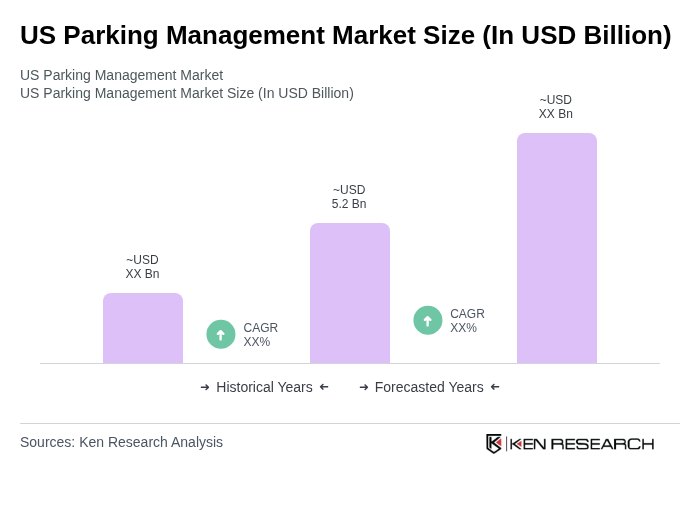
- The US Parking Management Market is valued at USD 5.2 billion, based on a five-year historical analysis. This growth is primarily driven by increasing urbanization, the rise in vehicle ownership, and the need for efficient space utilization in congested urban areas, as parking management solutions are increasingly adopted to reduce traffic congestion and greenhouse gas emissions. The demand for smart parking solutions, including sensor-based systems, mobile app payments, and data-driven parking guidance, along with broader technology integration, has also significantly contributed to the market's expansion.
- Key cities dominating the US Parking Management Market include New York, Los Angeles, and Chicago, which are among the most congested and densely populated urban areas in the country and face significant parking shortages and traffic delays. These cities have high population densities and significant traffic congestion, necessitating advanced parking management solutions such as off-street structured parking, dynamic pricing, and mobile-enabled parking reservations. The presence of numerous commercial establishments, airports, healthcare facilities, and public transport hubs further drives the demand for efficient parking systems in these metropolitan areas.
- The Infrastructure Investment and Jobs Act (IIJA), formally enacted as the Infrastructure Investment and Jobs Act of 2021 by the US federal government, allocates about USD 1.2 trillion for infrastructure improvements, including substantial funding for transportation systems, transit-oriented development, and related facilities that influence parking planning and management. This initiative aims to enhance urban mobility and reduce congestion through investments in roads, public transit, and EV charging infrastructure, thereby indirectly promoting the adoption of modern parking management systems such as integrated payment platforms, EV-ready parking, and smart curb management across the country.
US Parking Management Market Segmentation
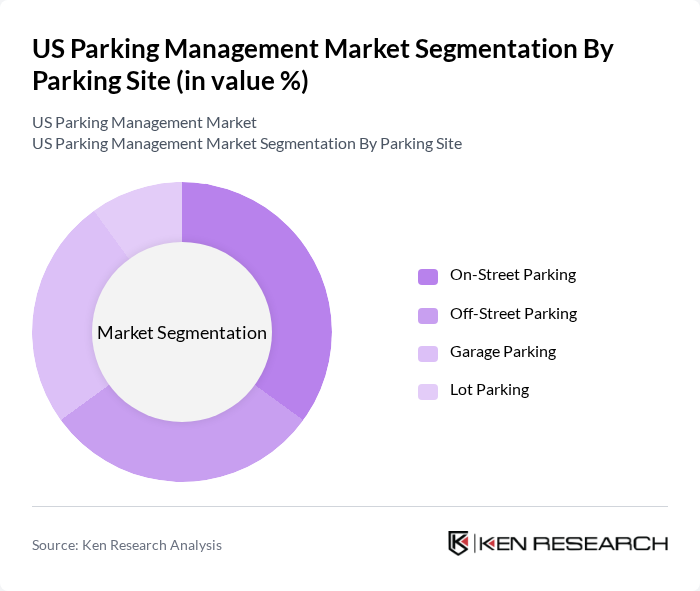
By Parking Site:The parking site segmentation includes various types of parking facilities that cater to different consumer needs. The subsegments are On-Street Parking, Off-Street Parking, Garage Parking, and Lot Parking. Each of these subsegments serves distinct purposes, with On-Street Parking being prevalent in urban areas due to space constraints and curbside management needs, while Off-Street Parking (including garages and structured parking) captures the largest share of parking management revenues in North America, driven by commercial, residential, and mixed-use developments. Garage Parking is often associated with residential and commercial buildings, airports, and downtown business districts, where automated access control and guidance systems are increasingly deployed, and Lot Parking is commonly used for events, campuses, stadiums, and large gatherings, where demand-based pricing and reservation systems are gaining traction.
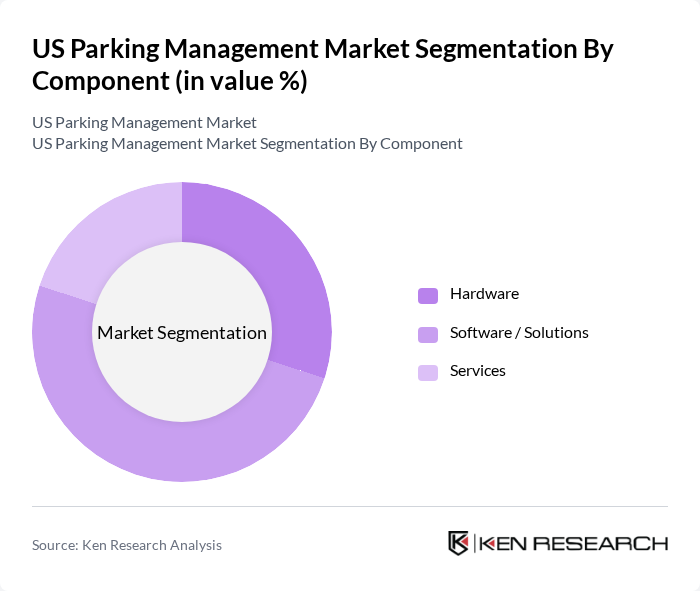
By Component:The component segmentation encompasses Hardware, Software / Solutions, and Services. Hardware includes physical equipment like parking meters, cameras, barriers, kiosks, and sensors that support automated fee collection and vehicle detection. Software / Solutions refers to the digital platforms that manage parking operations, such as parking guidance, reservation and permit management, mobile payment applications, and analytics dashboards, which collectively represent the largest revenue-generating component segment in recent US parking management deployments. Services cover the operational aspects, including system integration, monitoring, support, and maintenance, and are increasingly important as operators outsource day-to-day management and seek managed and cloud-based parking services to optimize operations and enhance user experience.
US Parking Management Market Competitive Landscape
The US Parking Management Market is characterized by a dynamic mix of regional and international players. Leading participants such as LAZ Parking, SP Plus Corporation (SP+), ABM Industries Incorporated, Propark Mobility, ParkMobile, ParkWhiz, SpotHero, Passport, T2 Systems, FlashParking (Flash), Flowbird, Parkopedia, ParkHub, Reef Parking (REEF Technology), and others contribute to innovation, geographic expansion, and service delivery in this space, with activities ranging from on?street and off?street operations to digital parking reservation and payment platforms.
US Parking Management Market Industry Analysis
Growth Drivers
- Increasing Urbanization:The US urban population is projected to reach 83% in the near term, up from 83% in 2020, according to the World Bank. This rapid urbanization leads to higher demand for parking spaces, as cities struggle to accommodate the growing number of vehicles. In metropolitan areas, the number of registered vehicles is expected to exceed 280 million in the future, necessitating efficient parking management solutions to optimize space utilization and reduce congestion.
- Rise in Vehicle Ownership:The US vehicle ownership rate is anticipated to rise to 1.9 vehicles per household in the future, reflecting a significant increase from 1.1 in 2020. This trend is driven by economic recovery and increased disposable income, leading to more cars on the road. Consequently, the demand for effective parking management systems is expected to surge, as urban areas face challenges in accommodating the growing number of vehicles and ensuring efficient parking solutions.
- Technological Advancements in Parking Solutions:The US parking management sector is witnessing a technological revolution, with investments in smart parking technologies projected to reach $3 billion in the future. Innovations such as automated parking systems, real-time parking availability apps, and AI-driven analytics are enhancing operational efficiency. These advancements not only streamline parking processes but also improve user experience, driving adoption among consumers and municipalities alike, thereby fueling market growth.
Market Challenges
- High Initial Investment Costs:The upfront costs associated with implementing advanced parking management systems can be substantial, often exceeding $500,000 for municipalities. This financial barrier can deter local governments from investing in necessary infrastructure upgrades. Additionally, the return on investment may take several years to materialize, creating hesitation among stakeholders who are concerned about budget constraints and long-term financial commitments.
- Regulatory Compliance Issues:The parking management industry faces complex regulatory frameworks that vary significantly across states and municipalities. Compliance with zoning laws, environmental regulations, and accessibility standards can impose additional costs and operational challenges. For instance, adhering to the Americans with Disabilities Act (ADA) requires specific design features in parking facilities, which can increase construction costs by up to 20%, complicating project feasibility and timelines.
US Parking Management Market Future Outlook
As urbanization continues to accelerate, the US parking management market is expected to evolve significantly, driven by technological innovations and changing consumer preferences. The integration of AI and IoT technologies will enhance operational efficiency, while the shift towards sustainable practices will shape future developments. Additionally, the increasing adoption of electric vehicles will necessitate the expansion of charging infrastructure, creating new opportunities for parking management solutions that cater to these emerging needs and trends.
Market Opportunities
- Expansion of Electric Vehicle Charging Stations:With over 1 million electric vehicles projected on US roads in the future, the demand for charging infrastructure is surging. This presents a significant opportunity for parking management companies to integrate EV charging stations into their offerings, enhancing service value and attracting environmentally conscious consumers while addressing the growing need for accessible charging solutions.
- Development of Mobile Parking Apps:The mobile app market for parking solutions is expected to grow, with over 50 million downloads anticipated in the future. These apps facilitate real-time parking availability, reservations, and payments, improving user convenience. By investing in mobile technology, parking management firms can enhance customer engagement and streamline operations, positioning themselves competitively in a rapidly evolving market landscape.
Scope of the Report
| Segment | Sub-Segments |
|---|---|
| By Parking Site | On-Street Parking Off-Street Parking Garage Parking Lot Parking |
| By Component | Hardware Software / Solutions Services |
| By Solution Type | Parking Revenue Management Parking Reservation Management Parking Access Control Parking Security and Surveillance Parking Guidance & Space Management Others |
| By Application | Transportation Facilities (Airports, Transit Hubs) Shopping Complex & Retail Corporate & Office Buildings Educational Institutions Healthcare Facilities Government & Municipal Residential Buildings Stadiums & Recreational Centers Hospitality Others |
| By Deployment Mode | On-Premise Cloud-Based Hybrid |
| By Service Type | Valet Parking Services Parking Operations & Management Services Consulting, Integration & Maintenance Services Others |
Key Target Audience
Investors and Venture Capitalist Firms
Government and Regulatory Bodies (e.g., Federal Highway Administration, Department of Transportation)
Municipalities and City Planning Departments
Parking Facility Operators
Real Estate Developers
Smart City Technology Providers
Transportation and Urban Planning Agencies
Financial Institutions and Investment Banks
Players Mentioned in the Report:
LAZ Parking
SP Plus Corporation (SP+)
ABM Industries Incorporated
Propark Mobility
ParkMobile
ParkWhiz
SpotHero
Passport
T2 Systems
FlashParking (Flash)
Flowbird
Parkopedia
ParkHub
Reef Parking (REEF Technology)
Others (Regional / Niche US Players)
Table of Contents
Market Assessment Phase
1. Executive Summary and Approach
2. US Parking Management Market Overview
2.1 Key Insights and Strategic Recommendations
2.2 US Parking Management Market Overview
2.3 Definition and Scope
2.4 Evolution of Market Ecosystem
2.5 Timeline of Key Regulatory Milestones
2.6 Value Chain & Stakeholder Mapping
2.7 Business Cycle Analysis
2.8 Policy & Incentive Landscape
3. US Parking Management Market Analysis
3.1 Growth Drivers
3.1.1 Increasing Urbanization
3.1.2 Rise in Vehicle Ownership
3.1.3 Technological Advancements in Parking Solutions
3.1.4 Government Initiatives for Smart City Development
3.2 Market Challenges
3.2.1 High Initial Investment Costs
3.2.2 Regulatory Compliance Issues
3.2.3 Competition from Alternative Transportation Modes
3.2.4 Limited Awareness of Smart Parking Solutions
3.3 Market Opportunities
3.3.1 Expansion of Electric Vehicle Charging Stations
3.3.2 Integration of AI and IoT in Parking Management
3.3.3 Development of Mobile Parking Apps
3.3.4 Partnerships with Ride-Sharing Services
3.4 Market Trends
3.4.1 Shift Towards Contactless Payment Solutions
3.4.2 Growth of Dynamic Pricing Models
3.4.3 Increasing Demand for Sustainable Parking Solutions
3.4.4 Adoption of Data Analytics for Parking Optimization
3.5 Government Regulation
3.5.1 Zoning Laws Impacting Parking Facilities
3.5.2 Environmental Regulations for Parking Structures
3.5.3 Accessibility Standards for Parking Spaces
3.5.4 Incentives for Smart Parking Technologies
4. SWOT Analysis
5. Stakeholder Analysis
6. Porter's Five Forces Analysis
7. US Parking Management Market Market Size, 2019-2024
7.1 By Value
7.2 By Volume
7.3 By Average Selling Price
8. US Parking Management Market Segmentation
8.1 By Parking Site
8.1.1 On-Street Parking
8.1.2 Off-Street Parking
8.1.3 Garage Parking
8.1.4 Lot Parking
8.2 By Component
8.2.1 Hardware
8.2.2 Software / Solutions
8.2.3 Services
8.3 By Solution Type
8.3.1 Parking Revenue Management
8.3.2 Parking Reservation Management
8.3.3 Parking Access Control
8.3.4 Parking Security and Surveillance
8.3.5 Parking Guidance & Space Management
8.3.6 Others
8.4 By Application
8.4.1 Transportation Facilities (Airports, Transit Hubs)
8.4.2 Shopping Complex & Retail
8.4.3 Corporate & Office Buildings
8.4.4 Educational Institutions
8.4.5 Healthcare Facilities
8.4.6 Government & Municipal
8.4.7 Residential Buildings
8.4.8 Stadiums & Recreational Centers
8.4.9 Hospitality
8.4.10 Others
8.5 By Deployment Mode
8.5.1 On-Premise
8.5.2 Cloud-Based
8.5.3 Hybrid
8.6 By Service Type
8.6.1 Valet Parking Services
8.6.2 Parking Operations & Management Services
8.6.3 Consulting, Integration & Maintenance Services
8.6.4 Others
9. US Parking Management Market Competitive Analysis
9.1 Market Share of Key Players
9.2 Cross Comparison of Key Players
9.2.1 Company Name
9.2.2 Company Size (by Revenue Tier)
9.2.3 3-year Revenue CAGR (Parking Management Segment)
9.2.4 EBITDA Margin (%)
9.2.5 Free Cash Flow Margin (%)
9.2.6 Contract Win Rate (%)
9.2.7 Average Contract Value (ACV)
9.2.8 Recurring Revenue Share (% of total)
9.2.9 Customer Retention / Net Revenue Retention (%)
9.2.10 Utilization Rate of Parking Assets (%)
9.2.11 Revenue per Parking Space / per Location
9.2.12 Capex Intensity (% of Revenue)
9.2.13 R&D / Innovation Spend (% of Revenue)
9.3 SWOT Analysis of Top Players
9.4 Pricing Analysis
9.5 Detailed Profile of Major Companies
9.5.1 LAZ Parking
9.5.2 SP Plus Corporation (SP+)
9.5.3 ABM Industries Incorporated
9.5.4 Propark Mobility
9.5.5 ParkMobile
9.5.6 ParkWhiz
9.5.7 SpotHero
9.5.8 Passport
9.5.9 T2 Systems
9.5.10 FlashParking (Flash)
9.5.11 Flowbird
9.5.12 Parkopedia
9.5.13 ParkHub
9.5.14 Reef Parking (REEF Technology)
9.5.15 Others (Regional / Niche US Players)
10. US Parking Management Market End-User Analysis
10.1 Procurement Behavior of Key Ministries
10.1.1 Budget Allocation for Parking Infrastructure
10.1.2 Decision-Making Processes
10.1.3 Evaluation Criteria for Vendors
10.1.4 Contracting Procedures
10.2 Corporate Spend on Infrastructure & Energy
10.2.1 Investment Trends in Parking Solutions
10.2.2 Budgeting for Smart Technologies
10.2.3 Long-term Financial Commitments
10.2.4 Cost-Benefit Analysis Practices
10.3 Pain Point Analysis by End-User Category
10.3.1 Common Challenges Faced by Commercial Users
10.3.2 Issues Encountered by Residential Users
10.3.3 Pain Points for Government Entities
10.3.4 Feedback from Educational Institutions
10.4 User Readiness for Adoption
10.4.1 Awareness of Smart Parking Solutions
10.4.2 Willingness to Invest in New Technologies
10.4.3 Training and Support Needs
10.4.4 Perceived Barriers to Adoption
10.5 Post-Deployment ROI and Use Case Expansion
10.5.1 Metrics for Evaluating Success
10.5.2 Case Studies of Successful Implementations
10.5.3 Opportunities for Scaling Solutions
10.5.4 Long-term Benefits Realized by Users
11. US Parking Management Market Future Size, 2025-2030
11.1 By Value
11.2 By Volume
11.3 By Average Selling Price
Go-To-Market Strategy Phase
1. Whitespace Analysis + Business Model Canvas
1.1 Market Gaps Identification
1.2 Business Model Development
2. Marketing and Positioning Recommendations
2.1 Branding Strategies
2.2 Product USPs
3. Distribution Plan
3.1 Urban Retail Strategies
3.2 Rural NGO Tie-ups
4. Channel & Pricing Gaps
4.1 Underserved Routes
4.2 Pricing Bands Analysis
5. Unmet Demand & Latent Needs
5.1 Category Gaps
5.2 Consumer Segments
6. Customer Relationship
6.1 Loyalty Programs
6.2 After-sales Service
7. Value Proposition
7.1 Sustainability Initiatives
7.2 Integrated Supply Chains
8. Key Activities
8.1 Regulatory Compliance
8.2 Branding Efforts
8.3 Distribution Setup
9. Entry Strategy Evaluation
9.1 Domestic Market Entry Strategy
9.1.1 Product Mix Considerations
9.1.2 Pricing Band Strategy
9.1.3 Packaging Options
9.2 Export Entry Strategy
9.2.1 Target Countries Identification
9.2.2 Compliance Roadmap Development
10. Entry Mode Assessment
10.1 Joint Ventures
10.2 Greenfield Investments
10.3 Mergers & Acquisitions
10.4 Distributor Model Evaluation
11. Capital and Timeline Estimation
11.1 Capital Requirements
11.2 Timelines for Implementation
12. Control vs Risk Trade-Off
12.1 Ownership Considerations
12.2 Partnerships Evaluation
13. Profitability Outlook
13.1 Breakeven Analysis
13.2 Long-term Sustainability Strategies
14. Potential Partner List
14.1 Distributors
14.2 Joint Ventures
14.3 Acquisition Targets
15. Execution Roadmap
15.1 Phased Plan for Market Entry
15.1.1 Market Setup
15.1.2 Market Entry
15.1.3 Growth Acceleration
15.1.4 Scale & Stabilize
15.2 Key Activities and Milestones
15.2.1 Milestone Planning
15.2.2 Activity Tracking
Research Methodology
Phase 1: Approach1
Desk Research
- Analysis of industry reports from the International Parking & Mobility Institute and National Parking Association
- Review of government publications and urban planning documents related to parking regulations
- Examination of market trends and statistics from transportation and urban mobility studies
Primary Research
- Interviews with city planners and municipal parking authorities
- Surveys with parking facility operators and management companies
- Focus groups with consumers to understand parking preferences and pain points
Validation & Triangulation
- Cross-validation of findings with data from parking technology providers
- Triangulation of insights from primary interviews with secondary data trends
- Sanity checks through expert panel discussions with industry veterans
Phase 2: Market Size Estimation1
Top-down Assessment
- Estimation of total parking revenue based on urban population density and vehicle ownership rates
- Segmentation of market size by parking type: on-street, off-street, and private parking
- Incorporation of growth factors such as urbanization and smart city initiatives
Bottom-up Modeling
- Collection of data on average parking fees and occupancy rates from major cities
- Estimation of total parking spaces available across different regions
- Calculation of revenue potential based on average duration of parking and turnover rates
Forecasting & Scenario Analysis
- Multi-variable regression analysis incorporating economic indicators and urban development trends
- Scenario modeling based on potential shifts in consumer behavior and regulatory changes
- Development of baseline, optimistic, and pessimistic forecasts through 2030
Phase 3: CATI Sample Composition1
| Scope Item/Segment | Sample Size | Target Respondent Profiles |
|---|---|---|
| Municipal Parking Authorities | 100 | City Planners, Parking Managers |
| Private Parking Operators | 80 | Facility Managers, Business Development Directors |
| Consumer Parking Preferences | 140 | Urban Commuters, College Students |
| Parking Technology Providers | 70 | Product Managers, Technology Developers |
| Real Estate Developers | 60 | Project Managers, Urban Development Specialists |
Frequently Asked Questions
What is the current value of the US Parking Management Market?
The US Parking Management Market is valued at approximately USD 5.2 billion, reflecting a significant growth driven by urbanization, increased vehicle ownership, and the demand for efficient parking solutions in congested urban areas.
What factors are driving growth in the US Parking Management Market?
Which cities are the largest markets for parking management in the US?
How does the Infrastructure Investment and Jobs Act impact parking management?
Other Regional/Country Reports
Other Adjacent Reports
Indonesia Smart City Technology Market
Oman Traffic Management System Market
UK Electric Vehicle Charging Infrastructure MarketMalaysia Urban Mobility Solution Market
Brazil IoT Sensor Technology Market
KSA Mobile Payment Platform Market
South Africa Transportation Infrastructure Development Market
New Zealand Automotive Telematics Market Size Share Growth Drivers Trends Opportunities & Forecast 2025–2030KSA Sustainable Transportation Market
Philippines Public Transit System Market
Why Buy From Us?

What makes us stand out is that our consultants follow Robust, Refine and Result (RRR) methodology. Robust for clear definitions, approaches and sanity checking, Refine for differentiating respondents' facts and opinions, and Result for presenting data with story.

We have set a benchmark in the industry by offering our clients with syndicated and customized market research reports featuring coverage of entire market as well as meticulous research and analyst insights.

While we don't replace traditional research, we flip the method upside down. Our dual approach of Top Bottom & Bottom Top ensures quality deliverable by not just verifying company fundamentals but also looking at the sector and macroeconomic factors.

With one step in the future, our research team constantly tries to show you the bigger picture. We help with some of the tough questions you may encounter along the way: How is the industry positioned? Best marketing channel? KPI's of competitors? By aligning every element, we help maximize success.

Our report gives you instant access to the answers and sources that other companies might choose to hide. We elaborate each steps of research methodology we have used and showcase you the sample size to earn your trust.

If you need any support, we are here! We pride ourselves on universe strength, data quality, and quick, friendly, and professional service.