About the Report
Base Year 2024US Patient Positioning Support Aids Market Overview
- The US Patient Positioning Support Aids Market is valued at USD 520 million, based on a five-year historical analysis. This growth is primarily driven by the increasing prevalence of chronic diseases, the aging population, and advancements in healthcare technology. The demand for patient positioning aids is further fueled by the need for improved patient safety and comfort during medical procedures, particularly in operating rooms, intensive care units, and diagnostic imaging suites where accurate positioning is critical.
- Key demand hubs in this market include major metropolitan regions with extensive healthcare infrastructure and high procedure volumes, such as the Northeast (including New York), the West (including Los Angeles), and the Midwest (including Chicago). These urban centers are home to leading hospitals and healthcare systems that perform a large number of surgical, interventional, and imaging procedures and prioritize patient safety and pressure-injury prevention, thereby driving the demand for innovative positioning support aids.
- Safe patient handling and mobility requirements in the US are supported through a combination of federal occupational safety mandates and state-level legislation. A key framework is provided by the Occupational Safety and Health Act and related standards enforced by the Occupational Safety and Health Administration (OSHA), which require employers to protect healthcare workers from musculoskeletal injuries associated with manual lifting and repositioning of patients, encouraging the use of mechanical lifts, transfer devices, and positioning aids. In addition, several states have enacted dedicated safe patient handling laws, such as the New York State Safe Patient Handling Act (NYS Labor Law § 200-d, enacted 2014) administered by the New York State Department of Labor and Department of Health, which requires covered healthcare facilities to implement safe patient handling programs, adopt equipment like mechanical lifts and repositioning aids, and provide staff training, thereby supporting broader adoption of patient positioning support aids across care settings.

US Patient Positioning Support Aids Market Segmentation
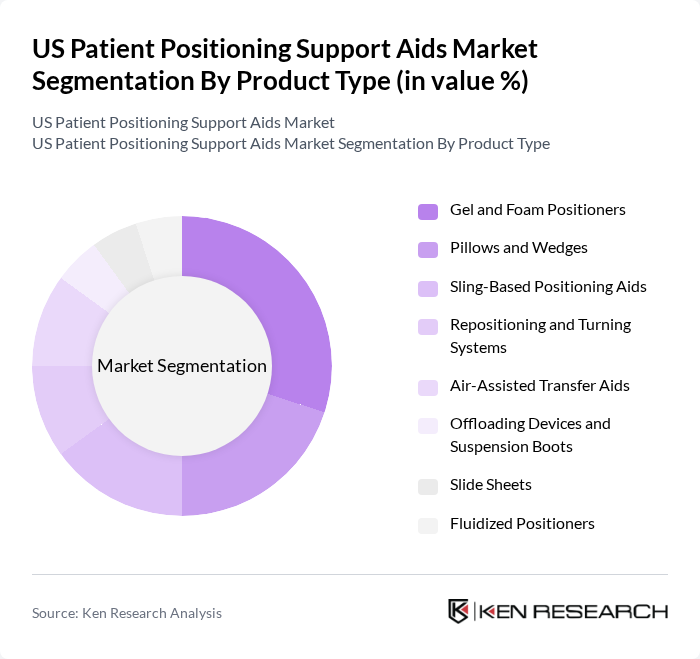
By Product Type:The product type segmentation includes various aids designed to enhance patient comfort, pressure redistribution, and procedural access during medical interventions. The subsegments are Gel and Foam Positioners, Pillows and Wedges, Sling-Based Positioning Aids, Repositioning and Turning Systems, Air-Assisted Transfer Aids, Offloading Devices and Suspension Boots, Slide Sheets, and Fluidized Positioners. Among these, Gel and Foam Positioners are leading the market due to their widespread use in operating rooms, ICUs, and imaging departments, where they provide effective pressure relief, help prevent pressure injuries and nerve damage during long procedures, and are available in a wide range of anatomical shapes and sizes.
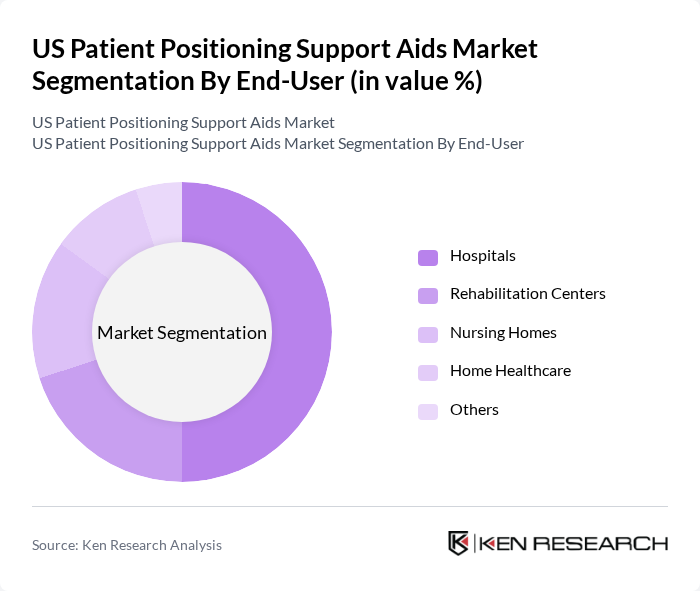
By End-User:The end-user segmentation encompasses various healthcare settings where patient positioning aids are utilized. This includes Hospitals, Rehabilitation Centers, Nursing Homes, Home Healthcare, and Others. Hospitals are the dominant end-user segment, driven by the high volume of surgical, interventional, and diagnostic imaging procedures that require effective patient positioning to ensure safety, avoid pressure injuries, and optimize access for clinicians. Rehabilitation centers and nursing homes increasingly adopt repositioning systems, slide sheets, and offloading devices to manage immobile and high-risk patients, while home healthcare is seeing growing use of simpler supports and transfer aids as more care shifts to home-based settings.
US Patient Positioning Support Aids Market Competitive Landscape
The US Patient Positioning Support Aids Market is characterized by a dynamic mix of regional and international players. Leading participants such as Hill-Rom Holdings, Inc. (Baxter Hillrom), Stryker Corporation, Arjo AB, Medline Industries, LP, Invacare Corporation, Drive DeVilbiss Healthcare (Drive Medical), GF Health Products, Inc. (Graham-Field), AliMed, Inc., Steris plc, Getinge AB, Joerns Healthcare LLC, Span-America Medical Systems, LLC, Blue Chip Medical Products, Inc., ROHO, Inc. (Permobil Group), Etac AB (including HoverTech International) contribute to innovation, geographic expansion, and service delivery in this space.
US Patient Positioning Support Aids Market Industry Analysis
Growth Drivers
- Increasing Prevalence of Chronic Diseases:The US is witnessing a significant rise in chronic diseases, with approximately **90%** of adults living with at least one chronic condition. This trend is driven by factors such as obesity, diabetes, and cardiovascular diseases, which collectively affect millions. The growing patient population necessitates advanced patient positioning support aids to ensure safety and comfort during medical procedures, thereby propelling market growth. The healthcare expenditure related to chronic diseases is projected to reach **$4.1 trillion**, further emphasizing this driver.
- Rising Geriatric Population:The US geriatric population is expected to exceed **58 million**, representing a substantial demographic shift. This age group is particularly vulnerable to health complications requiring hospitalization and specialized care. As older adults often face mobility issues, the demand for patient positioning aids that enhance comfort and safety during treatment is increasing. The aging population's healthcare costs are projected to reach **$1.1 trillion**, highlighting the urgent need for effective patient support solutions.
- Technological Advancements in Patient Positioning:The integration of innovative technologies in patient positioning aids is transforming the market landscape. The adoption of smart technologies, such as sensors and automated systems, is expected to enhance the functionality and effectiveness of these aids. For instance, the market for smart medical devices is projected to grow to **$50 billion**, indicating a robust trend towards automation and improved patient care. These advancements not only improve patient outcomes but also drive demand for sophisticated positioning solutions.
Market Challenges
- High Cost of Advanced Positioning Aids:The financial burden associated with advanced patient positioning aids poses a significant challenge. Many healthcare facilities face budget constraints, limiting their ability to invest in high-quality equipment. The average cost of advanced positioning systems is projected to be around **$15,000**, which can deter smaller healthcare providers from upgrading their equipment. This challenge is compounded by the need for ongoing maintenance and training, further straining financial resources.
- Limited Awareness Among Healthcare Providers:Despite the benefits of modern patient positioning aids, many healthcare providers remain unaware of their advantages. A survey conducted indicated that nearly **40%** of healthcare professionals lacked knowledge about the latest positioning technologies. This gap in awareness can lead to underutilization of effective aids, ultimately impacting patient safety and comfort. As healthcare providers prioritize cost-effective solutions, addressing this knowledge gap is crucial for market growth.
US Patient Positioning Support Aids Market Future Outlook
The future of the US Patient Positioning Support Aids Market appears promising, driven by ongoing technological innovations and demographic shifts. As the healthcare sector increasingly embraces smart technologies, patient positioning aids will evolve to offer enhanced functionality and improved patient outcomes. Additionally, the growing emphasis on personalized care will likely lead to tailored solutions that cater to individual patient needs. These trends, combined with the expansion of healthcare facilities, will create a conducive environment for market growth and innovation in future.
Market Opportunities
- Expansion of Healthcare Facilities:The ongoing expansion of healthcare facilities across the US presents a significant opportunity for the patient positioning aids market. With an estimated **1,500** new healthcare facilities projected to open, the demand for advanced positioning solutions will increase, driving market growth. This expansion will also necessitate the adoption of modern technologies to enhance patient care and safety.
- Development of Innovative Products:The continuous development of innovative patient positioning products is a key opportunity for market players. The introduction of new materials and designs that enhance comfort and safety is expected to attract healthcare providers. Companies investing in research and development can capitalize on this trend, creating products that meet the evolving needs of patients and healthcare professionals alike.
Scope of the Report
| Segment | Sub-Segments |
|---|---|
| By Product Type | Gel and Foam Positioners Pillows and Wedges Sling-Based Positioning Aids Repositioning and Turning Systems Air-Assisted Transfer Aids Offloading Devices and Suspension Boots Slide Sheets Fluidized Positioners |
| By End-User | Hospitals Rehabilitation Centers Nursing Homes Home Healthcare Others |
| By Clinical Application | Surgical Procedures Diagnostic & Imaging Procedures Patient Transfer & Transport Pressure Injury Prevention & Long-Term Care Rehabilitation & Physical Therapy |
| By Care Setting | Acute Care (Operating Rooms, ICUs, Emergency Departments) Post-Acute & Long-Term Care Facilities Home and Community-Based Care |
| By Distribution Channel | Direct Sales to Healthcare Providers Group Purchasing Organizations (GPOs) Medical Supply Distributors Online & E-commerce Platforms Retail Home Healthcare Stores |
| By Region | Northeast Midwest South West |
| By Buyer Type | Large Health Systems and IDNs Standalone Hospitals and Clinics Post-Acute and Long-Term Care Chains Home Health Agencies and DME Providers |
Key Target Audience
Investors and Venture Capitalist Firms
Government and Regulatory Bodies (e.g., Food and Drug Administration, Centers for Medicare & Medicaid Services)
Manufacturers and Producers
Distributors and Retailers
Healthcare Providers and Hospitals
Medical Device Wholesalers
Industry Associations (e.g., American Hospital Association, Medical Device Manufacturers Association)
Health Insurance Companies
Players Mentioned in the Report:
Hill-Rom Holdings, Inc. (Baxter Hillrom)
Stryker Corporation
Arjo AB
Medline Industries, LP
Invacare Corporation
Drive DeVilbiss Healthcare (Drive Medical)
GF Health Products, Inc. (Graham-Field)
AliMed, Inc.
Steris plc
Getinge AB
Joerns Healthcare LLC
Span-America Medical Systems, LLC
Blue Chip Medical Products, Inc.
ROHO, Inc. (Permobil Group)
Etac AB (including HoverTech International)
Table of Contents
Market Assessment Phase
1. Executive Summary and Approach
2. US Patient Positioning Support Aids Market Overview
2.1 Key Insights and Strategic Recommendations
2.2 US Patient Positioning Support Aids Market Overview
2.3 Definition and Scope
2.4 Evolution of Market Ecosystem
2.5 Timeline of Key Regulatory Milestones
2.6 Value Chain & Stakeholder Mapping
2.7 Business Cycle Analysis
2.8 Policy & Incentive Landscape
3. US Patient Positioning Support Aids Market Analysis
3.1 Growth Drivers
3.1.1 Increasing prevalence of chronic diseases
3.1.2 Rising geriatric population
3.1.3 Technological advancements in patient positioning
3.1.4 Growing demand for patient safety and comfort
3.2 Market Challenges
3.2.1 High cost of advanced positioning aids
3.2.2 Limited awareness among healthcare providers
3.2.3 Stringent regulatory requirements
3.2.4 Competition from alternative solutions
3.3 Market Opportunities
3.3.1 Expansion of healthcare facilities
3.3.2 Increasing investment in healthcare infrastructure
3.3.3 Development of innovative products
3.3.4 Strategic partnerships and collaborations
3.4 Market Trends
3.4.1 Shift towards minimally invasive procedures
3.4.2 Integration of smart technologies in patient aids
3.4.3 Focus on personalized patient care
3.4.4 Growing emphasis on sustainability in product design
3.5 Government Regulation
3.5.1 FDA regulations on medical devices
3.5.2 Compliance with safety standards
3.5.3 Reimbursement policies for patient positioning aids
3.5.4 Guidelines for clinical use and training
4. SWOT Analysis
5. Stakeholder Analysis
6. Porter's Five Forces Analysis
7. US Patient Positioning Support Aids Market Market Size, 2019-2024
7.1 By Value
7.2 By Volume
7.3 By Average Selling Price
8. US Patient Positioning Support Aids Market Segmentation
8.1 By Product Type
8.1.1 Gel and Foam Positioners
8.1.2 Pillows and Wedges
8.1.3 Sling-Based Positioning Aids
8.1.4 Repositioning and Turning Systems
8.1.5 Air-Assisted Transfer Aids
8.1.6 Offloading Devices and Suspension Boots
8.1.7 Slide Sheets
8.1.8 Fluidized Positioners
8.2 By End-User
8.2.1 Hospitals
8.2.2 Rehabilitation Centers
8.2.3 Nursing Homes
8.2.4 Home Healthcare
8.2.5 Others
8.3 By Clinical Application
8.3.1 Surgical Procedures
8.3.2 Diagnostic & Imaging Procedures
8.3.3 Patient Transfer & Transport
8.3.4 Pressure Injury Prevention & Long-Term Care
8.3.5 Rehabilitation & Physical Therapy
8.4 By Care Setting
8.4.1 Acute Care (Operating Rooms, ICUs, Emergency Departments)
8.4.2 Post-Acute & Long-Term Care Facilities
8.4.3 Home and Community-Based Care
8.5 By Distribution Channel
8.5.1 Direct Sales to Healthcare Providers
8.5.2 Group Purchasing Organizations (GPOs)
8.5.3 Medical Supply Distributors
8.5.4 Online & E-commerce Platforms
8.5.5 Retail Home Healthcare Stores
8.6 By Region
8.6.1 Northeast
8.6.2 Midwest
8.6.3 South
8.6.4 West
8.7 By Buyer Type
8.7.1 Large Health Systems and IDNs
8.7.2 Standalone Hospitals and Clinics
8.7.3 Post-Acute and Long-Term Care Chains
8.7.4 Home Health Agencies and DME Providers
9. US Patient Positioning Support Aids Market Competitive Analysis
9.1 Market Share of Key Players
9.2 Cross Comparison of Key Players
9.2.1 Company Name
9.2.2 Global Revenue from Patient Positioning & Support Aids (USD, Latest Year)
9.2.3 Share of Revenue from US Market (%)
9.2.4 Revenue CAGR in Patient Positioning & Support Aids (3–5 Years)
9.2.5 Product Portfolio Breadth (Number of SKUs / Product Categories)
9.2.6 Penetration Across Care Settings (Hospitals, LTC, Home Care, Rehab)
9.2.7 Average Selling Price Positioning (Premium / Mid / Value)
9.2.8 R&D and New Product Launch Intensity (Launches per Year)
9.2.9 Contract Coverage with GPOs and IDNs (Number of Active Contracts)
9.2.10 Distribution Network Strength (Number of US Distributors / Warehouses)
9.2.11 Key Strategic Partnerships and OEM/Private-Label Deals
9.2.12 Regulatory and Quality Certifications (e.g., FDA Clearances, ISO)
9.3 SWOT Analysis of Top Players
9.4 Pricing Analysis
9.5 Detailed Profile of Major Companies
9.5.1 Hill-Rom Holdings, Inc. (Baxter Hillrom)
9.5.2 Stryker Corporation
9.5.3 Arjo AB
9.5.4 Medline Industries, LP
9.5.5 Invacare Corporation
9.5.6 Drive DeVilbiss Healthcare (Drive Medical)
9.5.7 GF Health Products, Inc. (Graham-Field)
9.5.8 AliMed, Inc.
9.5.9 Steris plc
9.5.10 Getinge AB
9.5.11 Joerns Healthcare LLC
9.5.12 Span-America Medical Systems, LLC
9.5.13 Blue Chip Medical Products, Inc.
9.5.14 ROHO, Inc. (Permobil Group)
9.5.15 Etac AB (including HoverTech International)
10. US Patient Positioning Support Aids Market End-User Analysis
10.1 Procurement Behavior of Key Ministries
10.1.1 Budget Allocation Trends
10.1.2 Decision-Making Processes
10.1.3 Supplier Selection Criteria
10.1.4 Contracting Practices
10.2 Corporate Spend on Infrastructure & Energy
10.2.1 Investment Trends in Healthcare Infrastructure
10.2.2 Spending on Patient Safety Equipment
10.2.3 Budgeting for Technological Upgrades
10.2.4 Cost Management Strategies
10.3 Pain Point Analysis by End-User Category
10.3.1 Challenges Faced by Hospitals
10.3.2 Issues in Rehabilitation Centers
10.3.3 Concerns in Home Care Settings
10.3.4 Needs of Long-term Care Facilities
10.4 User Readiness for Adoption
10.4.1 Training and Education Needs
10.4.2 Technology Acceptance Levels
10.4.3 Support for Implementation
10.4.4 Feedback Mechanisms
10.5 Post-Deployment ROI and Use Case Expansion
10.5.1 Measurement of ROI
10.5.2 Case Studies of Successful Implementations
10.5.3 Opportunities for Product Expansion
10.5.4 Long-term Benefits Analysis
11. US Patient Positioning Support Aids Market Future Size, 2025-2030
11.1 By Value
11.2 By Volume
11.3 By Average Selling Price
Go-To-Market Strategy Phase
1. Whitespace Analysis + Business Model Canvas
1.1 Market Gaps Identification
1.2 Value Proposition Development
1.3 Revenue Streams Analysis
1.4 Cost Structure Evaluation
1.5 Key Partnerships Exploration
1.6 Customer Segmentation
1.7 Channels of Distribution
2. Marketing and Positioning Recommendations
2.1 Branding Strategies
2.2 Product USPs
2.3 Target Market Identification
2.4 Communication Strategies
2.5 Digital Marketing Approaches
3. Distribution Plan
3.1 Urban Retail Strategies
3.2 Rural NGO Tie-ups
3.3 E-commerce Integration
3.4 Logistics and Supply Chain Management
4. Channel & Pricing Gaps
4.1 Underserved Routes
4.2 Pricing Bands Analysis
4.3 Competitor Pricing Strategies
5. Unmet Demand & Latent Needs
5.1 Category Gaps Identification
5.2 Consumer Segments Analysis
5.3 Future Demand Projections
6. Customer Relationship
6.1 Loyalty Programs Development
6.2 After-sales Service Strategies
6.3 Customer Feedback Mechanisms
7. Value Proposition
7.1 Sustainability Initiatives
7.2 Integrated Supply Chains
7.3 Competitive Advantages
8. Key Activities
8.1 Regulatory Compliance
8.2 Branding Initiatives
8.3 Distribution Setup
9. Entry Strategy Evaluation
9.1 Domestic Market Entry Strategy
9.1.1 Product Mix Considerations
9.1.2 Pricing Band Strategies
9.1.3 Packaging Innovations
9.2 Export Entry Strategy
9.2.1 Target Countries Analysis
9.2.2 Compliance Roadmap Development
10. Entry Mode Assessment
10.1 Joint Ventures
10.2 Greenfield Investments
10.3 Mergers & Acquisitions
10.4 Distributor Model Evaluation
11. Capital and Timeline Estimation
11.1 Capital Requirements Analysis
11.2 Timelines for Market Entry
12. Control vs Risk Trade-Off
12.1 Ownership vs Partnerships
12.2 Risk Management Strategies
13. Profitability Outlook
13.1 Breakeven Analysis
13.2 Long-term Sustainability Strategies
14. Potential Partner List
14.1 Distributors Identification
14.2 Joint Ventures Opportunities
14.3 Acquisition Targets
15. Execution Roadmap
15.1 Phased Plan for Market Entry
15.1.1 Market Setup
15.1.2 Market Entry
15.1.3 Growth Acceleration
15.1.4 Scale & Stabilize
15.2 Key Activities and Milestones
15.2.1 Milestone Planning
15.2.2 Activity Tracking
Research Methodology
Phase 1: Approach1
Desk Research
- Analysis of industry reports from healthcare associations and market research firms
- Review of published articles and white papers on patient positioning technologies
- Examination of regulatory guidelines and standards from the FDA and other health authorities
Primary Research
- Interviews with healthcare professionals, including surgeons and anesthesiologists
- Surveys conducted with hospital procurement departments and purchasing managers
- Field interviews with manufacturers and suppliers of patient positioning aids
Validation & Triangulation
- Cross-validation of findings through multiple data sources, including sales data and market trends
- Triangulation of insights from primary interviews and secondary research findings
- Sanity checks through expert panel reviews and feedback from industry stakeholders
Phase 2: Market Size Estimation1
Top-down Assessment
- Estimation of market size based on national healthcare expenditure and surgical volume
- Segmentation by product type, including foam pads, positioning belts, and surgical tables
- Incorporation of growth rates from emerging trends in minimally invasive surgeries
Bottom-up Modeling
- Collection of sales data from leading manufacturers of patient positioning aids
- Estimation of unit sales based on hospital and surgical center usage rates
- Cost analysis based on average pricing of various positioning products
Forecasting & Scenario Analysis
- Multi-factor regression analysis incorporating demographic trends and surgical procedure growth
- Scenario modeling based on potential changes in healthcare policies and reimbursement rates
- Baseline, optimistic, and pessimistic forecasts through 2030 based on market dynamics
Phase 3: CATI Sample Composition1
| Scope Item/Segment | Sample Size | Target Respondent Profiles |
|---|---|---|
| Hospital Procurement Departments | 90 | Procurement Managers, Supply Chain Directors |
| Surgical Centers | 70 | Operating Room Managers, Surgical Coordinators |
| Healthcare Professionals | 110 | Surgeons, Anesthesiologists, Nurse Practitioners |
| Manufacturers of Positioning Aids | 50 | Product Managers, Sales Directors |
| Regulatory Bodies | 40 | Compliance Officers, Regulatory Affairs Specialists |
Frequently Asked Questions
What is the current value of the US Patient Positioning Support Aids Market?
The US Patient Positioning Support Aids Market is valued at approximately USD 520 million, reflecting a significant growth trend driven by factors such as the increasing prevalence of chronic diseases and advancements in healthcare technology.
What factors are driving the growth of the US Patient Positioning Support Aids Market?
Which regions in the US are major demand hubs for patient positioning aids?
What types of products are included in the US Patient Positioning Support Aids Market?
Other Regional/Country Reports
Indonesia Patient Positioning Support Aids Market
Malaysia Patient Positioning Support Aids Market
KSA Patient Positioning Support Aids Market
APAC Patient Positioning Support Aids Market
SEA Patient Positioning Support Aids Market
Other Adjacent Reports
Oman Pressure Ulcer Prevention Market
Bahrain Safe Patient Handling Equipment Market
Belgium Operating Room Supplies Market
South Korea Rehabilitation Aids Market
Mexico Wound Care Products Market
India Hospital Furniture Market Outlook to FY’2025Singapore Home Healthcare Equipment Market
Why Buy From Us?

What makes us stand out is that our consultants follow Robust, Refine and Result (RRR) methodology. Robust for clear definitions, approaches and sanity checking, Refine for differentiating respondents' facts and opinions, and Result for presenting data with story.

We have set a benchmark in the industry by offering our clients with syndicated and customized market research reports featuring coverage of entire market as well as meticulous research and analyst insights.

While we don't replace traditional research, we flip the method upside down. Our dual approach of Top Bottom & Bottom Top ensures quality deliverable by not just verifying company fundamentals but also looking at the sector and macroeconomic factors.

With one step in the future, our research team constantly tries to show you the bigger picture. We help with some of the tough questions you may encounter along the way: How is the industry positioned? Best marketing channel? KPI's of competitors? By aligning every element, we help maximize success.

Our report gives you instant access to the answers and sources that other companies might choose to hide. We elaborate each steps of research methodology we have used and showcase you the sample size to earn your trust.

If you need any support, we are here! We pride ourselves on universe strength, data quality, and quick, friendly, and professional service.