Ken Research Logo

Us Pocket Printer Market Report Size, Share, Growth Drivers, Trends, Opportunities & Forecast 2025–2030

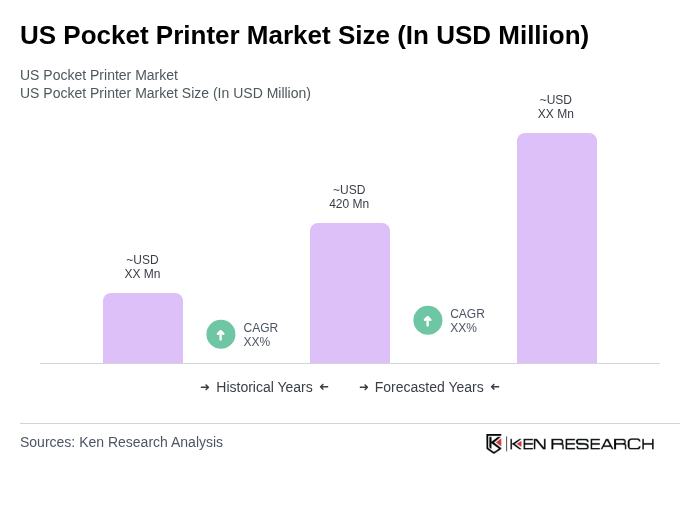
The US Pocket Printer Market, valued at USD 420 million, is growing due to rising mobile printing needs, smartphone integration, and sectors like retail and healthcare.

Region:North America

Author(s):Rebecca

Product Code:KRAD6116

Pages:82

Published On:December 2025
About the Report

Base Year 2024

US Pocket Printer Market Overview

  • The US Pocket Printer Market is valued at USD 420 million, based on a five-year historical analysis, in line with recent estimates that the United States pocket printer market generated revenue of about USD 412.7 million in a recent base year and accounts for a significant share of the global pocket/portable printer space. This growth is primarily driven by the increasing demand for portable and mobile printing solutions among consumers and businesses, coupled with advancements in printing technology that enhance print quality, wireless connectivity, and battery life. The rise of smartphones and tablets, photo-on-the-go usage, and applications in sectors such as retail, logistics, and healthcare have further fueled market expansion.
  • Key demand clusters in this market include large metropolitan areas such as New York, Los Angeles, and Chicago, which contribute strongly due to high population density, concentration of enterprises, and a large base of mobile workers and tech-savvy consumers. The presence of omnichannel retail, electronics chains, and strong e-commerce penetration in these urban regions supports rapid adoption of innovative portable and photo pocket printers, especially for instant photo printing, receipts, labels, and on-the-go documentation.
  • The US pocket printer market operates within broader federal frameworks for electronic waste and product stewardship, including regulations under the Resource Conservation and Recovery Act (RCRA) administered by the US Environmental Protection Agency, and specific rules such as the Hazardous Waste Generator Improvements Rule, 2016, issued by the US Environmental Protection Agency, which set requirements for the handling, storage, and disposal of hazardous waste from electronic products including certain printer components. In addition, programs under the National Strategy for Electronics Stewardship and various state-level e-waste laws encourage manufacturers to implement take-back, recycling, and design-for-environment practices for electronic devices, reinforcing the shift toward more sustainable pocket printer designs and end-of-life management.
US Pocket Printer Market Size

US Pocket Printer Market Segmentation

By Technology:The pocket printer market is segmented into three main technologies: Inkjet Pocket Printers, Thermal Pocket Printers, and Impact Pocket Printers. Inkjet Pocket Printers are widely used in photo-centric and consumer applications because they can produce high-quality, color-rich prints and are available in compact, smartphone-connected formats from brands such as Canon, HP, and Polaroid. Thermal Pocket Printers are gaining strong traction in retail, logistics, transportation, and field service operations, where they are used for receipts, shipping labels, barcodes, and proof-of-delivery documents due to their fast print speeds, low maintenance needs, and lower operating costs. Impact Pocket Printers remain a smaller, niche segment, primarily serving environments that require durable, multi-part forms or where impact printing offers advantages in harsh or industrial conditions.
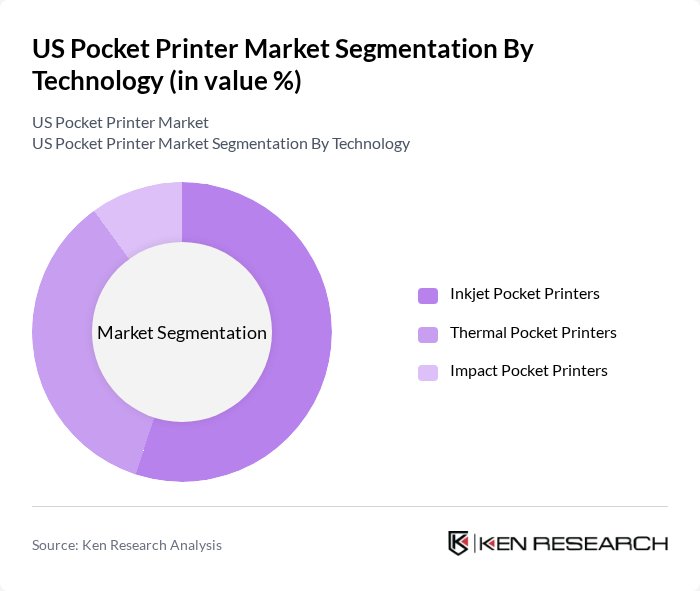
US Pocket Printer Market segmentation by Technology.

By End-User:The end-user segmentation includes Home Users, Office Users, School Users, and Others. Home Users represent a major usage segment, supported by trends such as instant photo printing, scrapbooking, and personal photo journaling with mobile photo printers, as well as remote work and home-based microbusinesses. Office Users constitute another substantial segment, as enterprises in sales, field service, logistics, and transportation increasingly deploy portable printers to improve documentation, mobility, and workflow efficiency. School Users contribute through adoption for classroom projects, event photography, and student activities, while the "Others" category includes sectors such as healthcare, hospitality, and retail, where pocket printers are utilized for bedside labeling, visitor badges, tickets, receipts, and other specialized applications.
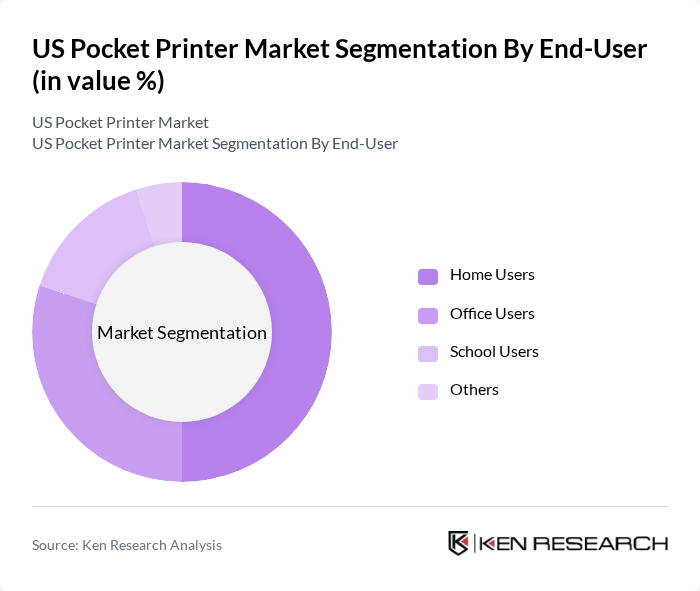
US Pocket Printer Market segmentation by End-User.

US Pocket Printer Market Competitive Landscape

The US Pocket Printer Market is characterized by a dynamic mix of regional and international players. Leading participants such as HP Development Company, L.P., Canon Inc., Epson America, Inc., Brother International Corporation, Fujifilm Instax, Kodak Alaris Inc., Polaroid Corporation, Zink Imaging, Inc., Zebra Technologies Corp., PeriPage, DNP Imagingcomm America Corporation, Prynt Inc., Lifeprint, Inc., Xiamen Hanin Co., Ltd., PoooliPrint contribute to innovation, geographic expansion, and service delivery in this space.

HP Development Company, L.P.

1939

Palo Alto, California, USA

Canon Inc.

1937

Tokyo, Japan

Epson America, Inc.

1975

Los Alamitos, California, USA

Brother International Corporation

1954

Bridgewater, New Jersey, USA

Fujifilm Instax

2003

Tokyo, Japan

Company

Establishment Year

Headquarters

Group Size (Large, Medium, or Small as per industry convention)

Revenue Growth Rate

US Market Share

Product Portfolio Breadth

Average Selling Price

Distribution Network Coverage

US Pocket Printer Market Industry Analysis

Growth Drivers

  • Increasing Demand for Portable Printing Solutions:The US pocket printer market is experiencing a surge in demand, driven by the need for portable printing solutions. In future, the number of mobile workers in the US is projected to reach 87.9 million, representing 59% of the workforce. This trend is supported by the rise in remote work, where convenience and mobility are paramount, leading to an increased adoption of pocket printers for on-the-go printing needs.
  • Advancements in Printing Technology:Technological innovations are significantly enhancing the capabilities of pocket printers. In future, the global investment in printing technology is expected to exceed $1.6 billion, focusing on miniaturization and improved print quality. These advancements enable pocket printers to produce high-resolution prints comparable to traditional printers, attracting tech-savvy consumers who prioritize quality and efficiency in their portable devices.
  • Growth in E-commerce and On-Demand Printing Services:The e-commerce sector in the US is projected to reach $1.1 trillion in sales in future, fueling the demand for on-demand printing services. This growth creates opportunities for pocket printers, as businesses seek efficient solutions for printing shipping labels, receipts, and promotional materials. The convenience of portable printers aligns with the fast-paced nature of e-commerce, driving their adoption among small businesses and entrepreneurs.

Market Challenges

  • High Competition from Traditional Printers:The pocket printer market faces intense competition from traditional printers, which still dominate the overall printing landscape. In future, traditional printer sales are expected to account for over 71% of the total printer market. This competition poses a challenge for pocket printers, as consumers may prefer established brands and larger devices that offer more features and capabilities, impacting market penetration.
  • Limited Awareness Among Potential Users:Despite the growing market, there remains a significant gap in awareness regarding pocket printers. A recent survey indicated that only 36% of potential users are familiar with the benefits of portable printing solutions. This lack of awareness hinders market growth, as consumers may not recognize the advantages of pocket printers for their personal or professional needs, limiting adoption rates.

US Pocket Printer Market Future Outlook

The US pocket printer market is poised for significant growth, driven by technological advancements and changing consumer behaviors. As mobile work continues to rise, the demand for portable printing solutions will likely increase. Additionally, the integration of smart technologies and eco-friendly practices will shape the future landscape, encouraging manufacturers to innovate. Companies that adapt to these trends and address consumer needs will find ample opportunities for expansion and market penetration in the coming years.

Market Opportunities

  • Expansion into Educational Institutions:Educational institutions represent a significant opportunity for pocket printers, with over 51 million students enrolled in US schools in future. By targeting this demographic, manufacturers can promote portable printing solutions for educational materials, enhancing learning experiences and facilitating project work, thus driving sales in this sector.
  • Integration with Smart Devices:The integration of pocket printers with smart devices is a promising opportunity, as the number of smartphone users in the US is projected to reach 305 million in future. This synergy can enhance user experience, allowing seamless printing from mobile applications, which can significantly boost the adoption of pocket printers among tech-savvy consumers.

Scope of the Report

SegmentSub-Segments
By Technology

Inkjet Pocket Printers

Thermal Pocket Printers

Impact Pocket Printers

By End-User

Home Users

Office Users

School Users

Others

By Application

Retail

Healthcare

Transport & Logistics

Telecom

Others

Key Target Audience

Investors and Venture Capitalist Firms

Government and Regulatory Bodies (e.g., Federal Communications Commission, Consumer Product Safety Commission)

Manufacturers and Producers

Distributors and Retailers

Technology Providers

Industry Associations (e.g., Consumer Technology Association)

Financial Institutions

Logistics and Supply Chain Companies

Players Mentioned in the Report:

HP Development Company, L.P.

Canon Inc.

Epson America, Inc.

Brother International Corporation

Fujifilm Instax

Kodak Alaris Inc.

Polaroid Corporation

Zink Imaging, Inc.

Zebra Technologies Corp.

PeriPage

DNP Imagingcomm America Corporation

Prynt Inc.

Lifeprint, Inc.

Xiamen Hanin Co., Ltd.

PoooliPrint

Table of Contents

Market Assessment Phase

1. Executive Summary and Approach


2. US Pocket Printer Market Overview

2.1 Key Insights and Strategic Recommendations

2.2 US Pocket Printer Market Overview

2.3 Definition and Scope

2.4 Evolution of Market Ecosystem

2.5 Timeline of Key Regulatory Milestones

2.6 Value Chain & Stakeholder Mapping

2.7 Business Cycle Analysis

2.8 Policy & Incentive Landscape


3. US Pocket Printer Market Analysis

3.1 Growth Drivers

3.1.1 Increasing demand for portable printing solutions
3.1.2 Advancements in printing technology
3.1.3 Rising trend of mobile and remote work
3.1.4 Growth in e-commerce and on-demand printing services

3.2 Market Challenges

3.2.1 High competition from traditional printers
3.2.2 Limited awareness among potential users
3.2.3 Dependence on smartphone compatibility
3.2.4 Price sensitivity among consumers

3.3 Market Opportunities

3.3.1 Expansion into educational institutions
3.3.2 Integration with smart devices
3.3.3 Development of eco-friendly printing solutions
3.3.4 Partnerships with mobile app developers

3.4 Market Trends

3.4.1 Increasing personalization in printing
3.4.2 Growth of subscription-based printing services
3.4.3 Rise of wireless printing technologies
3.4.4 Focus on compact and lightweight designs

3.5 Government Regulation

3.5.1 Compliance with environmental standards
3.5.2 Regulations on electronic waste disposal
3.5.3 Safety standards for consumer electronics
3.5.4 Incentives for energy-efficient products

4. SWOT Analysis


5. Stakeholder Analysis


6. Porter's Five Forces Analysis


7. US Pocket Printer Market Market Size, 2019-2024

7.1 By Value

7.2 By Volume

7.3 By Average Selling Price


8. US Pocket Printer Market Segmentation

8.1 By Technology

8.1.1 Inkjet Pocket Printers
8.1.2 Thermal Pocket Printers
8.1.3 Impact Pocket Printers

8.2 By End-User

8.2.1 Home Users
8.2.2 Office Users
8.2.3 School Users
8.2.4 Others

8.3 By Application

8.3.1 Retail
8.3.2 Healthcare
8.3.3 Transport & Logistics
8.3.4 Telecom
8.3.5 Others

9. US Pocket Printer Market Competitive Analysis

9.1 Market Share of Key Players

9.2 KPIs for Cross Comparison of Key Players

9.2.1 Company Name
9.2.2 Group Size (Large, Medium, or Small as per industry convention)
9.2.3 Revenue Growth Rate
9.2.4 US Market Share
9.2.5 Product Portfolio Breadth
9.2.6 Average Selling Price
9.2.7 Distribution Network Coverage
9.2.8 R&D Investment Intensity
9.2.9 Patent Portfolio Size
9.2.10 Net Promoter Score

9.3 SWOT Analysis of Top Players

9.4 Pricing Analysis

9.5 List of Major Companies

9.5.1 HP Development Company, L.P.
9.5.2 Canon Inc.
9.5.3 Epson America, Inc.
9.5.4 Brother International Corporation
9.5.5 Fujifilm Instax
9.5.6 Kodak Alaris Inc.
9.5.7 Polaroid Corporation
9.5.8 Zink Imaging, Inc.
9.5.9 Zebra Technologies Corp.
9.5.10 PeriPage
9.5.11 DNP Imagingcomm America Corporation
9.5.12 Prynt Inc.
9.5.13 Lifeprint, Inc.
9.5.14 Xiamen Hanin Co., Ltd.
9.5.15 PoooliPrint

10. US Pocket Printer Market End-User Analysis

10.1 Procurement Behavior of Key Ministries

10.1.1 Government Procurement Policies
10.1.2 Budget Allocations for Printing Solutions
10.1.3 Evaluation Criteria for Vendors
10.1.4 Adoption of Innovative Technologies

10.2 Corporate Spend on Infrastructure & Energy

10.2.1 Investment in Portable Printing Solutions
10.2.2 Budget Trends in Corporate Printing
10.2.3 Cost-Benefit Analysis of Pocket Printers
10.2.4 Adoption of Eco-Friendly Printing Practices

10.3 Pain Point Analysis by End-User Category

10.3.1 Challenges Faced by Individual Consumers
10.3.2 Issues Encountered by Small Businesses
10.3.3 Pain Points for Educational Institutions
10.3.4 Concerns of Event Organizers

10.4 User Readiness for Adoption

10.4.1 Awareness Levels Among Users
10.4.2 Training and Support Needs
10.4.3 User Experience Expectations
10.4.4 Feedback Mechanisms for Improvement

10.5 Post-Deployment ROI and Use Case Expansion

10.5.1 Measurement of ROI Post-Implementation
10.5.2 Case Studies of Successful Deployments
10.5.3 Expansion Opportunities in New Use Cases
10.5.4 Long-Term Value Assessment

11. US Pocket Printer Market Future Size, 2025-2030

11.1 By Value

11.2 By Volume

11.3 By Average Selling Price


Go-To-Market Strategy Phase

1. Whitespace Analysis + Business Model Canvas

1.1 Market Gaps Identification

1.2 Business Model Development


2. Marketing and Positioning Recommendations

2.1 Branding Strategies

2.2 Product USPs


3. Distribution Plan

3.1 Urban Retail Strategies

3.2 Rural NGO Tie-Ups


4. Channel & Pricing Gaps

4.1 Underserved Routes

4.2 Pricing Bands Analysis


5. Unmet Demand & Latent Needs

5.1 Category Gaps

5.2 Consumer Segments


6. Customer Relationship

6.1 Loyalty Programs

6.2 After-Sales Service


7. Value Proposition

7.1 Sustainability Initiatives

7.2 Integrated Supply Chains


8. Key Activities

8.1 Regulatory Compliance

8.2 Branding Efforts

8.3 Distribution Setup


9. Entry Strategy Evaluation

9.1 Domestic Market Entry Strategy

9.1.1 Product Mix Considerations
9.1.2 Pricing Band Strategy
9.1.3 Packaging Innovations

9.2 Export Entry Strategy

9.2.1 Target Countries Identification
9.2.2 Compliance Roadmap Development

10. Entry Mode Assessment

10.1 Joint Ventures

10.2 Greenfield Investments

10.3 Mergers & Acquisitions

10.4 Distributor Model Evaluation


11. Capital and Timeline Estimation

11.1 Capital Requirements Analysis

11.2 Timelines for Market Entry


12. Control vs Risk Trade-Off

12.1 Ownership Considerations

12.2 Partnerships Evaluation


13. Profitability Outlook

13.1 Breakeven Analysis

13.2 Long-Term Sustainability Assessment


14. Potential Partner List

14.1 Distributors Identification

14.2 Joint Ventures Opportunities

14.3 Acquisition Targets


15. Execution Roadmap

15.1 Phased Plan for Market Entry

15.1.1 Market Setup Activities
15.1.2 Market Entry Steps
15.1.3 Growth Acceleration Strategies
15.1.4 Scale & Stabilize Actions

15.2 Key Activities and Milestones

15.2.1 Milestone Planning
15.2.2 Activity Tracking

Research Methodology

ApproachModellingSample

Phase 1: Approach1

Desk Research

  • Analysis of industry reports from market research firms focusing on the US pocket printer market
  • Review of trade publications and articles discussing technological advancements in portable printing
  • Examination of consumer behavior studies related to mobile printing solutions

Primary Research

  • Interviews with product managers from leading pocket printer manufacturers
  • Surveys conducted with end-users, including students and professionals, to gauge usage patterns
  • Focus groups with retailers to understand market demand and customer preferences

Validation & Triangulation

  • Cross-validation of findings through comparison with sales data from major retailers
  • Triangulation of insights from primary interviews with secondary data trends
  • Sanity checks through expert reviews from industry analysts and consultants

Phase 2: Market Size Estimation1

Top-down Assessment

  • Estimation of market size based on overall printing industry revenue and segmenting for portable devices
  • Analysis of growth trends in mobile technology adoption and its impact on pocket printer sales
  • Incorporation of demographic data to assess potential user base expansion

Bottom-up Modeling

  • Collection of sales data from major pocket printer brands to establish baseline revenue figures
  • Estimation of average selling prices and unit sales across different market segments
  • Analysis of distribution channels and their contribution to overall market volume

Forecasting & Scenario Analysis

  • Multi-factor regression analysis incorporating trends in mobile device usage and printing needs
  • Scenario modeling based on potential technological innovations and market disruptions
  • Development of baseline, optimistic, and pessimistic forecasts through 2030

Phase 3: CATI Sample Composition1

Scope Item/SegmentSample SizeTarget Respondent Profiles
Consumer Usage of Pocket Printers120Students, Freelancers, Small Business Owners
Retail Insights on Pocket Printer Sales100Retail Managers, Sales Associates
Technological Adoption in Printing80IT Managers, Product Development Teams
Market Trends in Portable Printing70Market Analysts, Industry Experts
Consumer Preferences and Feedback90End-users, Tech Enthusiasts

Frequently Asked Questions

What is the current value of the US Pocket Printer Market?

The US Pocket Printer Market is valued at approximately USD 420 million, reflecting a significant share of the global portable printer market. This valuation is based on a five-year historical analysis and recent revenue estimates of around USD 412.7 million.

What factors are driving the growth of the US Pocket Printer Market?

Which technologies are used in pocket printers?

Who are the major players in the US Pocket Printer Market?

Other Regional/Country Reports

Indonesia Pocket Printer Market

Malaysia Pocket Printer Market

KSA Pocket Printer Market

APAC Pocket Printer Market

SEA Pocket Printer Market

Vietnam Pocket Printer Market

Other Adjacent Reports

Malaysia Mobile Photo Printer Market

Thailand Portable Label Printer Market

KSA Instant Camera Market

Mexico Printing Consumables Market

Brazil Smartphone Accessory Market

Qatar Wireless Printer Market

GCC Road Express (Parcel & LTL) E-commerce Logistics Market Size, Share, Growth Drivers, Trends, Opportunities, Competitive Landscape & Forecast 2025–2030

Germany Retail POS System Market

Vietnam Healthcare Labeling Market

Kuwait education technology market Size, Share, Growth Drivers, Trends, Opportunities & Forecast 2025–2030

Why Buy From Us?

Refine Robust Result (RRR) Framework

What makes us stand out is that our consultants follow Robust, Refine and Result (RRR) methodology. Robust for clear definitions, approaches and sanity checking, Refine for differentiating respondents' facts and opinions, and Result for presenting data with story.

Our Reach Is Unmatched

We have set a benchmark in the industry by offering our clients with syndicated and customized market research reports featuring coverage of entire market as well as meticulous research and analyst insights.

Shifting the Research Paradigm

While we don't replace traditional research, we flip the method upside down. Our dual approach of Top Bottom & Bottom Top ensures quality deliverable by not just verifying company fundamentals but also looking at the sector and macroeconomic factors.

More Insights-Better Decisions

With one step in the future, our research team constantly tries to show you the bigger picture. We help with some of the tough questions you may encounter along the way: How is the industry positioned? Best marketing channel? KPI's of competitors? By aligning every element, we help maximize success.

Transparency and Trust

Our report gives you instant access to the answers and sources that other companies might choose to hide. We elaborate each steps of research methodology we have used and showcase you the sample size to earn your trust.

Round the Clock Support

If you need any support, we are here! We pride ourselves on universe strength, data quality, and quick, friendly, and professional service.

Why Clients Choose Us?

400000+
Reports in repository
150+
Consulting projects a year
100+
Analysts
8000+
Client Queries in 2022








