Ken Research Logo

US suture anchor devices market report Size, Share, Growth Drivers, Trends, Opportunities & Forecast 2025–2030

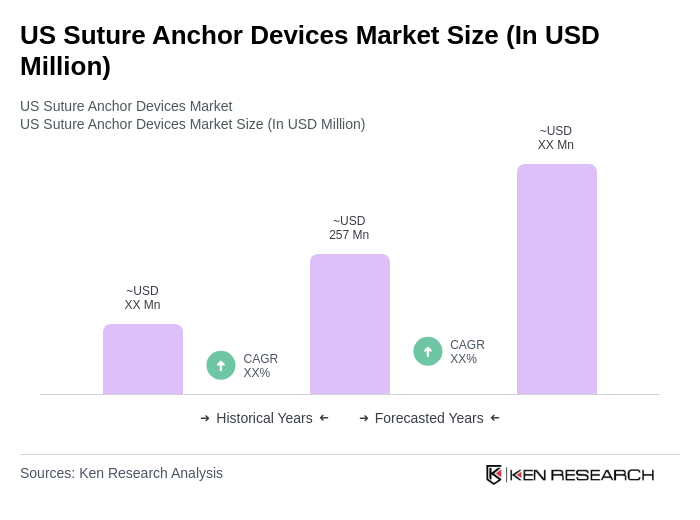
The US Suture Anchor Devices Market, worth USD 257 million, grows due to rising orthopedic needs, innovations in absorbable anchors, and expanding applications in shoulder and knee surgeries.

Region:North America

Author(s):Shubham

Product Code:KRAC4352

Pages:92

Published On:October 2025
About the Report

Base Year 2024

US Suture Anchor Devices Market Overview

  • The US Suture Anchor Devices Market is valued at USD 257 million, based on a five-year historical analysis. This growth is primarily driven by the increasing prevalence of orthopedic surgeries, advancements in surgical techniques, and the rising demand for minimally invasive procedures. The market is also supported by the growing geriatric population, which is more susceptible to musculoskeletal disorders, thereby increasing the need for effective surgical solutions .
  • Key players in this market operate in regions with advanced healthcare infrastructure and high patient volumes. Major cities such as New York, Los Angeles, and Chicago are significant due to their concentration of leading medical centers and access to innovative medical technologies. States like California and Texas contribute substantially, supported by large populations and extensive healthcare networks that facilitate the adoption of advanced suture anchor technologies .
  • The US regulatory framework for suture anchor devices is governed by the Federal Food, Drug, and Cosmetic Act (FD&C Act), with oversight from the US Food and Drug Administration (FDA). The FDA’s Quality System Regulation (21 CFR Part 820), last amended in 2023, mandates that manufacturers of medical devices, including suture anchors, comply with stringent quality control measures, undergo rigorous premarket testing, and adhere to post-market surveillance requirements to ensure patient safety and product efficacy .
US Suture Anchor Devices Market Size

US Suture Anchor Devices Market Segmentation

By Product Type:The product type segmentation includes various categories of suture anchors, each catering to specific surgical needs. Non-absorbable suture anchors are widely used due to their durability and strength, making them suitable for long-term applications. Absorbable suture anchors are gaining traction for their ability to dissolve over time, reducing the need for additional surgeries. Knotless suture anchors are preferred for their ease of use and reduced surgical time, while knotted anchors remain popular for their reliability in securing tissues. Other types include specialized anchors designed for unique surgical requirements .
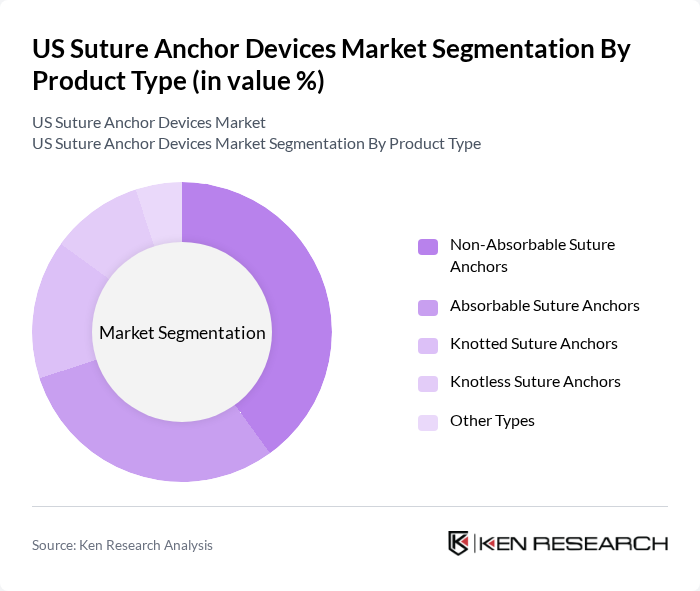
US Suture Anchor Devices Market segmentation by Product Type.

By Application:The application segmentation encompasses various surgical procedures where suture anchors are utilized. Shoulder surgery, particularly for rotator cuff and labral repairs, represents a significant portion of the market due to the high incidence of shoulder injuries. Knee surgery, including ligament and tendon repairs, is another major application area, driven by the increasing number of sports-related injuries. Hip and ankle surgeries are also notable applications, with growing demand for effective fixation solutions in these regions. Other applications include various orthopedic and sports medicine procedures .
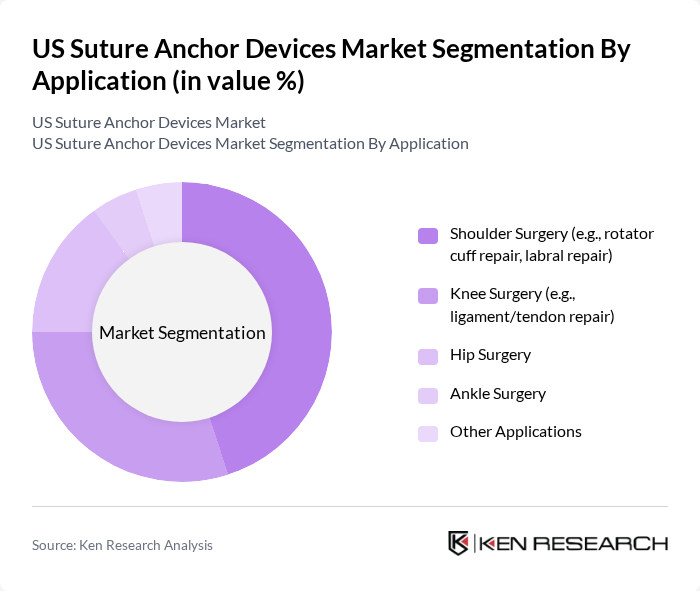
US Suture Anchor Devices Market segmentation by Application.

US Suture Anchor Devices Market Competitive Landscape

The US Suture Anchor Devices Market is characterized by a dynamic mix of regional and international players. Leading participants such as Arthrex, Inc., Smith & Nephew plc, Stryker Corporation, DePuy Synthes (Johnson & Johnson), Medtronic plc, Zimmer Biomet Holdings, Inc., ConMed Corporation, B. Braun Melsungen AG, NuVasive, Inc., Orthofix Medical Inc., Aesculap, Inc., RTI Surgical Holdings, Inc., KFx Medical Corporation, Tenex Health, Inc., Biorez, Inc., Anika Therapeutics, Inc., Enovis Corporation, Orthomed contribute to innovation, geographic expansion, and service delivery in this space .

Arthrex, Inc.

1981

Naples, Florida

Smith & Nephew plc

1856

London, UK

Stryker Corporation

1941

Kalamazoo, Michigan

DePuy Synthes (Johnson & Johnson)

1895

Warsaw, Indiana

Medtronic plc

1949

Dublin, Ireland

Company

Establishment Year

Headquarters

Group Size (Large, Medium, or Small as per industry convention)

US Suture Anchor Devices Revenue (USD million)

US Market Share (%)

Revenue Growth Rate (CAGR, %)

Product Portfolio Breadth (number of SKUs or product lines)

R&D Investment (% of revenue)

US Suture Anchor Devices Market Industry Analysis

Growth Drivers

  • Increasing Prevalence of Orthopedic Surgeries:The US has seen a significant rise in orthopedic surgeries, with over 8 million procedures performed annually. This increase is driven by factors such as sports injuries and degenerative conditions. According to the American Academy of Orthopaedic Surgeons, the demand for surgical interventions is projected to rise by 20% in future, necessitating advanced fixation devices like suture anchors to ensure effective surgical outcomes.
  • Advancements in Suture Anchor Technology:Technological innovations in suture anchor devices have led to improved materials and designs, enhancing their effectiveness and safety. For instance, the introduction of bioabsorbable materials has gained traction, with a market share increase of 15% in future. These advancements not only improve patient recovery times but also reduce the risk of complications, driving demand for these devices in surgical settings.
  • Rising Geriatric Population:The geriatric population in the US is projected to reach 80 million in future, significantly impacting healthcare needs. Older adults are more susceptible to orthopedic issues, leading to an increased demand for surgical interventions. The National Institute on Aging reports that approximately 50% of seniors will require orthopedic surgery, further propelling the need for suture anchor devices to facilitate effective treatment options.

Market Challenges

  • High Cost of Suture Anchor Devices:The cost of suture anchor devices can be a significant barrier to adoption, with prices ranging from USD 500 to USD 1,800 per unit. This high cost can limit access for healthcare facilities, particularly in underserved areas. According to the Healthcare Cost and Utilization Project, hospitals face increasing pressure to manage costs, which may hinder the procurement of advanced surgical devices, including suture anchors.
  • Stringent Regulatory Requirements:The regulatory landscape for medical devices in the US is complex, with the FDA imposing rigorous approval processes. The average time for device approval is approximately 12 months, which can delay market entry for new suture anchor technologies. Compliance with safety and efficacy standards adds to the development costs, potentially stifling innovation and limiting market growth.

US Suture Anchor Devices Market Future Outlook

The future of the US suture anchor devices market appears promising, driven by ongoing technological advancements and an increasing focus on patient-centric care. The integration of digital technologies in surgical practices is expected to enhance procedural efficiency and outcomes. Additionally, the shift towards outpatient surgical procedures is likely to expand the market, as healthcare providers seek to reduce costs while improving patient experiences and recovery times.

Market Opportunities

  • Expansion in Emerging Markets:Emerging markets present significant growth opportunities for suture anchor devices. With rising healthcare expenditures and increasing access to advanced medical technologies, companies can tap into these markets to expand their customer base and drive revenue growth, particularly in regions like Asia-Pacific and Latin America.
  • Development of Bioabsorbable Suture Anchors:The growing demand for bioabsorbable suture anchors offers a lucrative opportunity for manufacturers. These devices reduce the need for additional surgeries to remove anchors, aligning with the trend towards minimally invasive procedures. Investing in R&D for these innovative products can enhance market competitiveness and meet evolving patient needs.

Scope of the Report

SegmentSub-Segments
By Product Type

Non-Absorbable Suture Anchors

Absorbable Suture Anchors

Knotted Suture Anchors

Knotless Suture Anchors

Other Types

By Application

Shoulder Surgery (e.g., rotator cuff repair, labral repair)

Knee Surgery (e.g., ligament/tendon repair)

Hip Surgery

Ankle Surgery

Other Applications

By End-User

Hospitals

Ambulatory Surgical Centers

Specialty Clinics

Other End-Users

By Material

Metallic (e.g., titanium, stainless steel)

Bioabsorbable (e.g., polylactic acid, polyglycolic acid)

Polyethylene

Other Materials

By Region

Northeast

Midwest

South

West

By Others

Niche Products

Custom Solutions

Emerging Technologies

Key Target Audience

Investors and Venture Capitalist Firms

Government and Regulatory Bodies (e.g., Food and Drug Administration, Centers for Medicare & Medicaid Services)

Manufacturers and Producers

Distributors and Retailers

Healthcare Providers and Hospitals

Medical Device Wholesalers

Industry Associations (e.g., American Academy of Orthopaedic Surgeons)

Financial Institutions

Players Mentioned in the Report:

Arthrex, Inc.

Smith & Nephew plc

Stryker Corporation

DePuy Synthes (Johnson & Johnson)

Medtronic plc

Zimmer Biomet Holdings, Inc.

ConMed Corporation

B. Braun Melsungen AG

NuVasive, Inc.

Orthofix Medical Inc.

Aesculap, Inc.

RTI Surgical Holdings, Inc.

KFx Medical Corporation

Tenex Health, Inc.

Biorez, Inc.

Anika Therapeutics, Inc.

Enovis Corporation

Orthomed

Table of Contents

Market Assessment Phase

1. Executive Summary and Approach


2. US Suture Anchor Devices Market Overview

2.1 Key Insights and Strategic Recommendations

2.2 US Suture Anchor Devices Market Overview

2.3 Definition and Scope

2.4 Evolution of Market Ecosystem

2.5 Timeline of Key Regulatory Milestones

2.6 Value Chain & Stakeholder Mapping

2.7 Business Cycle Analysis

2.8 Policy & Incentive Landscape


3. US Suture Anchor Devices Market Analysis

3.1 Growth Drivers

3.1.1 Increasing prevalence of orthopedic surgeries
3.1.2 Advancements in suture anchor technology
3.1.3 Rising geriatric population
3.1.4 Growing demand for minimally invasive procedures

3.2 Market Challenges

3.2.1 High cost of suture anchor devices
3.2.2 Stringent regulatory requirements
3.2.3 Competition from alternative fixation methods
3.2.4 Limited awareness among healthcare professionals

3.3 Market Opportunities

3.3.1 Expansion in emerging markets
3.3.2 Development of bioabsorbable suture anchors
3.3.3 Strategic partnerships and collaborations
3.3.4 Increasing investment in orthopedic research

3.4 Market Trends

3.4.1 Shift towards outpatient surgical procedures
3.4.2 Integration of digital technologies in surgical practices
3.4.3 Growing focus on patient-centric care
3.4.4 Rise in product innovations and customizations

3.5 Government Regulation

3.5.1 FDA approval processes for medical devices
3.5.2 Compliance with safety and efficacy standards
3.5.3 Regulations on marketing and advertising of medical devices
3.5.4 Reporting requirements for adverse events

4. SWOT Analysis


5. Stakeholder Analysis


6. Porter's Five Forces Analysis


7. US Suture Anchor Devices Market Market Size, 2019-2024

7.1 By Value

7.2 By Volume

7.3 By Average Selling Price


8. US Suture Anchor Devices Market Segmentation

8.1 By Product Type

8.1.1 Non-Absorbable Suture Anchors
8.1.2 Absorbable Suture Anchors
8.1.3 Knotted Suture Anchors
8.1.4 Knotless Suture Anchors
8.1.5 Other Types

8.2 By Application

8.2.1 Shoulder Surgery (e.g., rotator cuff repair, labral repair)
8.2.2 Knee Surgery (e.g., ligament/tendon repair)
8.2.3 Hip Surgery
8.2.4 Ankle Surgery
8.2.5 Other Applications

8.3 By End-User

8.3.1 Hospitals
8.3.2 Ambulatory Surgical Centers
8.3.3 Specialty Clinics
8.3.4 Other End-Users

8.4 By Material

8.4.1 Metallic (e.g., titanium, stainless steel)
8.4.2 Bioabsorbable (e.g., polylactic acid, polyglycolic acid)
8.4.3 Polyethylene
8.4.4 Other Materials

8.5 By Region

8.5.1 Northeast
8.5.2 Midwest
8.5.3 South
8.5.4 West

8.6 Others

8.6.1 Niche Products
8.6.2 Custom Solutions
8.6.3 Emerging Technologies

9. US Suture Anchor Devices Market Competitive Analysis

9.1 Market Share of Key Players

9.2 KPIs for Cross Comparison of Key Players

9.2.1 Company Name
9.2.2 Group Size (Large, Medium, or Small as per industry convention)
9.2.3 US Suture Anchor Devices Revenue (USD million)
9.2.4 US Market Share (%)
9.2.5 Revenue Growth Rate (CAGR, %)
9.2.6 Product Portfolio Breadth (number of SKUs or product lines)
9.2.7 R&D Investment (% of revenue)
9.2.8 Regulatory Approvals (number of FDA-cleared devices)
9.2.9 Distribution Network Coverage (number of US states or facilities served)
9.2.10 Customer Satisfaction Score (Net Promoter Score or equivalent)
9.2.11 Pricing Strategy (premium, value, competitive)
9.2.12 Brand Recognition (market surveys, awards)

9.3 SWOT Analysis of Top Players

9.4 Pricing Analysis

9.5 List of Major Companies

9.5.1 Arthrex, Inc.
9.5.2 Smith & Nephew plc
9.5.3 Stryker Corporation
9.5.4 DePuy Synthes (Johnson & Johnson)
9.5.5 Medtronic plc
9.5.6 Zimmer Biomet Holdings, Inc.
9.5.7 ConMed Corporation
9.5.8 B. Braun Melsungen AG
9.5.9 NuVasive, Inc.
9.5.10 Orthofix Medical Inc.
9.5.11 Aesculap, Inc.
9.5.12 RTI Surgical Holdings, Inc.
9.5.13 KFx Medical Corporation
9.5.14 Tenex Health, Inc.
9.5.15 Biorez, Inc.
9.5.16 Anika Therapeutics, Inc.
9.5.17 Enovis Corporation
9.5.18 Orthomed

10. US Suture Anchor Devices Market End-User Analysis

10.1 Procurement Behavior of Key Ministries

10.1.1 Budget Allocation Trends
10.1.2 Decision-Making Processes
10.1.3 Supplier Selection Criteria

10.2 Corporate Spend on Infrastructure & Energy

10.2.1 Investment in Surgical Facilities
10.2.2 Spending on Medical Equipment
10.2.3 Budget for Training and Development

10.3 Pain Point Analysis by End-User Category

10.3.1 Challenges in Supply Chain Management
10.3.2 Issues with Product Availability
10.3.3 Concerns over Product Quality

10.4 User Readiness for Adoption

10.4.1 Training Needs Assessment
10.4.2 Technology Adoption Barriers
10.4.3 Feedback Mechanisms

10.5 Post-Deployment ROI and Use Case Expansion

10.5.1 Measurement of Surgical Outcomes
10.5.2 Cost-Benefit Analysis
10.5.3 Opportunities for Product Upgrades

11. US Suture Anchor Devices Market Future Size, 2025-2030

11.1 By Value

11.2 By Volume

11.3 By Average Selling Price


Go-To-Market Strategy Phase

1. Whitespace Analysis + Business Model Canvas

1.1 Market Gaps Identification

1.2 Value Proposition Development

1.3 Revenue Streams Analysis

1.4 Customer Segmentation

1.5 Key Partnerships

1.6 Cost Structure Analysis

1.7 Channels of Distribution


2. Marketing and Positioning Recommendations

2.1 Branding Strategies

2.2 Product USPs

2.3 Target Market Identification

2.4 Communication Strategies

2.5 Digital Marketing Approaches


3. Distribution Plan

3.1 Urban Retail Strategies

3.2 Rural NGO Tie-Ups

3.3 E-commerce Integration

3.4 Direct Sales Force Deployment


4. Channel & Pricing Gaps

4.1 Underserved Routes

4.2 Pricing Bands Analysis

4.3 Competitor Pricing Strategies

4.4 Customer Willingness to Pay


5. Unmet Demand & Latent Needs

5.1 Category Gaps Identification

5.2 Consumer Segments Analysis

5.3 Product Development Opportunities


6. Customer Relationship

6.1 Loyalty Programs

6.2 After-sales Service Enhancements

6.3 Customer Feedback Mechanisms


7. Value Proposition

7.1 Sustainability Initiatives

7.2 Integrated Supply Chains

7.3 Customer-Centric Innovations


8. Key Activities

8.1 Regulatory Compliance

8.2 Branding Initiatives

8.3 Distribution Setup


9. Entry Strategy Evaluation

9.1 Domestic Market Entry Strategy

9.1.1 Product Mix Considerations
9.1.2 Pricing Band Strategy
9.1.3 Packaging Innovations

9.2 Export Entry Strategy

9.2.1 Target Countries Identification
9.2.2 Compliance Roadmap Development

10. Entry Mode Assessment

10.1 Joint Ventures

10.2 Greenfield Investments

10.3 Mergers & Acquisitions

10.4 Distributor Model Evaluation


11. Capital and Timeline Estimation

11.1 Capital Requirements Analysis

11.2 Timelines for Market Entry


12. Control vs Risk Trade-Off

12.1 Ownership vs Partnerships


13. Profitability Outlook

13.1 Breakeven Analysis

13.2 Long-term Sustainability Strategies


14. Potential Partner List

14.1 Distributors

14.2 Joint Ventures

14.3 Acquisition Targets


15. Execution Roadmap

15.1 Phased Plan for Market Entry

15.1.1 Market Setup
15.1.2 Market Entry
15.1.3 Growth Acceleration
15.1.4 Scale & Stabilize

15.2 Key Activities and Milestones

15.2.1 Milestone Planning
15.2.2 Activity Tracking

Research Methodology

ApproachModellingSample

Phase 1: Approach1

Desk Research

  • Analysis of market reports from industry associations and medical device regulatory bodies
  • Review of published articles and white papers on suture anchor technology and trends
  • Examination of sales data and market share reports from leading manufacturers in the suture anchor segment

Primary Research

  • Interviews with orthopedic surgeons and sports medicine specialists to understand usage patterns
  • Surveys with hospital procurement managers regarding purchasing decisions and preferences
  • Field interviews with medical device distributors to gather insights on market dynamics

Validation & Triangulation

  • Cross-validation of findings through multiple data sources including clinical studies and market surveys
  • Triangulation of insights from primary interviews with secondary data trends
  • Sanity checks through expert panel discussions with industry veterans

Phase 2: Market Size Estimation1

Top-down Assessment

  • Estimation of total addressable market based on orthopedic surgery volumes and suture anchor usage rates
  • Segmentation of market size by product type, including bioabsorbable and metallic anchors
  • Incorporation of demographic trends and aging population statistics influencing surgery rates

Bottom-up Modeling

  • Collection of sales data from key manufacturers to establish baseline revenue figures
  • Estimation of average selling prices for different types of suture anchors
  • Volume estimates based on surgical procedure frequencies and anchor usage per procedure

Forecasting & Scenario Analysis

  • Multi-factor regression analysis incorporating factors such as technological advancements and healthcare spending
  • Scenario modeling based on potential changes in healthcare policies and reimbursement rates
  • Development of baseline, optimistic, and pessimistic forecasts through 2030

Phase 3: CATI Sample Composition1

Scope Item/SegmentSample SizeTarget Respondent Profiles
Orthopedic Surgeons45Orthopedic Surgeons, Sports Medicine Specialists
Hospital Procurement Managers35Procurement Managers, Supply Chain Directors
Medical Device Distributors30Sales Representatives, Distribution Managers
Clinical Researchers25Clinical Researchers, Medical Device Analysts
Healthcare Policy Makers20Healthcare Policy Analysts, Regulatory Affairs Specialists

Frequently Asked Questions

What is the current value of the US Suture Anchor Devices Market?

The US Suture Anchor Devices Market is valued at approximately USD 257 million, reflecting a significant growth driven by the increasing prevalence of orthopedic surgeries and advancements in surgical techniques.

What factors are driving the growth of the US Suture Anchor Devices Market?

What types of suture anchors are available in the market?

Which applications dominate the US Suture Anchor Devices Market?

Other Regional/Country Reports

Indonesia Suture Anchor Devices Market

Malaysia Suture Anchor Devices Market

KSA Suture Anchor Devices Market

APAC Suture Anchor Devices Market

SEA Suture Anchor Devices Market

Vietnam Suture Anchor Devices Market

Other Adjacent Reports

Kuwait orthopedic implants market Size, Share, Growth Drivers, Trends, Opportunities & Forecast 2025–2030Ksa Surgical Sutures Market Size, Share, Growth Drivers, Trends, Opportunities & Forecast 2025–2030

Mexico Arthroscopy Devices Market

KSA Sports Medicine Devices Market

Germany Bone Fixation Devices Market

South Korea Minimally Invasive Surgical Devices Market

KSA Orthopedic Surgery Instruments Market

KSA Medical Biomaterials Market

UAE Regenerative Medicine Market

Indonesia soft tissue repair market Size, Share, Growth Drivers, Trends, Opportunities & Forecast 2025–2030

Why Buy From Us?

Refine Robust Result (RRR) Framework

What makes us stand out is that our consultants follow Robust, Refine and Result (RRR) methodology. Robust for clear definitions, approaches and sanity checking, Refine for differentiating respondents' facts and opinions, and Result for presenting data with story.

Our Reach Is Unmatched

We have set a benchmark in the industry by offering our clients with syndicated and customized market research reports featuring coverage of entire market as well as meticulous research and analyst insights.

Shifting the Research Paradigm

While we don't replace traditional research, we flip the method upside down. Our dual approach of Top Bottom & Bottom Top ensures quality deliverable by not just verifying company fundamentals but also looking at the sector and macroeconomic factors.

More Insights-Better Decisions

With one step in the future, our research team constantly tries to show you the bigger picture. We help with some of the tough questions you may encounter along the way: How is the industry positioned? Best marketing channel? KPI's of competitors? By aligning every element, we help maximize success.

Transparency and Trust

Our report gives you instant access to the answers and sources that other companies might choose to hide. We elaborate each steps of research methodology we have used and showcase you the sample size to earn your trust.

Round the Clock Support

If you need any support, we are here! We pride ourselves on universe strength, data quality, and quick, friendly, and professional service.

Why Clients Choose Us?

400000+
Reports in repository
150+
Consulting projects a year
100+
Analysts
8000+
Client Queries in 2022








