About the Report
Base Year 2024US Tobacco Market Overview
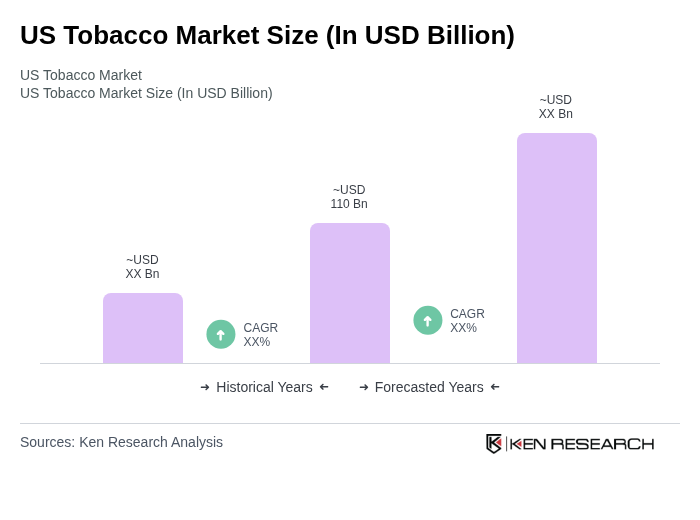
- The US Tobacco Market is valued at USD 110 billion, based on a five-year historical analysis. This market size is primarily driven by a combination of consumer demand for traditional tobacco products and the rising popularity of next-generation alternatives, such as e?cigarettes and heated tobacco products. The market has seen fluctuations due to regulatory changes, declining smoking prevalence among adults, and shifting consumer preferences towards products that are perceived as less harmful, including oral nicotine pouches and vapor products.
- Key regions dominating the US Tobacco Market include California, Texas, and Florida. These states have large populations and a significant number of tobacco retailers, contributing to higher sales volumes. Additionally, cultural factors, tourism activity (particularly in Florida), and historical consumption patterns in these areas have established a strong market presence for both traditional and innovative tobacco products, even as overall national smoking rates decline.
- The Family Smoking Prevention and Tobacco Control Act, enacted by the US Congress and implemented by the US Food and Drug Administration (FDA) in 2009, provides the primary federal framework for regulating the manufacturing, marketing, and sale of tobacco products. Under this Act and subsequent FDA rules, manufacturers must obtain premarket authorization for new tobacco products, comply with health warning and ingredient disclosure requirements, and adhere to restrictions on youth-oriented marketing and sales, including minimum age-of-sale requirements and limitations on characterizing flavors in cigarettes.
US Tobacco Market Segmentation
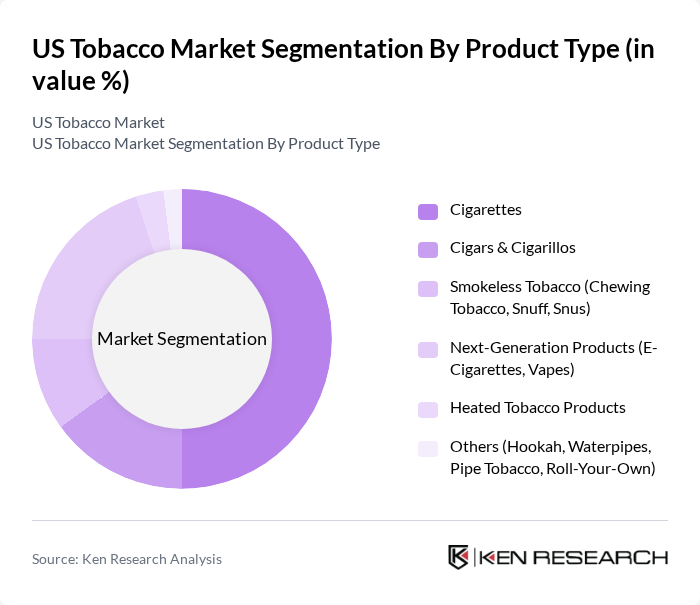
By Product Type:The product type segmentation of the US Tobacco Market includes various categories such as Cigarettes, Cigars & Cigarillos, Smokeless Tobacco (Chewing Tobacco, Snuff, Snus), Next-Generation Products (E?Cigarettes, Vapes), Heated Tobacco Products, and Others (Hookah, Waterpipes, Pipe Tobacco, Roll?Your?Own). This structure aligns with common industry classifications that distinguish between combustible, smokeless, and nicotine delivery products. Among these, Cigarettes remain the dominant segment by revenue due to their long?standing popularity and established consumer base, although unit volumes are gradually declining. The rise of Next?Generation Products is notable, as younger adult consumers increasingly experiment with e?cigarettes, vapes, and nicotine pouches perceived as less harmful or more convenient than traditional combustible products.
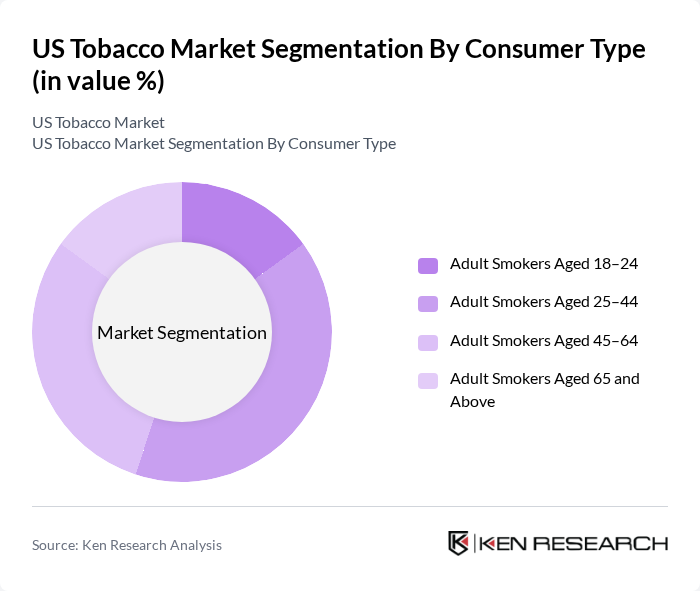
By Consumer Type:This segmentation includes Adult Smokers Aged 18–24, Adult Smokers Aged 25–44, Adult Smokers Aged 45–64, and Adult Smokers Aged 65 and Above. The segment of Adult Smokers Aged 25–44 is currently the largest in terms of tobacco use, reflecting higher daily and non?daily smoking prevalence compared with younger adults, who have shown sharper declines in combustible cigarette use. This demographic is also more inclined to experiment with new products, such as e?cigarettes and nicotine pouches, which are gaining traction among younger and middle?aged adults and contributing to a gradual shift in consumption from combustible to alternative products.
US Tobacco Market Competitive Landscape
The US Tobacco Market is characterized by a dynamic mix of regional and international players. Leading participants such as Altria Group, Inc., Philip Morris USA Inc. (PM USA), Reynolds American Inc. (RAI), ITG Brands, LLC, Swedish Match North America LLC, Japan Tobacco International U.S.A., Inc., Imperial Brands PLC (Imperial Tobacco U.S. Operations), British American Tobacco p.l.c. (BAT U.S. Operations), Turning Point Brands, Inc., Vector Group Ltd. (Liggett Vector Brands), National Tobacco Company, L.P., PT Djarum (Djarum USA), Kretek International, Inc., R.J. Reynolds Vapor Company (Vuse), NJOY, LLC (an Altria Company) contribute to innovation, geographic expansion, and service delivery in this space.
US Tobacco Market Industry Analysis
Growth Drivers
- Increasing Health Awareness:The US tobacco market is witnessing a shift as health awareness rises among consumers. In future, approximately 75% of adults recognize the health risks associated with smoking, according to the CDC. This awareness has led to a decline in traditional cigarette consumption, with sales dropping to about 192 billion units for manufactured cigarettes. Consequently, manufacturers are focusing on reduced-risk products, which are projected to capture a larger market share as consumers seek healthier alternatives.
- Innovations in Product Offerings:The tobacco industry is evolving with innovative product offerings, particularly in the e-cigarette and vaping segments. In future, e-cigarette sales reached $4.5 billion, reflecting a 20% increase from the previous year. This growth is driven by advancements in technology, such as improved battery life and flavor options, appealing to a broader demographic. As manufacturers invest in research and development, the introduction of new products is expected to further stimulate market growth in future.
- Expansion of Distribution Channels:The expansion of distribution channels is significantly enhancing the accessibility of tobacco products. In future, online sales of tobacco products accounted for $1.2 billion, a 15% increase from the previous year. Retailers are increasingly adopting omnichannel strategies, integrating e-commerce with traditional sales. This trend is expected to continue in future, as more consumers prefer the convenience of online shopping, thereby driving overall market growth and product availability across various platforms.
Market Challenges
- Stringent Regulatory Environment:The US tobacco market faces significant challenges due to stringent regulations imposed by the FDA and state governments. In future, over 30 states implemented new laws restricting the sale of flavored tobacco products, impacting sales by an estimated $1 billion. These regulations aim to reduce youth access to tobacco, creating hurdles for manufacturers. As compliance costs rise, companies must navigate this complex landscape while maintaining profitability in future.
- Declining Smoking Rates:The decline in smoking rates poses a substantial challenge for the tobacco industry. In future, the smoking prevalence among adults fell to about 11.5%, down from 15% in the past, according to the CDC. This trend is driven by public health campaigns and increased awareness of health risks. As traditional cigarette consumption continues to decrease, manufacturers must adapt their strategies to focus on alternative products to sustain revenue in the evolving market landscape.
US Tobacco Market Future Outlook
The US tobacco market is poised for transformation as consumer preferences shift towards reduced-risk products and innovative offerings. With the rise of e-cigarettes and vaping, manufacturers are likely to invest heavily in product development and marketing strategies that align with health-conscious trends. Additionally, the expansion of online sales channels will enhance accessibility, catering to a broader audience. As regulatory pressures persist, companies will need to navigate compliance while exploring new market segments to ensure sustainable growth in the coming years.
Market Opportunities
- Growth of E-Cigarettes and Vaping Products:The e-cigarette and vaping segment presents a significant opportunity, with sales projected to reach $6 billion in future. This growth is driven by increasing consumer acceptance and the demand for less harmful alternatives. Companies that innovate in this space can capture a larger market share and appeal to health-conscious consumers seeking alternatives to traditional tobacco products.
- Partnerships with Health Organizations:Collaborating with health organizations can create new opportunities for tobacco companies. By promoting reduced-risk products and engaging in public health initiatives, companies can enhance their brand image and credibility. Such partnerships could lead to increased consumer trust and potentially expand market reach, particularly among demographics concerned about health implications associated with tobacco use.
Scope of the Report
| Segment | Sub-Segments |
|---|---|
| By Product Type | Cigarettes Cigars & Cigarillos Smokeless Tobacco (Chewing Tobacco, Snuff, Snus) Next-Generation Products (E-Cigarettes, Vapes) Heated Tobacco Products Others (Hookah, Waterpipes, Pipe Tobacco, Roll-Your-Own) |
| By Consumer Type | Adult Smokers Aged 18–24 Adult Smokers Aged 25–44 Adult Smokers Aged 45–64 Adult Smokers Aged 65 and Above |
| By Distribution Channel | Tobacco Shops Convenience Stores Supermarkets & Hypermarkets Online Retail Others (Gas Stations, Duty-Free, Vape Shops) |
| By Price Tier | Premium Products Mid-Range Products Value/Discount Products Private Label and Generic Products |
| By Consumer Demographics | Age Group Gender Income Level Urban vs Rural Consumers |
| By Packaging Type | Soft Packs Hard Packs Cans, Pouches & Tins Others (Cartons, Refill Pods, Disposable Devices) |
| By Geographic Region | Northeast Midwest South West |
Key Target Audience
Investors and Venture Capitalist Firms
Government and Regulatory Bodies (e.g., Food and Drug Administration, Centers for Disease Control and Prevention)
Manufacturers and Producers
Distributors and Retailers
Public Health Organizations
Industry Associations (e.g., Tobacco Merchants Association)
Financial Institutions
Market Analysts and Research Firms
Players Mentioned in the Report:
Altria Group, Inc.
Philip Morris USA Inc. (PM USA)
Reynolds American Inc. (RAI)
ITG Brands, LLC
Swedish Match North America LLC
Japan Tobacco International U.S.A., Inc.
Imperial Brands PLC (Imperial Tobacco U.S. Operations)
British American Tobacco p.l.c. (BAT U.S. Operations)
Turning Point Brands, Inc.
Vector Group Ltd. (Liggett Vector Brands)
National Tobacco Company, L.P.
PT Djarum (Djarum USA)
Kretek International, Inc.
R.J. Reynolds Vapor Company (Vuse)
NJOY, LLC (an Altria Company)
Table of Contents
Market Assessment Phase
1. Executive Summary and Approach
2. US Tobacco Market Overview
2.1 Key Insights and Strategic Recommendations
2.2 US Tobacco Market Overview
2.3 Definition and Scope
2.4 Evolution of Market Ecosystem
2.5 Timeline of Key Regulatory Milestones
2.6 Value Chain & Stakeholder Mapping
2.7 Business Cycle Analysis
2.8 Policy & Incentive Landscape
3. US Tobacco Market Analysis
3.1 Growth Drivers
3.1.1 Increasing Health Awareness
3.1.2 Innovations in Product Offerings
3.1.3 Expansion of Distribution Channels
3.1.4 Rising Demand for Reduced-Risk Products
3.2 Market Challenges
3.2.1 Stringent Regulatory Environment
3.2.2 Declining Smoking Rates
3.2.3 Competition from Alternative Products
3.2.4 Public Health Campaigns Against Tobacco Use
3.3 Market Opportunities
3.3.1 Growth of E-Cigarettes and Vaping Products
3.3.2 Emerging Markets within the US
3.3.3 Product Diversification
3.3.4 Partnerships with Health Organizations
3.4 Market Trends
3.4.1 Shift Towards Organic and Natural Products
3.4.2 Increasing Use of Technology in Marketing
3.4.3 Rise of Subscription Services
3.4.4 Focus on Sustainability Practices
3.5 Government Regulation
3.5.1 Tobacco Control Act
3.5.2 FDA Regulations on E-Cigarettes
3.5.3 State-Level Taxation Policies
3.5.4 Advertising Restrictions
4. SWOT Analysis
5. Stakeholder Analysis
6. Porter's Five Forces Analysis
7. US Tobacco Market Market Size, 2019-2024
7.1 By Value
7.2 By Volume
7.3 By Average Selling Price
8. US Tobacco Market Segmentation
8.1 By Product Type
8.1.1 Cigarettes
8.1.2 Cigars & Cigarillos
8.1.3 Smokeless Tobacco (Chewing Tobacco, Snuff, Snus)
8.1.4 Next-Generation Products (E-Cigarettes, Vapes)
8.1.5 Heated Tobacco Products
8.1.6 Others (Hookah, Waterpipes, Pipe Tobacco, Roll-Your-Own)
8.2 By Consumer Type
8.2.1 Adult Smokers Aged 18–24
8.2.2 Adult Smokers Aged 25–44
8.2.3 Adult Smokers Aged 45–64
8.2.4 Adult Smokers Aged 65 and Above
8.3 By Distribution Channel
8.3.1 Tobacco Shops
8.3.2 Convenience Stores
8.3.3 Supermarkets & Hypermarkets
8.3.4 Online Retail
8.3.5 Others (Gas Stations, Duty-Free, Vape Shops)
8.4 By Price Tier
8.4.1 Premium Products
8.4.2 Mid-Range Products
8.4.3 Value/Discount Products
8.4.4 Private Label and Generic Products
8.5 By Consumer Demographics
8.5.1 Age Group
8.5.2 Gender
8.5.3 Income Level
8.5.4 Urban vs Rural Consumers
8.6 By Packaging Type
8.6.1 Soft Packs
8.6.2 Hard Packs
8.6.3 Cans, Pouches & Tins
8.6.4 Others (Cartons, Refill Pods, Disposable Devices)
8.7 By Geographic Region
8.7.1 Northeast
8.7.2 Midwest
8.7.3 South
8.7.4 West
9. US Tobacco Market Competitive Analysis
9.1 Market Share of Key Players
9.2 Cross Comparison of Key Players
9.2.1 Company Name
9.2.2 Group Size (Large, Medium, or Small as per industry convention)
9.2.3 US Tobacco Revenue (Latest Fiscal Year)
9.2.4 Revenue CAGR in US Tobacco Segment (3–5 Years)
9.2.5 US Market Share by Volume
9.2.6 US Market Share by Value
9.2.7 Product Portfolio Mix (Combustible vs. Smokeless vs. Next-Gen)
9.2.8 Average Real Price per Pack/Can vs Market Average
9.2.9 Retail Coverage (Number of Outlets / Channel Penetration)
9.2.10 Brand Leadership (Number of Top-10 Brands Held)
9.2.11 R&D and Harm-Reduction Spend (% of Sales)
9.2.12 Regulatory & Litigation Exposure Indicators
9.3 SWOT Analysis of Top Players
9.4 Pricing Analysis
9.5 Detailed Profile of Major Companies
9.5.1 Altria Group, Inc.
9.5.2 Philip Morris USA Inc. (PM USA)
9.5.3 Reynolds American Inc. (RAI)
9.5.4 ITG Brands, LLC
9.5.5 Swedish Match North America LLC
9.5.6 Japan Tobacco International U.S.A., Inc.
9.5.7 Imperial Brands PLC (Imperial Tobacco U.S. Operations)
9.5.8 British American Tobacco p.l.c. (BAT U.S. Operations)
9.5.9 Turning Point Brands, Inc.
9.5.10 Vector Group Ltd. (Liggett Vector Brands)
9.5.11 National Tobacco Company, L.P.
9.5.12 PT Djarum (Djarum USA)
9.5.13 Kretek International, Inc.
9.5.14 R.J. Reynolds Vapor Company (Vuse)
9.5.15 NJOY, LLC (an Altria Company)
10. US Tobacco Market End-User Analysis
10.1 Procurement Behavior of Key Ministries
10.1.1 Government Procurement Policies
10.1.2 Budget Allocations for Tobacco Products
10.1.3 Compliance with Health Regulations
10.1.4 Others
10.2 Corporate Spend on Infrastructure & Energy
10.2.1 Investment in Tobacco Production Facilities
10.2.2 Expenditure on Marketing and Advertising
10.2.3 Research and Development Budgets
10.2.4 Others
10.3 Pain Point Analysis by End-User Category
10.3.1 Regulatory Compliance Challenges
10.3.2 Supply Chain Disruptions
10.3.3 Consumer Health Concerns
10.3.4 Others
10.4 User Readiness for Adoption
10.4.1 Awareness of New Products
10.4.2 Willingness to Switch Brands
10.4.3 Acceptance of Reduced-Risk Products
10.4.4 Others
10.5 Post-Deployment ROI and Use Case Expansion
10.5.1 Measurement of Sales Growth
10.5.2 Customer Feedback and Satisfaction
10.5.3 Market Share Analysis
10.5.4 Others
11. US Tobacco Market Future Size, 2025-2030
11.1 By Value
11.2 By Volume
11.3 By Average Selling Price
Go-To-Market Strategy Phase
1. Whitespace Analysis + Business Model Canvas
1.1 Market Gaps Identification
1.2 Business Model Framework
2. Marketing and Positioning Recommendations
2.1 Branding Strategies
2.2 Product USPs
3. Distribution Plan
3.1 Urban Retail vs Rural NGO Tie-Ups
4. Channel & Pricing Gaps
4.1 Underserved Routes
4.2 Pricing Bands
5. Unmet Demand & Latent Needs
5.1 Category Gaps
5.2 Consumer Segments
6. Customer Relationship
6.1 Loyalty Programs
6.2 After-Sales Service
7. Value Proposition
7.1 Sustainability
7.2 Integrated Supply Chains
8. Key Activities
8.1 Regulatory Compliance
8.2 Branding
8.3 Distribution Setup
9. Entry Strategy Evaluation
9.1 Domestic Market Entry Strategy
9.1.1 Product Mix
9.1.2 Pricing Band
9.1.3 Packaging
9.2 Export Entry Strategy
9.2.1 Target Countries
9.2.2 Compliance Roadmap
10. Entry Mode Assessment
10.1 JV
10.2 Greenfield
10.3 M&A
10.4 Distributor Model
11. Capital and Timeline Estimation
11.1 Capital Requirements
11.2 Timelines
12. Control vs Risk Trade-Off
12.1 Ownership vs Partnerships
13. Profitability Outlook
13.1 Breakeven Analysis
13.2 Long-Term Sustainability
14. Potential Partner List
14.1 Distributors
14.2 JVs
14.3 Acquisition Targets
15. Execution Roadmap
15.1 Phased Plan for Market Entry
15.1.1 Market Setup
15.1.2 Market Entry
15.1.3 Growth Acceleration
15.1.4 Scale & Stabilize
15.2 Key Activities and Milestones
15.2.1 Milestone Planning
15.2.2 Activity Tracking
Research Methodology
Phase 1: Approach1
Desk Research
- Analysis of industry reports from the Tobacco Control Research and the American Lung Association
- Review of market data from the U.S. Department of Agriculture and the Centers for Disease Control and Prevention
- Examination of consumer behavior studies published in academic journals and market research publications
Primary Research
- Interviews with industry experts, including tobacco product manufacturers and regulatory officials
- Surveys conducted with retailers and distributors to understand market dynamics and consumer preferences
- Focus groups with consumers to gauge attitudes towards tobacco products and smoking cessation initiatives
Validation & Triangulation
- Cross-validation of findings through comparison with historical sales data and market trends
- Triangulation of insights from primary interviews with secondary data sources to ensure consistency
- Sanity checks through expert panel reviews to validate assumptions and projections
Phase 2: Market Size Estimation1
Top-down Assessment
- Estimation of total market size based on national tobacco consumption statistics and tax revenue data
- Segmentation of the market by product type, including cigarettes, cigars, and smokeless tobacco
- Incorporation of demographic trends and smoking prevalence rates across different age groups
Bottom-up Modeling
- Collection of sales data from leading tobacco companies to establish baseline revenue figures
- Analysis of distribution channels and their respective market shares to refine estimates
- Volume x price modeling to assess revenue potential across different product categories
Forecasting & Scenario Analysis
- Multi-factor regression analysis incorporating economic indicators, regulatory changes, and public health campaigns
- Scenario modeling based on potential shifts in consumer behavior and smoking regulations
- Development of baseline, optimistic, and pessimistic forecasts through 2030
Phase 3: CATI Sample Composition1
| Scope Item/Segment | Sample Size | Target Respondent Profiles |
|---|---|---|
| Cigarette Consumption Patterns | 150 | Adult Smokers, Retail Store Owners |
| Smokeless Tobacco Usage | 100 | Smokeless Tobacco Users, Health Professionals |
| Regulatory Impact Assessment | 80 | Policy Makers, Public Health Officials |
| Consumer Attitudes Towards Smoking Cessation | 120 | Former Smokers, Health Coaches |
| Tobacco Product Innovations | 90 | Product Development Managers, Marketing Executives |
Frequently Asked Questions
What is the current value of the US Tobacco Market?
The US Tobacco Market is valued at approximately USD 110 billion, driven by consumer demand for traditional tobacco products and the growing popularity of next-generation alternatives like e-cigarettes and heated tobacco products.
Which states dominate the US Tobacco Market?
What are the main product types in the US Tobacco Market?
How has health awareness impacted the US Tobacco Market?
Other Regional/Country Reports
Indonesia Tobacco Market Size, Share, Growth Drivers, Trends, Opportunities & Forecast 2025–2030
Malaysia Tobacco Market Size, Share, Growth Drivers, Trends, Opportunities & Forecast 2025–2030
KSA Tobacco Market Size, Share, Growth Drivers, Trends, Opportunities & Forecast 2025–2030
APAC Tobacco Market Size, Share, Growth Drivers, Trends, Opportunities & Forecast 2025–2030
SEA Tobacco Market Size, Share, Growth Drivers, Trends, Opportunities & Forecast 2025–2030
Other Adjacent Reports
Malaysia Electronic Cigarette Market
Germany Heated Tobacco Products Market
UAE Nicotine Replacement Therapy Market Report Size Share Growth Drivers Trends Opportunities & Forecast 2025–2030UAE Smokeless Tobacco MarketGermany Cannabis Products Market
Oman Smoking Cessation Aids Market
Mexico Vaping Devices Market
South Africa Oral Nicotine Products Market
Philippines tobacco packaging market Size, Share, Growth Drivers, Trends, Opportunities & Forecast 2025–2030Bahrain Alternative Nicotine Delivery Market
Why Buy From Us?

What makes us stand out is that our consultants follow Robust, Refine and Result (RRR) methodology. Robust for clear definitions, approaches and sanity checking, Refine for differentiating respondents' facts and opinions, and Result for presenting data with story.

We have set a benchmark in the industry by offering our clients with syndicated and customized market research reports featuring coverage of entire market as well as meticulous research and analyst insights.

While we don't replace traditional research, we flip the method upside down. Our dual approach of Top Bottom & Bottom Top ensures quality deliverable by not just verifying company fundamentals but also looking at the sector and macroeconomic factors.

With one step in the future, our research team constantly tries to show you the bigger picture. We help with some of the tough questions you may encounter along the way: How is the industry positioned? Best marketing channel? KPI's of competitors? By aligning every element, we help maximize success.

Our report gives you instant access to the answers and sources that other companies might choose to hide. We elaborate each steps of research methodology we have used and showcase you the sample size to earn your trust.

If you need any support, we are here! We pride ourselves on universe strength, data quality, and quick, friendly, and professional service.