Us Urology Surgical Instruments Market Size, Share, Growth Drivers, Trends, Opportunities & Forecast 2025–2030

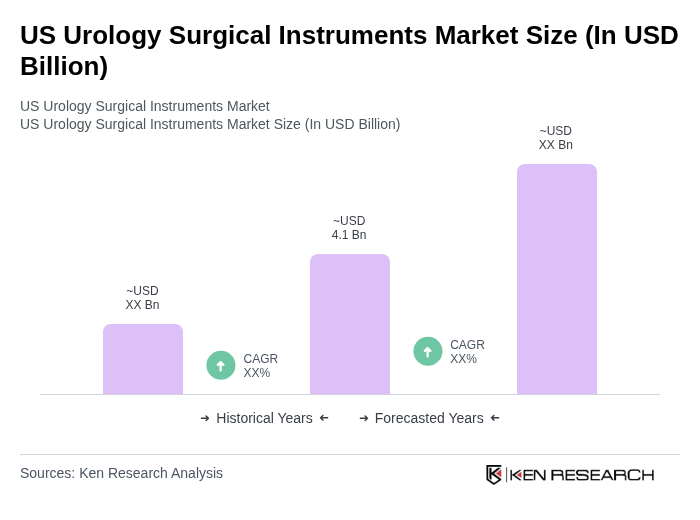
The US Urology Surgical Instruments Market is valued at USD 4.1 billion, growing due to rising urological disorders and advancements in surgical technologies.

Region:North America

Author(s):Geetanshi

Product Code:KRAD3917

Pages:94

Published On:November 2025
About the Report

Base Year 2024

US Urology Surgical Instruments Market Overview

  • The US Urology Surgical Instruments Market is valued at USD 4.1 billion, based on a five-year historical analysis. This growth is primarily driven by the increasing prevalence of urological disorders, advancements in surgical technologies, and a rising geriatric population that requires urological interventions. The demand for minimally invasive surgical procedures has also contributed significantly to the market's expansion.
  • Key players in this market include major cities such as New York, Los Angeles, and Chicago, which dominate due to their advanced healthcare infrastructure, high patient volumes, and the presence of leading medical institutions. These cities are also hubs for medical research and innovation, attracting investments and fostering collaborations that enhance the development of urology surgical instruments.
  • The FDA's Quality System Regulation (QSR), codified under 21 CFR Part 820 and issued by the U.S. Food and Drug Administration, establishes comprehensive requirements for the design, manufacture, packaging, labeling, storage, installation, and servicing of all finished devices intended for human use. This regulation mandates that manufacturers implement quality management systems including design controls, risk management, supplier management, production and process controls, acceptance criteria, traceability systems, and corrective and preventive actions. Compliance requires adherence to enhanced standards for sterilization validation, material biocompatibility, and electrical safety, with manufacturers maintaining detailed documentation and conducting regular audits to ensure patient safety and product quality.
US Urology Surgical Instruments Market Size

US Urology Surgical Instruments Market Segmentation

By Product Type:The product type segmentation includes various categories such as Endoscopes, Endovision Systems, Peripheral Systems, and Accessories & Consumables. Accessories & Consumables represent the leading sub-segment due to their recurring demand, critical role in minimally invasive surgeries, and the increasing preference for advanced imaging technologies. The growing trend towards outpatient procedures further bolsters the market for these essential consumable products.
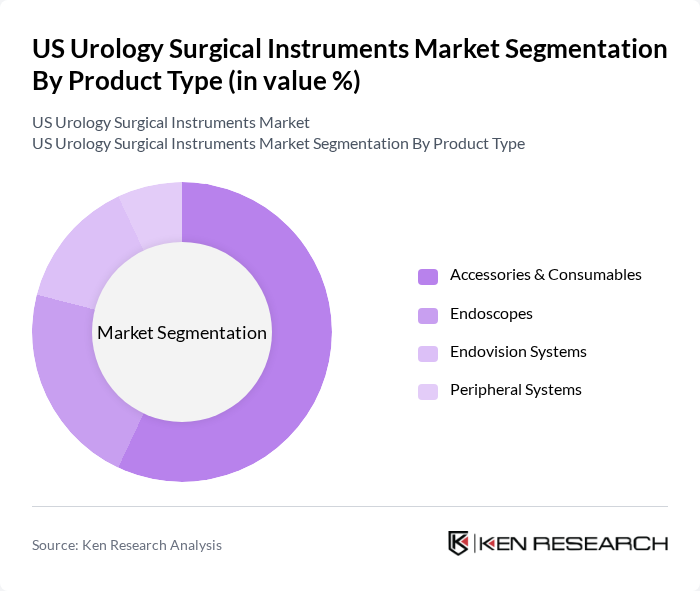
US Urology Surgical Instruments Market segmentation by Product Type.

By End-User:The end-user segmentation encompasses Hospitals, Ambulatory Surgical Centers, Specialty Clinics, Research Institutions, and Others. Hospitals dominate this segment, accounting for a significant share due to their comprehensive facilities and the high volume of urological procedures performed. The increasing adoption of advanced surgical technologies in hospitals, along with the growing patient population, drives the demand for urology surgical instruments in this setting.
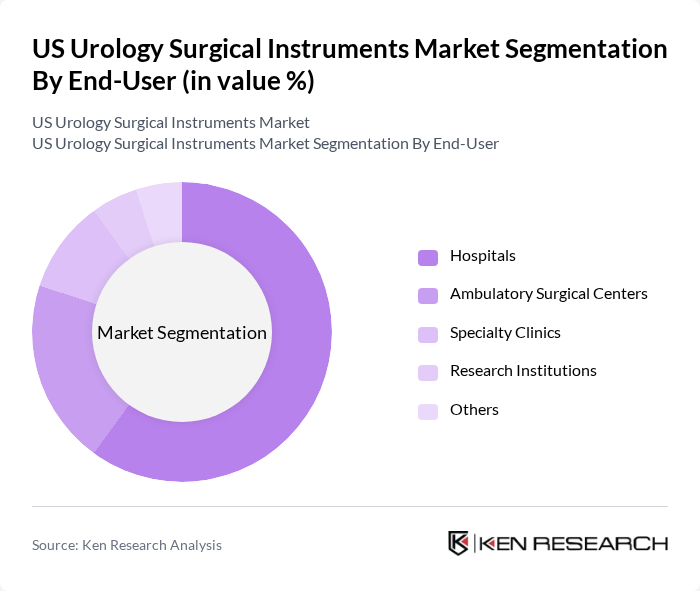
US Urology Surgical Instruments Market segmentation by End-User.

US Urology Surgical Instruments Market Competitive Landscape

The US Urology Surgical Instruments Market is characterized by a dynamic mix of regional and international players. Leading participants such as Medtronic PLC, Boston Scientific Corporation, Olympus Corporation, Karl Storz GmbH & Co. KG, Richard Wolf GmbH, Stryker Corporation, Teleflex Incorporated, Coloplast A/S, Cook Medical, Johnson & Johnson (Ethicon), B. Braun Melsungen AG, ConMed Corporation, Intuitive Surgical, Inc., Merit Medical Systems, Inc., EndoChoice Holdings, Inc. contribute to innovation, geographic expansion, and service delivery in this space.

Medtronic PLC

1949

Dublin, Ireland

Boston Scientific Corporation

1979

Natick, Massachusetts, USA

Olympus Corporation

1919

Tokyo, Japan

Karl Storz GmbH & Co. KG

1945

Tuttlingen, Germany

Richard Wolf GmbH

1921

Knittlingen, Germany

Company

Establishment Year

Headquarters

Group Size (Large, Medium, or Small as per industry convention)

Revenue Growth Rate (YoY)

Market Penetration Rate (by product segment)

Customer Retention Rate

Pricing Strategy (Premium, Value, or Competitive)

Product Innovation Rate (New product launches per year)

US Urology Surgical Instruments Market Industry Analysis

Growth Drivers

  • Increasing Prevalence of Urological Disorders:The prevalence of urological disorders in the US is significant, with approximately 42% of men over 50 experiencing benign prostatic hyperplasia (BPH). According to the National Kidney Foundation, around 37 million Americans suffer from chronic kidney disease, which often necessitates surgical intervention. This growing patient population drives demand for urology surgical instruments, as healthcare providers seek effective solutions to manage these conditions, thereby boosting market growth.
  • Advancements in Surgical Technologies:The US urology surgical instruments market is witnessing rapid technological advancements, particularly in robotic-assisted surgeries. The market for robotic surgical systems is projected to reach $7.5 billion in the future, driven by innovations that enhance precision and reduce recovery times. These advancements not only improve surgical outcomes but also increase the adoption of advanced instruments, further propelling market growth as hospitals invest in state-of-the-art technologies.
  • Rising Geriatric Population:The geriatric population in the US is expected to reach 85 million in the future, according to the US Census Bureau. This demographic shift is significant as older adults are more susceptible to urological disorders, leading to increased surgical procedures. The demand for specialized urology surgical instruments is anticipated to rise in tandem with this population growth, as healthcare systems adapt to meet the needs of an aging society, thereby driving market expansion.

Market Challenges

  • High Cost of Surgical Instruments:The high cost associated with advanced urology surgical instruments poses a significant challenge for healthcare providers. For instance, robotic surgical systems can exceed $2.5 million, making it difficult for smaller hospitals and outpatient centers to invest in such technologies. This financial barrier can limit access to cutting-edge surgical options, potentially hindering market growth as facilities may opt for less advanced, cost-effective alternatives.
  • Shortage of Skilled Professionals:The US healthcare system is currently facing a shortage of skilled urologists and surgical technicians, with estimates suggesting a deficit of over 25,000 urologists in the future. This shortage can lead to longer wait times for surgeries and reduced patient throughput, ultimately impacting the demand for urology surgical instruments. As the complexity of procedures increases, the need for highly trained professionals becomes critical, posing a challenge to market growth.

US Urology Surgical Instruments Market Future Outlook

The future of the US urology surgical instruments market appears promising, driven by ongoing technological innovations and an increasing focus on patient-centered care. As healthcare providers continue to adopt robotic-assisted and minimally invasive surgical techniques, the demand for advanced instruments is expected to rise. Additionally, the integration of digital technologies, such as telemedicine and AI, will likely enhance surgical planning and execution, further shaping the market landscape in the future.

Market Opportunities

  • Expansion of Outpatient Surgical Centers:The growth of outpatient surgical centers presents a significant opportunity for the urology surgical instruments market. With over 6,000 outpatient surgical centers operating in the US, these facilities are increasingly adopting advanced surgical technologies, which can drive demand for specialized instruments tailored for outpatient procedures, enhancing patient access and convenience.
  • Development of Innovative Surgical Instruments:There is a growing opportunity for manufacturers to develop innovative surgical instruments that cater to the evolving needs of urologists. With an increasing emphasis on personalized medicine, instruments that offer enhanced precision and adaptability can capture market share. Investment in R&D for new materials and designs can lead to breakthroughs that improve surgical outcomes and patient satisfaction.

Scope of the Report

SegmentSub-Segments
By Product Type

Endoscopes

Endovision Systems

Peripheral Systems

Accessories & Consumables

By End-User

Hospitals

Ambulatory Surgical Centers

Specialty Clinics

Research Institutions

Others

By Application

Urological Surgery

Nephrology

Oncology

Pediatric Urology

Others

By Material

Stainless Steel

Plastic

Titanium

Others

By Distribution Channel

Direct Sales

Distributors

Online Sales

Others

By Region

Northeast

Midwest

South

West

By Product Lifecycle Stage

New Products

Mature Products

Declining Products

Others

Key Target Audience

Investors and Venture Capitalist Firms

Government and Regulatory Bodies (e.g., Food and Drug Administration, Centers for Medicare & Medicaid Services)

Manufacturers and Producers

Distributors and Retailers

Healthcare Providers and Hospitals

Medical Device Wholesalers

Industry Associations (e.g., American Urological Association)

Financial Institutions

Players Mentioned in the Report:

Medtronic PLC

Boston Scientific Corporation

Olympus Corporation

Karl Storz GmbH & Co. KG

Richard Wolf GmbH

Stryker Corporation

Teleflex Incorporated

Coloplast A/S

Cook Medical

Johnson & Johnson (Ethicon)

B. Braun Melsungen AG

ConMed Corporation

Intuitive Surgical, Inc.

Merit Medical Systems, Inc.

EndoChoice Holdings, Inc.

Table of Contents

Market Assessment Phase

1. Executive Summary and Approach


2. US Urology Surgical Instruments Market Overview

2.1 Key Insights and Strategic Recommendations

2.2 US Urology Surgical Instruments Market Overview

2.3 Definition and Scope

2.4 Evolution of Market Ecosystem

2.5 Timeline of Key Regulatory Milestones

2.6 Value Chain & Stakeholder Mapping

2.7 Business Cycle Analysis

2.8 Policy & Incentive Landscape


3. US Urology Surgical Instruments Market Analysis

3.1 Growth Drivers

3.1.1 Increasing prevalence of urological disorders
3.1.2 Advancements in surgical technologies
3.1.3 Rising geriatric population
3.1.4 Growing demand for minimally invasive surgeries

3.2 Market Challenges

3.2.1 High cost of surgical instruments
3.2.2 Stringent regulatory requirements
3.2.3 Shortage of skilled professionals
3.2.4 Competition from alternative treatment options

3.3 Market Opportunities

3.3.1 Expansion of outpatient surgical centers
3.3.2 Increasing investment in healthcare infrastructure
3.3.3 Development of innovative surgical instruments
3.3.4 Strategic partnerships and collaborations

3.4 Market Trends

3.4.1 Growing adoption of robotic-assisted surgeries
3.4.2 Shift towards personalized medicine
3.4.3 Integration of digital technologies in surgical procedures
3.4.4 Focus on sustainability in manufacturing processes

3.5 Government Regulation

3.5.1 FDA regulations on medical devices
3.5.2 Compliance with safety standards
3.5.3 Reimbursement policies for surgical procedures
3.5.4 Guidelines for clinical trials and approvals

4. SWOT Analysis


5. Stakeholder Analysis


6. Porter's Five Forces Analysis


7. US Urology Surgical Instruments Market Size, 2019-2024

7.1 By Value

7.2 By Volume

7.3 By Average Selling Price


8. US Urology Surgical Instruments Market Segmentation

8.1 By Product Type

8.1.1 Endoscopes
8.1.2 Endovision Systems
8.1.3 Peripheral Systems
8.1.4 Accessories & Consumables

8.2 By End-User

8.2.1 Hospitals
8.2.2 Ambulatory Surgical Centers
8.2.3 Specialty Clinics
8.2.4 Research Institutions
8.2.5 Others

8.3 By Application

8.3.1 Urological Surgery
8.3.2 Nephrology
8.3.3 Oncology
8.3.4 Pediatric Urology
8.3.5 Others

8.4 By Material

8.4.1 Stainless Steel
8.4.2 Plastic
8.4.3 Titanium
8.4.4 Others

8.5 By Distribution Channel

8.5.1 Direct Sales
8.5.2 Distributors
8.5.3 Online Sales
8.5.4 Others

8.6 By Region

8.6.1 Northeast
8.6.2 Midwest
8.6.3 South
8.6.4 West

8.7 By Product Lifecycle Stage

8.7.1 New Products
8.7.2 Mature Products
8.7.3 Declining Products
8.7.4 Others

9. US Urology Surgical Instruments Market Competitive Analysis

9.1 Market Share of Key Players

9.2 Cross Comparison of Key Players

9.2.1 Company Name
9.2.2 Group Size (Large, Medium, or Small as per industry convention)
9.2.3 Revenue Growth Rate (YoY)
9.2.4 Market Penetration Rate (by product segment)
9.2.5 Customer Retention Rate
9.2.6 Pricing Strategy (Premium, Value, or Competitive)
9.2.7 Product Innovation Rate (New product launches per year)
9.2.8 Distribution Efficiency (Geographic coverage & channel reach)
9.2.9 Brand Recognition (Measured by market surveys)
9.2.10 Customer Satisfaction Score (Net Promoter Score or equivalent)

9.3 SWOT Analysis of Top Players

9.4 Pricing Analysis

9.5 Detailed Profile of Major Companies

9.5.1 Medtronic PLC
9.5.2 Boston Scientific Corporation
9.5.3 Olympus Corporation
9.5.4 Karl Storz GmbH & Co. KG
9.5.5 Richard Wolf GmbH
9.5.6 Stryker Corporation
9.5.7 Teleflex Incorporated
9.5.8 Coloplast A/S
9.5.9 Cook Medical
9.5.10 Johnson & Johnson (Ethicon)
9.5.11 B. Braun Melsungen AG
9.5.12 ConMed Corporation
9.5.13 Intuitive Surgical, Inc.
9.5.14 Merit Medical Systems, Inc.
9.5.15 EndoChoice Holdings, Inc.

10. US Urology Surgical Instruments Market End-User Analysis

10.1 Procurement Behavior of Key Ministries

10.1.1 Budget Allocation Trends
10.1.2 Decision-Making Processes
10.1.3 Supplier Selection Criteria
10.1.4 Contracting Practices

10.2 Corporate Spend on Infrastructure & Energy

10.2.1 Investment Trends in Healthcare Facilities
10.2.2 Spending on Surgical Equipment
10.2.3 Budgeting for Technology Upgrades
10.2.4 Others

10.3 Pain Point Analysis by End-User Category

10.3.1 Equipment Availability
10.3.2 Training and Support Needs
10.3.3 Cost Management Challenges
10.3.4 Others

10.4 User Readiness for Adoption

10.4.1 Training Programs
10.4.2 Technology Acceptance Levels
10.4.3 Infrastructure Readiness
10.4.4 Others

10.5 Post-Deployment ROI and Use Case Expansion

10.5.1 Performance Metrics
10.5.2 User Feedback Mechanisms
10.5.3 Scalability of Solutions
10.5.4 Others

11. US Urology Surgical Instruments Market Future Size, 2025-2030

11.1 By Value

11.2 By Volume

11.3 By Average Selling Price


Go-To-Market Strategy Phase

1. Whitespace Analysis + Business Model Canvas

1.1 Market Gaps Identification

1.2 Business Model Framework


2. Marketing and Positioning Recommendations

2.1 Branding Strategies

2.2 Product USPs


3. Distribution Plan

3.1 Urban Retail vs Rural NGO Tie-ups


4. Channel & Pricing Gaps

4.1 Underserved Routes

4.2 Pricing Bands


5. Unmet Demand & Latent Needs

5.1 Category Gaps

5.2 Consumer Segments


6. Customer Relationship

6.1 Loyalty Programs

6.2 After-sales Service


7. Value Proposition

7.1 Sustainability

7.2 Integrated Supply Chains


8. Key Activities

8.1 Regulatory Compliance

8.2 Branding

8.3 Distribution Setup


9. Entry Strategy Evaluation

9.1 Domestic Market Entry Strategy

9.1.1 Product Mix
9.1.2 Pricing Band
9.1.3 Packaging

9.2 Export Entry Strategy

9.2.1 Target Countries
9.2.2 Compliance Roadmap

10. Entry Mode Assessment

10.1 JV

10.2 Greenfield

10.3 M&A

10.4 Distributor Model


11. Capital and Timeline Estimation

11.1 Capital Requirements

11.2 Timelines


12. Control vs Risk Trade-Off

12.1 Ownership vs Partnerships


13. Profitability Outlook

13.1 Breakeven Analysis

13.2 Long-term Sustainability


14. Potential Partner List

14.1 Distributors

14.2 JVs

14.3 Acquisition Targets


15. Execution Roadmap

15.1 Phased Plan for Market Entry

15.1.1 Market Setup
15.1.2 Market Entry
15.1.3 Growth Acceleration
15.1.4 Scale & Stabilize

15.2 Key Activities and Milestones

15.2.1 Milestone Tracking
15.2.2 Activity Scheduling

Research Methodology

ApproachModellingSample

Phase 1: Approach1

Desk Research

  • Industry reports from urology associations and medical device organizations
  • Market analysis from healthcare journals and publications focused on surgical instruments
  • Government health statistics and regulatory updates from the FDA and CMS

Primary Research

  • Interviews with urologists and surgical instrument procurement managers
  • Telephonic surveys with hospital administrators and purchasing agents
  • Field interviews with surgical staff and operating room managers

Validation & Triangulation

  • Cross-validation using multi-source data from clinical studies and market reports
  • Triangulation of insights from primary interviews and secondary data sources
  • Sanity check through expert panel reviews comprising urology specialists

Phase 2: Market Size Estimation1

Top-down Assessment

  • Analysis of national healthcare expenditure trends related to urology
  • Breakdown of surgical instrument sales by type and application in urology
  • Incorporation of demographic data and prevalence rates of urological conditions

Bottom-up Modeling

  • Firm-level sales data from leading manufacturers of urology surgical instruments
  • Operational cost estimates based on pricing models for surgical tools
  • Volume x cost basis for different types of urological procedures

Forecasting & Scenario Analysis

  • Multi-factor regression analysis incorporating technological advancements and market trends
  • Scenarios based on changes in healthcare policies and reimbursement rates
  • Baseline, optimistic, and constrained projections through 2030

Phase 3: CATI Sample Composition1

Scope Item/SegmentSample SizeTarget Respondent Profiles
Urology Surgical Instrument Procurement100Procurement Managers, Hospital Supply Chain Directors
Urologist Insights on Instrument Usage80Urologists, Surgical Specialists
Operating Room Equipment Managers60Operating Room Managers, Surgical Coordinators
Healthcare Facility Administrators50Healthcare Administrators, Financial Officers
Clinical Research on Urology Instruments40Clinical Researchers, Medical Device Analysts

Frequently Asked Questions

What is the current value of the US Urology Surgical Instruments Market?

The US Urology Surgical Instruments Market is valued at approximately USD 4.1 billion, reflecting a significant growth driven by the rising prevalence of urological disorders, advancements in surgical technologies, and an increasing geriatric population requiring urological interventions.

What factors are driving the growth of the US Urology Surgical Instruments Market?

Which cities are major players in the US Urology Surgical Instruments Market?

What are the main product types in the US Urology Surgical Instruments Market?

Other Regional/Country Reports

Indonesia Urology Surgical Instruments Market

Malaysia Urology Surgical Instruments Market

KSA Urology Surgical Instruments Market

APAC Urology Surgical Instruments Market

SEA Urology Surgical Instruments Market

Vietnam Urology Surgical Instruments Market

Other Adjacent Reports

Germany Endoscopy Equipment Market

Oman Minimally Invasive Surgical Devices Market

Kuwait Urological Catheters Market

South Korea Robotic Surgical Systems Market

Germany Medical Imaging Devices Market

UAE Disposable Surgical Instruments Market

Philippines Nephrology Devices Market

Oman Gynecological Surgical Instruments Market

Oman Orthopedic Surgical Instruments Market

UAE Hospital Supplies Market

Why Buy From Us?

Refine Robust Result (RRR) Framework

What makes us stand out is that our consultants follow Robust, Refine and Result (RRR) methodology. Robust for clear definitions, approaches and sanity checking, Refine for differentiating respondents' facts and opinions, and Result for presenting data with story.

Our Reach Is Unmatched

We have set a benchmark in the industry by offering our clients with syndicated and customized market research reports featuring coverage of entire market as well as meticulous research and analyst insights.

Shifting the Research Paradigm

While we don't replace traditional research, we flip the method upside down. Our dual approach of Top Bottom & Bottom Top ensures quality deliverable by not just verifying company fundamentals but also looking at the sector and macroeconomic factors.

More Insights-Better Decisions

With one step in the future, our research team constantly tries to show you the bigger picture. We help with some of the tough questions you may encounter along the way: How is the industry positioned? Best marketing channel? KPI's of competitors? By aligning every element, we help maximize success.

Transparency and Trust

Our report gives you instant access to the answers and sources that other companies might choose to hide. We elaborate each steps of research methodology we have used and showcase you the sample size to earn your trust.

Round the Clock Support

If you need any support, we are here! We pride ourselves on universe strength, data quality, and quick, friendly, and professional service.

Why Clients Choose Us?

400000+
Reports in repository
150+
Consulting projects a year
100+
Analysts
8000+
Client Queries in 2022








