About the Report
Base Year 2024US Virtual Production Market Overview
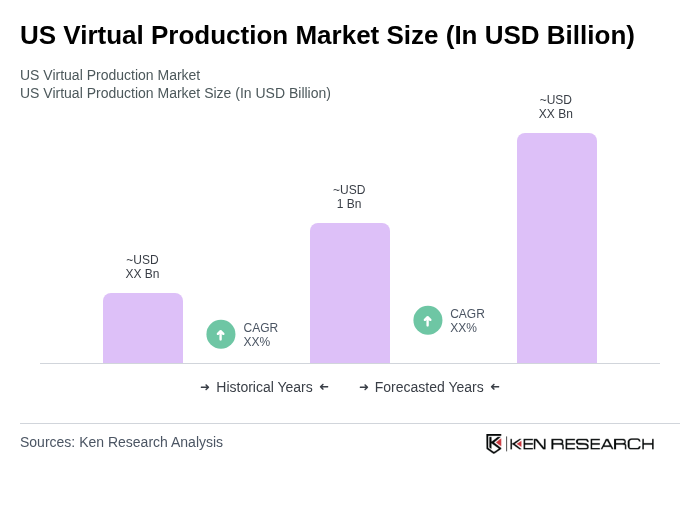
- The US Virtual Production Market is valued at USD 1 billion, based on a five-year historical analysis. This growth is primarily driven by advancements in technology, increasing demand for high-quality visual content, the rise of streaming platforms that require innovative production techniques, and growing adoption of real-time rendering, LED wall technology, and immersive virtual environments in film, television, and advertising. The integration of real-time rendering and virtual environments has revolutionized traditional filmmaking, making it more efficient and cost-effective.
- Key players in this market include Los Angeles, New York City, and Atlanta, which dominate due to their established film and entertainment industries. These cities offer a rich talent pool, advanced infrastructure, and a concentration of studios and production facilities, making them attractive locations for virtual production. The presence of major studios and tech companies further enhances their competitive edge in the market.
- The Federal Film and Television Production Incentive Program, administered by state-level authorities such as the California Film Commission under the California Labor and Workforce Development Agency, 2022, provides tax credits up to 25% of qualified production spending exceeding USD 1 million for feature films and television series incorporating advanced technologies including virtual production. Studios must meet in-state spending thresholds of at least USD 10 million annually and submit detailed compliance reports on technology integration and workforce hiring to qualify for transferable credits supporting sustainable and innovative practices.
US Virtual Production Market Segmentation
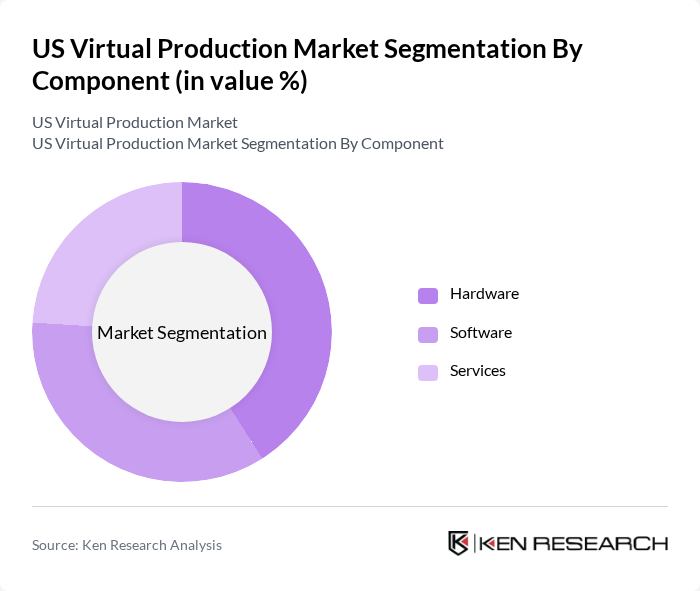
By Component:The components of the market include hardware, software, and services. Hardware encompasses LED volumes, camera tracking, motion capture, and storage solutions. Software includes real-time engines, 3D tools, and asset management systems. Services cover system integration, consulting, and training.
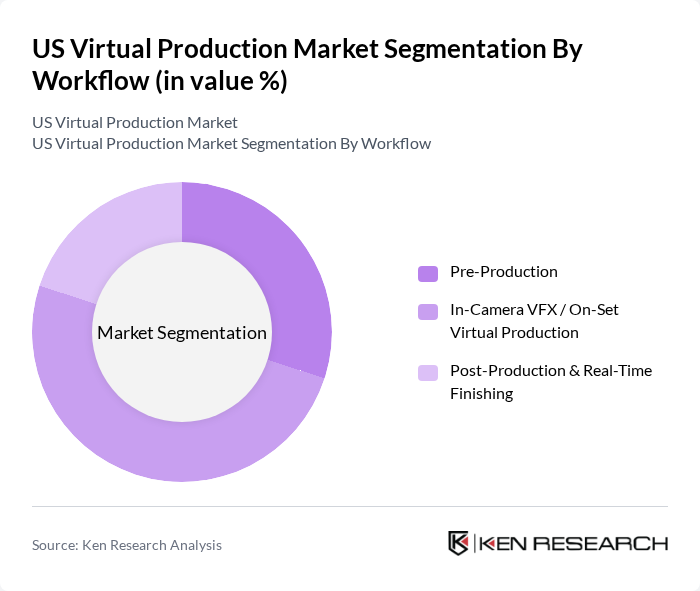
By Workflow:The workflow segmentation includes pre-production, in-camera VFX/on-set virtual production, and post-production. Pre-production involves virtual scouting and previs, while in-camera VFX focuses on real-time effects during filming. Post-production includes real-time finishing techniques that enhance the final product.
US Virtual Production Market Competitive Landscape
The US Virtual Production Market is characterized by a dynamic mix of regional and international players. Leading participants such as Industrial Light & Magic (ILM StageCraft), The Walt Disney Studios, Warner Bros. Discovery (Warner Bros. Studios Leavesden & Burbank VP), Netflix Studios (US Virtual Production Operations), Amazon MGM Studios & Amazon Studios (Virtual Production), Epic Games (Unreal Engine), NVIDIA Corporation, Unity Technologies, disguise, Mo-Sys Engineering, ROE Visual, Pixomondo, MELS Studios, Orbital Virtual Studios, Vu Technologies (Vu Studios) contribute to innovation, geographic expansion, and service delivery in this space.
US Virtual Production Market Industry Analysis
Growth Drivers
- Increasing Demand for High-Quality Content:The US entertainment industry generated approximately $720 billion in revenue, reflecting a robust appetite for high-quality content. This demand is driven by the proliferation of streaming platforms, which have increased content production budgets significantly. For instance, Netflix alone spent over $13 billion on content in recent years, emphasizing the need for innovative production techniques like virtual production to meet viewer expectations and enhance storytelling capabilities.
- Advancements in Technology and Equipment:The virtual production sector is experiencing rapid technological advancements, with the global market for virtual reality (VR) and augmented reality (AR) expected to reach $209 billion. Innovations such as LED wall technology and real-time rendering are revolutionizing production processes, allowing filmmakers to create immersive environments efficiently. Companies like Epic Games are leading this charge, providing tools that enhance creative possibilities and streamline workflows in virtual production.
- Cost Efficiency in Production Processes:Virtual production techniques can reduce costs significantly, with estimates suggesting savings of up to 30% compared to traditional methods. By minimizing location shoots and leveraging digital environments, productions can operate more efficiently. For example, the use of virtual sets can eliminate the need for extensive travel and logistics, allowing filmmakers to allocate resources more effectively, which is crucial in a competitive market where budgets are increasingly scrutinized.
Market Challenges
- High Initial Investment Costs:The upfront costs associated with virtual production technology can be prohibitive, often exceeding $1 million for advanced setups. This financial barrier limits access for smaller production companies and independent filmmakers. As a result, many traditional filmmakers may hesitate to adopt these technologies, fearing that the initial investment will not yield sufficient returns, especially in a market where profit margins are tight.
- Technical Skill Gaps in the Workforce:The rapid evolution of virtual production technologies has created a significant skills gap in the workforce. According to a recent report by the Bureau of Labor Statistics, only 15% of production professionals possess the necessary skills to operate advanced virtual production equipment. This shortage hampers the industry's ability to fully leverage the benefits of virtual production, as companies struggle to find qualified personnel to manage and execute these innovative techniques effectively.
US Virtual Production Market Future Outlook
The US virtual production market is poised for transformative growth, driven by technological advancements and an increasing focus on sustainability. As filmmakers seek innovative solutions to enhance storytelling, the integration of virtual and augmented reality will become more prevalent. Additionally, the rise of hybrid production models, combining traditional and virtual techniques, will reshape industry standards. This evolution will not only improve production efficiency but also foster collaboration across various sectors, paving the way for a more dynamic and responsive market landscape.
Market Opportunities
- Expansion into Live Event Production:Virtual production technologies are increasingly being adopted for live events, with the market for virtual events projected to reach $404 billion. This presents a significant opportunity for production companies to diversify their offerings and tap into new revenue streams, enhancing audience engagement through immersive experiences that blend physical and digital elements.
- Development of Training Programs for Professionals:As the demand for skilled professionals in virtual production grows, there is a substantial opportunity to develop targeted training programs. Investing in education and training can help bridge the skills gap, with industry leaders collaborating with educational institutions to create curricula that equip the workforce with the necessary skills to thrive in this evolving landscape.
Scope of the Report
| Segment | Sub-Segments |
|---|---|
| By Component | Hardware (LED volumes, camera tracking, motion capture, servers & storage) Software (real-time engines, 3D tools, virtual camera & asset management) Services (system integration, consulting, support & training) |
| By Workflow | Pre-Production (virtual scouting, previs, tech-vis) In-Camera VFX / On-Set Virtual Production Post-Production & Real-Time Finishing |
| By Application | Feature Films TV & Streaming Series Advertising & Branded Content Live Events, Sports & Esports Corporate, Education & Other Content |
| By Technology | LED Wall / Volume-Based Production Green Screen & Mixed Reality Stages Real-Time Rendering Engines (e.g., Unreal, Unity) Camera Tracking & Motion Capture Systems Cloud & Remote Collaboration Tools |
| By Facility Type | Dedicated Virtual Production Stages Traditional Studios with VP Capabilities Independent / Boutique VP Studios |
| By End-User | Major Film & TV Studios Streaming Platforms & OTT Content Producers Broadcast Networks & Sports Leagues Advertising Agencies & Brand Studios Game, Animation & XR Content Studios |
| By US Region | West Coast (California, Pacific) East Coast (New York, Mid-Atlantic & New England) South (Georgia, Texas & Other Southern States) Midwest Other States |
Key Target Audience
Investors and Venture Capitalist Firms
Government and Regulatory Bodies (e.g., Federal Communications Commission, National Endowment for the Arts)
Film and Television Production Companies
Virtual Reality and Augmented Reality Developers
Content Distribution Platforms
Advertising Agencies
Technology Providers and Equipment Manufacturers
Media and Entertainment Industry Associations
Players Mentioned in the Report:
Industrial Light & Magic (ILM StageCraft)
The Walt Disney Studios
Warner Bros. Discovery (Warner Bros. Studios Leavesden & Burbank VP)
Netflix Studios (US Virtual Production Operations)
Amazon MGM Studios & Amazon Studios (Virtual Production)
Epic Games (Unreal Engine)
NVIDIA Corporation
Unity Technologies
disguise
Mo-Sys Engineering
ROE Visual
Pixomondo
MELS Studios
Orbital Virtual Studios
Vu Technologies (Vu Studios)
Table of Contents
Market Assessment Phase
1. Executive Summary and Approach
2. US Virtual Production Market Overview
2.1 Key Insights and Strategic Recommendations
2.2 US Virtual Production Market Overview
2.3 Definition and Scope
2.4 Evolution of Market Ecosystem
2.5 Timeline of Key Regulatory Milestones
2.6 Value Chain & Stakeholder Mapping
2.7 Business Cycle Analysis
2.8 Policy & Incentive Landscape
3. US Virtual Production Market Analysis
3.1 Growth Drivers
3.1.1 Increasing Demand for High-Quality Content
3.1.2 Advancements in Technology and Equipment
3.1.3 Cost Efficiency in Production Processes
3.1.4 Rise of Remote Collaboration Tools
3.2 Market Challenges
3.2.1 High Initial Investment Costs
3.2.2 Limited Awareness Among Traditional Filmmakers
3.2.3 Technical Skill Gaps in the Workforce
3.2.4 Rapidly Evolving Technology Landscape
3.3 Market Opportunities
3.3.1 Expansion into Live Event Production
3.3.2 Integration with Augmented and Virtual Reality
3.3.3 Partnerships with Streaming Services
3.3.4 Development of Training Programs for Professionals
3.4 Market Trends
3.4.1 Increased Use of Real-Time Rendering
3.4.2 Growth of Hybrid Production Models
3.4.3 Adoption of Cloud-Based Solutions
3.4.4 Focus on Sustainability in Production Practices
3.5 Government Regulation
3.5.1 Tax Incentives for Film Production
3.5.2 Regulations on Data Privacy and Security
3.5.3 Compliance with Labor Laws in Production
3.5.4 Environmental Regulations for Production Sites
4. SWOT Analysis
5. Stakeholder Analysis
6. Porter's Five Forces Analysis
7. US Virtual Production Market Market Size, 2019-2024
7.1 By Value
7.2 By Volume
7.3 By Average Selling Price
8. US Virtual Production Market Segmentation
8.1 By Component
8.1.1 Hardware (LED volumes, camera tracking, motion capture, servers & storage)
8.1.2 Software (real-time engines, 3D tools, virtual camera & asset management)
8.1.3 Services (system integration, consulting, support & training)
8.2 By Workflow
8.2.1 Pre-Production (virtual scouting, previs, tech-vis)
8.2.2 In-Camera VFX / On-Set Virtual Production
8.2.3 Post-Production & Real-Time Finishing
8.3 By Application
8.3.1 Feature Films
8.3.2 TV & Streaming Series
8.3.3 Advertising & Branded Content
8.3.4 Live Events, Sports & Esports
8.3.5 Corporate, Education & Other Content
8.4 By Technology
8.4.1 LED Wall / Volume-Based Production
8.4.2 Green Screen & Mixed Reality Stages
8.4.3 Real-Time Rendering Engines (e.g., Unreal, Unity)
8.4.4 Camera Tracking & Motion Capture Systems
8.4.5 Cloud & Remote Collaboration Tools
8.5 By Facility Type
8.5.1 Dedicated Virtual Production Stages
8.5.2 Traditional Studios with VP Capabilities
8.5.3 Independent / Boutique VP Studios
8.6 By End-User
8.6.1 Major Film & TV Studios
8.6.2 Streaming Platforms & OTT Content Producers
8.6.3 Broadcast Networks & Sports Leagues
8.6.4 Advertising Agencies & Brand Studios
8.6.5 Game, Animation & XR Content Studios
8.7 By US Region
8.7.1 West Coast (California, Pacific)
8.7.2 East Coast (New York, Mid-Atlantic & New England)
8.7.3 South (Georgia, Texas & Other Southern States)
8.7.4 Midwest
8.7.5 Other States
9. US Virtual Production Market Competitive Analysis
9.1 Market Share of Key Players
9.2 Cross Comparison of Key Players
9.2.1 Company Name
9.2.2 Primary Offering (studio, hardware, software, services)
9.2.3 Installed LED Volume Capacity in the US (sqm / number of stages)
9.2.4 Number of US Virtual Production Facilities / Locations
9.2.5 US Virtual Production Revenue
9.2.6 US Revenue CAGR (Last 3 Years)
9.2.7 Average Stage Utilization Rate (%)
9.2.8 Average Project Size (Budget per Engagement)
9.2.9 Number of High-Profile Productions (Film/TV/Advertising) Served
9.2.10 Strategic Partnerships & Studio Alliances in the US
9.3 SWOT Analysis of Top Players
9.4 Pricing Analysis
9.5 Detailed Profile of Major Companies
9.5.1 Industrial Light & Magic (ILM StageCraft)
9.5.2 The Walt Disney Studios
9.5.3 Warner Bros. Discovery (Warner Bros. Studios Leavesden & Burbank VP)
9.5.4 Netflix Studios (US Virtual Production Operations)
9.5.5 Amazon MGM Studios & Amazon Studios (Virtual Production)
9.5.6 Epic Games (Unreal Engine)
9.5.7 NVIDIA Corporation
9.5.8 Unity Technologies
9.5.9 disguise
9.5.10 Mo-Sys Engineering
9.5.11 ROE Visual
9.5.12 Pixomondo
9.5.13 MELS Studios
9.5.14 Orbital Virtual Studios
9.5.15 Vu Technologies (Vu Studios)
10. US Virtual Production Market End-User Analysis
10.1 Procurement Behavior of Key Ministries
10.1.1 Government Film Commissions
10.1.2 Department of Education
10.1.3 Department of Defense
10.1.4 Others
10.2 Corporate Spend on Infrastructure & Energy
10.2.1 Film Studios
10.2.2 Production Companies
10.2.3 Streaming Platforms
10.2.4 Others
10.3 Pain Point Analysis by End-User Category
10.3.1 Budget Constraints
10.3.2 Technical Limitations
10.3.3 Time Constraints
10.3.4 Others
10.4 User Readiness for Adoption
10.4.1 Training and Skill Development
10.4.2 Technology Familiarity
10.4.3 Infrastructure Availability
10.4.4 Others
10.5 Post-Deployment ROI and Use Case Expansion
10.5.1 Performance Metrics
10.5.2 User Feedback
10.5.3 Scalability Potential
10.5.4 Others
11. US Virtual Production Market Future Size, 2025-2030
11.1 By Value
11.2 By Volume
11.3 By Average Selling Price
Go-To-Market Strategy Phase
1. Whitespace Analysis + Business Model Canvas
1.1 Market Gaps Identification
1.2 Business Model Development
2. Marketing and Positioning Recommendations
2.1 Branding Strategies
2.2 Product USPs
3. Distribution Plan
3.1 Urban Retail vs Rural NGO Tie-ups
4. Channel & Pricing Gaps
4.1 Underserved Routes
4.2 Pricing Bands
5. Unmet Demand & Latent Needs
5.1 Category Gaps
5.2 Consumer Segments
6. Customer Relationship
6.1 Loyalty Programs
6.2 After-Sales Service
7. Value Proposition
7.1 Sustainability
7.2 Integrated Supply Chains
8. Key Activities
8.1 Regulatory Compliance
8.2 Branding
8.3 Distribution Setup
9. Entry Strategy Evaluation
9.1 Domestic Market Entry Strategy
9.1.1 Product Mix
9.1.2 Pricing Band
9.1.3 Packaging
9.2 Export Entry Strategy
9.2.1 Target Countries
9.2.2 Compliance Roadmap
10. Entry Mode Assessment
10.1 JV
10.2 Greenfield
10.3 M&A
10.4 Distributor Model
11. Capital and Timeline Estimation
11.1 Capital Requirements
11.2 Timelines
12. Control vs Risk Trade-Off
12.1 Ownership vs Partnerships
13. Profitability Outlook
13.1 Breakeven Analysis
13.2 Long-Term Sustainability
14. Potential Partner List
14.1 Distributors
14.2 JVs
14.3 Acquisition Targets
15. Execution Roadmap
15.1 Phased Plan for Market Entry
15.1.1 Market Setup
15.1.2 Market Entry
15.1.3 Growth Acceleration
15.1.4 Scale & Stabilize
15.2 Key Activities and Milestones
15.2.1 Activity Timeline
15.2.2 Milestone Tracking
Research Methodology
Phase 1: Approach1
Desk Research
- Analysis of industry reports from leading market research firms focusing on virtual production trends
- Review of white papers and case studies published by technology providers in the virtual production space
- Examination of regulatory frameworks and government initiatives supporting virtual production in the US
Primary Research
- Interviews with directors and producers from major film and television studios utilizing virtual production
- Surveys with technology vendors providing virtual production tools and services
- Field interviews with production designers and cinematographers experienced in virtual environments
Validation & Triangulation
- Cross-validation of findings through multiple industry reports and expert opinions
- Triangulation of data from interviews, surveys, and secondary research sources
- Sanity checks conducted through expert panel discussions and feedback sessions
Phase 2: Market Size Estimation1
Top-down Assessment
- Estimation of market size based on overall film and television production budgets in the US
- Segmentation of the market by application areas such as film, television, and gaming
- Incorporation of growth rates from emerging technologies like AR and VR in production
Bottom-up Modeling
- Collection of data on spending patterns from key virtual production studios and production houses
- Operational cost analysis based on equipment and software pricing for virtual production
- Volume x cost calculations for various production projects utilizing virtual environments
Forecasting & Scenario Analysis
- Multi-factor regression analysis incorporating trends in content consumption and technological advancements
- Scenario modeling based on potential shifts in consumer behavior and production methodologies
- Development of baseline, optimistic, and pessimistic forecasts through 2030
Phase 3: CATI Sample Composition1
| Scope Item/Segment | Sample Size | Target Respondent Profiles |
|---|---|---|
| Film Production Studios | 100 | Producers, Directors, Production Managers |
| Television Networks | 80 | Content Executives, Technical Directors |
| Gaming Companies | 70 | Game Developers, Art Directors |
| Virtual Production Technology Providers | 60 | Product Managers, Sales Executives |
| Post-Production Houses | 90 | Editors, Visual Effects Supervisors |
Frequently Asked Questions
What is the current value of the US Virtual Production Market?
The US Virtual Production Market is valued at approximately USD 1 billion, driven by technological advancements and the increasing demand for high-quality visual content across film, television, and advertising sectors.
What are the key drivers of growth in the US Virtual Production Market?
Which cities are leading in the US Virtual Production Market?
What incentives are available for virtual production in the US?
Other Regional/Country Reports
Indonesia Virtual Production Market
Malaysia Virtual Production Market
KSA Virtual Production Market
Other Adjacent Reports
KSA Visual Effects Market
APAC augmented reality market Size, Share, Growth Drivers, Trends, Opportunities & Forecast 2025–2030Global Virtual Reality MarketKuwait Film Production Market
Brazil Television Production Market
Mexico LED Display Market
Japan Real-Time Rendering Market
Philippines Motion Capture Market
Germany Streaming Services Market
UAE Game Development MarketWhy Buy From Us?

What makes us stand out is that our consultants follow Robust, Refine and Result (RRR) methodology. Robust for clear definitions, approaches and sanity checking, Refine for differentiating respondents' facts and opinions, and Result for presenting data with story.

We have set a benchmark in the industry by offering our clients with syndicated and customized market research reports featuring coverage of entire market as well as meticulous research and analyst insights.

While we don't replace traditional research, we flip the method upside down. Our dual approach of Top Bottom & Bottom Top ensures quality deliverable by not just verifying company fundamentals but also looking at the sector and macroeconomic factors.

With one step in the future, our research team constantly tries to show you the bigger picture. We help with some of the tough questions you may encounter along the way: How is the industry positioned? Best marketing channel? KPI's of competitors? By aligning every element, we help maximize success.

Our report gives you instant access to the answers and sources that other companies might choose to hide. We elaborate each steps of research methodology we have used and showcase you the sample size to earn your trust.

If you need any support, we are here! We pride ourselves on universe strength, data quality, and quick, friendly, and professional service.