Vietnam agricultural microbials market report Size, Share, Growth Drivers, Trends, Opportunities & Forecast 2025–2030

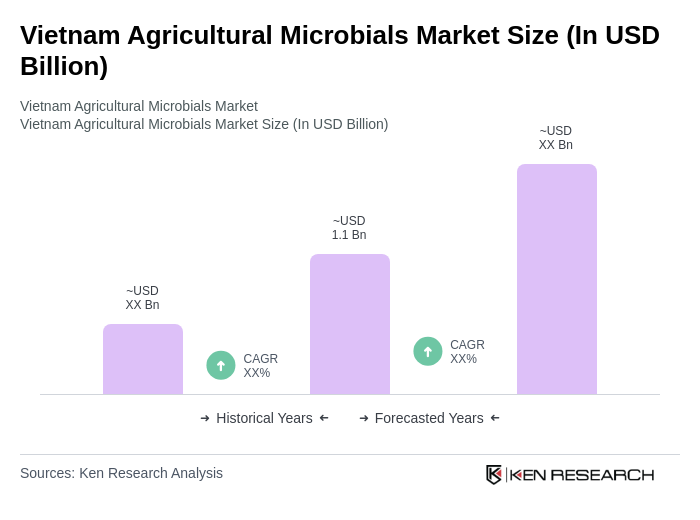
The Vietnam Agricultural Microbials Market, valued at USD 1.1 billion, is growing due to rising organic farming and government support for sustainable agriculture.

Region:Asia

Author(s):Rebecca

Product Code:KRAC4701

Pages:87

Published On:October 2025
About the Report

Base Year 2024

Vietnam Agricultural Microbials Market Overview

  • The Vietnam Agricultural Microbials Market is valued at USD 1.1 billion, based on a five-year historical analysis. This growth is primarily driven by the increasing adoption of sustainable agricultural practices, rising awareness of organic farming, and the need for effective pest management solutions. The market has seen a significant shift towards biological products as farmers seek alternatives to chemical fertilizers and pesticides, aligning with global trends in environmental sustainability .
  • Key players in this market include Ho Chi Minh City, Hanoi, and Da Nang, which dominate due to their robust agricultural infrastructure, research institutions, and access to technology. These cities are pivotal in fostering innovation and collaboration among agricultural stakeholders, including farmers, researchers, and companies, thereby enhancing the overall growth of the agricultural microbials sector .
  • In 2023, the Vietnamese government implemented Circular No. 10/2023/TT-BNNPTNT issued by the Ministry of Agriculture and Rural Development. This regulation mandates that all bio-pesticides and bio-fertilizers used in agriculture must comply with specific environmental and safety standards, including registration, labeling, and quality control requirements. The regulation aims to promote the use of biological inputs, encourage sustainable practices, and reduce the environmental impact of agriculture in Vietnam .
Vietnam Agricultural Microbials Market Size

Vietnam Agricultural Microbials Market Segmentation

By Microorganism Type:This segmentation includes various types of microorganisms used in agricultural applications. The subsegments are Bacterial Microbials, Fungal Microbials, Viral Microbials, Protozoan Microbials, and Others. Among these, Bacterial Microbials are leading the market due to their effectiveness in promoting plant growth and enhancing soil fertility. The increasing demand for organic farming practices has further propelled the use of bacterial products, making them a preferred choice among farmers .
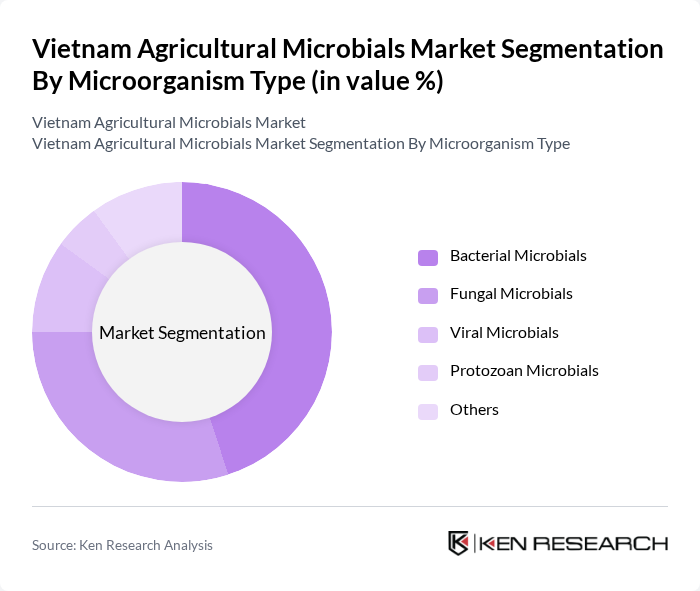
Vietnam Agricultural Microbials Market segmentation by Microorganism Type.

By Product Functionality:This segmentation focuses on the primary functions of agricultural microbials, which include Crop Protection and Soil Amendment. Crop Protection products are dominating the market as they provide effective solutions for pest and disease management, which is crucial for maintaining crop yields. The increasing prevalence of pests and diseases in Vietnam's agricultural landscape has led to a higher adoption of these products among farmers .
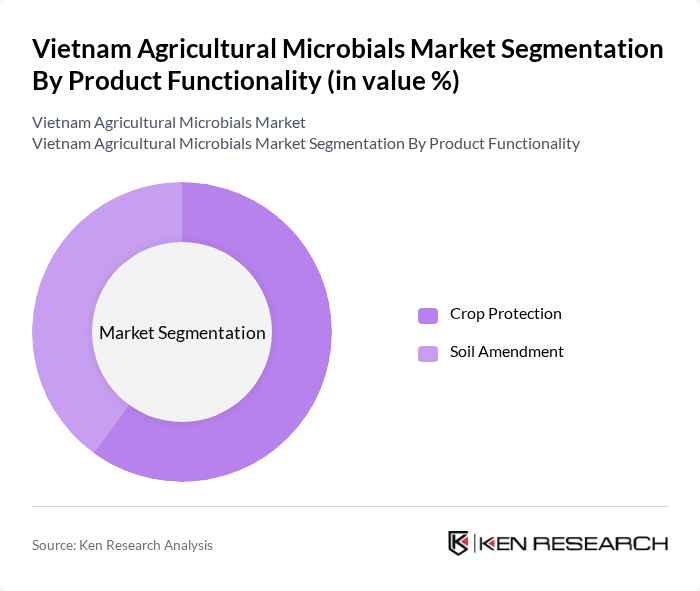
Vietnam Agricultural Microbials Market segmentation by Product Functionality.

Vietnam Agricultural Microbials Market Competitive Landscape

The Vietnam Agricultural Microbials Market is characterized by a dynamic mix of regional and international players. Leading participants such as Novozymes A/S, BASF SE, Syngenta AG, Bayer AG, BioWorks, Inc., AgBiome, Inc., Marrone Bio Innovations, Inc., Certis Biologicals, Koppert Biological Systems, Biobest Group NV, T. Stanes & Company Limited, Agtiv Inc. (Premier Tech), DAI THANH JOINT STOCK COMPANY, Biotech Bio-Agriculture, Suståne Natural Fertilizer Inc. contribute to innovation, geographic expansion, and service delivery in this space.

Novozymes A/S

1925

Bagsværd, Denmark

BASF SE

1865

Ludwigshafen, Germany

Syngenta AG

2000

Basel, Switzerland

Bayer AG

1863

Leverkusen, Germany

BioWorks, Inc.

1993

Victor, New York, USA

Company

Establishment Year

Headquarters

Group Size (Large, Medium, or Small as per industry convention)

Revenue Growth Rate (Vietnam agricultural microbials segment)

Market Penetration Rate (Vietnam, % of addressable market reached)

Customer Retention Rate (year-over-year %)

Product Portfolio Breadth (number of microbial SKUs offered)

Average Selling Price per Unit (VND or USD)

Vietnam Agricultural Microbials Market Industry Analysis

Growth Drivers

  • Increasing Demand for Organic Farming:The organic farming sector in Vietnam has seen a significant rise, with the area under organic cultivation reaching approximately 174,351 hectares in future. This growth is driven by a consumer shift towards healthier food options, with organic produce sales projected to exceed 1.5 trillion VND (approximately $53 million) in future. This trend is fostering a greater reliance on agricultural microbials, which enhance soil health and crop yield without synthetic chemicals.
  • Government Support for Sustainable Agriculture:The Vietnamese government has allocated over 2 trillion VND (around $85 million) in future to promote sustainable agricultural practices. This funding supports research and development of microbial products, aiming to reduce chemical fertilizer usage by 30% in future. Such initiatives are crucial for enhancing the adoption of agricultural microbials, as they align with national goals for environmental sustainability and food security.
  • Rising Awareness of Soil Health:In future, approximately 60% of Vietnamese farmers are expected to recognize the importance of soil health, up from 45% in previous periods. This increasing awareness is leading to a shift in farming practices, with more farmers seeking microbial solutions to improve soil fertility and crop resilience. The emphasis on soil health is supported by educational programs and workshops, which are projected to reach over 100,000 farmers nationwide in future.

Market Challenges

  • Limited Awareness Among Farmers:Despite the benefits of agricultural microbials, around 40% of farmers in Vietnam remain unaware of these products. This lack of knowledge hinders adoption rates, particularly in rural areas where traditional farming practices dominate. Efforts to educate farmers about the advantages of microbial solutions are essential, as they can significantly improve crop yields and soil health, ultimately impacting food production.
  • Regulatory Hurdles in Product Approval:The approval process for microbial products in Vietnam can take up to 18 months, creating significant delays in market entry. In future, only a limited number of new microbial products received government approval, limiting the variety available to farmers. Streamlining the regulatory framework is crucial to encourage innovation and ensure that effective microbial solutions reach the market in a timely manner.

Vietnam Agricultural Microbials Market Future Outlook

The future of the Vietnam agricultural microbials market appears promising, driven by increasing consumer demand for organic products and government initiatives supporting sustainable practices. As farmers become more educated about the benefits of microbial solutions, adoption rates are expected to rise. Additionally, advancements in technology and research will likely lead to more effective microbial products, enhancing their appeal. The integration of digital tools in agriculture will further facilitate the adoption of these innovative solutions, ensuring a more sustainable agricultural landscape.

Market Opportunities

  • Expansion into Untapped Rural Markets:With over 61% of Vietnam's population residing in rural areas, there is a significant opportunity to introduce agricultural microbials. Targeting these regions can enhance crop productivity and soil health, potentially increasing farmers' incomes by up to 20% through improved yields and reduced chemical dependency.
  • Development of Customized Microbial Solutions:The demand for tailored microbial products is on the rise, as farmers seek solutions that address specific soil and crop needs. Developing customized formulations can lead to higher effectiveness and satisfaction, potentially capturing a market share of 15% in future, as farmers increasingly prioritize personalized agricultural inputs.

Scope of the Report

SegmentSub-Segments
By Microorganism Type

Bacterial Microbials

Fungal Microbials

Viral Microbials

Protozoan Microbials

Others

By Product Functionality

Crop Protection

Soil Amendment

By Formulation

Liquid Formulation

Dry Formulation

By Mode of Application

Foliar Spray

Soil Treatment

Seed Treatment

Others

By Crop Type

Cereals & Grains

Oilseeds & Pulses

Fruits & Vegetables

Other Crops

By End-User

Crop Producers

Greenhouse Operators

Organic Farmers

Others

By Distribution Channel

Direct Sales

Retail Outlets

Online Sales

Others

By Region

Northern Vietnam

Central Vietnam

Southern Vietnam

Others

By Packaging Type

Bulk Packaging

Retail Packaging

Custom Packaging

By Price Range

Low Price

Mid Price

High Price

Key Target Audience

Investors and Venture Capitalist Firms

Government and Regulatory Bodies (e.g., Ministry of Agriculture and Rural Development, Vietnam Plant Protection Department)

Manufacturers and Producers of Agricultural Microbials

Distributors and Retailers of Agricultural Inputs

Agrochemical Companies

Biotechnology Firms

Industry Associations (e.g., Vietnam Crop Production Association)

Financial Institutions and Banks with Agricultural Investment Divisions

Players Mentioned in the Report:

Novozymes A/S

BASF SE

Syngenta AG

Bayer AG

BioWorks, Inc.

AgBiome, Inc.

Marrone Bio Innovations, Inc.

Certis Biologicals

Koppert Biological Systems

Biobest Group NV

T. Stanes & Company Limited

Agtiv Inc. (Premier Tech)

DAI THANH JOINT STOCK COMPANY

Biotech Bio-Agriculture

Sustane Natural Fertilizer Inc.

Table of Contents

Market Assessment Phase

1. Executive Summary and Approach


2. Vietnam Agricultural Microbials Market Overview

2.1 Key Insights and Strategic Recommendations

2.2 Vietnam Agricultural Microbials Market Overview

2.3 Definition and Scope

2.4 Evolution of Market Ecosystem

2.5 Timeline of Key Regulatory Milestones

2.6 Value Chain & Stakeholder Mapping

2.7 Business Cycle Analysis

2.8 Policy & Incentive Landscape


3. Vietnam Agricultural Microbials Market Analysis

3.1 Growth Drivers

3.1.1 Increasing demand for organic farming
3.1.2 Government support for sustainable agriculture
3.1.3 Rising awareness of soil health
3.1.4 Technological advancements in microbial products

3.2 Market Challenges

3.2.1 Limited awareness among farmers
3.2.2 Regulatory hurdles in product approval
3.2.3 Competition from synthetic fertilizers
3.2.4 Variability in product effectiveness

3.3 Market Opportunities

3.3.1 Expansion into untapped rural markets
3.3.2 Development of customized microbial solutions
3.3.3 Partnerships with agricultural cooperatives
3.3.4 Increasing export potential of microbial products

3.4 Market Trends

3.4.1 Shift towards bio-based agricultural inputs
3.4.2 Growth in precision agriculture practices
3.4.3 Rising investment in agricultural R&D
3.4.4 Integration of digital technologies in farming

3.5 Government Regulation

3.5.1 Standards for microbial product registration
3.5.2 Guidelines for organic certification
3.5.3 Policies promoting sustainable agriculture
3.5.4 Restrictions on synthetic chemical use

4. SWOT Analysis


5. Stakeholder Analysis


6. Porter's Five Forces Analysis


7. Vietnam Agricultural Microbials Market Market Size, 2019-2024

7.1 By Value

7.2 By Volume

7.3 By Average Selling Price


8. Vietnam Agricultural Microbials Market Segmentation

8.1 By Microorganism Type

8.1.1 Bacterial Microbials
8.1.2 Fungal Microbials
8.1.3 Viral Microbials
8.1.4 Protozoan Microbials
8.1.5 Others

8.2 By Product Functionality

8.2.1 Crop Protection
8.2.2 Soil Amendment

8.3 By Formulation

8.3.1 Liquid Formulation
8.3.2 Dry Formulation

8.4 By Mode of Application

8.4.1 Foliar Spray
8.4.2 Soil Treatment
8.4.3 Seed Treatment
8.4.4 Others

8.5 By Crop Type

8.5.1 Cereals & Grains
8.5.2 Oilseeds & Pulses
8.5.3 Fruits & Vegetables
8.5.4 Other Crops

8.6 By End-User

8.6.1 Crop Producers
8.6.2 Greenhouse Operators
8.6.3 Organic Farmers
8.6.4 Others

8.7 By Distribution Channel

8.7.1 Direct Sales
8.7.2 Retail Outlets
8.7.3 Online Sales
8.7.4 Others

8.8 By Region

8.8.1 Northern Vietnam
8.8.2 Central Vietnam
8.8.3 Southern Vietnam
8.8.4 Others

8.9 By Packaging Type

8.9.1 Bulk Packaging
8.9.2 Retail Packaging
8.9.3 Custom Packaging

8.10 By Price Range

8.10.1 Low Price
8.10.2 Mid Price
8.10.3 High Price

9. Vietnam Agricultural Microbials Market Competitive Analysis

9.1 Market Share of Key Players

9.2 KPIs for Cross Comparison of Key Players

9.2.1 Company Name
9.2.2 Group Size (Large, Medium, or Small as per industry convention)
9.2.3 Revenue Growth Rate (Vietnam agricultural microbials segment)
9.2.4 Market Penetration Rate (Vietnam, % of addressable market reached)
9.2.5 Customer Retention Rate (year-over-year %)
9.2.6 Product Portfolio Breadth (number of microbial SKUs offered)
9.2.7 Average Selling Price per Unit (VND or USD)
9.2.8 Distribution Network Coverage (number of provinces/regions served)
9.2.9 Brand Recognition Score (Vietnam, survey-based or proxy)
9.2.10 R&D Intensity (R&D spend as % of segment revenue)
9.2.11 Regulatory Compliance Track Record (number of product registrations/approvals in Vietnam)

9.3 SWOT Analysis of Top Players

9.4 Pricing Analysis

9.5 Detailed Profile of Major Companies

9.5.1 Novozymes A/S
9.5.2 BASF SE
9.5.3 Syngenta AG
9.5.4 Bayer AG
9.5.5 BioWorks, Inc.
9.5.6 AgBiome, Inc.
9.5.7 Marrone Bio Innovations, Inc.
9.5.8 Certis Biologicals
9.5.9 Koppert Biological Systems
9.5.10 Biobest Group NV
9.5.11 T. Stanes & Company Limited
9.5.12 Agtiv Inc. (Premier Tech)
9.5.13 DAI THANH JOINT STOCK COMPANY
9.5.14 Biotech Bio-Agriculture
9.5.15 Suståne Natural Fertilizer Inc.

10. Vietnam Agricultural Microbials Market End-User Analysis

10.1 Procurement Behavior of Key Ministries

10.1.1 Ministry of Agriculture and Rural Development
10.1.2 Ministry of Natural Resources and Environment
10.1.3 Ministry of Industry and Trade

10.2 Corporate Spend on Infrastructure & Energy

10.2.1 Investment in Sustainable Practices
10.2.2 Funding for Research and Development
10.2.3 Budget Allocation for Training Programs

10.3 Pain Point Analysis by End-User Category

10.3.1 Crop Yield Variability
10.3.2 Soil Degradation Issues
10.3.3 Pest and Disease Management

10.4 User Readiness for Adoption

10.4.1 Awareness of Microbial Benefits
10.4.2 Training and Support Needs
10.4.3 Financial Readiness for Investment

10.5 Post-Deployment ROI and Use Case Expansion

10.5.1 Measurement of Yield Improvements
10.5.2 Cost Savings Analysis
10.5.3 Expansion into New Crop Varieties

11. Vietnam Agricultural Microbials Market Future Size, 2025-2030

11.1 By Value

11.2 By Volume

11.3 By Average Selling Price


Go-To-Market Strategy Phase

1. Whitespace Analysis + Business Model Canvas

1.1 Market Gaps Identification

1.2 Value Proposition Development

1.3 Revenue Streams Analysis

1.4 Key Partnerships Exploration

1.5 Customer Segmentation

1.6 Cost Structure Assessment

1.7 Channels of Distribution


2. Marketing and Positioning Recommendations

2.1 Branding Strategies

2.2 Product USPs

2.3 Target Market Identification

2.4 Communication Strategy

2.5 Digital Marketing Approaches


3. Distribution Plan

3.1 Urban Retail Strategies

3.2 Rural NGO Tie-ups

3.3 E-commerce Integration

3.4 Logistics and Supply Chain Management


4. Channel & Pricing Gaps

4.1 Underserved Routes

4.2 Pricing Bands Analysis

4.3 Competitor Pricing Comparison


5. Unmet Demand & Latent Needs

5.1 Category Gaps Identification

5.2 Consumer Segments Analysis

5.3 Product Development Opportunities


6. Customer Relationship

6.1 Loyalty Programs

6.2 After-sales Service

6.3 Customer Feedback Mechanisms


7. Value Proposition

7.1 Sustainability Initiatives

7.2 Integrated Supply Chains

7.3 Community Engagement Strategies


8. Key Activities

8.1 Regulatory Compliance

8.2 Branding Efforts

8.3 Distribution Setup


9. Entry Strategy Evaluation

9.1 Domestic Market Entry Strategy

9.1.1 Product Mix Considerations
9.1.2 Pricing Band Strategy
9.1.3 Packaging Innovations

9.2 Export Entry Strategy

9.2.1 Target Countries Identification
9.2.2 Compliance Roadmap Development

10. Entry Mode Assessment

10.1 Joint Ventures

10.2 Greenfield Investments

10.3 Mergers & Acquisitions

10.4 Distributor Model Evaluation


11. Capital and Timeline Estimation

11.1 Capital Requirements

11.2 Timelines for Implementation


12. Control vs Risk Trade-Off

12.1 Ownership Considerations

12.2 Partnerships Evaluation


13. Profitability Outlook

13.1 Breakeven Analysis

13.2 Long-term Sustainability Strategies


14. Potential Partner List

14.1 Distributors

14.2 Joint Ventures

14.3 Acquisition Targets


15. Execution Roadmap

15.1 Phased Plan for Market Entry

15.1.1 Market Setup
15.1.2 Market Entry
15.1.3 Growth Acceleration
15.1.4 Scale & Stabilize

15.2 Key Activities and Milestones

15.2.1 Milestone Planning
15.2.2 Activity Tracking

Research Methodology

ApproachModellingSample

Phase 1: Approach1

Desk Research

  • Analysis of agricultural microbial product reports from the Ministry of Agriculture and Rural Development of Vietnam
  • Review of market trends and forecasts from industry publications and agricultural journals
  • Examination of import/export data and trade statistics from the General Department of Vietnam Customs

Primary Research

  • Interviews with agronomists and researchers specializing in microbial applications in agriculture
  • Surveys with distributors and retailers of agricultural microbial products
  • Field visits to farms utilizing microbial solutions to gather firsthand insights on usage and effectiveness

Validation & Triangulation

  • Cross-validation of findings through multiple data sources including government reports and industry surveys
  • Triangulation of qualitative insights from interviews with quantitative data from market reports
  • Sanity checks conducted through expert panel discussions with industry veterans

Phase 2: Market Size Estimation1

Top-down Assessment

  • Estimation of market size based on national agricultural output and microbial product penetration rates
  • Segmentation of the market by crop type and microbial product category
  • Incorporation of government initiatives promoting sustainable agriculture and microbial usage

Bottom-up Modeling

  • Collection of sales data from leading agricultural microbial manufacturers in Vietnam
  • Estimation of market share based on product volume sold across different regions
  • Analysis of pricing strategies and average selling prices of microbial products

Forecasting & Scenario Analysis

  • Development of growth projections based on historical data and emerging trends in sustainable agriculture
  • Scenario analysis considering factors such as climate change impact and regulatory changes
  • Creation of baseline, optimistic, and pessimistic forecasts through 2030

Phase 3: CATI Sample Composition1

Scope Item/SegmentSample SizeTarget Respondent Profiles
Microbial Product Distributors80Sales Managers, Distribution Coordinators
Farmers Utilizing Microbial Solutions120Crop Farmers, Agricultural Technicians
Research Institutions Focused on Agriculture60Research Scientists, Agricultural Policy Makers
Retailers of Agricultural Inputs50Store Managers, Product Buyers
Government Agricultural Agencies40Policy Analysts, Program Directors

Frequently Asked Questions

What is the current value of the Vietnam Agricultural Microbials Market?

The Vietnam Agricultural Microbials Market is valued at approximately USD 1.1 billion, reflecting a significant growth trend driven by the adoption of sustainable agricultural practices and the increasing demand for organic farming solutions.

What factors are driving the growth of the Vietnam Agricultural Microbials Market?

Which cities are key players in the Vietnam Agricultural Microbials Market?

What are the main types of microorganisms used in the Vietnam Agricultural Microbials Market?

Other Regional/Country Reports

Indonesia Agricultural Microbials Market

Malaysia Agricultural Microbials Market

KSA Agricultural Microbials Market

APAC Agricultural Microbials Market

SEA Agricultural Microbials Market

Thailand Agricultural Microbials Market

Why Buy From Us?

Refine Robust Result (RRR) Framework

What makes us stand out is that our consultants follow Robust, Refine and Result (RRR) methodology. Robust for clear definitions, approaches and sanity checking, Refine for differentiating respondents' facts and opinions, and Result for presenting data with story.

Our Reach Is Unmatched

We have set a benchmark in the industry by offering our clients with syndicated and customized market research reports featuring coverage of entire market as well as meticulous research and analyst insights.

Shifting the Research Paradigm

While we don't replace traditional research, we flip the method upside down. Our dual approach of Top Bottom & Bottom Top ensures quality deliverable by not just verifying company fundamentals but also looking at the sector and macroeconomic factors.

More Insights-Better Decisions

With one step in the future, our research team constantly tries to show you the bigger picture. We help with some of the tough questions you may encounter along the way: How is the industry positioned? Best marketing channel? KPI's of competitors? By aligning every element, we help maximize success.

Transparency and Trust

Our report gives you instant access to the answers and sources that other companies might choose to hide. We elaborate each steps of research methodology we have used and showcase you the sample size to earn your trust.

Round the Clock Support

If you need any support, we are here! We pride ourselves on universe strength, data quality, and quick, friendly, and professional service.

Why Clients Choose Us?

400000+
Reports in repository
150+
Consulting projects a year
100+
Analysts
8000+
Client Queries in 2022








