Vietnam AI in Digital Lending Risk Management Market

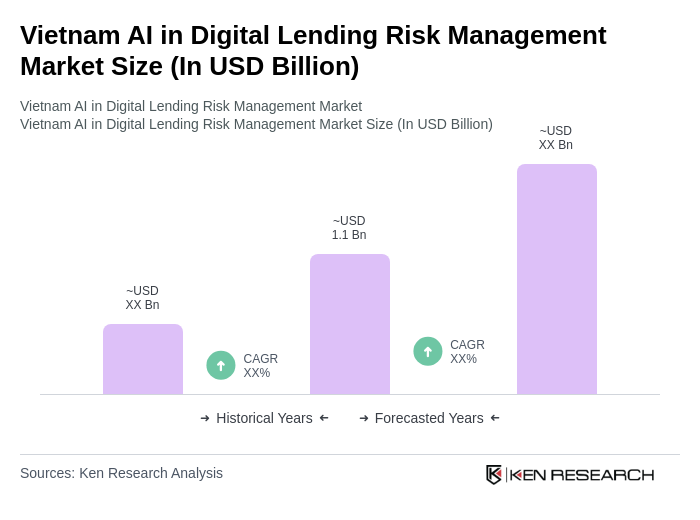
The Vietnam AI in Digital Lending Risk Management Market, valued at USD 1.1 billion, is driven by digital financial services growth, AI for risk assessment, and key hubs like Ho Chi Minh City and Hanoi.

Region:Asia

Author(s):Geetanshi

Product Code:KRAB3399

Pages:95

Published On:October 2025
About the Report

Base Year 2024

Vietnam AI in Digital Lending Risk Management Market Overview

  • The Vietnam AI in Digital Lending Risk Management Market is valued at USD 1.1 billion, based on a five-year historical analysis. This valuation aligns with the rapid digital adoption in financial services, where digital banking revenue alone is forecast to exceed USD 1 billion, and the overall AI market in finance is accelerating toward multi-billion-dollar scale . Growth is driven by increasing adoption of digital financial services, the rise of fintech companies, and the expanding need for efficient risk management solutions. The integration of AI technologies enables lenders to enhance decision-making, streamline operations, and reduce default rates, with leading banks reporting onboarding time reductions from 12 hours to under 5 minutes and up to 25% reduction in cash reserves at AI-enabled branches .
  • Key cities dominating this market include Ho Chi Minh City and Hanoi, serving as financial hubs with a high concentration of fintech startups and traditional banks. The urban population's increasing digital literacy and the government's push for a cashless economy further contribute to market growth in these regions. The presence of a young, tech-savvy demographic supports demand for innovative lending solutions, as over 80% smartphone penetration and high digital adoption rates are reported in these urban centers .
  • In 2025, the Vietnamese government enacted the Digital Technology Law (June 14, 2025, effective January 1, 2026), which introduces risk-based rules and labeling requirements for AI in financial services. The Law on Data (effective July 1, 2025) defines important data and restricts cross-border transfers, while Decree 94 launches a regulatory sandbox for fintech and AI from July 2025, allowing controlled trials for up to two years. These instruments require financial firms to document risk assessments, label AI outputs, implement human-in-the-loop controls, and comply with high-risk system standards, fostering innovation and protecting consumer rights .
Vietnam AI in Digital Lending Risk Management Market Size

Vietnam AI in Digital Lending Risk Management Market Segmentation

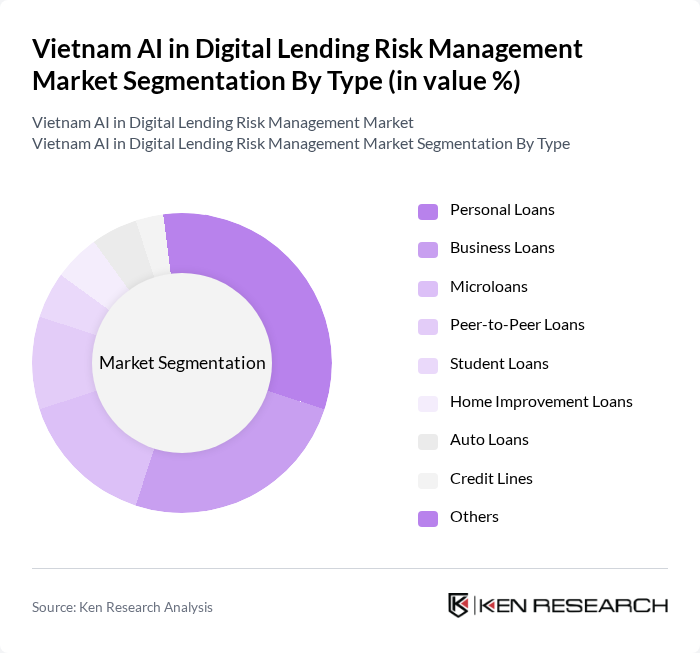
By Type:The market is segmented into various types of lending products, each catering to different consumer needs. Personal loans and business loans remain the most popular, driven by demand for quick and accessible financing. Microloans and peer-to-peer loans are gaining traction, especially among underserved populations, as AI-driven credit scoring and onboarding processes improve financial inclusion. The diversity in loan types allows lenders to target specific customer segments effectively .
Vietnam AI in Digital Lending Risk Management Market segmentation by Type.

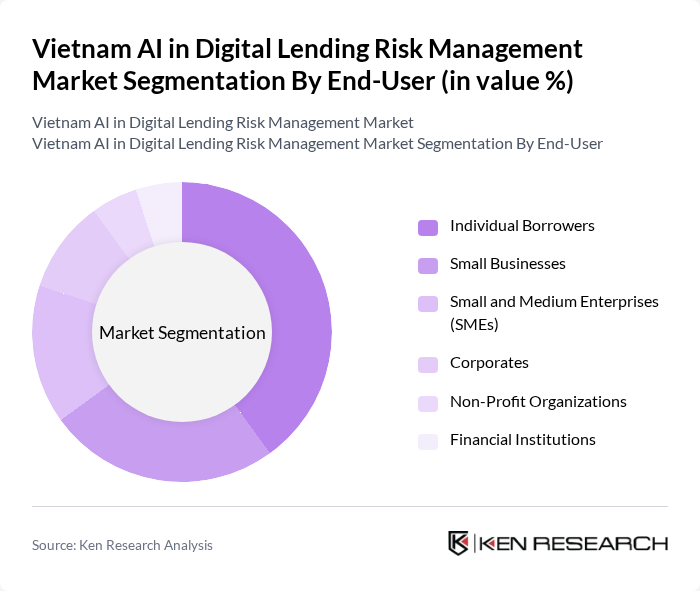
By End-User:The end-user segmentation includes individual borrowers, small businesses, SMEs, corporates, non-profit organizations, and financial institutions. Individual borrowers represent the largest share, driven by the need for personal financing and the convenience of digital onboarding. Small businesses and SMEs increasingly use digital lending platforms for fast access to capital, while corporates leverage AI-enabled services for operational efficiency and risk management. Financial institutions and non-profits also benefit from AI-driven solutions for credit assessment and fraud detection .
Vietnam AI in Digital Lending Risk Management Market segmentation by End-User.

Vietnam AI in Digital Lending Risk Management Market Competitive Landscape

The Vietnam AI in Digital Lending Risk Management Market is characterized by a dynamic mix of regional and international players. Leading participants such as MoMo, Timo, Trusting Social, VNDIRECT, VNPay, FiinGroup, ZaloPay, Home Credit Vietnam, FE Credit, BIDV, VietinBank, Techcombank, Sacombank, VPBank, Agribank, TPBank, Tima, VayMuon, Lendbiz, Finhay, Mcredit, Moca, FPT Corporation, Viettel Group, VNG Corporation contribute to innovation, geographic expansion, and service delivery in this space.

MoMo

2007

Ho Chi Minh City, Vietnam

Timo

2015

Ho Chi Minh City, Vietnam

Trusting Social

2013

Singapore

VNDIRECT

2006

Hanoi, Vietnam

VNPay

2007

Hanoi, Vietnam

Company

Establishment Year

Headquarters

Group Size (Large, Medium, or Small as per industry convention)

Customer Acquisition Cost (CAC)

Customer Retention Rate

Average Loan Processing Time (digital/AI-enabled)

Non-Performing Loan (NPL) Ratio / Default Rate

Revenue Growth Rate

Vietnam AI in Digital Lending Risk Management Market Industry Analysis

Growth Drivers

  • Increasing Demand for Automated Risk Assessment:The Vietnamese digital lending sector is witnessing a surge in demand for automated risk assessment tools, driven by the need for efficiency and accuracy. In future, the number of digital loan applications is projected to reach approximately 15 million, reflecting a significant increase from previous periods. This growth is fueled by the rising number of tech-savvy consumers, with smartphone penetration in Vietnam estimated at 73% of the population, facilitating access to digital lending platforms and enhancing the need for AI-driven risk management solutions.
  • Rising Adoption of Digital Lending Platforms:The digital lending landscape in Vietnam is rapidly evolving, with over 200 fintech companies operating in the sector. This growth is supported by a notable increase in online transactions, which reached approximately USD 15 billion. The convenience and accessibility of digital lending platforms are attracting a younger demographic, with 60% of borrowers aged between 18 and 35, further driving the demand for AI in risk management to streamline processes and enhance customer experience.
  • Enhanced Data Analytics Capabilities:The integration of advanced data analytics in Vietnam's digital lending market is transforming risk management practices. In future, the volume of data generated by digital transactions is expected to exceed 1.5 billion records monthly. This influx of data enables lenders to utilize AI algorithms for predictive analytics, improving risk assessment accuracy. As a result, financial institutions can reduce default rates by up to 15%, making data-driven decision-making a critical growth driver in the sector.

Market Challenges

  • Data Privacy Concerns:As digital lending grows, so do concerns regarding data privacy and security. In future, approximately 45% of consumers express apprehension about sharing personal information with digital lenders, primarily due to high-profile data breaches. This skepticism can hinder the adoption of AI-driven risk management solutions, as lenders must navigate stringent data protection regulations, which may require significant investments in cybersecurity measures to build consumer trust and ensure compliance.
  • High Initial Investment Costs:The implementation of AI technologies in digital lending requires substantial upfront investments. In future, the average cost for fintech companies to integrate AI solutions is estimated at USD 500,000, which can be a barrier for startups and smaller firms. This financial strain may limit innovation and slow down the adoption of advanced risk management tools, particularly in a competitive market where traditional lenders may have more resources to invest in technology.

Vietnam AI in Digital Lending Risk Management Market Future Outlook

The future of Vietnam's AI in digital lending risk management market appears promising, driven by technological advancements and increasing consumer acceptance. As the market matures, we anticipate a greater emphasis on regulatory compliance and data security, which will shape the development of innovative solutions. Additionally, the collaboration between fintech companies and traditional banks is expected to enhance service offerings, leading to more personalized lending experiences. This synergy will likely foster a more competitive landscape, benefiting consumers and driving further growth in the sector.

Market Opportunities

  • Expansion into Underserved Markets:There is a significant opportunity for digital lenders to expand into underserved regions in Vietnam, where traditional banking services are limited. Approximately 70% of the rural population lacks access to formal credit, presenting a market potential of over 10 million new borrowers. By leveraging AI-driven risk assessment tools, lenders can effectively evaluate creditworthiness and tailor products to meet the unique needs of these consumers.
  • Integration of AI with Blockchain Technology:The convergence of AI and blockchain technology presents a unique opportunity for enhancing transparency and security in digital lending. In future, the blockchain market in Vietnam is projected to reach USD 1 billion, providing a robust framework for secure transactions. This integration can streamline processes, reduce fraud, and improve trust among consumers, ultimately driving the adoption of AI in risk management solutions.

Scope of the Report

SegmentSub-Segments
By Type

Personal Loans

Business Loans

Microloans

Peer-to-Peer Loans

Student Loans

Home Improvement Loans

Auto Loans

Credit Lines

Others

By End-User

Individual Borrowers

Small Businesses

Small and Medium Enterprises (SMEs)

Corporates

Non-Profit Organizations

Financial Institutions

By Application

Risk Assessment

Credit Scoring

Fraud Detection

Loan Management

Regulatory Compliance

By Distribution Channel

Online Platforms

Mobile Applications

Direct Sales

Partnerships with Financial Institutions

By Customer Segment

Retail Customers

Corporate Clients

Institutional Clients

By Pricing Model

Fixed Rate

Variable Rate

Subscription-Based

By Regulatory Compliance

Local Regulations

International Standards

Compliance with Data Protection Laws

Key Target Audience

Investors and Venture Capitalist Firms

Government and Regulatory Bodies (e.g., State Bank of Vietnam, Ministry of Finance)

Financial Institutions

Insurance Companies

Credit Rating Agencies

Fintech Startups

Technology Providers

Industry Associations

Players Mentioned in the Report:

MoMo

Timo

Trusting Social

VNDIRECT

VNPay

FiinGroup

ZaloPay

Home Credit Vietnam

FE Credit

BIDV

VietinBank

Techcombank

Sacombank

VPBank

Agribank

TPBank

Tima

VayMuon

Lendbiz

Finhay

Mcredit

Moca

FPT Corporation

Viettel Group

VNG Corporation

Table of Contents

Market Assessment Phase

1. Executive Summary and Approach


2. Vietnam AI in Digital Lending Risk Management Market Overview

2.1 Key Insights and Strategic Recommendations

2.2 Vietnam AI in Digital Lending Risk Management Market Overview

2.3 Definition and Scope

2.4 Evolution of Market Ecosystem

2.5 Timeline of Key Regulatory Milestones

2.6 Value Chain & Stakeholder Mapping

2.7 Business Cycle Analysis

2.8 Policy & Incentive Landscape


3. Vietnam AI in Digital Lending Risk Management Market Analysis

3.1 Growth Drivers

3.1.1 Increasing demand for automated risk assessment
3.1.2 Rising adoption of digital lending platforms
3.1.3 Enhanced data analytics capabilities
3.1.4 Supportive government regulations

3.2 Market Challenges

3.2.1 Data privacy concerns
3.2.2 High initial investment costs
3.2.3 Limited technological infrastructure
3.2.4 Competition from traditional lending institutions

3.3 Market Opportunities

3.3.1 Expansion into underserved markets
3.3.2 Integration of AI with blockchain technology
3.3.3 Development of personalized lending solutions
3.3.4 Collaboration with fintech startups

3.4 Market Trends

3.4.1 Increasing use of machine learning algorithms
3.4.2 Growth of peer-to-peer lending platforms
3.4.3 Shift towards mobile lending applications
3.4.4 Focus on customer-centric lending practices

3.5 Government Regulation

3.5.1 Implementation of data protection laws
3.5.2 Guidelines for digital lending practices
3.5.3 Licensing requirements for fintech companies
3.5.4 Consumer protection regulations

4. SWOT Analysis


5. Stakeholder Analysis


6. Porter's Five Forces Analysis


7. Vietnam AI in Digital Lending Risk Management Market Market Size, 2019-2024

7.1 By Value

7.2 By Volume

7.3 By Average Selling Price


8. Vietnam AI in Digital Lending Risk Management Market Segmentation

8.1 By Type

8.1.1 Personal Loans
8.1.2 Business Loans
8.1.3 Microloans
8.1.4 Peer-to-Peer Loans
8.1.5 Student Loans
8.1.6 Home Improvement Loans
8.1.7 Auto Loans
8.1.8 Credit Lines
8.1.9 Others

8.2 By End-User

8.2.1 Individual Borrowers
8.2.2 Small Businesses
8.2.3 Small and Medium Enterprises (SMEs)
8.2.4 Corporates
8.2.5 Non-Profit Organizations
8.2.6 Financial Institutions

8.3 By Application

8.3.1 Risk Assessment
8.3.2 Credit Scoring
8.3.3 Fraud Detection
8.3.4 Loan Management
8.3.5 Regulatory Compliance

8.4 By Distribution Channel

8.4.1 Online Platforms
8.4.2 Mobile Applications
8.4.3 Direct Sales
8.4.4 Partnerships with Financial Institutions

8.5 By Customer Segment

8.5.1 Retail Customers
8.5.2 Corporate Clients
8.5.3 Institutional Clients

8.6 By Pricing Model

8.6.1 Fixed Rate
8.6.2 Variable Rate
8.6.3 Subscription-Based

8.7 By Regulatory Compliance

8.7.1 Local Regulations
8.7.2 International Standards
8.7.3 Compliance with Data Protection Laws

9. Vietnam AI in Digital Lending Risk Management Market Competitive Analysis

9.1 Market Share of Key Players

9.2 Cross Comparison of Key Players

9.2.1 Company Name
9.2.2 Group Size (Large, Medium, or Small as per industry convention)
9.2.3 Customer Acquisition Cost (CAC)
9.2.4 Customer Retention Rate
9.2.5 Average Loan Processing Time (digital/AI-enabled)
9.2.6 Non-Performing Loan (NPL) Ratio / Default Rate
9.2.7 Revenue Growth Rate
9.2.8 Market Penetration Rate (by user base or loan volume)
9.2.9 AI Model Accuracy (risk prediction, fraud detection)
9.2.10 Regulatory Compliance Score
9.2.11 Digital Adoption Rate (share of loans processed digitally)
9.2.12 Net Promoter Score (NPS)

9.3 SWOT Analysis of Top Players

9.4 Pricing Analysis

9.5 Detailed Profile of Major Companies

9.5.1 MoMo
9.5.2 Timo
9.5.3 Trusting Social
9.5.4 VNDIRECT
9.5.5 VNPay
9.5.6 FiinGroup
9.5.7 ZaloPay
9.5.8 Home Credit Vietnam
9.5.9 FE Credit
9.5.10 BIDV
9.5.11 VietinBank
9.5.12 Techcombank
9.5.13 Sacombank
9.5.14 VPBank
9.5.15 Agribank
9.5.16 TPBank
9.5.17 Tima
9.5.18 VayMuon
9.5.19 Lendbiz
9.5.20 Finhay
9.5.21 Mcredit
9.5.22 Moca
9.5.23 FPT Corporation
9.5.24 Viettel Group
9.5.25 VNG Corporation

10. Vietnam AI in Digital Lending Risk Management Market End-User Analysis

10.1 Procurement Behavior of Key Ministries

10.1.1 Budget Allocation for Digital Solutions
10.1.2 Decision-Making Processes
10.1.3 Evaluation Criteria for Vendors

10.2 Corporate Spend on Infrastructure & Energy

10.2.1 Investment in Digital Transformation
10.2.2 Spending on AI Technologies
10.2.3 Budget for Risk Management Solutions

10.3 Pain Point Analysis by End-User Category

10.3.1 Challenges in Loan Approval Processes
10.3.2 Issues with Data Management
10.3.3 Need for Enhanced Customer Experience

10.4 User Readiness for Adoption

10.4.1 Awareness of AI Benefits
10.4.2 Training and Support Needs
10.4.3 Technology Infrastructure Readiness

10.5 Post-Deployment ROI and Use Case Expansion

10.5.1 Measurement of ROI Metrics
10.5.2 Potential for Scaling Solutions
10.5.3 Feedback Mechanisms for Improvement

11. Vietnam AI in Digital Lending Risk Management Market Future Size, 2025-2030

11.1 By Value

11.2 By Volume

11.3 By Average Selling Price


Go-To-Market Strategy Phase

1. Whitespace Analysis + Business Model Canvas

1.1 Identification of Market Gaps

1.2 Business Model Framework


2. Marketing and Positioning Recommendations

2.1 Branding Strategies

2.2 Product USPs


3. Distribution Plan

3.1 Urban Retail vs Rural NGO Tie-ups


4. Channel & Pricing Gaps

4.1 Underserved Routes

4.2 Pricing Bands


5. Unmet Demand & Latent Needs

5.1 Category Gaps

5.2 Consumer Segments


6. Customer Relationship

6.1 Loyalty Programs

6.2 After-sales Service


7. Value Proposition

7.1 Sustainability

7.2 Integrated Supply Chains


8. Key Activities

8.1 Regulatory Compliance

8.2 Branding

8.3 Distribution Setup


9. Entry Strategy Evaluation

9.1 Domestic Market Entry Strategy

9.1.1 Product Mix
9.1.2 Pricing Band
9.1.3 Packaging

9.2 Export Entry Strategy

9.2.1 Target Countries
9.2.2 Compliance Roadmap

10. Entry Mode Assessment

10.1 JV

10.2 Greenfield

10.3 M&A

10.4 Distributor Model


11. Capital and Timeline Estimation

11.1 Capital Requirements

11.2 Timelines


12. Control vs Risk Trade-Off

12.1 Ownership vs Partnerships


13. Profitability Outlook

13.1 Breakeven Analysis

13.2 Long-term Sustainability


14. Potential Partner List

14.1 Distributors

14.2 JVs

14.3 Acquisition Targets


15. Execution Roadmap

15.1 Phased Plan for Market Entry

15.1.1 Market Setup
15.1.2 Market Entry
15.1.3 Growth Acceleration
15.1.4 Scale & Stabilize

15.2 Key Activities and Milestones

15.2.1 Milestone Planning
15.2.2 Activity Tracking

Research Methodology

ApproachModellingSample

Phase 1: Approach1

Desk Research

  • Analysis of government reports on digital lending regulations in Vietnam
  • Review of industry publications and white papers on AI applications in financial services
  • Examination of market trends and statistics from financial institutions and fintech associations

Primary Research

  • Interviews with risk management executives at leading digital lending platforms
  • Surveys targeting data scientists and AI specialists in the financial sector
  • Focus groups with end-users to understand perceptions of AI in lending

Validation & Triangulation

  • Cross-validation of findings with insights from industry conferences and seminars
  • Triangulation of data from regulatory bodies, market reports, and expert opinions
  • Sanity checks through feedback from a panel of financial technology experts

Phase 2: Market Size Estimation1

Top-down Assessment

  • Estimation of the digital lending market size based on national financial inclusion statistics
  • Segmentation of the market by loan types and customer demographics
  • Incorporation of growth rates from fintech adoption trends in Vietnam

Bottom-up Modeling

  • Data collection on transaction volumes from major digital lending platforms
  • Cost analysis of AI implementation in risk assessment processes
  • Estimation of average loan sizes and repayment rates across different segments

Forecasting & Scenario Analysis

  • Development of predictive models based on historical lending data and AI advancements
  • Scenario planning considering regulatory changes and economic conditions
  • Projections of market growth under various adoption rates of AI technologies

Phase 3: CATI Sample Composition1

Scope Item/SegmentSample SizeTarget Respondent Profiles
Digital Lending Platforms80Risk Managers, Product Development Leads
Financial Institutions60Compliance Officers, IT Security Managers
Fintech Startups40Founders, Data Analysts
Regulatory Bodies40Policy Makers, Financial Analysts
Consumer Insights100Borrowers, Financial Literacy Advocates

Frequently Asked Questions

What is the current value of the Vietnam AI in Digital Lending Risk Management Market?

The Vietnam AI in Digital Lending Risk Management Market is valued at approximately USD 1.1 billion, reflecting significant growth driven by the rapid adoption of digital financial services and the increasing need for efficient risk management solutions.

What factors are driving the growth of AI in digital lending in Vietnam?

Which cities are leading in the Vietnam AI in Digital Lending Market?

What types of loans are most popular in Vietnam's digital lending market?

Other Regional/Country Reports

Indonesia AI in Digital Lending Risk Management Market

Malaysia AI in Digital Lending Risk Management Market

KSA AI in Digital Lending Risk Management Market

APAC AI in Digital Lending Risk Management Market

SEA AI in Digital Lending Risk Management Market

Thailand AI in Digital Lending Risk Management Market

Other Adjacent Reports

Why Buy From Us?

Refine Robust Result (RRR) Framework

What makes us stand out is that our consultants follow Robust, Refine and Result (RRR) methodology. Robust for clear definitions, approaches and sanity checking, Refine for differentiating respondents' facts and opinions, and Result for presenting data with story.

Our Reach Is Unmatched

We have set a benchmark in the industry by offering our clients with syndicated and customized market research reports featuring coverage of entire market as well as meticulous research and analyst insights.

Shifting the Research Paradigm

While we don't replace traditional research, we flip the method upside down. Our dual approach of Top Bottom & Bottom Top ensures quality deliverable by not just verifying company fundamentals but also looking at the sector and macroeconomic factors.

More Insights-Better Decisions

With one step in the future, our research team constantly tries to show you the bigger picture. We help with some of the tough questions you may encounter along the way: How is the industry positioned? Best marketing channel? KPI's of competitors? By aligning every element, we help maximize success.

Transparency and Trust

Our report gives you instant access to the answers and sources that other companies might choose to hide. We elaborate each steps of research methodology we have used and showcase you the sample size to earn your trust.

Round the Clock Support

If you need any support, we are here! We pride ourselves on universe strength, data quality, and quick, friendly, and professional service.

Why Clients Choose Us?

400000+
Reports in repository
150+
Consulting projects a year
100+
Analysts
8000+
Client Queries in 2022








