About the Report
Base Year 2024Vietnam Ambulatory Surgery Centers Market Overview
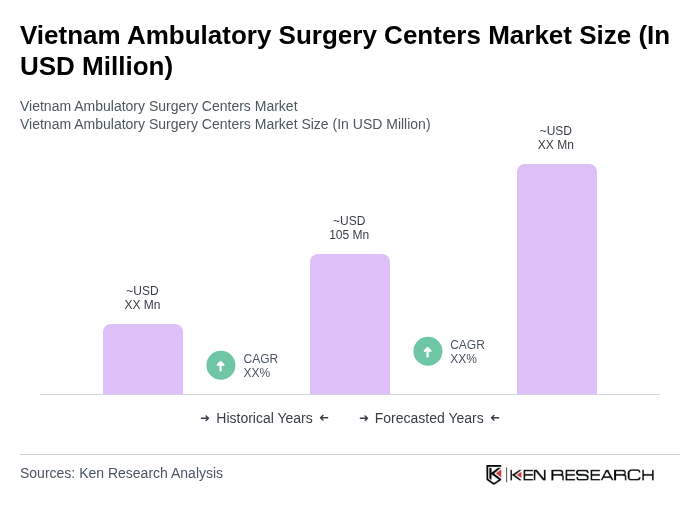
- The Vietnam Ambulatory Surgery Centers Market is valued at USD 105 million, based on a five-year historical analysis. This growth is primarily driven by the increasing demand for outpatient surgical procedures, advancements in medical technology including minimally invasive techniques, and a shift towards cost-effective healthcare solutions. The rise in chronic diseases and the aging population further contribute to the market's expansion, as more patients seek minimally invasive surgical options.
- Key cities dominating the market include Ho Chi Minh City, Hanoi, and Da Nang. These urban centers benefit from a higher concentration of healthcare facilities, advanced medical infrastructure, and a growing population that demands accessible surgical services. The presence of leading healthcare providers and a robust insurance framework in these cities also play a significant role in their market dominance.
- The Circular 43/2018/TT-BYT, 2018 issued by the Ministry of Health, governs ambulatory surgery centers by setting standards for facility licensing, equipment requirements, personnel qualifications, and infection control protocols with mandatory annual audits for facilities performing over 500 outpatient procedures annually. This regulation mandates that all facilities must adhere to strict safety and operational standards, including regular inspections and accreditation processes. The initiative is designed to improve patient outcomes and ensure that surgical procedures are performed in a safe and efficient environment.
Vietnam Ambulatory Surgery Centers Market Segmentation
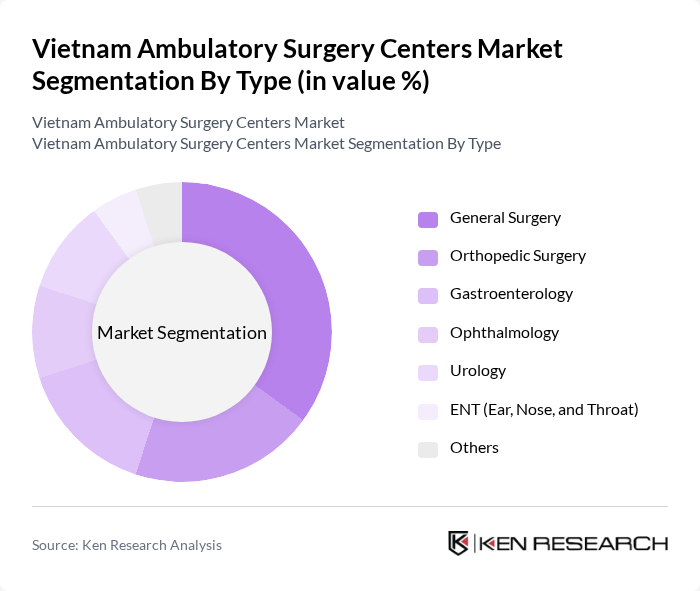
By Type:The market is segmented into various types of surgical procedures, including General Surgery, Orthopedic Surgery, Gastroenterology, Ophthalmology, Urology, ENT (Ear, Nose, and Throat), and Others. Among these, General Surgery is the leading segment due to its wide range of procedures and high patient turnover. The increasing prevalence of conditions requiring surgical intervention, coupled with advancements in surgical techniques, has driven the demand for general surgical procedures in ambulatory settings.
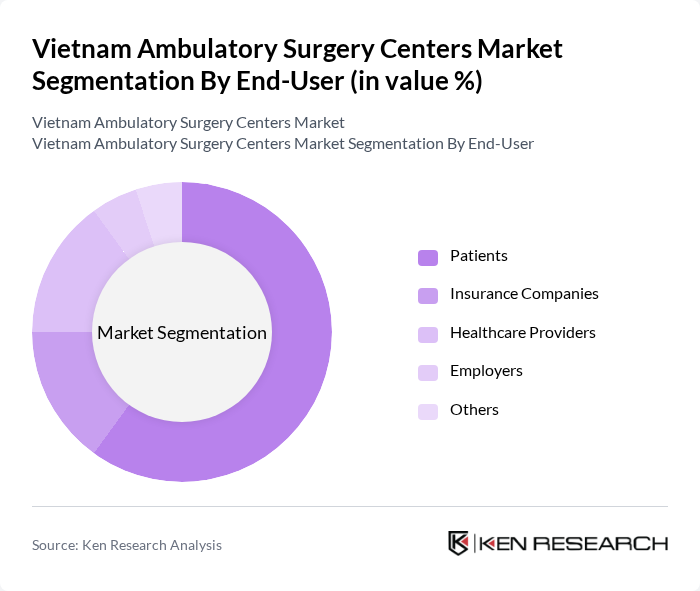
By End-User:The market is categorized based on end-users, including Private Patients, Insurance Providers, Corporate Clients, Government Health Programs, and Others. Private Patients represent the largest segment, driven by the increasing preference for outpatient services and the willingness to pay for quicker access to surgical care. The trend towards personalized healthcare and the growing number of insured individuals further bolster this segment's growth.
Vietnam Ambulatory Surgery Centers Market Competitive Landscape
The Vietnam Ambulatory Surgery Centers Market is characterized by a dynamic mix of regional and international players. Leading participants such as FV Hospital, Vinmec Healthcare System, Hoan My Medical Corporation, Hanoi French Hospital, Columbia Asia Hospital, Family Medical Practice, Saigon International Hospital, Medic Medical Center, An Sinh Hospital, Tam Duc Heart Hospital, Cho Ray Hospital, Binh Dan Hospital, Gia Dinh People's Hospital, Viet Duc University Hospital, 108 Military Central Hospital contribute to innovation, geographic expansion, and service delivery in this space.
Vietnam Ambulatory Surgery Centers Market Industry Analysis
Growth Drivers
- Increasing Demand for Outpatient Procedures:The Vietnamese healthcare system is witnessing a significant shift towards outpatient procedures, with over 70% of surgeries now performed in ambulatory settings. This trend is driven by the rising population, which is projected to reach 102 million in future, and an increasing prevalence of chronic diseases, such as diabetes and hypertension, affecting approximately 17% of the population. This growing demand is expected to enhance the operational capacity of ambulatory surgery centers (ASCs).
- Rising Healthcare Costs Driving Efficiency:Vietnam's healthcare expenditure is anticipated to reach $25 billion in future, prompting a need for cost-effective solutions. ASCs offer lower operational costs compared to traditional hospitals, with average procedure costs in ASCs being 35% lower. This efficiency is crucial as the government aims to reduce the financial burden on patients, making ASCs an attractive option for both providers and patients seeking affordable healthcare solutions.
- Technological Advancements in Surgical Procedures:The integration of advanced technologies, such as minimally invasive surgical techniques and robotic-assisted surgeries, is transforming the ASC landscape in Vietnam. In future, it is expected that 50% of surgeries will utilize these technologies, enhancing patient outcomes and reducing recovery times. This technological shift not only improves surgical precision but also attracts more patients to ASCs, further driving market growth.
Market Challenges
- Regulatory Compliance Complexities:Navigating the regulatory landscape in Vietnam poses significant challenges for ASCs. The Ministry of Health has stringent licensing requirements, with over 60% of applications facing delays due to compliance issues. This complexity can hinder the establishment and operation of new centers, limiting market expansion and increasing operational costs for existing facilities.
- Limited Awareness Among Patients:Despite the benefits of ASCs, patient awareness remains low, with only 30% of the population familiar with outpatient surgical options. This lack of awareness can lead to underutilization of ASCs, as many patients still prefer traditional hospital settings for surgeries. Educational initiatives are essential to inform patients about the advantages of ASCs, including shorter wait times and lower costs.
Vietnam Ambulatory Surgery Centers Market Future Outlook
The future of Vietnam's ambulatory surgery centers is promising, driven by increasing patient acceptance and technological advancements. As the government continues to promote private healthcare investment, ASCs are likely to expand their services and improve operational efficiencies. Additionally, the integration of telemedicine for pre and post-operative care will enhance patient experiences, while the focus on preventive healthcare will further solidify the role of ASCs in the healthcare ecosystem, ensuring sustainable growth in the coming years.
Market Opportunities
- Expansion of Insurance Coverage for Outpatient Services:With the Vietnamese government aiming to increase health insurance coverage to 95% of the population in future, ASCs stand to benefit significantly. This expansion will facilitate greater access to outpatient services, encouraging more patients to choose ASCs for their surgical needs, thus driving revenue growth.
- Partnerships with International Healthcare Providers:Collaborations with international healthcare organizations can enhance the quality of care in ASCs. In future, such partnerships are expected to improve service offerings and attract foreign investment, leading to better technology adoption and training for local staff, ultimately elevating the standard of outpatient care in Vietnam.
Scope of the Report
| Segment | Sub-Segments |
|---|---|
| By Type | General Surgery Orthopedic Surgery Gastroenterology Ophthalmology Urology ENT (Ear, Nose, and Throat) Others |
| By End-User | Private Patients Insurance Providers Corporate Clients Government Health Programs Others |
| By Patient Demographics | Age Group (Pediatric, Adult, Geriatric) Gender Socioeconomic Status Others |
| By Surgical Procedure Complexity | Simple Procedures Moderate Procedures Complex Procedures Others |
| By Geographic Distribution | Urban Areas Rural Areas Regional Distribution (North, Central, South) Others |
| By Payment Model | Fee-for-Service Capitation Bundled Payments Others |
| By Technology Utilization | Traditional Techniques Laparoscopic Techniques Robotic-Assisted Techniques Others |
Key Target Audience
Investors and Venture Capitalist Firms
Government and Regulatory Bodies (e.g., Ministry of Health, Vietnam National Health Insurance)
Healthcare Providers and Ambulatory Surgery Center Operators
Medical Equipment Manufacturers
Pharmaceutical Companies
Health Insurance Companies
Technology Providers (e.g., Telemedicine and Health IT Solutions)
Industry Associations (e.g., Vietnam Medical Association)
Players Mentioned in the Report:
FV Hospital
Vinmec Healthcare System
Hoan My Medical Corporation
Hanoi French Hospital
Columbia Asia Hospital
Family Medical Practice
Saigon International Hospital
Medic Medical Center
An Sinh Hospital
Tam Duc Heart Hospital
Cho Ray Hospital
Binh Dan Hospital
Gia Dinh People's Hospital
Viet Duc University Hospital
108 Military Central Hospital
Table of Contents
Market Assessment Phase
1. Executive Summary and Approach
2. Vietnam Ambulatory Surgery Centers Market Overview
2.1 Key Insights and Strategic Recommendations
2.2 Vietnam Ambulatory Surgery Centers Market Overview
2.3 Definition and Scope
2.4 Evolution of Market Ecosystem
2.5 Timeline of Key Regulatory Milestones
2.6 Value Chain & Stakeholder Mapping
2.7 Business Cycle Analysis
2.8 Policy & Incentive Landscape
3. Vietnam Ambulatory Surgery Centers Market Analysis
3.1 Growth Drivers
3.1.1 Increasing demand for outpatient procedures
3.1.2 Rising healthcare costs driving efficiency
3.1.3 Technological advancements in surgical procedures
3.1.4 Government initiatives to promote private healthcare
3.2 Market Challenges
3.2.1 Regulatory compliance complexities
3.2.2 Limited awareness among patients
3.2.3 Competition from traditional hospitals
3.2.4 High initial investment costs
3.3 Market Opportunities
3.3.1 Expansion of insurance coverage for outpatient services
3.3.2 Partnerships with international healthcare providers
3.3.3 Development of specialized surgical centers
3.3.4 Increasing focus on preventive healthcare
3.4 Market Trends
3.4.1 Shift towards minimally invasive surgeries
3.4.2 Growth of telemedicine in pre and post-operative care
3.4.3 Rising patient preference for outpatient care
3.4.4 Integration of AI and robotics in surgical procedures
3.5 Government Regulation
3.5.1 Licensing requirements for ambulatory surgery centers
3.5.2 Standards for patient safety and quality of care
3.5.3 Regulations on surgical procedures and equipment
3.5.4 Policies promoting private sector investment in healthcare
4. SWOT Analysis
5. Stakeholder Analysis
6. Porter's Five Forces Analysis
7. Vietnam Ambulatory Surgery Centers Market Market Size, 2019-2024
7.1 By Value
7.2 By Volume
7.3 By Average Selling Price
8. Vietnam Ambulatory Surgery Centers Market Segmentation
8.1 By Type
8.1.1 General Surgery
8.1.2 Orthopedic Surgery
8.1.3 Gastroenterology
8.1.4 Ophthalmology
8.1.5 Urology
8.1.6 ENT (Ear, Nose, and Throat)
8.1.7 Others
8.2 By End-User
8.2.1 Private Patients
8.2.2 Insurance Providers
8.2.3 Corporate Clients
8.2.4 Government Health Programs
8.2.5 Others
8.3 By Patient Demographics
8.3.1 Age Group (Pediatric, Adult, Geriatric)
8.3.2 Gender
8.3.3 Socioeconomic Status
8.3.4 Others
8.4 By Surgical Procedure Complexity
8.4.1 Simple Procedures
8.4.2 Moderate Procedures
8.4.3 Complex Procedures
8.4.4 Others
8.5 By Geographic Distribution
8.5.1 Urban Areas
8.5.2 Rural Areas
8.5.3 Regional Distribution (North, Central, South)
8.5.4 Others
8.6 By Payment Model
8.6.1 Fee-for-Service
8.6.2 Capitation
8.6.3 Bundled Payments
8.6.4 Others
8.7 By Technology Utilization
8.7.1 Traditional Techniques
8.7.2 Laparoscopic Techniques
8.7.3 Robotic-Assisted Techniques
8.7.4 Others
9. Vietnam Ambulatory Surgery Centers Market Competitive Analysis
9.1 Market Share of Key Players
9.2 Cross Comparison of Key Players
9.2.1 Company Name
9.2.2 Group Size (Large, Medium, or Small as per industry convention)
9.2.3 Patient Turnover Rate
9.2.4 Average Revenue per Procedure
9.2.5 Pricing Strategy
9.2.6 Patient Satisfaction Score
9.2.7 Operational Efficiency Ratio
9.2.8 Market Penetration Rate
9.2.9 Staff-to-Patient Ratio
9.2.10 Average Length of Stay
9.3 SWOT Analysis of Top Players
9.4 Pricing Analysis
9.5 Detailed Profile of Major Companies
9.5.1 FV Hospital
9.5.2 Vinmec Healthcare System
9.5.3 Hoan My Medical Corporation
9.5.4 Hanoi French Hospital
9.5.5 Columbia Asia Hospital
9.5.6 Family Medical Practice
9.5.7 Saigon International Hospital
9.5.8 Medic Medical Center
9.5.9 An Sinh Hospital
9.5.10 Tam Duc Heart Hospital
9.5.11 Cho Ray Hospital
9.5.12 Binh Dan Hospital
9.5.13 Gia Dinh People's Hospital
9.5.14 Viet Duc University Hospital
9.5.15 108 Military Central Hospital
10. Vietnam Ambulatory Surgery Centers Market End-User Analysis
10.1 Procurement Behavior of Key Ministries
10.1.1 Budget Allocation for Healthcare
10.1.2 Decision-Making Processes
10.1.3 Evaluation Criteria for Service Providers
10.1.4 Others
10.2 Corporate Spend on Infrastructure & Energy
10.2.1 Investment Trends in Healthcare Infrastructure
10.2.2 Energy Efficiency Initiatives
10.2.3 Budgeting for Surgical Equipment
10.2.4 Others
10.3 Pain Point Analysis by End-User Category
10.3.1 Access to Quality Care
10.3.2 Affordability of Services
10.3.3 Availability of Specialized Procedures
10.3.4 Others
10.4 User Readiness for Adoption
10.4.1 Awareness of Ambulatory Surgery Benefits
10.4.2 Trust in Outpatient Facilities
10.4.3 Financial Preparedness
10.4.4 Others
10.5 Post-Deployment ROI and Use Case Expansion
10.5.1 Measurement of Surgical Outcomes
10.5.2 Patient Follow-Up and Satisfaction
10.5.3 Expansion of Services Offered
10.5.4 Others
11. Vietnam Ambulatory Surgery Centers Market Future Size, 2025-2030
11.1 By Value
11.2 By Volume
11.3 By Average Selling Price
Go-To-Market Strategy Phase
1. Whitespace Analysis + Business Model Canvas
1.1 Market Gaps Identification
1.2 Business Model Development
1.3 Value Proposition Articulation
1.4 Revenue Streams Analysis
1.5 Cost Structure Evaluation
1.6 Key Partnerships Identification
1.7 Customer Segmentation
2. Marketing and Positioning Recommendations
2.1 Branding Strategies
2.2 Product USPs
2.3 Target Market Identification
2.4 Communication Strategy
2.5 Digital Marketing Approach
2.6 Customer Engagement Tactics
2.7 Performance Metrics
3. Distribution Plan
3.1 Urban Retail Strategies
3.2 Rural NGO Tie-Ups
3.3 Direct Sales Channels
3.4 Online Distribution Channels
3.5 Partnership with Healthcare Providers
3.6 Logistics and Supply Chain Management
3.7 Performance Evaluation
4. Channel & Pricing Gaps
4.1 Underserved Routes
4.2 Pricing Bands Analysis
4.3 Competitor Pricing Comparison
4.4 Customer Willingness to Pay
4.5 Value-Based Pricing Strategies
4.6 Discount and Promotion Strategies
4.7 Pricing Strategy Evaluation
5. Unmet Demand & Latent Needs
5.1 Category Gaps Identification
5.2 Consumer Segments Analysis
5.3 Emerging Trends and Needs
5.4 Service Expansion Opportunities
5.5 Customer Feedback Mechanisms
5.6 Market Research Insights
5.7 Future Demand Projections
6. Customer Relationship
6.1 Loyalty Programs
6.2 After-Sales Service
6.3 Customer Feedback and Improvement
6.4 Engagement Strategies
6.5 Retention Strategies
6.6 Customer Education Initiatives
6.7 Performance Metrics
7. Value Proposition
7.1 Sustainability Initiatives
7.2 Integrated Supply Chains
7.3 Unique Selling Points
7.4 Customer-Centric Approach
7.5 Competitive Advantage Analysis
7.6 Value Delivery Mechanisms
7.7 Performance Metrics
8. Key Activities
8.1 Regulatory Compliance
8.2 Branding Initiatives
8.3 Distribution Setup
8.4 Training and Development
8.5 Quality Assurance Processes
8.6 Performance Monitoring
8.7 Continuous Improvement Strategies
9. Entry Strategy Evaluation
9.1 Domestic Market Entry Strategy
9.1.1 Product Mix
9.1.2 Pricing Band
9.1.3 Packaging
9.2 Export Entry Strategy
9.2.1 Target Countries
9.2.2 Compliance Roadmap
10. Entry Mode Assessment
10.1 Joint Ventures
10.2 Greenfield Investments
10.3 Mergers & Acquisitions
10.4 Distributor Model
10.5 Risk Assessment
10.6 Strategic Fit Evaluation
10.7 Performance Metrics
11. Capital and Timeline Estimation
11.1 Capital Requirements
11.2 Timelines for Implementation
11.3 Financial Projections
11.4 Funding Sources
11.5 Risk Management Strategies
11.6 Performance Metrics
12. Control vs Risk Trade-Off
12.1 Ownership vs Partnerships
12.2 Risk Mitigation Strategies
12.3 Control Mechanisms
12.4 Performance Metrics
13. Profitability Outlook
13.1 Breakeven Analysis
13.2 Long-Term Sustainability
13.3 Financial Health Indicators
13.4 Performance Metrics
14. Potential Partner List
14.1 Distributors
14.2 Joint Ventures
14.3 Acquisition Targets
14.4 Strategic Alliances
14.5 Performance Metrics
15. Execution Roadmap
15.1 Phased Plan for Market Entry
15.1.1 Market Setup
15.1.2 Market Entry
15.1.3 Growth Acceleration
15.1.4 Scale & Stabilize
15.2 Key Activities and Milestones
15.2.1 Activity Planning
15.2.2 Milestone Tracking
15.2.3 Performance Metrics
Research Methodology
Phase 1: Approach1
Desk Research
- Analysis of government health statistics and reports on ambulatory surgery centers in Vietnam
- Review of industry publications and market reports specific to the healthcare sector
- Examination of demographic data and healthcare expenditure trends from national databases
Primary Research
- Interviews with healthcare administrators and managers of existing ambulatory surgery centers
- Surveys conducted with patients who have utilized outpatient surgical services
- Focus group discussions with healthcare professionals specializing in outpatient care
Validation & Triangulation
- Cross-validation of findings through multiple data sources, including government and private sector reports
- Triangulation of patient feedback with operational data from surgery centers
- Sanity checks through expert panel reviews comprising healthcare economists and industry veterans
Phase 2: Market Size Estimation1
Top-down Assessment
- Estimation of total healthcare spending in Vietnam and its allocation to outpatient services
- Analysis of the growth rate of ambulatory surgery centers in relation to overall healthcare market growth
- Incorporation of government initiatives aimed at promoting outpatient care and reducing hospital congestion
Bottom-up Modeling
- Collection of operational data from a sample of ambulatory surgery centers to establish average revenue per procedure
- Estimation of patient volume based on demographic trends and healthcare access improvements
- Calculation of market size based on the number of procedures multiplied by average costs
Forecasting & Scenario Analysis
- Multi-factor regression analysis incorporating variables such as population growth, urbanization, and healthcare policy changes
- Scenario modeling based on potential shifts in patient preferences and technological advancements in surgical procedures
- Development of baseline, optimistic, and pessimistic market projections through 2030
Phase 3: CATI Sample Composition1
| Scope Item/Segment | Sample Size | Target Respondent Profiles |
|---|---|---|
| Ambulatory Surgery Center Administrators | 100 | Center Directors, Operations Managers |
| Patients who have undergone outpatient procedures | 120 | Recent Surgery Patients, Patient Advocates |
| Healthcare Professionals in Outpatient Care | 80 | Surgeons, Anesthesiologists, Nurses |
| Health Insurance Providers | 60 | Policy Analysts, Claims Managers |
| Government Health Officials | 50 | Health Policy Makers, Regulatory Officers |
Frequently Asked Questions
What is the current value of the Vietnam Ambulatory Surgery Centers Market?
The Vietnam Ambulatory Surgery Centers Market is valued at approximately USD 105 million, reflecting a significant growth trend driven by increasing demand for outpatient surgical procedures and advancements in medical technology.
What factors are driving the growth of ambulatory surgery centers in Vietnam?
Which cities are leading in the Vietnam Ambulatory Surgery Centers Market?
What regulations govern ambulatory surgery centers in Vietnam?
Other Regional/Country Reports
Indonesia Ambulatory Surgery Centers Market
Malaysia Ambulatory Surgery Centers Market
KSA Ambulatory Surgery Centers Market
APAC Ambulatory Surgery Centers Market
SEA Ambulatory Surgery Centers Market
Other Adjacent Reports
Vietnam Surgical Instruments Market
Global minimally invasive surgery market report size, share, growth drivers, trends, opportunities & forecast 2025–2030Qatar Orthopedic Devices Market Report Size Share Growth Drivers Trends Opportunities & Forecast 2025–2030Oman Ophthalmology Equipment Market
Egypt Gastroenterology Devices Market
Japan Urology Equipment Market
UAE ENT Devices Market Report Size Share Growth Drivers Trends Opportunities & Forecast 2025–2030KSA healthcare insurance market Size, Share, Growth Drivers, Trends, Opportunities & Forecast 2025–2030Global Telemedicine Market Report Size, Share, Growth Drivers, Trends, Opportunities & Forecast 2025–2030Vietnam Post-Operative Care Market
Why Buy From Us?

What makes us stand out is that our consultants follow Robust, Refine and Result (RRR) methodology. Robust for clear definitions, approaches and sanity checking, Refine for differentiating respondents' facts and opinions, and Result for presenting data with story.

We have set a benchmark in the industry by offering our clients with syndicated and customized market research reports featuring coverage of entire market as well as meticulous research and analyst insights.

While we don't replace traditional research, we flip the method upside down. Our dual approach of Top Bottom & Bottom Top ensures quality deliverable by not just verifying company fundamentals but also looking at the sector and macroeconomic factors.

With one step in the future, our research team constantly tries to show you the bigger picture. We help with some of the tough questions you may encounter along the way: How is the industry positioned? Best marketing channel? KPI's of competitors? By aligning every element, we help maximize success.

Our report gives you instant access to the answers and sources that other companies might choose to hide. We elaborate each steps of research methodology we have used and showcase you the sample size to earn your trust.

If you need any support, we are here! We pride ourselves on universe strength, data quality, and quick, friendly, and professional service.