About the Report
Base Year 2024Vietnam Carob Powder Market Overview
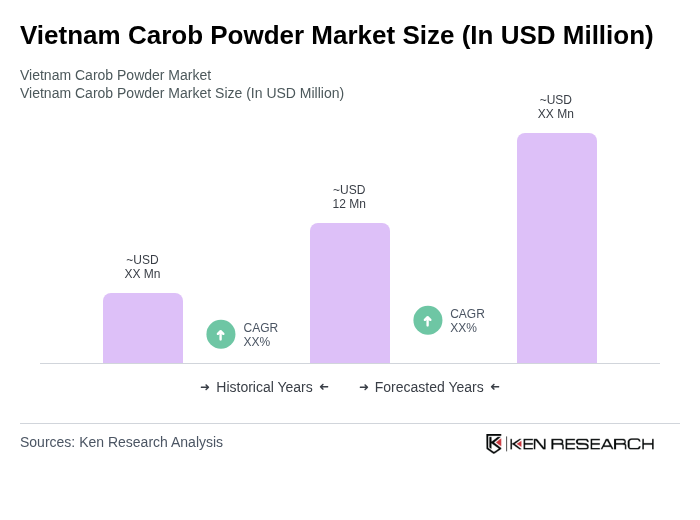
- The Vietnam Carob Powder Market is valued at USD 12 million, based on a five-year historical analysis and extrapolation from the global carob powder market size and Asia–Pacific’s increasing role in demand. This growth is primarily driven by increasing health consciousness among consumers, the rising demand for natural and organic food products, and the expanding applications of carob powder in various food and beverage sectors, in line with global adoption of carob as a natural, caffeine?free cocoa alternative.
- Key cities such as Ho Chi Minh City and Hanoi dominate the market due to their large populations, higher disposable incomes, rapid urbanization, and growing food and beverage processing and modern retail channels, which mirror how bakery, confectionery, and beverage applications lead carob powder usage globally. These cities serve as major hubs for distribution and consumption, facilitating the growth of carob powder products in both retail and foodservice sectors through supermarkets, hypermarkets, specialty health stores, and café chains.
- In 2023, the Vietnamese government strengthened the policy framework to promote the use of organic and safe ingredients in food production under instruments such as the Law on Crop Production 2018 and its implementing Decree No. 109/2018/ND?CP on organic agriculture issued by the Government of Vietnam, which set definitions, certification conditions, labeling rules, and support policies for organic farming and processing. This includes incentives and technical support for manufacturers and farmers to source and produce certified organic ingredients such as carob?based products, aiming to enhance food safety and quality while supporting local agriculture, export competitiveness, and sustainability initiatives.
Vietnam Carob Powder Market Segmentation
By Type:The carob powder market can be segmented into four types: Natural Carob Powder, Organic Carob Powder, Conventional Carob Powder, and Instant / Ready-to-Drink Carob Powder. Each type caters to different consumer preferences and applications, with organic and minimally processed natural options gaining traction due to health trends, rising demand for clean labels, and a shift toward plant-based ingredients in bakery, confectionery, and beverage formulations.
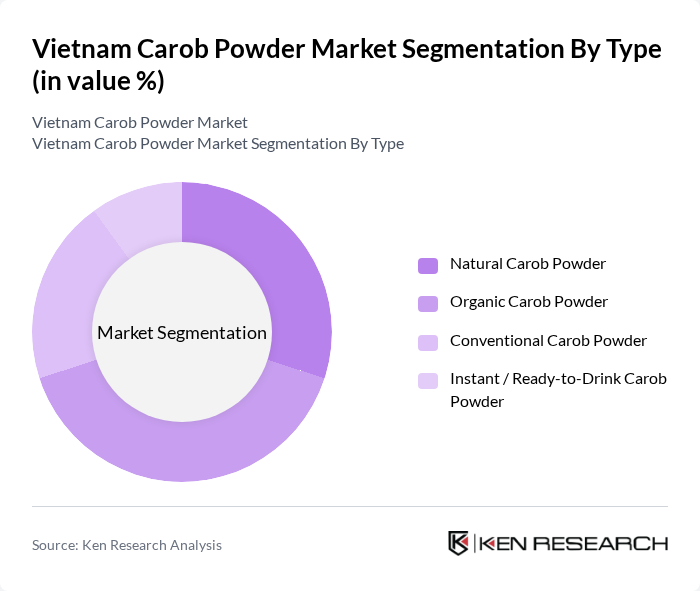
The Organic Carob Powder segment is currently leading the market due to the increasing consumer preference for organic and health-oriented products, consistent with global growth in organic carob offerings. This trend is driven by a growing awareness of the health benefits associated with organic foods, including lower pesticide exposure and alignment with clean-label positioning. Additionally, the rise of veganism, dairy- and caffeine-free diets, and broader plant-based eating has further propelled the demand for organic carob powder, as it serves as a natural alternative to chocolate and other sweeteners in snacks, beverages, and bakery applications.
By End-User:The market can be segmented based on end-users into Bakery and Confectionery Manufacturers, Beverage and Dairy Alternatives Producers, Nutraceuticals and Dietary Supplements, Foodservice & HoReCa (Cafés, Restaurants, Hotels), and Household / Retail Consumers. Each segment has unique requirements and preferences that influence their purchasing decisions, mirroring global usage patterns where bakery and confectionery, followed by beverages and nutraceuticals, are the leading demand centers for carob powder.
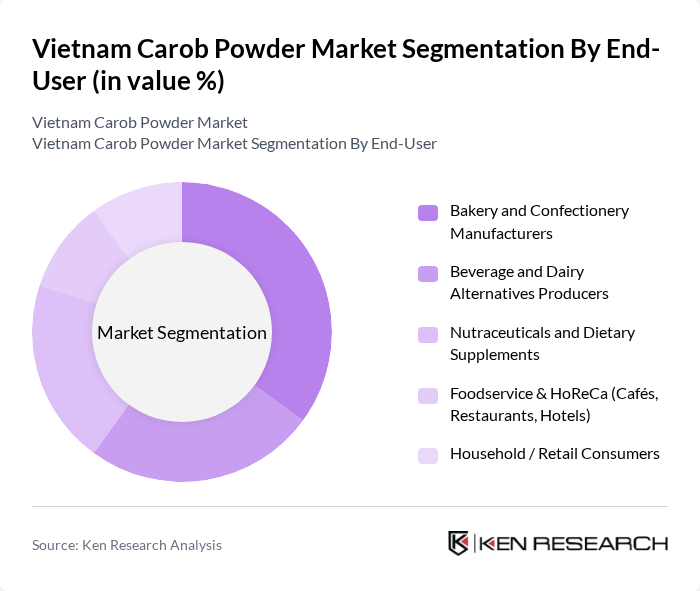
The Bakery and Confectionery Manufacturers segment is the dominant player in the market, driven by the increasing incorporation of carob powder in baked goods, snack bars, and confectionery products, in line with its leading share in global applications. The versatility of carob powder as a natural sweetener, colorant, and flavoring agent makes it a preferred choice among manufacturers looking to cater to health-conscious consumers seeking caffeine-free, gluten-free, and lower-sugar options. Additionally, the growing trend of gluten-free, allergen-free, and vegan products has further enhanced the appeal of carob powder in this segment, particularly in chocolate alternatives, cookies, cakes, and functional snack formats.
Vietnam Carob Powder Market Competitive Landscape
The Vietnam Carob Powder Market is characterized by a dynamic mix of regional and international players. Leading participants such as Erca Group (Erca Spa), The Australian Carob Co., The Carob Kitchen, Euroduna Food Ingredients GmbH, JBS Group (Carob Supply / Carobs Direct), Pedro Pérez, S.A., Lewis Confectionery Pty Ltd, Algarrobos Organicos del Peru S.A.C., Creta Carob S.A., Carob S.A., Savvy Foods Ltd, Sanei Dairy Food Co., Ltd. (Carob Powder Division), Vietnam Organic Agriculture JSC (VOA), Vinamit JSC, The Fruit Republic Co., Ltd. contribute to innovation, geographic expansion, and service delivery in this space, reflecting the globally fragmented but steadily professionalizing nature of the carob powder supply chain.
Vietnam Carob Powder Market Industry Analysis
Growth Drivers
- Increasing Health Consciousness:The Vietnamese population is becoming increasingly health-conscious, with a reported 60% of consumers actively seeking healthier food options. This trend is supported by the World Health Organization's findings that highlight rising obesity rates, prompting a shift towards natural ingredients. The demand for carob powder, known for its low glycemic index and high fiber content, is expected to grow as consumers prioritize health, leading to an estimated increase in sales volume to 5,500 tons in future.
- Rising Demand for Natural Sweeteners:The global shift towards natural sweeteners is reflected in Vietnam, where the market for natural sweeteners is projected to reach $160 million in future. Carob powder, being a natural alternative to sugar, is gaining traction among consumers looking to reduce refined sugar intake. This trend is further supported by the Vietnamese government's initiatives promoting healthier eating habits, which are expected to drive carob powder consumption to approximately 4,000 tons annually.
- Expansion of Vegan and Gluten-Free Products:The vegan and gluten-free food market in Vietnam is expanding rapidly, with a growth rate of 22% annually. This trend is driven by a growing awareness of dietary restrictions and lifestyle choices. Carob powder, being naturally gluten-free and suitable for vegan diets, is increasingly being incorporated into various products, including snacks and baked goods. In future, the demand for carob powder in these segments is anticipated to reach 2,500 tons, reflecting its rising popularity.
Market Challenges
- Limited Awareness Among Consumers:Despite the health benefits of carob powder, consumer awareness remains low, with only 32% of the population familiar with its uses and advantages. This lack of knowledge hinders market growth, as many consumers still prefer traditional sweeteners. Educational campaigns and marketing strategies are essential to increase awareness and drive demand, particularly among health-conscious demographics, which could potentially increase market penetration by 17% in future.
- Competition from Other Natural Sweeteners:The carob powder market faces stiff competition from other natural sweeteners like stevia and agave syrup, which have established market presence. In future, the combined market share of these alternatives is approximately 48% in Vietnam. This competition poses a challenge for carob powder to differentiate itself and capture market share. Strategic partnerships and product innovation will be crucial to overcoming this challenge and enhancing market visibility.
Vietnam Carob Powder Market Future Outlook
The future of the Vietnam carob powder market appears promising, driven by increasing health awareness and a shift towards natural ingredients. As consumers continue to seek healthier alternatives, the demand for carob powder is expected to rise significantly. Innovations in product applications, particularly in the bakery and snack sectors, will further enhance its market presence. Additionally, the growth of e-commerce platforms will facilitate wider distribution, making carob powder more accessible to consumers across the country.
Market Opportunities
- Export Potential to International Markets:Vietnam's carob powder has significant export potential, particularly to markets in Europe and North America, where demand for natural sweeteners is surging. With an estimated export value of $12 million in future, tapping into these markets could provide substantial revenue growth for local producers, enhancing the overall industry landscape.
- Development of Innovative Product Applications:There is a growing opportunity for developing innovative product applications using carob powder, particularly in health foods and supplements. The market for functional foods is projected to reach $220 million in future in Vietnam, creating a favorable environment for carob powder to be integrated into new product lines, thus expanding its market reach and consumer base.
Scope of the Report
| Segment | Sub-Segments |
|---|---|
| By Type | Natural Carob Powder Organic Carob Powder Conventional Carob Powder Instant / Ready-to-Drink Carob Powder |
| By End-User | Bakery and Confectionery Manufacturers Beverage and Dairy Alternatives Producers Nutraceuticals and Dietary Supplements Foodservice & HoReCa (Cafés, Restaurants, Hotels) Household / Retail Consumers |
| By Packaging Type | Industrial Bulk (Bags, Sacks, Big Bags) Retail Pouches and Stand-up Packs Jars, Tins, and Canisters Eco-friendly & Recyclable Packaging |
| By Distribution Channel | B2B (Direct Sales, Distributors, Importers) Modern Trade (Supermarkets/Hypermarkets) Specialty & Health Food Stores Online Retail & E-commerce Platforms |
| By Region | Northern Vietnam Central Vietnam Southern Vietnam Export-oriented Production Clusters |
| By Application | Bakery Products Confectionery (Bars, Chips, Spreads) Beverages and Ready-to-Drink Mixes Dairy and Non-Dairy Alternatives Nutraceuticals and Functional Foods |
| By Consumer Demographics | Health-conscious and Weight-management Consumers Diabetic and Sugar-sensitive Consumers Vegan and Plant-based Lifestyle Consumers Premium and Export-focused Buyers |
Key Target Audience
Investors and Venture Capitalist Firms
Government and Regulatory Bodies (e.g., Ministry of Industry and Trade, Ministry of Agriculture and Rural Development)
Manufacturers and Producers of Carob Powder
Distributors and Retailers of Health Food Products
Food and Beverage Companies
Natural Product Suppliers
Health and Wellness Brands
Export and Import Agencies
Players Mentioned in the Report:
Erca Group (Erca Spa)
The Australian Carob Co.
The Carob Kitchen
Euroduna Food Ingredients GmbH
JBS Group (Carob Supply / Carobs Direct)
Pedro Perez, S.A.
Lewis Confectionery Pty Ltd
Algarrobos Organicos del Peru S.A.C.
Creta Carob S.A.
Carob S.A.
Savvy Foods Ltd
Sanei Dairy Food Co., Ltd. (Carob Powder Division)
Vietnam Organic Agriculture JSC (VOA)
Vinamit JSC
The Fruit Republic Co., Ltd.
Table of Contents
Market Assessment Phase
1. Executive Summary and Approach
2. Vietnam Carob Powder Market Overview
2.1 Key Insights and Strategic Recommendations
2.2 Vietnam Carob Powder Market Overview
2.3 Definition and Scope
2.4 Evolution of Market Ecosystem
2.5 Timeline of Key Regulatory Milestones
2.6 Value Chain & Stakeholder Mapping
2.7 Business Cycle Analysis
2.8 Policy & Incentive Landscape
3. Vietnam Carob Powder Market Analysis
3.1 Growth Drivers
3.1.1 Increasing Health Consciousness
3.1.2 Rising Demand for Natural Sweeteners
3.1.3 Expansion of Vegan and Gluten-Free Products
3.1.4 Government Support for Organic Farming
3.2 Market Challenges
3.2.1 Limited Awareness Among Consumers
3.2.2 Competition from Other Natural Sweeteners
3.2.3 Supply Chain Disruptions
3.2.4 Price Volatility of Raw Materials
3.3 Market Opportunities
3.3.1 Export Potential to International Markets
3.3.2 Development of Innovative Product Applications
3.3.3 Collaborations with Health Food Brands
3.3.4 Growing E-commerce Platforms for Distribution
3.4 Market Trends
3.4.1 Increasing Use in Bakery Products
3.4.2 Rising Popularity in Nutritional Supplements
3.4.3 Shift Towards Sustainable Packaging
3.4.4 Focus on Clean Label Products
3.5 Government Regulation
3.5.1 Standards for Organic Certification
3.5.2 Import Tariffs on Carob Products
3.5.3 Food Safety Regulations
3.5.4 Subsidies for Organic Farming Initiatives
4. SWOT Analysis
5. Stakeholder Analysis
6. Porter's Five Forces Analysis
7. Vietnam Carob Powder Market Market Size, 2019-2024
7.1 By Value
7.2 By Volume
7.3 By Average Selling Price
8. Vietnam Carob Powder Market Segmentation
8.1 By Type
8.1.1 Natural Carob Powder
8.1.2 Organic Carob Powder
8.1.3 Conventional Carob Powder
8.1.4 Instant / Ready-to-Drink Carob Powder
8.2 By End-User
8.2.1 Bakery and Confectionery Manufacturers
8.2.2 Beverage and Dairy Alternatives Producers
8.2.3 Nutraceuticals and Dietary Supplements
8.2.4 Foodservice & HoReCa (Cafés, Restaurants, Hotels)
8.2.5 Household / Retail Consumers
8.3 By Packaging Type
8.3.1 Industrial Bulk (Bags, Sacks, Big Bags)
8.3.2 Retail Pouches and Stand-up Packs
8.3.3 Jars, Tins, and Canisters
8.3.4 Eco-friendly & Recyclable Packaging
8.4 By Distribution Channel
8.4.1 B2B (Direct Sales, Distributors, Importers)
8.4.2 Modern Trade (Supermarkets/Hypermarkets)
8.4.3 Specialty & Health Food Stores
8.4.4 Online Retail & E-commerce Platforms
8.5 By Region
8.5.1 Northern Vietnam
8.5.2 Central Vietnam
8.5.3 Southern Vietnam
8.5.4 Export-oriented Production Clusters
8.6 By Application
8.6.1 Bakery Products
8.6.2 Confectionery (Bars, Chips, Spreads)
8.6.3 Beverages and Ready-to-Drink Mixes
8.6.4 Dairy and Non-Dairy Alternatives
8.6.5 Nutraceuticals and Functional Foods
8.7 By Consumer Demographics
8.7.1 Health-conscious and Weight-management Consumers
8.7.2 Diabetic and Sugar-sensitive Consumers
8.7.3 Vegan and Plant-based Lifestyle Consumers
8.7.4 Premium and Export-focused Buyers
9. Vietnam Carob Powder Market Competitive Analysis
9.1 Market Share of Key Players
9.2 Cross Comparison of Key Players
9.2.1 Company Name
9.2.2 Ownership & Group Size (Multinational, Regional, Local SME)
9.2.3 Vietnam Carob Powder Revenue (Latest Year)
9.2.4 3-year Revenue CAGR from Carob Powder in Vietnam
9.2.5 Export Share in Total Carob Powder Sales
9.2.6 Average Realized Price per Kg in Vietnam
9.2.7 Product Portfolio Breadth (Grades, Formats, Certifications)
9.2.8 Number of Active B2B Accounts in Vietnam
9.2.9 Distribution Reach (Cities/Provinces Covered)
9.2.10 Share of Sales via Modern Trade & E-commerce
9.2.11 Certification Stack (Organic, Halal, HACCP, ISO, FSSC 22000)
9.2.12 R&D / New Product Launches per Year
9.3 SWOT Analysis of Top Players
9.4 Pricing Analysis
9.5 Detailed Profile of Major Companies
9.5.1 Erca Group (Erca Spa)
9.5.2 The Australian Carob Co.
9.5.3 The Carob Kitchen
9.5.4 Euroduna Food Ingredients GmbH
9.5.5 JBS Group (Carob Supply / Carobs Direct)
9.5.6 Pedro Pérez, S.A.
9.5.7 Lewis Confectionery Pty Ltd
9.5.8 Algarrobos Organicos del Peru S.A.C.
9.5.9 Creta Carob S.A.
9.5.10 Carob S.A.
9.5.11 Savvy Foods Ltd
9.5.12 Sanei Dairy Food Co., Ltd. (Carob Powder Division)
9.5.13 Vietnam Organic Agriculture JSC (VOA)
9.5.14 Vinamit JSC
9.5.15 The Fruit Republic Co., Ltd.
10. Vietnam Carob Powder Market End-User Analysis
10.1 Procurement Behavior of Key Ministries
10.1.1 Government Procurement Policies
10.1.2 Budget Allocations for Health Products
10.1.3 Supplier Selection Criteria
10.1.4 Others
10.2 Corporate Spend on Infrastructure & Energy
10.2.1 Investment in Sustainable Practices
10.2.2 Budget for Health and Wellness Products
10.2.3 Corporate Social Responsibility Initiatives
10.2.4 Others
10.3 Pain Point Analysis by End-User Category
10.3.1 Quality Concerns
10.3.2 Supply Chain Reliability
10.3.3 Cost Management
10.3.4 Others
10.4 User Readiness for Adoption
10.4.1 Awareness Levels
10.4.2 Willingness to Pay
10.4.3 Training and Support Needs
10.4.4 Others
10.5 Post-Deployment ROI and Use Case Expansion
10.5.1 Measurement of Success Metrics
10.5.2 Feedback Mechanisms
10.5.3 Opportunities for Upselling
10.5.4 Others
11. Vietnam Carob Powder Market Future Size, 2025-2030
11.1 By Value
11.2 By Volume
11.3 By Average Selling Price
Go-To-Market Strategy Phase
1. Whitespace Analysis + Business Model Canvas
1.1 Market Gaps Identification
1.2 Value Proposition Development
1.3 Revenue Streams
1.4 Cost Structure Analysis
1.5 Key Partnerships
1.6 Customer Segments
1.7 Channels
2. Marketing and Positioning Recommendations
2.1 Branding Strategies
2.2 Product USPs
3. Distribution Plan
3.1 Urban Retail vs Rural NGO Tie-ups
4. Channel & Pricing Gaps
4.1 Underserved Routes
4.2 Pricing Bands
5. Unmet Demand & Latent Needs
5.1 Category Gaps
5.2 Consumer Segments
6. Customer Relationship
6.1 Loyalty Programs
6.2 After-sales Service
7. Value Proposition
7.1 Sustainability
7.2 Integrated Supply Chains
8. Key Activities
8.1 Regulatory Compliance
8.2 Branding
8.3 Distribution Setup
9. Entry Strategy Evaluation
9.1 Domestic Market Entry Strategy
9.1.1 Product Mix
9.1.2 Pricing Band
9.1.3 Packaging
9.2 Export Entry Strategy
9.2.1 Target Countries
9.2.2 Compliance Roadmap
10. Entry Mode Assessment
10.1 JV
10.2 Greenfield
10.3 M&A
10.4 Distributor Model
11. Capital and Timeline Estimation
11.1 Capital Requirements
11.2 Timelines
12. Control vs Risk Trade-Off
12.1 Ownership vs Partnerships
13. Profitability Outlook
13.1 Breakeven Analysis
13.2 Long-term Sustainability
14. Potential Partner List
14.1 Distributors
14.2 JVs
14.3 Acquisition Targets
15. Execution Roadmap
15.1 Phased Plan for Market Entry
15.1.1 Market Setup
15.1.2 Market Entry
15.1.3 Growth Acceleration
15.1.4 Scale & Stabilize
15.2 Key Activities and Milestones
15.2.1 Milestone Planning
15.2.2 Activity Tracking
Research Methodology
Phase 1: Approach1
Desk Research
- Analysis of market reports from agricultural and food industry associations in Vietnam
- Review of academic journals and publications on carob powder and its applications
- Examination of import/export data from Vietnamese customs and trade statistics
Primary Research
- Interviews with key stakeholders in the food and beverage industry, including manufacturers and distributors
- Surveys targeting health food retailers and organic product suppliers
- Field interviews with agricultural experts and carob growers in Vietnam
Validation & Triangulation
- Cross-validation of findings through multiple data sources, including trade publications and expert opinions
- Triangulation of market size estimates using both qualitative and quantitative data
- Sanity checks through feedback from industry panels and focus groups
Phase 2: Market Size Estimation1
Top-down Assessment
- Estimation of the overall food ingredient market size in Vietnam as a baseline
- Segmentation of the carob powder market by application, including food, beverages, and health supplements
- Incorporation of growth trends in organic and health-conscious consumer segments
Bottom-up Modeling
- Collection of sales data from leading carob powder suppliers and manufacturers
- Estimation of average pricing and volume sold across different distribution channels
- Analysis of production capacity and yield from local carob farms
Forecasting & Scenario Analysis
- Development of forecasting models based on historical growth rates and market trends
- Scenario analysis considering factors such as consumer preferences and regulatory changes
- Projections for market growth through 2030 under various economic conditions
Phase 3: CATI Sample Composition1
| Scope Item/Segment | Sample Size | Target Respondent Profiles |
|---|---|---|
| Food and Beverage Manufacturers | 120 | Product Development Managers, Quality Assurance Specialists |
| Health Food Retailers | 90 | Store Managers, Purchasing Agents |
| Organic Product Suppliers | 80 | Sales Directors, Supply Chain Managers |
| Agricultural Experts and Growers | 70 | Farm Owners, Agricultural Consultants |
| Nutritionists and Health Coaches | 60 | Registered Dietitians, Wellness Coaches |
Frequently Asked Questions
What is the current value of the Vietnam Carob Powder Market?
The Vietnam Carob Powder Market is valued at approximately USD 12 million, reflecting a growing demand for natural and organic food products, driven by increasing health consciousness among consumers and the expanding applications of carob powder in various food sectors.
What are the main drivers of growth in the Vietnam Carob Powder Market?
Which cities are the primary markets for carob powder in Vietnam?
What types of carob powder are available in the Vietnamese market?
Other Regional/Country Reports
Indonesia Carob Powder Market
Malaysia Carob Powder Market
KSA Carob Powder Market
APAC Carob Powder Market
SEA Carob Powder Market
Other Adjacent Reports
Brazil Organic Food Ingredients Market
Vietnam Vegan Products Market
Vietnam Gluten-Free Foods Market
Egypt Bakery Ingredients Market
Thailand Confectionery Ingredients Market
KSA Beverage Additives Market
GCC Nutraceuticals MarketUnited States Dietary Supplements Market Outlook to 2030: Size, Share, Growth and TrendsBrazil Health Food Products Market
Why Buy From Us?

What makes us stand out is that our consultants follow Robust, Refine and Result (RRR) methodology. Robust for clear definitions, approaches and sanity checking, Refine for differentiating respondents' facts and opinions, and Result for presenting data with story.

We have set a benchmark in the industry by offering our clients with syndicated and customized market research reports featuring coverage of entire market as well as meticulous research and analyst insights.

While we don't replace traditional research, we flip the method upside down. Our dual approach of Top Bottom & Bottom Top ensures quality deliverable by not just verifying company fundamentals but also looking at the sector and macroeconomic factors.

With one step in the future, our research team constantly tries to show you the bigger picture. We help with some of the tough questions you may encounter along the way: How is the industry positioned? Best marketing channel? KPI's of competitors? By aligning every element, we help maximize success.

Our report gives you instant access to the answers and sources that other companies might choose to hide. We elaborate each steps of research methodology we have used and showcase you the sample size to earn your trust.

If you need any support, we are here! We pride ourselves on universe strength, data quality, and quick, friendly, and professional service.