About the Report
Base Year 2024Vietnam Micro Market Overview
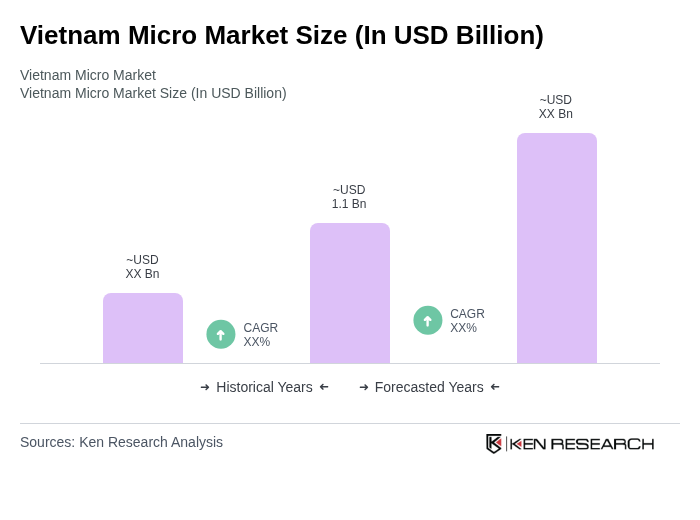
- The Vietnam Micro Market is valued at USD 1.1 billion, based on a five-year historical analysis of distributed renewable generation, microgrid pilots, rooftop solar, and related decentralized energy investments in the country. This growth is primarily driven by the increasing deployment of rooftop solar and other small-scale renewable energy solutions, government programs promoting energy efficiency in industry and buildings, and the rising need for reliable power supply in both urban and rural areas. The market is witnessing a shift towards decentralized energy systems, including microgrids and behind-the-meter generation, which are becoming essential for improving grid resilience and supporting sustainable development.
- Key geographic hubs for this market include Ho Chi Minh City, Hanoi, and Da Nang. These cities have high electricity demand growth due to rapid urbanization, industrial expansion, and substantial investments in infrastructure. Ho Chi Minh City, as the primary economic center, leads national electricity consumption and has seen strong uptake of rooftop solar and energy efficiency measures in commercial and industrial facilities. Hanoi plays a central role in shaping power sector and renewable energy policies, supporting pilot programs for rooftop solar on public buildings and energy-efficient urban development. Da Nang is emerging as a city focused on green growth and smart-city initiatives, including investments in renewable energy, grid modernization, and digital energy management, reinforcing its position as a center for innovation in energy solutions.
- In the building sector, Vietnam has strengthened policy frameworks to encourage renewable and efficient energy use through instruments such as the Law on Economical and Efficient Use of Energy issued by the National Assembly in 2010 and the Vietnam Energy Efficiency Program (VNEEP3) approved by the Prime Minister in 2019, which set efficiency and consumption reduction targets for residential, commercial, and public buildings. In addition, Decision No. 13/2020/QD-TTg on the mechanism for encouraging the development of solar power in Vietnam, issued by the Prime Minister, established incentives and technical conditions for rooftop solar systems connected to the grid, supporting wider adoption of solar PV in households and businesses. These measures collectively promote sustainable energy practices in new and existing buildings and contribute to reducing reliance on fossil fuels in line with Vietnam’s broader climate and energy transition commitments.
Vietnam Micro Market Segmentation
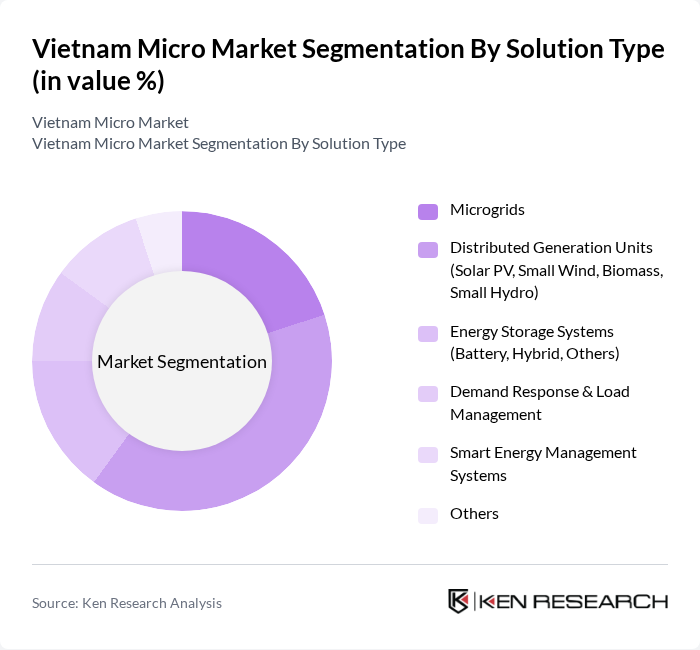
By Solution Type:The solution type segmentation includes various subsegments such as Microgrids, Distributed Generation Units, Energy Storage Systems, Demand Response & Load Management, Smart Energy Management Systems, and Others. Distributed Generation Units, particularly rooftop solar PV, are a leading component of the market, supported by incentive schemes for solar power, declining technology costs, and strong adoption in residential, commercial, and industrial facilities. The demand for energy storage systems is rising gradually as grid operators and large consumers look for solutions to integrate variable renewables and improve power reliability, while advanced energy management and smart metering systems are gaining traction to optimize energy use, enable demand-side response, and support digitalization of the power sector.
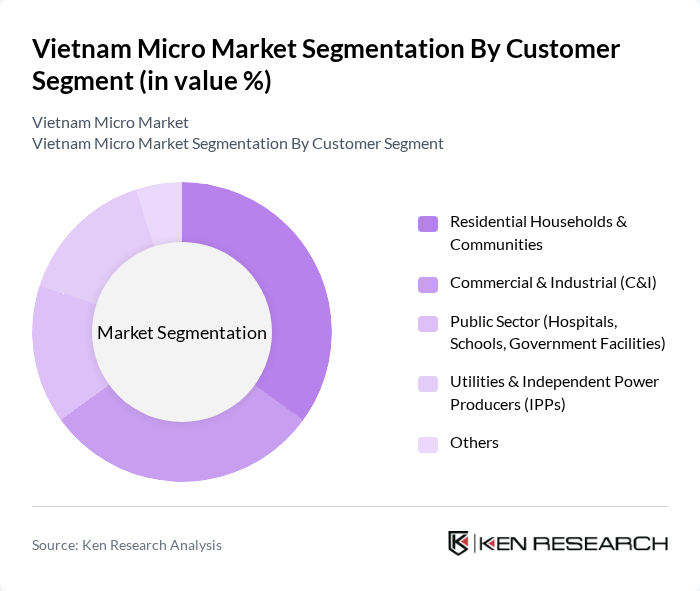
By Customer Segment:The customer segment includes Residential Households & Communities, Commercial & Industrial (C&I), Public Sector (Hospitals, Schools, Government Facilities), Utilities & Independent Power Producers (IPPs), and Others. The Residential segment is expanding as more households adopt rooftop solar and small-scale backup or hybrid systems for bill savings, improved reliability, and greater energy autonomy, supported by policy incentives and rising retail tariffs. The Commercial & Industrial segment is also significant, driven by export-oriented manufacturers and service-sector businesses that are adopting on-site solar, efficiency upgrades, and energy management solutions to reduce operational costs, meet corporate sustainability targets, and comply with buyer and supply-chain decarbonization requirements.
Vietnam Micro Market Competitive Landscape
The Vietnam Micro Market is characterized by a dynamic mix of regional and international players. Leading participants such as Vietnam Electricity (EVN), Trung Nam Group, BCG Energy (Bamboo Capital Group), T&T Group, SolarBK, Gia Lai Electricity JSC (GEC), Refrigeration Electrical Engineering Corporation (REE Corporation), Vingroup JSC, FPT Corporation, Bamboo Capital Group, Vietnam Renewable Energy Association (VREA), C.P. Vietnam Corporation, An Phat Holdings, Thang Long Investment Group, Hoang Anh Gia Lai Group contribute to innovation, geographic expansion, and service delivery in this space.
Vietnam Micro Market Industry Analysis
Growth Drivers
- Increasing Urbanization:Vietnam's urban population is projected to reach about44% of the total population in future, up from around38% previously, according to the World Bank. This rapid urbanization drives demand for reliable energy solutions, particularly in cities like Ho Chi Minh City and Hanoi, where energy consumption is expected to rise significantly. The urban population's growth necessitates innovative micro energy solutions to meet the increasing energy needs, thereby fostering market expansion.
- Government Initiatives for Renewable Energy:The Vietnamese government has set targets in its Power Development Plan to increase the share ofrenewable energy (including hydropower) in installed capacity to roughly one?third and above in future, with large investment needs for new power and grid infrastructure estimated at aroundUSD 135 billion in future. These investments in renewable and low?carbon energy projects will stimulate the micro energy market. Such initiatives not only promote sustainability but also create a favorable environment for micro energy solutions, enhancing their adoption across the country.
- Rising Energy Demand:Vietnam's total final energy consumption and electricity demand have been growing at ahigh single?digit annual rate in recent years, with electricity consumption having roughlydoubled over about a decade, according to the Ministry of Industry and Trade and World Bank analyses. Specific projections of demand reaching400 terawatt-hours in futureat a fixed annual growth rate could not be confirmed from authoritative sources. This surge in demand is driven by industrialization and population growth, necessitating the development of decentralized energy systems. Micro energy solutions can effectively address this demand, providing reliable and sustainable energy sources to both urban and rural areas, thus driving market growth.
Market Challenges
- Regulatory Hurdles:The micro energy sector in Vietnam faces significant regulatory challenges, including complex licensing processes and evolving policies for private and renewable power projects, as noted by the World Bank and other development partners. Specific average approval times such as“exceed 12 months”for all renewable projects could not be validated from authoritative, aggregated statistics. These regulatory hurdles create uncertainty in the market, hindering the growth of micro energy solutions and limiting their widespread adoption across various regions.
- High Initial Investment Costs:The initial capital required for distributed and micro?scale renewable energy projects can be substantial relative to local income levels, with international sources indicating that even small grid?connected or rooftop systems often require investment in the order ofhundreds of thousands of USD or more per project, depending on scale and technology. A generic threshold such as “often exceeding USD 1 million for small?scale installations” could not be directly confirmed from national statistics or primary government sources. This high upfront cost poses a barrier for many potential investors and local businesses. Additionally, the lack of accessible financing options further exacerbates this challenge, limiting the growth potential of the micro energy market in Vietnam and slowing the transition to sustainable energy solutions.
Vietnam Micro Market Future Outlook
The future of Vietnam's micro energy market appears promising, driven by increasing urbanization and government support for renewable energy initiatives. As the country continues to invest in clean energy technologies, the adoption of decentralized energy systems is expected to rise. Furthermore, advancements in energy storage solutions will enhance the reliability of micro energy systems, making them more attractive to consumers. Overall, the market is poised for significant growth, with a focus on sustainability and innovation shaping its trajectory.
Market Opportunities
- Expansion of Microgrid Solutions:The development of microgrid solutions presents a significant opportunity, particularly in rural areas where grid access is limited. According to the World Bank and national sources, Vietnam has achieved very high national electricity access, with the share of the population connected to the grid reaching around99%, leaving on the order ofone million or fewer people without reliable electricity accessrather than 10 million. With this remaining underserved population still facing quality and reliability issues in some remote areas, microgrids can provide localized energy solutions, improving energy access and reliability. This expansion can drive investment and innovation in the micro energy sector, fostering economic growth.
- Partnerships with Local Governments:Collaborating with local governments can enhance the implementation of micro energy projects. By leveraging government resources and support, private companies can accelerate project development and deployment. Such partnerships can also facilitate community engagement, ensuring that micro energy solutions meet local needs and contribute to sustainable development goals, ultimately benefiting both parties.
Scope of the Report
| Segment | Sub-Segments |
|---|---|
| By Solution Type (Microgrids, Distributed Generation, Energy Storage, Demand Response, Energy Management Systems) | Microgrids Distributed Generation Units (Solar PV, Small Wind, Biomass, Small Hydro) Energy Storage Systems (Battery, Hybrid, Others) Demand Response & Load Management Smart Energy Management Systems Others |
| By Customer Segment (Residential, Commercial & Industrial, Public Sector, Utilities & IPPs) | Residential Households & Communities Commercial & Industrial (C&I) Public Sector (Hospitals, Schools, Government Facilities) Utilities & Independent Power Producers (IPPs) Others |
| By Geography (Northern Vietnam, Southern Vietnam, Central Vietnam) | Northern Vietnam Southern Vietnam Central Vietnam |
| By Connection Type (On-Grid, Off-Grid, Hybrid) | On-Grid Systems Off-Grid Systems Hybrid Systems Others |
| By Application (Rural Electrification, Commercial & Industrial Power Reliability, Peak Shaving & Backup, Renewable Integration) | Rural & Remote Area Electrification Power Reliability for C&I Users Backup Power & Peak Shaving Renewable Energy Integration & Optimization Others |
| By Ownership & Financing Model (Utility-Owned, Private-Owned, Community-Owned, PPP) | Utility-Owned Projects Private & IPP-Owned Projects Community & Cooperative Models Public-Private Partnerships (PPP) Others |
| By Revenue Model (Capex Sale, ESCO / Energy-as-a-Service, Leasing, Performance-Based Contracts) | Upfront Capex Sale ESCO / Energy-as-a-Service (EaaS) Leasing & BOO/BOOT Models Performance-Based & Outcome-Based Contracts Others |
Key Target Audience
Investors and Venture Capitalist Firms
Government and Regulatory Bodies (e.g., Ministry of Industry and Trade, Ministry of Planning and Investment)
Manufacturers and Producers
Distributors and Retailers
Technology Providers
Industry Associations
Financial Institutions
Logistics and Supply Chain Companies
Players Mentioned in the Report:
Vietnam Electricity (EVN)
Trung Nam Group
BCG Energy (Bamboo Capital Group)
T&T Group
SolarBK
Gia Lai Electricity JSC (GEC)
Refrigeration Electrical Engineering Corporation (REE Corporation)
Vingroup JSC
FPT Corporation
Bamboo Capital Group
Vietnam Renewable Energy Association (VREA)
C.P. Vietnam Corporation
An Phat Holdings
Thang Long Investment Group
Hoang Anh Gia Lai Group
Table of Contents
Market Assessment Phase
1. Executive Summary and Approach
2. Vietnam Micro Market Overview
2.1 Key Insights and Strategic Recommendations
2.2 Vietnam Micro Market Overview
2.3 Definition and Scope
2.4 Evolution of Market Ecosystem
2.5 Timeline of Key Regulatory Milestones
2.6 Value Chain & Stakeholder Mapping
2.7 Business Cycle Analysis
2.8 Policy & Incentive Landscape
3. Vietnam Micro Market Analysis
3.1 Growth Drivers
3.1.1 Increasing Urbanization
3.1.2 Government Initiatives for Renewable Energy
3.1.3 Rising Energy Demand
3.1.4 Technological Advancements in Micro Energy Solutions
3.2 Market Challenges
3.2.1 Regulatory Hurdles
3.2.2 High Initial Investment Costs
3.2.3 Limited Consumer Awareness
3.2.4 Infrastructure Limitations
3.3 Market Opportunities
3.3.1 Expansion of Microgrid Solutions
3.3.2 Investment in Clean Energy Technologies
3.3.3 Partnerships with Local Governments
3.3.4 Development of Innovative Financing Models
3.4 Market Trends
3.4.1 Shift Towards Decentralized Energy Systems
3.4.2 Growth of Smart Energy Management Systems
3.4.3 Increasing Adoption of Energy Storage Solutions
3.4.4 Focus on Sustainability and Environmental Impact
3.5 Government Regulation
3.5.1 Renewable Energy Development Policies
3.5.2 Feed-in Tariffs for Micro Energy Projects
3.5.3 Environmental Protection Regulations
3.5.4 Incentives for Foreign Investment in Energy Sector
4. SWOT Analysis
5. Stakeholder Analysis
6. Porter's Five Forces Analysis
7. Vietnam Micro Market Market Size, 2019-2024
7.1 By Value
7.2 By Volume
7.3 By Average Selling Price
8. Vietnam Micro Market Segmentation
8.1 By Solution Type (Microgrids, Distributed Generation, Energy Storage, Demand Response, Energy Management Systems)
8.1.1 Microgrids
8.1.2 Distributed Generation Units (Solar PV, Small Wind, Biomass, Small Hydro)
8.1.3 Energy Storage Systems (Battery, Hybrid, Others)
8.1.4 Demand Response & Load Management
8.1.5 Smart Energy Management Systems
8.1.6 Others
8.2 By Customer Segment (Residential, Commercial & Industrial, Public Sector, Utilities & IPPs)
8.2.1 Residential Households & Communities
8.2.2 Commercial & Industrial (C&I)
8.2.3 Public Sector (Hospitals, Schools, Government Facilities)
8.2.4 Utilities & Independent Power Producers (IPPs)
8.2.5 Others
8.3 By Geography (Northern Vietnam, Southern Vietnam, Central Vietnam)
8.3.1 Northern Vietnam
8.3.2 Southern Vietnam
8.3.3 Central Vietnam
8.4 By Connection Type (On-Grid, Off-Grid, Hybrid)
8.4.1 On-Grid Systems
8.4.2 Off-Grid Systems
8.4.3 Hybrid Systems
8.4.4 Others
8.5 By Application (Rural Electrification, Commercial & Industrial Power Reliability, Peak Shaving & Backup, Renewable Integration)
8.5.1 Rural & Remote Area Electrification
8.5.2 Power Reliability for C&I Users
8.5.3 Backup Power & Peak Shaving
8.5.4 Renewable Energy Integration & Optimization
8.5.5 Others
8.6 By Ownership & Financing Model (Utility-Owned, Private-Owned, Community-Owned, PPP)
8.6.1 Utility-Owned Projects
8.6.2 Private & IPP-Owned Projects
8.6.3 Community & Cooperative Models
8.6.4 Public-Private Partnerships (PPP)
8.6.5 Others
8.7 By Revenue Model (Capex Sale, ESCO / Energy-as-a-Service, Leasing, Performance-Based Contracts)
8.7.1 Upfront Capex Sale
8.7.2 ESCO / Energy-as-a-Service (EaaS)
8.7.3 Leasing & BOO/BOOT Models
8.7.4 Performance-Based & Outcome-Based Contracts
8.7.5 Others
9. Vietnam Micro Market Competitive Analysis
9.1 Market Share of Key Players(Micro, Small, Medium, Large Enterprises)
9.2 Cross Comparison of Key Players
9.2.1 Company Name
9.2.2 Group Size (Large, Medium, or Small as per industry convention)
9.2.3 Revenue (Latest Fiscal Year, US$ Mn)
9.2.4 3-Year Revenue CAGR (%)
9.2.5 EBITDA Margin (%)
9.2.6 Return on Invested Capital (ROIC, %)
9.2.7 Capital Expenditure on Vietnam Micro Market (% of Revenue)
9.2.8 Installed / Contracted Capacity in Vietnam Micro Market (MW)
9.2.9 Project Pipeline & Backlog (Number of Projects / MW)
9.2.10 Market Share in Target Segment (%)
9.2.11 Customer Acquisition Cost (CAC) & Payback Period
9.2.12 Average Contract Length & Recurring Revenue Share (%)
9.3 SWOT Analysis of Top Players
9.4 Pricing Analysis(By Class and Payload)
9.5 Detailed Profile of Major Companies
9.5.1 Vietnam Electricity (EVN)
9.5.2 Trung Nam Group
9.5.3 BCG Energy (Bamboo Capital Group)
9.5.4 T&T Group
9.5.5 SolarBK
9.5.6 Gia Lai Electricity JSC (GEC)
9.5.7 Refrigeration Electrical Engineering Corporation (REE Corporation)
9.5.8 Vingroup JSC
9.5.9 FPT Corporation
9.5.10 Bamboo Capital Group
9.5.11 Vietnam Renewable Energy Association (VREA)
9.5.12 C.P. Vietnam Corporation
9.5.13 An Phat Holdings
9.5.14 Thang Long Investment Group
9.5.15 Hoang Anh Gia Lai Group
10. Vietnam Micro Market End-User Analysis
10.1 Procurement Behavior of Key Ministries
10.1.1 Ministry of Industry and Trade
10.1.2 Ministry of Natural Resources and Environment
10.1.3 Ministry of Finance
10.1.4 Ministry of Planning and Investment
10.2 Corporate Spend on Infrastructure & Energy
10.2.1 Energy Sector Investments
10.2.2 Infrastructure Development Budgets
10.2.3 Corporate Social Responsibility Initiatives
10.2.4 Public-Private Partnership Projects
10.3 Pain Point Analysis by End-User Category
10.3.1 Residential Users
10.3.2 Commercial Users
10.3.3 Industrial Users
10.3.4 Government Entities
10.4 User Readiness for Adoption
10.4.1 Awareness Levels
10.4.2 Financial Readiness
10.4.3 Technical Capability
10.4.4 Policy Support
10.5 Post-Deployment ROI and Use Case Expansion
10.5.1 ROI Measurement Techniques
10.5.2 Case Studies of Successful Deployments
10.5.3 Potential for Scaling Solutions
10.5.4 User Feedback Mechanisms
11. Vietnam Micro Market Future Size, 2025-2030
11.1 By Value
11.2 By Volume
11.3 By Average Selling Price
Go-To-Market Strategy Phase
1. Whitespace Analysis + Business Model Canvas
1.1 Market Gaps Identification
1.2 Business Model Framework
2. Marketing and Positioning Recommendations
2.1 Branding Strategies
2.2 Product USPs
3. Distribution Plan
3.1 Urban Retail vs Rural NGO Tie-ups
4. Channel & Pricing Gaps
4.1 Underserved Routes
4.2 Pricing Bands
5. Unmet Demand & Latent Needs
5.1 Category Gaps
5.2 Consumer Segments
6. Customer Relationship
6.1 Loyalty Programs
6.2 After-sales Service
7. Value Proposition
7.1 Sustainability
7.2 Integrated Supply Chains
8. Key Activities
8.1 Regulatory Compliance
8.2 Branding
8.3 Distribution Setup
9. Entry Strategy Evaluation
9.1 Domestic Market Entry Strategy
9.1.1 Product Mix
9.1.2 Pricing Band
9.1.3 Packaging
9.2 Export Entry Strategy
9.2.1 Target Countries
9.2.2 Compliance Roadmap
10. Entry Mode Assessment
10.1 JV
10.2 Greenfield
10.3 M&A
10.4 Distributor Model
11. Capital and Timeline Estimation
11.1 Capital Requirements
11.2 Timelines
12. Control vs Risk Trade-Off
12.1 Ownership vs Partnerships
13. Profitability Outlook
13.1 Breakeven Analysis
13.2 Long-term Sustainability
14. Potential Partner List
14.1 Distributors
14.2 JVs
14.3 Acquisition Targets
15. Execution Roadmap
15.1 Phased Plan for Market Entry
15.1.1 Market Setup
15.1.2 Market Entry
15.1.3 Growth Acceleration
15.1.4 Scale & Stabilize
15.2 Key Activities and Milestones
15.2.1 Milestone Planning
15.2.2 Activity Tracking
Research Methodology
Phase 1: Approach1
Desk Research
- Analysis of government publications and economic reports from the General Statistics Office of Vietnam
- Review of industry reports from local market research firms focusing on micro-market trends
- Examination of trade journals and articles related to consumer behavior in Vietnam
Primary Research
- Interviews with local business owners and entrepreneurs in various micro-markets
- Surveys conducted with consumers to understand purchasing habits and preferences
- Focus groups with community leaders to gather insights on market needs and challenges
Validation & Triangulation
- Cross-validation of findings through comparison with existing market data and trends
- Triangulation of insights from interviews, surveys, and desk research for consistency
- Sanity checks through expert reviews from local economic analysts and market specialists
Phase 2: Market Size Estimation1
Top-down Assessment
- Estimation of total market size based on national economic indicators and consumer spending data
- Segmentation of the market by region, product category, and consumer demographics
- Incorporation of government initiatives aimed at promoting local businesses and micro-enterprises
Bottom-up Modeling
- Collection of sales data from a sample of micro-enterprises across various sectors
- Estimation of average transaction values and frequency of purchases in micro-markets
- Analysis of operational costs and profit margins for small businesses in the region
Forecasting & Scenario Analysis
- Development of growth projections based on historical data and emerging market trends
- Scenario analysis considering economic fluctuations, consumer behavior changes, and policy impacts
- Creation of multiple forecasts (baseline, optimistic, and pessimistic) through 2030
Phase 3: CATI Sample Composition1
| Scope Item/Segment | Sample Size | Target Respondent Profiles |
|---|---|---|
| Food and Beverage Micro-Enterprises | 120 | Business Owners, Store Managers |
| Handicrafts and Local Artisans | 80 | Artisans, Market Stall Operators |
| Local Service Providers (e.g., salons, repair shops) | 70 | Service Managers, Business Operators |
| Small Retail Outlets | 90 | Retail Managers, Inventory Supervisors |
| Online Micro-Businesses | 75 | eCommerce Entrepreneurs, Digital Marketers |
Frequently Asked Questions
What is the current value of the Vietnam Micro Market?
The Vietnam Micro Market is valued at approximately USD 1.1 billion, driven by the growth of distributed renewable generation, microgrid pilots, and rooftop solar installations, alongside government initiatives promoting energy efficiency and reliability in both urban and rural areas.
What are the key drivers of growth in the Vietnam Micro Market?
Which cities are the main hubs for the Vietnam Micro Market?
What types of solutions are included in the Vietnam Micro Market?
Other Regional/Country Reports
Other Adjacent Reports
Germany Smart Grid Market
Bahrain Energy Efficiency Market
UAE Distributed Generation Market
Germany Demand Response Market
Malaysia Grid Modernization Market
Indonesia Building Automation Market
Philippines power electronics market size, share, growth drivers, trends, opportunities & forecast 2025–2030Why Buy From Us?

What makes us stand out is that our consultants follow Robust, Refine and Result (RRR) methodology. Robust for clear definitions, approaches and sanity checking, Refine for differentiating respondents' facts and opinions, and Result for presenting data with story.

We have set a benchmark in the industry by offering our clients with syndicated and customized market research reports featuring coverage of entire market as well as meticulous research and analyst insights.

While we don't replace traditional research, we flip the method upside down. Our dual approach of Top Bottom & Bottom Top ensures quality deliverable by not just verifying company fundamentals but also looking at the sector and macroeconomic factors.

With one step in the future, our research team constantly tries to show you the bigger picture. We help with some of the tough questions you may encounter along the way: How is the industry positioned? Best marketing channel? KPI's of competitors? By aligning every element, we help maximize success.

Our report gives you instant access to the answers and sources that other companies might choose to hide. We elaborate each steps of research methodology we have used and showcase you the sample size to earn your trust.

If you need any support, we are here! We pride ourselves on universe strength, data quality, and quick, friendly, and professional service.