About the Report
Base Year 2024Listen to the audio summary
Africa Gaming Market Overview
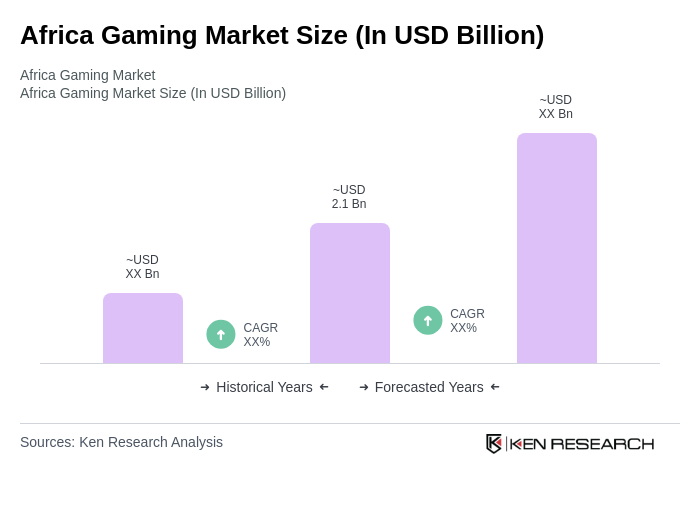
- The Africa Gaming Market is valued at USD 2.1 billion, based on a five-year historical analysis. This growth is primarily driven by increasing penetration of smartphones, improved internet connectivity, and a young demographic that is highly engaged with mobile-first gaming; mobile accounts for the dominant share of gamers and revenue across Africa. The rise of mobile gaming and e-sports continues to expand the user base and spend, with mobile representing the vast majority of players and revenue and esports-related engagement rising alongside streaming and social gaming behaviors.
- Key players in this market include South Africa, Nigeria, and Kenya, buoyed by large populations, rising disposable incomes, and vibrant gaming cultures; recent revenue leaderboards also show Egypt among the top markets by gaming revenue alongside Nigeria and South Africa. South Africa benefits from relatively better infrastructure and broadband access, Nigeria from rapid mobile adoption, and Kenya from widespread mobile money/payment innovations that lower friction for in-app purchases and subscriptions.
- In 2023, South Africa advanced measures on responsible online gambling and advertising, reinforcing age restrictions and consumer protections through national and provincial regulators; online gambling itself remains restricted/illegal except for licensed online sports betting, with regulators emphasizing protection of minors and responsible practices in advertising and digital channels.
Africa Gaming Market Segmentation
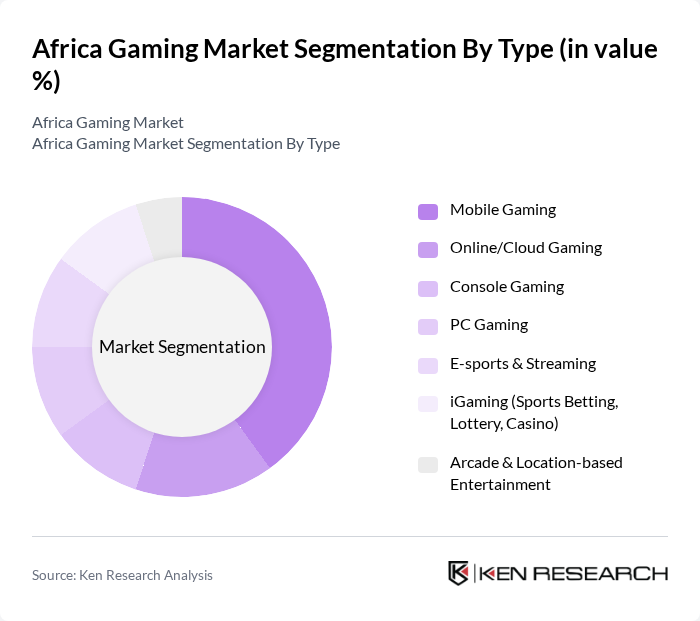
By Type:The gaming market can be segmented into various types, including Mobile Gaming, Online/Cloud Gaming, Console Gaming, PC Gaming, E-sports & Streaming, iGaming (Sports Betting, Lottery, Casino), and Arcade & Location-based Entertainment. Each of these segments caters to different consumer preferences and technological advancements.
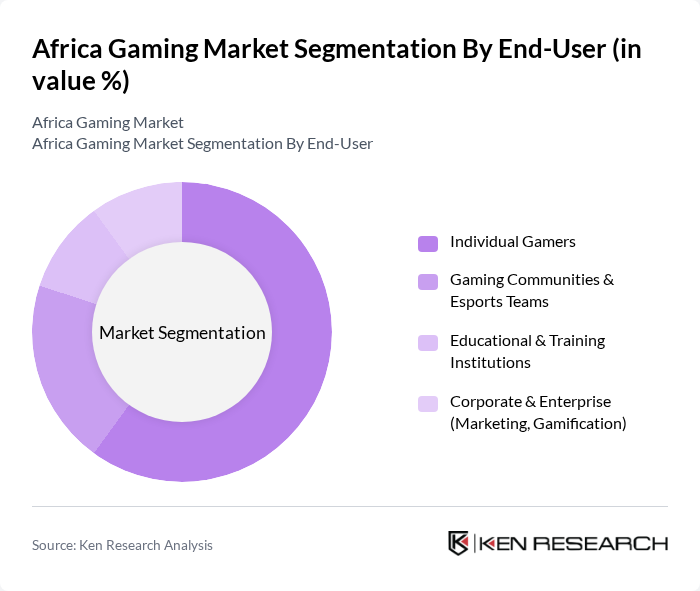
By End-User:The end-user segmentation includes Individual Gamers, Gaming Communities & Esports Teams, Educational & Training Institutions, and Corporate & Enterprise (Marketing, Gamification). Each segment reflects the diverse applications and audiences within the gaming ecosystem.
Africa Gaming Market Competitive Landscape
The Africa Gaming Market is characterized by a dynamic mix of regional and international players. Leading participants such as Carry1st, Maliyo Games, Kagiso Interactive, Nyamakop, Kiro’o Games, Usiku Games, Leti Arts, Kucheza Gaming, Sea Monster Entertainment, Celestial Games, Nexters (Africa operations), Sony Interactive Entertainment (PlayStation Africa), Microsoft Xbox (MEA), Tencent (Africa publishing/partnerships), MTN Group (Gaming & esports initiatives) contribute to innovation, geographic expansion, and service delivery in this space.
Africa Gaming Market Industry Analysis
Growth Drivers
- Increasing Smartphone Penetration:As of future, Africa is projected to have over 700 million smartphone users, a significant increase from 500 million in 2022. This surge in smartphone adoption is crucial for the gaming market, as mobile devices account for approximately 70% of gaming revenue in the region. The affordability of smartphones, with prices averaging around $120, has made gaming accessible to a broader audience, particularly among the youth, driving engagement and revenue growth.
- Rise of Online Gaming Platforms:The number of online gaming platforms in Africa has increased from 200 in 2022 to over 400 in future. This growth is fueled by the rising demand for diverse gaming experiences, including casino games and sports betting. The online gaming sector is expected to generate approximately $2 billion in revenue in future, reflecting a robust interest in digital entertainment. This trend is further supported by the increasing availability of localized content tailored to African audiences.
- Expanding Internet Connectivity:Internet penetration in Africa is projected to reach 60% in future, up from 40% in 2022, translating to around 800 million internet users. This expansion is driven by investments in infrastructure, with over $7 billion allocated to broadband development. Improved connectivity enhances access to online gaming platforms, enabling more users to participate in gaming activities. The growth of affordable data plans, averaging $1.50 per GB, further supports this trend, making online gaming more accessible.
Market Challenges
- Regulatory Hurdles:The gaming industry in Africa faces significant regulatory challenges, with over 25 countries having stringent laws governing online gaming. For instance, Nigeria's National Lottery Regulatory Commission has imposed strict licensing requirements, leading to delays in market entry for new operators. These regulations can stifle innovation and limit the growth potential of gaming companies, as compliance costs can exceed $1.5 million for major operators, impacting profitability and market expansion.
- High Competition:The African gaming market is becoming increasingly competitive, with over 400 operators vying for market share. This saturation has led to aggressive marketing strategies, with companies spending an estimated $250 million annually on advertising. The intense competition can drive down profit margins, as operators are forced to offer promotions and bonuses to attract players. Additionally, established brands dominate the market, making it challenging for new entrants to gain traction and visibility.
Africa Gaming Market Future Outlook
The Africa gaming market is poised for significant transformation, driven by technological advancements and changing consumer preferences. As mobile gaming continues to dominate, developers are likely to focus on creating immersive experiences that leverage augmented and virtual reality technologies. Furthermore, the integration of blockchain technology in gaming is expected to enhance transparency and security, attracting more players. With a growing emphasis on responsible gaming practices, operators will need to adapt to regulatory changes while fostering a sustainable gaming environment that prioritizes player welfare.
Market Opportunities
- E-sports Growth:The e-sports market in Africa is projected to reach $150 million in future, driven by increasing participation and viewership. With over 30 million active e-sports players, this segment presents a lucrative opportunity for gaming companies to engage younger audiences through tournaments and sponsorships, enhancing brand visibility and loyalty.
- Partnerships with Telecom Companies:Collaborations with telecom providers can enhance gaming accessibility, as companies like MTN and Vodacom are investing in gaming bundles. These partnerships can facilitate the development of tailored gaming packages, potentially increasing user engagement and driving revenue growth, as mobile data usage for gaming is expected to rise by 40% in future.
Scope of the Report
| Segment | Sub-Segments |
|---|---|
| By Type | Mobile Gaming Online/Cloud Gaming Console Gaming PC Gaming E-sports & Streaming iGaming (Sports Betting, Lottery, Casino) Arcade & Location-based Entertainment |
| By End-User | Individual Gamers Gaming Communities & Esports Teams Educational & Training Institutions Corporate & Enterprise (Marketing, Gamification) |
| By Age Group | Under 18 24 34 44 and above |
| By Revenue Model | Free-to-Play (Ad-Supported) Subscription (Game Pass, Cloud, VIP) Premium/Pay-to-Play In-Game Purchases & Microtransactions Hybrid (Freemium + IAP/Ads) |
| By Distribution Channel | Mobile App Stores (Google Play, App Store, Huawei AppGallery) Online Platforms/Marketplaces (Steam, Epic, PlayStation Store, Xbox Store) Telco Bundles & Direct Carrier Billing Retail & Console Hardware Sales |
| By Game Genre | Action & Battle Royale Sports & Racing Strategy & MOBA Casino & Casual Simulation & Adventure |
| By Payment Method | Mobile Money (M-Pesa, MTN Mobile Money, Airtel Money) Cards (Credit/Debit) E-wallets & Fintech (Flutterwave, Paystack, Ozow, Yoco) Bank Transfers & Direct Carrier Billing |
| By Country | South Africa Nigeria Egypt Kenya Morocco Ghana Rest of Africa |
Key Target Audience
Investors and Venture Capitalist Firms
Government and Regulatory Bodies (e.g., National Gaming Board, Ministry of Communications and Digital Technologies)
Game Developers and Publishers
Telecommunications Companies
Payment Solution Providers
Advertising and Marketing Agencies
Event Organizers and Esports Tournament Hosts
Content Creators and Influencers in Gaming
Players Mentioned in the Report:
Carry1st
Maliyo Games
Kagiso Interactive
Nyamakop
Kiroo Games
Usiku Games
Leti Arts
Kucheza Gaming
Sea Monster Entertainment
Celestial Games
Nexters (Africa operations)
Sony Interactive Entertainment (PlayStation Africa)
Microsoft Xbox (MEA)
Tencent (Africa publishing/partnerships)
MTN Group (Gaming & esports initiatives)
Table of Contents
Market Assessment Phase
1. Executive Summary and Approach
2. Africa Gaming Market Overview
2.1 Key Insights and Strategic Recommendations
2.2 Africa Gaming Market Overview
2.3 Definition and Scope
2.4 Evolution of Market Ecosystem
2.5 Timeline of Key Regulatory Milestones
2.6 Value Chain & Stakeholder Mapping
2.7 Business Cycle Analysis
2.8 Policy & Incentive Landscape
3. Africa Gaming Market Analysis
3.1 Growth Drivers
3.1.1 Increasing smartphone penetration
3.1.2 Rise of online gaming platforms
3.1.3 Expanding internet connectivity
3.1.4 Growing youth population
3.2 Market Challenges
3.2.1 Regulatory hurdles
3.2.2 High competition
3.2.3 Limited payment options
3.2.4 Cultural resistance to gambling
3.3 Market Opportunities
3.3.1 E-sports growth
3.3.2 Partnerships with telecom companies
3.3.3 Development of localized content
3.3.4 Investment in virtual reality gaming
3.4 Market Trends
3.4.1 Shift towards mobile gaming
3.4.2 Increased focus on responsible gaming
3.4.3 Emergence of blockchain gaming
3.4.4 Growth of social gaming platforms
3.5 Government Regulation
3.5.1 Licensing requirements
3.5.2 Age restrictions
3.5.3 Taxation policies
3.5.4 Advertising regulations
4. SWOT Analysis
5. Stakeholder Analysis
6. Porter's Five Forces Analysis
7. Africa Gaming Market Market Size, 2019-2024
7.1 By Value
7.2 By Volume
7.3 By Average Selling Price
8. Africa Gaming Market Segmentation
8.1 By Type
8.1.1 Mobile Gaming
8.1.2 Online/Cloud Gaming
8.1.3 Console Gaming
8.1.4 PC Gaming
8.1.5 E-sports & Streaming
8.1.6 iGaming (Sports Betting, Lottery, Casino)
8.1.7 Arcade & Location-based Entertainment
8.2 By End-User
8.2.1 Individual Gamers
8.2.2 Gaming Communities & Esports Teams
8.2.3 Educational & Training Institutions
8.2.4 Corporate & Enterprise (Marketing, Gamification)
8.3 By Age Group
8.3.1 Under 18
8.3.2 18-24
8.3.3 25-34
8.3.4 35-44
8.3.5 45 and above
8.4 By Revenue Model
8.4.1 Free-to-Play (Ad-Supported)
8.4.2 Subscription (Game Pass, Cloud, VIP)
8.4.3 Premium/Pay-to-Play
8.4.4 In-Game Purchases & Microtransactions
8.4.5 Hybrid (Freemium + IAP/Ads)
8.5 By Distribution Channel
8.5.1 Mobile App Stores (Google Play, App Store, Huawei AppGallery)
8.5.2 Online Platforms/Marketplaces (Steam, Epic, PlayStation Store, Xbox Store)
8.5.3 Telco Bundles & Direct Carrier Billing
8.5.4 Retail & Console Hardware Sales
8.6 By Game Genre
8.6.1 Action & Battle Royale
8.6.2 Sports & Racing
8.6.3 Strategy & MOBA
8.6.4 Casino & Casual
8.6.5 Simulation & Adventure
8.7 By Payment Method
8.7.1 Mobile Money (M-Pesa, MTN Mobile Money, Airtel Money)
8.7.2 Cards (Credit/Debit)
8.7.3 E-wallets & Fintech (Flutterwave, Paystack, Ozow, Yoco)
8.7.4 Bank Transfers & Direct Carrier Billing
8.8 By Country
8.8.1 South Africa
8.8.2 Nigeria
8.8.3 Egypt
8.8.4 Kenya
8.8.5 Morocco
8.8.6 Ghana
8.8.7 Rest of Africa
9. Africa Gaming Market Competitive Analysis
9.1 Market Share of Key Players
9.2 Cross Comparison of Key Players
9.2.1 Company Name
9.2.2 Regional Footprint (No. of African markets served)
9.2.3 Active Users (MAUs/DAUs) in Africa
9.2.4 Revenue in Africa (USD) and Growth Rate (YoY)
9.2.5 Average Revenue Per Paying User (ARPPU) / ARPU
9.2.6 Monetization Mix (% IAP, Ads, Subscription, Betting Hold)
9.2.7 Payments Coverage (Mobile money, cards, carrier billing integrations)
9.2.8 Telco Partnerships (No. and key partners)
9.2.9 Esports Presence (tournaments, viewership, teams)
9.2.10 User Acquisition Cost (CAC) and LTV/CAC
9.2.11 Retention (D30/D90) and Churn
9.2.12 Compliance Footprint (licenses held by country)
9.2.13 Localization Depth (languages, local content/IP)
9.2.14 Infrastructure Readiness (cloud/CDN/edge, latency)
9.2.15 Community & Creator Metrics (streamers, UGC, affiliates)
9.3 SWOT Analysis of Top Players
9.4 Pricing Analysis
9.5 Detailed Profile of Major Companies
9.5.1 Carry1st
9.5.2 Maliyo Games
9.5.3 Kagiso Interactive
9.5.4 Nyamakop
9.5.5 Kiro’o Games
9.5.6 Usiku Games
9.5.7 Leti Arts
9.5.8 Kucheza Gaming
9.5.9 Sea Monster Entertainment
9.5.10 Celestial Games
9.5.11 Nexters (Africa operations)
9.5.12 Sony Interactive Entertainment (PlayStation Africa)
9.5.13 Microsoft Xbox (MEA)
9.5.14 Tencent (Africa publishing/partnerships)
9.5.15 MTN Group (Gaming & esports initiatives)
10. Africa Gaming Market End-User Analysis
10.1 Procurement Behavior of Key Ministries
10.1.1 Budget Allocation for Gaming
10.1.2 Approval Processes
10.1.3 Stakeholder Engagement
10.2 Corporate Spend on Infrastructure & Energy
10.2.1 Investment in Gaming Infrastructure
10.2.2 Spending on Technology Upgrades
10.2.3 Budget for Marketing and Promotions
10.3 Pain Point Analysis by End-User Category
10.3.1 Accessibility Issues
10.3.2 Payment Processing Challenges
10.3.3 Content Localization Needs
10.4 User Readiness for Adoption
10.4.1 Awareness Levels
10.4.2 Technology Familiarity
10.4.3 Willingness to Pay
10.5 Post-Deployment ROI and Use Case Expansion
10.5.1 Performance Metrics
10.5.2 User Feedback Mechanisms
10.5.3 Future Investment Plans
11. Africa Gaming Market Future Size, 2025-2030
11.1 By Value
11.2 By Volume
11.3 By Average Selling Price
Go-To-Market Strategy Phase
1. Whitespace Analysis + Business Model Canvas
1.1 Market Gaps Identification
1.2 Value Proposition Development
1.3 Revenue Streams Analysis
1.4 Cost Structure Evaluation
1.5 Key Partnerships Exploration
1.6 Customer Segments Definition
1.7 Channels Strategy
2. Marketing and Positioning Recommendations
2.1 Branding Strategies
2.2 Product USPs
2.3 Target Audience Identification
2.4 Communication Strategy
2.5 Digital Marketing Tactics
3. Distribution Plan
3.1 Urban Retail Strategies
3.2 Rural NGO Tie-ups
3.3 Online Distribution Channels
3.4 Partnerships with Local Retailers
4. Channel & Pricing Gaps
4.1 Underserved Routes
4.2 Pricing Bands Analysis
4.3 Competitor Pricing Comparison
5. Unmet Demand & Latent Needs
5.1 Category Gaps Identification
5.2 Consumer Segments Analysis
5.3 Emerging Trends Exploration
6. Customer Relationship
6.1 Loyalty Programs Development
6.2 After-sales Service Strategies
6.3 Customer Feedback Mechanisms
7. Value Proposition
7.1 Sustainability Initiatives
7.2 Integrated Supply Chains
7.3 Unique Selling Points
8. Key Activities
8.1 Regulatory Compliance
8.2 Branding Initiatives
8.3 Distribution Setup
9. Entry Strategy Evaluation
9.1 Domestic Market Entry Strategy
9.1.1 Product Mix Considerations
9.1.2 Pricing Band Strategy
9.1.3 Packaging Options
9.2 Export Entry Strategy
9.2.1 Target Countries Identification
9.2.2 Compliance Roadmap Development
10. Entry Mode Assessment
10.1 Joint Ventures
10.2 Greenfield Investments
10.3 Mergers & Acquisitions
10.4 Distributor Model Evaluation
11. Capital and Timeline Estimation
11.1 Capital Requirements Analysis
11.2 Timelines for Market Entry
12. Control vs Risk Trade-Off
12.1 Ownership vs Partnerships
13. Profitability Outlook
13.1 Breakeven Analysis
13.2 Long-term Sustainability Strategies
14. Potential Partner List
14.1 Distributors Identification
14.2 Joint Ventures Opportunities
14.3 Acquisition Targets
15. Execution Roadmap
15.1 Phased Plan for Market Entry
15.1.1 Market Setup
15.1.2 Market Entry
15.1.3 Growth Acceleration
15.1.4 Scale & Stabilize
15.2 Key Activities and Milestones
15.2.1 Milestone Planning
15.2.2 Activity Tracking
Research Methodology
Phase 1: Approach1
Desk Research
- Analysis of market reports from industry associations and gaming regulatory bodies in Africa
- Review of published articles and white papers on gaming trends and consumer behavior in African markets
- Examination of demographic and economic data from national statistics offices and international organizations
Primary Research
- Interviews with key stakeholders including game developers, publishers, and distributors operating in Africa
- Surveys targeting gamers to understand preferences, spending habits, and platform usage
- Focus groups with industry experts and gaming enthusiasts to gather qualitative insights on market dynamics
Validation & Triangulation
- Cross-validation of findings through comparison with global gaming market trends and forecasts
- Triangulation of data from multiple sources including consumer surveys, expert interviews, and market reports
- Sanity checks through expert panel reviews to ensure the reliability of the data collected
Phase 2: Market Size Estimation1
Top-down Assessment
- Estimation of total addressable market (TAM) based on regional gaming revenue reports and growth rates
- Segmentation of the market by gaming type (mobile, console, PC) and demographic factors
- Incorporation of trends in internet penetration and smartphone adoption across African countries
Bottom-up Modeling
- Collection of revenue data from leading gaming companies operating in the region
- Estimation of average revenue per user (ARPU) based on survey data and industry benchmarks
- Calculation of market size by aggregating revenue estimates from various gaming segments
Forecasting & Scenario Analysis
- Multi-factor regression analysis incorporating variables such as economic growth, urbanization, and technology adoption
- Scenario modeling based on potential regulatory changes and shifts in consumer preferences
- Development of baseline, optimistic, and pessimistic forecasts for the gaming market through 2030
Phase 3: CATI Sample Composition1
| Scope Item/Segment | Sample Size | Target Respondent Profiles |
|---|---|---|
| Mobile Gaming Users | 120 | Casual Gamers, Mobile App Developers |
| Console Gaming Enthusiasts | 90 | Console Gamers, Retail Managers |
| PC Gaming Community | 80 | PC Gamers, eSports Organizers |
| Game Development Insights | 60 | Game Developers, Industry Analysts |
| Regulatory Impact Assessment | 50 | Policy Makers, Legal Advisors in Gaming |
Frequently Asked Questions
1. What is the current value of the Africa Gaming Market?
The Africa Gaming Market is valued at approximately USD 2.1 billion, driven by factors such as increased smartphone penetration, improved internet connectivity, and a young demographic engaged in mobile-first gaming.
2. Which countries are leading in the Africa Gaming Market?
3. What are the main types of gaming in Africa?
4. How is mobile gaming impacting the Africa Gaming Market?
Why Buy From Us?

What makes us stand out is that our consultants follow Robust, Refine and Result (RRR) methodology. Robust for clear definitions, approaches and sanity checking, Refine for differentiating respondents' facts and opinions, and Result for presenting data with story.

We have set a benchmark in the industry by offering our clients with syndicated and customized market research reports featuring coverage of entire market as well as meticulous research and analyst insights.

While we don't replace traditional research, we flip the method upside down. Our dual approach of Top Bottom & Bottom Top ensures quality deliverable by not just verifying company fundamentals but also looking at the sector and macroeconomic factors.

With one step in the future, our research team constantly tries to show you the bigger picture. We help with some of the tough questions you may encounter along the way: How is the industry positioned? Best marketing channel? KPI's of competitors? By aligning every element, we help maximize success.

Our report gives you instant access to the answers and sources that other companies might choose to hide. We elaborate each steps of research methodology we have used and showcase you the sample size to earn your trust.

If you need any support, we are here! We pride ourselves on universe strength, data quality, and quick, friendly, and professional service.