APAC Animal Antimicrobials and Antibiotics Market Size Share Growth Drivers Trends Opportunities & Forecast 2025–2030

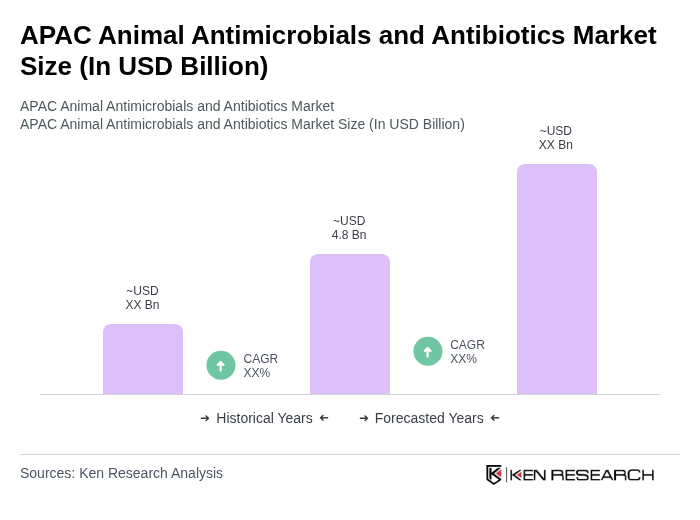
The APAC animal antimicrobials and antibiotics market, valued at USD 5.2 billion, is growing due to increasing demand for animal protein and advancements in veterinary medicine.

Region:Asia

Author(s):Geetanshi

Product Code:KRAA3461

Pages:89

Published On:January 2026
About the Report

Base Year 2024

APAC Animal Antimicrobials and Antibiotics Market Overview

  • The APAC Animal Antimicrobials and Antibiotics Market is valued at USD 5.2 billion, based on a five-year historical analysis. This growth is primarily driven by the increasing demand for animal protein, rising awareness of animal health, the need for effective disease management in livestock, increasing livestock and aquaculture production, and the growing prevalence of animal diseases requiring antibiotic treatment. The market is also influenced by advancements in veterinary medicine and the growing trend of pet ownership, which has led to a surge in the use of antibiotics and antimicrobials in companion animals.
  • Key players in this market include China, India, and Japan, which dominate due to their large livestock populations and significant investments in animal health. China leads with its extensive poultry and swine industries, while India has a growing dairy sector. Japan's advanced veterinary practices and high standards for animal health further contribute to its market prominence. These countries are also focusing on regulatory frameworks to ensure the responsible use of antimicrobials.
  • The National Action Plan on Antimicrobial Resistance (NAP-AMR) 2017–2021, extended through 2023–2027 and issued by the Ministry of Health and Family Welfare and the Ministry of Animal Husbandry and Dairying, mandates surveillance of antimicrobial use in veterinary practices, prescription-only sales of antibiotics classified as per the WHO list, and promotion of alternatives like vaccines and probiotics for livestock disease control with compliance monitored through annual reporting.
APAC Animal Antimicrobials and Antibiotics Market Size

APAC Animal Antimicrobials and Antibiotics Market Segmentation

By Product Type:The product type segmentation includes various categories of antimicrobials and antibiotics used in veterinary medicine. The subsegments are Tetracyclines, Penicillins, Macrolides, Aminoglycosides, Sulfonamides, Fluoroquinolones, and Others. Among these, Tetracyclines are the most widely used due to their broad-spectrum efficacy and cost-effectiveness, making them a preferred choice for treating various bacterial infections in animals.
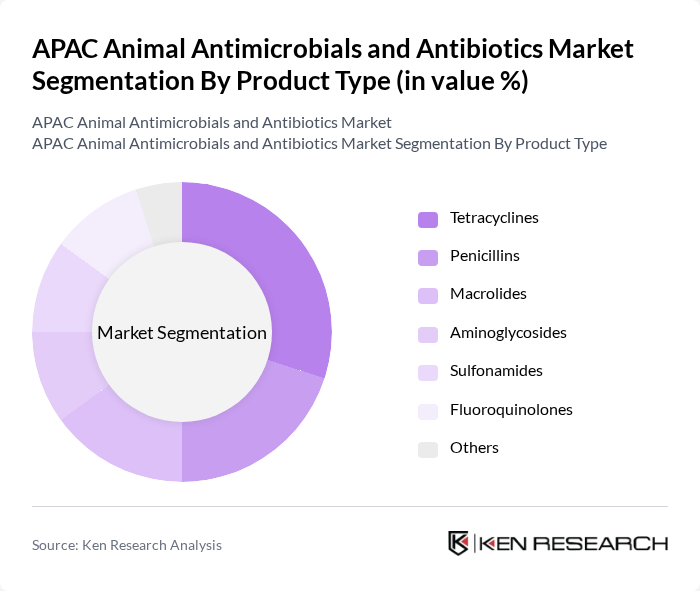
APAC Animal Antimicrobials and Antibiotics Market segmentation by Product Type.

By Animal Type:This segmentation covers various animal categories that utilize antimicrobials and antibiotics, including Livestock, Cattle, Poultry, Swine, Sheep & Goats, Companion Animals, Dogs, Cats, Horses, and Others. The Livestock segment is the largest due to the high demand for meat and dairy products, leading to increased antibiotic use for disease prevention and growth promotion in animals.
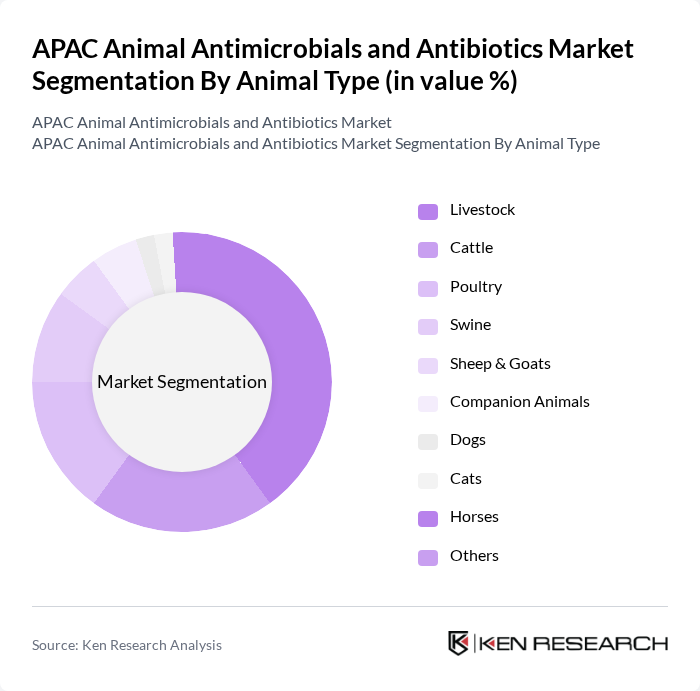
APAC Animal Antimicrobials and Antibiotics Market segmentation by Animal Type.

APAC Animal Antimicrobials and Antibiotics Market Competitive Landscape

The APAC Animal Antimicrobials and Antibiotics Market is characterized by a dynamic mix of regional and international players. Leading participants such as Zoetis Inc., Merck Animal Health, Elanco Animal Health, Bayer Animal Health, Boehringer Ingelheim, Ceva Santé Animale, Virbac, Huvepharma, Vetoquinol, Phibro Animal Health, Dechra Pharmaceuticals, Intas Pharmaceuticals, Neogen Corporation, Kemin Industries, Alltech contribute to innovation, geographic expansion, and service delivery in this space.

Zoetis Inc.

1952

Parsippany, New Jersey, USA

Merck Animal Health

1891

Kenilworth, New Jersey, USA

Elanco Animal Health

1954

Greenfield, Indiana, USA

Bayer Animal Health

1863

Leverkusen, Germany

Boehringer Ingelheim

1885

Ingelheim am Rhein, Germany

Company

Establishment Year

Headquarters

Revenue (USD Billion)

Revenue Growth Rate (CAGR %)

Market Share (%)

EBITDA Margin (%)

R&D Investment (% of Revenue)

Geographic Coverage Score

APAC Animal Antimicrobials and Antibiotics Market Industry Analysis

Growth Drivers

  • Increasing Demand for Animal Protein:The APAC region is witnessing a significant rise in animal protein consumption, projected to reach 200 million tons in future, driven by a growing population and urbanization. The World Bank estimates that meat consumption in Asia will increase by 30% in future. This surge in demand necessitates enhanced livestock productivity, thereby increasing the need for effective antimicrobials and antibiotics to ensure animal health and growth.
  • Rising Awareness of Animal Health:With the increasing focus on food safety and quality, awareness regarding animal health is on the rise. In future, the veterinary services market in APAC is expected to exceed $20 billion, reflecting a growing investment in animal healthcare. This trend is driven by consumers demanding healthier livestock products, prompting farmers to adopt better health management practices, including the use of antimicrobials to prevent disease outbreaks.
  • Government Initiatives for Livestock Productivity:Governments across APAC are implementing policies to enhance livestock productivity, with funding exceeding $5 billion in future for agricultural innovation. Initiatives include subsidies for veterinary services and research into antimicrobial alternatives. These efforts aim to improve animal health standards and productivity, thereby increasing the demand for effective antimicrobials and antibiotics in the livestock sector.

Market Challenges

  • Regulatory Restrictions on Antibiotic Use:Stricter regulations on antibiotic usage in livestock are being enforced across APAC, with over 15 countries implementing bans on certain antibiotics in future. These regulations aim to combat antimicrobial resistance but pose challenges for farmers who rely on these products for livestock health. Compliance with these regulations requires significant adjustments in farming practices, potentially impacting productivity and profitability.
  • Growing Resistance to Antimicrobials:The rise of antimicrobial resistance (AMR) is a critical challenge, with the World Health Organization reporting that AMR could cause 10 million deaths annually by 2050 if not addressed. In APAC, the prevalence of resistant pathogens in livestock is increasing, leading to higher treatment costs and reduced effectiveness of existing antimicrobials. This situation necessitates urgent action to develop new solutions and alternatives.

APAC Animal Antimicrobials and Antibiotics Market Future Outlook

The APAC Animal Antimicrobials and Antibiotics Market is poised for transformation, driven by a shift towards preventive healthcare and sustainable farming practices. The integration of digital health solutions in veterinary care is expected to enhance disease management and monitoring. Additionally, the growth of e-commerce platforms for veterinary products will facilitate access to essential medications, improving overall animal health outcomes. These trends indicate a proactive approach to addressing challenges while meeting the rising demand for animal protein.

Market Opportunities

  • Expansion of Veterinary Services:The expansion of veterinary services in rural areas presents a significant opportunity, with investments projected to reach $3 billion in future. Improved access to veterinary care can enhance animal health management, leading to better productivity and reduced reliance on antibiotics, ultimately benefiting the entire livestock sector.
  • Development of Alternative Therapies:The increasing focus on developing alternative therapies, such as probiotics and vaccines, is gaining momentum. With an estimated market potential of $1.5 billion in future, these alternatives can help mitigate the challenges posed by antibiotic resistance, providing farmers with effective tools to maintain animal health without compromising food safety.

Scope of the Report

SegmentSub-Segments
By Product Type

Tetracyclines

Penicillins

Macrolides

Aminoglycosides

Sulfonamides

Fluoroquinolones

Others

By Animal Type

Livestock

Cattle

Poultry

Swine

Sheep & Goats

Companion Animals

Dogs

Cats

Horses

Others

By Route of Administration

Oral

Injectable

Topical

Intramammary

In-feed / In-water Medication

Others

By End-User

Animal Farms

Veterinary Hospitals & Clinics

Others

By Distribution Channel

Prescription-based

Over-the-counter (OTC)

By Geography

China

India

Japan

Australia

Others

By Application

Therapeutic

Prophylactic

Growth Promotion

Others

Key Target Audience

Investors and Venture Capitalist Firms

Government and Regulatory Bodies (e.g., Food and Agriculture Organization, World Organisation for Animal Health)

Manufacturers and Producers

Distributors and Retailers

Pharmaceutical Companies

Veterinary Service Providers

Industry Associations

Financial Institutions

Players Mentioned in the Report:

Zoetis Inc.

Merck Animal Health

Elanco Animal Health

Bayer Animal Health

Boehringer Ingelheim

Ceva Sante Animale

Virbac

Huvepharma

Vetoquinol

Phibro Animal Health

Dechra Pharmaceuticals

Intas Pharmaceuticals

Neogen Corporation

Kemin Industries

Alltech

Table of Contents

Market Assessment Phase

1. Executive Summary and Approach


2. APAC Animal Antimicrobials and Antibiotics Market Overview

2.1 Key Insights and Strategic Recommendations

2.2 APAC Animal Antimicrobials and Antibiotics Market Overview

2.3 Definition and Scope

2.4 Evolution of Market Ecosystem

2.5 Timeline of Key Regulatory Milestones

2.6 Value Chain & Stakeholder Mapping

2.7 Business Cycle Analysis

2.8 Policy & Incentive Landscape


3. APAC Animal Antimicrobials and Antibiotics Market Analysis

3.1 Growth Drivers

3.1.1 Increasing demand for animal protein
3.1.2 Rising awareness of animal health
3.1.3 Government initiatives for livestock productivity
3.1.4 Technological advancements in veterinary medicine

3.2 Market Challenges

3.2.1 Regulatory restrictions on antibiotic use
3.2.2 Growing resistance to antimicrobials
3.2.3 High cost of research and development
3.2.4 Limited access to veterinary services in rural areas

3.3 Market Opportunities

3.3.1 Expansion of veterinary services
3.3.2 Development of alternative therapies
3.3.3 Increasing investment in animal health
3.3.4 Rising demand for organic and antibiotic-free products

3.4 Market Trends

3.4.1 Shift towards preventive healthcare in livestock
3.4.2 Growth of e-commerce in veterinary products
3.4.3 Increasing focus on sustainable farming practices
3.4.4 Adoption of digital health solutions in veterinary care

3.5 Government Regulation

3.5.1 Stricter regulations on antibiotic usage in livestock
3.5.2 Implementation of residue testing protocols
3.5.3 Guidelines for responsible antimicrobial use
3.5.4 Support for research on antimicrobial alternatives

4. SWOT Analysis


5. Stakeholder Analysis


6. Porter's Five Forces Analysis


7. APAC Animal Antimicrobials and Antibiotics Market Market Size, 2019-2024

7.1 By Value

7.2 By Volume

7.3 By Average Selling Price


8. APAC Animal Antimicrobials and Antibiotics Market Segmentation

8.1 By Product Type

8.1.1 Tetracyclines
8.1.2 Penicillins
8.1.3 Macrolides
8.1.4 Aminoglycosides
8.1.5 Sulfonamides
8.1.6 Fluoroquinolones
8.1.7 Others

8.2 By Animal Type

8.2.1 Livestock
8.2.2 Cattle
8.2.3 Poultry
8.2.4 Swine
8.2.5 Sheep & Goats
8.2.6 Companion Animals
8.2.7 Dogs
8.2.8 Cats
8.2.9 Horses
8.2.10 Others

8.3 By Route of Administration

8.3.1 Oral
8.3.2 Injectable
8.3.3 Topical
8.3.4 Intramammary
8.3.5 In-feed / In-water Medication
8.3.6 Others

8.4 By End-User

8.4.1 Animal Farms
8.4.2 Veterinary Hospitals & Clinics
8.4.3 Others

8.5 By Distribution Channel

8.5.1 Prescription-based
8.5.2 Over-the-counter (OTC)

8.6 By Geography

8.6.1 China
8.6.2 India
8.6.3 Japan
8.6.4 Australia
8.6.5 Others

8.7 By Application

8.7.1 Therapeutic
8.7.2 Prophylactic
8.7.3 Growth Promotion
8.7.4 Others

9. APAC Animal Antimicrobials and Antibiotics Market Competitive Analysis

9.1 Market Share of Key Players

9.2 Cross Comparison of Key Players

9.2.1 Company Name
9.2.2 Revenue (USD Billion)
9.2.3 Revenue Growth Rate (CAGR %)
9.2.4 Market Share (%)
9.2.5 EBITDA Margin (%)
9.2.6 R&D Investment (% of Revenue)
9.2.7 Geographic Coverage Score
9.2.8 Product Portfolio Breadth
9.2.9 Manufacturing Capacity Utilization (%)
9.2.10 Patent Portfolio Strength

9.3 SWOT Analysis of Top Players

9.4 Pricing Analysis

9.5 Detailed Profile of Major Companies

9.5.1 Zoetis Inc.
9.5.2 Merck Animal Health
9.5.3 Elanco Animal Health
9.5.4 Bayer Animal Health
9.5.5 Boehringer Ingelheim
9.5.6 Ceva Santé Animale
9.5.7 Virbac
9.5.8 Huvepharma
9.5.9 Vetoquinol
9.5.10 Phibro Animal Health
9.5.11 Dechra Pharmaceuticals
9.5.12 Intas Pharmaceuticals
9.5.13 Neogen Corporation
9.5.14 Kemin Industries
9.5.15 Alltech

10. APAC Animal Antimicrobials and Antibiotics Market End-User Analysis

10.1 Procurement Behavior of Key Ministries

10.1.1 Budget Allocation Trends
10.1.2 Decision-Making Processes
10.1.3 Compliance with Regulations
10.1.4 Evaluation Criteria for Suppliers

10.2 Corporate Spend on Infrastructure & Energy

10.2.1 Investment in Veterinary Infrastructure
10.2.2 Spending on Research and Development
10.2.3 Budget for Training and Education
10.2.4 Allocation for Sustainable Practices

10.3 Pain Point Analysis by End-User Category

10.3.1 Cost of Antimicrobials
10.3.2 Access to Veterinary Services
10.3.3 Quality of Products
10.3.4 Regulatory Compliance Challenges

10.4 User Readiness for Adoption

10.4.1 Awareness of Antimicrobial Resistance
10.4.2 Training Needs for Veterinary Staff
10.4.3 Availability of Alternatives
10.4.4 Financial Readiness for New Solutions

10.5 Post-Deployment ROI and Use Case Expansion

10.5.1 Measurement of Effectiveness
10.5.2 Long-term Cost Savings
10.5.3 Expansion into New Markets
10.5.4 User Feedback and Improvement

11. APAC Animal Antimicrobials and Antibiotics Market Future Size, 2025-2030

11.1 By Value

11.2 By Volume

11.3 By Average Selling Price


Go-To-Market Strategy Phase

1. Whitespace Analysis + Business Model Canvas

1.1 Market Gaps Identification

1.2 Business Model Development


2. Marketing and Positioning Recommendations

2.1 Branding Strategies

2.2 Product USPs


3. Distribution Plan

3.1 Urban Retail vs Rural NGO Tie-ups


4. Channel & Pricing Gaps

4.1 Underserved Routes

4.2 Pricing Bands


5. Unmet Demand & Latent Needs

5.1 Category Gaps

5.2 Consumer Segments


6. Customer Relationship

6.1 Loyalty Programs

6.2 After-sales Service


7. Value Proposition

7.1 Sustainability

7.2 Integrated Supply Chains


8. Key Activities

8.1 Regulatory Compliance

8.2 Branding

8.3 Distribution Setup


9. Entry Strategy Evaluation

9.1 Domestic Market Entry Strategy

9.1.1 Product Mix
9.1.2 Pricing Band
9.1.3 Packaging

9.2 Export Entry Strategy

9.2.1 Target Countries
9.2.2 Compliance Roadmap

10. Entry Mode Assessment

10.1 JV

10.2 Greenfield

10.3 M&A

10.4 Distributor Model


11. Capital and Timeline Estimation

11.1 Capital Requirements

11.2 Timelines


12. Control vs Risk Trade-Off

12.1 Ownership vs Partnerships


13. Profitability Outlook

13.1 Breakeven Analysis

13.2 Long-term Sustainability


14. Potential Partner List

14.1 Distributors

14.2 JVs

14.3 Acquisition Targets


15. Execution Roadmap

15.1 Phased Plan for Market Entry

15.1.1 Market Setup
15.1.2 Market Entry
15.1.3 Growth Acceleration
15.1.4 Scale & Stabilize

15.2 Key Activities and Milestones

15.2.1 Activity Planning
15.2.2 Milestone Tracking

Research Methodology

ApproachModellingSample

Phase 1: Approach1

Desk Research

  • Analysis of market reports from veterinary pharmaceutical associations across APAC
  • Review of academic journals and publications on antimicrobial usage in livestock
  • Compilation of regulatory frameworks and guidelines from APAC countries' agricultural departments

Primary Research

  • Interviews with veterinarians and animal health experts regarding antimicrobial practices
  • Surveys with livestock producers to understand usage patterns and challenges
  • Focus groups with industry stakeholders, including feed manufacturers and distributors

Validation & Triangulation

  • Cross-validation of findings with data from international health organizations
  • Triangulation of market insights from primary interviews and secondary data sources
  • Sanity checks through expert panels comprising veterinarians and industry analysts

Phase 2: Market Size Estimation1

Top-down Assessment

  • Estimation of total market size based on national livestock population statistics
  • Segmentation by species (cattle, poultry, aquaculture) and product type (antibiotics, non-antibiotics)
  • Incorporation of government initiatives aimed at reducing antimicrobial resistance

Bottom-up Modeling

  • Collection of sales data from leading animal health companies operating in the region
  • Estimation of average consumption rates of antimicrobials per livestock unit
  • Calculation of market size based on volume sold and average pricing of products

Forecasting & Scenario Analysis

  • Development of predictive models based on historical growth rates and market trends
  • Scenario analysis considering regulatory changes and shifts in consumer preferences
  • Projections for market growth through 2030 under various economic conditions

Phase 3: CATI Sample Composition1

Scope Item/SegmentSample SizeTarget Respondent Profiles
Poultry Antimicrobial Usage120Poultry Farmers, Veterinary Consultants
Cattle Health Management100Cattle Ranchers, Animal Nutritionists
Aquaculture Antibiotic Practices80Aquaculture Farmers, Marine Biologists
Veterinary Pharmaceutical Distribution70Pharmaceutical Distributors, Veterinary Pharmacists
Regulatory Compliance in Animal Health60Regulatory Affairs Specialists, Compliance Officers

Frequently Asked Questions

What is the current value of the APAC Animal Antimicrobials and Antibiotics Market?

The APAC Animal Antimicrobials and Antibiotics Market is valued at approximately USD 5.2 billion, driven by increasing demand for animal protein, rising awareness of animal health, and the need for effective disease management in livestock and aquaculture.

Which countries dominate the APAC Animal Antimicrobials and Antibiotics Market?

What are the main drivers of growth in the APAC Animal Antimicrobials and Antibiotics Market?

What challenges does the APAC Animal Antimicrobials and Antibiotics Market face?

Other Regional/Country Reports

Indonesia Animal Antimicrobials and Antibiotics Market

Malaysia Animal Antimicrobials and Antibiotics Market

KSA Animal Antimicrobials and Antibiotics Market

SEA Animal Antimicrobials and Antibiotics Market

Vietnam Animal Antimicrobials and Antibiotics Market

Thailand Animal Antimicrobials and Antibiotics Market

Why Buy From Us?

Refine Robust Result (RRR) Framework

What makes us stand out is that our consultants follow Robust, Refine and Result (RRR) methodology. Robust for clear definitions, approaches and sanity checking, Refine for differentiating respondents' facts and opinions, and Result for presenting data with story.

Our Reach Is Unmatched

We have set a benchmark in the industry by offering our clients with syndicated and customized market research reports featuring coverage of entire market as well as meticulous research and analyst insights.

Shifting the Research Paradigm

While we don't replace traditional research, we flip the method upside down. Our dual approach of Top Bottom & Bottom Top ensures quality deliverable by not just verifying company fundamentals but also looking at the sector and macroeconomic factors.

More Insights-Better Decisions

With one step in the future, our research team constantly tries to show you the bigger picture. We help with some of the tough questions you may encounter along the way: How is the industry positioned? Best marketing channel? KPI's of competitors? By aligning every element, we help maximize success.

Transparency and Trust

Our report gives you instant access to the answers and sources that other companies might choose to hide. We elaborate each steps of research methodology we have used and showcase you the sample size to earn your trust.

Round the Clock Support

If you need any support, we are here! We pride ourselves on universe strength, data quality, and quick, friendly, and professional service.

Why Clients Choose Us?

400000+
Reports in repository
150+
Consulting projects a year
100+
Analysts
8000+
Client Queries in 2022








