Ken Research Logo

Apac Antibody Fragments Market Report Size, Share, Growth Drivers, Trends, Opportunities & Forecast 2025–2030

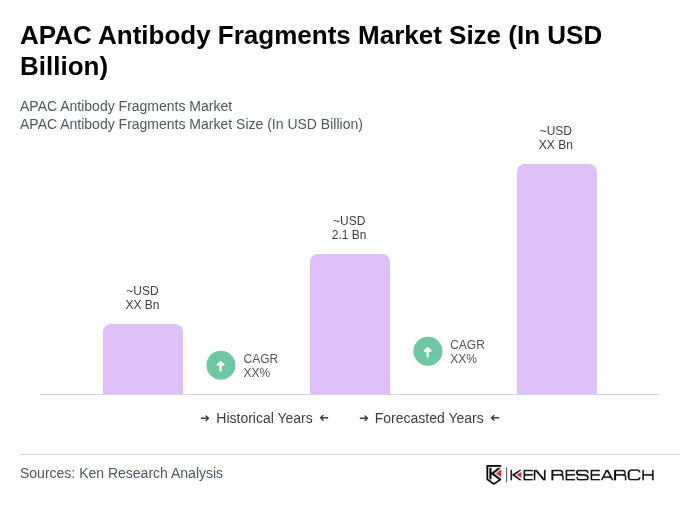
APAC Antibody Fragments Market, valued at USD 2.1 Bn, is growing due to rising chronic diseases, antibody engineering innovations, and demand for precision medicine across the region.

Region:Asia

Author(s):Geetanshi

Product Code:KRAD5932

Pages:80

Published On:December 2025
About the Report

Base Year 2024

APAC Antibody Fragments Market Overview

  • The APAC Antibody Fragments Market is valued at USD 2.1 billion, based on a five-year historical analysis. This growth is primarily driven by the increasing prevalence of chronic diseases, advancements in biotechnology, and the rising demand for targeted therapies. The market is also supported by the growing investment in research and development activities aimed at discovering novel antibody-based therapeutics.
  • Key players in this market include China, Japan, and South Korea, which dominate due to their robust pharmaceutical industries, significant investments in biopharmaceutical research, and a strong focus on innovation. These countries benefit from advanced healthcare infrastructure and a high level of collaboration between academic institutions and industry, facilitating rapid development and commercialization of antibody fragment therapies.
  • The New Drugs and Clinical Trials Rules, 2019 issued by the Central Drugs Standard Control Organisation (CDSCO), Ministry of Health and Family Welfare, Government of India, govern the approval process for biopharmaceuticals, including antibody fragments. This regulation mandates submission of clinical trial data, compliance with Good Clinical Practices, and phase-wise approvals for biologics, with thresholds for bioequivalence and stability testing, thereby streamlining drug development and encouraging innovation and investment in the biopharmaceutical sector.
APAC Antibody Fragments Market Size

APAC Antibody Fragments Market Segmentation

By Fragment Type:The market is segmented into various types of antibody fragments, including Fab (Fragment antigen-binding), F(ab')? Fragments, scFv (Single-chain variable fragment), sdAb / Nanobodies (Single-domain antibodies), Bispecific Antibody Fragments, and Other Antibody Fragments (e.g., diabodies, minibodies). Among these, Fab fragments are leading the market due to their high specificity and affinity for antigens, making them ideal for therapeutic applications. The increasing focus on personalized medicine and targeted therapies is further driving the demand for these fragments.
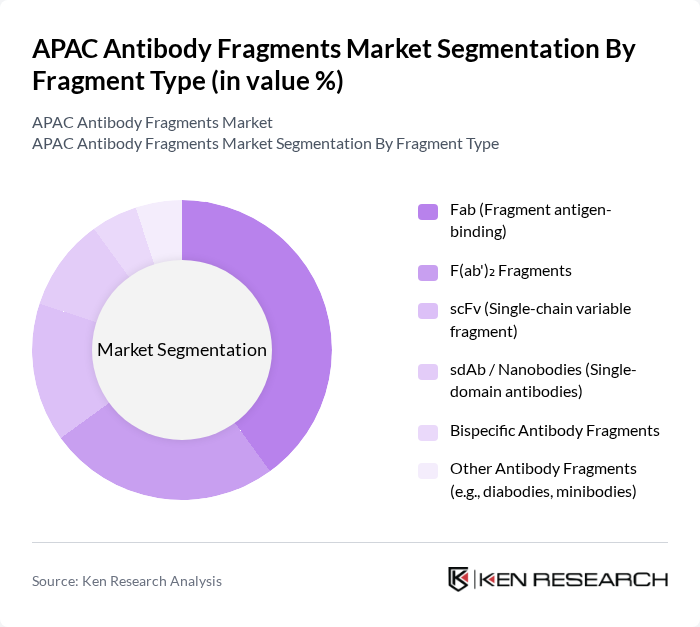
APAC Antibody Fragments Market segmentation by Fragment Type.

By End-User:The end-user segmentation includes Biopharmaceutical & Biotechnology Companies, Academic & Research Institutes, Contract Research Organizations (CROs), Contract Development & Manufacturing Organizations (CDMOs), and Diagnostic Laboratories & Imaging Centers. Biopharmaceutical companies are the dominant end-users, driven by their need for innovative therapies and the increasing number of antibody-based drugs in development. The collaboration between these companies and research institutes is also fostering advancements in antibody fragment technologies.
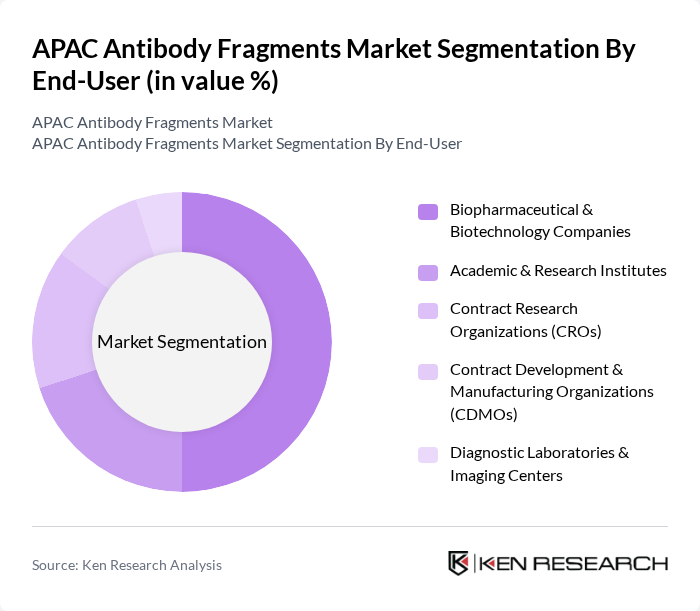
APAC Antibody Fragments Market segmentation by End-User.

APAC Antibody Fragments Market Competitive Landscape

The APAC Antibody Fragments Market is characterized by a dynamic mix of regional and international players. Leading participants such as F. Hoffmann-La Roche AG, Novartis AG, Takeda Pharmaceutical Company Limited, Chugai Pharmaceutical Co., Ltd., Daiichi Sankyo Company, Limited, Samsung Biologics Co., Ltd., WuXi Biologics (Cayman) Inc., BeiGene, Ltd., Jiangsu Hengrui Pharmaceuticals Co., Ltd., Zai Lab Limited, Innovent Biologics, Inc., Bio-Rad Laboratories, Inc., Abcam plc, Merck KGaA, Regeneron Pharmaceuticals, Inc. contribute to innovation, geographic expansion, and service delivery in this space.

F. Hoffmann-La Roche AG

1896

Basel, Switzerland

Novartis AG

1996

Basel, Switzerland

Takeda Pharmaceutical Company Limited

1781

Osaka, Japan

Chugai Pharmaceutical Co., Ltd.

1925

Tokyo, Japan

Daiichi Sankyo Company, Limited

1899

Tokyo, Japan

Company

Establishment Year

Headquarters

Group Size (Global Major, Regional Player, or Emerging APAC Biotech)

APAC Antibody Fragment Revenue (USD Million)

APAC Revenue CAGR (3–5 Year)

R&D Intensity (% of Revenue Spent on R&D)

Number of Antibody Fragment Programs in Pipeline (Preclinical to Phase III)

Number of Approved Fragment-based Products in APAC

APAC Antibody Fragments Market Industry Analysis

Growth Drivers

  • Increasing Prevalence of Chronic Diseases:The APAC region is witnessing a significant rise in chronic diseases, with the World Health Organization reporting that non-communicable diseases accounted for more than 60% of all deaths in 2020. This alarming trend is expected to escalate, with projections indicating that by future, chronic diseases will affect over 1.7 billion people in the region. This growing patient population drives the demand for innovative therapies, including antibody fragments, which are increasingly recognized for their efficacy in treating complex conditions.
  • Advancements in Antibody Engineering Technologies:The APAC market is benefiting from rapid advancements in antibody engineering technologies, with investments in R&D reaching approximately $20 billion in future. These innovations have led to the development of more effective and targeted antibody fragments, enhancing therapeutic outcomes. For instance, the introduction of bispecific antibodies has revolutionized treatment protocols, allowing for more personalized approaches to patient care, which is crucial in addressing the diverse health needs of the population.
  • Rising Demand for Targeted Therapies:The shift towards precision medicine is driving the demand for targeted therapies in the APAC region. According to a report by the Asia-Pacific Biotech Association, the market for targeted therapies is projected to reach $60 billion by future. This trend is fueled by the increasing recognition of the benefits of antibody fragments, which offer higher specificity and reduced side effects compared to traditional therapies, making them a preferred choice among healthcare providers and patients alike.

Market Challenges

  • High Development Costs:The development of antibody fragments involves substantial financial investment, with costs often exceeding $1.5 billion per successful drug. This high barrier to entry can deter smaller biotech firms from entering the market, limiting innovation and competition. Furthermore, the lengthy development timelines, which can span over a decade, exacerbate the financial strain, making it challenging for companies to sustain operations and attract funding in a competitive landscape.
  • Regulatory Hurdles:Navigating the regulatory landscape in the APAC region poses significant challenges for companies developing antibody fragments. Stringent approval processes can delay product launches, with the average time for regulatory approval estimated at 12-24 months. Additionally, varying regulations across countries complicate compliance efforts, leading to increased operational costs and potential market entry barriers for new therapies, ultimately impacting the overall growth of the antibody fragments market.

APAC Antibody Fragments Market Future Outlook

The future of the APAC antibody fragments market appears promising, driven by ongoing innovations in biotechnology and a growing emphasis on personalized medicine. As healthcare systems increasingly adopt digital health technologies, the integration of data analytics and artificial intelligence will enhance the development and delivery of targeted therapies. Furthermore, the expansion of biosimilars is expected to create competitive pricing dynamics, making antibody therapies more accessible to a broader patient population, thereby fostering market growth in the coming years.

Market Opportunities

  • Expansion into Emerging Markets:The APAC region's emerging markets present significant opportunities for antibody fragment manufacturers. With a combined population exceeding 2.8 billion, countries like India and Vietnam are experiencing rapid economic growth, leading to increased healthcare spending. This trend is expected to create a favorable environment for the introduction of innovative therapies, including antibody fragments, catering to the rising demand for advanced medical solutions.
  • Collaborations with Research Institutions:Collaborating with research institutions can enhance the development of antibody fragments by leveraging academic expertise and resources. Such partnerships can facilitate access to cutting-edge research and technology, accelerating the innovation process. In future, over 40% of biopharmaceutical companies in the APAC region reported engaging in collaborative research initiatives, highlighting the potential for synergistic advancements in antibody fragment development and commercialization.

Scope of the Report

SegmentSub-Segments
By Fragment Type

Fab (Fragment antigen-binding)

F(ab')? Fragments

scFv (Single-chain variable fragment)

sdAb / Nanobodies (Single-domain antibodies)

Bispecific Antibody Fragments

Other Antibody Fragments (e.g., diabodies, minibodies)

By End-User

Biopharmaceutical & Biotechnology Companies

Academic & Research Institutes

Contract Research Organizations (CROs)

Contract Development & Manufacturing Organizations (CDMOs)

Diagnostic Laboratories & Imaging Centers

By Application

Oncology (Cancer Therapy)

Autoimmune & Inflammatory Diseases

Infectious Diseases

Cardiovascular & Metabolic Diseases

Diagnostic & Imaging Applications

Other Therapeutic Areas

By Distribution / Commercial Channel

Direct Sales to Biopharma & Research Institutes

Distributors / Local Agents

Online Scientific & E-commerce Platforms

Other Channels

By Country / Sub-region

China

Japan

South Korea

India

Australia & New Zealand

Southeast Asia (Singapore, Malaysia, Thailand, Indonesia, Others)

Rest of APAC

By Research / Development Stage

Preclinical Research

Early-stage Clinical Trials (Phase I–II)

Late-stage Clinical Trials (Phase III)

Commercialized Products

By Funding Source

Public & Government Grants

Corporate R&D Budgets

Venture Capital & Private Equity

Other Funding Sources (Foundations, Consortia, PPPs)

Key Target Audience

Investors and Venture Capitalist Firms

Government and Regulatory Bodies (e.g., Therapeutic Goods Administration, Ministry of Health, National Medical Products Administration)

Biopharmaceutical Companies

Contract Research Organizations (CROs)

Biotechnology Firms

Pharmaceutical Supply Chain Companies

Healthcare Providers and Hospitals

Industry Associations and Trade Groups

Players Mentioned in the Report:

F. Hoffmann-La Roche AG

Novartis AG

Takeda Pharmaceutical Company Limited

Chugai Pharmaceutical Co., Ltd.

Daiichi Sankyo Company, Limited

Samsung Biologics Co., Ltd.

WuXi Biologics (Cayman) Inc.

BeiGene, Ltd.

Jiangsu Hengrui Pharmaceuticals Co., Ltd.

Zai Lab Limited

Innovent Biologics, Inc.

Bio-Rad Laboratories, Inc.

Abcam plc

Merck KGaA

Regeneron Pharmaceuticals, Inc.

Table of Contents

Market Assessment Phase

1. Executive Summary and Approach


2. APAC Antibody Fragments Market Overview

2.1 Key Insights and Strategic Recommendations

2.2 APAC Antibody Fragments Market Overview

2.3 Definition and Scope

2.4 Evolution of Market Ecosystem

2.5 Timeline of Key Regulatory Milestones

2.6 Value Chain & Stakeholder Mapping

2.7 Business Cycle Analysis

2.8 Policy & Incentive Landscape


3. APAC Antibody Fragments Market Analysis

3.1 Growth Drivers

3.1.1 Increasing prevalence of chronic diseases
3.1.2 Advancements in antibody engineering technologies
3.1.3 Rising demand for targeted therapies
3.1.4 Growing investment in biopharmaceutical R&D

3.2 Market Challenges

3.2.1 High development costs
3.2.2 Regulatory hurdles
3.2.3 Competition from alternative therapies
3.2.4 Limited awareness among healthcare professionals

3.3 Market Opportunities

3.3.1 Expansion into emerging markets
3.3.2 Collaborations with research institutions
3.3.3 Development of personalized medicine
3.3.4 Increasing focus on biosimilars

3.4 Market Trends

3.4.1 Shift towards combination therapies
3.4.2 Growth of point-of-care testing
3.4.3 Rise in contract manufacturing
3.4.4 Adoption of digital health technologies

3.5 Government Regulation

3.5.1 Stringent approval processes
3.5.2 Guidelines for biosimilar development
3.5.3 Intellectual property protections
3.5.4 Funding incentives for R&D

4. SWOT Analysis


5. Stakeholder Analysis


6. Porter's Five Forces Analysis


7. APAC Antibody Fragments Market Market Size, 2019-2024

7.1 By Value

7.2 By Volume

7.3 By Average Selling Price


8. APAC Antibody Fragments Market Segmentation

8.1 By Fragment Type

8.1.1 Fab (Fragment antigen-binding)
8.1.2 F(ab')? Fragments
8.1.3 scFv (Single-chain variable fragment)
8.1.4 sdAb / Nanobodies (Single-domain antibodies)
8.1.5 Bispecific Antibody Fragments
8.1.6 Other Antibody Fragments (e.g., diabodies, minibodies)

8.2 By End-User

8.2.1 Biopharmaceutical & Biotechnology Companies
8.2.2 Academic & Research Institutes
8.2.3 Contract Research Organizations (CROs)
8.2.4 Contract Development & Manufacturing Organizations (CDMOs)
8.2.5 Diagnostic Laboratories & Imaging Centers

8.3 By Application

8.3.1 Oncology (Cancer Therapy)
8.3.2 Autoimmune & Inflammatory Diseases
8.3.3 Infectious Diseases
8.3.4 Cardiovascular & Metabolic Diseases
8.3.5 Diagnostic & Imaging Applications
8.3.6 Other Therapeutic Areas

8.4 By Distribution / Commercial Channel

8.4.1 Direct Sales to Biopharma & Research Institutes
8.4.2 Distributors / Local Agents
8.4.3 Online Scientific & E-commerce Platforms
8.4.4 Other Channels

8.5 By Country / Sub-region

8.5.1 China
8.5.2 Japan
8.5.3 South Korea
8.5.4 India
8.5.5 Australia & New Zealand
8.5.6 Southeast Asia (Singapore, Malaysia, Thailand, Indonesia, Others)
8.5.7 Rest of APAC

8.6 By Research / Development Stage

8.6.1 Preclinical Research
8.6.2 Early-stage Clinical Trials (Phase I–II)
8.6.3 Late-stage Clinical Trials (Phase III)
8.6.4 Commercialized Products

8.7 By Funding Source

8.7.1 Public & Government Grants
8.7.2 Corporate R&D Budgets
8.7.3 Venture Capital & Private Equity
8.7.4 Other Funding Sources (Foundations, Consortia, PPPs)

9. APAC Antibody Fragments Market Competitive Analysis

9.1 Market Share of Key Players

9.2 Cross Comparison of Key Players

9.2.1 Company Name
9.2.2 Group Size (Global Major, Regional Player, or Emerging APAC Biotech)
9.2.3 APAC Antibody Fragment Revenue (USD Million)
9.2.4 APAC Revenue CAGR (3–5 Year)
9.2.5 R&D Intensity (% of Revenue Spent on R&D)
9.2.6 Number of Antibody Fragment Programs in Pipeline (Preclinical to Phase III)
9.2.7 Number of Approved Fragment-based Products in APAC
9.2.8 Strategic Collaborations & Licensing Deals in APAC (Last 5 Years)
9.2.9 Manufacturing Footprint in APAC (Own Sites vs CDMO Dependence)
9.2.10 Time-to-Market for Key Fragment Assets (from IND to First Approval)
9.2.11 Share of Oncology in Fragment Portfolio (%)
9.2.12 Patent Portfolio Strength in Antibody Fragments (APAC Filings)

9.3 SWOT Analysis of Top Players

9.4 Pricing Analysis

9.5 Detailed Profile of Major Companies

9.5.1 F. Hoffmann-La Roche AG
9.5.2 Novartis AG
9.5.3 Takeda Pharmaceutical Company Limited
9.5.4 Chugai Pharmaceutical Co., Ltd.
9.5.5 Daiichi Sankyo Company, Limited
9.5.6 Samsung Biologics Co., Ltd.
9.5.7 WuXi Biologics (Cayman) Inc.
9.5.8 BeiGene, Ltd.
9.5.9 Jiangsu Hengrui Pharmaceuticals Co., Ltd.
9.5.10 Zai Lab Limited
9.5.11 Innovent Biologics, Inc.
9.5.12 Bio-Rad Laboratories, Inc.
9.5.13 Abcam plc
9.5.14 Merck KGaA
9.5.15 Regeneron Pharmaceuticals, Inc.

10. APAC Antibody Fragments Market End-User Analysis

10.1 Procurement Behavior of Key Ministries

10.1.1 Budget Allocation Trends
10.1.2 Decision-Making Processes
10.1.3 Preferred Suppliers
10.1.4 Compliance Requirements

10.2 Corporate Spend on Infrastructure & Energy

10.2.1 Investment Trends
10.2.2 Budget Prioritization
10.2.3 Long-term Contracts
10.2.4 Cost Management Strategies

10.3 Pain Point Analysis by End-User Category

10.3.1 Quality Assurance Issues
10.3.2 Supply Chain Disruptions
10.3.3 Regulatory Compliance Challenges
10.3.4 Cost Constraints

10.4 User Readiness for Adoption

10.4.1 Training and Support Needs
10.4.2 Technology Adoption Rates
10.4.3 Feedback Mechanisms
10.4.4 Integration with Existing Systems

10.5 Post-Deployment ROI and Use Case Expansion

10.5.1 Performance Metrics
10.5.2 User Satisfaction Levels
10.5.3 Scalability Potential
10.5.4 Future Investment Plans

11. APAC Antibody Fragments Market Future Size, 2025-2030

11.1 By Value

11.2 By Volume

11.3 By Average Selling Price


Go-To-Market Strategy Phase

1. Whitespace Analysis + Business Model Canvas

1.1 Market Gaps Identification

1.2 Value Proposition Development

1.3 Revenue Streams Analysis

1.4 Cost Structure Evaluation

1.5 Key Partnerships Exploration

1.6 Customer Segmentation

1.7 Competitive Advantage Assessment


2. Marketing and Positioning Recommendations

2.1 Branding Strategies

2.2 Product USPs

2.3 Target Audience Identification

2.4 Communication Channels

2.5 Marketing Budget Allocation

2.6 Performance Metrics

2.7 Feedback Mechanisms


3. Distribution Plan

3.1 Urban Retail Strategies

3.2 Rural NGO Tie-ups

3.3 Online Distribution Channels

3.4 Direct Sales Approaches

3.5 Logistics and Supply Chain Management

3.6 Partnership Opportunities

3.7 Distribution Cost Analysis


4. Channel & Pricing Gaps

4.1 Underserved Routes

4.2 Pricing Bands Analysis

4.3 Competitor Pricing Strategies

4.4 Customer Willingness to Pay

4.5 Price Sensitivity Assessment

4.6 Discounting Strategies

4.7 Pricing Model Evaluation


5. Unmet Demand & Latent Needs

5.1 Category Gaps Identification

5.2 Consumer Segments Analysis

5.3 Emerging Trends Exploration

5.4 Customer Feedback Analysis

5.5 Market Research Insights

5.6 Future Demand Projections

5.7 Product Development Opportunities


6. Customer Relationship

6.1 Loyalty Programs

6.2 After-sales Service

6.3 Customer Engagement Strategies

6.4 Feedback Collection Mechanisms

6.5 Relationship Management Tools

6.6 Customer Retention Strategies

6.7 Performance Metrics


7. Value Proposition

7.1 Sustainability Initiatives

7.2 Integrated Supply Chains

7.3 Unique Selling Points

7.4 Customer-Centric Approaches

7.5 Competitive Differentiation

7.6 Value Delivery Mechanisms

7.7 Performance Metrics


8. Key Activities

8.1 Regulatory Compliance

8.2 Branding Initiatives

8.3 Distribution Setup

8.4 Market Research Activities

8.5 Training and Development

8.6 Performance Monitoring

8.7 Stakeholder Engagement


9. Entry Strategy Evaluation

9.1 Domestic Market Entry Strategy

9.1.1 Product Mix
9.1.2 Pricing Band
9.1.3 Packaging Considerations

9.2 Export Entry Strategy

9.2.1 Target Countries
9.2.2 Compliance Roadmap

10. Entry Mode Assessment

10.1 Joint Ventures

10.2 Greenfield Investments

10.3 Mergers & Acquisitions

10.4 Distributor Model

10.5 Risk Assessment

10.6 Strategic Fit Evaluation

10.7 Performance Metrics


11. Capital and Timeline Estimation

11.1 Capital Requirements

11.2 Timelines for Implementation

11.3 Funding Sources

11.4 Financial Projections

11.5 Risk Management Strategies

11.6 Performance Metrics


12. Control vs Risk Trade-Off

12.1 Ownership vs Partnerships

12.2 Risk Mitigation Strategies

12.3 Control Mechanisms

12.4 Performance Metrics


13. Profitability Outlook

13.1 Breakeven Analysis

13.2 Long-term Sustainability

13.3 Financial Health Assessment

13.4 Performance Metrics


14. Potential Partner List

14.1 Distributors

14.2 Joint Ventures

14.3 Acquisition Targets

14.4 Strategic Alliances

14.5 Performance Metrics


15. Execution Roadmap

15.1 Phased Plan for Market Entry

15.1.1 Market Setup
15.1.2 Market Entry
15.1.3 Growth Acceleration
15.1.4 Scale & Stabilize

Research Methodology

ApproachModellingSample

Phase 1: Approach1

Desk Research

  • Analysis of market reports from industry associations such as the Asia Pacific Biotech Association
  • Review of scientific publications and patents related to antibody fragment technologies
  • Examination of regulatory frameworks and guidelines from health authorities across APAC countries

Primary Research

  • Interviews with R&D heads at biopharmaceutical companies focusing on antibody fragment development
  • Surveys with clinical researchers involved in antibody fragment applications in therapeutics
  • Field interviews with key opinion leaders in immunology and biotechnology sectors

Validation & Triangulation

  • Cross-validation of findings through multiple data sources including market reports and expert opinions
  • Triangulation of quantitative data from surveys with qualitative insights from expert interviews
  • Sanity checks through peer reviews and feedback from industry stakeholders

Phase 2: Market Size Estimation1

Top-down Assessment

  • Estimation of market size based on overall biopharmaceutical market growth in the APAC region
  • Segmentation of the market by application areas such as oncology, autoimmune diseases, and infectious diseases
  • Incorporation of trends in personalized medicine and targeted therapies influencing antibody fragment demand

Bottom-up Modeling

  • Collection of sales data from leading manufacturers of antibody fragments in the APAC region
  • Estimation of production capacities and output from key players in the market
  • Analysis of pricing strategies and revenue models employed by antibody fragment producers

Forecasting & Scenario Analysis

  • Multi-variable forecasting using historical growth rates and emerging market trends
  • Scenario analysis based on potential regulatory changes and advancements in biotechnology
  • Development of baseline, optimistic, and pessimistic market projections through 2030

Phase 3: CATI Sample Composition1

Scope Item/SegmentSample SizeTarget Respondent Profiles
Biopharmaceutical R&D Departments120R&D Directors, Lead Scientists
Clinical Research Organizations90Clinical Trial Managers, Regulatory Affairs Specialists
Healthcare Providers and Hospitals75Oncologists, Immunologists
Biotech Startups Focused on Antibody Fragments55Founders, Product Development Managers
Academic Institutions and Research Labs95Professors, Research Fellows

Frequently Asked Questions

What is the current value of the APAC Antibody Fragments Market?

The APAC Antibody Fragments Market is valued at approximately USD 2.1 billion, driven by the increasing prevalence of chronic diseases, advancements in biotechnology, and a growing demand for targeted therapies.

Which countries dominate the APAC Antibody Fragments Market?

What are the key regulations governing the APAC Antibody Fragments Market?

What are the main types of antibody fragments in the market?

Other Regional/Country Reports

Indonesia Antibody Fragments Market

Malaysia Antibody Fragments Market

KSA Antibody Fragments Market

SEA Antibody Fragments Market

Vietnam Antibody Fragments Market

Thailand Antibody Fragments Market

Why Buy From Us?

Refine Robust Result (RRR) Framework

What makes us stand out is that our consultants follow Robust, Refine and Result (RRR) methodology. Robust for clear definitions, approaches and sanity checking, Refine for differentiating respondents' facts and opinions, and Result for presenting data with story.

Our Reach Is Unmatched

We have set a benchmark in the industry by offering our clients with syndicated and customized market research reports featuring coverage of entire market as well as meticulous research and analyst insights.

Shifting the Research Paradigm

While we don't replace traditional research, we flip the method upside down. Our dual approach of Top Bottom & Bottom Top ensures quality deliverable by not just verifying company fundamentals but also looking at the sector and macroeconomic factors.

More Insights-Better Decisions

With one step in the future, our research team constantly tries to show you the bigger picture. We help with some of the tough questions you may encounter along the way: How is the industry positioned? Best marketing channel? KPI's of competitors? By aligning every element, we help maximize success.

Transparency and Trust

Our report gives you instant access to the answers and sources that other companies might choose to hide. We elaborate each steps of research methodology we have used and showcase you the sample size to earn your trust.

Round the Clock Support

If you need any support, we are here! We pride ourselves on universe strength, data quality, and quick, friendly, and professional service.

Why Clients Choose Us?

400000+
Reports in repository
150+
Consulting projects a year
100+
Analysts
8000+
Client Queries in 2022








